Published
Almond Flavoring
Almond flavoring is a concentrated food-flavor system that can express sweet marzipan, cherry-like kernel, creamy almond paste, or roasted nut character. For first-pass screening, use 10 g/kg (1.0% w/w) as the high-side reference benchmark, bracket each supplier’s use range, and compare processed samples at the 22°C controlled reference and intended serving temperature.
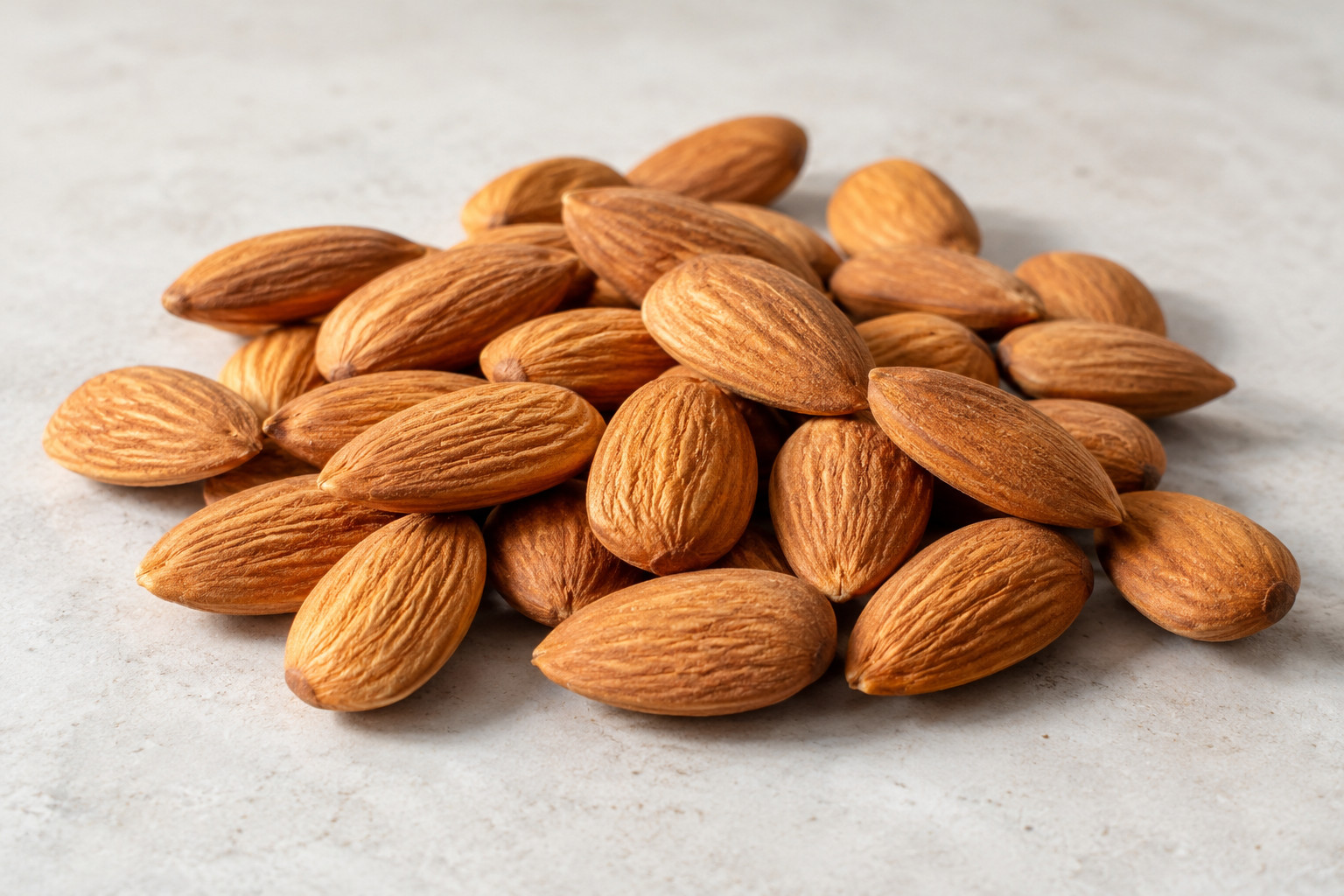
Almond kernels: a sensory reference for defining the target flavor profile.
How should almond flavoring be described without vague sensory adjectives?
A precise almond flavoring brief names the reference, timed notes, sweetness, roast, finish, matrix, and serving condition. “Strong and nutty” cannot distinguish mild kernel, marzipan, praline, or cherry-almond.
Write one controlled target sentence before requesting samples: “Sweet-almond and marzipan opening at 0–2 s; creamy kernel body at 2–10 s; short vanilla-praline finish at 10–30 s; low cherry; evaluated in a 10 °Brix dairy drink at 4°C.” A bakery brief might specify “medium roast, low marzipan, clean nut finish after 18 min at 180°C.”
How do almond extract, essence, emulsion, and amaretto change the buying decision?
Almond extract, essence, emulsion, and amaretto raise different composition, carrier, sensory, and handling questions; none is a dependable equal-volume substitute.
United States standards in 21 CFR Part 169 define vanilla extracts and related vanilla flavorings, not a federal potency ladder for almond extract or almond essence. Compare almond products by source, carrier, solubility, alcohol, recommended g/kg, process behavior, and finished sensory result.
| Term | What it normally communicates | What it does not establish | Buyer instruction |
|---|---|---|---|
| Almond flavoring | A formulated sensory system with an almond direction | Nut content, natural status, solubility, strength, or label wording | Request formula class, carrier, source, allergen, and use guidance |
| Almond extract | An extract-style product, often carried in alcohol and water | A universal concentration or automatic superiority | Compare source, alcohol, strength, and finished-product performance |
| Almond essence | A market term that may describe an extract, compounded flavor, or imitation direction | A fixed legal identity across every country | Treat the name as incomplete until the specification is reviewed |
| Almond emulsion | A dispersed liquid system designed to carry flavor materials in water-rich products | Guaranteed opacity, baking stability, or nut-free status | Check droplet system, clarity, heat response, and package stability |
| Amaretto flavor | A liqueur-inspired profile with almond, stone-fruit, vanilla, caramel, or alcohol cues | The same profile as plain almond extract | Specify whether alcohol warmth, cherry, caramel, and sweetness belong |
| Almond ingredient | Almond paste, meal, butter, milk, oil, or another physical almond material | A substitute for a concentrated flavor system | Treat texture, fat, protein, color, and allergen control as separate work |
“Almond” describes a sensory target, not a source or allergen result. The item declaration decides that question. The B2B guide to artificial flavor owns the wider labeling definition.
Which top, middle, and base-note directions can change an almond brief?
Almond direction changes when benzaldehyde, raw kernel, roasted pyrazines, cream, vanilla, caramel, or bitterness moves within the sensory sequence. Top, middle, and base describe timing, not regulation.
The Almond Board of California describes benzaldehyde as a dominant volatile in raw almond character and reports that roasted profiles shift toward pyrazines, branched aldehydes, and ketones. Marzipan-like almond and roasted almond are related, but one is not a stronger version of the other. The Almond Board sensory characterization and the 2019 University of California, Davis review support this distinction.
| Almond direction | Opening, 0–2 s | Body, 2–10 s | Finish, 10–60 s | Main failure mode | First-fit product |
|---|---|---|---|---|---|
| Sweet marzipan | Bright almond, light cherry | Sugar-paste, soft floral | Clean vanilla-almond | Medicinal or glue-like peak | Frosting, fondant, confectionery |
| Mild sweet kernel | Gentle raw nut | Creamy, slightly green kernel | Short, clean nut | Too weak beside sugar or cocoa | Dairy alternatives, cereal, nutrition drinks |
| Roasted almond | Toasted shell, low smoke | Nut, cocoa, malt, pyrazine | Dry roast, slight caramel | Burnt, peanut-like, stale oil | Coffee drinks, bakery, chocolate |
| Almond paste | Soft marzipan | Dense kernel, sugar, cream | Long pastry filling | Heavy sweetness and flat top | Frangipane, cookies, cake filling |
| Cherry-almond | Benzaldehyde-led fruit lift | Red-fruit and almond bridge | Tart stone-fruit tail | Cough-syrup association | Cherry bakery, berry filling, candy |
| Amaretto-inspired | Almond and alcohol cue | Vanilla, caramel, stone fruit | Warm liqueur-like finish | Alcohol note dominates the food | Syrup, dessert, coffee, adult beverage |
| Praline almond | Roasted nut and caramel | Cream, brown sugar, cocoa | Sweet toasted persistence | Hazelnut or peanut drift | Ice cream, spread, chocolate |
Use acceptance limits: “medium roasted, no smoke, low cherry, low marzipan, no peanut, no oxidized-oil finish.”
Intensity needs a clock. A fast benzaldehyde peak can win on a smelling strip yet leave an empty middle in a cold drink; a heavy roasted base can cover fruit at 30–60 s. Keep fixed onset, peak, and decay windows.
How do water, fat, protein, sugar, salt, acid, and serving temperature alter almond perception?
The finished matrix can shift almond flavoring from mild kernel to cherry-like, creamy, flat, bitter, or roasted at a fixed dose. Water cannot approve dairy, protein, chocolate, or bakery performance.
| Matrix variable | Practical screening points | Likely sensory change | Measurement to retain |
|---|---|---|---|
| Water and solids | 0%, 5%, 10%, and 15% total soluble solids | Dilution exposes sharp cherry, solvent, and thin finish; solids slow release | Total solids, water source, viscosity |
| Fat | 0%, 3%, 10%, and 20% fat | Fat rounds sharp notes, retains hydrophobic materials, and delays release | Fat source, melt state, emulsion condition |
| Protein | 0%, 3%, 8%, and 15% protein | Protein can suppress aroma and add dairy, cereal, soy, or pea background | Protein source, hydration time, pH, heat history |
| Sugar | 0, 5, 10, and 15 °Brix | Sweetness supports marzipan and paste notes but can hide mild kernel detail | °Brix, sweetener identity, aftertaste |
| Salt | 0%, 0.05%, 0.15%, and 0.50% salt equivalent | Low salt can sharpen contrast; more salt can push almond toward savory nut | Sodium source, mineral salts, total level |
| Acid | pH 3.0, 3.5, 4.0, 4.5, and 6.5 | Acid brightens attack and can push benzaldehyde-led character toward cherry | pH to 0.1, acid type, titratable acidity |
| Alcohol | 0%, 5%, 12%, and 20% v/v | Alcohol increases headspace release and can create an amaretto association | Alcohol by volume, equilibration, package |
| Temperature | 4°C, 22°C, and 60°C | Cold suppresses release; warmth raises aroma impact and exposes harshness | Core temperature, hold time, covered state |
In a 0% solids cup, concentrated almond may appear more cherry-like than in a 10 °Brix beverage or 20% fat filling. Test the production base before rejection.
Fat and protein change timing. A 10% fat mix can round the opening but delay nut body; an 8% protein shake can suppress the top and add cereal background. More flavor may create a medicinal finish without rebuilding the middle.
Sugar and acid change identity together. At 15 °Brix, a sample may read as marzipan; at 5 °Brix and pH 3.0, it can resemble cherry stone. Record pH and titratable acidity because two systems at pH 3.5 can differ.
Use 22°C as the controlled panel reference benchmark because it exposes more detail than a 4°C sample without turning a chilled-product decision into a warm tasting. Approval still requires the intended condition: 4°C for refrigerated products, 20–22°C for ambient products, and 60°C for hot coffee, syrup, or sauce. Hold every sample for the same time.
Which almond delivery system survives the actual process and package?
The right almond delivery system fits the product phase, process, factory, and storage. Screen water-soluble liquid, oil-soluble liquid, water-based bakery emulsion, spray-dried water-dispersible powder, dry-blended or encapsulated powder, and alcohol/water extract.
| Format option | Best first screen | Representative published boundary | First-pass design | Key acceptance checks |
|---|---|---|---|---|
| Water-soluble liquid | Clear beverage, syrup, water-phase dairy | 0.5–4 g/kg for one beverage item; 5–20 g/kg for another liquid | 0.5×, 1.0×, 1.5× supplier start; add 10 g/kg high-side | Clarity, ring, top-note loss, alcohol or glycol limits |
| Oil-soluble liquid | Chocolate, fat filling, coating, oil system | 1 g/kg, 1.5 g/kg, 2 g/kg, 2.5 g/kg, 3 g/kg, 4 g/kg for one item | Use that complete item set when testing its named applications | Phase fit, bloom, migration, delayed release |
| Water-based bakery emulsion | Batter, icing, cream, bakery filling | Potency and carrier are item-specific | 0.5×, 1.0×, 1.5× supplier start; compare extract | Heat retention, crumb balance, separation, opacity |
| Spray-dried water-dispersible powder | Dry beverage, protein premix, cake mix | About 1–9 g/kg for one published powder | 0.5×, 1.0×, 1.5× supplier start; add 10 g/kg high-side | Flow, caking, carrier taste, reconstitution |
| Dry-blended or encapsulated powder | Direct dry blending or protected release | Wall, carrier, and release design set the working range | 0.5×, 1.0×, 1.5× supplier start; add 10 g/kg high-side | Release trigger, retention, particle feel, humidity |
| Alcohol/water extract | Bakery, confectionery, syrup, compatible beverages | Alcohol and potency vary by item | 0.5×, 1.0×, 1.5× supplier start; compare emulsion | Alcohol flash-off, restrictions, process loss |
Published almond-product endpoints span 0.5–20 g/kg because concentration, carrier, source, and application differ. 20 g/kg is a product-specific high endpoint; 10 g/kg (1.0% w/w) is the selected high-side reference benchmark for an initial cross-format screen. It is not an equal-strength substitution rule. Weigh on finished-product mass and identify the supplier code beside every dose.
The oil-soluble values are a real discrete supplier set: 1 g/kg, 1.5 g/kg, 2 g/kg, 2.5 g/kg, 3 g/kg, and 4 g/kg. Those six values belong together; no 3.5 g/kg option was published. They show why a genuine item sequence should be preserved while an industry-wide continuous ladder should not be invented.
A water-soluble liquid is the first test for a clear drink, with clarity checks at 24 h and 7 days. Oil-soluble liquid fits chocolate or fat filling. Oil-in-water emulsion fits a cloudy drink, but droplet stability joins sensory approval.
Powder is not automatically stronger or more heat resistant. Spray drying and encapsulation can both lose top notes. The powder-versus-liquid food flavor guide covers handling; almond approval needs the real base.
Which processing and storage conditions can change the intended almond profile?
Heat, open mixing, oxygen, light, packaging, and moisture can remove almond top notes or expose stale and chemical character. A “heat-stable” label cannot replace a process-matched trial.
| Process or storage event | Reference challenge | Almond-specific risk | Compare before approval |
|---|---|---|---|
| Open premixing | 5 min, 15 min, and 30 min at 22°C | Loss of volatile almond and cherry top notes | Covered control versus open treatment |
| High-shear mixing | 2 min and 10 min | Air incorporation, emulsion stress, aroma stripping | Low-shear versus production shear |
| Pasteurization | 72°C for 15 s or the actual schedule | Reduced opening, cooked dairy interaction | Preheat and postheat at 4°C and 22°C |
| Hot fill | 85°C for 30 s or the actual line | Headspace loss, cap or liner interaction | Fresh fill, 24 h, and 7 day package checks |
| Baking | 160°C, 180°C, and 200°C oven settings | Volatile loss, roast shift, crumb or crust imbalance | Raw batter, crumb, crust, 24 h product |
| Freezing and thawing | −18°C storage; 1 and 3 cycles | Delayed release, emulsion break, watery top note | Fresh, frozen, and thawed samples |
| Light exposure | Dark control and 7 day illuminated pack | Color or aroma drift in clear packaging | Same package, same temperature |
| Storage | Day 0; Days 7, 14, 28, 56, and 90 | Top-note fade, stale oil, carrier aftertaste | 4°C, 20°C, and 37°C where product safety permits |
Add flavor at the latest permitted point to protect a marzipan or cherry-almond top. Balance reduced exposure against dispersion and sanitation; record the addition point.
Packaging can reverse a bench decision. Store the best 2 candidates in the intended pack. The 37°C condition is an accelerated comparison challenge, not a commercial storage instruction or shelf-life claim.
Actual almond ingredients can oxidize into cardboard, painty, stale, or rancid notes. Diagnose ingredient oxidation, flavor loss, and package interaction separately.
How should buyers compare almond flavor samples in the real application base?
Buyers should compare coded almond samples in one locked formula, process, package, storage checkpoint, and serving condition. Neat smelling can reject defects, not rank commercial performance.

Flavor sample library in the LULIN laboratory
Build the trial in five steps:
- Prepare a no-flavor control, the current product or target reference, and each supplier candidate from the same base lot.
- Screen 0.5×, 1.0×, and 1.5× the supplier’s starting level, then include 10 g/kg (1.0% w/w) as the high-side reference when that item’s guidance permits it.
- Assign random 3-digit codes, balance serving order, and use identical 30 mL, 30 g, or product-appropriate portions.
- Score the fresh samples at the 22°C controlled reference and at the intended 4°C, 20–22°C, or 60°C service condition.
- Process the best 2 candidates, pack them, and repeat at Day 0 plus the selected Day 7, Day 28, Day 56, or Day 90 checkpoint.
| Evaluation dimension | Scale and timing | Reference setup | Passing question | Diagnostic clue |
|---|---|---|---|---|
| Almond identity | 0–10 at aroma and first bite | 30 g at 22°C; repeat at 4°C | Does the sample read as the named almond direction? | Generic cherry suggests too much fruit-like top |
| Opening | 0–10 at 0–2 s | 30 g at 22°C; repeat at 4°C | Is the first note clean and proportionate? | Solvent or glue note signals a sharp imbalance |
| Kernel body | 0–10 at 2–10 s | 30 g at 22°C; repeat at 60°C when served hot | Does a recognizable nut middle remain? | Empty middle can indicate matrix suppression |
| Roast character | 0–10 at 2–30 s | 30 g at 22°C; repeat after 180°C process | Is roast level light, medium, or dark as briefed? | Peanut, smoke, or burnt drift misses the target |
| Sweetness fit | −3 to +3 versus target | 30 g at 22°C; repeat at 5 °Brix and 15 °Brix | Does almond change perceived sweetness correctly? | Marzipan can rise without added sugar |
| Finish | 0–10 at 10–60 s | 30 g at 22°C; repeat at 4°C | Is persistence long enough and still clean? | Bitter, medicinal, or stale tail fails |
| Process retention | 0–100% relative sensory score | 100 g at 22°C; repeat after 72°C/15 s | What remains after the actual process? | Loud raw batter and weak crumb show top-note loss |
| Appearance | Measured at 0 h, 24 h, and 7 days | 100 g at 4°C; repeat at 20°C | Does the sample stay clear or uniformly cloudy? | Ring, sediment, or oiling-off indicates format mismatch |
| Overall fit | 0–10 after full evaluation | 30 g at 22°C; repeat at 60°C when relevant | Which code is closest to the written brief? | Preference without target fit can select the wrong profile |
Use 6–12 screened assessors and keep membership stable. ISO 13299:2016 supports sensory profiles; ISO 8586:2023 covers assessors; ISO 4120:2021 defines triangle tests; ISO 8589:2007 and ASTM E1871-17 support controlled test conditions. A triangle test establishes difference, not target fit.
Diagnose before increasing dose. At 0.05%, a cherry-like sample may need a roasted direction, not just less flavor. After 180°C baking, compare another carrier or addition point. In a 20% fat filling, test oil-soluble flavor before doubling water-soluble liquid.
Record formula, lots, code, dose, order, process, package, storage, temperature, and decision. Use B2B formulation support when matrix or process effects block a clear result.
What supplier facts, documents, and destination-market details belong in an almond flavoring RFQ?
An almond flavoring RFQ should connect one sensory target to one product, process, market, sample protocol, and forecast. “Best natural almond price” defines nothing.
For the United States, 21 CFR 101.22 defines flavor-related labeling terms and declaration rules, while 21 CFR 182.60 lists synthetic flavoring substances and adjuvants used under good manufacturing practice. The United States Food and Drug Administration (FDA) Substances Added to Food inventory identifies benzaldehyde, CAS 100-52-7, as a flavoring agent or adjuvant. A no-artificial-flavor designation requires written supplier certification retained for at least 3 years under the characterizing-flavor provision in 21 CFR 101.22. None of these references determines a finished label from the sensory name alone.
| RFQ field | Exact information to send | Supplier response required |
|---|---|---|
| Sensory direction | Marzipan, mild kernel, roasted, paste, cherry-almond, amaretto-inspired, or praline | Item code and timed profile description |
| Finished matrix | pH, °Brix, fat %, protein %, salt %, alcohol %, viscosity, color | Recommended phase and first trial format |
| Process | Addition point, shear, 72°C/15 s pasteurization, 85°C/30 s hot fill, 180°C/18 min bake, or actual schedule | Process-use guidance and comparison sample |
| Dose design | 0.5×, 1.0×, 1.5× supplier start plus 10 g/kg (1.0% w/w) high-side reference; retain item-specific values | Supplier use range on finished-product basis |
| Destination | United States plus every export country and customer standard | Market-specific regulatory statement |
| Source and label | Natural flavor, natural and artificial flavor, artificial flavor, or another permitted route | Composition-class and label-support statement |
| Allergen control | Almond-derived material allowed or excluded; shared-line limits; customer wording | Item-specific allergen and source declaration |
| Technical files | Specification, TDS, SDS, lot COA, carrier and solvent statement, storage, shelf life | Current document set tied to the sample code |
| Certification files | ISO 22000, HACCP, Halal, Kosher, vegan, non-GMO, organic, or customer-required scope | Certificate owner, facility, product scope, and validity |
| Commercial terms | Sample size, 20 kg or 25 kg trial stage, annual forecast, pack size, Incoterm, target date | MOQ, tiered price, sample lead, production lead |
| Supply control | Lot traceability, retained sample, change notice, complaint route | Written control and notification terms |
Almond allergen review needs a source question. Almond character can exist without almond material; an extract can use an almond source. Match the code to ingredient, allergen, facility, and label review.
The food flavor compliance-document guide distinguishes COA, TDS, SDS, allergen, regulatory, and certificate files. Tie each file to the item, facility, lot, destination, and revision.
How does LULIN FLAVOR support an almond flavor project from sample to production?
LULIN FLAVOR supports almond projects with timed sensory briefs, matrix and phase selection, liquid and powder samples, process-matched evaluation, technical documents, and export-oriented commercial planning. LULIN FLAVOR is the English brand of QUANZHOU LVLIN BIOENGINEERING CO., LTD., established in 2001 in Quanzhou, Fujian, China.
The company operates 3 modernized production lines in more than 8,000 m² of building area, with 50+ employees and 12+ flavor engineers whose development and application experience exceeds 20 years. Its application laboratory refines existing directions and develops custom profiles. ISO 22000 and HACCP systems support production control, traceability, and document handling.
For commercial planning, LULIN FLAVOR prepares application samples in 3–5 business days, offers powder-flavor MOQ from 20 kg and liquid-flavor MOQ from 25 kg, and schedules standard production in 10–15 business days after formula and sample approval. The project file can include specification, TDS, SDS, lot COA, carrier and solvent information, allergen statement, regulatory statement, and applicable certificate files.
Send matrix, process, timed direction, format, dose, market, documents, deadline, first order, and forecast through the food flavor sample request. Review the LULIN FLAVOR manufacturing profile, contact the project team, or use the flavor-concentrates category for broader navigation.
Frequently asked questions about almond flavoring
What is the difference between almond flavoring and almond extract?
Almond flavoring is the broader category, while almond extract usually describes an extract-style liquid carried in alcohol and water. Either can be natural, artificial, nut-derived, or built from another permitted source route depending on the item. Compare source, carrier, allergen statement, strength, solubility, and performance instead of substituting equal volumes automatically.
Is almond essence the same as almond extract?
Almond essence and almond extract are not reliable synonyms across suppliers or countries. “Essence” may name a compounded flavor, an imitation direction, or an extract-style product, while “extract” may describe a particular source and solvent system. The product specification, ingredient statement, regulatory classification, and use rate settle the distinction.
Is almond emulsion better than almond extract for baking?
Almond emulsion can retain a rounded profile in some batters, but it is not automatically better or more heat stable than extract. Compare both at matched sensory intensity through the actual 160°C, 180°C, or 200°C bake. Score raw batter, crumb, crust, and 24 h flavor before selecting the carrier system.
How does amaretto extract differ from almond extract?
Amaretto extract targets a liqueur-style profile, often combining almond with stone fruit, vanilla, caramel, sweetness, or an alcohol cue. Almond extract can be narrower and more benzaldehyde-led. A food developer should specify whether cherry, caramel, alcohol warmth, and a long sweet finish are desired rather than treating the two products as direct substitutes.
Can vanilla extract replace almond extract?
Vanilla extract cannot reproduce almond identity, although it can soften sharp almond notes and extend a creamy or bakery finish. Vanilla emphasizes sweet, woody, creamy, or phenolic directions; almond emphasizes kernel, marzipan, cherry-like, or roasted-nut directions. Start a blend with separate controls so the panel can identify masking and balance.
Does almond flavoring always contain tree nuts?
Almond flavoring does not always contain almond-derived material, but the name alone never proves a nut-free formulation. Request the exact item’s ingredient or source statement, allergen statement, shared-equipment information, and destination-market review. Actual almond extract, oil, paste, meal, butter, or milk requires its own tree-nut control.
What almond flavor format works best in a clear beverage?
A water-soluble liquid is the first format to screen in a clear beverage. Test 0.5×, 1.0×, and 1.5× the supplier’s start, then include 10 g/kg (1.0% w/w) when the item permits it. Check clarity, ring, sediment, aroma loss, and taste at 0 h, 24 h, 48 h, 7 days, and 14 days at the finished pH.
How much almond flavoring should a manufacturer use first?
Use 10 g/kg (1.0% w/w) as the high-side first-pass reference, bracket it with the supplier’s lower and midpoint guidance, and test in the finished product. The 10 g/kg value represents the high cluster below a 20 g/kg product-specific endpoint; approval still uses the selected item code, recommended range, and finished-mass basis.
Can almond flavoring survive pasteurization, hot fill, or baking?
Almond flavoring can be designed for heated products, but retention depends on composition, carrier, addition point, temperature, hold time, shear, cooling, and package. Compare pre-process and post-process samples under the actual schedule. Useful reference challenges include 72°C for 15 s, 85°C for 30 s, and 180°C for 18 min.
What should a buyer send when requesting an almond flavor sample?
Send the timed sensory target, finished base, pH, °Brix, fat, protein, salt, alcohol, process, package, serving temperature, preferred format, dose ladder, destination market, source and allergen rules, required documents, sample deadline, first order, annual forecast, and acceptance method. One complete brief produces more comparable samples and a usable quotation.
Develop this flavor in your product
Send your product, target market and project goal. We will review the sample direction with you.