Published
Cereal And Granola Flavoring
Cereal and granola flavoring is a concentrated aroma system for flakes, puffs, granola, and cereal bars, not honey, maple syrup, or a cereal-flavored protein powder. Name the breakfast system, addition point, fat, water activity, and heat path first. Screen matched concentrates at 0.40% w/w as the high-end reference benchmark, then keep the lowest dose that holds.
Last updated: September 1, 2026
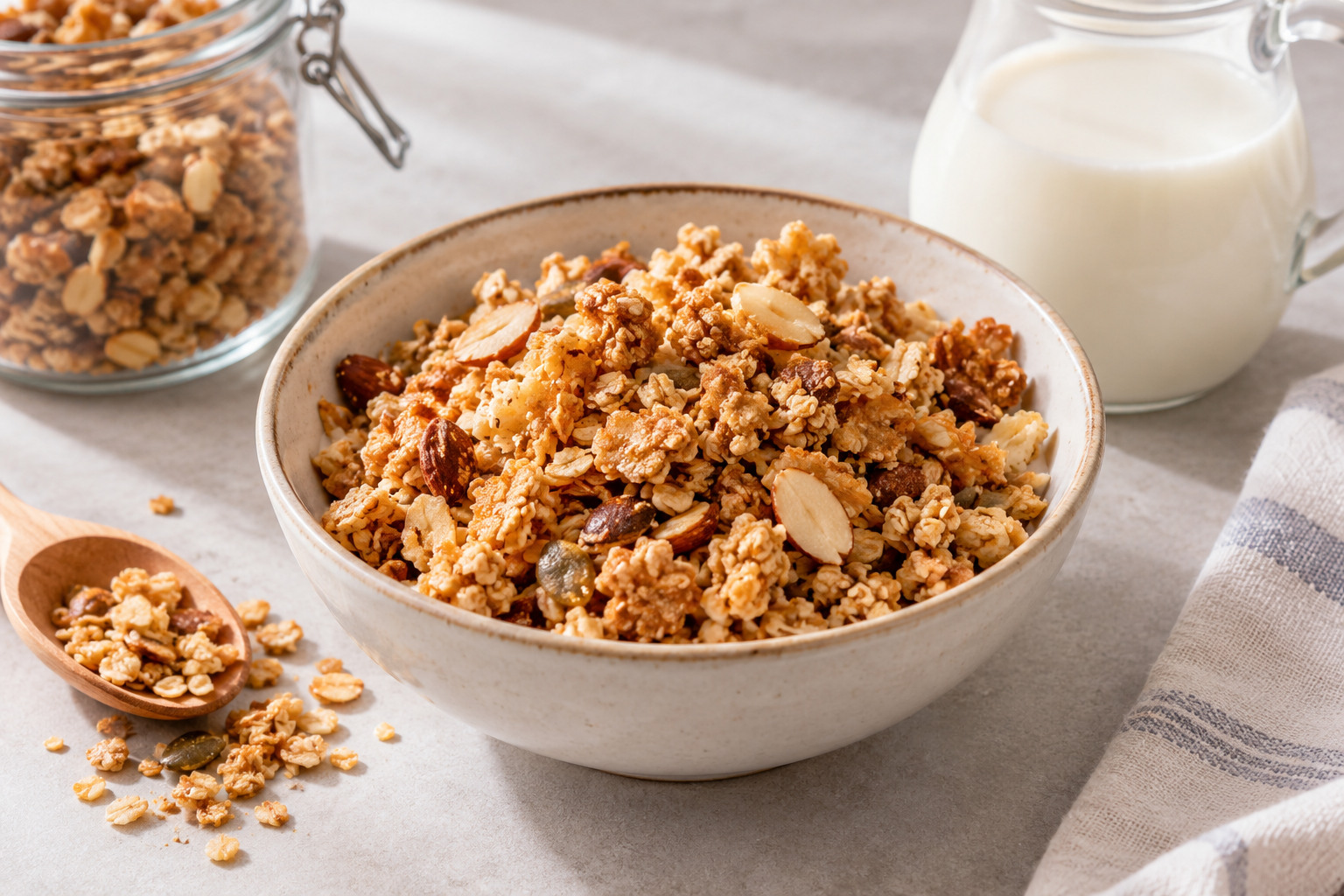
AI-generated application concept for cereal and granola flavoring.
Why cereal and granola flavoring fails after extrusion, toast, or packed storage
A mismatched cereal and granola flavoring fails when the code is chosen for a retail flavor name instead of a defined grain base, addition point, fat level, water activity, and heat path. The piece can still look toasted. The flavor is already gone.
Flaked RTE Cereal is toasted near 180°C. Fruit esters leave in the toaster. Extruded Puffed Cereal sees a 160°C die. Mash-in flavor does not arrive as the kettle smelled. Oven-Toasted Granola bakes near 170°C for 25 min. Honey can turn medicinal while the oats still look golden. Chewy Granola Bar is a different food: binder near 120°C and water activity near 0.55 hold cinnamon, then push it harsh by Day 30.
Cost is not only a rejected panel. A 12-month liner can scalp citrus and leave cardboard oil. Vitamin premix can add metal on Instant Hot Cereal. Frosted Sugar-Coated Cereal can lock a top note in the crust, then dump solvent in the bowl. A dry-cup winner can vanish in 5°C milk.
Parent bakery flavors for B2B baked goods cover the wider bakery set. This page stays on breakfast-cereal and granola matrices, addition points, formats, and tests.
What a developer must define before selecting cereal and granola flavoring
A developer must define the breakfast system, addition point, fat, sugar solids, water activity, heat path, package liner, serving form, label class, and forbidden notes before anyone recommends a cereal and granola flavoring code. “Honey granola” is not a brief.

Flavor sample library in the LULIN laboratory
Write the system by name. Use the complete first-round set in the table: Flaked RTE Cereal, Extruded Puffed Cereal, Shredded Biscuit Cereal, Frosted Sugar-Coated Cereal, Oven-Toasted Granola, Granola Clusters, Chewy Granola Bar, Crunchy Baked Granola Bar, Soft-Baked Cereal Bar, Instant Hot Cereal, Muesli Blend, and Honey-Nut Coated Cereal.
| Application system | Phase | Fat | aw at 25°C | Heat path | First format | Addition point |
|---|---|---|---|---|---|---|
| Flaked RTE Cereal | Starch flake | 2% | 0.28 | Toast 180°C, 8 min | Encapsulated Powder | Post-toast oil spray |
| Extruded Puffed Cereal | Starch melt | 2% | 0.25 | Die 160°C | Encapsulated Powder | Post-dry oil spray |
| Shredded Biscuit Cereal | Wheat shred | 2% | 0.30 | Toast 180°C | Spray-Dried Powder | Post-toast oil spray |
| Frosted Sugar-Coated Cereal | Sugar crust | 4% | 0.35 | Slurry 80°C | Water-Soluble Liquid | Sugar-coating slurry |
| Oven-Toasted Granola | Oat-oil-sugar | 18% | 0.30 | Bake 170°C, 25 min | Oil-Soluble Liquid | Binder syrup |
| Granola Clusters | Bound oats | 16% | 0.32 | Binder 120°C | Oil-Soluble Liquid | Binder syrup |
| Chewy Granola Bar | Syrup bar | 12% | 0.55 | Binder 118°C | Water-Dispersible Emulsion | Binder syrup |
| Crunchy Baked Granola Bar | Baked oat bar | 14% | 0.28 | Bake 170°C, 22 min | Encapsulated Powder | Mash or binder |
| Soft-Baked Cereal Bar | Soft dough | 12% | 0.60 | Bake 160°C, 12 min | Encapsulated Powder | Dough |
| Instant Hot Cereal | Dry oat mix | 6% | 0.20 | Hot milk 60°C | Spray-Dried Powder | Dry powder dust |
| Muesli Blend | Mixed grain | 12% | 0.35 | Ambient | Plated Powder | Dry powder dust |
| Honey-Nut Coated Cereal | Honey-nut slurry | 8% | 0.35 | Slurry 80°C | Water-Dispersible Emulsion | Coating slurry |
Those fat and water-activity figures are first-screen controls. Replace them with the plant recipe before approval.
Good signal: the brief names one system, one addition point, a serving form, and two exclusions such as “no medicinal honey” or “no burnt pyrazine.” Red flag: the brief says “cereal flavor” and asks one liquid to cover extrusion mash, a sugar coater, and a chewy bar.
Flaked RTE Cereal and Extruded Puffed Cereal punish mash-in dosing. Write the addition point after toast or after the dryer. Oven-Toasted Granola, Granola Clusters, and Chewy Granola Bar take flavor in the binder. Instant Hot Cereal is scored in 60°C milk. Muesli Blend has no process kill step. Honey-Nut Coated Cereal is a slurry problem, not a honey-solids problem.
Cereal-flavored protein powder and cereal-flavored protein shakes are nutrition SKUs with different protein loads and drink pH. They are not this breakfast application.
Food flavor formulation support for B2B R&D is the next step when the addition point or carrier still has to be chosen.
How grain base, fat, sugar, water activity, and milk service change flavor choice
Grain base, fat, sugar solids, water activity, and serving form change how cereal and granola flavoring is released, bound, or chemically aged. A winner on a 2% fat flake can disappear in 18% fat Oven-Toasted Granola and turn harsh in a 0.55 aw Chewy Granola Bar.
| Matrix variable | Complete checkpoints | What the panel usually hears | Controlled comparison |
|---|---|---|---|
| Fat | 2%, 6%, 12%, 18%, 24% | Low fat: fast top. High fat: late honey or cinnamon | Hold sugar and aw; change only oil |
| Sugar solids | 8%, 18%, 28%, 38%, 48% | Higher sugar rounds acid and can push fruit toward candy | Hold fat; change only sucrose or invert |
| Water activity at 25°C | 0.20, 0.28, 0.35, 0.45, 0.55, 0.65 | Low aw mutes esters. 0.55 holds spice, then burns | Measure aw on the finished piece |
| Serving form | Dry bowl, cold milk at 5°C, hot milk at 60°C, handheld bar | 5°C hides esters. 60°C opens Instant Hot Cereal | Score the same code in the real eat form |
Oat, corn, rice, and wheat do not carry the same roast. Corn flake plus 2-Acetylpyrazine (FEMA 3126) can read popcorn. Wheat shred can read bread crust. Rice puff needs a coating, not a mash dose.
Flaked RTE Cereal near 2% fat and 0.28 aw gives a fast top. Vanillin (FEMA 3107) holds. Light berry esters do not. Frosted Sugar-Coated Cereal at 28% to 38% sugar crust can hide flavor until saliva hits, then flash Propylene Glycol or ethanol.
Oven-Toasted Granola near 18% fat holds Maltol (FEMA 2656), Ethyl Maltol (FEMA 3487), and Cinnamaldehyde (FEMA 2286). Chewy Granola Bar at 0.55 aw can turn that cinnamon medicinal by Day 30. Instant Hot Cereal is a 60°C cup extraction. Score it after a 3 min hold.
Change one variable at a time. Keep the flavor code, coater, and liner constant.
Which flavor formats should be screened for cereal, granola, and bars?
The cereal and granola flavoring format must match continuous phase, appearance, heat path, and factory dosing. Liquid versus powder is not enough. Screen the complete set: Water-Soluble Liquid, Oil-Soluble Liquid, Water-Dispersible Emulsion, Spray-Dried Powder, Plated Powder, and Encapsulated Powder.
| Format option | Best starting systems | Main advantage | Main risk | Approval check |
|---|---|---|---|---|
| Water-Soluble Liquid | Frosted Sugar-Coated Cereal, Instant Hot Cereal | Fast wet dosing | Weak oil notes; toaster loss | Slurry at 80°C, dry crust |
| Oil-Soluble Liquid | Oven-Toasted Granola, Granola Clusters, oil-spray flakes | Direct fat-phase delivery | Cardboard if spray oil oxidizes | Spray at 45°C, 30-day liner |
| Water-Dispersible Emulsion | Chewy Granola Bar, Honey-Nut Coated Cereal | Oil notes in a water binder | Ringing, sticky clusters | Binder at 120°C, Day 7 chew |
| Spray-Dried Powder | Instant Hot Cereal, Shredded Biscuit Cereal, Muesli Blend | Dry premix dosing | Caking; muted 60°C milk | 10% w/w in hot milk |
| Plated Powder | Muesli Blend | Simple dry dosing | Segregation in a tote | Blend uniformity at aw 0.35 |
| Encapsulated Powder | Extruded Puffed Cereal, Flaked RTE Cereal, Crunchy Baked Granola Bar, Soft-Baked Cereal Bar | Heat protection | Incomplete dry-bowl release | 160°C die or 180°C toast, then milk |
Category-level flavor concentrates for food manufacturing explain the family. The powder versus liquid food flavor guide covers handling.
Honey, maple syrup, ground cinnamon, cocoa, and culinary ethanol extract are food ingredients, not extra flavor formats. They change Brix, water, color, and bind. Culinary extract used at 1.00% to 2.00% in home granola sits outside the concentrate ladder. Screen a B2B concentrate at 0.05%, 0.10%, 0.15%, 0.20%, 0.25%, 0.30%, 0.40%, and 0.50% w/w. Use 0.40% w/w (4 g/kg) as the high-end reference benchmark. Treat 0.50% w/w as the extrusion-loss or high-fat binder outlier.
| Ingredient class | What it contributes | Typical use band | Why it is not a concentrate substitute |
|---|---|---|---|
| Concentrated cereal and granola flavoring | Aroma and taste in a declared carrier | 0.05% to 0.50% w/w; 0.40% w/w high-end screen | Built for controlled sensory work |
| Culinary ethanol extract | Dilute volatiles plus solvent | 1.00% to 2.00% in granola | Thins binder; dose is not comparable |
| Honey or maple syrup | Water, sugar, color, cooked aroma | 4% to 18% of granola or coating | Changes bind, color, and declaration |
| Ground cinnamon or cocoa | Spice or cocoa solids | 0.50% to 3.00% of the mix | Changes color, grit, and heat note |
| Cereal-flavored protein powder base | Protein, sweetener, drink pH | Nutrition SKU | Different matrix and serving form |
Good signal: the supplier asks whether the system is Flaked RTE Cereal, Extruded Puffed Cereal, or Chewy Granola Bar, and whether flavor goes in mash, oil spray, slurry, or binder. Red flag: one Water-Soluble Liquid is offered as universal “cereal flavor” for a 160°C die and a chewy bar.
Encapsulated Powder still needs a 180°C flake check and a 160°C die check. Plated Powder is a handling convenience, not an extrusion plan. Oil-Soluble Liquid in Instant Hot Cereal leaves grease rings. Water-Soluble Liquid in 18% fat Oven-Toasted Granola can bead on oil and vanish.
Which failure modes appear after coating, toasting, storage, or scale-up?
Cereal and granola flavoring fails after process when heat, oxygen, shear, water migration, or package aroma strips the intended top note and leaves solvent, burnt grain, medicinal honey, or cardboard. The failure is usually visible in a short pilot.
| Pilot challenge | Reference condition | Likely drift | Diagnostic action |
|---|---|---|---|
| Extrusion die | 140°C, 150°C, 160°C, 170°C, 180°C; design screen 160°C | Fruit dies; burnt 2-Acetylpyridine (FEMA 3251) remains | Compare mash with cooled puff |
| Flake toast | 160°C, 170°C, 180°C, 190°C, 200°C; high-end 180°C for 8 min | Berry or citrus gone; roast remains | Score toaster infeed versus packed flake |
| Granola bake | 150°C, 160°C, 170°C, 180°C; high-end 170°C for 25 min | Honey goes medicinal; oily oats | Score hot pan and 20°C cluster |
| Sugar slurry | 50°C, 60°C, 70°C, 80°C, 90°C | Solvent flash; crust dumps later | Taste slurry and dried crust |
| Oil spray | 25°C, 35°C, 45°C, 55°C | Uneven coat; later cardboard | Weigh oil pickup; age in the liner |
| Binder cook | 105°C, 110°C, 115°C, 120°C, 125°C, 130°C; high-end 120°C | Caramel overwrites fruit esters | Add flavor before and after cook |
| Packed flake or granola | 30 days at 25°C in production liner | Citrus scalp, film, cardboard | Age in the real bag or box liner |
| Shelf screen | 6 months, 9 months, 12 months, 18 months; reference 12 months at 25°C/60% RH | Fade, rancid oil, spice burn | Pull the 12-month pack, not a jar |
| Hot-milk service | Instant Hot Cereal, 3 min at 60°C | Metallic vitamin, woody vanillin | Score the cup, not the dry mix |
Light esters age. Lemon granola that was clean on Day 0 can taste of polish by Day 30. Ethyl Maltol can bloom candy-floss in oil spray. Cinnamaldehyde in Chewy Granola Bar can rise as oat notes fade. Benzaldehyde (FEMA 2127) in Honey-Nut Coated Cereal can read cherry-almond medicine.
A 5 kg kettle is not a continuous coater. Oil spray that sits 20 min in a header loses tops. Binder cooked 8 min longer is a different product. Repeat the winning dose on the plant extruder, toaster, coater, and bar press.
Physical failure stops the item. Greasy Instant Hot Cereal, sticky Granola Clusters that will not dry, slurry that will not crust, or a bar that oils off is an automatic reject.
How a cereal and granola sample test should use controls, coded samples, and acceptance criteria
A cereal and granola flavoring sample test should use one master base per system, blind three-digit codes, a complete dose ladder, process-matched controls, and a written 80/100 rule. Informal smelling of the flavor bottle is not a test.
Make one 5 kg master and divide it only after the base is uniform. Prepare a blank, the in-plant reference if one exists, and each candidate code twice. Test matched concentrate at 0.05%, 0.10%, 0.15%, 0.20%, 0.25%, 0.30%, 0.40%, and 0.50% w/w. The high-end reference benchmark is 0.40% w/w (4 g/kg). Use 0.50% w/w only for Extruded Puffed Cereal mash-loss work, Crunchy Baked Granola Bar, or an 18% to 24% fat binder. Record addition point, heat path, oil pickup, water activity at 25°C, and liner. Serve 20 g dry and 20 g in 5°C milk; Instant Hot Cereal in 60°C milk after 3 min. Score 0 to 10 on Day 0, Day 7, and Day 30. Advance the lowest 80/100 dose with no physical or off-note failure, then confirm on the plant line.
| Application screen | Batch | Matrix controls | Process challenge | Serving check | Dose ladder |
|---|---|---|---|---|---|
| Flaked RTE Cereal | 1 kg | 2% fat; aw 0.28 | Toast 180°C, 8 min; oil spray 45°C | Dry and 5°C milk | 0.05%, 0.10%, 0.15%, 0.20%, 0.25%, 0.30%, 0.40%, 0.50% |
| Extruded Puffed Cereal | 1 kg | 2% fat; aw 0.25 | Die 160°C; post-dry oil spray | Dry and 5°C milk | Same ladder |
| Frosted Sugar-Coated Cereal | 1 kg | 4% fat; aw 0.35 | Slurry 80°C | Dry and 5°C milk | Same ladder |
| Oven-Toasted Granola | 1 kg | 18% fat; aw 0.30 | Binder 120°C; bake 170°C, 25 min | 20°C handful | Same ladder |
| Chewy Granola Bar | 1 kg | 12% fat; aw 0.55 | Binder 118°C; 7 days packed | Bar at 20°C | Same ladder |
| Crunchy Baked Granola Bar | 1 kg | 14% fat; aw 0.28 | Bake 170°C, 22 min | Bar at 20°C | Same ladder |
Replace these laboratory bases with the real formula before approval. Buyers can request cereal and granola flavor samples for a controlled B2B trial after the system, addition point, process, and ladder are fixed.
| Advancement criterion | Weight | Passing evidence |
|---|---|---|
| Recognizable target identity | 20% | Honey-nut, cinnamon, maple, berry, cocoa, or toasted grain remains |
| Match to the named system | 15% | Fits Flaked RTE Cereal, Extruded Puffed Cereal, granola, or bar |
| Top-note retention | 15% | Fruit, spice, dairy, or roast top survives toast, die, or binder |
| Body and sweetness integration | 10% | Sits in the grain-fat-sugar matrix rather than as solvent |
| Clean finish and off-note control | 15% | No medicinal honey, polish, popcorn diacetyl, cinnamon burn, or cardboard |
| Matrix and piece integrity | 10% | No greasy cup, sticky cluster, wet crust, or oiling-off bar |
| Physical and package stability | 10% | Day 7 and Day 30 pass in the real liner |
| Cost-in-use and supply fit | 5% | Approved dose produces an acceptable cost per 1,000 kg |
Advance at 80/100 or higher only when no automatic-rejection condition appears. Physical failure stops the item. Use ISO 13299:2016 for profile work and ISO 4120:2021 for difference testing after a process or package change.
A culinary extract can sit on the bench as an extra control. Do not place it on the 0.05% to 0.50% concentrate ladder. Record a 1.00% or 2.00% inclusion as a separate class.
What belongs in a cereal and granola flavoring RFQ before dosage is discussed
A cereal and granola flavoring RFQ should lock the breakfast system, formula, addition point, process, format, market, documents, and supply plan before anyone argues about a starting dose. Dosage without a system is guesswork.
| RFQ field | Buyer input | Required supplier response |
|---|---|---|
| Sensory target | System name; top, middle, base; exclusions | Item code and sensory description |
| Formula | Fat %, sugar solids %, water activity, grain bill, oil, vitamin premix | Format, phase behavior, starting use guidance |
| Process | Addition point, die, toast, slurry, binder, bake, liner | Process-fit guidance and trial cautions |
| Dose plan | 0.05%, 0.10%, 0.15%, 0.20%, 0.25%, 0.30%, 0.40%, 0.50% w/w ladder | Recommended range and item-specific ceiling |
| Destination market | United States or other country; intended declaration | Regulatory-status statement for the exact item |
| Quality files | TDS, SDS, COA, carrier, allergen, GMO, vegan, Halal, Kosher, origin, shelf life | Current item-level pack with issue dates |
| Supply plan | Sample quantity, first order, pack, destination, Incoterm | MOQ, price basis, pack sizes, lead time, capacity |
| Change control | Approved code, lot, critical sensory and physical fields | Notice for formula, carrier, site, or specification change |
Retail names such as Nature Valley, Open Nature, Sunbelt Bakery, and Cascadian Farm train shoppers to ask about flavor names and vegan natural flavors. Those queries do not set a formula. The RFQ still has to name the system and the legal class.
For a United States project, request the 9-major-allergen statement, including sesame. Ask for the exact item’s natural or artificial status under 21 CFR 101.22. A “honey granola” sketch does not settle classification. Keep the broad definition on what artificial flavor means for B2B food buyers. The food flavor compliance document request guide helps QA assemble one review pack.
FEMA GRAS numbers identify evaluated substances under intended flavor use. They do not approve a brand. Food and Drug Administration facility registration is not product approval. FSVP cooperation still belongs in the importer file.
LULIN FLAVOR is the English brand of QUANZHOU LVLIN BIOENGINEERING CO., LTD., a flavor manufacturer established in 2001 in Quanzhou, Fujian. The company operates 3 production lines with more than 50 employees, over 8000 m² building area, and more than 12 application engineers with over 20 years of flavor-development experience.
LULIN supplies Water-Soluble Liquid, Oil-Soluble Liquid, Water-Dispersible Emulsion, Spray-Dried Powder, and Plated Powder; Encapsulated Powder is scoped when die, toast, or bake protection is part of the brief. Technical responses issue within 2 days, matched samples dispatch within 5 days after brief acceptance, the standard MOQ is 25 kg per selected item, and production lead time is 10 days to 15 days after approval.
The ISO 9001 pack includes ISO 9001 and HACCP documentation plus the item’s TDS, SDS, COA, carrier, allergen, origin, storage, and destination-market files. Compare quotations on approved cost-in-use per 1,000 kg, remaining shelf life, freight, lead time, and change control.
Red flags that disqualify a cereal and granola flavoring supplier
These cereal and granola flavoring red flags override an attractive aroma in the bottle.
- Sends one liquid for Extruded Puffed Cereal and Chewy Granola Bar without asking about die temperature, binder cook, or water activity. Phase and heat path are the product.
- Treats honey, maple syrup, or culinary extract as a 1:1 stand-in for concentrated flavoring. Water, sugar, and ethanol change bind and toast color.
- Claims a toast-proof berry or lemon without a 180°C flake result or a 160°C die result. Kettle aroma is not toaster evidence.
- Omits an item-specific 21 CFR 101.22 statement, SDS, or current-lot COA. A cereal SKU cannot be released on a catalog paragraph.
- Changes carrier, site, or assay without notice. Oil-spray viscosity and slurry crusting both move when the solvent moves.
- Cannot support a 25 kg first production pack or a 5-day matched sample after the brief is accepted. The trial dies in logistics.
- Scores samples only in water, sugar syrup, or a dry cup. Breakfast cereal is a toast, milk, and liner problem.
- Offers a protein-shake “cereal flavor” as the granola solution. The protein drink is a different matrix.
Frequently asked questions about cereal and granola flavoring
Is cereal and granola flavoring the same as honey, maple syrup, or a cereal-flavored protein powder?
No. Cereal and granola flavoring is a concentrated aroma system screened at 0.05% to 0.50% w/w, while honey and maple syrup contribute water, sugar, and bind, and cereal-flavored protein powder is a nutrition SKU. Compare classes in the finished flake, granola, or bar because process and declaration differ.
What starting dose should be used for concentrated cereal and granola flavoring?
Use 0.40% w/w as the high-end reference benchmark for matched concentrated samples, alongside 0.05%, 0.10%, 0.15%, 0.20%, 0.25%, 0.30%, and 0.50% w/w. Optimize downward after the preferred item survives the real system, addition point, and heat path; do not place honey, maple syrup, or culinary extract on this concentrate ladder.
Where should flavor be added on a cereal line versus a granola line?
Flaked RTE Cereal and Extruded Puffed Cereal should take flavor after toast or after the dryer, usually as oil spray or Encapsulated Powder, because mash-in dosing loses esters at 160°C to 180°C. Oven-Toasted Granola, Granola Clusters, and Chewy Granola Bar usually take flavor in the binder. Instant Hot Cereal and Muesli Blend often take Spray-Dried Powder or Plated Powder in the dry blend.
Which format belongs in Flaked RTE Cereal versus Chewy Granola Bar?
Flaked RTE Cereal usually starts with Encapsulated Powder or post-toast Oil-Soluble Liquid. Chewy Granola Bar usually starts with Water-Dispersible Emulsion or a cook-stable Water-Soluble Liquid in the binder. Confirm phase, 180°C toast or 118°C binder, and packed aw before treating powder and liquid as interchangeable.
Why does granola taste cardboard or stale after packed storage?
Oil-spray and granola oil oxidize, and polyolefin liners can scalp citrus and light esters, so a clean Day 0 cluster can read cardboard by Day 30 or at the 12-month screen. Age coded samples in the production liner at 25°C, then reject film, rancid oil, or solvent before raising dose.
Does Encapsulated Powder always survive a 160°C extrusion die?
No. Encapsulated Powder is the first extrusion and toast screen, not a guarantee, because release still depends on the capsule, moisture, dwell, and later oil spray. Compare mash aroma with the cooled puff after a 160°C die, then score the dry bowl and 5°C milk before approving the code.
How should a sample test score cereal eaten dry and in cold milk?
Score the same coded piece dry and after a short soak in 5°C milk, because a sugar crust or oil coat can hide solvent until the bowl. Instant Hot Cereal needs a third score in 60°C milk after 3 min. Keep the 0.40% w/w high-end benchmark on the concentrate ladder for both serving forms.
What documents belong in a United States cereal and granola flavoring RFQ?
Request the TDS, SDS, current-lot COA, carrier statement, allergen and sesame statement, item-specific natural or artificial status, GRAS or regulatory statement, vegan statement if claimed, shelf life, storage, origin, change-control terms, MOQ, pack size, price basis, Incoterm, lead time, and FSVP cooperation information.
Does granola have to use artificial flavors?
No. Granola and cereal bars can be built with an item that is natural, artificial, or a mixed declaration under 21 CFR 101.22; the choice is a brief and label decision, not a process law. Retail questions about Nature Valley, Open Nature, Sunbelt Bakery, or Cascadian Farm vegan natural flavors do not replace an item-specific status letter.
Can one flavor code cover Frosted Sugar-Coated Cereal and Chewy Granola Bar?
Rarely. Frosted Sugar-Coated Cereal sees an 80°C slurry and a dry crust, while Chewy Granola Bar sees a 118°C binder and water activity near 0.55. The same honey-nut or cinnamon idea usually needs two item codes or two formats.
Send LULIN FLAVOR a cereal and granola flavoring brief
An application-matched cereal and granola flavoring brief should name the breakfast system, addition point, forbidden notes, fat, sugar solids, water activity, grain bill, heat path, liner, serving form, market, documents, and sample quantity. Include the 0.05%, 0.10%, 0.15%, 0.20%, 0.25%, 0.30%, 0.40%, and 0.50% w/w plan, with 0.40% w/w as the high-end reference benchmark.
LULIN FLAVOR can prepare routes for Flaked RTE Cereal, Extruded Puffed Cereal, Frosted Sugar-Coated Cereal, Oven-Toasted Granola, Chewy Granola Bar, and Honey-Nut Coated Cereal. Use Contact LULIN FLAVOR for a cereal and granola project inquiry with the matrix, process, target market, and sample deadline.
Develop this flavor in your product
Send your product, target market and project goal. We will review the sample direction with you.