Published
Cookies And Cream Flavoring for Cookie
Cookies and cream flavoring for cookie is a dual-note concentrate for baked cookie dough and sandwich creme, not an ice-cream mix-in. Name the cookie system, fat, pH, and bake path first. Screen matched concentrates at 0.40% w/w as the high-end reference benchmark, then confirm the dual note after a 190°C bake.
Last updated: September 1, 2026
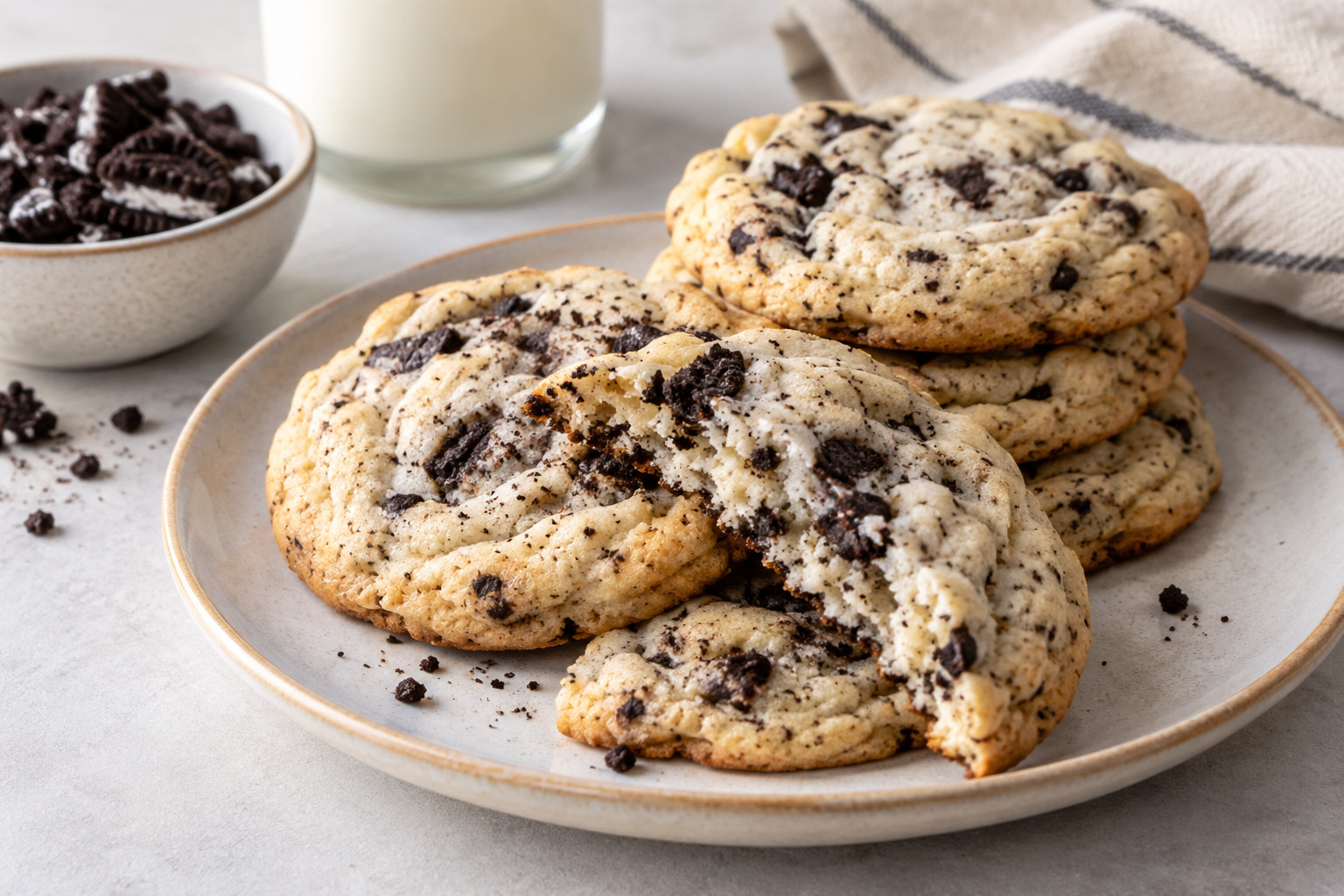
AI-generated application concept for cookies and cream flavoring for cookie.
Why cookies and cream flavoring collapses inside a cookie that already bakes cocoa and vanilla
Cookies and cream flavoring for cookie fails when the code is chosen for an ice-cream name instead of a defined dough fat, alkalinity, water activity, and oven path. The piece can still look like a cookies-and-cream SKU. The dual note is already gone.
A Rotary-Molded Cocoa Sandwich Shell already carries Cocoa Powder, toasted sugar, and Maillard notes. Adding a Cocoa-Biscuit Forward concentrate on top of that shell can read as burnt cocoa, not as cookie crumb in cream. A Shortbread Cookie at 28% fat buries vanillin and dairy-lactone body until the panel only hears fat and sugar. A Protein Cookie with Whey Protein Isolate binds the cream note and leaves a dry cocoa dust. The same named profile is three products.
Cost is not only a rejected panel. A Wire-Cut Drop Cookie that won in the mixer can lose the cream top at 190°C for 12 min and then taste of cardboard by Day 30 in the wrap. Sandwich Creme Center that was quiet at 36°C deposit can bloom ethyl maltol or a film note after 30 days at 20°C. Gluten-Free Cookie dough with a high-starch paste can hold water at aw 0.40 and then stale the cocoa note before the cream note ever appears.
Parent bakery flavors for B2B baked goods cover the wider bakery set. Shared cookie and biscuit flavoring for B2B bakery covers generic cookie and biscuit aroma. This page stays on the cookies-and-cream dual note inside named cookie systems, formats, tests, and the 25 kg buying file.
What a developer must define before selecting cookies and cream flavoring for cookie
A developer must define the cookie system, continuous fat phase, Cocoa Powder level, dough pH, bake or deposit path, package, serving temperature, label class, and forbidden notes before anyone recommends a cookies and cream flavoring for cookie. “Cookies and cream cookie” is not a brief.
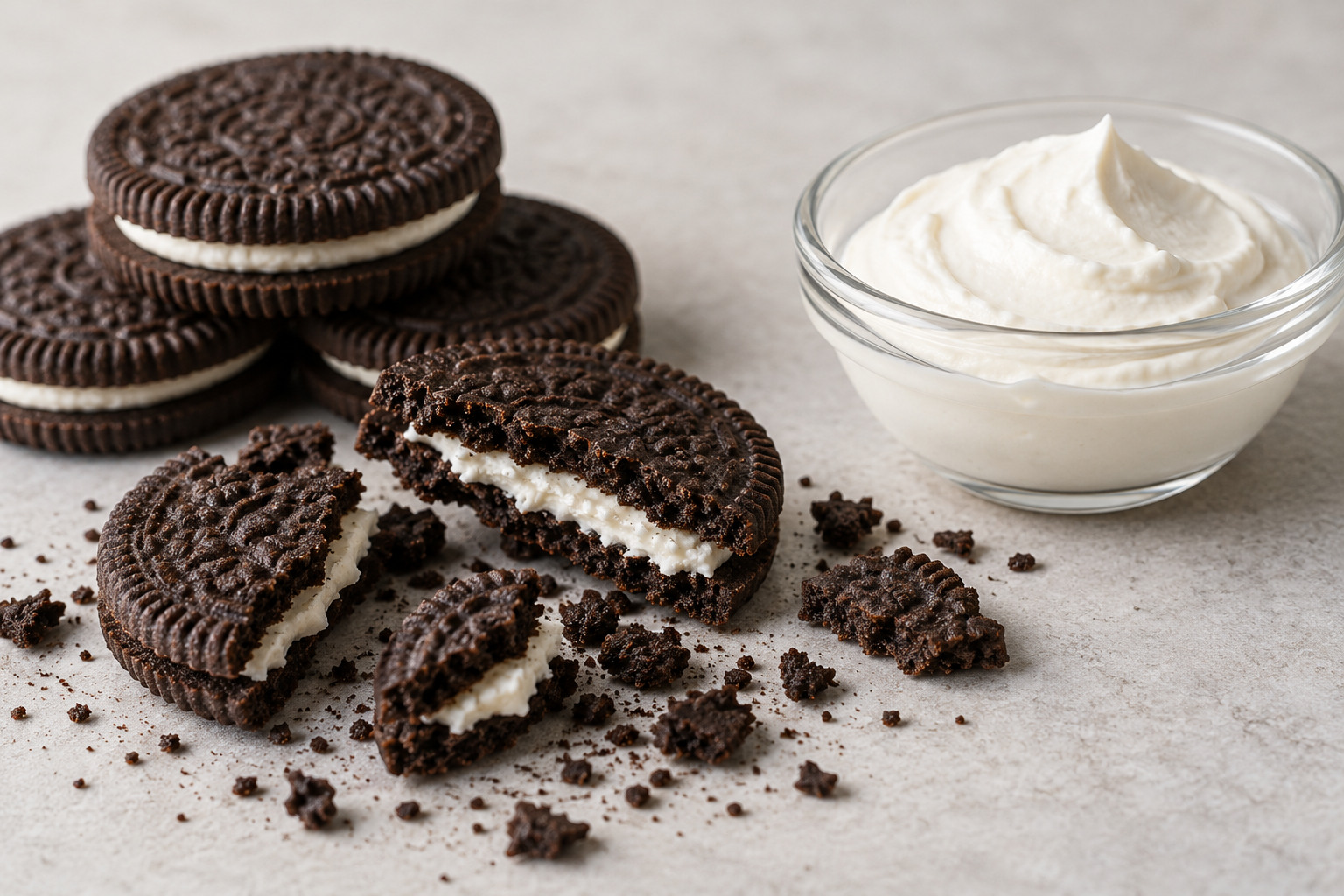
Cookies cream sensory reference: an AI-generated sensory reference for this flavor brief.
Write the system by name. The complete set used for first-round screening is Rotary-Molded Cocoa Sandwich Shell, Rotary-Molded Vanilla Sandwich Shell, Wire-Cut Drop Cookie, Shortbread Cookie, Co-Extruded Filled Cookie, Protein Cookie, Gluten-Free Cookie, and Sandwich Creme Center.
| Cookie system | Continuous phase | Typical fat | Typical dough pH | Heat path | First format to screen |
|---|---|---|---|---|---|
| Rotary-Molded Cocoa Sandwich Shell | Low-moisture cocoa dough | 12% | 7.5 | 190°C for 12 min | Encapsulated Powder |
| Rotary-Molded Vanilla Sandwich Shell | Low-moisture vanilla dough | 12% | 7.0 | 180°C for 10 min | Encapsulated Powder |
| Wire-Cut Drop Cookie | Plastic fat dough | 20% | 7.0 | 180°C for 12 min | Oil-Soluble Liquid |
| Shortbread Cookie | High-fat short dough | 28% | 6.5 | 170°C for 14 min | Oil-Soluble Liquid |
| Co-Extruded Filled Cookie | Shell dough plus fat filling | 16% shell / 32% filling | 7.0 | 175°C for 12 min | Encapsulated Powder plus Oil-Soluble Liquid |
| Protein Cookie | Protein-fat paste | 16% | 6.5 | 160°C for 16 min | Spray-Dried Powder |
| Gluten-Free Cookie | Starch-fat paste | 20% | 7.0 | 175°C for 12 min | Water-Dispersible Emulsion |
| Sandwich Creme Center | Fat-sugar paste | 32% | 6.5 | Deposit at 36°C; no bake | Oil-Soluble Liquid |
Those fat and pH figures are comparison controls for a first screen, not a finished formula. Replace them with the plant recipe before approval.
Good signal: the brief names one system from the table, a target bake or deposit, and two exclusions such as “no soapy vanillin,” “no popcorn diacetyl,” or “no burnt cocoa.” Red flag: the brief says “cookies and cream flavor” and asks one liquid to cover cocoa shell, vanilla shell, drop dough, and Sandwich Creme Center.
Flavor added in Sandwich Creme Center never reaches a rotary shell. Write the addition point. Co-Extruded Filled Cookie is two phases. Protein Cookie and Gluten-Free Cookie change binding and aw. The same cookies-and-cream idea is eight products.
Cream and cheese flavors for food stay on cultured dairy identity. A cookies-and-cream cookie brief may forbid a cream-cheese tang; it does not become a cream-cheese project.
How fat, alkalinity, bake heat, and water activity change cookies and cream flavoring in cookie dough
Fat, dough pH, oven temperature, finished-cookie water activity, and serving temperature change how cookies and cream flavoring for cookie is released, bound, or stripped. A winner in Sandwich Creme Center at 36°C can disappear in a Rotary-Molded Cocoa Sandwich Shell and turn harsh in a Protein Cookie.
| Matrix variable | Complete checkpoints | What the panel usually hears | Controlled comparison |
|---|---|---|---|
| Dough fat | 8%, 12%, 16%, 20%, 24%, 28%, 32% | Low fat: fast cocoa top, thin cream. High fat: late release, muted vanilla, longer candy or cocoa finish | Hold sugar and pH; change only fat |
| Dough pH | 6.0, 6.5, 7.0, 7.5, 8.0, 8.5 | 6.0 keeps dairy cream. 8.0 from Ammonium Bicarbonate or extra Sodium Bicarbonate can push cocoa toward alkali bitterness | Name the leavening: Sodium Bicarbonate, Ammonium Bicarbonate, or none |
| Oven temperature | 160°C, 170°C, 175°C, 180°C, 190°C, 200°C, 205°C, 220°C | 160°C leaves solvent. 190°C strips cream lactones. 220°C is a cracker/biscuit outlier that burns cocoa | Hold time at 12 min unless the plant uses another time |
| Bake time | 8 min, 10 min, 12 min, 14 min, 16 min | Longer time dries the cream note and raises toasted-sugar and cocoa dust | Hold 180°C or 190°C; change only time |
| Water activity at 25°C | 0.20, 0.25, 0.30, 0.35, 0.40, 0.45 | Lower aw mutes cream. Higher aw speeds stale cardboard and microbial risk | Measure aw on the cooled cookie, not the dough |
| Service temperature | 5°C, 20°C, 40°C | 5°C hides esters in icebox dough. 40°C opens fat and can show solvent or cocoa dust | Score every code at the real eat temperature |
Rotary-Molded Cocoa Sandwich Shell sits near 12% fat and pH 7.5. Cocoa Powder already supplies bitterness. A Dark-Cocoa Crumb direction on that shell needs less extra cocoa character, not more. Rotary-Molded Vanilla Sandwich Shell at pH 7.0 can take Vanilla-Cream Forward without fighting alkali cocoa.
Shortbread Cookie at 28% fat is the high-end dough matrix screen. Dairy-Fat Cream can sit in that fat if the code is oil-soluble. Water-Soluble Liquid beads and then vanishes. Protein Cookie at 16% fat plus Whey Protein Isolate or Soy Protein Isolate binds vanillin. Spray-Dried Powder or Encapsulated Powder is the first protein screen, not a water tasting.
Gluten-Free Cookie dough often holds more water. Finished aw near 0.40 can stale cocoa by Day 7. Sandwich Creme Center at 32% fat is not a bake problem. It is a deposit-and-age problem at 32°C, 36°C, and 40°C.
The high-end oven challenge is 190°C for 12 min. Keep the complete oven set at 160°C, 170°C, 175°C, 180°C, 190°C, 200°C, 205°C, and 220°C. Treat 220°C as a cracker/biscuit outlier. Change one variable at a time.
Which flavor formats should be screened in cookie dough versus sandwich creme?
The cookies and cream flavoring for cookie format must match continuous phase, appearance, heat path, and factory dosing. Liquid versus powder is not enough. Screen the complete set: Water-Soluble Liquid, Oil-Soluble Liquid, Water-Dispersible Emulsion, Spray-Dried Powder, Plated Powder, and Encapsulated Powder.
| Format option | Best starting systems | Main advantage | Main risk | Approval check |
|---|---|---|---|---|
| Water-Soluble Liquid | High-moisture Gluten-Free Cookie premix; rare wet doughs | Fast wet dosing | Weak oil-note delivery; volatile loss at 190°C | Clarity in a 10% w/w syrup, then dough bake |
| Oil-Soluble Liquid | Wire-Cut Drop Cookie, Shortbread Cookie, Sandwich Creme Center | Direct fat-phase cream and cocoa delivery | Specks or grease in starch pastes; flash in a long 36°C jacket | Viscosity at 36°C, bake score, oiling-off |
| Water-Dispersible Emulsion | Gluten-Free Cookie, some Protein Cookie batters | Oil-affine notes in a more water-continuous paste | Emulsion break, ringing, muted bake | 5°C dough hold, then 175°C bake |
| Spray-Dried Powder | Protein Cookie, dry bakery premix | Dry handling and premix dosing | Carrier load, caking, muted steam | Moisture, reconstitution in 10% w/w dough |
| Plated Powder | Shortbread Cookie premix, dry compound | Simple dry dosing onto fat or sugar | Segregation, weak protection at 190°C | Blend uniformity, cooled-cookie score |
| Encapsulated Powder | Rotary-Molded Cocoa Sandwich Shell, Rotary-Molded Vanilla Sandwich Shell, Co-Extruded Filled Cookie | Extra protection through oven heat | Incomplete release, higher cost-in-use | 190°C for 12 min, cooled cookie score |
Frozen-dairy pages stay on frozen dessert. Vegan ice cream flavors for food buyers and vanilla ice cream flavoring for food buyers do not set cookie-dough format. Soft serve ice cream flavoring for food buyers is a draw-temperature dairy problem, not a 190°C cookie problem.
Cocoa Powder, crushed sandwich-cookie crumb, and culinary ethanol extract are ingredients, not extra flavor formats. Extract at 1.00% to 2.00% in home dough sits outside the concentrate ladder. Screen a B2B concentrate at 0.05%, 0.10%, 0.15%, 0.20%, 0.25%, 0.30%, 0.40%, and 0.50% w/w. Use 0.40% w/w (4 g/kg) as the high-end reference benchmark. Treat 0.50% w/w as the Encapsulated Powder, Protein Cookie, or 32% fat Shortbread Cookie outlier.
| Ingredient class | What it contributes | Typical use band | Why it is not a concentrate substitute |
|---|---|---|---|
| Concentrated cookies and cream flavoring | Dual-note aroma through a declared carrier | 0.05% to 0.50% w/w; 0.40% w/w high-end screen | Designed for controlled sensory work |
| Culinary ethanol extract | Dilute volatiles plus solvent | 1.00% to 2.00% of extract in dough | Adds ethanol; dose is not comparable |
| Cocoa Powder or cocoa mass | Color, bitterness, fat, solids | Formula-level | Flavoring cannot replace cocoa solids |
| Crushed sandwich-cookie crumb | Texture, color, some baked aroma | 5% to 15% of dough | Changes bake rheology; does not lock a cream note |
| Vanilla extract | Dilute vanilla plus solvent | Recipe-dependent | Does not supply cocoa-biscuit crumb |
Good signal: the supplier asks whether the system is Rotary-Molded Cocoa Sandwich Shell, Wire-Cut Drop Cookie, or Sandwich Creme Center before sending a sample. Red flag: one Water-Soluble Liquid is offered as universal “cookies and cream flavor” for a 190°C shell and a 36°C creme.
Encapsulated Powder still needs a 190°C for 12 min check. Plated Powder is a handling convenience, not a bake-stable plan for a Rotary-Molded Cocoa Sandwich Shell. Oil-Soluble Liquid in a wet Gluten-Free Cookie paste can leave specks. Water-Soluble Liquid in Shortbread Cookie fat can bead and then vanish.
Which cookies-and-cream directions belong on a cookie brief?
A cookies and cream flavoring for cookie brief should name one dual-note direction, not a mood board. The complete set used for first-round screening is Cocoa-Biscuit Forward, Vanilla-Cream Forward, Balanced Dual-Note, Toasted-Sugar Cookie, Dark-Cocoa Crumb, and Dairy-Fat Cream.
| Direction | Top note | Middle | Base | Cookie systems that usually fit | Exclusion to write |
|---|---|---|---|---|---|
| Cocoa-Biscuit Forward | Toasted cocoa wafer | Light vanilla | Dry crumb | Rotary-Molded Vanilla Sandwich Shell, Wire-Cut Drop Cookie | No burnt cocoa |
| Vanilla-Cream Forward | Vanillin cream | Sweet dairy | Soft fat | Rotary-Molded Cocoa Sandwich Shell, Sandwich Creme Center | No soapy vanillin |
| Balanced Dual-Note | Equal cocoa crumb and cream | Baked sugar | Short dairy | Wire-Cut Drop Cookie, Co-Extruded Filled Cookie | Neither note may vanish after bake |
| Toasted-Sugar Cookie | Caramelized sugar | Light cocoa | Biscuit | Shortbread Cookie, Wire-Cut Drop Cookie | No burnt sugar, no popcorn diacetyl |
| Dark-Cocoa Crumb | Dutch-style cocoa | Low cream | Bitter crumb | Rotary-Molded Vanilla Sandwich Shell, Protein Cookie | No alkali soap, no ash |
| Dairy-Fat Cream | Fresh cream | Vanilla | Milk-fat lactones | Sandwich Creme Center, Shortbread Cookie | No evaporated-milk, no cheese tang |
Cocoa-Biscuit Forward on a Rotary-Molded Cocoa Sandwich Shell is usually too much cocoa. Put that direction on a Rotary-Molded Vanilla Sandwich Shell or a pale Wire-Cut Drop Cookie so the crumb note has somewhere to sit. Vanilla-Cream Forward is the usual pair for a cocoa shell. Balanced Dual-Note is the default when the dough is not already cocoa-heavy.
Toasted-Sugar Cookie is not caramel candy. It is baked sucrose and light maltol on a Shortbread Cookie or Wire-Cut Drop Cookie. Dark-Cocoa Crumb is a lean cocoa direction for a vanilla shell or a Protein Cookie that already tastes of whey. Dairy-Fat Cream is a creme-center and high-fat dough direction. It is not cultured cream cheese and it is not a frozen vanilla ice cream.
Write the two notes that must remain after process. “Cookies and cream” without a direction lets the supplier send a cocoa candy and a vanilla candy as one bottle.
Good signal: the brief picks Balanced Dual-Note or Vanilla-Cream Forward and names the shell color. Red flag: the brief attaches a photo of an ice-cream pint and asks for the same flavor in a 190°C cookie.
Which cookie-pilot failure modes should be forced before scale-up?
Cookies and cream flavoring for cookie fails after process when heat, oxygen, shear, protein binding, or package aroma strips one of the two notes and leaves solvent, burnt cocoa, candy, or cardboard. The failure is usually visible in a short pilot. It is rarely a mystery at full scale.
| Pilot challenge | Reference condition | Likely drift | Diagnostic action |
|---|---|---|---|
| Mixer flash in drop dough | 8 min at 20°C, open bowl | Cream esters gone; cocoa remains | Compare bowl aroma with 60 min dough rest |
| Rotary-mold heat | Die at 40°C; 190°C for 12 min | Cream dies; toasted cocoa remains | Score dough, hot cookie, and 20°C cookie |
| Shortbread bake | 170°C for 14 min; 28% fat | Muted cream; fat film | Taste at 20°C and 40°C |
| Protein bind | Protein Cookie with Whey Protein Isolate | Dry cocoa dust; no dairy | Compare milk-protein and pea-protein doughs |
| Gluten-free hold | Gluten-Free Cookie; aw 0.40 | Stale cocoa by Day 7 | Measure aw; age 7 days at 20°C |
| Creme deposit | Sandwich Creme Center at 32°C, 36°C, 40°C | Solvent, candy bloom, or oiling-off | Hold 30 days packed at 20°C |
| Co-extrusion | Co-Extruded Filled Cookie; 175°C for 12 min | Shell and filling notes swap or smear | Score shell, filling, and whole bite |
| Packed cookie age | Day 0, Day 7, Day 30 at 20°C | Cardboard, soap, or lost cream | Age in the production wrap |
Vanillin and dairy lactones age in fat and oxygen. A Vanilla-Cream Forward cookie that was clean on Day 0 can taste of furniture soap by Day 30. Ethyl maltol in a candy-leaning cream can coat the mouth after a week in 28% fat. Diacetyl written as “buttery cream” can read as popcorn in a Toasted-Sugar Cookie.
A 1 kg mixer is not a 200 kg hopper. Sandwich Creme Center at 36°C can lose volatiles in a long jacket. Repeat the winning dose on the plant mixer, molder, oven, and packer.
Physical failure stops the item. Spread that ruins sandwich register, oiling-off in Sandwich Creme Center, cracked Gluten-Free Cookie, or a Protein Cookie that will not machine is an automatic reject, even if the bottle aroma is attractive.
How a coded cookies and cream flavoring sample test should run in cookie dough
A cookies and cream flavoring for cookie sample test should use one master dough or creme per system, blind three-digit codes, a complete dose ladder, process-matched controls, and a written 80/100 rule. Informal smelling of the flavor bottle is not a test.
Run this protocol. Make one 5 kg master and divide it only after the base is uniform. Prepare a blank, the in-plant reference if one exists, and each candidate code twice. For a matched concentrate, test 0.05%, 0.10%, 0.15%, 0.20%, 0.25%, 0.30%, 0.40%, and 0.50% w/w. The high-end reference benchmark is 0.40% w/w (4 g/kg). Use 0.50% w/w only for Encapsulated Powder in a Rotary-Molded Cocoa Sandwich Shell, a Protein Cookie, or a 32% fat Shortbread Cookie. Process every sample the same way. Record mixer time, addition point, dough temperature, pH, bake or deposit, water activity at 25°C, and package. Serve 20 g at the intended temperature. Score 0 to 10. Repeat on Day 0, Day 7, and Day 30. Advance the lowest dose that reaches 80/100 without a physical or off-note failure, then confirm on the plant mixer.
| Application screen | Batch | Key matrix controls | Process challenge | Serving check | Dose ladder |
|---|---|---|---|---|---|
| Rotary-Molded Cocoa Sandwich Shell | 1 kg | 12% fat; pH 7.5; Cocoa Powder as in plant | 190°C for 12 min | 20°C cooled cookie | 0.05%, 0.10%, 0.15%, 0.20%, 0.25%, 0.30%, 0.40%, 0.50% |
| Rotary-Molded Vanilla Sandwich Shell | 1 kg | 12% fat; pH 7.0 | 180°C for 10 min | 20°C | Same ladder |
| Wire-Cut Drop Cookie | 1 kg | 20% fat; pH 7.0 | 180°C for 12 min | 20°C | Same ladder |
| Shortbread Cookie | 1 kg | 28% fat; pH 6.5 | 170°C for 14 min | 20°C, 40°C | Same ladder |
| Co-Extruded Filled Cookie | 1 kg | 16% shell; 32% filling | 175°C for 12 min | 20°C whole bite | Same ladder |
| Protein Cookie | 1 kg | 16% fat; Whey Protein Isolate | 160°C for 16 min | 20°C | Same ladder |
| Gluten-Free Cookie | 1 kg | 20% fat; aw target 0.30 | 175°C for 12 min; 7 days at 20°C | 20°C | Same ladder |
| Sandwich Creme Center | 1 kg | 32% fat; 50% sugar | Deposit at 36°C; 30 days packed | 20°C | Same ladder |
Replace these laboratory bases with the real formula before approval. Buyers can request a B2B food flavor sample pack after the system, process, and ladder are fixed.
| Advancement criterion | Weight | Passing evidence |
|---|---|---|
| Recognizable dual-note identity | 20% | Cocoa-biscuit and dairy-cream both remain after process |
| Match to the named system | 15% | Fits the written cookie system, not an ice-cream mix-in |
| Cream-note retention | 15% | Required vanilla-cream or dairy-fat top survives bake or deposit |
| Cocoa-biscuit balance | 10% | Crumb note is present without burnt cocoa or alkali soap |
| Clean finish and off-note control | 15% | No soapy vanillin, popcorn diacetyl, solvent, or cardboard |
| Dough and creme integrity | 10% | No oiling-off, machine failure, or collapsed sandwich register |
| Physical and package stability | 10% | Day 7 and Day 30 pass in the real wrap |
| Cost-in-use and supply fit | 5% | Approved dose produces an acceptable cost per 1,000 kg |
Advance at 80/100 or higher only when no automatic-rejection condition appears. Physical failure stops the item. A lost cream note at 190°C also stops the item, even if cocoa remains. Use ISO 13299:2016 for profile work and ISO 4120:2021 for difference testing after a process or package change.
Keep culinary extract and crushed-cookie crumb off the 0.05% to 0.50% concentrate ladder. Record extract near 1.00% or 2.00%, and crumb near 5% to 15%, as separate classes.
What belongs in a cookies and cream flavoring RFQ for a United States cookie plant
A cookies and cream flavoring for cookie RFQ should lock the cookie system, formula, process, format, market, documents, and supply plan before anyone argues about a starting dose. Dosage without a system is guesswork.
| RFQ field | Buyer input | Required supplier response |
|---|---|---|
| Sensory target | System name; Cocoa-Biscuit Forward, Vanilla-Cream Forward, Balanced Dual-Note, or other named direction; exclusions | Matching item code and sensory description |
| Formula | Fat %, Cocoa Powder %, protein type, dough pH, water activity, leavening, color plan | Format, phase behavior, starting use guidance |
| Process | Addition point, mixer, rotary mold or wire-cut, bake, deposit temperature, package | Process-fit guidance and trial cautions |
| Dose plan | 0.05%, 0.10%, 0.15%, 0.20%, 0.25%, 0.30%, 0.40%, 0.50% w/w ladder | Recommended range and item-specific ceiling |
| Destination market | United States or other country; intended declaration | Regulatory-status statement for the exact item |
| Quality files | TDS, SDS, COA, carrier, allergen, GMO, vegan, Halal, Kosher, origin, shelf life | Current item-level pack with issue dates |
| Supply plan | Sample quantity, pilot demand, first order, pack, destination, Incoterm | MOQ, price basis, pack sizes, lead time, capacity |
| Change control | Approved code, lot, critical sensory and physical fields | Notice for formula, carrier, site, or specification change |
For a United States project, request the 9-major-allergen statement, including sesame; the carrier can still matter. Ask for the exact item’s natural or artificial status under 21 CFR 101.22. A cookies-and-cream sketch does not settle classification. FEMA GRAS numbers identify evaluated substances under intended flavor use. They do not approve a brand. Food and Drug Administration facility registration is not product approval. Foreign Supplier Verification Programs cooperation still belongs in the importer file.
LULIN FLAVOR is the English brand of QUANZHOU LVLIN BIOENGINEERING CO., LTD., a flavor manufacturer established in 2001 in Quanzhou, Fujian. The company operates 3 production lines with more than 50 employees, over 8000 m² building area, and more than 12 application engineers with over 20 years of flavor-development experience.
LULIN supplies Water-Soluble Liquid, Oil-Soluble Liquid, Water-Dispersible Emulsion, Spray-Dried Powder, and Plated Powder; Encapsulated Powder is scoped when bake protection is part of the brief. Technical responses issue within 2 days, matched samples dispatch within 5 days after brief acceptance, the standard MOQ is 25 kg per selected liquid item and 20 kg per selected powder item, and production lead time is 10 days to 15 days after approval.
The ISO 9001 pack includes ISO 9001, ISO 22000, and HACCP documentation plus the item’s TDS, SDS, COA, carrier, allergen, origin, storage, and destination-market files. Compare quotations on approved cost-in-use per 1,000 kg, remaining shelf life, freight, lead time, and change control. A low price per kilogram can still be an expensive 0.40% w/w cookie.
Red flags that disqualify a cookies and cream flavoring supplier for cookie work
These cookies and cream flavoring for cookie red flags override an attractive aroma in the bottle.
- Sends one liquid for Rotary-Molded Cocoa Sandwich Shell and Sandwich Creme Center without asking about fat, pH, or oven time. Phase and heat path are the product.
- Treats crushed cookie crumb or culinary extract as a 1:1 stand-in for concentrated flavoring. Texture, water, and ethanol change the dough.
- Claims a bake-proof cream note without a 190°C for 12 min cookie result. Bowl aroma is not oven evidence.
- Omits an item-specific 21 CFR 101.22 statement, SDS, or current-lot COA. A cookie SKU cannot be released on a catalog paragraph.
- Changes carrier, site, or assay without notice. Shortbread Cookie spread and Sandwich Creme Center viscosity both move when the solvent moves.
- Cannot support a 25 kg liquid or 20 kg powder first production pack, or a 5-day matched sample after the brief is accepted. The trial dies in logistics.
- Scores samples only in water, sugar syrup, or ice cream. Cookie dough is a fat, pH, protein, and oven problem.
- Offers a cream-cheese or frozen-dessert code as the cookies-and-cream cookie solution. Cultured dairy and draw-temperature ice cream are different products.
Frequently asked questions about cookies and cream flavoring for cookie
Is cookies and cream flavoring for cookie the same as cookies-and-cream ice cream flavoring?
No. Cookies and cream flavoring for cookie must keep cocoa-biscuit and dairy-cream notes after dough mix and bake, while ice-cream cookies-and-cream is a frozen vanilla base plus cookie pieces. Screen the cookie code in the named cookie system at 0.40% w/w, not in a pint of ice cream.
What starting dose should be used for concentrated cookies and cream flavoring in cookie dough?
Use 0.40% w/w as the high-end reference benchmark for matched concentrated samples, alongside 0.05%, 0.10%, 0.15%, 0.20%, 0.25%, 0.30%, and 0.50% w/w. Optimize downward after the preferred item survives the real cookie system and 190°C bake; do not place juice, crumb, or culinary extract on this concentrate ladder.
Which format belongs in cookie dough versus Sandwich Creme Center?
Baked shells and Co-Extruded Filled Cookie usually start with Encapsulated Powder or Oil-Soluble Liquid. Sandwich Creme Center usually starts with Oil-Soluble Liquid. Confirm phase and the 190°C bake before treating powder and liquid as interchangeable.
Can crushed sandwich-cookie pieces replace concentrated cookies and cream flavoring?
No. Crushed crumb adds texture, color, and some baked aroma at 5% to 15% of dough, while concentrated flavoring changes the dual note at 0.05% to 0.50% w/w without rebuilding the formula. Run crumb and concentrate as separate controls if both will appear in the SKU.
Why does the cream note disappear after a 190°C bake?
Dairy-cream volatiles and vanillin flash or bind in a 190°C cookie while cocoa and toasted sugar remain, so a Balanced Dual-Note can collapse into burnt biscuit. Compare Encapsulated Powder with Oil-Soluble Liquid at 0.40% w/w after 190°C for 12 min, then age the wrap to Day 7.
How should a coded cookies and cream flavoring sample test run in cookie dough?
Use one 5 kg master per cookie system, blind three-digit codes, the 0.05% to 0.50% w/w ladder, a blank, and an 80/100 rule after the real bake or 36°C deposit. Score Day 0, Day 7, and Day 30 at 20°C, and reject a lost cream note or a physical dough failure before raising dose.
Which cookies-and-cream direction should a sandwich cookie brief name first?
Name Vanilla-Cream Forward for a Rotary-Molded Cocoa Sandwich Shell and Cocoa-Biscuit Forward for a Rotary-Molded Vanilla Sandwich Shell, then test Balanced Dual-Note only if neither shell is already carrying that note. Write “no burnt cocoa” and “no soapy vanillin” on the same brief.
What documents belong in a United States cookies and cream flavoring RFQ for cookie?
Request the TDS, SDS, current-lot COA, carrier statement, allergen and sesame statement, item-specific natural or artificial status, GRAS or regulatory statement, shelf life, storage, country of origin, change-control terms, MOQ, pack size, price basis, Incoterm, lead time, and FSVP cooperation information.
Does Encapsulated Powder always survive a 190°C cookie bake?
No. Encapsulated Powder is the first bake-stable screen, not a guarantee, because release still depends on the capsule, dough aw, bake time, and cookie geometry. Compare mixer aroma with the cooled cookie after 190°C for 12 min before approving the code.
Can one flavor code cover both the cocoa shell and the Sandwich Creme Center?
Rarely. Rotary-Molded Cocoa Sandwich Shell sees 190°C for 12 min, while Sandwich Creme Center is a 36°C fat paste with no bake. The same cookies-and-cream idea usually needs two item codes or two formats.
Send LULIN FLAVOR a cookies and cream cookie flavoring brief
An application-matched cookies and cream flavoring for cookie brief should name the cookie system, dual-note direction, forbidden notes, fat, Cocoa Powder level, dough pH, addition point, bake or deposit path, package, serving temperature, market, documents, and sample quantity. Include the 0.05%, 0.10%, 0.15%, 0.20%, 0.25%, 0.30%, 0.40%, and 0.50% w/w plan, with 0.40% w/w as the high-end reference benchmark and 190°C for 12 min as the oven challenge.
LULIN FLAVOR can prepare routes for Rotary-Molded Cocoa Sandwich Shell, Rotary-Molded Vanilla Sandwich Shell, Wire-Cut Drop Cookie, Shortbread Cookie, Co-Extruded Filled Cookie, Protein Cookie, Gluten-Free Cookie, and Sandwich Creme Center. Use Contact LULIN FLAVOR for a food flavor project inquiry with the matrix, process, target market, and sample deadline.
Develop this flavor in your product
Send your product, target market and project goal. We will review the sample direction with you.