Published
Filling And Frosting Flavoring
Filling and frosting flavoring is a concentrated aroma system for buttercream, ganache, royal icing, fruit filling, and sandwich cream, not juice, puree, or culinary extract. Name the bakery system, fat, sugar, water activity, and heat path first. Screen matched concentrates at 0.40% w/w as the high-end reference benchmark, then keep the lowest dose that holds.
Last updated: September 1, 2026
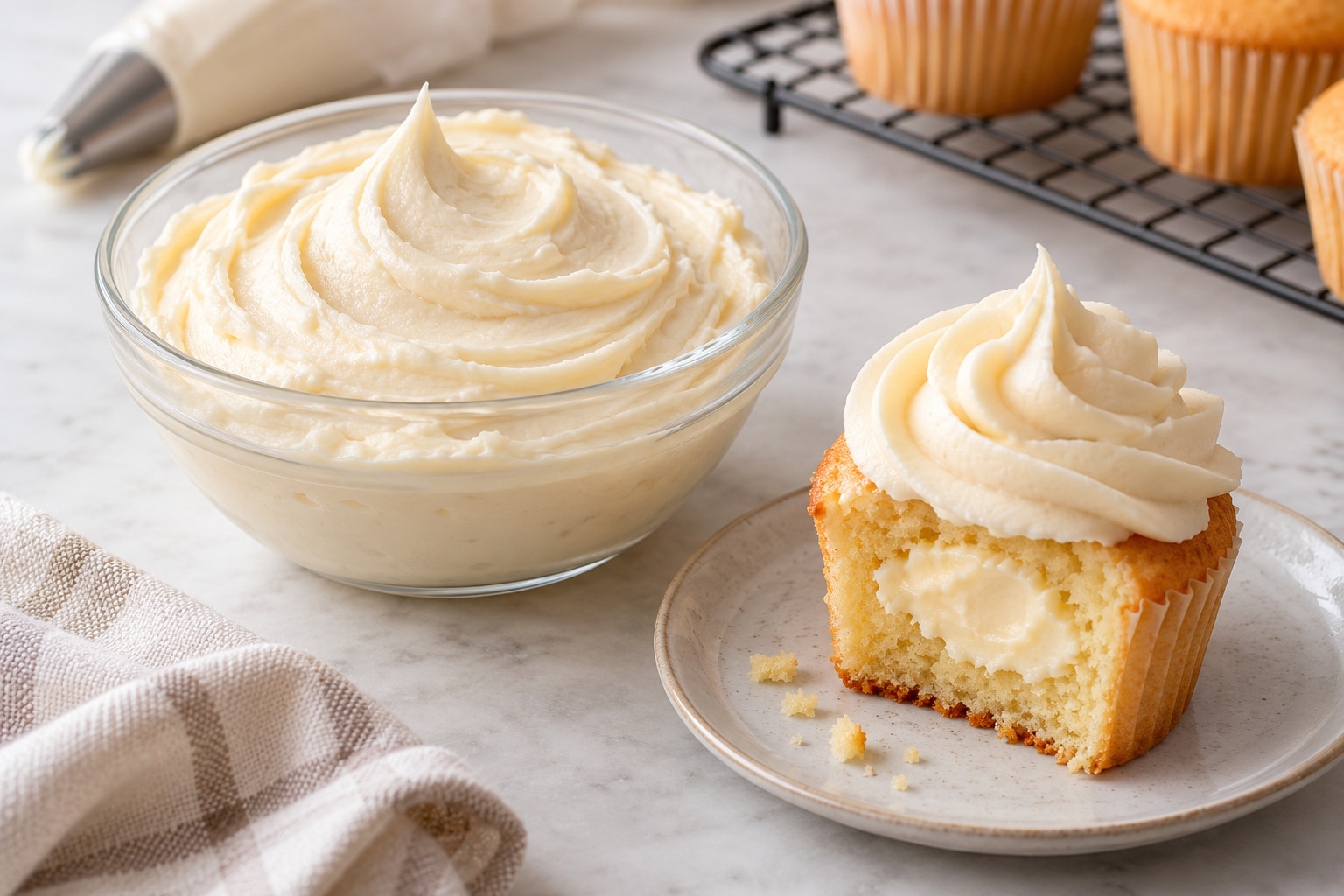
AI-generated application concept for filling and frosting flavoring.
Why a mismatched filling and frosting flavoring fails after bake, freeze, or display
A mismatched filling and frosting flavoring fails when the code is chosen for a cake name instead of a defined fat level, sugar solids, water activity, pH, and heat path. The pastry can still look correct. The flavor is already wrong.
American Buttercream is a high-sugar fat paste. Citrus esters flash in the bowl, then flatten in the fat. Chocolate Ganache locks those esters until the piece warms. Royal Icing is almost fat-free; ethanol thins it and slows the crust. Bake-Stable Fruit Filling is cooked near 90°C and baked near 180°C. Fresh strawberry at 20°C can read as jam or empty gel after the oven.
Cost is not only a rejected panel. Cream Cheese Frosting can weep into crumb. Lemon juice can split American Buttercream. A cotton-candy note that won on Day 0 can bloom in 28% fat by Day 7. Sandwich cream can taste of film after 30 days at 20°C. Frozen cake hides tops at 5°C.
Parent bakery flavors for B2B baked goods cover the wider bakery set. This page stays on filling and frosting matrices, formats, and tests.
What a developer must define before selecting filling and frosting flavoring
A developer must define the bakery system, fat, sugar solids, water activity, pH, heat path, package, serving temperature, label class, and forbidden notes before anyone recommends a filling and frosting flavoring code. “Strawberry cake frosting” is not a brief.

Flavor sample library in the LULIN laboratory
Write the system by name. The complete set used for first-round screening is American Buttercream, Swiss Meringue Buttercream, Italian Meringue Buttercream, Cream Cheese Frosting, Chocolate Ganache, Royal Icing, Rolled Fondant, Whipped Topping, Bake-Stable Fruit Filling, Custard Cream Filling, Fat-Based Sandwich Filling, and Nut Paste Filling.
| Application system | Continuous phase | Typical fat | Typical sugar solids | Heat path | First format to screen |
|---|---|---|---|---|---|
| American Buttercream | Fat–sugar paste | 18% | 60% | Cold finish at 20°C | Oil-Soluble Liquid |
| Swiss Meringue Buttercream | Fat plus cooked meringue | 24% | 48% | 70°C meringue, then 20°C | Oil-Soluble Liquid |
| Italian Meringue Buttercream | Fat plus hot syrup meringue | 24% | 48% | 115°C syrup, then 20°C | Oil-Soluble Liquid |
| Cream Cheese Frosting | Dairy-acid fat paste | 22% | 52% | Cold finish; serve at 5°C | Water-Dispersible Emulsion |
| Chocolate Ganache | Fat-continuous or emulsion | 35% | 28% | 45°C melt, 20°C set | Oil-Soluble Liquid |
| Royal Icing | Sugar–water–protein | 0% | 80% | Air-dry 24 h at 20°C | Water-Soluble Liquid |
| Rolled Fondant | Sugar paste | 8% | 75% | Ambient sheet at 20°C | Spray-Dried Powder |
| Whipped Topping | Aerated emulsion | 26% | 18% | Hold and serve at 5°C | Water-Dispersible Emulsion |
| Bake-Stable Fruit Filling | Water-continuous gel | 2% | 65% | 90°C cook, 180°C bake | Encapsulated Powder |
| Custard Cream Filling | Dairy–starch | 12% | 20% | 85°C cook; serve at 5°C | Water-Soluble Liquid |
| Fat-Based Sandwich Filling | Fat paste | 36% | 50% | Deposit at 36°C | Oil-Soluble Liquid |
| Nut Paste Filling | Oil–nut solids | 48% | 22% | Cold finish or 160°C bake | Oil-Soluble Liquid |
Those fat and sugar figures are first-screen controls. Replace them with the plant recipe before approval.
Good signal: the brief names one system from the table, a target serving temperature, and two exclusions such as “no soapy citral” or “no ethyl-maltol candy bloom.” Red flag: the brief says “cake and frosting flavors” and asks one liquid to cover crumb, filling, and icing.
Swiss Meringue Buttercream and Italian Meringue Buttercream see 70°C or a 115°C syrup before butter. Flavor added after the butter meets a cold fat paste. Write the addition point. Custard Cream Filling is a cook-up. Fat-Based Sandwich Filling is a deposit. Nut Paste Filling may still bake.
Rolled Fondant and Royal Icing punish extra juice or ethanol. Whipped Topping collapses if an oil flavor kills overrun. “More chocolate” in ganache is often a cocoa-solids problem.
Food flavor formulation support for B2B R&D is the next step when the addition point or carrier still has to be chosen.
How fat, sugar, water activity, and pH change filling and frosting flavoring
Fat, sugar solids, water activity, pH, and serving temperature change how filling and frosting flavoring is released, bound, or chemically aged. A winner in a 0% fat sugar icing can disappear in Chocolate Ganache and turn harsh in Cream Cheese Frosting.
| Matrix variable | Complete checkpoints | What the panel usually hears | Controlled comparison |
|---|---|---|---|
| Fat | 0%, 8%, 18%, 28%, 40% | Low fat: fast top. High fat: late citrus, longer candy or cocoa | Hold sugar and pH; change only fat |
| Sugar solids | 35%, 45%, 55%, 65%, 75% | Higher sugar rounds acid and can push fruit toward jam | Hold fat; change only sucrose or invert |
| Water activity at 25°C | 0.65, 0.72, 0.80, 0.88 | Higher aw speeds ester loss; lower aw can mute tops | Measure aw on the finished filling |
| pH | 3.2, 3.8, 4.6, 5.5, 6.8 | 3.2 brightens fruit and can split buttercream. 6.8 dulls citrus | Name the acid: Citric Acid, malic, or lactic |
| Service temperature | 5°C, 20°C, 40°C | 5°C hides esters. 40°C opens ganache and solvent | Score every code at the real eat temperature |
Royal Icing sits near 0% fat and 80% sugar. Citrus and berry notes leave the crust quickly. Culinary extract adds ethanol and slows drying. Lemon juice adds water and Citric Acid. The icing can stay tacky and taste of sour sugar. That is a set problem, not proof the bakery needs more extract.
American Buttercream at 18% fat and 60% sugar holds vanillin, cinnamon, and cotton-candy ethyl maltol. It buries a light strawberry ester. Cream Cheese Frosting at 5°C adds lactic tang. Cinnamaldehyde that felt warm at 20°C can read medicinal at 5°C. Judge Chocolate Ganache at 20°C after set, not as a 45°C fluid.
Bake-Stable Fruit Filling is a pectin or starch gel near 65% sugar solids and pH 3.2 to 3.8. Water activity near 0.80, a 90°C cook, and a later oven kill fresh esters and leave jam. Custard Cream Filling is 85°C cook and 5°C service. Overcooked dairy sulfur will mask a fruit top.
Change one variable at a time. Keep the flavor code, mixer, and package constant.
Which flavor formats should be screened for fillings and frostings?
The filling and frosting flavoring format must match continuous phase, appearance, heat path, and factory dosing. Liquid versus powder is not enough. Screen the complete set: Water-Soluble Liquid, Oil-Soluble Liquid, Water-Dispersible Emulsion, Spray-Dried Powder, Plated Powder, and Encapsulated Powder.
| Format option | Best starting systems | Main advantage | Main risk | Approval check |
|---|---|---|---|---|
| Water-Soluble Liquid | Royal Icing, Custard Cream Filling, fruit gel | Fast wet dosing | Weak oil notes; bake loss | Clarity, crusting, cook-off |
| Oil-Soluble Liquid | American Buttercream, Chocolate Ganache, Fat-Based Sandwich Filling, Nut Paste Filling | Direct fat-phase delivery | Haze in water gels; cocoa seizing | Viscosity at 36°C, bloom |
| Water-Dispersible Emulsion | Cream Cheese Frosting, Whipped Topping, Swiss or Italian meringue buttercreams | Oil notes in water-continuous icing | Overrun loss, ringing | 5°C hold, freeze-thaw |
| Spray-Dried Powder | Rolled Fondant, dry icing mix, cinnamon-roll frosting powder | Dry premix dosing | Caking, muted steam | Moisture, 10% w/w icing |
| Plated Powder | Fat-Based Sandwich Filling premix | Simple dry dosing | Segregation; weak 180°C protection | Blend uniformity |
| Encapsulated Powder | Bake-Stable Fruit Filling, baked Nut Paste Filling | Oven protection | Incomplete release | 180°C pastry-cup score |
Category-level flavor concentrates for food manufacturing explain the family. The powder versus liquid food flavor guide covers handling.
Juice, puree, jam, cocoa mass, and nut paste are food ingredients, not extra flavor formats. They change Brix, water, color, and set. Culinary ethanol extract is often used at 1.00% to 2.00% in home icing and sits outside the concentrate ladder. Screen a B2B concentrate at 0.05%, 0.10%, 0.15%, 0.20%, 0.25%, 0.30%, 0.40%, and 0.50% w/w. Use 0.40% w/w (4 g/kg) as the high-end reference benchmark. Treat 0.50% w/w as the bake-stable or high-fat outlier.
| Ingredient class | What it contributes | Typical use band | Why it is not a concentrate substitute |
|---|---|---|---|
| Concentrated filling and frosting flavoring | Aroma and taste through a declared carrier | 0.05% to 0.50% w/w; 0.40% w/w high-end screen | Designed for controlled sensory work |
| Culinary ethanol extract | Dilute volatiles plus solvent | 1.00% to 2.00% of extract in icing | Thins Royal Icing; dose is not comparable |
| Fruit juice | Water, Citric Acid, sugar, color | Recipe-dependent, often 2% to 8% | Changes pH, aw, and crusting |
| Puree or jam | Fruit solids, pectin, color, cooked aroma | 8% to 30% of a filling | Changes bake rheology and declaration |
Good signal: the supplier asks whether the system is Royal Icing, American Buttercream, or Bake-Stable Fruit Filling before sending a sample. Red flag: one Water-Soluble Liquid is offered as universal “frosting flavor” for ganache and bake-stable filling.
Encapsulated Powder is not a magic oven shield. It still needs a 180°C pastry-cup check. Plated Powder is a handling convenience. It is a poor bake-stable plan. Oil-Soluble Liquid in Royal Icing leaves specks or grease. Water-Soluble Liquid in Chocolate Ganache can bead and then vanish into the fat.
Which failure modes appear after processing, storage, or scale-up?
Filling and frosting flavoring fails after process when heat, oxygen, shear, water migration, or package aroma strips the intended top note and leaves solvent, candy, cooked sugar, or cardboard. The failure is usually visible in a short pilot.
| Pilot challenge | Reference condition | Likely drift | Diagnostic action |
|---|---|---|---|
| Mixer flash in buttercream | 8 min at 20°C, open bowl | Citrus esters gone; vanilla or cinnamon remains | Compare bowl aroma with 60 min icing |
| Meringue heat | 70°C Swiss or 115°C Italian syrup | Fresh fruit dies; cooked sugar remains | Add flavor before and after the heat step |
| Fruit-filling cook | 85°C for 8 min, 90°C for 10 min, 95°C for 12 min | Jam, empty gel, or browned pectin | Score hot filling and the 20°C gel |
| Pastry bake | 170°C for 12 min, 180°C for 15 min, 190°C for 18 min, 200°C for 22 min | Strawberry or lemon reads candy or nothing | Score cooled filling in the pastry |
| Ganache set | 45°C melt, 20°C for 4 h | Muted top; cocoa bitterness up | Taste at 20°C and 40°C |
| Royal Icing dry | 24 h at 20°C | Tacky crust from ethanol or juice | Measure dry time and surface tack |
| Cream-cheese hold | 5°C for 7 days | Cinnamon burn, weeping | Check emulsion and flavor together |
| Freeze-thaw cake | −18°C; 3 cycles; serve at 5°C | Ice damage, watery filling, lost top | Score frozen, thawed, and 5°C service |
| Packed sandwich cream | 30 days at 20°C | Film, cardboard, or oil rancidity | Age in the production wrap |
Citral and Limonene age. A lemon icing that was clean on Day 0 can taste of furniture polish by Day 30. Ethyl maltol in cotton-candy frosting can coat the mouth after a week in 28% fat. Cinnamaldehyde in cinnamon-roll frosting can rise as dairy notes fade.
Scale-up changes shear and time. A 1 kg bowl is not a 200 kg hopper. Fat-Based Sandwich Filling at 36°C can lose volatiles in a long jacket. Bake-Stable Fruit Filling cooked 12 min longer is a different product. Repeat the winning dose on the plant mixer, cooker, and depositor.
Physical failure stops the item. Weeping, split buttercream, collapsed Whipped Topping, oiling-off in ganache, or a Royal Icing that will not crust is an automatic reject.
How a filling and frosting sample test should use controls, coded samples, and acceptance criteria
A filling and frosting flavoring sample test should use one master base per system, blind three-digit codes, a complete dose ladder, process-matched controls, and a written 80/100 rule. Informal spoon tasting in the flavor bottle is not a test.
Run this protocol. Make one 5 kg master and divide it only after the base is uniform. Prepare a blank, the in-plant reference if one exists, and each candidate code twice. For a matched concentrate, test 0.05%, 0.10%, 0.15%, 0.20%, 0.25%, 0.30%, 0.40%, and 0.50% w/w. The high-end reference benchmark is 0.40% w/w (4 g/kg). Use 0.50% w/w only for Bake-Stable Fruit Filling, baked Nut Paste Filling, or a 36% to 40% fat sandwich cream. Process every sample the same way. Record mixer time, addition point, cook, bake, deposit temperature, pH, water activity at 25°C, and package. Serve 20 g at the intended temperature. Score 0 to 10. Repeat on Day 0, Day 7, and Day 30. For frozen cake, add 3 freeze-thaw cycles and a 5°C service score. Advance the lowest dose that reaches 80/100 without a physical or off-note failure, then confirm on the plant mixer.
| Application screen | Batch | Key matrix controls | Process challenge | Serving check | Dose ladder |
|---|---|---|---|---|---|
| American Buttercream | 1 kg | 18% fat; 60% sugar; pH 6.8 | 8 min mix at 20°C | 20°C | 0.05%, 0.10%, 0.15%, 0.20%, 0.25%, 0.30%, 0.40%, 0.50% |
| Cream Cheese Frosting | 1 kg | 22% fat; 52% sugar; pH 4.6 | 8 min mix; 7 days at 5°C | 5°C, 20°C | Same ladder |
| Royal Icing | 1 kg | 0% fat; 80% sugar; meringue powder | 24 h dry at 20°C | 20°C crust | Same ladder |
| Chocolate Ganache | 1 kg | 35% fat; 28% sugar | 45°C melt; 4 h at 20°C | 20°C, 40°C | Same ladder |
| Bake-Stable Fruit Filling | 1 kg | 2% fat; 65% sugar; pH 3.2 | 90°C for 10 min; 180°C for 15 min | 20°C cooled pastry | Same ladder |
| Fat-Based Sandwich Filling | 1 kg | 36% fat; 50% sugar | Deposit at 36°C; 30 days packed | 20°C | Same ladder |
Replace these laboratory bases with the real formula before approval. Buyers can request filling and frosting flavor samples for a controlled B2B trial after the system, process, and ladder are fixed.
| Advancement criterion | Weight | Passing evidence |
|---|---|---|
| Recognizable target identity | 20% | Strawberry, citrus, cinnamon, cocoa, or candy-floss remains after process |
| Match to the named system | 15% | Fits American Buttercream, Royal Icing, ganache, or bake-stable filling as written |
| Top-note retention | 15% | Required peel, berry, cinnamon, or dairy top survives the heat path |
| Body and sweetness integration | 10% | Flavor sits in the sugar-fat paste rather than floating as solvent |
| Clean finish and off-note control | 15% | No soapy citral, polish, popcorn diacetyl, medicinal cinnamon, or cardboard |
| Matrix and set integrity | 10% | No split, weep, tacky crust, collapsed overrun, or broken gel |
| Physical and package stability | 10% | Day 7 and Day 30 pass in the real wrap |
| Cost-in-use and supply fit | 5% | Approved dose produces an acceptable cost per 1,000 kg |
Advance at 80/100 or higher only when no automatic-rejection condition appears. Physical failure stops the item. Use ISO 13299:2016 for profile work and ISO 4120:2021 for difference testing after a process or package change.
A culinary extract can sit on the bench as an extra control. Do not place it on the 0.05% to 0.50% concentrate ladder. Record its actual icing inclusion, often near 1.00% or 2.00%, as a separate class.
What belongs in a filling and frosting flavoring RFQ before dosage is discussed
A filling and frosting flavoring RFQ should lock the bakery system, formula, process, format, market, documents, and supply plan before anyone argues about a starting dose. Dosage without a system is guesswork.
| RFQ field | Buyer input | Required supplier response |
|---|---|---|
| Sensory target | System name; top, middle, base; exclusions | Matching item code and sensory description |
| Formula | Fat %, sugar solids %, water activity, pH, acid type, color plan | Format, phase behavior, starting use guidance |
| Process | Addition point, cook, bake, deposit temperature, freeze-thaw, package | Process-fit guidance and trial cautions |
| Dose plan | 0.05%, 0.10%, 0.15%, 0.20%, 0.25%, 0.30%, 0.40%, 0.50% w/w ladder | Recommended range and item-specific ceiling |
| Destination market | United States or other country; intended declaration | Regulatory-status statement for the exact item |
| Quality files | TDS, SDS, COA, carrier, allergen, GMO, vegan, Halal, Kosher, origin, shelf life | Current item-level pack with issue dates |
| Supply plan | Sample quantity, first order, pack, destination, Incoterm | MOQ, price basis, pack sizes, lead time, capacity |
| Change control | Approved code, lot, critical sensory and physical fields | Notice for formula, carrier, site, or specification change |
For a United States project, request the 9-major-allergen statement, including sesame; the carrier can still matter. Ask for the exact item’s natural or artificial status under 21 CFR 101.22. A strawberry sketch does not settle classification. Keep the broad definition on what artificial flavor means for B2B food buyers. The food flavor compliance document request guide helps QA assemble one review pack.
FEMA GRAS numbers identify evaluated substances under intended flavor use. They do not approve a brand. Food and Drug Administration facility registration is not product approval. FSVP cooperation still belongs in the importer file.
LULIN FLAVOR is the English brand of QUANZHOU LVLIN BIOENGINEERING CO., LTD., a flavor manufacturer established in 2001 in Quanzhou, Fujian. The company operates 3 production lines with more than 50 employees, over 8000 m² building area, and more than 12 application engineers with over 20 years of flavor-development experience.
LULIN supplies Water-Soluble Liquid, Oil-Soluble Liquid, Water-Dispersible Emulsion, Spray-Dried Powder, and Plated Powder; Encapsulated Powder is scoped when bake protection is part of the brief. Technical responses issue within 2 days, matched samples dispatch within 5 days after brief acceptance, the standard MOQ is 25 kg per selected item, and production lead time is 10 days to 15 days after approval.
The ISO 9001 pack includes ISO 9001 and HACCP documentation plus the item’s TDS, SDS, COA, carrier, allergen, origin, storage, and destination-market files. Compare quotations on approved cost-in-use per 1,000 kg, remaining shelf life, freight, lead time, and change control. A low price per kilogram can still be an expensive 0.40% w/w frosting.
Red flags that disqualify a filling and frosting flavoring supplier
These filling and frosting flavoring red flags override an attractive aroma in the bottle.
- Sends one liquid for American Buttercream and Bake-Stable Fruit Filling without asking about fat, pH, or oven time. Phase and heat path are the product.
- Treats juice, puree, or culinary extract as a 1:1 stand-in for concentrated flavoring. Water, acid, and ethanol change set.
- Claims a bake-proof strawberry or lemon without a 180°C pastry-cup result. Bowl aroma is not oven evidence.
- Omits an item-specific 21 CFR 101.22 statement, SDS, or current-lot COA. A frosting SKU cannot be released on a catalog paragraph.
- Changes carrier, site, or assay without notice. Royal Icing crusting and ganache viscosity both move when the solvent moves.
- Cannot support a 25 kg first production pack or a 5-day matched sample after the brief is accepted. The trial dies in logistics.
- Scores samples only in water or sugar syrup. Filling and frosting are fat, sugar, and water-activity problems.
Frequently asked questions about filling and frosting flavoring
Is filling and frosting flavoring the same as bakery extract or fruit puree?
No. Filling and frosting flavoring is a concentrated aroma system screened at 0.05% to 0.50% w/w, while culinary extract is a dilute ethanol solution and puree contributes fruit solids, water, acid, and color. Compare classes in the finished icing because set and declaration differ.
What starting dose should be used for concentrated filling and frosting flavoring?
Use 0.40% w/w as the high-end reference benchmark for matched concentrated samples, alongside 0.05%, 0.10%, 0.15%, 0.20%, 0.25%, 0.30%, and 0.50% w/w. Optimize downward after the preferred item survives the real system and process; do not place juice, puree, or culinary extract on this concentrate ladder.
Which format belongs in American Buttercream versus Bake-Stable Fruit Filling?
American Buttercream usually starts with Oil-Soluble Liquid or Water-Dispersible Emulsion. Bake-Stable Fruit Filling usually starts with Encapsulated Powder or a cook-stable Water-Soluble Liquid. Confirm phase, 90°C cook, and 180°C bake before treating powder and liquid as interchangeable.
Can lemon juice replace concentrated flavoring in Royal Icing?
No. Lemon juice adds water and Citric Acid that slow crusting and can leave a sour-sugar icing, while concentrated flavoring changes aroma at 0.05% to 0.40% w/w without rebuilding the icing. Culinary lemon extract adds ethanol that can keep Royal Icing tacky. Keep juice, extract, and concentrate as separate trials.
Why does citrus frosting taste soapy or like furniture polish after storage?
Citral and related citrus notes oxidize in fat, light, and oxygen, so a clean Day 0 lemon or orange frosting can read soapy by Day 30. Age coded samples in the production package at 20°C and, when relevant, 40°C, then reject polish, cardboard, or solvent before raising dose.
How much strawberry extract should a developer use in frosting?
Do not convert a household extract teaspoon into a B2B concentrate dose. Screen matched strawberry concentrates at 0.05%, 0.10%, 0.15%, 0.20%, 0.25%, 0.30%, 0.40%, and 0.50% w/w in the real frosting, with 0.40% w/w as the high-end reference benchmark. Record any culinary extract near 1.00% or 2.00% as a separate control.
Does Encapsulated Powder always survive a 180°C bake?
No. Encapsulated Powder is the first bake-stable screen, not a guarantee, because release still depends on the capsule, filling aw, cook time, and pastry geometry. Compare kettle aroma with the cooled filling after 180°C for 15 min before approving the code.
What documents belong in a United States filling and frosting flavoring RFQ?
Request the TDS, SDS, current-lot COA, carrier statement, allergen and sesame statement, item-specific natural or artificial status, GRAS or regulatory statement, shelf life, storage, country of origin, change-control terms, MOQ, pack size, price basis, Incoterm, lead time, and FSVP cooperation information.
How should cotton candy or cinnamon-roll frosting flavoring be specified?
Name the system and the note that must stay in bounds. Cotton-candy frosting is an ethyl-maltol candy-floss direction on American Buttercream or Whipped Topping. Cinnamon-roll frosting is cinnamaldehyde on brown sugar with Cream Cheese Frosting or American Buttercream. Write “no soap,” “no medicinal cinnamon,” and “no popcorn diacetyl,” then screen that paste at 5°C and 20°C.
Can one flavor code cover filling and frosting in the same cake?
Rarely. Bake-Stable Fruit Filling sees 90°C cook and 180°C bake, while American Buttercream or Royal Icing is a cold finish with a different fat and sugar load. The same strawberry or lemon idea usually needs two item codes or two formats.
Send LULIN FLAVOR a filling and frosting flavoring brief
An application-matched filling and frosting flavoring brief should name the bakery system, forbidden notes, fat, sugar solids, water activity, pH, addition point, cook or bake path, package, serving temperature, market, documents, and sample quantity. Include the 0.05%, 0.10%, 0.15%, 0.20%, 0.25%, 0.30%, 0.40%, and 0.50% w/w plan, with 0.40% w/w as the high-end reference benchmark.
LULIN FLAVOR can prepare routes for American Buttercream, Cream Cheese Frosting, Royal Icing, Chocolate Ganache, Bake-Stable Fruit Filling, and Fat-Based Sandwich Filling. Use Contact LULIN FLAVOR for a filling and frosting project inquiry with the matrix, process, target market, and sample deadline.
Develop this flavor in your product
Send your product, target market and project goal. We will review the sample direction with you.