Published
Beef Flavoring
Beef flavoring is a concentrated savory system built to deliver a defined beef direction, such as seared steak, roasted meat, braised stock, or grilled fat, inside a specific food matrix. Commercial products have no standardized dose ladder; screen compatible formats at 0.10%, 0.30%, and 0.50% w/w, using 0.50% w/w (5 g/kg) as the high-end reference benchmark.
Last updated: August 31, 2026
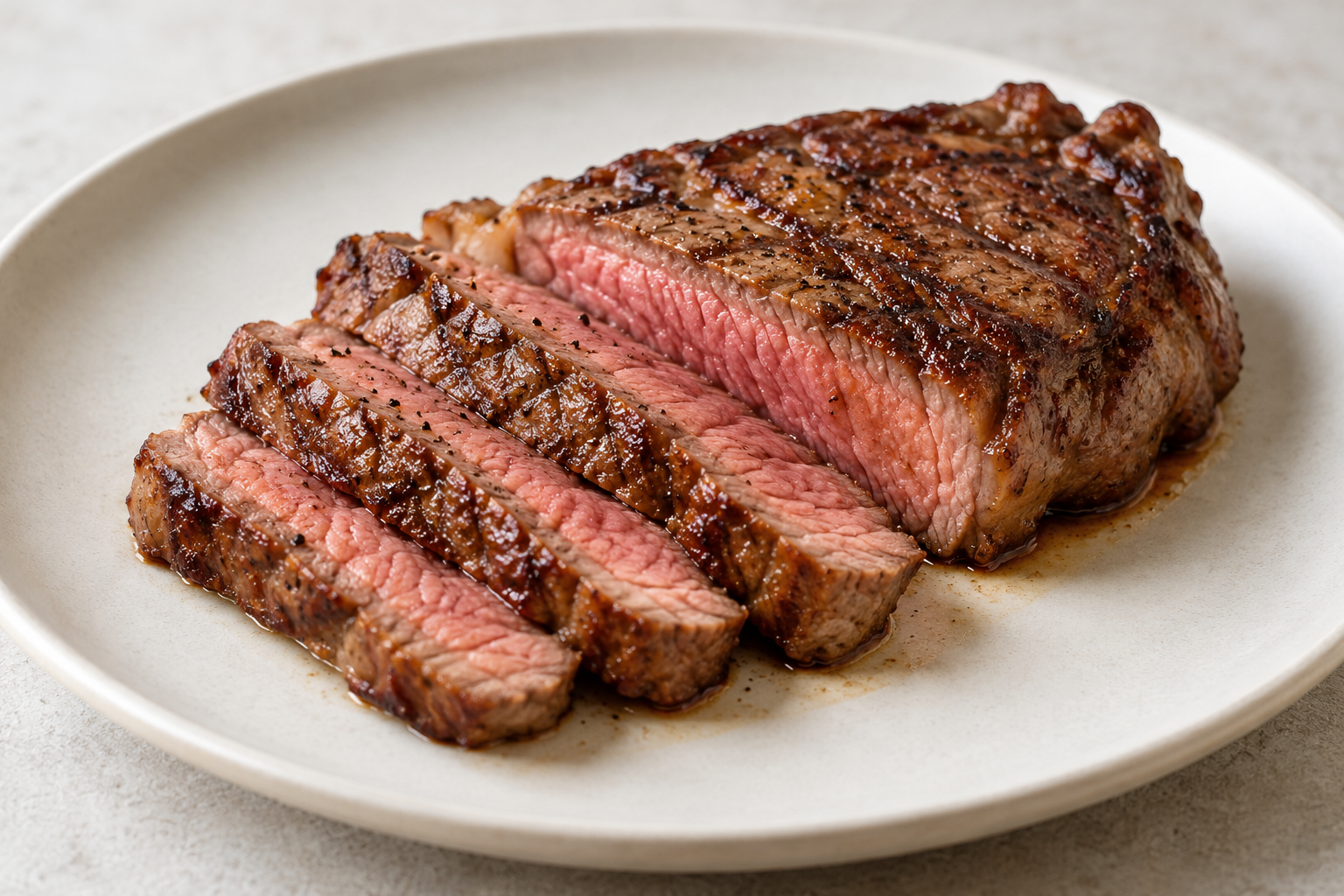
Beef: a sensory reference for defining the target flavor profile.
What does beef flavoring mean in a food-manufacturing brief?
Beef flavoring means a flavor system selected to create or reinforce a recognizable beef sensory profile in a finished food; the name alone does not identify its raw-material source, legal label declaration, carrier, solubility, or process tolerance. A commercial brief therefore needs two descriptions: what the product should taste like and what the supplied flavor must do in production.
The sensory side may point toward rare-seared steak, grilled burger, oven roast, pan drippings, braised beef, marrow-rich stock, cured beef, or a plant-based beef analogue. Those are different targets. A sharp seared top note can read thin in gravy; a dark braised base can make a snack coating taste burnt.
The technical side defines application, phase, carrier limits, addition point, time-temperature history, storage, market, and label position. It also separates flavoring from beef stock, beef extract, hydrolyzed protein, yeast extract, smoke flavor, spices, salt, monosodium glutamate, and nucleotide taste enhancers. These materials may work together, but they perform different jobs.
The broader Flavor Concentrates for Food Manufacturing page covers category selection. This profile page owns the narrower decision: how to define, format, process, and evaluate beef character. The related guide to what artificial flavor means in food owns the general natural-versus-artificial definition, so that topic is addressed here only where it changes a beef-flavor RFQ or claim.
How should a beef flavor profile be described without vague sensory adjectives?
A beef flavor profile should be described as a timed sequence of identifiable cues, not as “rich,” “authentic,” or “premium.” Specify the opening aroma, the cooked-meat body, the taste foundation, the finish, and the notes that must stay below rejection level.

Flavor sample library in the LULIN laboratory
| Sensory Layer | Precise Direction Options | Control Function | Failure Signals |
|---|---|---|---|
| Top Note, First 0–5 Seconds | Pan-Seared Crust, Grilled Char, Roasted Onion, Black Pepper, Light Smoke, Browned Butter, Fresh Cooked Meat | Immediate Beef Identity | Solventy Lift, Acrid Smoke, Burnt Onion, Sulfur Spike |
| Middle Layer, About 5–20 Seconds | Roast Beef, Grilled Burger, Braised Muscle, Pan Drippings, Fatty Tallow, Bone Marrow, Caramelized Allium | Main Beef Recognition | Generic Bouillon, Fatty Coating, Liver-Like Tone, Soy-Like Drift |
| Base Taste And Body | Beef Broth, Savory Umami, Salt-Linked Savoriness, Slow-Cooked Stock, Gelatinous Depth, Kokumi-Style Continuity | Weight And Mouthfulness | Flat Finish, Salt Dependence, Yeast Dominance, Bitter Hydrolysate |
| Finish After Swallowing | Clean Roasted Persistence, Stock Tail, Pepper Warmth, Light Smoke, Fatty Linger | Duration And Signature | Metallic Tail, Stale Fat, Lingering Sulfur, Drying Bitterness |
| Exclusion List | No Liver, No Blood Or Iron, No Cured Note, No Smoke, No Sweetness, No Onion, No Animal-Derived Material | Wrong-Sample Prevention | Attractive Sample, Wrong Beef Direction |
Top notes are the easiest to lose during retort, baking, extrusion, frying, hot fill, or open-kettle holding. Middle notes establish grilled steak, burger, roast, or braise. Base notes carry through starch, protein, and salt, but excess base turns a clear profile into generic soup seasoning.
Cooked-meat character often draws on Maillard Reaction products, lipid-derived notes, sulfur-containing volatiles, pyrazines, aldehydes, and taste-active materials. Chemistry is a design vocabulary, not a shopping list. Send a target such as “fast seared crust, medium roast-beef body, low smoke, no liver, clean 20-second finish,” paired with the real base and process, when requesting Food Flavor Formulation Support.
How do water, fat, protein, sugar, salt, acid, and serving temperature change beef flavor perception?
Water, fat, protein, sugar, salt, acid, and serving temperature change both aroma release and sensory interpretation, so a beef flavor judged in plain water cannot predict performance in a sauce, extruded snack, protein powder, or plant-based patty. The same sample can open quickly in one matrix and feel muted, sweeter, harsher, or longer-lasting in another.
| Matrix Variable | Typical Perception Shift | Controlled Comparison | Diagnostic Adjustment |
|---|---|---|---|
| Water And Solids | Dilution Lowers Impact; Higher Viscosity Mutes Opening Aroma | Total Water, Starch Level, Gum Level, Final Viscosity | Matched Solids And Serving Dilution |
| Fat And Oil | Lipophilic Notes Enter Fat; Opening Softens While Finish Extends | Fat Type, Fat Percentage, Emulsion State, Droplet Size | Intended Fat Phase And Lower-Fat Stress Base |
| Protein Matrix | Aroma Binding Plus Pea, Soy, Whey, Or Meat Odors | Protein Source, Concentration, Hydration, Shear | Full Protein Hydration And Heat Treatment |
| Sugar And Reducing Sugars | Sweetness Softens Roast Bitterness; Heating Adds Browned Notes | Sugar Type, Reducing-Sugar Content, Thermal Load | Flavor Impact Versus Process Browning |
| Salt System | Savoriness Support And Compound-Specific Volatile Release | Sodium Chloride, Potassium Salts, MSG, Yeast Extract, Nucleotides | Final Sodium System Before Ranking |
| Acid And pH | Sharper Profile, Thinner Broth Cues, Exposed Metallic Notes | Acid Type, Target pH, Titratable Acidity, Buffer System | Target pH After Full Hold Time |
| Serving Temperature | Warm Service Increases Volatile Release; Chilling Mutes Opening Aroma | Evaluation Temperature, Hold Time | Factory Release And Consumer-Use Temperatures |
Aroma-release research explains the variation. Lipids alter phase partitioning, proteins bind some odorants, viscosity changes diffusion, salt produces compound-specific salting-out effects, and temperature changes vapor release. Compare in the finished matrix. Plain water is not enough.
Complete protein hydration first. Establish emulsion droplet size and shear before ranking. Lock a reduced-sodium system before sample selection, and evaluate sweet-savory glaze after thermal concentration because sugar, water loss, and browning move together.
Which beef flavoring format should a manufacturer test?
A manufacturer should test the format that matches the addition point and continuous phase, while keeping one alternate when heat loss, dry handling, or separation is credible. Physical form and phase compatibility are different axes; the complete practical set for this brief is water-soluble liquid, oil-soluble liquid, emulsion, water-dispersible powder, and dry-blend powder.
| Format Option | Best Application Fit | Main Advantage | Main Risk | Factory Question |
|---|---|---|---|---|
| Water-Soluble Liquid | Broths, Soups, Gravies, Sauces, Wet Protein Slurries | Fast Water-Phase Dosing | Volatile Loss, Carrier Limits, Haze | Can Late Addition Avoid Full Heat? |
| Oil-Soluble Liquid | Seasoning Oils, Fat Fillings, Fried Coatings, Oil-Based Marinades | Direct Lipid-Phase Delivery | Uneven Dilution, Weak Low-Fat Impact | Where Is Oil Formed And Metered? |
| Flavor Emulsion | Mixed-Phase Sauces, Dressings, Fillings, Spray Systems | Oil-Affine Notes In Aqueous Systems | Shear Break, Ring Formation, Storage Separation | Which Shear And Droplet Limits Apply? |
| Water-Dispersible Powder | Instant Soups, Powdered Gravies, Protein Powders, Reconstituted Meals | Dry Handling With Planned Water Release | Caking, Carrier Taste, Delayed Aroma | Which Water Activity And Particle Limits Apply? |
| Dry-Blend Powder | Snack Seasonings, Bouillon Blends, Noodles, Dry Rubs, Premixes | Ribbon Blending And Surface Seasoning | Segregation, Dust, Adhesion Loss, Oxidation | Is Flavor Preblended, Oil-Plated, Or Added Neat? |
These are manufacturing routes, not quality grades. Spray drying or encapsulation changes protection and release; it does not create a universal phase. Paste handling still resolves to a water-continuous, oil-continuous, or dispersed system.
The Powder Versus Liquid Format Guide compares dosing, dust, pumping, moisture, and cleaning. For beef-flavored protein powder, test carrier taste, flow, reconstitution, protein masking, sodium balance, and aroma at actual consumption temperature.
What processing and storage conditions can shift an intended roasted-beef profile?
Heat history, addition point, shear, oxygen, light, moisture, packaging, and storage time can shift a roasted-beef profile even when the flavor code and dosage stay unchanged. Process validation must compare the untreated base, the post-process product, and the stored product under matched tasting conditions.
| Process Or Storage Condition | Likely Profile Movement | Minimum Comparison |
|---|---|---|
| Retort Or Pressure Cooking | Lost Top Notes; Stronger Cooked, Sulfurous, Or Brothy Character | Pre-Retort, Post-Retort After 24 h, End-Of-Shelf-Life Sample |
| Pasteurization, Hot Fill, Open-Kettle Hold | Progressive Loss Of Seared Volatiles | Shortest And Longest Validated Hold At One Fill Temperature |
| Extrusion, Baking, Frying | Aroma Loss Plus Toasted Cereal, Oxidized Fat, Or Maillard Cues | Unprocessed Premix And Cooled Finished Product |
| High-Shear Emulsification | Changed Droplet Structure And Volatile Partitioning | Low-Shear Bench Control And Factory-Equivalent Shear |
| Late Topical Application | Stronger Opening, Greater Headspace Oxidation | Day 1, Day 30, Intended Shelf-Life Condition |
| Oxygen Or Light Exposure | Faded Top Notes, Stale Fat, Package Scalping | Intended Package And Oxygen-Light Stress Package |
| Moisture Pickup In Powders | Caking, Slow Dispersion, Local Concentration | Initial Water Activity And Controlled Humidity Stress |
| Freeze-Thaw Cycling | Phase Separation, Texture Change, Altered Release | Fresh Control And Required Complete Cycles |
No generic “heat-stable” label replaces an application test. Record peak temperature, hold time, pressure, addition point, cooling rate, exposed area, and package headspace. Survival at 90°C for 30 seconds in a closed exchanger does not prove suitability for 121°C retort or a 170°C extrusion zone.
Track Seared Top Note, Roast Body, Fatty Character, Sulfur, Smoke, Salt-Linked Savoriness, Bitterness, Metallic Finish, and Overall Beef Identity at defined dates. A pass requires profile retention, not merely visual stability.
How should buyers compare beef flavor samples in the real application base?
Buyers should compare coded beef flavor samples in one locked base, through the real process, at the intended serving temperature. Public product guidance spans continuous, item-specific levels rather than fixed industry steps, so use a blank plus a 0.10%, 0.30%, and 0.50% w/w laboratory grid; treat 0.50% w/w as the high-end reference benchmark, not a supplier guarantee.
Use A Four-Point, 1 kg Screening Grid
| Sample Code | Flavor Concentration | Flavor Mass For A 1 kg Batch | Screening Purpose |
|---|---|---|---|
| B000 | 0.00% w/w | 0.0 g | Base Control |
| B010 | 0.10% w/w | 1.0 g | Entry-Level Impact And Off-Note Check |
| B030 | 0.30% w/w | 3.0 g | Core-Profile Screening Point |
| B050 | 0.50% w/w | 5.0 g | High-End Reference Benchmark And Overload Check |
These are evaluation points, not commercial dosage options. Potency, carrier load, application, regulation, and companion savory ingredients move the final level. The 0.50% w/w point exposes profile shape, bitterness, carrier taste, smoke, sulfur, or fatty overload; a winning sample may finish lower.
Prepare 2 independent 1 kg batches for each finalist. Keep ingredient lot, hydration, mixing order, shear, fill weight, process time, cooling, package, storage, and tasting temperature identical. Randomize three-digit codes and balance presentation order. Test the product, not the concentrate.
Score Beef Identity, Not Simple Strength
Use a 0–5 scale with fixed anchors: 0 absent, 1 trace, 2 weak, 3 target, 4 strong, 5 excessive. Score Seared Top Note, Roast-Beef Body, Fatty Character, Broth Depth, Smoke, Sulfur, Salt-Linked Savoriness, Bitterness, Metallic Finish, 20-second persistence, and Overall Target Match. Strength cannot rescue the wrong shape.
Run the scorecard after processing, after 24 h of equilibration, and at shelf-life checkpoints. Record Dispersion, Dust, Caking, Pumpability, Emulsion Stability, Appearance, Package Odor, and Line Cleanup separately. The B2B Food Flavor Sample Request should carry the base, process, grid, scorecard, and rejection notes.
Which supplier facts and destination-market details belong in a beef flavoring RFQ?
A beef flavoring RFQ should connect the approved sensory sample to one item code, one application, one destination market, and one commercial plan. Asking only for “natural beef flavor powder price” leaves the supplier unable to align format, documents, packing, use guidance, or shipment terms.
| RFQ Field | Direct Information To Provide Or Request | Decision Effect |
|---|---|---|
| Finished Application | Soup, Gravy, Snack Coating, Noodle Seasoning, Plant-Based Meat, Protein Powder, Marinade, Prepared Meal | Matrix And Process Context |
| Sensory Target | Top Note, Middle Body, Base Taste, Finish, Benchmark, Exclusions | Prevents Generic Beef Matching |
| Formula Context | Water, Fat, Protein, Sugar, Salt, Acid, Color, Taste Enhancers | Reveals Interactions And Restrictions |
| Manufacturing Process | Addition Point, Mixing, Peak Temperature, Hold Time, Pressure, Shear, Drying, Frying, Extrusion | Screens Process Compatibility |
| Flavor Format | Water-Soluble Liquid, Oil-Soluble Liquid, Flavor Emulsion, Water-Dispersible Powder, Dry-Blend Powder | Aligns Phase And Handling |
| Approved Trial | Item Code, Lot, 0.10%, 0.30%, 0.50% w/w Results, Tasting Dates, Winning Level | Sample-To-Order Traceability |
| Market And Claims | Destination Country, Label Language, Natural Or Artificial Position, Vegan Or Vegetarian, Halal, Kosher, Non-GMO, Allergens | Defines Composition Constraints |
| Technical Documents | Product Specification, TDS, COA Format, SDS, Ingredient Declaration, Allergen Statement, Use Guidance, Shelf Life, Storage | Supports Quality Assurance |
| Certification Scope | Certificate Owner, Issuing Body, Facility Or Product Scope, Validity Date, Item Coverage | Prevents False Certificate Extension |
| Commercial Facts | Sample Terms, MOQ, Price Basis, Package Size, Production Lead Time, Incoterm, Payment Term, Annual Forecast | Enables Comparable Quotations |
| Destination Support | Export Documents, Importer Needs, Pallet Rules, Freight Mode, Customs Description, Target Arrival Date | Reduces Shipment Delays |
| Change Control | Formula, Carrier, Plant, Specification, Allergen, Document, Packaging Notifications | Protects Approved Sensory Position |
The Food Flavor Compliance Document Guide helps Quality Assurance teams name exact files and scope. Compare cost in use at the approved concentration, including yield loss, handling, freight, package waste, and companion ingredients. Cheap material that needs more dosage or fails processing costs more.
Are natural, vegan, vegetarian, and Halal beef flavoring the same thing?
Natural, vegan, vegetarian, and Halal are separate determinations; none follows from the words “beef flavoring.” In the United States, 21 CFR 101.22 defines Natural Flavor by permitted source categories and flavoring function, while Artificial Flavor covers flavoring substances outside those categories.
A natural beef-type flavor may contain animal-derived material or may build beef character from plant, yeast, fermentation, or other permitted natural sources. Artificial classification does not prove vegan suitability. Halal status also depends on source, slaughter status where applicable, alcohol or solvent handling, carriers, processing aids, cross-contact controls, certificate scope, and importing-market acceptance.
| Jurisdiction Or Claim | Reference Point | Buyer Action |
|---|---|---|
| United States FDA Food | Food And Drug Administration; 21 CFR 101.22; 9 Major Food Allergen Sources | Confirm Flavor Designation, Allergen Sources, Carriers, Processing Aids, Protein Hydrolysate Names |
| United States USDA Meat Or Poultry | Food Safety And Inspection Service; 9 CFR Parts 317 And 381 | Request End-Use Labeling Guidance For Species-Specific Stocks, Extracts, Hydrolysates, Reaction Ingredients |
| European Union | European Commission Regulation (EC) No 1334/2008; 95% w/w Named-Source Rule; 14 Allergen Categories | Review European Natural-Flavouring Wording And Annex II Allergens Separately |
| Vegan Or Vegetarian | International Organization For Standardization; ISO 23662:2021 As A Voluntary Reference | Obtain Product-Specific Source, Carrier, Processing-Aid, And Conformity Statements |
| Halal Market | Codex Alimentarius CXG 24-1997 Plus Accepted Certifier Requirements | Check Product And Plant Scope, Validity, Shared-Line Controls, Import-Market Acceptance |
United States flavor ingredients still trigger allergen-source labeling when they contain protein from milk, egg, fish, Crustacean shellfish, tree nuts, wheat, peanuts, soybeans, or sesame. For USDA-regulated meat and poultry, the Food Safety and Inspection Service applies separate ingredient rules; beef stock, meat extract, and hydrolyzed protein cannot simply disappear under a generic flavor declaration.
Where does beef flavoring create the clearest formulation value?
Beef flavoring creates the clearest value where a defined cooked-beef identity must survive a demanding matrix or raw-material variation. Format and profile differ by application.
- Soups, Broths, And Gravies: build Roast Beef or Braised Beef identity without making salt and yeast extract carry the profile. Judge after dilution, hot holding, and service.
- Instant Noodles And Dry Meals: coordinate Powder Flow, Sachet Blending, Reconstitution, Broth Color, and Top-Note Release in the complete seasoning system.
- Snack And Surface Seasonings: balance Dry-Blend Powder with Oil Adhesion, Salt, Acid, Smoke, and Thermal History. Assess package headspace at Day 1 and later storage points.
- Sauces, Marinades, And Prepared Meals: choose Seared Beef, Grilled Beef, Pan Drippings, Roast Beef, or Braised Beef. Test pH, fat phase, pasteurization, freeze-thaw exposure, and reheating.
- Plant-Based Meat And Savory Protein Powders: mask Pea Protein or Soy Protein notes while retaining Beef Identity. Hydration, extrusion, fat, color, iron-like notes, and serving temperature can change the result.
Keep format tied to the factory: Dry-Blend Powder for powder handling, Water-Soluble Liquid for aqueous dosing, Oil-Soluble Liquid for fat phases, Flavor Emulsion for mixed systems, and Water-Dispersible Powder for dry storage followed by wet preparation.
Build a sample-ready beef flavor brief with LULIN FLAVOR
LULIN FLAVOR develops and supplies food-grade flavors through QUANZHOU LVLIN BIOENGINEERING CO., LTD., a Quanzhou, Fujian manufacturer established in 2001. Beef-flavor projects can use powder or liquid samples, application review, profile adjustment, document preparation, and commercial RFQ discussion.
Send Finished Application, Formula Context, Top-Middle-Base Profile, Exclusions, Process Conditions, Intended Format, Destination Market, Label Position, Document List, Trial Quantity, First-Order Estimate, and Target Schedule. A reference product helps only when its desired sensory cues are named. LULIN FLAVOR can then select a sample route and align item information with the project.
Use the LULIN FLAVOR Manufacturer Overview for company context, then Contact The Project Team with the application base, process, target market, and required sample timing.
Frequently asked questions about beef flavoring
Beef flavoring buyers most often need direct answers about composition, claims, format, processing, use level, and documents before approving a sample.
What Is Beef Flavoring Made From?
Beef flavoring can combine Aroma Materials, Reaction Flavors, Extracts, Distillates, Protein Hydrolysates, Yeast-Derived Materials, Spices, Taste Components, Carriers, Solvents, Emulsifiers, or Encapsulating Materials. Composition follows the sensory target, format, label position, and market. Request declaration information for the specific item; its name does not reveal the formula.
Does Natural Beef Flavor Always Contain Beef?
No. Under United States rules, Natural Flavor describes permitted source categories and a flavoring function; it does not state that the material came from beef. A Natural Beef-Type Profile may contain beef-derived material or other permitted natural sources. Confirm the Product Source Statement and label wording for the exact item.
Is Natural Beef Flavor Vegan Or Vegetarian?
Not automatically. Natural Flavor may come from plant, yeast, fermentation, dairy, egg, seafood, poultry, meat, or other permitted sources. Vegan Or Vegetarian suitability requires item-level review of Flavor Ingredients, Carriers, Processing Aids, and the customer standard. “Natural” is not a vegan claim.
Is Artificial Beef Flavor Vegan Or Vegetarian?
Artificial beef flavor can be vegan or vegetarian, but Artificial Classification proves neither status. Review Flavoring Components, Carriers, Solvents, Processing Aids, and Manufacturing Controls against the buyer’s definition. Obtain a Product-Specific Conformity Statement before making a finished-product claim.
Is Beef Flavoring Halal?
Beef flavoring is Halal only when the exact item meets applicable ingredient, processing, handling, and certification requirements. Review Animal Source, Slaughter Status, Alcohol Or Solvent Use, Carriers, Processing Aids, Cross-Contact, Facility Scope, Issuing Body, Validity Date, and Destination-Market Acceptance. Product naming cannot replace certification review.
Which Beef Flavoring Format Best Fits A Dry Seasoning?
A Dry-Blend Powder usually offers the simplest route for seasoning blends; a Water-Dispersible Powder fits products reconstituted into broth or sauce. Compare Powder Flow, Dust, Segregation, Adhesion, Carrier Taste, Oxidation, and Package-Headspace Aroma. An Oil-Soluble Liquid may win when seasoning is applied through an oil slurry.
What Beef Flavoring Use Level Should A First Lab Screen Test?
Use 0.50% w/w, or 5 g/kg, as the high-end reference benchmark, paired with 0.10% and 0.30% w/w points plus a 0.00% blank. This Laboratory Screening Grid reveals profile shape and overload; it is not a commercial dose standard. Final level follows supplier guidance, regulation, matrix, process, and sensory results.
Can Beef Flavoring Survive Retort, Baking, Frying, Or Extrusion?
Some beef flavor systems are designed for severe heat, but suitability must be shown in the actual process. Compare Pre-Process, Post-Process, and Stored Samples while recording Peak Temperature, Residence Time, Pressure, Moisture, Addition Point, Cooling, and Packaging. A generic Heat-Stability Statement cannot predict every retort, oven, fryer, or extruder.
What Documents Should Accompany A Beef Flavoring Sample?
A sample should carry a Unique Item Code, Lot Identification, Flavor Format, Use Guidance, Storage Information, and stage-appropriate documents. Typical requests include Product Specification or TDS, COA Format, SDS, Allergen Statement, Ingredient Declaration, Natural Or Artificial Status, and applicable Halal, Kosher, Vegan, Non-GMO, or destination-market files.
Develop this flavor in your product
Send your product, target market and project goal. We will review the sample direction with you.