Published
Bubble Tea And Boba Flavoring
Bubble tea and boba flavoring should be selected against the finished drink, not by flavor name alone. Define the tea or dairy base, process, service dilution, topping, and shelf life before screening nine formats. For clear fruit tea made with sweetened syrup, use a 1:5 syrup-to-diluent ratio, or 16.7% syrup, as the high-end design benchmark.
Last updated: 2026-08-31
This guide covers cups, concentrates, powder mixes, and packaged drinks. Beverage flavors for B2B drink development remains the category owner; bubble gum flavoring for candy-style profiles handles a different intent. Here, boba means tea beverages plus tapioca, popping-boba, or jelly inclusions.
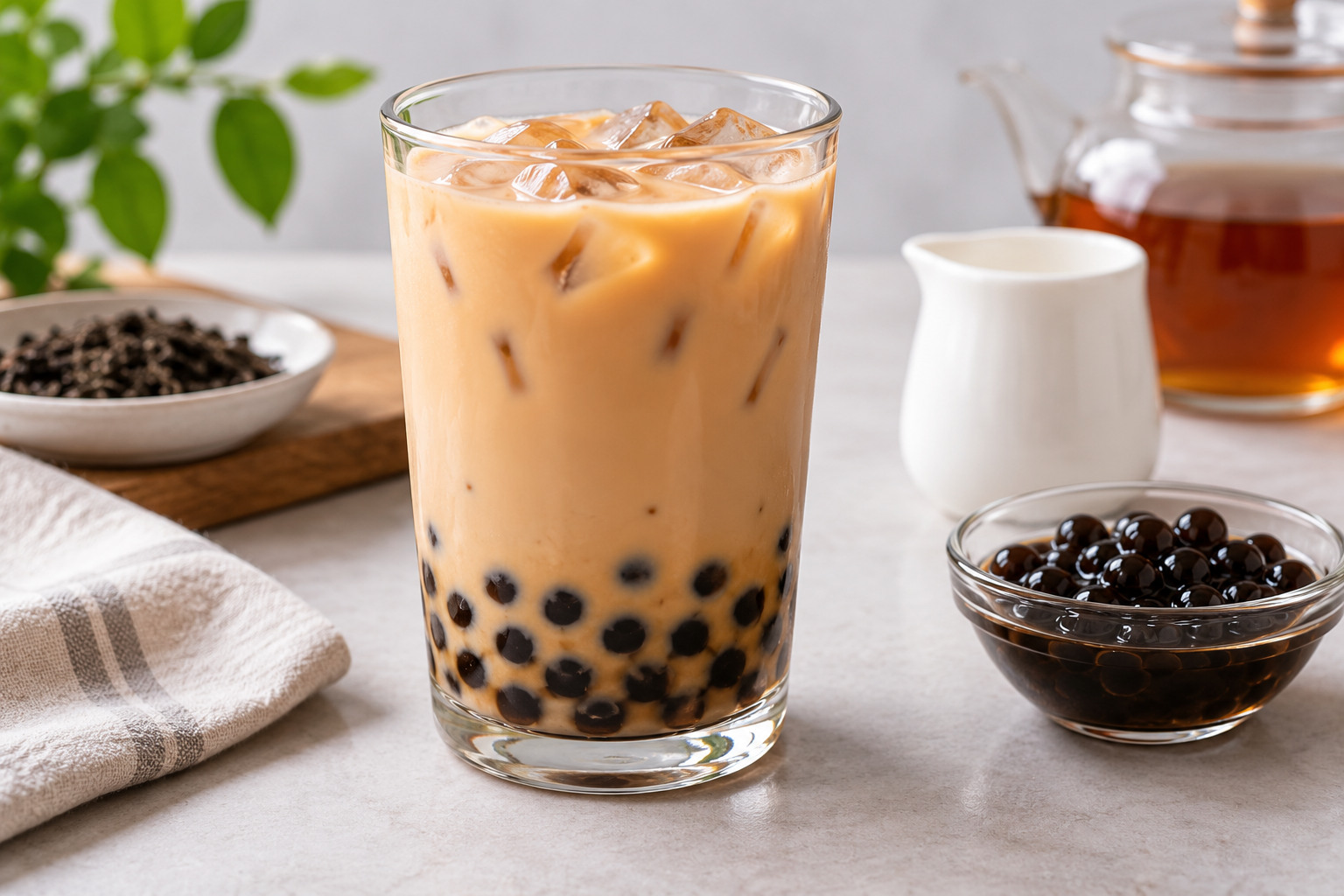
AI-generated application concept for bubble tea and boba flavoring.
What must a developer define before choosing flavoring for bubble tea and boba?
A developer must define the complete product system first. “Mango” could mean fruit tea, milk tea, 1:5 syrup, powder, RTD, or topping; each needs a different format test.
The model sets the test.
| Product model | Base and process to define | Serving or package condition | Flavor decision that follows |
|---|---|---|---|
| Made-to-Order Milk Tea | Brewed tea or extract, dairy/creamer/plant base, sweetener, cold or hot assembly | Ice level, cup size, straw, 0–30 minute hold | Cold-release profile that survives dilution and remains distinct beside milk and tea |
| Made-to-Order Fruit Tea | Tea strength, acid system, juice/purée, syrup, shaking sequence | Ice melt, fruit pieces, 4–8 °C service | Water-soluble or emulsified direction with controlled haze and a clean acid finish |
| Foodservice Syrup or Concentrate | Dilution water, tea addition, pump or pour dosing, preservative system | Open-bottle handling and outlet consistency | Reproducible dilution, pourability, flavor strength, and cost per serving |
| Instant Flavored Powder | Sugar, creamer, tea solids, carrier, anticaking system, dry blending | Reconstitution temperature, water volume, package humidity | Powder wetting, aroma release, caking resistance, and uniformity across the blend |
| Refrigerated or Ambient RTD | Full formula, homogenization, pasteurization, hot fill, UHT/aseptic, or retort | PET, glass, can, light and oxygen exposure, target shelf life | Heat survival, physical stability, package compatibility, and retained aroma |
| Tapioca Pearls, Popping Boba, or Jelly | Inclusion syrup, cook/soak step, pH, color, solids, hold time | Dose per cup and contact time with the drink | Separate flavor and migration test; beverage approval does not approve the topping |
Record tea solids, dairy or plant composition, Brix, pH, target, topping, process, dilution, package, shelf life, and market. Context precedes price.
How do tea, milk, sweeteners, toppings, and ice change bubble tea flavor choice?
Tea, dairy, sweeteners, toppings, and ice change flavor release. Cold changes aroma. Water-only strips mislead.
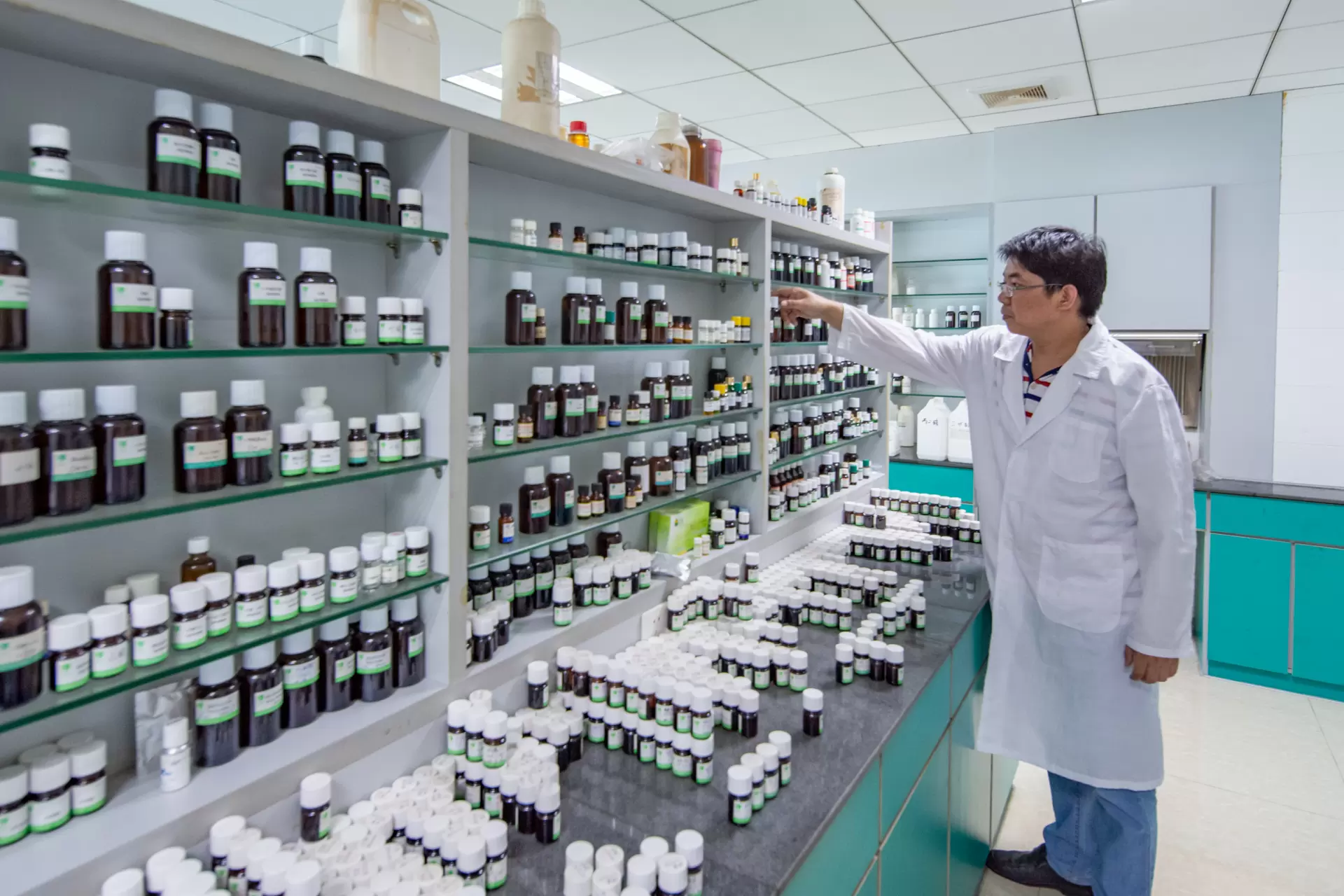
Flavor sample library in the LULIN laboratory
| Matrix variable | What it does to perception or stability | Selection response |
|---|---|---|
| Black Tea or Roasted Oolong | Tannins add dryness; roasted notes can absorb delicate fruit tops | Use a stronger middle note, then check whether the finish remains tea-led rather than candy-like |
| Green, Jasmine, or Light Oolong Tea | Floral and grassy notes expose harsh peel, solvent-like tops, or excessive sweetness | Screen cleaner fruit and floral directions at the actual brew strength and hold time |
| Dairy, Non-Dairy Creamer, or Coconut Base | Fat rounds sharp notes; protein and emulsifiers can mute aroma or alter cloud | Compare flavor before and after homogenization or full mixing, not in tea alone |
| Oat, Soy, Almond, or Pea Base | Grain, bean, nut, or protein notes can remain after sweetening | Include an unflavored plant-base control and score masking separately from flavor identity |
| Sucrose, Fructose, or High-Intensity Sweetener | Sweetness increases fruit body; some intense sweeteners leave a metallic or lingering tail | Lock the sweetener and Brix before choosing the flavor dose |
| Fruit Acid, Juice, or Purée | Acid sharpens aroma while pulp and juice solids add body, haze, and native flavor | Test pH, acid type, and fruit solids as formulation variables, not as post-selection adjustments |
| Brown-Sugar Syrup, Tapioca Pearls, Popping Boba, or Jelly | Toppings add caramel, fruit, color, acid, sweetness, and dilution during the drinking sequence | Taste the plain beverage and the complete cup; approve each inclusion under its own hold condition |
| Ice and Cold Service | Cold suppresses aroma, then meltwater reduces tea, sweetness, and flavor together | Score at 4–8 °C, repeat after a 20% added-water challenge, and record the 30-minute cup hold |
Tea character may come from leaf, extract, flavor, or all three. Black Tea extract supplies solids and astringency; flavor can restore heat-lost top notes but cannot repair an over-bitter brew. See tea and coffee flavor directions for B2B drinks for profile context.
Which bubble tea flavor formats should an R&D team screen?
A bubble tea R&D team should match format to manufacturing and service, then compare equal sensory impact rather than equal mass. Formats are not doses. The nine options cover concentrates, protected powders, syrups, and premixes.
| Format | Strongest starting fit | Main trade-off | Proof required in the actual product |
|---|---|---|---|
| Water-Soluble Liquid Flavor | Clear tea, simple syrup, low-fat milk tea, fast bench dosing | May lack oil-derived peel depth or cloud | Clarity, top-note retention, carrier contribution, and dose repeatability |
| Oil-Soluble Liquid Flavor | Fat-containing bases or a later emulsification step | Direct dosing into water can create a surface ring or uneven distribution | Oil-phase compatibility, dispersion route, and package-ring check |
| Beverage Emulsion | Citrus or tropical fruit tea and creamy systems needing oil delivery | Droplet instability can cause creaming, ringing, or haze drift | Homogenization need, ionic-strength tolerance, heat cycle, and 24-hour appearance |
| Liquid Extract or Essence | Tea, coffee, botanical, spice, or fruit identity tied to an extracted source | Native solids, color, bitterness, and batch variation may enter the formula | Standardization, microbial/process fit, and contribution beyond aroma |
| Dry Plated Powder | Low-moisture premix, simple dry blending, or a cost-sensitive powder system | Surface-carried volatiles can release early and oxidize faster | Blend uniformity, dust, aroma retention, and package barrier |
| Spray-Dried Encapsulated Powder | Instant drinks and dry systems needing protected aroma | Carrier solids affect solubility, mouthfeel, and delivered strength | Wetting, sediment, carrier declaration, storage humidity, and reconstituted aroma |
| Vacuum-Dried or Freeze-Dried Powder | Premium tea, fruit, or botanical systems where source character matters | Higher cost, hygroscopicity, and native insoluble material | Moisture pickup, reconstitution, color, sediment, and real-time retention |
| Sweetened Flavoring Syrup | Foodservice fruit tea, slush, topping, or pump-dosed outlet programs | Sugar and water are bundled with flavor, raising shipping weight and formula constraints | Dilution accuracy, Brix, preservative/open-bottle plan, and cost per finished cup |
| All-in-One Flavored Powder Premix | Fast-service milk tea or fruit drink with standardized preparation | Flavor, sugar, creamer, tea solids, color, and stabilizer may be locked together | Full ingredient specification, allergen file, water ratio, texture, and batch consistency |
For clear fruit tea, start sweetened flavoring syrup at 1 part syrup to 5 parts tea/water plus ice-equivalent diluent. The 1:5 ratio equals 16.7% of the pre-topping drink and is the high-end design benchmark; 1:6 is the leaner comparison. Never transfer this ratio to concentrate, emulsion, extract, flavor powder, or milk-tea premix.
Do not compare kilograms. Test concentrates at 0.5×, 1.0×, and 1.5× the supplier rate, then price the lowest passing level per 1,000 servings. Compare powder versus liquid food flavor formats and flavor concentrates for food manufacturing separately.
Which flavor directions fit milk tea, fruit tea, and brown-sugar boba?
The right bubble tea profile supports the base. Define its opening, body, finish, sweetness, tea, and topping roles.
| Finished concept | Useful profile architecture | Frequent mismatch to reject |
|---|---|---|
| Classic Black Milk Tea | Black-tea top, malt or light-caramel middle, rounded dairy finish | Vanilla-heavy flavor that turns the drink into a generic dessert |
| Roasted Oolong or Coffee Milk Tea | Toasted grain, nut, cocoa, caramel, or restrained cream | Burnt note that intensifies during hot hold |
| Taro, Coconut, or Dessert-Style Tea | Starchy/vanilla body, coconut or dairy support, clean sweet finish | Powdery aroma, excessive color association, or weak tea identity |
| Brown-Sugar Boba Milk | Molasses, caramelized sugar, light smoke, cream, and tea contrast | Bitter burnt-sugar tail or a flavor that disappears beside pearl syrup |
| Mango, Passion Fruit, Peach, Lychee, or Strawberry Fruit Tea | Recognizable fruit top, tea-compatible middle, clean acid finish | Perfumery top note, peel harshness, or syrup sweetness without fruit body |
| Matcha, Jasmine, or Botanical Concept | Source-led green/floral note with controlled cream and sweetness | Flavor that masks the defining ingredient or amplifies grassy bitterness |
Color can mislead. Taro, Thai-style tea, and mango profiles should pass in a controlled color system before appearance is scored.
Which failure modes appear after heat, storage, dilution, or scale-up?
Bubble tea flavor failures are easiest to fix when the first defect point is known. Dose is not diagnosis.
| Symptom and timing | Likely cause | Isolation check | Corrective direction |
|---|---|---|---|
| Post-Pasteurization Fruit Fade | Volatile loss or cooked-note formation | Compare the same base before and after the exact heat history | Use a protected format, revise addition point, or rebuild the middle note |
| Milk-Tea Chalkiness During Hold | Tea solids, protein, minerals, pH, or hydrocolloid interaction | Taste tea-only, dairy-only, and combined controls at fixed Brix | Correct the base interaction before changing flavor dosage |
| Oil Ring or Cream Layer | Oil-soluble material is not adequately emulsified, or emulsion droplets are destabilized | Photograph at 0 and 24 hours; repeat with controlled shear | Use a beverage emulsion or revise homogenization, addition order, and electrolyte load |
| Powder Sediment or Floating Specks | Poor wetting, insoluble carrier, native extract solids, or low mixing energy | Compare water temperature, mixing time, and powder addition sequence | Select a faster-wetting powder or redesign the premix and mixing step |
| Perfumery Fruit Note After Storage | Top/middle imbalance, oxidation, light, or package headspace | Compare dark/light and low/high-headspace retained samples | Strengthen fruit body, reduce oxygen pickup, or improve the package barrier |
| Ice-Dilution Flavor Loss | Cold suppression and meltwater dilution | Compare 4–8 °C samples before and after 20% added water | Increase the appropriate middle note or change syrup strength, not just aroma top |
| Brown-Sugar Topping Dominance | Topping syrup migrates into the beverage during the cup hold | Score the drink alone, fresh complete cup, and 30-minute complete cup | Rebalance beverage sweetness and flavor against the real topping dose |
| Plant-Based Milk Aftertaste | Base flavor remains after the target profile fades | Use an unflavored plant-base control and a masking-only control | Add targeted masking and body before raising the character flavor |
| Pilot-to-Plant Batch Shift | Addition order, premix quality, shear, temperature, or dosing accuracy changed | Compare batch sheet, in-line addition point, mixing time, and retained samples | Define a manufacturing window and lock the flavor addition procedure |
At scale-up, record lots, addition temperature, mixer speed, mixing time, batch mass, fill order, and retained sample. Food flavor formulation support for B2B R&D can separate flavor from process failures.
How should a coded bubble tea flavor sample test be run?
A coded bubble tea sample test uses one master base, neutral three-digit codes, matched processing, and limits written before tasting. Codes reduce bias.
- Lock the master base. Record tea type and brew/extract level, Brix, pH, fat/protein or creamer dose, acid, stabilizer, color, topping load, water, and process. Make enough base for every code and repeat.
- Set controls and codes. Use a no-flavor control, current or target reference, and candidates from the relevant formats. Randomize serving order; do not let the candidate name or supplier identify the cup.
- Normalize the dose. For concentrates, prepare 0.5×, 1.0×, and 1.5× the supplier starting rate. For sweetened syrup, include 1:6 and the 1:5 high-end benchmark. Record mass and final batch mass, not drops or pump counts alone.
- Apply the real process. Run the intended heat, homogenization, cooling, dry blending, or dilution sequence. Serve cold concepts at 4–8 °C and hot concepts at the actual service temperature.
- Challenge the cup. Score the prepared beverage, the beverage with 20% added water, and the complete cup with its production topping at 0 and 30 minutes. Packaged products follow the intended storage and package plan.
- Advance only passing codes. Repeat the leading code in a new base batch, calculate cost in use, review documents, and take that code into pilot production.
| Code | Sample role | What it isolates |
|---|---|---|
| 104 | No-Flavor Master-Base Control | Tea, dairy, plant, sweetener, acid, and topping defects already present |
| 286 | Current Product or Target Reference | Direction, intensity, and commercial comparison |
| 431 | Leading Liquid, Syrup, or Extract Candidate | Solubility, opening aroma, and service dilution |
| 572 | Emulsion or Oil-Delivery Candidate | Fruit depth, cloud, ring, and homogenization response |
| 803 | Powder or Premix Candidate | Wetting, solids, mouthfeel, aroma retention, and outlet handling |
Use the register below to reproduce a relevant stress test, not to run every value on every product. The actual formula and process select the rows; bold points are this guide’s decision references.
| Test variable | Screening register | Decision reference or boundary |
|---|---|---|
| Syrup content | 10%, 12.5%, 14.3%, 16.7%, 20% | 16.7% equals the 1:5 syrup benchmark |
| Concentrated-flavor references | 0.02%, 0.05%, 0.10%, 0.20%, 0.30%, 0.50%, 0.60% | Supplier rate controls; values are not one universal ladder |
| Added-water dilution | 0%, 5%, 10%, 15%, 20%, 25%, 30% | 20% is the iced-service challenge |
| Cold service | 4 °C, 6 °C, 8 °C, 10 °C, 12 °C, 20 °C | Judge cold concepts at 4–8 °C |
| Hot service | 50 °C, 55 °C, 60 °C, 65 °C, 70 °C | Use only for a declared hot product |
| Process temperature | 20 °C, 60 °C, 72 °C, 85 °C, 95 °C, 121 °C, 135 °C | Select the actual cold-fill, pasteurization, retort, or UHT point |
| Thermal hold | 5 s, 15 s, 30 s, 45 s, 60 s, 120 s, 300 s | Pair with the actual process temperature |
| Cup hold | 0 min, 5 min, 10 min, 20 min, 30 min, 45 min, 60 min | Complete-cup reference is 30 min |
| Storage checkpoint | 0 days, 1 day, 7 days, 14 days, 30 days, 60 days, 90 days, 180 days, 365 days | Apply only points within the declared shelf life |
| Mixing time | 1 min, 2 min, 5 min, 10 min, 15 min, 20 min, 30 min | Lock the passing plant window |
| Batch mass | 100 g, 250 g, 500 g, 1 kg, 5 kg, 25 kg, 100 kg, 200 kg | Repeat the winner at the next relevant scale |
| Topping mass | 0 g, 20 g, 40 g, 60 g, 80 g, 100 g, 120 g | Use the production cup dose |
| Ice mass | 0 g, 50 g, 100 g, 150 g, 200 g, 250 g, 300 g | Convert melted ice to the added-water challenge |
| Flavor retention | 70%, 75%, 80%, 85%, 90%, 95%, 100% | Advance at 80% or higher |
| Tea/dairy-solids stress | 0%, 1%, 2%, 3%, 4%, 5%, 6%, 8%, 10%, 12% | Use formula-relevant solids only |
| Sweetener reduction | 0%, 10%, 20%, 30%, 40%, 50%, 75%, 100% | Recheck bitterness and flavor identity at the claim target |
| Package/light hold | 0 h, 4 h, 8 h, 24 h, 48 h, 72 h, 168 h | Pair light exposure with a dark control |
| Shake or mix pulse | 5 s, 10 s, 15 s, 20 s, 30 s, 45 s, 60 s | Match outlet or plant preparation |
Use a 9-point technical scale. Advance a code at 7/9 target match, no more than 2/9 for each off-note, at least 80% day-0 profile retention, and no ring, creaming, sediment, or topping-color migration. Accelerated storage screens. Real-time testing approves shelf life.
Attach the base, codes, preparation record, images, scores, and decision log when you request food flavor samples for product testing. Controls find causes.
What belongs in a bubble tea flavor supplier brief before dosage or price?
A supplier brief must define the finished system, process, service, market, and evidence package before dose or price. Documents complete the purchase.
| RFQ field | Buyer input | Supplier response to require |
|---|---|---|
| Product Identity | Made-to-Order Milk Tea, Fruit Tea, Syrup, Instant Powder, Refrigerated RTD, Ambient RTD, or Topping | Recommended product code, format, and addition point |
| Formula Matrix | Tea/extract, Brix, pH, acid, dairy/plant base, fat/protein, stabilizer, juice, color, sweetener | Compatibility notes, carrier contribution, and masking approach |
| Process Route | Brew, blend, homogenize, pasteurize, hot fill, UHT/aseptic, retort, dry blend, cool, fill | Heat/shear boundary and process-matched sample plan |
| Service and Package | Cup size, tea/water ratio, ice, topping dose, 30-minute hold, bottle/can/pouch, light and oxygen | Dilution plan, appearance checkpoints, and storage protocol |
| Sensory Target | Named profile, opening/middle/finish, target reference, defects to remove | Two or more differentiated codes and a reason for each |
| Dose and Economics | Supplier-rate ladder, 1:5 syrup benchmark where applicable, annual volume, servings, pack size | Starting rate, cost per serving, MOQ, price basis, and packing |
| Shelf Life and Logistics | Real-time target, accelerated screen, shipping climate, destination, launch date | Shelf-life plan, storage, inventory status, sample dispatch, and production lead time |
| Regulatory and Quality File | United States or other market, label position, allergens, natural/artificial requirement, customer certificates | Specification/TDS, COA, SDS, ingredient/carrier declaration, allergen statement, batch ID, and applicable certificates |
For a United States product, review naming and ingredient declaration under 21 CFR 101.22. Match the exact code and premix against Food and Drug Administration information on major food allergens, including sesame, and check added color under FDA color-additive requirements. Premixes change labels.
Reject candidates lacking code or lot traceability, a matrix-specific dose, process-matched stability, carrier/allergen declarations, batch COA, or complete MOQ, pack, price, inventory, and lead-time terms. Taste alone is insufficient.
Bubble tea and boba flavoring FAQ for product developers
What is the best flavor format for bubble tea?
The best flavor format is the one that matches the finished product and handling route. Water-soluble liquid often starts clear tea trials; emulsions add oil-derived depth or cloud; protected powders fit dry mixes; sweetened syrups fit foodservice dilution; and complete premixes fit standardized outlet preparation.
What is in flavored powder for boba tea?
Flavored powder for boba tea can be either concentrated flavor on a carrier or a complete premix containing flavor, sugar, creamer or tea solids, color, stabilizer, and flow aids. Request the ingredient specification, carrier declaration, allergen statement, reconstitution ratio, and flavor use rate for the exact code.
What syrup dilution should a clear fruit tea trial use?
Use 1 part sweetened flavoring syrup to 5 parts combined tea/water plus ice-equivalent diluent as the high-end design benchmark. That is 16.7% syrup in the pre-topping beverage. Also test 1:6, then select the lowest level that passes flavor, sweetness, and cost-per-serving targets.
How much concentrated flavor should be added to bubble tea?
Start concentrated flavor at 0.5×, 1.0×, and 1.5× the supplier’s application-specific starting rate. Absolute percentages are not transferable across liquids, emulsions, extracts, and powders. Approve the lowest dose that reaches at least 7/9 target-profile match and passes the process, dilution, and stability gates.
Can one flavor work in both milk tea and fruit tea?
One flavor can work in both systems only after separate testing. Fat, protein, tea tannins, acid, juice solids, sweetener, and service temperature change release and balance. Treat milk tea and fruit tea as separate applications even when the label uses the same mango, taro, peach, or strawberry name.
How should boba pearls and popping boba be included in the test?
Test the beverage alone, the topping alone, the fresh complete cup, and the complete cup after its maximum service hold. Use the production topping dose. Record syrup migration, acid, sweetness, color transfer, texture, and whether the topping masks or distorts the beverage flavor.
What causes an oil ring, cream layer, or sediment in boba tea?
An oil ring or cream layer usually points to poor oil dispersion or emulsion instability, while sediment often comes from extract solids, powder wetting, protein interaction, or insufficient mixing. Compare format, shear, addition order, temperature, and electrolyte load before increasing flavor dosage.
Which documents should a bubble tea flavor supplier provide?
The supplier should provide the selected code’s specification or TDS, batch COA, SDS, ingredient and carrier declaration, allergen statement, storage guidance, shelf-life information, batch identification, and target-market label support. The quotation should also state MOQ, price basis, packing, inventory status, sample timing, and production lead time.
How should a buyer start a bubble tea project with LULIN FLAVOR?
Send LULIN FLAVOR the finished product model, formula matrix, process, service dilution, topping, target profile, market, package, shelf life, candidate format, sample quantity, document list, and forecast. Include a reference and the defects to remove so the first sample set can be coded around a clear decision.
Send LULIN FLAVOR a bubble tea brief that can survive the real cup
LULIN FLAVOR is the English brand of QUANZHOU LVLIN BIOENGINEERING CO., LTD., a Quanzhou, Fujian company established in 2001 that develops, produces, and sells food-grade flavors. Its workflow covers liquid, powder, concentrate, emulsion, water-soluble, oil-compatible, spray-dried, and encapsulated directions, coded samples, item-specific documents, and RFQ preparation.
To start, contact LULIN FLAVOR about a formulation project with the base, Brix, pH, process, package, ice and topping load, target life, market, documents, sample amount, and forecast. Include 1:5 and 1:6 syrup trials; provide the supplier-rate ladder for concentrates and powders.
Develop this flavor in your product
Send your product, target market and project goal. We will review the sample direction with you.