Published
Powdered Drink Flavoring
Powdered drink flavoring should be selected against the dry formula, dilution, package, and shelf-life target, not by tasting in plain water. For screening, use 1.00% w/w of total dry mix as a high-end design benchmark, test 0.25%, 0.50%, and 1.00%, and design the pack around a 24-month target.
Last updated: August 31, 2026
Dry drink mixes expose flavor to low-inclusion blending, segregation, moisture, oxygen, storage, reconstitution, and dilution. A cup test can miss uneven stick packs, tub fade, an oil ring, or mineral and vitamin off-notes at scale.
Broader beverage flavor development provides the application map. This page covers dry beverage powders. Real juice content, pulp, fruit body, cloud, and juice top-note recovery belong under juice flavors for juice drinks and fruit bases. Decisions here begin with the dry blend and end with the reconstituted serving.
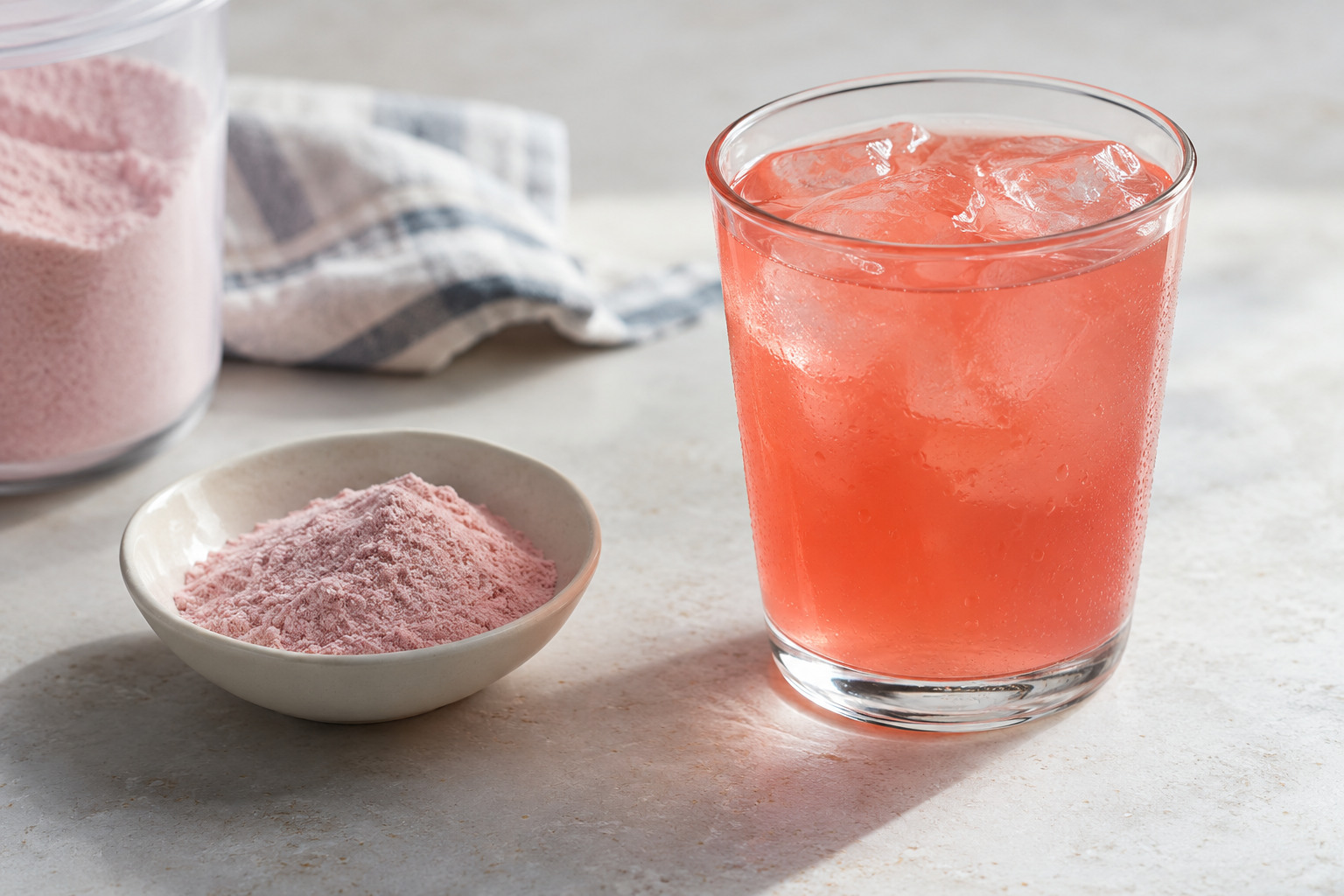
AI-generated application concept for powdered drink flavoring.
What must a developer define before selecting powdered drink flavoring?
A developer must define the complete powdered-drink system before selecting flavor or dosage. The brief identifies serving mass, dilution water, sweetener, acid, functional load, process, package, shelf life, market, and sensory endpoint.
| Project field | What to state | Why it changes flavor selection |
|---|---|---|
| Serving format | Stick, sachet, scoop, jar, or foodservice pouch | Determines dose tolerance, headspace, resealing, and consumer preparation |
| Dry serving mass | Grams of mix per serving | Sets the flavor percentage and weighing precision |
| Dilution | Water volume and permitted variation | Controls perceived strength and dilution sensitivity |
| Sweetener system | Sugar, polyols, stevia, sucralose, or blends | Changes sweetness onset, linger, bitterness, and flavor release |
| Acid system | Citric, malic, phosphoric, or other acids; target pH | Shapes brightness, sourness duration, and flavor identity |
| Functional load | Electrolytes, protein, fiber, botanicals, vitamins, caffeine | Introduces bitterness, astringency, metallic notes, haze, or sediment |
| Process | Order of addition, mixer type, batch size, and blend time | Affects distribution, shear, dusting, and volatile loss |
| Serving condition | Still or carbonated water, temperature, and ice use | Changes aroma release, sweetness, acidity, and mouthfeel |
| Package | Film structure, tub, closure, fill weight, and headspace | Controls moisture and oxygen exposure |
| Commercial target | Market, label position, target cost, and shelf life | Limits ingredient choices and defines the approval evidence |
Define the sensory target operationally. “Strawberry” is not enough. Specify fresh, candy-like, jammy, creamy, green, acidic, or juice-like character, opening aroma, body, aftertaste, cloud, and incumbent standard.
A useful brief separates fixed from adjustable conditions. Fix electrolyte load, label claim, package, and serving size before adjusting format, profile, carrier, or use level. Otherwise a sample may be accidental.
State dosage as percentage by weight of total dry mix, never final beverage or an undefined “per batch” value. Record physical form and carrier; equal percentages can deliver different aromatic loads.
How do the dry base, process, serving condition, and target shelf life change flavor choice?
The powdered-drink matrix changes aroma release, masking, distribution, oxidation, and reconstitution. Screen the intended base and preparation method; plain water omits distorting ingredients.
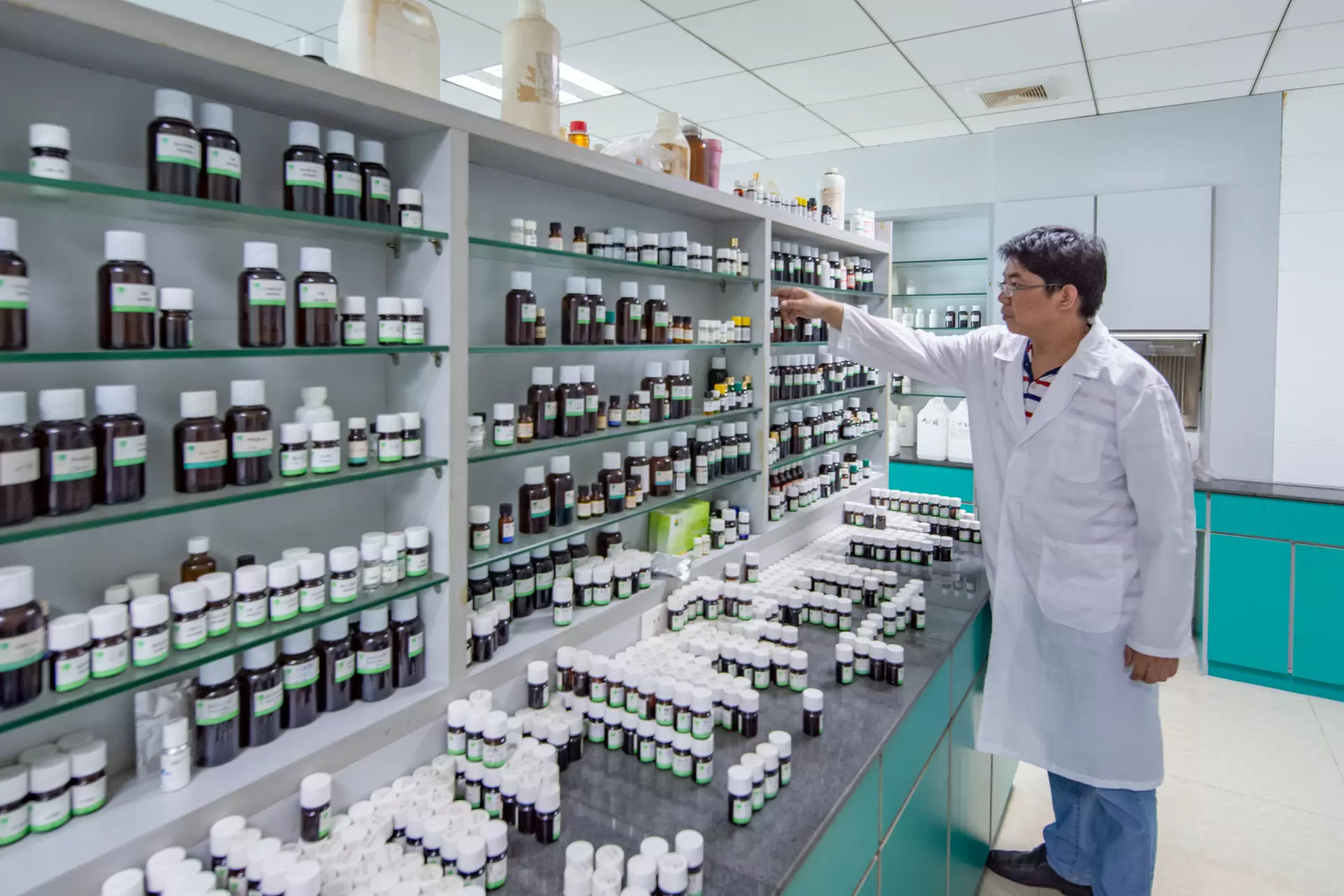
Flavor sample library in the LULIN laboratory
| Application variable | Likely sensory or physical effect | Required screening response |
|---|---|---|
| High sugar solids | Adds body and suppresses some sharp top notes | Match sweetness and solids before ranking profiles |
| High-intensity sweeteners | Can add delayed sweetness, licorice, bitterness, or linger | Evaluate onset, peak flavor, and aftertaste separately |
| Citric or malic acid | Raises brightness but can thin creamy or ripe notes | Test at final acid level and target pH |
| Sodium, potassium, magnesium, or zinc salts | Can create salty, bitter, metallic, or drying notes | Screen masking and character flavor together |
| Vitamins and botanicals | May oxidize, discolor, or add persistent off-notes | Include them in fresh and stored samples |
| Protein or fiber | Adds opacity, binding, foam, sediment, or flavor suppression | Compare against an unflavored base control |
| Hot processing or warm filling of a premix | Increases volatile loss and reaction risk | Reproduce the actual thermal exposure |
| Cold-water serving with ice | Suppresses sweetness and aroma release | Approve at the coldest intended serving condition |
Water minerals, chlorine, temperature, and dilution error change the formula. Check 500 mL at 450 mL, 500 mL, and 550 mL; cold service exposes weak balance.
Use 24 months in the final commercial package as the high-end finished-product design benchmark. It applies to complete powder, not flavor ingredient alone. Test the actual film or tub, seal, headspace, storage condition, and sensory endpoint; a 12- or 18-month flavor specification does not establish finished-pack life.
A fruit-flavored powder without meaningful juice solids remains a dry-mix project. For fruit content or body, use fruit beverage flavor profile guidance; for sparkling-water reconstitution, apply carbonated drink flavor development controls.
Which flavor formats should a powdered-drink team screen first?
A powdered-drink team should first screen dry formats that distribute uniformly, survive storage, and meet reconstitution requirements. Retain liquid formats only when delivery fits the process.
| Complete format option | Best application fit | Main advantage | Main trade-off to test |
|---|---|---|---|
| water-soluble liquid flavor | Liquid premix, post-blend spray application, or a supplier-prepared dry carrier system | Rapid release into water | Local wetting, clumping, and poor dry distribution if added directly |
| oil-soluble liquid flavor | Citrus oils, emulsified systems, or profiles later fixed onto a carrier | Strong oil-phase character | Oil ring, haze, oxidation, and need for emulsifier or encapsulation |
| dry-plated powder | Low-moisture dry blends needing fast flavor release | Simple dry handling and direct incorporation | Dust, segregation, and exposed volatiles |
| spray-dried/encapsulated powder flavor | Long-life mixes, citrus profiles, and oxidation-sensitive top notes | Better volatile protection and dry compatibility | Carrier load, slower release, cloud, and processing cost |
| granulated/agglomerated flavor | Instant mixes where dust control and wetting matter | Improved flow, handling, and rapid dispersion | Particle mismatch with fine base ingredients |
| carrier-based dry flavor blend | Custom dry system combining flavor with a selected carrier or premix | Can match bulk density and simplify dosing | Carrier labeling, hygroscopicity, and delivered flavor strength |
| complete beverage compound | Projects that want flavor, acid, color, cloud, sweetener support, or masking in one system | Fewer independent variables during development | Less formula control and higher dependence on one compound specification |
For single-serve mixes, compare spray-dried/encapsulated powder flavor, dry-plated powder, and granulated/agglomerated flavor first. Add a carrier-based dry flavor blend below 1% use or with a sharp particle-size or bulk-density mismatch. Use a complete beverage compound when one supplier coordinates the full system.
Liquid formats work only with controlled delivery. Meter a water-soluble liquid flavor onto an absorbent carrier or validated intermediate. An oil-soluble liquid flavor needs emulsification, plating, or encapsulation; drizzling liquid into finished powder invites wet spots, caking, aroma pockets, and pack variation.
Ingredient source and delivery format are separate decisions. Flavor concentrates for food manufacturing can enter several systems; fruit and juice powders add solids, color, acids, or fruit material. Powder versus liquid flavor selection covers broad handling; this page approves dry-blend, storage, and reconstitution behavior.
Record carrier, physical form, bulk density, particle description, storage, strength, and delivered cost per serving. A low kilogram price can cost more after dose and premixing.
Why can powdered drink flavoring pass in the lab but fail during dry blending and scale-up?
Powdered drink flavoring can pass in a lab cup but fail at scale because mixing, transfer, dust collection, holding, and packing expose particle differences hidden by hand preparation. Distribution control is critical below 1%.
| Production stage | Scale-up risk | Practical control | Record for approval |
|---|---|---|---|
| Flavor preweigh | Small weighing error becomes a large dose error | Match scale readability to the smallest addition | Actual weight and lot code |
| Sub-1% addition | Flavor forms concentrated pockets | Use geometric dilution with a compatible carrier or base fraction | Premix ratio, time, and sequence |
| Main blending | Unequal particle size or bulk density limits distribution | Compare physical properties before setting blend time | Mixer load, speed, and time |
| Discharge and transfer | Vibration and free fall cause segregation | Reduce drop height and unnecessary transfer | Transfer path and hold time |
| Dust collection | Fine aromatic fraction is removed preferentially | Quantify loss and avoid excessive aspiration | Dust weight and recovery rule |
| Intermediate hold | Vibration or settling separates the blend | Define maximum hold and reblend conditions | Hold duration and movement |
| Packing | Early, middle, and late packs differ | Sample the beginning, middle, and end of the run | Pack codes and sensory results |
Geometric dilution starts with a similar quantity of compatible base, then adds portions until the premix suits the blender. Fine plated flavor can still separate from coarse crystals during conveying.
Preserve the addition order. Direct contact with acid, a hygroscopic mineral premix, or a warm vitamin blend can change flavor locally. Check walls, screens, hoppers, and filters.
Never approve scale-up from one composite. Compare beginning, middle, and end packs under one coded method. A higher dose cannot correct distribution.
Which failure modes appear after powdered-drink storage, dilution, or serving?
Powdered-drink failures after storage or dilution trace to oxidation, moisture, separation, matrix interactions, or an unsuitable format. Diagnose the attribute before changing dosage; more flavor can intensify an off-note.
| Observed failure | Probable cause | Fast diagnostic | Corrective direction |
|---|---|---|---|
| Aroma fade | Volatile loss, permeable package, or flavor adsorption | Compare fresh powder, stored powder, and retained flavor | Improve barrier or screen protected format |
| Oxidized or paint-like note | Oxygen, light, metal ions, or exposed citrus oil | Compare low-oxygen pack and oil-containing formats | Encapsulate, reduce oxygen, or review antioxidants |
| Caking or hard lumps | Moisture pickup or hygroscopic carrier interaction | Measure pack integrity and compare unflavored control | Change carrier, anticaking plan, or package |
| Oil ring after dilution | Poorly emulsified oil-soluble material | Run a clear-water flavor control | Use suitable emulsion or encapsulated powder |
| Sediment or cloud drift | Insoluble carrier, base solids, or emulsion breakdown | Compare flavored and unflavored bases at equal dilution | Separate base sediment from flavor-derived sediment |
| Bitter, metallic, or vitamin note | Electrolyte, botanical, vitamin, or sweetener interaction | Omit one active at a time in controlled cups | Rebalance profile and masking system |
| Dilution sensitivity | Narrow sweet-acid-flavor balance | Test low, nominal, and high water volumes | Broaden the acceptable sensory window |
| Pack-to-pack variation | Segregation, dust loss, or dosing error | Compare beginning, middle, and end packs | Correct premixing, transfer, or feeder control |
Separate powder aroma from beverage performance. Stored powder may smell weak yet release well after hydration, or retain headspace aroma but taste oxidized. Assess dry appearance and odor, then prepare it at the specified mass, water, temperature, mixing method, and hold time.
In clear or slightly cloudy drinks, flavor-derived sediment and surface oil signal failure. Protein, fiber, cocoa, minerals, and botanicals can create intended haze; compare each candidate with the unflavored complete base to assign cause.
The 24-month design benchmark needs a prewritten endpoint. ASTM E2454-20 from ASTM International covers sensory shelf-life approaches using difference, descriptive attributes, acceptance, and business risk. For drink powder, combine character intensity, oxidation, off-note, dissolution, appearance, and acceptance. Accelerated storage ranks risk; the final pack and real-time condition support the claim.
How should a powdered-drink sample test use controls, coded samples, and acceptance criteria?
A powdered-drink sample test should compare an unflavored control, an incumbent or gold standard, and three dose candidates under randomized three-digit codes, with independent preparations and prewritten limits. The as-supplied screen is 0.25%, 0.50%, and 1.00% w/w of total dry mix.
ASTM E1871-25 emphasizes consistent preparation and serving conditions. Fix dry weight, water source, volume, temperature, mixing time, vessel, serving volume, order, and read time. Prepare three independent cups per candidate.
| Sample set | Purpose | Preparation rule | Required readout |
|---|---|---|---|
| Unflavored complete base | Identifies matrix bitterness, haze, foam, and sediment | Full formula without character flavor | Base defects and physical baseline |
| Incumbent or gold standard | Defines the intended sensory direction | Current formula at approved dose | Attribute target and comparison score |
| Candidate at 0.25% w/w | Tests low-load efficiency | Same dry-mix and dilution basis | Character, masking, and off-note |
| Candidate at 0.50% w/w | Tests the middle screening point | Same preparation and random coding | Balance and cost-per-serving potential |
| Candidate at 1.00% w/w | Tests the high-end starting design benchmark | Same as-supplied basis | Intensity ceiling and side effects |
| Stored checkpoints | Tests retention in the intended package | Fresh, 3, 6, 9, 12, 18, and 24 months | Change from fresh and endpoint status |
Assign random three-digit codes that reveal neither supplier, format, nor dose. Rotate serving order. Evaluate aroma, character, sweetness-acid balance, masking, off-note, mouthfeel, and appearance immediately and at 30 minutes. Use the intended cold-water temperature and repeat any carbonated serving in the specified sparkling-water system. Measure every lot. Record each code.
The U.S. Department of Agriculture (USDA) Commercial Item Description A-A-20098F provides a useful reference gate for the powdered beverage bases within its procurement scope: full dissolution within 2 minutes with constant stirring, no hard lumps, and a clear to slightly cloudy, sediment-free beverage. Use the 2-minute criterion as a bench reference, not as a universal requirement for every protein, fiber, botanical, or intentionally cloudy product.
| Attribute | Example prewritten acceptance gate |
|---|---|
| Reconstitution time | Full intended dispersion within 2 minutes of constant stirring |
| Hard lumps | None attributable to the flavor delivery system |
| Surface and sediment | No oil ring or flavor-derived sediment in a clear or slightly cloudy formula |
| Character identity | At least 6 on a 9-point intensity scale and within 1 point of the gold standard |
| Unwanted notes | No individual flavor-derived off-note above 2 on a 9-point scale |
| Thirty-minute retention | Character intensity decreases by no more than 1 point |
| Preparation repeatability | Maximum-to-minimum intensity spread no greater than 1 point across three preparations |
| Scale-up uniformity | Beginning, middle, and end packs remain within 1 point of one another |
| Stored-product endpoint | All critical gates remain met through the 24-month finished-pack target |
These gates are a starting protocol. A sports drink with heavy mineral masking may need a different character threshold from a lightly flavored hydration mix; keep the method constant when changing the limit. Repeat each preparation.
Advance the best one or two candidates into a narrow optimization around the winning point. Compare delivered cost per serving, then move the selected sample to pilot blending, beginning/middle/end pack checks, and final-package storage.
A numeric run sheet for pilot transfer
Use this run sheet to keep dose, batch mass, temperature, time, and storage on one basis. It is a planning worksheet, not a supplier guarantee.
| Pilot check | Values to record | Practical use |
|---|---|---|
| Dose ladder | 0.25%, 0.50%, 0.75%, 1.00%, 1.25%, 1.50%, 2.00%; 2.5 g, 5.0 g, 7.5 g, 10.0 g, 12.5 g, 15.0 g, 20.0 g per kg | Align the screen with an as-supplied basis |
| 10 kg batch | 10 kg; 25 g, 50 g, 75 g, 100 g, 125 g, 150 g, 200 g | Bench transfer |
| 25 kg batch | 25 kg; 62.5 g, 125 g, 187.5 g, 250 g, 312.5 g, 375 g, 500 g | Small lot |
| 50 kg batch | 50 kg; 125 g, 250 g, 375 g, 500 g, 625 g, 750 g, 1000 g | Feeder loading |
| 100 kg batch | 100 kg; 250 g, 500 g, 750 g, 1000 g, 1250 g, 1500 g, 2000 g | Pilot reference |
| 250 kg batch | 250 kg; 625 g, 1250 g, 1875 g, 2500 g, 3125 g, 3750 g, 5000 g | Before full run |
| 500 kg batch | 500 kg; 1250 g, 2500 g, 3750 g, 5000 g, 6250 g, 7500 g, 10000 g | Stress controls |
| 750 kg batch | 750 kg; 1875 g, 3750 g, 5625 g, 7500 g, 9375 g, 11250 g, 15000 g | High-load blend |
| 1000 kg batch | 1000 kg; 2500 g, 5000 g, 7500 g, 10000 g, 12500 g, 15000 g, 20000 g | Set the commercial planning reference |
| Water and temperature | 450 mL, 500 mL, 550 mL; 5 °C, 10 °C, 15 °C, 20 °C, 25 °C, 30 °C, 35 °C, 40 °C | Expose dilution and cold-service sensitivity |
| Mixing and hold | 0 min, 1 min, 2 min, 3 min, 5 min, 10 min, 15 min, 30 min, 60 min; 0 h, 1 h, 2 h, 4 h, 8 h, 24 h | Separate wetting, release, and hold effects |
| Storage checkpoints | 0 days, 7 days, 14 days, 28 days, 56 days, 84 days; 4 weeks, 8 weeks, 12 weeks, 24 weeks, 52 weeks, 78 weeks, 104 weeks | Rank early risk before real-time release |
| Sensory read times | 0 min, 5 min, 10 min, 30 min, 60 min, 120 min; 1 g, 2 g, 3 g, 4 g, 5 g preparation checks | Keep preparation and read timing repeatable |
| Package temperature | 5 °C, 10 °C, 20 °C, 25 °C, 30 °C, 40 °C, 45 °C | Compare distribution and storage conditions |
| Relative humidity | 20%, 30%, 40%, 50%, 60%, 70%, 75%, 80% | Log moisture-stress study setpoints |
| Headspace oxygen | 0%, 0.1%, 0.5%, 1.0%, 2.0% | Tie oxidation observations to package data |
| Particle screen | 100 µm, 250 µm, 500 µm, 750 µm, 1000 µm; 300 g, 400 g, 500 g, 600 g, 700 g | Compare size and bulk-loading behavior |
| Reconstitution timing | 30 s, 60 s, 90 s, 120 s; 1 min, 2 min, 5 min | Apply the 2-minute reference consistently |
| Pack and serving masses | 2.0 g, 4.0 g, 8.0 g, 10.0 g, 12.0 g; 5.0 g, 8.0 g, 10.0 g, 20.0 g, 50.0 g, 100.0 g | Reconcile label serving and fill-weight checks |
What belongs in a powdered drink flavoring RFQ before dosage or performance is discussed?
A powdered drink flavoring RFQ must describe the finished application, matrix, process, package, market, sensory target, and approval test before asking for dosage, price, or performance. This worked brief prepares relevant lemon-lime candidates.
| RFQ field | Worked B2B brief |
|---|---|
| Product | Zero-sugar lemon-lime electrolyte drink powder |
| Unit format | 8.0 g single-serve stick pack |
| Reconstitution | One stick in 500 mL water at 5–10°C |
| Sweetener system | Sucralose and acesulfame potassium; no added sugar |
| Acid system | Citric and malic acids; finished beverage target pH 3.1–3.5 |
| Functional matrix | Sodium, potassium, and magnesium electrolyte salts plus vitamin premix |
| Sensory direction | Fresh lemon opening, recognizable lime peel, clean acid finish, low candy note |
| Main masking need | Reduce mineral bitterness and metallic aftertaste without a heavy sweet linger |
| Appearance | Clear to slightly cloudy; no oil ring or flavor-derived sediment |
| Preferred formats | Spray-dried/encapsulated powder and granulated/agglomerated comparison |
| Dose screen | 0.25%, 0.50%, and 1.00% w/w of total dry mix |
| Process | Geometric premix, ribbon blending, hopper transfer, and stick packing |
| Package | High-barrier foil laminate stick with sealed secondary carton |
| Shelf-life target | 24 months in the finished commercial package |
| Market and label | United States; provide proposed flavor declaration for label review |
| Sample request | Two profile directions in each suitable format, with carrier and as-supplied dose basis |
| Commercial request | MOQ, pack size, sample lead time, production lead time, price basis, and change-notification route |
Send the complete ingredient list or, if confidentiality limits disclosure, the critical classes and levels. Electrolyte type, acid level, sweetener, protein or botanical load, and target pH can change the profile.
Request sample code, physical format, carrier, dose basis, storage instructions, and preparation method with every submission. Attach the matrix when teams request food flavor samples for product testing.
Which supplier facts and documents should a buyer require before powdered-drink approval?
A powdered-drink buyer should require item identity, composition documents, physical data, regulatory and allergen statements, lot controls, commercial terms, and change notification before approval. Catalog claims cannot replace documents tied to the selected flavor code.
| Supplier fact or document | Required content | Approval use |
|---|---|---|
| Item identity | Exact item code, flavor name, format, and carrier | Locks the sampled material to the purchased item |
| TDS or specification | Appearance, physical form, relevant limits, and test methods | Defines incoming acceptance |
| Lot COA | Lot-specific results against the agreed specification | Supports release and traceability |
| SDS | Handling, storage, and transport information | Supports plant safety review |
| Allergen statement | Allergens, cross-contact position, and declaration basis | Supports finished-label assessment |
| U.S. flavor statement | Natural, artificial, or combined status and proposed declaration | Supports review under 21 CFR 101.22 |
| Use-level guidance | As-supplied basis, application, and relevant limits | Prevents dose-basis errors |
| Physical data | Particle description, bulk density where relevant, dispersibility, and solubility behavior | Supports premixing and scale-up |
| Storage and shelf life | Conditions, unopened life, and retest or expiry convention | Sets inventory controls |
| Packaging and traceability | Pack size, lot coding, manufacturing identity, and country of origin | Supports receiving and recall readiness |
| Commercial terms | MOQ, sample timing, price basis, production lead time, and freight basis | Establishes landed-cost feasibility |
| Qualification files | Halal, Kosher, ISO, HACCP, FSSC, non-GMO, vegan, organic, or market files as required | Confirms project-specific suitability |
| Change control | Contact route and notice expectations for formula, site, carrier, or specification changes | Protects the approved application |
For U.S. projects, the regulatory packet should support the finished-product manufacturer's label decision under the U.S. Food and Drug Administration's 21 CFR 101.22. Supplier qualification and manufacturing controls should fit the buyer's food-safety plan under 21 CFR Part 117. The finished-product manufacturer remains responsible for the final formula, label, controls, and release.
Require qualification files by item and production site. A certificate for one facility or product family does not cover every flavor. Put the approved item code, carrier, format, specification revision, pack, price basis, lead time, and change contact in the purchasing record.
A quotation naming only “lemon flavor,” price, and dose is incomplete. It does not establish the sampled item, dry-blend behavior, lot documents, or carrier-change requalification.
Frequently asked questions about powdered drink flavoring
Powdered-drink teams can resolve most recurring sourcing questions by fixing the dosage basis, format, matrix, preparation method, package, and approval gate.
What is a good starting dosage for powdered drink flavoring?
Use 1.00% w/w of the total dry mix as a high-end starting design benchmark for a comparable powder-flavor screen, while testing 0.25%, 0.50%, and 1.00% side by side. The final use level may fall outside that screen because flavor strength, carrier load, matrix masking, and target intensity differ by item.
Which flavor format works best for a powdered drink that must dissolve in cold water?
A spray-dried/encapsulated powder flavor or granulated/agglomerated flavor is usually the strongest first screen for cold-water drink mixes. The first protects volatile notes; the second can improve wetting and reduce dust. Approval still depends on the complete formula because proteins, fibers, minerals, and cloud systems may prevent a truly clear solution.
Can a liquid flavor be used in a dry powdered drink mix?
Yes, a liquid flavor can be used when the process includes controlled metering onto a compatible carrier, a prepared premix, or conversion into a dry delivery system. Pouring liquid directly into the finished powder risks wet spots, caking, concentrated aroma pockets, and poor pack uniformity. Oil-soluble liquids also need an emulsion or encapsulation plan.
How should a manufacturer validate a 24-month powdered-drink shelf life?
Validate 24 months in the complete formula and final commercial package using defined real-time storage conditions and prewritten sensory and physical endpoints. Check fresh, 3, 6, 9, 12, 18, and 24-month samples for character retention, oxidation, off-notes, caking, dissolution, surface oil, sediment, and package integrity. Accelerated samples can support risk diagnosis.
Does the USDA 2-minute dissolution reference apply to every powdered beverage?
No, the 2-minute constant-stirring gate is a reference from USDA A-A-20098F for powdered beverage bases within that description, not a universal rule for every formula. Use it as a practical starting point. Protein, fiber, cocoa, botanical, mineral, and intentionally cloudy products need control-based criteria that distinguish hydration or suspension from a flavor defect.
How can a dry-blend manufacturer prevent flavor segregation?
Use a physical-property review, accurate preweighing, geometric dilution for low-dose additions, a compatible premix carrier, controlled transfer, and beginning/middle/end pack checks. Match particle size and bulk density where practical, reduce free fall and vibration, account for dust-collection loss, and define maximum intermediate hold time before packing.
Why does the selected flavor taste different after consumer dilution?
The flavor changes because water volume, temperature, mineral content, acid concentration, sweetness, and active-ingredient concentration all shift during dilution. Test the nominal serving plus realistic under- and over-dilution points. A 500 mL product can be screened at 450, 500, and 550 mL to expose a narrow sensory balance.
What documents are needed before buying a powdered drink flavor?
Require the selected item code, carrier, physical format, TDS or specification, lot COA, SDS, allergen statement, U.S. flavor declaration support, use-level basis, physical and solubility data, storage and shelf life, packaging, traceability, commercial terms, change notification, and any item-specific Halal, Kosher, quality-system, non-GMO, vegan, or organic files.
Is powdered flavor the same as fruit powder or juice flavor?
No, concentrated powdered flavor primarily supplies sensory character, while fruit or juice powder may contribute solids, acids, sugars, color, nutrition, cloud, and recognizable fruit material. They can be used together, but they are not dose-for-dose substitutes. A real-juice beverage also requires juice-base decisions beyond dry flavor distribution and reconstitution.
Send a powdered-drink brief that can be sampled without rework
A useful LULIN FLAVOR sample request states the complete matrix, serving size, water volume, process, package, target market, sensory direction, required documents, and 24-month finished-pack target. Include the 0.25%, 0.50%, and 1.00% w/w screening plan or ask for an equivalent as-supplied comparison.
LULIN FLAVOR is the English brand of QUANZHOU LVLIN BIOENGINEERING CO., LTD., a food-flavor developer, manufacturer, and supplier established in 2001 in Quanzhou, Fujian. The company supports application-led sample evaluation, delivery-format discussion, item-specific document requests, and RFQ preparation.
Contact LULIN FLAVOR with a project brief that includes the application matrix, process, target market, and commercial requirements.
Develop this flavor in your product
Send your product, target market and project goal. We will review the sample direction with you.