Published
Blue Raspberry Flavoring
Blue raspberry flavoring is a constructed sweet-tart berry profile defined by a fast sour-candy top note, a rounded raspberry-cherry middle, and a clean sugar-like finish—not by a single fruit extract. Specify the matrix, process, format, color, and serving temperature; for emulsion screening, use 0.50% as a high-end reference benchmark, subject to item guidance.
Last updated: August 31, 2026
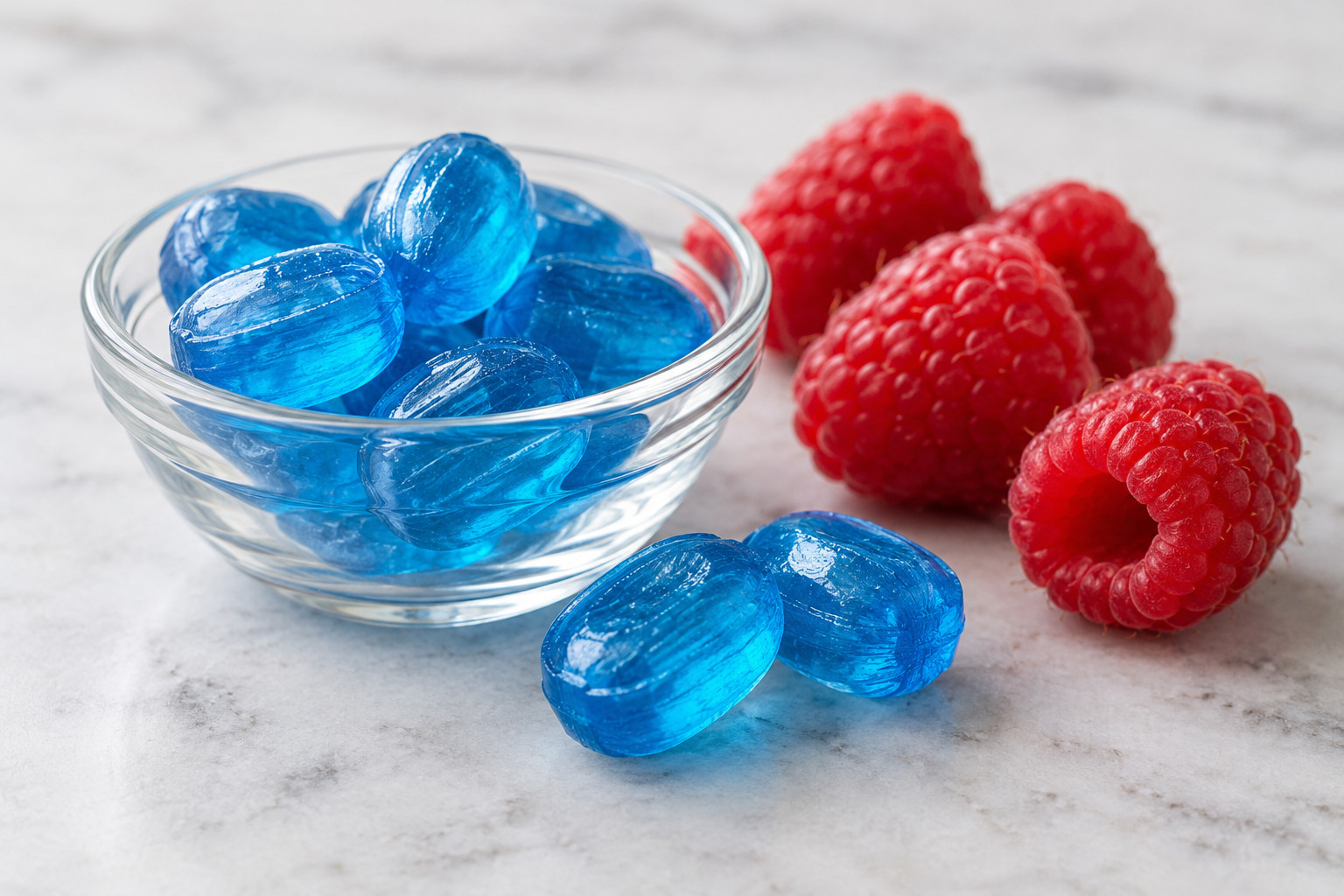
Blue raspberry confectionery reference; the blue color represents a formulated flavor concept.
What should a Blue Raspberry flavor profile include beyond “sweet and tart”?
A useful Blue Raspberry profile specifies the order, intensity, and duration of its sensory signals. “Sweet,” “tart,” and “fruity” cannot select a sample. State what arrives first, which berry carries the middle, and whether the finish is clean, cooling, sugary, jammed, or dry.
Blue Raspberry is constructed. It is not the standard taste of one blue-colored species, and blue color does not prove fruit origin. The name may describe natural, natural-type, natural-and-artificial, or artificial flavor according to the selected formula and market rules. In the United States, 21 CFR 101.22 governs flavor terminology; the Food and Drug Administration treats certified color, including FD&C Blue No. 1, as a separate declaration.
This page sits below Flavor Concentrates for Food Manufacturing and stays narrower than Raspberry Flavoring for Food Buyers. The latter owns fresh red fruit, seed, jam, and general sourcing. Blue Raspberry owns amplified candy architecture, visual-taste alignment, format behavior, and application testing.
Which top, middle, and base notes change a Blue Raspberry formulation brief?
The top, middle, base, and finish of Blue Raspberry each perform a different job, so a buyer should brief them separately. A profile can become lemonade-like, generic berry, bubblegum-like, floral, or heavy simply because one layer is too loud or lasts too long.
| Sensory layer | Job in the profile | Useful directions | Common failure | Precise buyer wording |
|---|---|---|---|---|
| Top | Creates recognition across the first 1 s, 2 s, and 3 s | Bright raspberry lift, pineapple-like fruit sparkle, citrus peel, lemonade, sour-candy attack | Solvent-like, lemon-only, thin, or lost after heat | “Immediate tart berry lift with a short citrus edge” |
| Middle | Establishes the berry identity through the bite or sip | Red raspberry, blackberry, cherry roundness, floral berry, light jam | Generic mixed berry, cough-syrup cherry, perfume, or flat candy | “Raspberry leads; cherry only rounds the center” |
| Base | Supports body after the volatile top fades | Cotton-candy sugar, vanilla, marshmallow, dark berry, restrained seed or wood | Bubblegum, burnt sugar, heavy vanilla, or muddy dark fruit | “Clean candy body without vanilla dominance” |
| Finish | Controls the final memory and repeat-sip behavior | Malic-style lingering sourness, short citric snap, cooling, dry berry, clean sugar | Metallic, bitter, astringent, cloying, or cooling aftertaste | “Two-stage sour finish with no metallic tail” |
Match the layers to the product. Cold mutes aroma. A frozen drink can carry more top-note lift; a gummy needs slower berry body and longer acid; a dairy drink needs enough middle to survive protein; a bakery filling may need cooked-candy character.
Color changes expectation, but flavor must work blind. Electric blue cues high-impact candy, pale blue suggests a lighter drink, and a color-free product removes the visual shortcut. Blue Raspberry should remain recognizable in the uncolored base.
How do water, fat, protein, sugar, salt, acid, and serving temperature change Blue Raspberry perception?
Water, fat, protein, sugar, salt, acid, and temperature change Blue Raspberry by altering volatile release, taste balance, and the order in which notes appear. A sample that wins in sweetened water can become weak in whey protein, delayed in fat, harsh at low pH, or nearly silent at 5°C.
| Matrix variable | Main mechanism | Likely sensory shift | Failure to watch | Minimum comparison condition |
|---|---|---|---|---|
| Blue Raspberry in water | Fast dispersion and headspace release | Strong opening, lighter body, quicker fade | Powerful aroma with an empty middle | Production water, carbonation, minerals |
| Blue Raspberry in fat | Hydrophobic materials partition into lipid | Slower release, rounder body, longer finish | Muted top or waxy tail | Final fat type at 3%, 5%, or project level |
| Blue Raspberry in protein | Whey, casein, soy, or pea protein retains aroma | Lower impact and delayed berry release | Chalky, beany, dairy-sour, or perfume clash | Final protein at 3%, 8%, or project level |
| Blue Raspberry with sugar | Sweetness changes sour balance and release | Softer acid, fuller candy body | Cloying finish or hidden berry | Final 8%, 12%, or project solids |
| Blue Raspberry with salt/minerals | Ionic strength changes release and emulsion behavior | Some top notes lift; acid may harden | Mineral, metallic, or saline tail | 0.10%, 0.30%, or final project salt |
| Blue Raspberry with acid | Citric and malic systems change attack and persistence | Citric snaps; malic sourness lasts | Lemon-only character or instability | 0.10%, 0.30%, 0.50%, or final project acid |
| Blue Raspberry by temperature | Cold suppresses volatility; warmth increases it | Chilled samples read quieter | Under-flavoring cold; over-flavoring warm | 5°C service plus 22°C control |
Test the real base. For a chilled drink, compare 5°C with 22°C. For frozen dessert, taste frozen, during melt, and after melting. For candy, record the first 5 seconds, the middle, and the finish.
Split the acid system too. Citric acid gives a quick lemonade-like attack; malic acid lengthens candy sourness. Equal pH does not mean equal taste. Hold sweetness, solids, color, and temperature constant.
Which liquid, powder, emulsion, oil-soluble, and water-soluble Blue Raspberry formats merit testing?
Liquid, powder, emulsion, oil-soluble, and water-soluble Blue Raspberry options merit testing when each format matches the product phase, process, appearance target, and dosing equipment. These names overlap: a liquid can be water-soluble, an emulsion is a water-dispersible oil-in-water system, and a powder may be spray-dried around a carrier.
| Format option | Best first applications | Technical question | Typical advantage | Main failure mode |
|---|---|---|---|---|
| Blue Raspberry liquid | Syrups, gummies, fillings, dairy bases | Which carrier enters the formula, and when? | Easy bench adjustment and metering | Carrier restriction, volatility, local overdose |
| Blue Raspberry water-soluble | Clear drinks, water, syrup, gel | Does it stay clear at final pH and minerals? | Fast dispersion without visible oil | Ring, haze, precipitation, short finish |
| Blue Raspberry emulsion | Cloudy drink, frozen dessert, bakery, opaque candy | Is the droplet/hydrocolloid system stable after dilution? | Moves oil-phase aroma into a water system | Creaming, oil ring, sediment, mineral sensitivity |
| Blue Raspberry powder | Dry drink, tablet, confectionery or bakery premix | How do carrier, moisture, particle size, and rehydration affect release? | Dry handling and premix incorporation | Caking, dust, uneven dispersion, top-note loss |
| Blue Raspberry oil-soluble | Fat filling, coating, chocolate-style system | Does it distribute without thickening or separation? | Better phase match in high-fat products | Weak oral release or coating change |
The Powder vs Liquid Food Flavors decision follows the line, not a belief that one format is always stronger. Powder can protect aroma yet lose low-boiling notes during drying. Liquid gives fast impact but may lose lift in an open hot process. Emulsion adds body and cloud, but still needs ring, creaming, sediment, and turbidity checks after dilution.
Published supplier examples show why use rates must keep their application scope:
| Industry reference | Format and application | Published level | Procurement meaning |
|---|---|---|---|
| Givaudan PRIMETIME Blue Raspberry | Powder in water | 0.08%; water ≤7.0%; 850 µm screen | Low-dose water reference for that item |
| Givaudan PRIMETIME Blue Raspberry | Frozen dessert, powder drink, sweet snack | 0.09%, 0.10%, 0.15%; 365 days at 10–30°C | Complete set: 0.08%, 0.09%, 0.10%, 0.15% |
| Nature’s Flavors Blue Raspberry Emulsion | Water-dispersible emulsion | 0.10–0.50%; pH 3.97; 32.5 °Brix | 0.50% is the high-end emulsion-screen benchmark |
| Flavor West Blue Raspberry | Water-soluble liquid | 1.03 g/mL; 2 years at 20–25°C | Carrier and storage stay item-specific |
| SpecializedRx Blue Raspberry SD Powder | High-load candy/oral base | 1–2% | Separate powder context, not a beverage-liquid rate |
| United States Dairy Export Council formula | Protein beverage dry mix | 0.65%; pH 4.0; 88°C | Formula-specific protein, acid, and heat context |
For early emulsion selection, screen 0.10%, 0.25%, and 0.50% w/w in the actual base. Use 0.50% as the high-end reference benchmark. Scope matters. Liquid concentrate and spray-dried powder need their own supplier-rated ladders; copying 1–2% from a high-load powder into water creates a false comparison and may expose carrier or overdose artifacts.
How do pasteurization, baking, oxygen, light, pH, and storage reshape Blue Raspberry flavoring?
Pasteurization, baking, oxygen, light, pH, and storage can remove the Blue Raspberry top note, alter its berry balance, or destabilize its delivery system. The correct test reproduces the actual addition point, peak temperature, hold time, cooling time, package headspace, and storage condition.
Flavor sample library in the LULIN laboratory
| Stress | Likely change | Practical split test | Decision signal |
|---|---|---|---|
| Pasteurization/hot fill | Volatile lift falls; cooked berry emerges | Match the line, such as 72°C for 15 s or an 88°C reference process | First-sip identity after cooling |
| Baking/candy cooking | Top-note loss; base and acid dominate | Run a 160°C or 180°C bake and the actual candy endpoint | Finished impact without burnt/medicinal notes |
| Oxygen/headspace | Oxidized fruit lift; dull finish | Compare packs at 0 days, 7 days, 28 days | Stable top-to-middle ratio |
| Light | Aroma and blue-color drift | Compare protected and display-light packs | Sensory/color alignment |
| pH/minerals/emulsion dilution | Haze, ring, creaming, sediment, release change | Use final pH, electrolytes, dilution | No defect or mineral tail |
| Powder humidity | Caking, carrier hydration, dry-aroma loss | Check sealed powder at 22°C and 40°C | Flow, dissolution, rehydrated flavor |
Late addition can preserve lift when the validated line allows it. Otherwise, select a profile and format for the thermal step. Heat changes balance. Store samples sealed and protected from heat, air, and light in the commercial container.
Blue color needs its own review. FD&C Blue No. 1 and other approved sources carry different label and use conditions. The Food and Drug Administration’s ingredient guidance separates flavor from certified color. A color-free flavor leaves that choice with the formula owner.
How should a product developer compare Blue Raspberry samples in the real application base?
A product developer should compare coded Blue Raspberry samples in one controlled batch, then split by format, level, process, temperature, and storage. Test the base. Neat smelling can reject an obvious defect, but it cannot approve a flavor.
Use this executable sequence:
- Lock the target. Write one sentence each for top, middle, and finish. Record the visual target and defect to solve.
- Prepare one base. Hold water, fat, protein, °Brix, sweetener, salt, acid, pH, color, and solids constant.
- Build coded levels. For Blue Raspberry emulsion, use 0.10%, 0.25%, and 0.50%. Keep 0.50% as the high-end reference benchmark. Apply item guidance to other formats.
- Split the process. Compare pre-heat with post-cooling, or pre-bake with filling after bake.
- Serve correctly. Evaluate chilled product at 5°C, ambient product at 22°C, and hot product at its serving point. Use random 3-digit codes.
- Record time. Score aroma, first impact, middle, acid shape, finish, aftertaste, and appearance at 0 days, 7 days, and 28 days. Add a 40°C screen under the established shelf-life protocol.
| Observation | Likely diagnosis | Next controlled change |
|---|---|---|
| Blue Raspberry aroma is strong; taste is weak | Top is too volatile or acid/sweetness is misaligned | Strengthen middle before raising total level |
| Blue Raspberry reads as cherry medicine | Cherry or floral middle dominates | Reduce cherry/perfume; retain tart opening |
| Blue Raspberry disappears in protein | Binding, heat, or off-note masking suppresses release | Test protein-compatible format; adjust middle/base |
| Blue Raspberry becomes lemon candy | Citric attack dominates raspberry | Rebalance acid or add berry body |
| Blue Raspberry forms cloud, ring, sediment | Format conflicts with pH, minerals, dilution | Compare water-soluble liquid with revised emulsion |
| Blue Raspberry finish is metallic/bitter | Mineral, color, sweetener, acid, or overdose interaction | Run omission tests before replacing flavor |
Keep 1 untreated control and 1 market benchmark. LULIN FLAVOR’s food flavor formulation support can work from coded feedback instead of a request for “more Blue Raspberry.”
What facts and documents belong in a Blue Raspberry flavoring RFQ?
A Blue Raspberry flavoring RFQ should identify the sensory target, matrix, process, format, label position, market, evaluation method, and commercial stage. Separate flavor from color so the supplier can select the correct item and files.
| RFQ field | Information to send | Why it changes the supplier decision |
|---|---|---|
| Application | Water, carbonated drink, dairy drink, gummy, hard candy, frozen dessert, filling, coating, or dry mix | Defines release, phase, equipment, and process stress |
| Sensory brief | Top, middle, base, finish, sour duration, cooling, and excluded notes | Prevents generic blue-candy sampling |
| Formula | pH, acids, °Brix, sweeteners, fat, protein, salt, minerals, alcohol, and color | Identifies matrix interactions and carrier limits |
| Process | Addition point, mixing, peak temperature, hold time, cooling, carbonation, drying, or baking | Screens volatility and physical stability |
| Format | Liquid, powder, emulsion, oil-soluble, water-soluble, or supplier recommendation | Directs sample and production handling |
| Market and label | Destination country, natural/artificial position, color declaration, allergen and customer rules | Determines the applicable regulatory package |
| Documents | TDS, COA, SDS, ingredient/label statement, allergen, color, origin, Halal, Kosher, GMO, vegan, ISO 9001, ISO 22000 | Keeps item, facility, batch, system, and market scope clear |
| Commercial facts | Sample quantity, annual forecast, pack size, MOQ, target cost-in-use, delivery point, Incoterm, production date | Supports a usable quotation and supply plan |
Use the Food Flavor Compliance Document Request Guide before sample approval. For United States projects, FEMA GRAS references apply to actual ingredients and intended use, not the Blue Raspberry name as a blanket category. The FEMA Flavor Ingredient Library supports ingredient-level review.
Build the next Blue Raspberry sample brief with LULIN FLAVOR
LULIN FLAVOR is the English brand of QUANZHOU LVLIN BIOENGINEERING CO., LTD., a Quanzhou food-grade flavor manufacturer established in 2001. The company operates 3 modern production lines and an application laboratory serving beverage, confectionery, bakery, dairy-style, syrup, and powder projects.
Start with the LULIN FLAVOR manufacturer profile, then send the matrix, Blue Raspberry architecture, process, format, market, documents, sample quantity, and forecast. LULIN FLAVOR returns an application-matched sample path and quotation covering specifications, pack size, MOQ, price, schedule, production lead time, shelf life, storage, and shipment terms.
Request a B2B food flavor sample for a controlled application trial, or contact LULIN FLAVOR about the project when the formula, target profile, and commercial timeline are ready.
Blue Raspberry Flavoring FAQ
Blue Raspberry flavoring buyers need direct answers about identity, labels, format, dosage, processing, evaluation, and supplier documents. The following answers use the same application-first boundaries applied throughout this page.
What is Blue Raspberry flavoring?
Blue Raspberry flavoring is a constructed sweet-tart berry profile, usually built around a sharp candy-like opening, a raspberry-led middle, and a sweet or lingering sour finish. It describes a sensory direction rather than one botanical fruit, and its natural or artificial label position follows the selected formula and destination-market rules.
Is natural Blue Raspberry flavoring made from a real Blue Raspberry fruit?
No, the term natural Blue Raspberry flavoring does not mean it comes from one real Blue Raspberry fruit. A natural label position depends on the sources and processing of the flavor ingredients under the applicable market rules. The fantasy profile can still combine recognizable berry, citrus, tropical-fruit, floral, and sweet note directions.
Does Blue Raspberry flavoring contain FD&C Blue No. 1?
Not necessarily; Blue Raspberry flavoring can be supplied with color, without added color, or for use beside a separate color system. In the United States, FD&C Blue No. 1 is a certified color declared separately from flavor. Buyers should state the visual target and request the exact item’s color and label statement.
Which Blue Raspberry format should a beverage or candy manufacturer test first?
A beverage manufacturer should usually begin with a water-soluble liquid or a beverage emulsion selected for the required clarity, cloud, pH, and mineral system. A candy manufacturer may compare liquid, powder, or oil-soluble options according to cooking and fat phase. The actual production base decides the first format, not flavor strength alone.
What use level should a Blue Raspberry emulsion screen include?
For a supplier-rated water-dispersible emulsion, screen 0.10%, 0.25%, and 0.50% w/w in the real base, using 0.50% as the high-end reference benchmark. That ladder does not transfer to every liquid or powder. Follow the selected item’s technical guidance, formula limits, sensory result, and destination-market review before commercial approval.
Why can Blue Raspberry taste different after pasteurization, baking, or candy cooking?
Heat can remove volatile top notes and leave a heavier berry, sugar, or acid impression, while the carrier and addition point affect retention. Compare the intended time-temperature process with an alternate addition point where the line permits. Judge both samples only after cooling, equilibration, and final dilution in the commercial base.
How should Blue Raspberry be tested in a protein or dairy-style product?
Test Blue Raspberry in the final protein source, concentration, fat level, sweetener system, acid blend, pH, heat process, and serving temperature. Protein binding and interfacial effects can mute or delay aroma, while cultured or plant notes can distort the berry middle. Compare coded levels after processing and at the planned cold-storage checkpoints.
Which documents should a Blue Raspberry flavoring buyer request?
Request the item-specific TDS, COA, SDS, ingredient or label statement, allergen statement, natural or artificial status, color statement, country of origin, shelf life, storage, and destination-market documents. Add required Halal, Kosher, GMO, vegan, or customer declarations, then include MOQ, pack size, lead time, Incoterm, and sample details in the RFQ.
How is Blue Raspberry flavoring different from standard raspberry flavoring?
Blue Raspberry flavoring is usually an amplified fantasy-candy direction with a sharper opening, stronger acid cue, and clearer sugar-like finish. Standard raspberry flavoring can target fresh red fruit, seed, green, floral, or jam notes with greater botanical realism. Buyers should keep separate benchmarks and sensory briefs for the two search and product intents.