Published
Cheesecake Flavoring
Cheesecake flavoring is a configurable cultured-dairy dessert system, not a single cream-cheese note. A brief defines lactic tang, dairy-fat body, vanilla, graham crust, lemon, and finish, then tests liquid, powder, emulsion, oil-soluble, and water-soluble options in the finished base; use 3.0 g/kg (0.30% w/w) as the high first-pass benchmark for comparable concentrated liquids.
A bottle sniff only checks identity. Timing, fat, protein, acid, and serving temperature decide whether the sample still reads as cheesecake after processing.
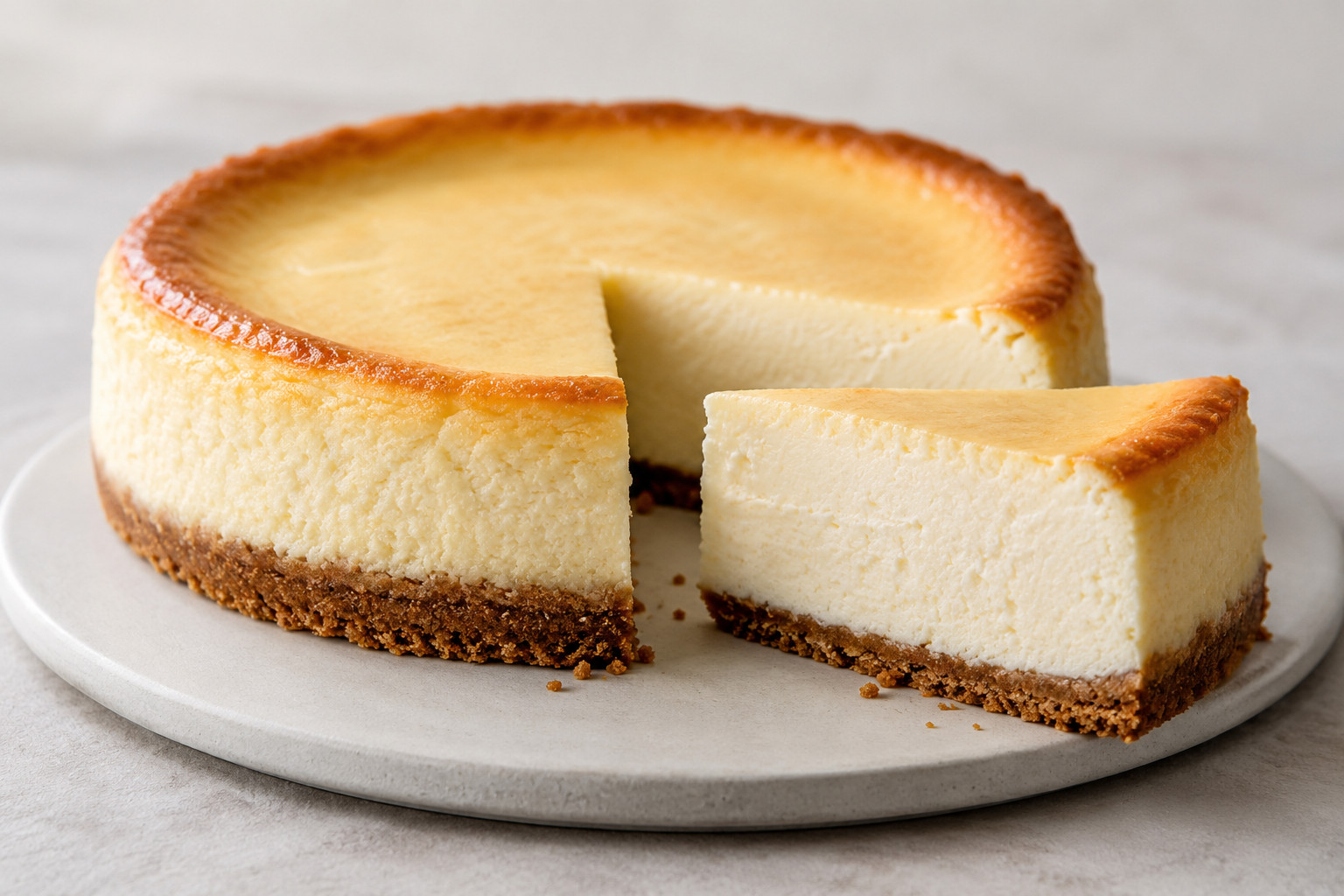
Cheesecake: a sensory reference for defining the target flavor profile.
How should a cheesecake flavor profile be specified without dessert-menu adjectives?
A precise cheesecake flavor profile names cultured tang, dairy-fat body, vanilla, crust, lemon, baked character, fruit overlay, finish, and rejection notes instead of relying on “creamy,” “rich,” or “authentic.”
Menu words do not tell a flavorist what to build. “Creamy” can mean milk fat, vanilla softness, or a waxy coating. “Cheesy” can mean Cream Cheese tang or a savory cheddar direction. “Graham” can mean toasted biscuit, raw wheat bran, or burnt sugar.
Write the target as controlled axes before samples move. Give each axis a low anchor, a high anchor, and a rejection point.
| Sensory axis | 0 anchor | 10 anchor | Rejection signal |
|---|---|---|---|
| Cultured tang | 0%: sweet uncultured dairy | 100%: sharp Cream Cheese acidity | Cheddar, yogurt whey, or vinegar |
| Dairy-fat body | 0%: lean and watery | 100%: dense New York mouthfeel | Waxy oil or tallow |
| Vanilla support | 0%: dairy only | 100%: custard-vanilla dessert | Cake-mix vanilla that erases cheese |
| Crust / biscuit | 0%: no baked cereal | 100%: Graham Cracker crust | Raw flour, cardboard, or ash |
| Lemon lift | 0%: no citrus | 100%: lemon-zest New York cut | Furniture polish or soda lemon |
| Baked / eggy note | 0%: cold no-bake dairy | 100%: set baked cheesecake | Sulfur egg or omelet |
| Fruit overlay | 0%: plain cheesecake | 100%: strawberry or blueberry swirl | Candy fruit that replaces dairy |
| Finish | 0%: short and clean | 100%: lingering lactic-vanilla | Butyric rancidity, solvent, or stale crust |
Profile is separate from dose and delivery form. A buyer can source flavor concentrates for food manufacturing and still receive a cheddar, yogurt, or cake-batter direction.
The same search phrase can point to five different purchase objects.
| Term | What it contributes | What the name does not prove |
|---|---|---|
| Cheesecake flavoring | Concentrated cultured-dairy dessert aroma and taste | Cream cheese solids, dairy protein, or label wording |
| Cheesecake flavor extract | Extract-style or solvent-carried flavor, often sold by volume | A botanical extract of cheesecake or a legal extract standard |
| Cheesecake flavor powder | Flavor on a dry carrier for premixes and protein blends | Dehydrated cheesecake or a fixed use rate |
| Cheesecake seasoning | Snack blend that may add sugar, salt, and dairy powders | A clean dessert profile or the same dose as a concentrate |
| Cheesecake flavor drops | Consumer dosing format for home drinks or yogurt | Industrial potency or factory metering |
| Cheesecake flavored protein powder | Finished consumer mix already containing protein and flavor | The B2B flavor item a manufacturer should buy |
A usable brief is one timed sentence: “Cream Cheese tang 7/10 and lemon 3/10 at 0–3 seconds; dairy-fat and vanilla 6/10 at 3–15 seconds; Graham Cracker crust 5/10 at 15–45 seconds; no cheddar or solvent; 25 g whey at 5°C after 24 h.”
Which cream-cheese, crust, and vanilla timings change a cheesecake brief?
A cheesecake flavor brief should use top notes for first aroma, middle notes for recognizable Cream Cheese identity, and base notes for crust, lactone body, vanilla, and persistence.
Top, middle, and base are an operational timing model: first impression, recognizable bite or sip, and finish. They are not a regulatory class.
| Stage | Useful cheesecake directions | Application role | Typical failure |
|---|---|---|---|
| Top | Lemon zest, fresh dairy, acetaldehyde-like brightness, light graham dust | Opens chilled yogurt, protein shakes, and lemon New York concepts | Solvent flash, soda lemon, or raw-milk sour |
| Middle | Cultured Cream Cheese, Lactic Acid tang, butter, vanilla custard | Establishes dessert-cheese identity in dairy, bakery, and confectionery | Cheddar, yogurt drink, or cake batter |
| Base | Graham Cracker crust, baked biscuit, dairy lactones, caramelized sugar, vanilla | Gives body to frozen dessert, filling, bars, and dry mixes | Stale cereal, burnt sugar, waxy fat, or lingering butyric acid |
Cheesecake is a stacked dessert, not one molecule. Sensory language can borrow dairy and baked-crust odorants as anchors: 2,3-butanedione (diacetyl), acetoin, acetaldehyde, delta-decalactone, delta-dodecalactone, vanillin, maltol, furaneol, limonene, 2-acetyl-1-pyrroline, and tightly limited butanoic acid. Those names are interpretation aids, not a LULIN FLAVOR formula.
Style families change the stack. They are project directions, not supplier grades.
| Style family | Tang | Crust | Baked/eggy | Lemon | Body | Watch-out |
|---|---|---|---|---|---|---|
| New York baked | Medium-high | Graham Cracker | Present | Light zest | Dense | Sulfur egg, heavy bake, dull lemon |
| No-bake cold set | High | Light cookie | Absent | Optional | Lighter | Thin yogurt, missing set impression |
| Japanese Souffle | Low-medium | Minimal | Soft egg-vanilla | Low | Airy | Sponge cake with no cheese identity |
| Basque Burnt | Medium | Optional | Dark caramelized top | Low | Dense | Coffee ash or burnt-sugar candy |
| Fruit-swirl | Medium | Graham or cookie | Optional | Optional | Medium | Berry candy that erases dairy |
A protein-powder brief often needs a stronger middle because whey, casein, pea, or soy notes compete. Frozen dessert needs enough base to survive 5°C. Muffin filling needs crust reserve after 12 min to 18 min at 180°C. A cheesecake latte needs the 60°C cup without turning into cooked milk.
Classification does not define that stack. A product may be labeled under solely natural flavor, natural and artificial flavor, or solely artificial flavor depending on composition and the destination-market rule. The guide to how artificial flavor is defined for food labels owns the general definition.
How do water, fat, protein, sugar, salt, acid, and serving temperature change cheesecake perception?
Water, fat, protein, sugar, salt, acid, and serving temperature change cheesecake aroma release, cultured tang, crust definition, sweetness association, body, and finish, so a sample decision belongs in the intended product matrix.
The same concentrate can smell loud in water and seem muted in an 8% protein shake. It can read as New York filling in a 12% fat dairy base, thin in an unsweetened plant drink, or sharper after acidification to pH 4.2. Aroma compounds partition, bind, and reach the headspace differently as the formula changes.
Use the control points below as an internal challenge set. The commercial formula remains the approval base.
| Matrix variable | Likely perceptual shift | Illustrative control points | Controlled question | Common misdiagnosis |
|---|---|---|---|---|
| Water | Fast opening, short body after dilution | 1,000 g base; 0.10%, 0.20%, 0.30% liquid screen | Does Cream Cheese identity survive final dilution? | A strong water sniff is treated as finished-product proof |
| Fat | Slower release, rounder body, longer crust and lactone finish | 0%, 3%, 10%, 18% fat | Does the flavor open at the actual fat type, level, and temperature? | A cold fatty sample is called weak |
| Protein | Binding and base notes from whey, casein, pea, or soy | 0%, 3%, 8% protein; 15 g and 25 g servings | Does cheesecake remain distinct beside the selected protein after process? | Base bitterness is blamed on the flavor |
| Sugar | Stronger dessert association; viscosity can slow top notes | 0%, 6%, 12% sucrose | Does fixed sweetness hide tang and crust? | Sweetness is mistaken for flavor strength |
| Salt | Changed contrast; snack seasoning can turn dessert savory | 0%, 0.10%, 0.30% salt | Does sodium clean the dairy note or push it toward cheese powder? | A formula effect is treated as a profile defect |
| Acid / pH | Sharper tang, weaker vanilla-cream association, protein/emulsion change | pH 4.2, pH 4.6, pH 5.0, pH 6.8 | Does the profile stay coherent at finished pH? | Acid bite is called authentic Cream Cheese |
| Temperature | Faster release when warm; slower opening when cold or frozen | 5°C, 22°C, 60°C | What is perceived at the real consumption temperature? | A 22°C bench result is applied to a 5°C or 60°C product |
A peer-reviewed review of beverage flavor retention and release treats composition, temperature, and pH as coupled variables (PMC6209173). Fat often retains lipophilic volatiles. Protein can bind aroma compounds. Sugar or salt can alter release.
Evaluate yogurt and frozen dessert at 5°C. Evaluate bakery filling after cooling to 22°C. A cheesecake latte or hot creamer needs the intended cup plus a 60°C high-end hot-cup check. Neutral protein drinks near pH 6.8 do not predict cultured dairy at pH 4.6.
Hold the formula constant during flavor comparison. If sugar, protein, or acid changes between samples, the panel is comparing two products rather than two flavors.
Which liquid, powder, emulsion, oil-soluble, and water-soluble cheesecake systems belong in the first trial?
A manufacturer should choose cheesecake flavor format by phase compatibility, point of addition, process, dosing method, appearance, storage, and factory handling rather than assuming liquid or powder indicates quality.
The complete commercial vocabulary includes liquid, powder, emulsion, oil-soluble, and water-soluble. These terms overlap. Liquid, powder, and emulsion describe physical form. Oil-soluble and water-soluble describe phase compatibility. A liquid can be water-soluble or oil-soluble. A spray-dried powder can disperse into water after reconstitution.
The powder versus liquid food flavor comparison covers general handling. The first cheesecake screen uses four non-duplicative routes.
| First-round route | Best first applications | Example challenge | What to measure | Frequent failure mode |
|---|---|---|---|---|
| Water-soluble liquid | Yogurt, RTD shake, syrup, milk drink, cheesecake latte | 5°C and 60°C; 24 h equilibration | Dispersion, clarity, carrier impact, post-heat identity | Haze, ring, solvent flash, protein masking |
| Oil-soluble liquid | Chocolate coating, fat filling, compound coating, seasoning oil | 45°C addition; 22°C tasting | Distribution through fat, oxidation, release during eating | Poor transfer into an aqueous phase; delayed or fatty release |
| Water-based emulsion | Cake, muffin, frosting, cloudy drink, composite dairy | 5°C and 60°C; 7 days | Droplet stability, opacity, pH behavior, bake result | Ringing, separation, unwanted color or cloud |
| Spray-dried water-soluble powder | Protein powder, bakery premix, instant dessert, dry blend | 25°C, 65% RH; 30 days | Flow, dust, caking, wetting, carrier taste, reconstituted release | Moisture pickup, uneven dosing, weak top notes, stale crust |
Paste, plated powder, freeze-dried, and controlled-release systems are secondary custom routes. They are not missing steps in the first-round set.
Do not transfer a liquid ladder onto a powder. Concentrated liquids in this category commonly screen at 0.10% w/w (1.0 g/kg), 0.20% w/w (2.0 g/kg), and 0.30% w/w (3.0 g/kg). Use 3.0 g/kg (0.30% w/w) as the high first-pass design benchmark when the selected liquid’s supplier range includes that value. Spray-dried powders carry flavor on maltodextrin, gum, or other carriers, so dry-mix screens often sit higher: 0.50% w/w, 1.00% w/w, and 1.50% w/w (15 g/kg dry mix) as the high-end powder reference benchmark. Advance the lowest passing dose. A cheaper flavor per kilogram can cost more per tonne if its passing dose is higher.
Snack “cheesecake seasoning” is a different construction. Salt, sugar, and dairy powders change the brief.
Which heat, freeze, and storage conditions flatten cultured dairy or stale the crust note?
Heat, oxygen, freeze-thaw, shear, hold time, light, package headspace, moisture, and point of addition can flatten cheesecake tang, dull graham crust, or push dairy notes toward cooked milk or rancid butter.
Process the sample the way the factory will process the product. A bench stir at 22°C does not represent 18 min at 180°C or a 72°C pasteurization hold.
| Condition | What often changes | Practical check |
|---|---|---|
| Mixing and addition point | Early addition can strip top notes; late addition can leave carrier flash | Compare pre-process, post-process, and permitted late addition |
| Pasteurization | Diacetyl and lemon lift drop; cooked-dairy notes rise | 72°C for 15 s versus the plant’s actual hold |
| UHT or hot fill | Stronger cooked milk, weaker crust, possible sulfur | 141°C for 3 s or the specified hot-fill curve, then chilled tasting |
| Homogenization | Release and body change as fat droplets change | Taste before and after the production pressure |
| Baking | Crust can grow or turn ashy; tang can collapse | 160°C and 180°C; 12 min and 18 min; cool to 22°C |
| Freeze and thaw | Ice-cream and bar systems can mute body or throw off crust | 5°C serving after freeze; one thaw cycle and three thaw cycles |
| Dry blend and reconstitution | Segregation, dust, incomplete wetting, carrier taste | Blend 5 min; reconstitute at label dilution; wait 5 min |
| Oxygen, light, and headspace | Stale cereal, cardboard, and oxidized dairy | Clear versus barrier pack; 7 days and 30 days |
| Moisture and RH | Powder caking and crust-note drift | 25°C at 65% RH for 30 days |
Addition point is a specification. If the plant can add flavor after heat, say so in the RFQ. If it cannot, the sample must survive the full curve. Day 0 approval at 22°C does not predict day 30 in a protein jar. Recheck leading codes in the intended package.
How should product developers compare cheesecake flavor samples in the real application base?
Product developers should compare coded cheesecake flavor samples in one batch of the finished base at matched dose, mixing order, process, storage, portion, and serving temperature, using a written 0–10 cheesecake scorecard rather than a bottle sniff.

Flavor sample library in the LULIN laboratory
Water cups are for orientation. Approval happens in the commercial matrix. ISO 6658:2017 covers sensory methodology. ISO 13299:2016 covers profiling. Neither standard selects the flavor.
Build a coded, real-base protocol
Freeze one unflavored production-representative base and split later samples from that batch. Include an unflavored control and, if one exists, a commercial or internal reference. Assign three-digit codes. Hide supplier names until scores are recorded.
Match dose units. Do not compare 0.20% liquid with 1.00% powder as if they were equal. For comparable concentrated liquids, run 0.10%, 0.20%, and 0.30% w/w, and treat 0.30% as the high first-pass reference benchmark. For spray-dried powders in dry mixes, run 0.50%, 1.00%, and 1.50% w/w of the mix, and treat 1.50% as the high-end powder design benchmark.
Apply the real process. Serve at the real temperature, adding 5°C for cold dessert and 60°C when a hot cup is in scope. Score tang, dairy-fat body, vanilla, crust, lemon, baked note, fruit overlay, off-notes, and persistence on the 0–10 anchors written before tasting. Recheck leading codes after 24 h, 7 days, and 30 days in the intended package.
Calculate cost-in-use: flavor price per kilogram × dose (kg/kg) × 1,000 = flavor cost per tonne of finished product. Repeat the two leading codes on a second day. Keep a sample only if the direction is stable. Balance serving order; the first sip of a high-tang sample can make the next sample taste flat.
If the base still fights the profile after two coded rounds, use food flavor formulation support for B2B R&D rather than raising dose until solvent or bitterness appears.
Read the result in the actual application
Protein powder and RTD shakes. A 25 g whey serving at pH 6.8 binds aroma differently than a 15 g serving. Pea and soy add green or beany notes that can be misread as missing cheesecake character. Reconstitute with the label liquid, wait 5 min, and taste at 5°C.
Frozen dessert and yogurt. Fat, overrun, and 5°C serving slow the opening. A sample that is loud at 22°C can disappear in ice cream. Yogurt already supplies cultured notes; the flavor should add Cream Cheese identity and crust, not a second yogurt.
Bakery filling, muffin, and frosting. Bake at the plant curve, then cool to 22°C. Crust notes should still read as Graham Cracker, not ash. Emulsions often belong in high-moisture batter. Oil-soluble liquids belong in fat fillings.
Coffee, creamer, and snack seasoning. Run the 60°C cup for latte and hot creamer. For pretzel or popcorn seasoning, document salt and sugar. A dessert concentrate plus 0.30% salt is a new product, not a failed cheesecake.
What belongs in a cheesecake flavoring RFQ for a destination market?
A cheesecake flavoring RFQ should state the application, matrix, timed note stack, exclusions, process, addition point, package, destination market, flavor-status wording, allergen expectations, carrier limits, sample plan, documents, MOQ, price basis, lead time, and traceability before the first sample ships.
Product and process. Name the finished product, country of sale, and process. Include fat %, protein %, sweetener, pH, salt, serving temperature, shelf-life target, and package. State whether flavor is added before heat, after heat, or in a dry blender.
Sensory target. Paste the 0–10 axis sentence. Name the style family: New York baked, no-bake, Japanese Souffle, Basque Burnt, or fruit-swirl. List exclusions: cheddar, butyric rancidity, solvent, ash, cake-mix vanilla, candy fruit.
Label path. For United States-facing work, 21 CFR 101.22 distinguishes solely natural flavor, natural and artificial flavor, and solely artificial flavor. Characterizing-flavor presentation on the finished food is a separate requirement. FEMA GRAS status is not Food and Drug Administration approval.
Allergens and carriers. The sensory name does not prove dairy protein, wheat, egg, or soy. Request an item-specific allergen statement covering composition and manufacturing controls under the Food Allergen Labeling and Consumer Protection Act. Ask whether the carrier is propylene glycol, triacetin, ethanol, medium-chain triglyceride, maltodextrin, gum, or another declared substrate.
Sample and commercial terms. Request matched liquid and powder candidates when the factory can run both. State sample size, the 0.10%/0.20%/0.30% liquid ladder or the 0.50%/1.00%/1.50% powder ladder, plus TDS, lot COA, SDS/MSDS, ingredient declaration, flavor-status statement, allergen statement, shelf-life guidance, country of origin, and change-control policy. Add Halal, Kosher, ISO 9001, ISO 22000, HACCP, non-GMO, or vegan files when required. Quote MOQ, pack size, price basis, lead time, and lot traceability against the same item code.
Use the food flavor compliance document request guide to align the file set with the market. Contact LULIN FLAVOR about a cheesecake project when the brief is ready for item selection.
Cheesecake flavoring questions from product developers and buyers
How should cheesecake flavoring be described for a supplier?
Describe cheesecake flavoring through cultured tang, dairy-fat body, vanilla, Graham Cracker crust, lemon, baked or no-bake character, fruit overlay, finish, a physical benchmark, and unwanted notes. Add the finished matrix, process, serving temperature, preferred format, and acceptance method so the supplier can select a relevant sample.
Does cheesecake flavoring contain cream cheese or dairy protein?
No. The sensory name alone does not establish Cream Cheese solids or milk-protein status; a flavor that contains milk-derived protein must identify that allergen source in the United States, while a dairy-free cheesecake-style item needs an item-specific allergen statement covering composition and manufacturing controls.
What is the difference between cheesecake flavoring and cheese flavoring?
Cheesecake flavoring is a sweet cultured-dairy dessert direction with vanilla, crust, and optional lemon, whereas cheese flavoring is usually a savory cheddar, Parmesan, or processed-cheese system built for snacks and sauces. A cheddar-type sample in a protein shake or yogurt is a wrong-category miss, not a weak cheesecake.
Which format should a protein-powder team test first?
Start dry protein mixes with a spray-dried water-soluble powder, then compare a water-soluble liquid in the reconstituted shake if the plant can dose liquids. Screen 0.50%, 1.00%, and 1.50% w/w of the dry mix for powders, and keep liquid comparison on 0.10%, 0.20%, and 0.30% in the finished drink.
What use level should a formulator test first for concentrated liquid cheesecake flavoring?
Use 3.0 g/kg finished base, or 0.30% w/w, as the high first-pass reference benchmark when the selected concentrated liquid’s supplier range includes it. Bracket that point with 1.0 g/kg and 2.0 g/kg samples. Do not transfer the ladder to powders, emulsions, or liquids with different potency.
Why does the same cheesecake flavor taste different in water, yogurt, and a whey shake?
Fat and protein change aroma partitioning, binding, and release, while sweetness, salt, pH, viscosity, and temperature reposition tang, crust, vanilla, bitterness, and finish. Water is useful for orientation, but only the full yogurt, whey, or plant formula can show whether the sample fits the commercial product.
Can cheesecake flavoring survive baking, pasteurization, or freezing?
Cheesecake flavoring can survive a thermal or freeze process when format, dose, and addition point fit the actual time-temperature or freeze-thaw profile. Screen the processed product at 22°C after baking, after a 72°C or 141°C beverage curve, and at 5°C after freeze-thaw rather than relying on an unprocessed bench sample.
Is natural cheesecake flavor always the better choice?
No. The better direction meets the product’s label target, sensory profile, matrix, process, document requirements, cost-in-use, and commercial position. Natural status does not guarantee dairy derivation, allergen absence, stronger tang, or better stability, so solely natural flavor, natural and artificial flavor, or solely artificial flavor candidates belong only within the approved label path.
How should two cheesecake flavor samples be compared?
Compare coded samples in one batch of the finished base at matched dose, mixing order, process, storage, portion, and serving temperature. Include an unflavored control and a defined reference, use a written 0–10 cheesecake scorecard, balance serving order, and repeat the leading samples on a separate occasion.
What documents belong in a cheesecake flavoring RFQ?
Request the applicable TDS, lot COA, SDS/MSDS, ingredient declaration, flavor-status statement, allergen statement, shelf-life and storage guidance, country of origin, change-control policy, and destination-market files. Add required Halal, Kosher, ISO 9001, ISO 22000, HACCP, non-GMO, or vegan documents, plus MOQ, packaging, price basis, lead time, and traceability.
Move the cheesecake brief into a LULIN FLAVOR sample trial
LULIN FLAVOR moves a cheesecake brief into sample review by aligning the product, sensory direction, format, process, destination market, quantity stage, and document list before the first trial.
The LULIN FLAVOR food flavor manufacturer is the English brand of QUANZHOU LVLIN BIOENGINEERING CO., LTD., a Quanzhou Fujian producer established in 2001. Its cheesecake project route covers water-soluble and oil-soluble liquids, emulsions, powders, application testing, sample adjustment, commercial quotation, and document preparation.
Send the application base, 0–10 note targets, style family, process, serving temperature, label path, destination market, and sample plan. Then request a cheesecake flavor sample for a coded real-base comparison.
Develop this flavor in your product
Send your product, target market and project goal. We will review the sample direction with you.