Published
Chicken Flavoring: Sensory Design, Formats, and B2B Application Testing
Chicken flavoring is a concentrated sensory system designed to create a defined cooked-poultry, broth, roasted-skin, fried, or chicken-fat impression in a finished food. For the first application screen, test 0.25%, 0.50%, 1.00%, and 2.00% w/w, using 1.00% w/w (10 g/kg) as the high-side reference benchmark before process and storage validation.
Last updated: 2026-08-31
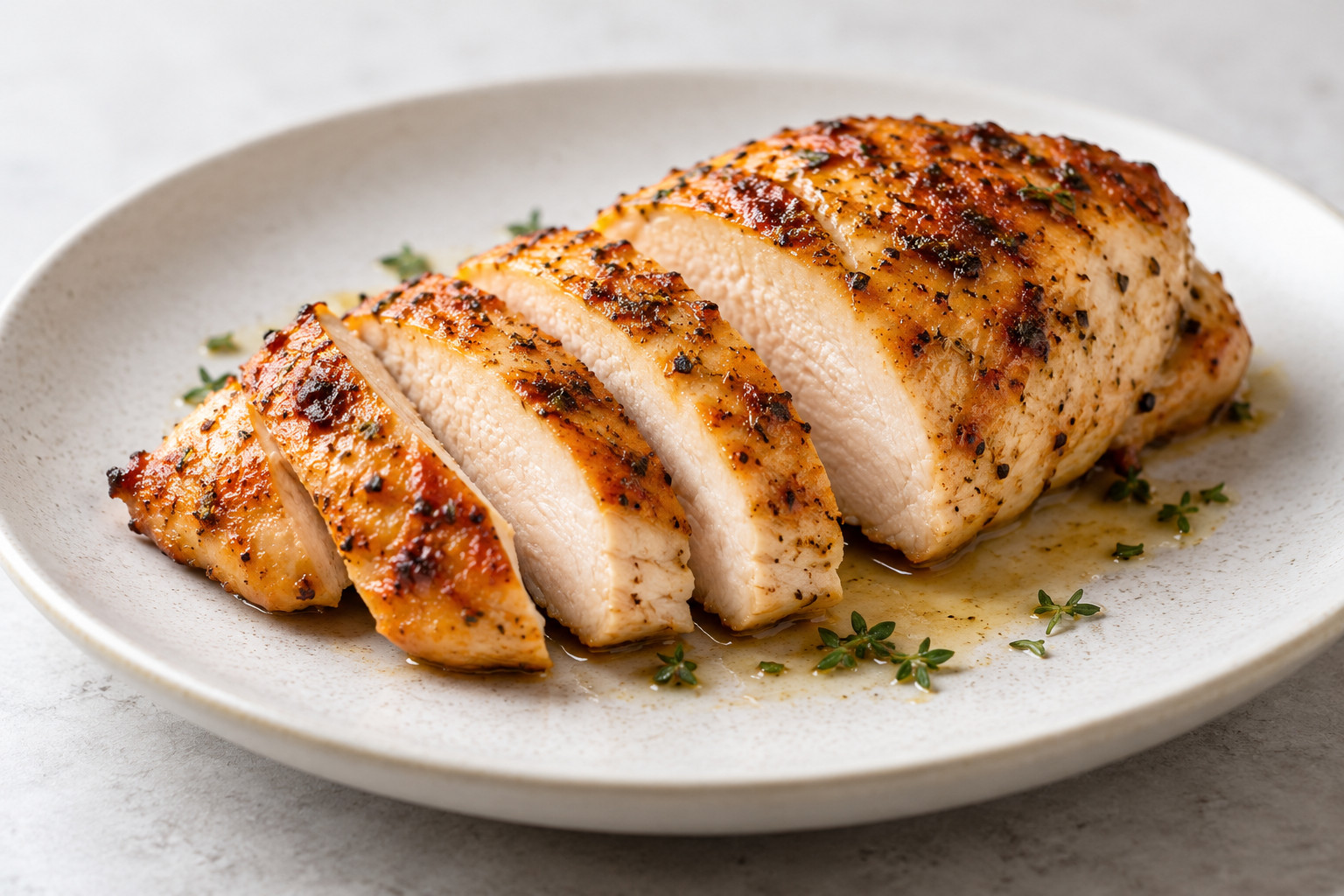
Cooked chicken: a sensory reference for defining the target flavor profile.
How should a food manufacturer define chicken flavoring before requesting a sample?
Define chicken flavoring by sensory role, composition class, format, matrix, and process. A concentrate is not interchangeable with chicken extract, broth powder, bouillon, or compound seasoning.
Chicken extract or meat powder can add animal-derived protein, fat, salt, color, and body. A reaction flavor develops cooked character by heating amino compounds, reducing sugars, and sulfur-containing materials. A compound seasoning may combine flavor with salt, starch, yeast extract, hydrolyzed protein, spices, and fat. Normalize those contributions before comparing cost-in-use.
A useful definition is: “Clean roasted-skin opening, juicy white-meat middle, light broth body, and short pepper-garlic finish in a 5% fat frozen filling, after 90 °C cooking for 20 min, served at 60 °C.”
The broader Flavor Concentrates for Food Manufacturing page covers category navigation. This profile page stays with chicken-specific sensory, matrix, process, and selection decisions. The regulatory meaning of artificial flavor is handled separately in What Is Artificial Flavor? B2B Food Guide.
Which top, middle, and base notes belong in a chicken flavor brief?
A chicken brief needs a timed structure: top notes establish cooking style, middle notes establish poultry and broth, and base notes control juiciness, browned depth, and persistence.

Flavor sample library in the LULIN laboratory
| Chicken direction | Top note at 0–2 s | Middle at 2–10 s | Base and finish at 10–60 s | Common application | Typical mismatch |
|---|---|---|---|---|---|
| Clean boiled white meat | Steam, mild onion, fresh cooked poultry | Lean white meat, light stock | Short saline broth finish | Clear soup, dumpling filling, rice product | Too bland, eggy, or sulfurous |
| Roasted skin / rotisserie | Browned skin, pepper, garlic, roasted sulfur | Juicy meat and rendered-fat impression | Toasted skin, warm spice, lingering fat | Sauce, prepared meal, snack seasoning | Burnt, smoky, greasy, or stale |
| Fried chicken | Hot oil, crust, pepper-spice lift | Cooked meat under cereal/breading notes | Savory fat, salt, toasted crumb | Coating, chips, instant noodles | Oil dominates while chicken disappears |
| Dark meat / braised | Onion, spice, deeper cooked aroma | Dark poultry, stock, umami | Long fatty, caramelized, soy-compatible finish | Braise sauce, meal kit, filling | Beef-like, liver-like, or overly sweet |
| Chicken broth | Celery, onion, herb, light poultry aroma | Stock, marrow-like body, yeast-compatible umami | Saline, rounded, clean finish | Soup base, bouillon, gravy | Generic seasoning with no poultry identity |
| Plant-based chicken-style | Roasted onion, pepper, restrained sulfur | Chicken-like savory body without meat solids | Controlled fat and umami tail | Plant protein, vegan snack, meat analogue | Beany, cereal-like, rubbery, or bouillon-heavy |
State which layer leads. A snack coating needs a fast roasted opening; soup needs a stable middle at 60 °C; plant protein needs enough body to cover beany notes without becoming salty bouillon.
Reference products help only when the attribute is named. Instead of “match Brand X,” record “more roasted skin at 0–2 s, less chicken fat after 20 s, and no celery note.”
How do water, fat, protein, sugar, salt, acid, and serving temperature change chicken flavoring?
Water, fat, protein, sugar, salt, acid, and serving temperature change chicken flavoring by altering dispersion, volatile partitioning, taste balance, mouth coating, and release time. A water dilution can expose defects, but approval must occur in the actual formula because 0% fat broth and 15% fat filling will not release the same profile.
| Matrix variable | Controlled screening bracket | Likely sensory effect | Record before comparing samples |
|---|---|---|---|
| Water / total solids | Finished dilution, then one level at −10% solids and one at +10% solids | Dilution thins broth body; higher solids can slow release and extend the finish | Total solids, water activity, viscosity, dilution ratio |
| Fat | 0%, 5%, and 15% fat when the product family permits | Retains hydrophobic roasted/fatty notes, softens salt and acid, and can delay aroma release | Fat source, emulsion state, melt point, serving temperature |
| Protein | 0%, 5%, and 15% protein in a matched model | Binds or suppresses some volatiles and contributes cooked, beany, dairy, or meaty background | Protein source, hydration, shear, heat history, pH |
| Sugar / sweetener | 0%, 1%, and 3% sugar equivalent for savory screens | Softens salt, acid, and sulfur; excess can shift roasted chicken toward barbecue or caramel | Sweetener identity, solids, sweetness onset, aftertaste |
| Salt and umami | 0.5%, 1.0%, and 1.5% NaCl; hold MSG, IMP, GMP, and yeast extract constant | Salt can increase headspace release; glutamate and nucleotides can strengthen retronasal chicken aroma | NaCl, MSG, IMP/GMP, yeast extract, potassium or mineral salts |
| Acid / pH | pH 4.0, 5.5, and 7.0 when safe and relevant to the product | Changes sourness, protein behavior, reaction-note balance, and perceived freshness | Measured pH, titratable acidity, acid type, hold time |
| Serving temperature | 4 °C, 25 °C, and 60 °C, or the real cold/ambient/hot conditions | Cold suppresses aroma; warmth increases release and may reveal sulfur, oxidation, or stale-fat notes | Core temperature, equilibration time, vessel, covered/uncovered state |
A controlled matrix screen changes one variable at a time. A 2015 Food Chemistry model-chicken-soup study found that raising MSG from 0% to 0.3% materially increased retronasal aroma intensity, supporting the need to lock MSG and nucleotide levels during supplier comparisons (PubMed record).
Fat and protein deserve paired controls. A flavor may lose its top note in a 15% protein base, while an oil-compatible fraction may release late from a 15% fat filling. Test a phase-compatible format before increasing dose.
Score refrigerated products at 4 °C, ambient snacks near 25 °C, and soup or sauce near the intended 60 °C service point. Keep containers closed until serving.
Should a buyer choose chicken flavor powder, liquid, emulsion, water-soluble, or oil-soluble format?
Format follows the continuous phase, addition point, heat, mixing equipment, and release target. “Powder” and “liquid” describe form; solubility and dispersion describe application behavior.
| Format option | Best first fit | Main advantage | Failure mode to test | Factory question |
|---|---|---|---|---|
| Water-soluble liquid | Broth, brine, sauce, aqueous filling | Fast tank dispersion and easy bench adjustment | Heat loss, carrier note, haze in complex systems | Can it be metered into the water phase before heat? |
| Oil-soluble liquid | Frying oil, fat filling, seasoning oil | Direct delivery of lipophilic roasted and fatty notes | Weak transfer into the aqueous eating phase | Is the product fat-continuous at addition and consumption? |
| Oil-dispersible liquid | Coatings and mixed-fat sauces | Spreads through oil without requiring full molecular solubility | Settling, uneven spray coverage, delayed release | What shear and hold time keep it uniform? |
| Oil-in-water (O/W) emulsion | Soup, sauce, plant-protein slurry | Carries oil-phase aroma through a water-continuous base | Creaming, ring, droplet growth, shear damage | Can the line reproduce the bench homogenization? |
| Spray-dried powder | Snack seasoning, instant noodles, dry soup, premix | Dry dosing and distribution through powder blends | Dust loss, segregation, caking, weak reconstitution | What carrier, particle size, and blending order are used? |
| Encapsulated powder | Retort, baking, delayed-release or storage-sensitive systems | Protects selected notes and changes the release window | Incomplete release or carrier-heavy taste | Which heat, moisture, and shear trigger release? |
| Reaction flavor concentrate | Cooked, roasted, dark-meat, skin, or stock direction | Builds process-like meat and browned notes | Overcooked sulfur, bitter roast, dark color | Was the profile designed for the buyer’s actual thermal process? |
| Compound chicken seasoning or bouillon | Complete soup base, noodle sachet, savory premix | Combines flavor with salt, starch, protein, spices, and enhancers | High use rate, excess sodium, formula duplication | What percentage is flavor versus functional seasoning solids? |
One spray-dried powder lists pH 4.5–6.5, density 0.3–0.7 g/mL, and 20 °C storage; another is only slightly soluble. Request code-specific dispersibility, carrier, density, pH, and moisture behavior.
Use Powder vs Liquid Food Flavors when handling decides the format. Keep the sensory target constant so the format remains the only test variable.
Why does chicken flavor change after retort, frying, baking, freezing, or storage?
Heat, water loss, oxygen, light, phase movement, and packaging change the balance of top note, broth body, reaction note, fat, and aftertaste. Test the actual time–temperature profile.
| Stress condition | Likely change | Controlled comparison | Corrective direction |
|---|---|---|---|
| Pasteurization / hot fill | Loss of fresh cooked and spice top notes | Before heat versus 85 °C for the actual hold time | Later addition, protected top note, or heat-matched profile |
| Retort | Stronger cooked base, weaker top, possible sulfur or bitter roast | Before retort versus the scheduled process; use 115 °C for 1 h only when that schedule matches | Encapsulation, reaction-profile adjustment, process-tolerant fraction |
| Baking | Volatile loss, browning interaction, dry finish | Raw dough/batter versus center temperature and bake time | Powder or encapsulated route; shift middle/base balance |
| Frying | Rapid top-note loss, oxidation, oil carryover | Fresh oil and end-of-run oil at the real temperature | Oil-compatible format, post-fry coating, oxidation control |
| Freezing / thawing | Emulsion movement and muted cold aroma | Day 0 versus one and three freeze–thaw cycles | Emulsion stabilization and cold-evaluation target |
| Powder storage | Caking, oxidation, segregation, aroma loss | Day 0, Day 30, and Day 90 in planned package | Barrier pack, carrier change, moisture and oxygen control |
| Liquid storage | Color drift, headspace loss, separation | 4 °C and 25 °C holds in the intended closure | Phase adjustment, light barrier, headspace control |
| Reheating / hot holding | Top-note stripping and stale-fat exposure | 0 min, 30 min, and 120 min at service temperature | Shorter hold, split addition, cleaner fatty base |
Historical reaction-flavor examples at 85 °C, 100 °C, and 115 °C produced cooked, dark-meat, and roasted-skin directions (EP0160794B1). Those development temperatures do not prove finished-product survival; they show why the supplier needs the buyer’s actual process window.
Compare the intended sachet, lined can, PET jar, retort pouch, or pail; a Day 0 win can fail by Day 90 through moisture, oxidation, or headspace loss.
How should buyers compare chicken flavor samples in the real application base?
Buyers should compare coded, process-matched prototypes in one locked base, scoring aroma timing, meat/broth identity, fatty finish, off-notes, and overall fit. Water tasting cannot approve a commercial sample.
Prepare a no-flavor control, the current reference, and each candidate. Weigh on finished-food mass unless every candidate uses the same premix basis. Use random three-digit codes and serve at 4 °C, 25 °C, or 60 °C according to use.
| Attribute | 0–10 scoring anchor | Timing | Reject signal |
|---|---|---|---|
| Chicken identity | 0 = absent; 10 = unmistakable target direction | First recognition | Generic yeast, onion, or bouillon replaces poultry |
| Cooking-style top | 0 = absent; 10 = exact boiled, roasted, fried, or grilled target | 0–2 s | Burnt, solvent-like, eggy, or sharp sulfur |
| Meat and broth body | 0 = hollow; 10 = full but balanced | 2–10 s | Loud aroma with an empty middle |
| Fat / juiciness | 0 = dry; 10 = excessive fat | 10–30 s | Greasy, waxy, rancid, or clinging finish |
| Salt–umami integration | 0 = disconnected; 10 = fully integrated | 2–30 s | Flavor only works by increasing sodium or MSG |
| Off-note control | 0 = severe defect; 10 = clean | 0–60 s | Beany, bitter, metallic, cardboard, or liver-like note |
| Overall application fit | 0 = reject; 10 = target match | Full sample | Profile fails after process or at serving temperature |
Session 1 screens Day 0 samples. Session 2 repeats survivors after the target process and a relevant Day 7 or Day 30 storage checkpoint. Keep panel instructions identical and record any salt or temperature dependency.
Record formula, code, batch, process, package, temperature, scores, observations, and decision. Food Flavor Formulation Support for B2B R&D can translate the controls into production testing.
Attach one controlled test card to every sample round:
| Test-card field | Locked values or checkpoints |
|---|---|
| Concentrate dose | 0.25%, 0.50%, 1.00%, 2.00% |
| Dose equivalent | 2.5 g/kg, 5.0 g/kg, 10.0 g/kg, 20.0 g/kg |
| 100 kg batch addition | 250 g, 500 g, 1 kg, 2 kg |
| Fat screen | 0%, 5%, 15% |
| Protein screen | 0%, 5%, 15% |
| Sugar screen | 0%, 1%, 3% |
| NaCl screen | 0.5%, 1.0%, 1.5% |
| Serving points | 4 °C, 25 °C, 60 °C |
| Reaction references | 85 °C, 100 °C, 115 °C |
| Retort reference | 115 °C, 1 h |
| Hold checkpoints | 0 min, 20 min, 30 min, 60 min, 120 min |
| Tasting windows | 0 s, 2 s, 10 s, 30 s, 60 s |
| Storage checkpoints | 0 days, 7 days, 30 days, 90 days |
| Powder handling | 0.3 g/mL, 0.7 g/mL, 20 °C, 12 months |
| Sample timing | 3 days, 4 days, 5 days |
| MOQ planning | 20 kg, 25 kg |
| Production timing | 10 days, 15 days |
What dosage ladder gives a useful chicken flavoring benchmark?
Use 1.00% w/w, equal to 10 g/kg finished food, as the high-side reference benchmark for the first concentrated chicken flavor screen, with the complete ladder at 0.25%, 0.50%, 1.00%, and 2.00% w/w. The purpose is to reveal profile shape and failure, not to set a universal production dosage.
| Test point | Finished-food equivalent | Decision purpose |
|---|---|---|
| 0.25% w/w | 2.5 g/kg | Detect a clean, high-impact concentrate and early top-note shape |
| 0.50% w/w | 5.0 g/kg | Check balance before salt, fat, or roast becomes dominant |
| 1.00% w/w | 10.0 g/kg | High-side design benchmark for a decisive first screen |
| 2.00% w/w | 20.0 g/kg | Escalation point to expose carrier, sulfur, bitterness, fat, or sodium defects |
Commercial examples range from 0.1–0.3% for some liquids to 1–2% for an anhydrous powder, while another liquid spans 0.2–5%. Keep dosage attached to product code, carrier, format, base, and process.
Normalize a compound bouillon before comparison: a 2.00% compound can deliver salt, starch, yeast extract, and protein, while a 0.25% liquid may carry mostly aromatic components.
Is artificial chicken flavor vegetarian or vegan, and does it contain meat?
Artificial chicken flavor can be vegetarian or vegan, but the name does not prove complete-product status. Under U.S. FDA definitions in 21 CFR 101.22, artificial flavor is not derived from listed natural sources such as meat or poultry; a blend can still contain dairy, animal materials, or separately declared ingredients.
Natural chicken flavor cannot be classified as vegan by name. U.S. natural flavor may derive from plants, meat, poultry, dairy, eggs, or fermentation. Request item-level source documents. Under 21 CFR 101.22, protein hydrolysates used for flavor require their specific common or usual name.
| Buyer question | Decisive supplier evidence | What the wording does not prove |
|---|---|---|
| Does it contain chicken or poultry? | Ingredient/source declaration and animal-origin statement | The sensory name “chicken” |
| Is it vegetarian or vegan? | Signed vegetarian/vegan declaration for the exact code | “Artificial,” “natural,” or “plant-based” marketing alone |
| Does it contain milk, soy, wheat, egg, or sesame? | U.S. major-allergen statement plus ingredient review | A vegan claim or flavor-category name |
| Is it Halal or Kosher? | Current certificate and product/facility scope | Absence of obvious pork or meat wording |
| How should it be labeled in the United States? | Composition, intended use, finished-product label context, and U.S. regulatory statement | A supplier catalog name |
| Does it fit another destination market? | Market-specific declaration and importer/customer checklist | U.S. documentation copied across borders |
The Food Flavor Compliance Document Request Guide explains how COA, SDS, TDS, allergen, source, and certification records serve different review tasks. Dietary, religious, allergen, and regulatory questions should travel with the sample code through approval.
For individual flavor-substance review, the FEMA flavor safety and labeling resources can support the supplier’s regulatory basis; FEMA GRAS status does not replace finished-formula, use-level, allergen, or destination-market review.
What should a U.S.-market chicken flavoring RFQ include?
A chicken flavoring RFQ needs the sensory target, base, process, format, dose test, destination market, documents, volume, and acceptance method.
| RFQ field | Details to send | Why procurement needs it |
|---|---|---|
| Finished application | Soup, sauce, snack coating, noodle sachet, filling, plant protein, prepared meal, pet food, or other defined product | Separates phase, regulatory, and use-level context |
| Chicken direction | Boiled white meat, roasted skin, fried, dark meat, broth, rotisserie, or plant-based chicken-style | Aligns the sample with a scoreable sensory target |
| Formula matrix | Water, fat %, protein %, sugar %, NaCl %, MSG/nucleotide system, acid, pH, viscosity | Predicts release, suppression, and compatibility |
| Process and package | Addition point, shear, 85 °C/20 min cook, 115 °C/1 h retort when applicable, frying, baking, freezing, hot hold, package | Defines the performance challenge |
| Format options | Water-soluble liquid, oil-soluble liquid, oil-dispersible liquid, O/W emulsion, spray-dried powder, encapsulated powder, reaction concentrate, or compound | Prevents a physical-form mismatch |
| Sample protocol | No-flavor control, current benchmark, 0.25%, 0.50%, 1.00%, 2.00% ladder, serving temperature, Day 0/7/30 checks | Makes supplier samples comparable |
| U.S. and destination documents | Specification, TDS, SDS, lot COA, ingredient/carrier, allergen, animal-origin, vegan/vegetarian, Halal/Kosher, regulatory statement | Connects sensory approval to QA and import review |
| Commercial scope | Trial quantity, first order, annual forecast, pack size, MOQ, price tiers, Incoterm, sample deadline, production date | Produces a usable quote and supply plan |
| Change control | Formula/code identity, notification period, substitute-material policy, retained sample, complaint route | Protects the approved sensory and document profile |
Quote flavor concentrate and compound seasoning separately. Record price per kilogram, approved use level, non-flavor solids, process yield, and rejected-batch risk; unit price alone does not establish cost-in-use.
How does LULIN FLAVOR support a chicken flavor project from sample to supply?
LULIN FLAVOR provides application-led profile selection, powder and liquid options, phase matching, samples, documentation, and export support. The brand belongs to QUANZHOU LVLIN BIOENGINEERING CO., LTD., established in 2001 in Quanzhou, Fujian, China.
Three modernized production lines occupy more than 8,000 m², supported by more than 50 employees and over a dozen flavor engineers with over 20 years of development experience. ISO 22000 and HACCP systems support traceability. Application samples take 3–5 business days; MOQ starts at 20 kg for powder and 25 kg for liquid; standard production takes 10–15 business days after approval.
Submit the matrix, process, profile, market, ladder, and documents through the Food Flavor Sample Request for B2B Buyers or Contact LULIN FLAVOR for Food Flavor Project Inquiries. Review LULIN FLAVOR food manufacturer capabilities during qualification.
Chicken flavoring FAQ for formulators and buyers
What is chicken flavoring?
Chicken flavoring is a concentrated flavor system designed to create a selected boiled, broth, roasted, fried, skin, fat, or chicken-style sensory impression. It may be liquid, powder, emulsified, encapsulated, reaction-derived, water-compatible, or oil-compatible. It is not automatically the same as chicken extract, bouillon, or compound seasoning.
What is a practical starting dosage for chicken flavoring?
Use 1.00% w/w (10 g/kg finished food) as a high-side reference benchmark in a first concentrated-flavor screen. Test the complete ladder at 0.25%, 0.50%, 1.00%, and 2.00% w/w in the real base. The selected product code, carrier, process, and supplier guidance determine the final use level.
How should a buyer describe roasted chicken flavor precisely?
Describe roasted chicken as a timed profile: browned-skin and pepper-garlic top notes at 0–2 s, juicy cooked-meat body at 2–10 s, then toasted skin, warm spice, and controlled fat through 10–60 s. State whether burnt, smoky, greasy, sulfurous, or long fatty notes are unacceptable.
Should soup use chicken flavor powder or liquid?
Either format can work, but soup should first test a water-compatible liquid or readily dispersible powder at the real salt, fat, protein, pH, heat, and serving temperature. Powder may simplify dry premixing; liquid may simplify tank dosing. Compare sensory performance, dispersion, process loss, documents, and cost-in-use.
Why does chicken flavor become weaker in a high-protein base?
Protein can bind or suppress aroma compounds while contributing cooked, beany, dairy, mineral, or cereal notes of its own. Compare the same dose in the actual protein base and a matched low-protein control. If the opening disappears but the finish becomes greasy, change delivery format or sensory architecture before increasing dose.
How do salt and MSG affect chicken aroma?
Salt and MSG change more than basic taste: salt can alter volatile release, while glutamate and nucleotides can strengthen retronasal savory aroma. Keep NaCl, MSG, IMP, GMP, yeast extract, and mineral salts constant during supplier comparisons. Rebalance them only in a separate matrix experiment with the flavor dose locked.
Is artificial chicken flavor vegan or vegetarian?
Artificial chicken flavor may be vegan or vegetarian, but the category name is not sufficient proof. Request the exact product’s ingredient, animal-origin, allergen, vegetarian/vegan, carrier, and processing declarations. A finished seasoning can combine an artificial flavor with dairy, meat-derived fat, hydrolyzed protein, or other separately declared ingredients.
Does natural chicken flavor always contain chicken meat?
No. The phrase alone does not identify every source or establish animal content, vegetarian status, or finished-label wording. U.S. natural flavor can derive from several plant, animal, dairy, egg, poultry, or fermentation sources. Review the supplier’s source declaration, ingredient statement, allergen record, and destination-market regulatory statement for the selected code.
What process conditions should be included in a chicken flavor sample test?
Include the exact addition point, mixing and shear, time–temperature profile, frying or baking condition, cooling, freezing, reheating, hot holding, package, storage, and serving temperature. Compare pre-process and post-process samples. Use a 115 °C/1 h challenge only when it represents the product’s scheduled retort process.
Which documents should a chicken flavor supplier provide?
A supplier package should include the product specification, TDS, SDS, lot COA, ingredient and carrier declaration, allergen statement, animal-origin and vegetarian/vegan status, shelf-life and storage guidance, destination-market regulatory statement, relevant certificates, and change-control terms. The quotation should add pack size, MOQ, price tiers, Incoterm, sample timing, and production lead time.
Send a process-matched chicken flavor selection brief
State one sensory sentence, locked formula, real process, serving temperature, and acceptance scorecard. Screen 0.25%, 0.50%, 1.00%, and 2.00% w/w; use 1.00% w/w as the high-side reference benchmark; carry only the best profile-format combinations into process, storage, document, and commercial review.