Published
Cola Flavoring
Cola flavoring is a layered citrus, brown-spice, vanilla, caramel, herbal, and cooling profile whose final character depends on the food matrix and process. Define each sensory layer, then compare formats in the real base; for regular carbonated beverage screening, use 7.0 g/L CO₂ in 10% w/v sucrose as the design benchmark.
Last updated: August 31, 2026
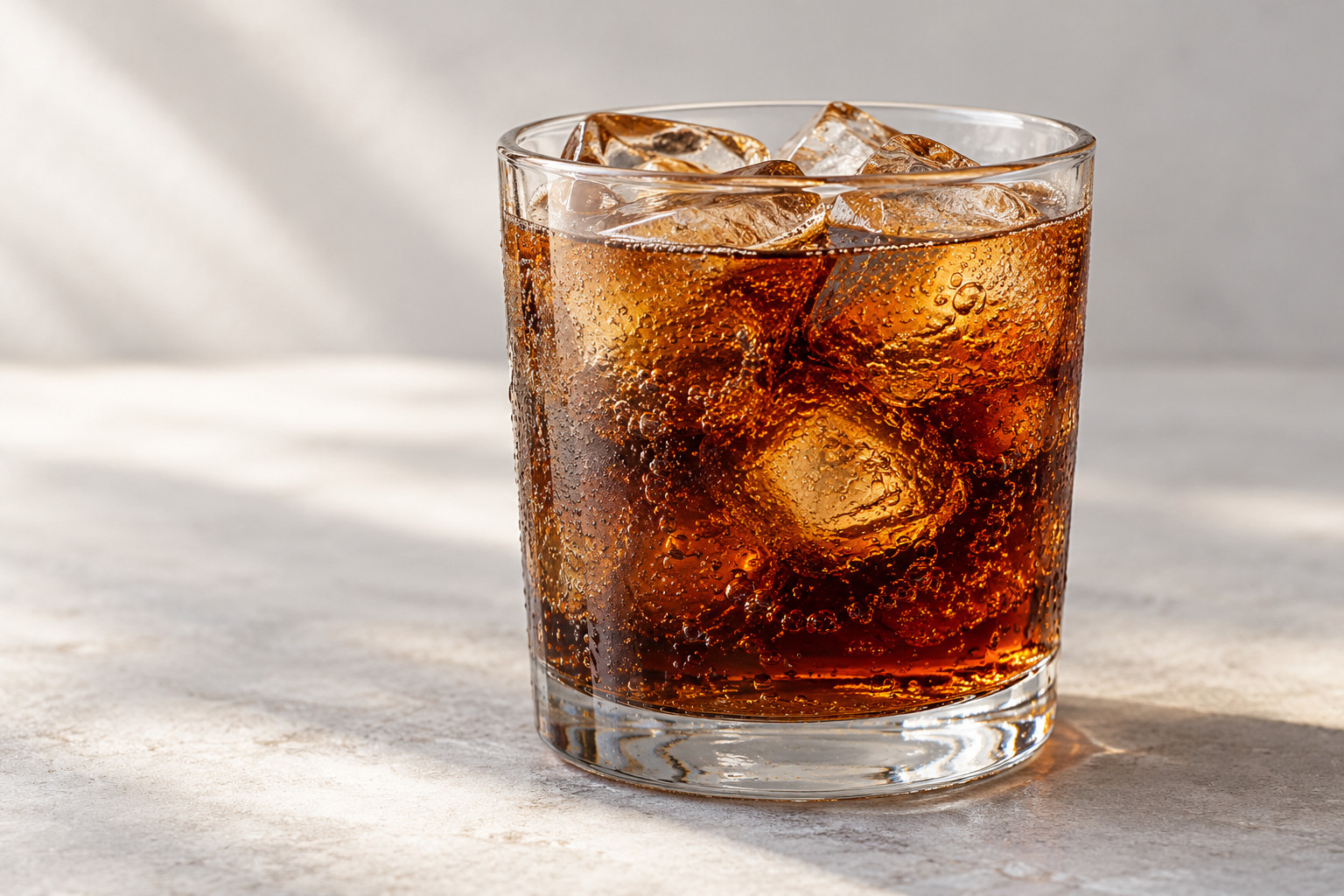
Cola-style soft drink: a sensory reference for defining the target flavor profile.
How should a product developer describe a Cola flavor profile without vague sensory adjectives?
A product developer should describe a Cola profile by sensory layer, intensity, timing, reference, and defect limit. Precise language matters. Vague adjectives fail. “Classic,” “bold,” and “refreshing” cannot tell a flavorist whether lime leads orange, cassia dominates clove, or vanilla rounds the finish.
Cola is an accord, not one raw material. Published U.S. analysis identifies citrus, spicy, floral, herbal, sweet, smoky, and cooling odorants; descriptive work uses lemon-lime, orange, brown spice, herbal, vanilla, caramel, cooling, and pine. No single compound carries the identity. Balance does.
Top, middle, base, and finish are briefing layers, not a chemical standard. The reference windows make supplier samples comparable while recognizing that volatiles release at different rates.
| Sensory layer | Reference time | Job in Cola Flavoring | Precise directions to choose from | Common failure | Better brief language |
|---|---|---|---|---|---|
| Top | 0–3 s | Signals brightness and first recognition | Lemon peel, lime peel, sweet orange, neroli-like floral lift, cooling | Lemonade-only, perfumed, solvent-like, or weak after chilling | “Lime leads lemon; orange is 3/10; cooling stays below 2/10” |
| Middle | 3–10 s | Builds the spicy and herbal heart | Cassia, cinnamon, clove, coriander, nutmeg, mace, restrained ginger, dry herb | Medicinal clove, dusty spice, root-beer drift, or generic brown flavor | “Cassia-led brown spice at 6/10 with a clean coriander edge” |
| Base | 10–30 s | Supplies continuity and body | Vanilla, dry caramel, brown sugar, sweet-herbaceous, light smoky wood | Cream-soda vanilla, burnt caramel, syrup heaviness, or empty center | “Dry vanilla rounds the acid; caramel supports but does not lead” |
| Finish | 30–60 s | Controls the final memory and repeat-sip behavior | Clean bitterness, lingering spice, short citrus, cooling, dry botanical tail | Metallic, piney, soapy, bitter-sweetener, or long medicinal tail | “Short dry finish; bitter note below 2/10; no pine after 30 s” |
A usable brief reads: “Lime-led top, orange support, cassia-coriander middle, dry vanilla, restrained caramel, clean bitter finish; no clove medicine, pine, or cream-soda drift.” Add a market reference and the intended difference.
Color and carbonation cannot replace aroma language. Caramel color changes visual expectation; carbon dioxide creates bite, burn, and numbing. Neither defines the citrus-spice accord. General food-manufacturing flavor concentrate formats sit at the category level; this brief defines the narrower Cola decision.
How do water, fat, protein, sugar, salt, acid, carbonation, and temperature change Cola Flavoring?
Water, fat, protein, sugar, salt, acid, carbonation, and temperature change Cola Flavoring through volatile partitioning, taste balance, dispersion, and release. Bench aroma misleads. A correct-smelling concentrate can become flat in whey protein, slow in fat, lemon-heavy with one sweetener, or harsh at 4°C.
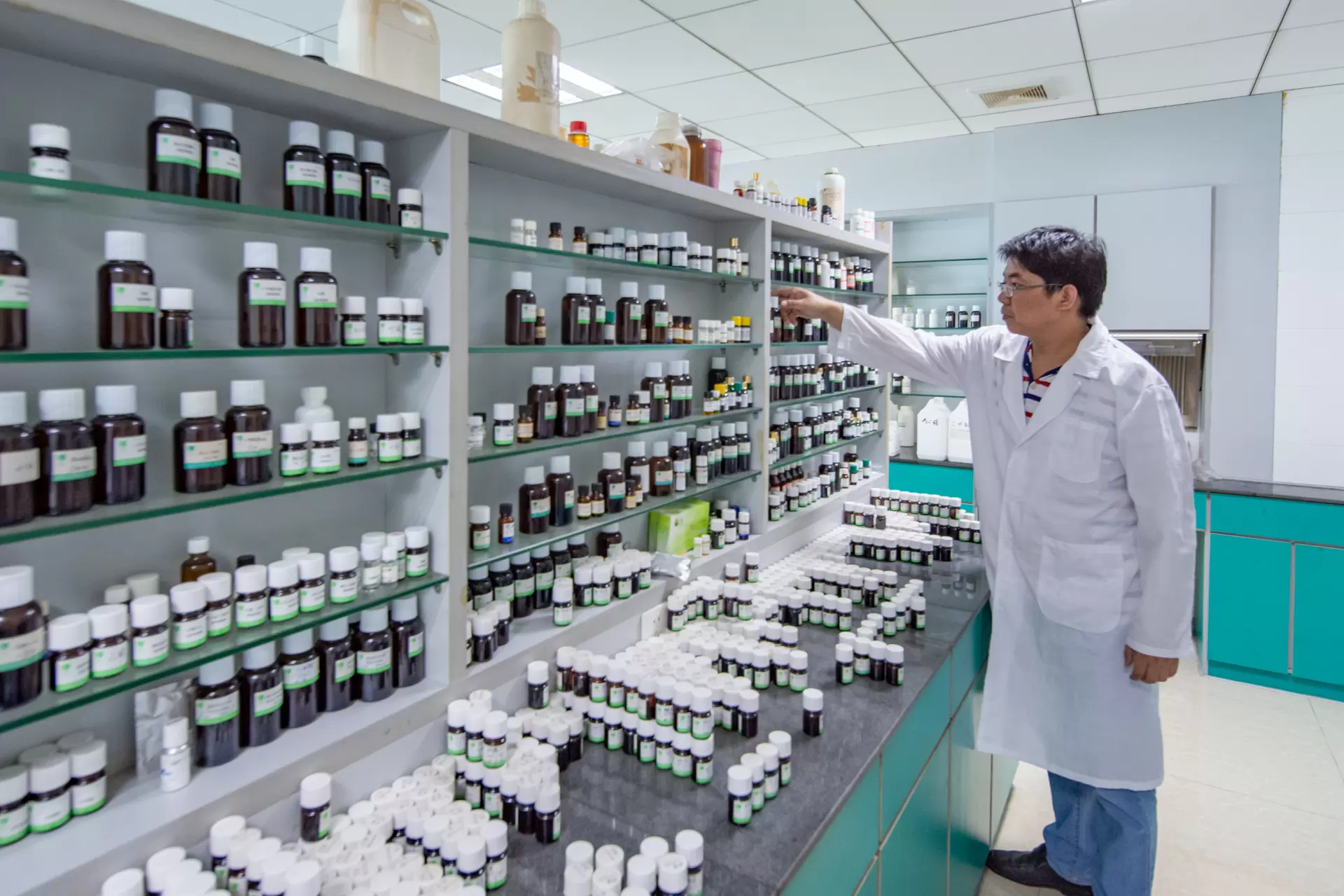
Flavor sample library in the LULIN laboratory
Change one variable at a time. The diagnostic grid below uses deliberate screening points, not universal finished-product specifications.
| Matrix variable | Controlled screening set | Likely sensory or physical shift | Decision to record |
|---|---|---|---|
| Water | Laboratory water, plant water, final mineral profile | Dilution exposes weak body; bicarbonate changes acid expression; minerals can reveal haze or an oil ring | Clarity, citrus lift, mineral tail, pH, titratable acidity |
| Fat | 0%, 3%, 8% w/w | Hydrophobic citrus and spice materials partition into fat, lowering first impact and extending persistence | Top-note loss at 3 s; release at 10 s and 30 s |
| Protein | 0%, 5%, 10% w/w | Whey, casein, soy, or pea protein can bind aroma and add chalky, beany, bitter, or astringent signals | Total Cola identity, masking need, sediment, finish |
| Sucrose | 0%, 10%, 20%, 30% w/v | Dissolved solids change body and headspace behavior; sweetness suppresses acid and bitterness | Spicy versus lemon-lime balance, body, aftertaste |
| High-intensity sweetener | Sweetness matched to 10% w/v sucrose | Similar sweetness does not reproduce sucrose solids, temporal profile, or aroma partitioning | Sweetness onset, metallic/bitter tail, vanilla fullness |
| Salt and electrolytes | 0%, 0.05%, 0.10% w/w, then actual formula | Ionic strength may lift some volatiles but can harden mineral or bitter notes and disturb an emulsion | Saline/metallic tail, ring, cloud, bitterness |
| Acid system | Phosphoric, citric, malic, and the planned blend at matched pH | Phosphoric reads dry and sharp; citric pushes citrus; malic extends sourness; equal pH can still taste different | pH, titratable acidity, citrus-spice balance, finish length |
| Carbon dioxide | 0 g/L, 4.0 g/L, 7.0 g/L | CO₂ adds bite and changes aroma delivery, sweetness, sourness, and mouthfeel | First-sip impact, burn, numbing, total Cola, fill loss |
| Serving temperature | 4°C, 20°C, 35°C | Cold reduces volatile impact; warmth exposes heavy spice, vanilla, oxidation, and carrier notes | Intended-use result plus 20°C diagnostic control |
Scope matters here. The 10% w/v sucrose and 7.0 g/L CO₂ pairing is a regular ready-to-drink reference. The 7.0 g/L CO₂ value is the high-end design benchmark, not a flavor dosage. Other applications need their own base.
Sweetener changes need a separate split. Published Cola work found movement in total Cola, spicy, lemon-lime, bitterness, and metallic aftertaste even at matched sweetness. Replacing sucrose with sucralose, aspartame, acesulfame potassium, stevia, or a blend is a flavor reformulation.
Protein and fat can retain hydrophobic aroma materials; protein also binds some carbonyls and contributes off-notes. More flavor may amplify the wrong top note while the middle stays muted. Test application-specific formulation support against the final protein, fat, acid, and heat conditions.
Which Cola Flavoring delivery formats should a manufacturer test?
A manufacturer should test the Cola Flavoring format that matches phase, appearance, process, and dosing equipment, plus one technically distinct backup. The named set is Water-Soluble Liquid, Oil-Soluble Liquid, Beverage Emulsion, Spray-Dried Powder, and Plated Powder.
| Named format | What it is | Best first application | Main advantage | Failure mode to challenge |
|---|---|---|---|---|
| Water-Soluble Liquid | Liquid designed to dissolve clearly in the specified water phase | Clear carbonated drinks, syrups, water enhancers, gels | Fast bench adjustment and pump dosing | Haze, low-temperature precipitation, carrier note, weak persistence |
| Oil-Soluble Liquid | Liquid designed for fat or oil distribution | Fat fillings, compound coatings, chocolate-style systems, oil-based confectionery | Direct phase match and strong oil-phase distribution | Weak oral release, uneven pre-emulsion, water-phase separation |
| Beverage Emulsion | Oil-in-water delivery system for citrus/spice oils and other lipophilic materials | Cloudy RTD drinks, energy drinks, juice-style systems, frozen desserts | Carries oil notes into water and can add controlled cloud | Ringing, creaming, sediment, oil film, droplet growth, mineral sensitivity |
| Spray-Dried Powder | Encapsulated liquid flavor dried onto or within a carrier matrix | Powdered drink mix, protein powder, tablets, dry premixes | Dry handling, measured dosing, improved volatile protection | Surface-oil oxidation, caking, dust, slow dissolution, drying loss |
| Plated Powder | Liquid flavor adsorbed onto a dry carrier | Fast-turn dry mixes, bakery premixes, seasoning-style systems | Simple dry blending and strong opening aroma | Weaker oxidation protection, segregation, top-note loss, carrier load |
Format labels overlap. Liquid and Powder are physical states; Water-Soluble and Oil-Soluble identify phase behavior; Emulsion, Spray Drying, and Plating identify delivery technology. An extract can enter either liquid type. “Concentrate” does not define clarity, carrier, or use rate.
Equal weight is not equal strength. A 0.20% Water-Soluble Liquid and 0.20% Spray-Dried Powder can carry different active loads and release curves. Compare each item at 75%, 100%, and 125% of its own starting rate in one finished base.
Phase match comes first. Confirm tank order, pre-dilution, shear, dust control, metering, clean-in-place compatibility, and pack size. The powder and liquid flavor formats guide covers handling; the Cola decision still rests on sensory and physical performance.
How should Cola Flavoring change for carbonated drinks, water enhancers, energy drinks, powders, and protein products?
Cola Flavoring should change with the application because each base exposes another weakness. The matrix decides. Select the sample that survives the commercial formula, not the one that wins in neutral water.
| Application | First format route | Matrix challenge | Profile adjustment to test | Decisive evaluation condition |
|---|---|---|---|---|
| Regular carbonated soft drink | Water-Soluble Liquid or Beverage Emulsion | Acid, 10% w/v sucrose, 7.0 g/L CO₂, cold service | Balance lemon-lime against brown spice; keep vanilla dry | 4°C finished drink versus 20°C control after carbonation |
| Cola water enhancer | Water-Soluble Liquid | Low solids, plant-water minerals, consumer dilution error | Cleaner middle, restrained caramel, enough body at final dilution | Minimum, target, and 125% label dilution in actual water |
| Cola-flavored energy drink | Water-Soluble Liquid or Beverage Emulsion | Caffeine, B vitamins, minerals, high-intensity sweeteners, acid | Stronger spice/base continuity plus bitter and metallic masking | Final caffeine/vitamin system at 4°C and after 28 days |
| Cola powdered drink mix | Spray-Dried Powder or Plated Powder | Moisture pickup, segregation, reconstitution, low-temperature dissolution | Protect citrus lift; prevent carrier-heavy or dusty finish | Dry blend and reconstituted drink at 5°C and 25°C |
| Cola-flavored protein powder | Spray-Dried Powder | Whey/plant binding, chalkiness, beany notes, sweetener tail | More middle and base; controlled citrus; targeted masking | Final protein at 5% and 10% w/w after 24 h hydration |
| Cola confectionery or frozen dessert | Oil-Soluble Liquid, Beverage Emulsion, or Powder | Fat partition, cooking, freezing, chew/melt release | Longer spice and vanilla body; top note matched to process | Finished bite or melt profile, not pre-process syrup |
Taste water enhancers and powders at consumer dilution. Energy drinks need the complete active system because caffeine and minerals create bitterness that a plain base misses. Protein systems need both a fresh sample and a 24 h hydrated sample.
Confectionery shifts the timeline. Gummies need recognition through chew; frozen desserts need impact at low temperature and during melt. A beverage-style top note may vanish too early.
Which processing and storage conditions can move Cola Flavoring away from target?
Heat, acid, oxygen, light, headspace, shear, packaging, and humidity can make Cola Flavoring flat, caramel-heavy, piney, medicinal, or unstable. Process history matters. Conditions define stability. Name the item, matrix, temperature, time, package, and acceptance criterion.
| Stress point | Reference comparison | Likely change | Pass/fail observation |
|---|---|---|---|
| Short heat | Unprocessed control versus 72°C for 15 s | Loss of light citrus aldehydes; spice becomes more visible | Total Cola and citrus lift after cooling |
| Hot-fill screen | Unprocessed control versus 85°C for 30 s | Top-note stripping, cooked base, carrier exposure | No medicinal, scorched, or empty-center defect |
| Acid aging | Final pH and acid blend at 5°C, 25°C, 40°C | Citrus terpene change; weaker lemon-lime; heavier caramel or aged note | Attribute movement from 0 days through 12 weeks |
| Oxygen/headspace | Commercial closure with low and high process headspace | Oxidized citrus, soapy or piney drift, dull finish | Package-open aroma and 30 s finish |
| Light | Dark control versus planned display-light exposure | Aroma oxidation and color/profile mismatch | Blind flavor score plus visual score |
| Beverage emulsion | Finished drink at 4°C, 20°C, 35°C | Ring, cream layer, sediment, haze, droplet growth | No oil film; defined cloud or clarity remains within target |
| PET interaction | Intended PET at 4°C, 25°C, 40°C | Absorption of lipophilic citrus materials and changed headspace | Pack comparison against glass control |
| Powder humidity | Sealed control versus plant and distribution humidity | Caking, surface-oil oxidation, segregation, slow reconstitution | Flow, aroma, dose uniformity, dissolution |
These conditions diagnose risk. They do not establish shelf life by conversion. A 40°C sample held for 12 weeks is a high-stress comparison, not a fixed number of months at 25°C.
Control the addition point. Late addition may protect top notes; early addition may improve distribution but increase thermal and headspace loss. Record peak temperature, hold time, mixing mode, cooling time, homogenization pressure, carbonation point, fill temperature, package, and orientation.
Package matters. Glass, PET, film, and closure liners interact differently with lipophilic aroma. Published Cola work found profile movement among 5°C, room-temperature, and 40°C storage, so the bottle belongs in the plan.
How should buyers compare Cola Flavoring samples in the real application base?
Buyers should compare coded Cola Flavoring samples in one batch, using item-specific ladders, the intended process, fixed service, and a written rule. Code every sample. Neat aroma misleads. It can reject contamination, but it cannot approve a production flavor.
Use this reference protocol:
- Freeze the brief. Write the top, middle, base, finish, market reference, and 3 prohibited defects before samples arrive.
- Prepare one base. Hold water, fat, protein, sugar, sweetener, salt, acids, pH, titratable acidity, color, and preservatives constant.
- Set the RTD benchmark. For a regular carbonated screen, use 10% w/v sucrose and 7.0 g/L CO₂. Apply another base to non-RTD projects.
- Build each item’s ladder. Test 75%, 100%, and 125% of that supplier’s starting rate. Never copy one format’s rate onto another.
- Blind the samples. Use random 3-digit codes, 8 trained assessors, 3 evaluation sessions, and balanced serving order. Serve equal 50 g portions.
- Track time. Record 0–3 s top impact, 3–10 s middle, 10–30 s base, and 30–60 s finish at 4°C and 20°C.
- Split process and storage. Compare untreated and processed samples at 0 days, 7 days, and 28 days; add the validated shelf-life design afterward.
ISO 13299:2016 covers sensory profiles, reference comparisons, and off-note characterization. This 100-point scorecard turns that method into a Cola supplier screen.
| Decision dimension | Weight | 0-point anchor | Full-score anchor |
|---|---|---|---|
| Total Cola identity | 20% | Reads as citrus soda, cream soda, root beer, or generic brown flavor | Recognizable Cola in blind service at 4°C and 20°C |
| Citrus-spice balance | 15% | Lemon-lime or clove dominates | Target top and brown-spice middle remain distinct |
| Base and finish continuity | 15% | Empty center, heavy caramel, or vanilla cream | Dry vanilla/caramel support and clean 30–60 s finish |
| Matrix integration | 15% | Protein, mineral, acid, or sweetener conflict controls the taste | Profile fits the complete finished formula |
| Process retention | 15% | Major identity loss after heat, fill, or drying | Processed sample stays within the approved profile |
| Aftertaste and defect control | 10% | Medicinal, metallic, soapy, piney, burnt, or carrier tail | No critical defect above 2/10 |
| Physical stability | 10% | Ring, oil film, sediment, caking, or failed dissolution | Appearance and handling meet the written target |
Advance a sample at 75/100 or higher only when every critical defect is 2/10 or lower. This screens suppliers; it does not prove consumer acceptance, scale-up, compliance, or shelf life.
| Observation | Probable cause | Next controlled change |
|---|---|---|
| Strong aroma, weak Cola taste | Volatile top without middle/base continuity | Strengthen spice and dry vanilla before raising total dose |
| Lemon-lime soda rather than Cola | Citrus or citric acid dominates | Reduce citrus attack; increase brown-spice definition |
| Cream-soda drift | Vanilla and sweet base are too round | Dry the base; raise spice and clean bitterness |
| Medicinal or root-beer finish | Clove, cooling, herbal, or sweetener tail is excessive | Run omission splits and shorten the finish |
| Flat result in protein | Binding and off-notes suppress the accord | Compare protein-adapted powder and stronger middle/base |
| Ring, haze, cream, or sediment | Delivery system conflicts with minerals, pH, or dilution | Compare Water-soluble liquid with a revised Beverage emulsion |
Send coded results. “Sample B lost lime after 85°C for 30 s and gained a 4/10 clove-medicinal finish” gives a flavorist an actionable correction. “Make it stronger” does not.
What facts and documents belong in a Cola Flavoring RFQ?
A Cola Flavoring RFQ should name the sensory target, matrix, process, format, market, method, documents, and commercial stage. Price follows performance. Compare price per kilogram only after aligning strength, use rate, carrier, retention, pack size, and freight.
| RFQ field | Information to send or request | Why it changes the supplier decision |
|---|---|---|
| Finished application | Carbonated RTD, enhancer, syrup, energy drink, powder mix, protein product, confectionery, frozen dessert | Defines phase, release, process, serving temperature, and equipment |
| Sensory direction | Top/middle/base/finish scores, market reference, prohibited defects | Prevents generic “classic Cola” sampling |
| Formula | Water, 10% or actual sugar, sweeteners, fat, protein, salt, acids, pH, titratable acidity, minerals, caffeine, color | Reveals binding, masking, emulsion, and aftertaste risks |
| Process | Addition point, shear, homogenization, 72°C/15 s or actual heat, cooling, carbonation, drying, cook endpoint | Establishes the relevant stability test |
| Format and handling | Water-Soluble Liquid, Oil-Soluble Liquid, Beverage Emulsion, Spray-Dried Powder, Plated Powder; dosing equipment | Aligns phase behavior, metering, dust, tank, and clean-in-place needs |
| Market and label | United States or other destination; natural/artificial position; characterizing-flavor wording; customer restrictions | Determines ingredient and declaration review |
| Documents | TDS/specification, sample or lot COA, SDS, ingredient/carrier/solvent statement, allergen statement, country of origin, shelf life, storage, label-status statement | Gives R&D, QA, regulatory, and procurement one item-level file set |
| Commercial facts | Sample quantity, pack size, MOQ, annual forecast, price basis, production lead time, delivery point, Incoterm | Produces a usable landed-cost and supply comparison |
For a United States launch, 21 CFR 101.22 separates sensory identity from natural or artificial status. Cola taste cannot decide the declaration; composition, source, processing, finished-food representation, and the rule do. The detailed boundary belongs in how artificial flavor status is determined. The RFQ should state target wording and request the item’s regulatory basis.
Request the nine-major-allergen statement, U.S. regulatory-status statement, traceability, intended-use guidance, process limits, and Foreign Supplier Verification Program data needed by the importer. Avoid a generic “FDA approved” checkbox. Use the LULIN FLAVOR guide to prepare a food flavor compliance document request.
Send LULIN FLAVOR a Cola brief built for the real process
LULIN FLAVOR routes a Cola project from application to profile, format, process trial, documents, and RFQ. Application context leads. LULIN FLAVOR is the English brand of QUANZHOU LVLIN BIOENGINEERING CO., LTD., a Quanzhou, Fujian food-grade flavor manufacturer established in 2001.
The company develops Liquid and Powder flavors for beverage, bakery, dairy-style, confectionery, and dry-mix applications. Cola projects can be screened as Water-Soluble Liquid, Oil-Soluble Liquid, Beverage Emulsion, Spray-Dried Powder, or Plated Powder. The LULIN FLAVOR application-first food flavor portfolio connects samples with TDS, COA, SDS, allergen, origin, label-status, storage, packaging, and market documents.
Request Cola samples for application testing with the matrix, 7.0 g/L CO₂ or actual carbonation, process, note architecture, format, quantity, and documents. For an active formula, discuss the Cola flavor project with LULIN FLAVOR and include the 75%, 100%, and 125% coded results.
Cola Flavoring FAQ
Cola Flavoring buyers need direct answers about identity, syrup, natural status, format, dosage, protein, heat, and documents. Finished-product testing governs.
What does Cola flavoring taste like?
Cola flavoring tastes like lemon-lime and orange lift, cassia or cinnamon, herbal support, dry vanilla, restrained caramel, cooling, and a clean bitter finish. Relative intensity and timing create the identity: excess citrus reads as lemon soda, while excess vanilla reads as cream soda.
Is Cola flavoring the same as Cola syrup?
No, Cola Flavoring is the aroma and taste system; Cola syrup usually combines flavor with sweetener, acid, color, caffeine, water, or preservatives. A concentrate cannot predict syrup performance. Separate flavor dosage from syrup dilution and evaluate both in the finished beverage.
What is natural Cola flavor?
Natural Cola flavor is a regulatory sourcing and processing category, not one recipe or a promise of greater authenticity. In the United States, 21 CFR 101.22 defines natural flavor by source and function. The item, finished-food representation, destination market, and supplier documents determine the label position.
Which Cola format should a carbonated beverage developer test first?
A carbonated beverage developer should test a Water-Soluble Liquid for a clear drink and a Beverage Emulsion when oil-phase notes or cloud are required. Compare each at its supplier-rated level in the final acid, sweetener, mineral, preservative, and carbonation system. A flat water cup cannot rank them.
Can Cola flavor powder work in a protein powder?
Yes, a Spray-Dried Powder can work in Cola-flavored protein powder when carrier, particle size, moisture, dispersibility, and flavor load fit the blend. Reconstitute it in the final whey, casein, soy, or pea protein at 5% and 10% w/w, then repeat after 24 h hydration.
What use level should a Cola flavoring trial start with?
A Cola Flavoring trial should start with the item’s supplier recommendation, then compare 75%, 100%, and 125% in one finished base. No universal dosage covers Water-Soluble Liquid, Beverage Emulsion, Spray-Dried Powder, or Plated Powder. The 7.0 g/L benchmark applies to carbon dioxide, not flavor dosage.
Why does a Cola sample taste good in water but flat in the finished product?
A Cola sample can taste good in water but flat in product because fat and protein retain aroma, sweeteners change release, acid shifts citrus-spice balance, minerals affect stability, and cold suppresses volatility. Repeat the complete formula at its process and serving temperature before changing dose.
Does heat damage Cola flavoring?
Heat can reduce lemon-lime top notes, expose heavier spice or caramel, and change a carrier or emulsion. The result depends on temperature, hold time, addition point, headspace, cooling, and package. Compare an unprocessed control with the line condition after equal cooling.
What documents should a United States buyer request for Cola flavoring?
A United States buyer should request the TDS or specification, sample or lot COA, SDS, carrier/solvent statement, nine-major-allergen statement, natural or artificial status, U.S. regulatory basis, origin, traceability, shelf life, storage, packaging, intended-use guidance, processing limits, and importer or FSVP information.
Develop this flavor in your product
Send your product, target market and project goal. We will review the sample direction with you.