Published
Marshmallow Flavoring
Marshmallow flavoring is a confectionery aroma system for Classic White Marshmallow, Marshmallow Creme, or Toasted Marshmallow in candy, bakery, ice cream, and protein foods. Define foam, cook, addition point, and serving condition before choosing a format. Screen concentrates at 0.25% w/w (2.5 g/kg) as the high-end design benchmark, then optimize downward.
Last updated: September 1, 2026
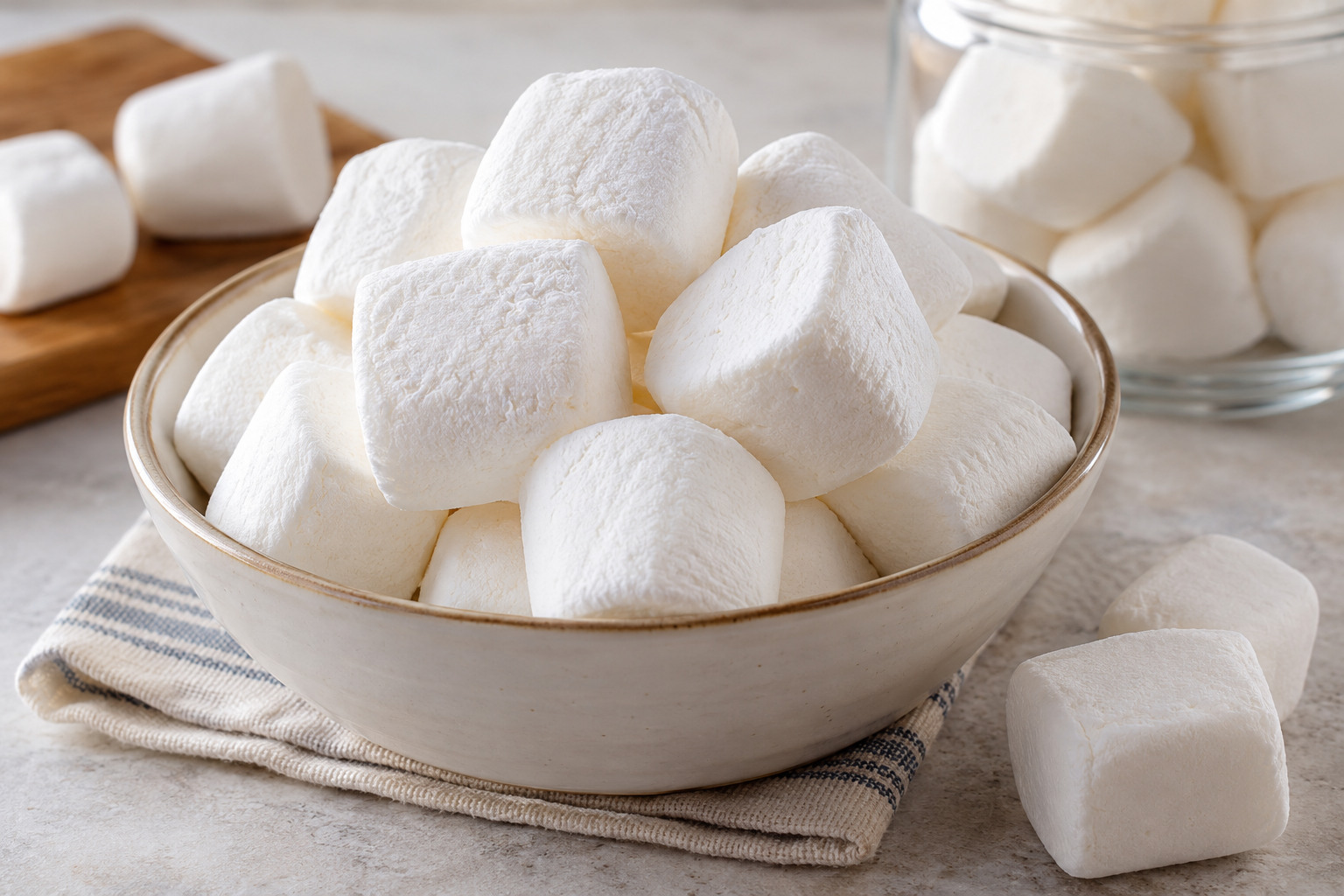
AI-generated application concept for marshmallow flavoring.
Why marshmallow flavoring fails after a clean bottle smell
Marshmallow flavoring fails when a neat aroma is approved before the gelatin foam, chocolate coating, protein load, cook, and package are tested. A bottle that smells like vanilla candy can go blank in a whip kettle, harsh in Whey Protein Isolate, or greasy in Milk Chocolate.
Sucrose and Corn Syrup are cooked, hydrated gelatin is combined, and the mass is whipped, then deposited, extruded, or starch-moguled. Flavor added too early flashes with steam. Bottle aroma never sees shear, air, or starch dust.
The Confectionery Flavors for Candy Products page covers category navigation. This page stays with marshmallow-specific selection.
| Finished-product symptom | Likely cause | First check | Useful next screen |
|---|---|---|---|
| Kettle vanilla, empty after set | Top flashed during cook or whip | Addition versus 118°C cook | Late Water-Soluble Liquid versus Encapsulated Powder |
| Sticky surface after 7 days | Carrier water, Propylene Glycol, or humidity | Moisture, water activity, pack | Lower-carrier liquid or Spray-Dried Powder |
| Coat aroma in the mass, none in the bite | Water-phase flavor trapped under fat | Coat thickness | Oil-Soluble Liquid or Water-Dispersible Emulsion in the fat film |
| Protein powder tastes candy-sweet | Protein binding plus high-intensity sweetener | Whey Protein Isolate, Soy Protein Isolate, or Pea Protein Isolate load | 0.80% w/w powder screen and Marshmallow Creme |
| Toast reads as smoke or burnt sugar | Campfire Marshmallow overshot | Toast versus Classic White Marshmallow | Lower dose and a cleaner Toasted Marshmallow item |
| Day 0 fine; Day 28 dull | Oxidation, light, or liner sorption | Same lot at 0 days, 7 days, 14 days, and 28 days | Encapsulated Powder or a different carrier |
Approve marshmallow flavoring in the shipping architecture. Water is not the approval base.
What must a developer define before selecting marshmallow flavoring?
A developer must define eight fields before requesting marshmallow flavoring samples: candy architecture; gelatin and foam; sugar and moisture; cook and addition point; fat, coating, or protein; sensory direction; format and carrier; and release, shelf life, and documents. “Marshmallow” is not a specification.

Flavor sample library in the LULIN laboratory
| Criterion | Define before sampling | Why it changes selection | Good signal | Red flag |
|---|---|---|---|---|
| Candy architecture | Pillow, rope, starch-mogul, Marshmallow Creme, coated piece, cookie, or dry mix | Bite time and surface area control release | Named SKU and eating sequence | “Marshmallow” with no texture |
| Gelatin and foam | Gelatin Bloom, hydrocolloid, overrun, density | Foam holds or strips aroma | Bloom grade and density recorded | Gelatin left unnamed |
| Sugar and moisture | Sucrose, Corn Syrup, Invert Sugar, polyol, final moisture | Stickiness and aroma mobility follow water | Cook endpoint and moisture written | Flavor chosen before water balance |
| Cook and addition point | Peak syrup temperature, whip time, shear, hold | Heat and steam remove vanilla tops | Addition window measured on the line | “Heat stable” with no profile |
| Fat, coating, or protein | Cocoa Butter, Milk Chocolate, Dark Chocolate, dairy fat, Whey Protein Isolate | Fat and protein hide or bind the middle | Phase percentages listed | “Creamy” with no phase context |
| Sensory direction | Classic White Marshmallow, Vanilla Marshmallow, Marshmallow Creme, Toasted Marshmallow, Campfire Marshmallow, Honey Marshmallow, Chocolate Marshmallow, or S'mores Marshmallow | White candy and toast are different briefs | Notes to keep and avoid written | Color used as a flavor target |
| Format and carrier | Liquid, powder, emulsion, solubility, carrier | Dispersion and label wording are item-specific | Shortlist tested in the real base | Universal all-purpose flavor assumed |
| Release and documents | First impact, chew time, package, COA, SDS, TDS | Approval must survive distribution | Same lot and pack used over time | Commercial approval without a file |
Commercial food gelatin is sold in discrete Bloom grades: 100 Bloom, 125 Bloom, 150 Bloom, 175 Bloom, 200 Bloom, 225 Bloom, 250 Bloom, 275 Bloom, and 300 Bloom. Use 250 Bloom as the high-end design benchmark for a firm aerated marshmallow candy. 300 Bloom is exceptional gel strength, not the default screen. Pectin, agar, or modified starch vegan foams need their own release test.
Marshmallow syrup cook checkpoints, in 1°C steps from soft ball toward firm ball, are 112°C, 113°C, 114°C, 115°C, 116°C, 117°C, 118°C, 119°C, and 120°C. Set 118°C as the high-end cook reference before whipping. Flavor added at 118°C is not the same item as flavor added at 50°C during deposit.
Do not treat herbal marshmallow root, Althaea officinalis, as this confectionery brief. Plant mucilage and a candy foam are different materials.
How do gelatin foam, chocolate coating, protein, and toasted sugar change marshmallow flavoring?
Gelatin foam, fat coating, protein, sugar, salt, acid, and serving temperature change dispersion, volatile release, and whether the piece reads as Classic White Marshmallow or as generic vanilla candy. A sample bright in water can taste late, thin, or chemical in foam, chocolate, or protein.
| Matrix factor | Likely sensory change | Controlled marshmallow test |
|---|---|---|
| Water phase | Fast vanilla tops; thin cooked-sugar middle | Water for dispersion only; approve in the formula |
| Gelatin foam | Air cells strip or hold aroma; density changes bite time | Compare 200 Bloom, 225 Bloom, and 250 Bloom at the same overrun |
| Fat / chocolate coat | Retains oil-affine notes; can hide a water-phase middle | Uncoated foam versus Milk Chocolate or Dark Chocolate enrobe |
| Protein source | Binds vanillin; adds dairy, soy, or pea notes | Whey Protein Isolate, Soy Protein Isolate, or Pea Protein Isolate after hydration, plus a 24 h sample |
| Sugar solids | Softens sharpness; can push toast toward burnt sugar | Hold Corn Syrup ratio; change only flavor dose |
| Salt level | Raises cooked-sugar impact; can expose harsh vanilla | Sodium Chloride at 0.2%, 0.4%, or 0.6% if the formula uses salt |
| Acid system | Brightens a fruit-marshmallow hybrid; can thin creme body | Record acid type and pH |
| Serving temperature | Cold suppresses aroma; warmth exposes toast | Evaluate at −12°C, 8°C, 20°C, 40°C, or 60°C |
Judge deposited candy at 20°C after 24 h, then again at 7 days. Judge Marshmallow Creme at 8°C. Judge ice cream at −12°C. Judge a toasted drink at 60°C. Judge protein powder in the labeled reconstitution.
Chocolate is a second product. A Water-Soluble Liquid that works in foam can disappear under Cocoa Butter. Protein is a third: Whey Protein Isolate binds vanillin, so a 0.25% w/w liquid that works in sugar foam can taste like candy sweetener in a 25 g protein serving. Move that screen to the powder ladder and a Marshmallow Creme or Vanilla Marshmallow body.
Food flavor formulation support for B2B R&D connects the brief with foam density, coat fat, protein load, and addition point.
Which marshmallow flavor formats should be screened first?
Marshmallow flavoring format must match phase, process, appearance, release, and factory dosing. Six named routes cover development.
| Format option | Best starting marshmallow uses | Main advantage | Approval check |
|---|---|---|---|
| Water-Soluble Liquid | Gelatin foam, Marshmallow Creme, syrup, hot cocoa | Fast wet dosing after cook | Clarity, carrier water, whip loss |
| Oil-Soluble Liquid | Milk Chocolate coat, compound coating, fat filling | Direct delivery through Cocoa Butter | Water-phase separation in foam |
| Water-Dispersible Emulsion | Creme, ice cream mix, dual-phase dessert | Oil-affine toast in a water-continuous product | Creaming, oil ring, shear |
| Spray-Dried Powder | Protein powder, bakery premix, dry cocoa mix | Dry handling with protected aroma | Caking, dust, reconstitution |
| Plated Powder | Sugar sanding, starch dust, dry blend | Simple dry dosing | Segregation, carrier load |
| Encapsulated Powder | High cook, long storage, delayed toast | Process protection or later release | Capsule open during chew, not only in the kettle |
Category-level flavor concentrates for food manufacturing explain concentrate handling. The guide to powder versus liquid food flavors covers weighing and hygiene. Request carrier, solubility, addition point, and a matched marshmallow direction.
Oil-Soluble Liquid is a format choice here, not a stand-alone flavor-oil catalog. Encapsulated Powder protects only against a named heat window. A capsule that survives 118°C may never open in cold Marshmallow Creme.
Which marshmallow directions belong on the brief?
Marshmallow top, middle, and base notes describe sensory timing. The top arrives first. The middle establishes candy identity. The base remains after swallowing. Write one named direction. “Authentic marshmallow” is not a usable target.
| Complete profile direction | Top note | Middle note | Base or finish | Typical rejection cue |
|---|---|---|---|---|
| Classic White Marshmallow | Soft vanilla lift | Cooked-sugar foam | Short clean candy finish | Soap, solvent, raw gelatin |
| Vanilla Marshmallow | Clear vanillin / Ethyl Vanillin | Creamy vanilla candy | Warm vanilla linger | Ice-cream vanilla with no foam identity |
| Marshmallow Creme | Dairy-cream lift | Soft spreadable foam | Lactone-like creamy tail | Butter popcorn, coconut, stale dairy |
| Toasted Marshmallow | Warm browned sugar | Soft toast over vanilla foam | Gentle Maillard linger | Smoke, acrid burn, dark caramel takeover |
| Campfire Marshmallow | Charred-edge lift | Toast plus residual foam | Longer burnt-sugar finish | Phenolic smoke, ash, barbecue spice |
| Honey Marshmallow | Floral honey lift | Honeyed cooked sugar | Soft floral-candy tail | Beeswax, perfume, cheap honey candy |
| Chocolate Marshmallow | Cocoa lift over vanilla foam | Chocolate-marshmallow middle | Cocoa-candy finish | Generic cocoa with no marshmallow body |
| S'mores Marshmallow | Graham and toast lift | Toasted foam plus biscuit | Chocolate-graham finish | Graham cracker only, or smoke without foam |
Classic White Marshmallow is vanilla-and-cooked-sugar foam. Toasted Marshmallow is Maillard warmth on that foam, not smoke with a marshmallow name. Campfire Marshmallow may accept a restrained charred edge. S'mores Marshmallow needs graham and chocolate without erasing the foam. Honey Marshmallow and Chocolate Marshmallow still need a marshmallow middle; if it is missing, the brief has already failed.
Pillow candy wants Classic White Marshmallow at 20°C. Jarred Marshmallow Creme wants body at 8°C. Protein powder often wants Vanilla Marshmallow or Marshmallow Creme after reconstitution. S'mores ice cream wants Toasted Marshmallow or S'mores Marshmallow at −12°C, not a kettle-hot Campfire Marshmallow spike.
Which failure modes appear after whipping, depositing, coating, baking, or protein mixing?
Heat, shear, air, starch, fat, protein, oxygen, humidity, and package shift marshmallow flavoring from a white-candy top toward empty vanilla, burnt toast, or stale fat. Approve only after the full process.
| Condition | Common marshmallow shift | Trial that answers the decision |
|---|---|---|
| Syrup cook at 118°C | Vanilla top falls; cooked sugar remains | Before cook versus after 118°C hold |
| Whip / aeration | Aroma strips into headspace; density changes bite | Same dose at two overrun targets |
| Deposit or starch mogul | Starch dust mutes surface aroma | Mass versus dusted surface |
| Chocolate enrobe | Water-phase flavor trapped; fat-phase notes dominate | Uncoated versus coated coded pair |
| Baking at 160°C or 180°C | Tops leave the cookie; hollow vanilla remains | Actual peak and residence time |
| Protein blending | Vanillin binds; candy-sweet aftertaste rises | Dry mix versus labeled reconstitution at 24 h |
| Pasteurization at 72°C, 85°C, or 95°C | Toasted top collapses in RTD | Before heat, after heat, and after 24 h |
| Frozen storage | Freeze-out of tops; icy thin middle | −12°C at 0 days, 7 days, and 28 days |
| Humidity and package | Stickiness; liner sorption | 20°C / 50% RH versus 30°C / 60% RH |
Addition point can fix what dose cannot. Add cooked-sugar body before or during whip. Where hygiene allows, a permitted Vanilla Marshmallow or Classic White Marshmallow fraction can go later, at deposit. Encapsulated Powder belongs in the dry premix only when the capsule opens during eating. A 2 kg bench whip does not match a 200 kg kettle; repeat the winning coded item on the production mixer before locking a specification.
How should a coded marshmallow flavoring sample test be run?
Compare coded marshmallow flavoring samples in one production-relevant base. Use 0.05%, 0.10%, 0.15%, 0.20%, 0.25%, and 0.30% w/w for concentrated liquid or emulsion items. The 0.25% w/w (2.5 g/kg) high end is the design/reference benchmark. Then move the preferred item down to the lowest dose that survives process, storage, and service.
For Spray-Dried Powder, Plated Powder, or Encapsulated Powder in a dry protein mix or bakery premix, use 0.40%, 0.50%, 0.60%, 0.80%, and 1.00% w/w. The 0.80% w/w (8 g/kg) high end is the powder reference benchmark. Do not place a liquid concentrate and a plated powder on the same percentage ladder.
| Protocol field | Required setting |
|---|---|
| Base | One named formula: gelatin foam, Marshmallow Creme, coated piece, ice cream mix, cookie dough, or protein mix |
| Controls | Unflavored process control plus a previously approved marshmallow reference when one exists |
| Coding | Three-digit blind codes; no vendor names on cups |
| Liquid ladder | 0.05%, 0.10%, 0.15%, 0.20%, 0.25%, 0.30% w/w |
| Powder ladder | 0.40%, 0.50%, 0.60%, 0.80%, 1.00% w/w |
| Process | Actual cook, whip, deposit, coat, bake, freeze, or reconstitution |
| Checkpoints | 0 days, 7 days, 14 days, 28 days |
| Serving | −12°C, 8°C, 20°C, 40°C, or 60°C as the product is eaten |
| Discrimination | ISO 4120:2021 triangle or duo-trio when two close items remain |
| Descriptive frame | ISO 13299:2016 profile headings: identity, cream/vanilla body, toast, process survival, off-notes |
| Scorecard dimension | Weight | 80/100 meaning | Automatic reject |
|---|---|---|---|
| Marshmallow identity | 25 | Named direction is obvious at serving temperature | Generic vanilla candy or missing foam |
| Cream / vanilla body | 20 | Middle lasts through chew | Solvent, soap, raw gelatin |
| Process survival | 20 | Same identity after cook, whip, coat, bake, or protein mix | Identity only in the kettle |
| Physical stability | 20 | Foam, coat, emulsion, or powder remains in spec | Stickiness, oil ring, caking, separation |
| Off-notes | 15 | No smoke, ash, metallic, or stale dairy | Any critical off-note |
Advance the lowest dose that reaches 80/100 with no automatic reject. A 0.30% sample that only wins by loudness is not a pass. If 0.25% is harsh, the item is wrong, not underdosed.
Keep gelatin, Corn Syrup ratio, overrun, and serving temperature fixed while dose changes. Change one format at a time. Food flavor sample request for B2B buyers should follow this protocol, not a smelling-strip shipment.
What belongs in a marshmallow flavoring supplier brief before dosage is discussed?
A marshmallow flavoring RFQ should lock application, direction, format, process, label, documents, and logistics before anyone argues about a 0.25% screen. Dosage without a base is theater.
| RFQ field | What to send | Why it belongs before dose |
|---|---|---|
| Application SKU | Deposited marshmallow, Marshmallow Creme, coated pillow, cookie inclusion, ice cream, hot cocoa, or protein powder | Selects foam versus fat versus dry mix |
| Sensory direction | One named direction plus forbidden notes | Prevents toast/white mix-ups |
| Gelatin / hydrocolloid | Bloom grade or vegan system | Controls release |
| Cook and addition | 118°C cook, whip time, deposit temperature | Controls flash-off |
| Format shortlist | Water-Soluble Liquid, Oil-Soluble Liquid, Water-Dispersible Emulsion, Spray-Dried Powder, Plated Powder, Encapsulated Powder | Stops all-purpose samples |
| Label position | Natural, natural and artificial, or artificial under 21 CFR 101.22 | Changes the item, not only the paperwork |
| Diet and religion | Gelatin, vegan, Halal, Kosher, allergen, GMO | Can disqualify an otherwise good item |
| Destination market | United States plus any export list | Sets document pack |
| Evidence file | TDS, SDS, lot COA, allergen, carrier, country of origin, shelf life | Makes the sample reviewable |
| Logistics | Sample size, MOQ, pack, lead time, Incoterm | Makes the quote comparable |
United States flavor wording follows 21 CFR 101.22. Natural flavoring is defined by source and process. Artificial flavoring is flavoring that is not natural under that rule. Marshmallow candy is not a spice. Vanilla Marshmallow can still be natural, natural and artificial, or artificial depending on the item. Broad terminology belongs on What Is Artificial Flavor? B2B Food Guide. Item files belong on the food flavor compliance document request guide.
LULIN FLAVOR is the English brand of QUANZHOU LVLIN BIOENGINEERING CO., LTD., established in 2001 in Quanzhou, Fujian, China. The company runs three production lines on more than 8,000 m² of building area, with more than 50 employees and more than 12 application engineers who have over 20 years of flavor-development experience. Qualification documents include ISO 9001, ISO 22000, and HACCP files plus item-level technical and market packs.
Commercial settings: technical response within 2 days; application samples in 3 days to 5 days after brief acceptance; MOQ 20 kg for powder and 25 kg for liquid per selected item; production 10 days to 15 days after sample approval.
Frequently asked questions
What is marshmallow flavoring in a B2B food brief?
Marshmallow flavoring is a concentrated confectionery aroma system specified by direction, format, matrix, and process, not by the candy’s gelatin solids. Classic White Marshmallow, Marshmallow Creme, and Toasted Marshmallow are different briefs. Herbal Althaea officinalis extract is outside this confectionery specification.
Is marshmallow extract the same as marshmallow flavoring?
Marshmallow extract is not automatically the same as marshmallow flavoring. In food manufacturing, “extract” is a composition and label class that still needs solubility, carrier, and 21 CFR 101.22 wording. In herbals, marshmallow extract often means Althaea officinalis root.
Which marshmallow flavoring format should a gelatin foam candy start with?
A gelatin foam candy should start with Water-Soluble Liquid added after the 118°C syrup cook, during or just before whipping. Compare Encapsulated Powder when cook hold is long or storage is aggressive.
What dose should a first marshmallow flavoring screen use?
A first concentrated marshmallow flavoring screen should use 0.05%, 0.10%, 0.15%, 0.20%, 0.25%, and 0.30% w/w, with 0.25% w/w (2.5 g/kg) as the high-end design benchmark. Powder dry mixes should use 0.40%, 0.50%, 0.60%, 0.80%, and 1.00% w/w, with 0.80% w/w as the powder reference. Advance the lowest dose that reaches 80/100 after process.
How is Toasted Marshmallow different from Classic White Marshmallow?
Toasted Marshmallow adds browned-sugar and Maillard warmth on top of a white-foam middle; Classic White Marshmallow stays on vanilla and cooked sugar without toast. Campfire Marshmallow allows a restrained charred edge. Smoke, ash, or barbecue spice is a reject, not a toast success.
Why does marshmallow flavoring disappear in protein powder?
Marshmallow flavoring disappears in protein powder because Whey Protein Isolate, Soy Protein Isolate, and Pea Protein Isolate bind vanillin and because high-intensity sweeteners can leave a candy aftertaste. Screen Spray-Dried Powder or Encapsulated Powder at 0.80% w/w in the labeled reconstitution, and prefer Vanilla Marshmallow or Marshmallow Creme over a kettle-hot Campfire Marshmallow.
What documents belong in a marshmallow flavoring RFQ?
A marshmallow flavoring RFQ should include TDS, SDS, lot or representative COA, carrier statement, 21 CFR 101.22 natural/artificial declaration, allergen and GMO statements, country of origin, shelf life, storage, and any Halal, Kosher, vegan, or gelatin statements.
Can one marshmallow flavoring cover candy, chocolate coating, and ice cream?
One marshmallow flavoring item rarely covers gelatin foam, Milk Chocolate coating, and ice cream without a format or direction change. Foam wants a water-phase Classic White Marshmallow or Vanilla Marshmallow. Coating wants Oil-Soluble Liquid. Frozen dessert wants a freeze-checked emulsion or a Toasted Marshmallow that still reads at −12°C.
How should a coded marshmallow sample panel be run?
A coded marshmallow sample panel should use blind three-digit codes, an unflavored process control, the full dose ladder, and evaluation after the real cook, whip, coat, bake, freeze, or reconstitution. Use ISO 4120:2021 when two close items remain. Score identity, body, process survival, physical stability, and off-notes against an 80/100 advance line.
What lead time and MOQ does LULIN FLAVOR use for marshmallow flavoring?
LULIN FLAVOR answers a complete marshmallow brief within 2 days, dispatches application samples in 3 days to 5 days after brief acceptance, and produces approved items in 10 days to 15 days. Standard MOQ is 20 kg for powder and 25 kg for liquid per selected item. Send the matrix, process, target market, and sample quantity with the inquiry.
Marshmallow flavoring sample brief for the next bench trial
Send one named SKU, one sensory direction, the gelatin Bloom or vegan system, the cook and addition window, the format shortlist, the 0.05–0.30% w/w liquid ladder or the 0.40–1.00% w/w powder ladder, and the 0.25% w/w (2.5 g/kg) high-end design benchmark for concentrates. Include forbidden notes, serving temperature, package, destination market, and the document pack.
LULIN FLAVOR can prepare Classic White Marshmallow, Vanilla Marshmallow, Marshmallow Creme, Toasted Marshmallow, Campfire Marshmallow, Honey Marshmallow, Chocolate Marshmallow, and S'mores Marshmallow routes in Water-Soluble Liquid, Oil-Soluble Liquid, Water-Dispersible Emulsion, Spray-Dried Powder, Plated Powder, and Encapsulated Powder. Use Contact LULIN FLAVOR for a marshmallow project inquiry with the application matrix, process, target market, and sample deadline.
Develop this flavor in your product
Send your product, target market and project goal. We will review the sample direction with you.