Published
Toffee And Caramel Candy Flavoring
Toffee and caramel candy flavoring is a confectionery aroma system for English Butter Toffee, Hard Crack Toffee, Chewy Caramel, or Salted Caramel. Define cook stage, dairy fat, addition point, and wrap before choosing a format. Screen concentrates at 0.25% w/w (2.5 g/kg) as the high-end design benchmark, then optimize downward.
Last updated: September 1, 2026
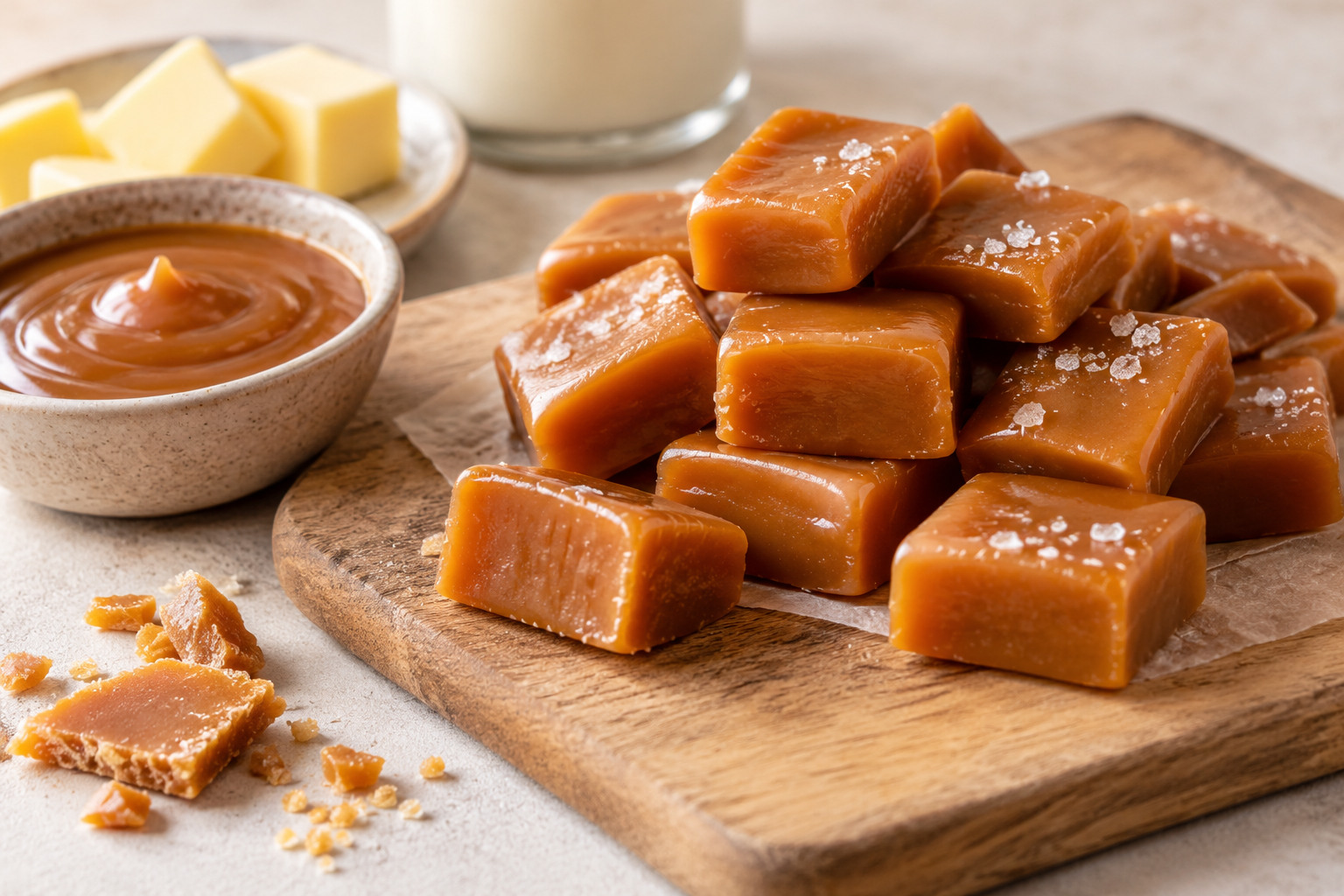
AI-generated application concept for toffee and caramel candy flavoring.
Why a bottle of toffee aroma fails in the candy kettle
Toffee and caramel candy flavoring fails when a neat aroma is approved before the kettle cook, dairy fat, pull or deposit, and wrap are tested. A bottle that smells like English Butter Toffee can go blank at 150°C, greasy under Milk Chocolate, or dull after Twist Wrap.
Dairy caramel is not burnt sucrose. A Chewy Caramel mass is Sucrose, Glucose Syrup or Corn Syrup, Sweetened Condensed Milk or Evaporated Milk, and dairy fat cooked into the Firm Ball cluster. Milk proteins drive Maillard notes. Steam leaves during concentration. Flavor added at peak cook rides that steam out of the kettle.
Hard Crack Toffee is a different thermal job. Butter and sugar are taken through Soft Crack into Hard Crack. Industrial setpoints in that window are 146°C, 147°C, 148°C, 149°C, 150°C, 151°C, 152°C, 153°C, and 154°C. Set 150°C as the high-end cook reference for Hard Crack Toffee. 154°C is the burnt-edge ceiling, not the default screen.
The Confectionery Flavors for Candy Products page covers category navigation. This page stays with kettle candy: slab toffee, pulled toffee, deposited caramel, wrapped caramel, and chocolate-coated pieces.
| Finished-product symptom | Likely cause | First check | Useful next screen |
|---|---|---|---|
| Kettle butter, empty after cool | Top flashed during 150°C cook | Addition versus peak temperature | Encapsulated Powder or late Water-Soluble Liquid |
| Greasy chocolate, no toffee bite | Water-phase flavor trapped under fat | Coat thickness and Cocoa Butter | Oil-Soluble Liquid in the Milk Chocolate film |
| Day 0 fine; Day 14 cardboard | Oxidation, light, or liner sorption | Same lot at 0 days, 7 days, 14 days, and 28 days | Encapsulated Powder or a different wrap |
| Grainy caramel, thin aroma | Sucrose crystallization after cut | Invert Sugar, Glucose Syrup ratio, seed control | Rebuild mass, then re-dose |
| Cold-flow slab, muted middle | Moisture too high for the wrap | Solids and storage at 20°C | Firmer 120°C cook, lower-carrier liquid |
| Salted Caramel tastes metallic | Acid plus salt on dairy protein | Sodium Chloride versus citric acid | Drop acid; hold 0.8% salt |
| Protein powder tastes candy-sweet | Protein binding plus high-intensity sweetener | Dry mix reconstitution at 24 h | 0.80% w/w powder screen, Milk Caramel |
Approve flavoring in the shipping architecture. Water is not the approval base. Caramel color sold for tint is not this brief.
What must a developer define before selecting toffee and caramel candy flavoring?
A developer must define eight fields before requesting toffee and caramel candy flavoring samples: candy architecture; cook stage; dairy and fat; sugar and moisture; addition point; sensory direction; format and carrier; and release, shelf life, and documents. “Toffee” is not a specification.

Flavor sample library in the LULIN laboratory
| Criterion | Define before sampling | Why it changes selection | Good signal | Red flag |
|---|---|---|---|---|
| Candy architecture | Slab, pull, deposit, Twist Wrap, Flow Wrap, Foil Wrap, Milk Chocolate enrobe | Bite time and surface area control release | Named SKU and eating sequence | “Caramel candy” with no texture |
| Cook stage | Named band plus kettle setpoint | Heat and steam remove butter tops | Peak temperature recorded on the line | “Heat stable” with no profile |
| Dairy and fat | Sweetened Condensed Milk, Evaporated Milk, Butter Oil, Anhydrous Milk Fat, percent fat | Fat holds oil-affine notes and hides water-phase middles | Fat percentage listed | “Creamy” with no fat number |
| Sugar and moisture | Sucrose, Corn Syrup, Glucose Syrup, Invert Sugar, Brown Sugar, final moisture | Grain and cold flow change aroma mobility | Cook endpoint and moisture written | Flavor chosen before water balance |
| Addition point | Peak cook, cool-down, deposit, pull, coat | A 150°C addition is not a 90°C addition | Addition window measured | One sample asked to survive every step |
| Sensory direction | One named toffee or caramel direction | English Butter Toffee and Salted Caramel are different briefs | Notes to keep and avoid written | Color used as a flavor target |
| Format and carrier | Liquid, powder, emulsion, solubility, carrier | Dispersion, dust, and label wording are item-specific | Shortlist tested in the real mass | Universal all-purpose flavor assumed |
| Release and documents | First bite, chew time, package, COA, SDS, TDS | Approval must survive distribution | Same lot and pack used over time | Commercial approval without a file |
Candy-thermometer named bands used on toffee and caramel lines are Thread, Soft Ball, Firm Ball, Hard Ball, Soft Crack, and Hard Crack. Dairy caramel lives in Soft Ball through Hard Ball. Hard Crack Toffee lives in Hard Crack. Thread is a syrup checkpoint, not a finished piece.
Industrial kettle setpoints for dairy caramel, in 2°C steps, are 112°C, 114°C, 116°C, 118°C, 120°C, 122°C, and 124°C. Use 118°C as the high-end cook reference for Chewy Caramel. 124°C is a firmer Hard Ball edge for a stand-up piece, not the first screen for a soft wrap caramel.
Dairy fat in caramel is specified in 2% steps: 6%, 8%, 10%, 12%, 14%, and 16%. Use 12% as the high-end fat reference for Chewy Caramel and Milk Caramel. 16% is a rich exceptional formula. Butter Oil and Anhydrous Milk Fat are not interchangeable with Sweetened Condensed Milk on aroma; milk solids carry Dulce de Leche and Milk Caramel identity.
Salted Caramel salt, as Sodium Chloride on a mass basis, is specified in 0.2% steps: 0.4%, 0.6%, 0.8%, 1.0%, and 1.2%. Use 0.8% as the high-end salt reference. 1.2% is an aggressive spike that can read metallic once dairy protein is cooked.
Do not treat caramel color under the United States color rules as this flavoring brief. Tint does not replace English Butter Toffee or Chewy Caramel identity.
How do cook stage, dairy fat, and serving condition change toffee and caramel candy flavoring?
Cook stage, dairy fat, milk solids, sugar, salt, acid, and serving temperature change dispersion, volatile release, and whether the piece reads as English Butter Toffee or as generic cooked sugar. A sample bright in water can taste late, thin, or chemical in a 12% fat caramel or a 150°C slab.
| Matrix factor | Likely sensory change | Controlled candy test |
|---|---|---|
| Water phase | Fast butter tops; thin cooked-sugar middle | Water for dispersion only; approve in the mass |
| Dairy fat | Holds diacetyl-like and lactone notes; can hide a water-phase middle | Compare 8%, 10%, and 12% fat at the same cook |
| Milk solids | Maillard body for Milk Caramel and Dulce de Leche; can bind vanillin | Sweetened Condensed Milk versus Butter Oil-only toffee |
| Sugar solids | Softens sharpness; excess invert can thin identity | Hold Glucose Syrup ratio; change only flavor dose |
| Salt level | Raises caramel impact; overshoot tastes metallic | Sodium Chloride at 0.4%, 0.6%, or 0.8% |
| Acid system | Brightens fruit-caramel hybrids; thins dairy body | Record acid type; keep sour-candy acids off dairy caramel |
| Serving temperature | Cold suppresses aroma; warmth exposes burnt sugar | Evaluate at 8°C, 20°C, 37°C, or 40°C |
Judge wrapped caramel at 20°C after 24 h, then again at 7 days. Judge refrigerated caramel at 8°C. Judge a chew at 37°C. Judge a bakery inclusion at 40°C after the actual bake. Judge Hard Crack Toffee at 20°C after full set.
Milk Chocolate is a second product. A Water-Soluble Liquid that works in Chewy Caramel can disappear under Cocoa Butter. Oil-Soluble Liquid belongs in the coat, not as a substitute for a cooked-sugar middle in the slab.
Protein in a dry mix is a third product. Whey Protein Isolate binds butter and vanilla notes. A 0.25% w/w liquid that works in caramel candy can taste like sweetener in a 25 g protein serving. Move that screen to the powder ladder and a Milk Caramel or Dulce de Leche body.
The Caramel Flavoring for Food Buyers page covers caramel as a general flavor profile across foods. This page stays with kettle candy, cook stage, and wrap.
Which flavor formats belong on a toffee versus caramel candy screen?
Toffee and caramel candy flavoring format must match phase, kettle heat, appearance, release, and factory dosing. Six named routes cover development.
| Format option | Best starting candy uses | Main advantage | Approval check |
|---|---|---|---|
| Water-Soluble Liquid | Chewy Caramel, Soft Caramel, caramel slurry after cool-down | Fast wet dosing below peak cook | Carrier water, grain, cold flow |
| Oil-Soluble Liquid | Milk Chocolate coat, compound coating, fat-rich English Butter Toffee | Direct delivery through Cocoa Butter or Butter Oil | Water-phase separation in a dairy caramel |
| Water-Dispersible Emulsion | Dual-phase caramel dessert, ice cream mix, sauce-adjacent caramel | Oil-affine toffee in a water-continuous product | Creaming, oil ring, shear |
| Spray-Dried Powder | Protein powder, bakery premix, dry caramel blend | Dry handling with protected aroma | Caking, dust, reconstitution |
| Plated Powder | Sugar sanding, dry blend, small-batch seasoning of pieces | Simple dry dosing | Segregation, carrier load |
| Encapsulated Powder | 150°C Hard Crack Toffee, long storage, delayed butter release | Process protection or later bite release | Capsule open during chew, not only in the kettle |
Category-level Candy Flavor Concentrates for Food Buyers explain concentrate handling across candy. Food Flavoring Oils for Candy and Baking covers oil-soluble dosing in fat systems. Request carrier, solubility, addition point, and a matched toffee or caramel direction.
Oil-Soluble Liquid is a format choice here, not a stand-alone flavor-oil catalog. Encapsulated Powder protects only against a named heat window. A capsule that survives 150°C may never open in a cold Soft Caramel. A 2 kg bench kettle does not match a 200 kg production kettle; repeat the winning coded item on the line before locking a specification.
Which toffee and caramel directions belong on the brief?
Toffee and caramel top, middle, and base notes describe sensory timing. The top arrives first. The middle establishes candy identity. The base remains after swallowing. Write one named direction. “Authentic caramel” is not a usable target.
| Complete profile direction | Top note | Middle note | Base or finish | Typical rejection cue |
|---|---|---|---|---|
| English Butter Toffee | Fresh butter lift | Cooked butter-sugar slab | Short clean butter linger | Cheese, popcorn, stale dairy |
| Hard Crack Toffee | Sharp cooked-sugar snap | Brittle butter-sugar middle | Dry candy finish | Smoke, acrid burn, sticky chew |
| Chewy Toffee | Soft butter lift | Pliable cooked-sugar chew | Longer butter-sugar tail | Caramel sauce with no chew |
| Butterscotch Toffee | Brown Sugar lift | Butter plus brown-sugar candy | Warm brown-sugar linger | Molasses tar, fake maple |
| Soft Caramel | Dairy-cream lift | Soft flowable caramel | Short dairy-sugar finish | Thin syrup, no milk body |
| Chewy Caramel | Cooked-milk lift | Stand-up caramel chew | Lactone-like dairy tail | Grain, cold flow, empty sugar |
| Salted Caramel | Salt spark on dairy caramel | Chewy caramel plus Sodium Chloride | Saline dairy finish | Metallic salt, soy sauce |
| Burnt Sugar Caramel | Dark cooked-sugar lift | Bitter-edge caramel middle | Longer roast finish | Ash, phenolic smoke, charcoal |
| Milk Caramel | Cooked-milk lift | Sweetened Condensed Milk caramel | Milky candy linger | Evaporated Milk tin, baby formula |
| Dulce de Leche | Slow-cooked milk lift | Deep milk-jam caramel | Long cooked-milk finish | Scorched pan, bitter protein |
English Butter Toffee is butter and cooked sugar with a snap or a short chew. It is not Salted Caramel with the salt omitted. Hard Crack Toffee needs the brittle middle; if the piece chews like Chewy Caramel, the direction is already wrong. Butterscotch Toffee needs Brown Sugar character without molasses tar.
Soft Caramel is flowable. Chewy Caramel stands up in Twist Wrap. Salted Caramel is Chewy Caramel plus a controlled salt spark at 0.8% Sodium Chloride as the high-end reference, not a salt lick. Burnt Sugar Caramel may accept a restrained roast edge. Smoke is a reject. Milk Caramel and Dulce de Leche need cooked-milk solids; Butter Oil alone will not get there.
Slab candy wants English Butter Toffee or Hard Crack Toffee at 20°C. Wrapped pieces want Chewy Caramel or Salted Caramel at 20°C. Ice cream mix wants Soft Caramel or Dulce de Leche at 8°C after freeze. Protein powder often wants Milk Caramel after reconstitution.
Failure modes after cook, pull, cut, wrap, or storage
Heat, shear, air, fat, milk protein, oxygen, humidity, and package shift toffee and caramel candy flavoring from a butter-sugar top toward empty sugar, burnt roast, or stale fat. Approve only after the full process.
| Condition | Common candy shift | Trial that answers the decision |
|---|---|---|
| Caramel cook at 118°C | Butter top falls; cooked milk remains | Before cook versus after 118°C hold |
| Toffee cook at 150°C | Butter top flashes; burnt sugar rises | 148°C versus 150°C versus 154°C hold |
| Pull or aerate | Aroma strips into headspace; density changes bite | Same dose at two pull times |
| Cut and cool | Grain starts; aroma locks in crystals | 0 h versus 24 h after cut |
| Twist Wrap or Flow Wrap | Liner sorption; solvent-like carrier odor | Mass versus wrapped piece at 14 days |
| Foil Wrap | Better aroma hold; can trap moisture | Compare Foil Wrap versus Twist Wrap |
| Milk Chocolate enrobe | Water-phase flavor trapped; fat-phase notes dominate | Uncoated versus coated coded pair |
| Bake at 160°C or 180°C | Tops leave the inclusion; hollow sugar remains | Actual peak and residence time |
| Humidity | Cold flow, stick, muted surface | 20°C / 50% RH versus 30°C / 60% RH |
| Frozen storage | Freeze-out of tops; icy thin middle | −12°C at 0 days, 7 days, and 28 days |
Addition point can fix what dose cannot. Add cooked-sugar and milk body before or during the late cook. Where hygiene allows, a permitted English Butter Toffee or Chewy Caramel fraction can go later, during cool-down near 90°C. Encapsulated Powder belongs in the dry premix or the sugar sand only when the capsule opens during eating.
Rock Candy Flavoring for Food Buyers is a sucrose-crystal brief. Hard Crack Toffee is an amorphous slab. Do not copy a rock-candy dose or format onto toffee. Sour Candy Flavoring for Food Buyers is an acid-bright brief. Citric acid at sour-candy levels thins dairy caramel and turns Salted Caramel metallic. Keep that acid system off this kettle.
How should a coded toffee and caramel candy flavoring sample test be run?
Compare coded toffee and caramel candy flavoring samples in one production-relevant mass. Use 0.05%, 0.10%, 0.15%, 0.20%, 0.25%, and 0.30% w/w for concentrated liquid or emulsion items. The 0.25% w/w (2.5 g/kg) high end is the design/reference benchmark. Then move the preferred item down to the lowest dose that survives process, storage, and service.
For Spray-Dried Powder, Plated Powder, or Encapsulated Powder in a dry mix or as a protected high-cook addition, use 0.40%, 0.50%, 0.60%, 0.80%, and 1.00% w/w. The 0.80% w/w (8 g/kg) high end is the powder reference benchmark. Do not place a liquid concentrate and a plated powder on the same percentage ladder.
| Protocol field | Required setting |
|---|---|
| Base | One named formula: Chewy Caramel at 118°C, Hard Crack Toffee at 150°C, English Butter Toffee slab, Salted Caramel wrap, or a dry mix |
| Controls | Unflavored process control plus a previously approved toffee or caramel reference when one exists |
| Coding | Three-digit blind codes; no vendor names on cups |
| Liquid ladder | 0.05%, 0.10%, 0.15%, 0.20%, 0.25%, 0.30% w/w |
| Powder ladder | 0.40%, 0.50%, 0.60%, 0.80%, 1.00% w/w |
| Process | Actual cook, pull, deposit, cut, wrap, coat, bake, freeze, or reconstitution |
| Checkpoints | 0 days, 7 days, 14 days, 28 days |
| Serving | 8°C, 20°C, 37°C, or 40°C as the product is eaten |
| Discrimination | ISO 4120:2021 triangle or duo-trio when two close items remain |
| Descriptive frame | ISO 13299:2016 profile headings: identity, butter/dairy body, roast, process survival, off-notes |
| Scorecard dimension | Weight | 80/100 meaning | Automatic reject |
|---|---|---|---|
| Candy identity | 25 | Named direction is obvious at serving temperature | Generic cooked sugar or missing dairy/butter |
| Butter / dairy body | 20 | Middle lasts through chew or snap | Solvent, cheese, tin, raw fat |
| Process survival | 20 | Same identity after cook, pull, wrap, or coat | Identity only in the kettle |
| Physical stability | 20 | Grain, cold flow, emulsion, or powder remains in spec | Grain, oil ring, caking, sticky wrap |
| Off-notes | 15 | No smoke, ash, metallic salt, or stale dairy | Any critical off-note |
Advance the lowest dose that reaches 80/100 with no automatic reject. A 0.30% sample that only wins by loudness is not a pass. If 0.25% is harsh, the item is wrong, not underdosed.
Keep Glucose Syrup ratio, dairy fat, cook setpoint, and serving temperature fixed while dose changes. Change one format at a time. Food Flavor Sample Request for B2B Buyers should follow this protocol, not a smelling-strip shipment.
What belongs in a supplier brief before dosage is discussed?
A toffee and caramel candy flavoring RFQ should lock application, direction, format, process, label, documents, and logistics before anyone argues about a 0.25% screen. Dosage without a mass is theater.
| RFQ field | What to send | Why it belongs before dose |
|---|---|---|
| Application SKU | Slab toffee, pulled toffee, wrapped caramel, deposited caramel, chocolate-coated piece, bakery inclusion, or dry mix | Selects cook, fat, and wrap |
| Sensory direction | One named direction plus forbidden notes | Prevents English Butter Toffee / Salted Caramel mix-ups |
| Cook and addition | 118°C caramel or 150°C toffee, cool-down, deposit temperature | Controls flash-off |
| Dairy and fat | Sweetened Condensed Milk, Evaporated Milk, Butter Oil, Anhydrous Milk Fat, 12% fat target | Controls milk versus butter identity |
| Format shortlist | Water-Soluble Liquid, Oil-Soluble Liquid, Water-Dispersible Emulsion, Spray-Dried Powder, Plated Powder, Encapsulated Powder | Stops all-purpose samples |
| Label position | Natural, natural and artificial, or artificial under 21 CFR 101.22 | Changes the item, not only the paperwork |
| Diet and religion | Dairy, vegan, Halal, Kosher, allergen, GMO | Can disqualify an otherwise good item |
| Destination market | United States plus any export list | Sets document pack |
| Evidence file | TDS, SDS, lot COA, allergen, carrier, country of origin, shelf life | Makes the sample reviewable |
| Logistics | Sample size, MOQ, pack, lead time, Incoterm | Makes the quote comparable |
United States flavor wording follows 21 CFR 101.22. Natural flavoring is defined by source and process. Artificial flavoring is flavoring that is not natural under that rule. Toffee candy is not a spice. English Butter Toffee can still be natural, natural and artificial, or artificial depending on the item.
LULIN FLAVOR is the English brand of QUANZHOU LVLIN BIOENGINEERING CO., LTD., established in 2001 in Quanzhou, Fujian, China. The company runs three production lines on more than 8,000 m² of building area, with more than 50 employees and more than 12 application engineers who have over 20 years of flavor-development experience. Qualification documents include ISO 9001, ISO 22000, and HACCP files plus item-level technical and market packs.
Commercial settings: technical response within 2 days; application samples in 3 days to 5 days after brief acceptance; MOQ 20 kg for powder and 25 kg for liquid per selected item; production 10 days to 15 days after sample approval.
Frequently asked questions
What is toffee and caramel candy flavoring in a B2B food brief?
Toffee and caramel candy flavoring is a concentrated confectionery aroma system specified by direction, format, cook stage, and dairy fat, not by caramel color. English Butter Toffee, Hard Crack Toffee, Chewy Caramel, and Salted Caramel are different briefs. Dry-sugar caramelization at 170°C is outside the dairy-caramel kettle used for wrapped candy.
Is caramel color the same as caramel candy flavoring?
Caramel color is not caramel candy flavoring. Color tints the mass. Flavoring supplies English Butter Toffee, Chewy Caramel, Milk Caramel, or Dulce de Leche identity. A dark Chewy Caramel can still be underflavored. Specify color and flavor as separate item codes.
Which flavor format should a Chewy Caramel candy start with?
A Chewy Caramel candy should start with Water-Soluble Liquid added after the 118°C cook, during cool-down near 90°C. Compare Encapsulated Powder when cook hold is long or Twist Wrap storage is aggressive. Oil-Soluble Liquid belongs in a Milk Chocolate coat, not as the first caramel-mass screen.
What dose should a first toffee and caramel candy flavoring screen use?
A first concentrated toffee and caramel candy flavoring screen should use 0.05%, 0.10%, 0.15%, 0.20%, 0.25%, and 0.30% w/w, with 0.25% w/w (2.5 g/kg) as the high-end design benchmark. Powder dry mixes should use 0.40%, 0.50%, 0.60%, 0.80%, and 1.00% w/w, with 0.80% w/w as the powder reference. Advance the lowest dose that reaches 80/100 after process.
How is English Butter Toffee different from Salted Caramel?
English Butter Toffee is butter and cooked sugar with a snap or short chew and no saline spark. Salted Caramel is Chewy Caramel plus Sodium Chloride, with 0.8% as the high-end salt reference. Swapping the names without changing cook, fat, and salt produces a failed panel, not a flavor variant.
Why does toffee flavoring disappear after a 150°C cook?
Toffee flavoring disappears after a 150°C cook because butter tops flash with steam in the Hard Crack window of 146°C, 147°C, 148°C, 149°C, 150°C, 151°C, 152°C, 153°C, and 154°C. Add a late fraction during cool-down, or screen Encapsulated Powder that opens during chew. Raising dose at peak cook usually raises burnt sugar, not butter.
What documents belong in a toffee and caramel candy flavoring RFQ?
A toffee and caramel candy flavoring RFQ should include TDS, SDS, lot or representative COA, carrier statement, 21 CFR 101.22 natural/artificial declaration, allergen and GMO statements, country of origin, shelf life, storage, and any Halal, Kosher, vegan, or dairy statements.
Can one flavoring cover Hard Crack Toffee and Chewy Caramel?
One flavoring item rarely covers Hard Crack Toffee and Chewy Caramel without a format or direction change. Hard Crack Toffee wants Encapsulated Powder or a late butter-stable liquid that survives 150°C. Chewy Caramel wants Water-Soluble Liquid in a 12% fat mass at 118°C. Milk Chocolate coating wants Oil-Soluble Liquid as a second item.
How should a coded toffee and caramel candy sample panel be run?
A coded toffee and caramel candy sample panel should use blind three-digit codes, an unflavored process control, the full dose ladder, and evaluation after the real cook, pull, wrap, coat, bake, freeze, or reconstitution. Use ISO 4120:2021 when two close items remain. Score identity, body, process survival, physical stability, and off-notes against an 80/100 advance line.
What lead time and MOQ does LULIN FLAVOR use for toffee and caramel candy flavoring?
LULIN FLAVOR answers a complete toffee and caramel candy brief within 2 days, dispatches application samples in 3 days to 5 days after brief acceptance, and produces approved items in 10 days to 15 days. Standard MOQ is 20 kg for powder and 25 kg for liquid per selected item. Send the mass, process, target market, and sample quantity with the inquiry.
Toffee and caramel candy sample brief for the next kettle trial
Send one named SKU, one sensory direction, the cook setpoint, the dairy-fat target, the format shortlist, the 0.05–0.30% w/w liquid ladder or the 0.40–1.00% w/w powder ladder, and the 0.25% w/w (2.5 g/kg) high-end design benchmark for concentrates. Include forbidden notes, wrap type, serving temperature, destination market, and the document pack.
LULIN FLAVOR can prepare English Butter Toffee, Hard Crack Toffee, Chewy Toffee, Butterscotch Toffee, Soft Caramel, Chewy Caramel, Salted Caramel, Burnt Sugar Caramel, Milk Caramel, and Dulce de Leche routes in Water-Soluble Liquid, Oil-Soluble Liquid, Water-Dispersible Emulsion, Spray-Dried Powder, Plated Powder, and Encapsulated Powder. Use Contact LULIN FLAVOR | Food Flavor Project Inquiries with the application matrix, process, target market, and sample deadline.
Develop this flavor in your product
Send your product, target market and project goal. We will review the sample direction with you.