Published
Cookies And Cream Flavoring
Cookies and cream flavoring is a two-part chocolate-cookie and vanilla-cream system, not a cocoa note or a bag of crumbs. Specify cookie, cream, dairy body, and finish, then test liquid, powder, emulsion, oil-soluble, and water-soluble options in the real base; use 3.0 g/kg (0.30% w/w) as the high first-pass benchmark for comparable concentrated liquids.
A bottle sniff only checks identity. Fat, protein, freeze temperature, and cookie-piece loading decide whether the sample still reads as cookies and cream after processing.
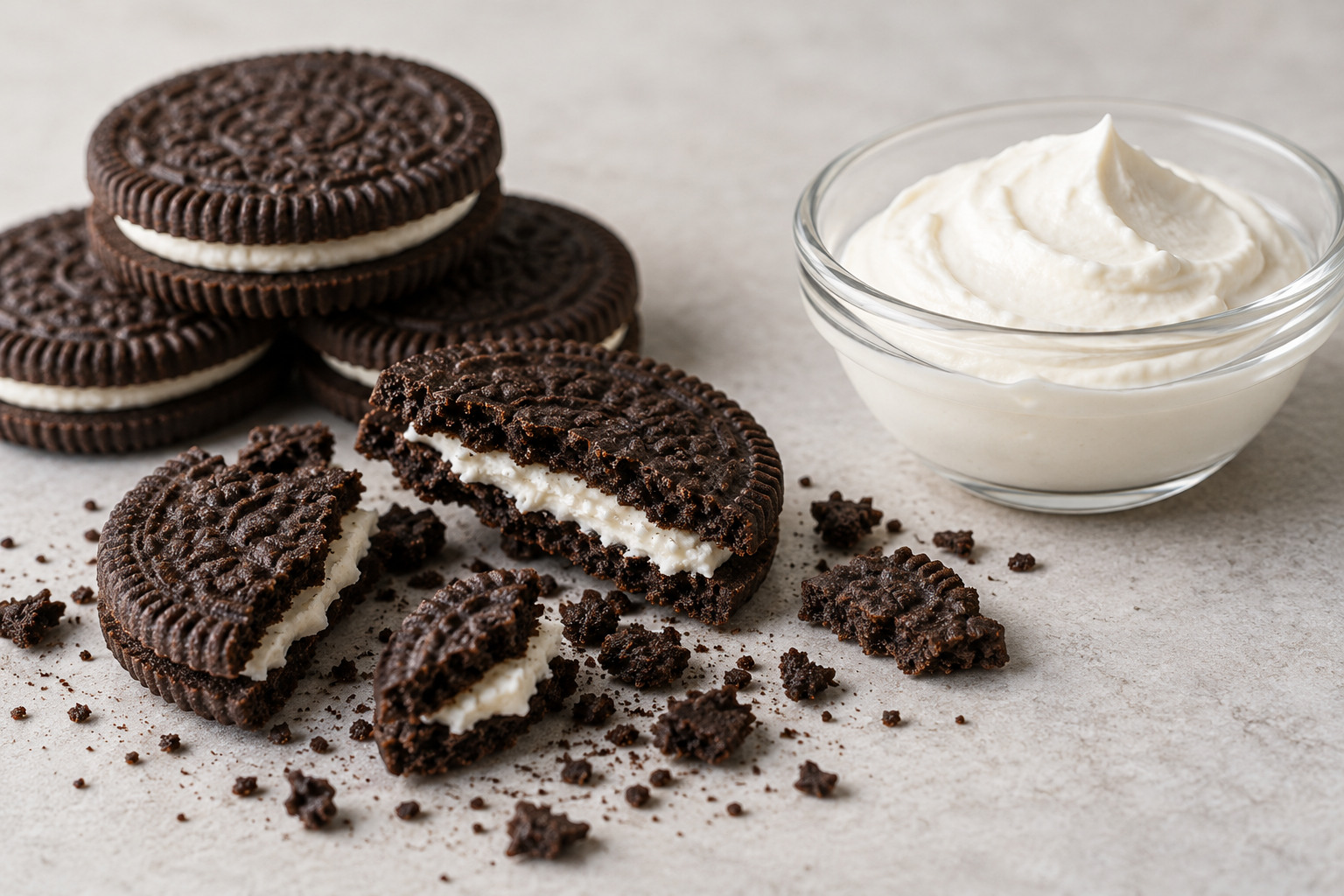
Cookies cream sensory reference: an AI-generated sensory reference for this flavor brief.
How should cookies and cream flavoring be specified as chocolate sandwich cookie plus vanilla cream filling?
Cookies and cream flavoring should be specified as a Chocolate Sandwich Cookie wafer plus a Vanilla Cream Filling, scored on both parts, rather than as a cocoa, vanilla, or dessert-menu slogan.
Menu words do not tell a flavorist what to build. “Cookies and cream” on an Ice Cream carton can mean crushed pieces in vanilla ice cream, a flavor concentrate with 0% inclusions, or both. Write both sandwich parts before samples move. Give each axis a 0 anchor, a 10 anchor, and a rejection point.
| Sensory axis | 0 anchor | 10 anchor | Rejection signal |
|---|---|---|---|
| Cookie cocoa | 0%: no cocoa | 100%: dark sandwich-cookie crumb | Chocolate milk, coffee ash, or burnt roast |
| Baked biscuit | 0%: no baked cereal | 100%: toasted cookie wafer | Raw flour, cardboard, or stale cereal |
| Vanilla Cream Filling | 0%: cocoa only | 100%: sweet sandwich-cookie cream | Cake-mix vanilla that erases cookie |
| Dairy-fat body | 0%: lean and watery | 100%: Ice Cream Mix richness | Waxy oil or tallow |
| Sweetness association | 0%: unsweet cocoa | 100%: dessert-level cookie cream | Syrup candy with no biscuit |
| Bitterness | 0%: no cocoa bite | 100%: dark-cookie edge | Harsh Dutch Cocoa or burnt grain |
| Finish | 0%: short and clean | 100%: lingering cookie-and-cream | Solvent, butyric rancidity, or stale crumb |
How is the chocolate sandwich cookie wafer specified without a cocoa-only brief?
The wafer is a dry, baked, slightly salted dark cocoa biscuit, not ganache, brownie, mocha, or chocolate milk. Score cocoa depth, roast versus bake, dryness versus moist cake, cereal Maillard, salt, and bitterness. Cocoa 8/10 with biscuit 2/10 is a chocolate flavor, not cookies and cream.
How is the vanilla cream filling specified without ice cream vanilla or cultured dairy?
The filling is shortening-fat, confectioners sugar, bakery vanillin, and low moisture. It is not pastry cream, Ice Cream Mix vanilla, or cultured dairy. If the cream half reads as tangy cheese, use cream cheese flavors for cultured dairy briefs rather than forcing this profile to supply Cream Cheese.
Which cookie:cream ratio should the scorecard start with?
Start at an even sandwich unless the SKU name says otherwise: cookie cocoa 6/10 to 7/10, Vanilla Cream Filling 6/10 to 7/10, biscuit 5/10 to 6/10. Cookie-forward briefs raise cocoa. Cream-forward briefs raise filling. Protein briefs often need cookie 8/10 because whey at 8% to 20% protein binds aroma.
Profile is separate from dose, delivery form, and cookie-piece loading. A buyer can source flavor concentrates used in food manufacturing and still receive a cocoa beverage, a vanilla dessert, or Cream Cheese drift. Cookies and cream flavoring is not cookie inclusions, finished ice cream, a consumer dropper, or a botanical extract of a sandwich cookie.
A usable brief is one timed sentence. Example: “Chocolate Sandwich Cookie cocoa 7/10 and baked biscuit 6/10 at 0–3 seconds; Vanilla Cream Filling 7/10 and dairy-fat body 6/10 at 3–15 seconds; clean cookie-and-cream finish at 15–45 seconds; no chocolate milk, Cream Cheese tang, solvent, or stale cereal; evaluate in Ice Cream Mix at -12°C after 24 h, with a -6°C aroma-release check.” That sentence is an acceptance test, not a slogan.
Which cocoa wafer, cream filling, and sandwich-ratio notes change the top, middle, and base of a cookies and cream brief?
A cookies and cream brief should use top notes for first cocoa dust and cream flash, middle notes for recognizable sandwich-cookie identity, and base notes for biscuit, dairy lactones, vanilla, and persistence. The timing model is operational, not a regulatory class or a formula disclosure.
| Stage | Useful directions | Application role | Typical failure |
|---|---|---|---|
| Top | Cocoa dust, vanilla cream flash, light biscuit, optional mint lift | Opens Protein Shake, milk drinks, and the first Ice Cream spoon | Solvent flash, chocolate syrup, or raw-flour dust |
| Middle | Chocolate Sandwich Cookie, Vanilla Cream Filling, sweet dairy | Holds the dual identity in frozen dessert, bakery, and confectionery | Cocoa beverage, cake batter, or cream-only vanilla |
| Base | Baked wafer, cocoa roast, dairy lactones, vanilla, mild caramelized sugar | Gives body to ice cream, bars, fillings, and dry mixes | Stale cereal, burnt sugar, waxy fat, or lingering solvent |
Which top-note cream vanillin and cocoa-dust flashes set first identity?
The first 0–3 seconds should show cocoa dust and a Vanilla Cream Filling flash together. Vanillin without cocoa is a cream-only code. Cocoa without cream is chocolate syrup. Optional peppermint belongs only on a mint SKU; toothpaste mint is a reject.
Which middle-note wafer cocoa and filling body hold the sandwich?
The 3–15 second window must read as Chocolate Sandwich Cookie plus filling, not as vanilla ice cream flavoring as a cream-only code. Vanilla ice cream flavoring can support the cream half. It cannot replace the cocoa-biscuit stack.
Which base-note roast cocoa and cream lactones stop chocolate-milk drift?
The 15–45 second finish should leave biscuit, mild roast, and lactonic cream, not chocolate milk. Sensory anchors include 2,5-dimethylpyrazine, 2,3,5-trimethylpyrazine, tetramethylpyrazine, 2-acetyl-1-pyrroline, maltol, furaneol, vanillin, ethyl vanillin, delta-decalactone, gamma-decalactone, 2,3-butanedione (diacetyl), acetoin, 2-methylbutanal, and 3-methylbutanal. They are language for “cookie,” “cream,” “stale,” and “burnt,” not a LULIN FLAVOR formula.
Style families change the stack. They are project directions, not supplier grades: even sandwich; cookie-forward Dutch Cocoa; cream-forward shortening filling; golden sandwich cookie; mint cookies and cream; protein cookies and cream; plant-based cookies and cream; flavor-only ice cream with 0% inclusions.
How do water, fat, protein, sugar, salt, acid, and serving temperature split cookie cocoa from vanilla cream?
Water, fat, protein, sugar, salt, acid, and serving temperature split cookies and cream so cocoa and Vanilla Cream Filling do not move together; a sample decision belongs in the intended product matrix.
The same concentrate can smell loud in water and seem muted in an 8% Protein Shake. It can read as sandwich-cookie ice cream in a 10% milkfat mix, thin in an unsweetened plant drink, or sharper after acidification to pH 4.2.
| Matrix variable | Cookie-part shift | Cream-part shift | Control points | Common misdiagnosis |
|---|---|---|---|---|
| Water | Cocoa turns dusty or drink-like | Vanillin flashes; filling thins | 1,000 g; 0.10%, 0.20%, 0.30% liquid | Water sniff treated as finished proof |
| Fat | Cookie delayed, then longer biscuit | Filling rounds; lactones persist | 0%, 4%, 10%, 16% fat | Cold fatty sample called weak |
| Protein | Wafer goes cardboard or stale cereal | Filling collapses first | 0%, 3%, 8%, 20% protein | Whey cardboard blamed on stale cookie |
| Sugar | Cocoa bitterness drops | Cream reads dessert-like | 0%, 6%, 12%, 18% sucrose | High-sugar water treated as Ice Cream Mix |
| Salt | Biscuit and cocoa sharpen | Cream can dirty | 0%, 0.15%, 0.30%, 0.50% salt | Salted cocoa called burnt |
| Acid / pH | Top cocoa brightens | Filling strips toward chocolate milk | pH 6.8, pH 6.2, pH 5.5, pH 4.2 | Yogurt tang called a profile defect |
| Temperature | Freeze locks cocoa; heat burns biscuit | Freeze mutes cream; 60°C cooks filling | -18°C, -12°C, -6°C, 5°C, 22°C, 60°C | 22°C cup used to approve ice cream |
Fat type matters as much as fat level. Milkfat in Ice Cream Mix carries dairy lactones that support the cream half. Coconut, cocoa butter, or palm blends used in vegan ice cream flavors for plant-protein frozen dessert do not donate the same dairy-cream cue, so the flavor must supply more Vanilla Cream Filling. A 10% milkfat United States ice cream under 21 CFR 135.110 is not the same matrix as a 4% fat milk drink or a 16% fat frosting.
Whey at 20% in a dry mix, reconstituted to an 8% drink, binds vanillin and pyrazines; pea and soy can read as stale biscuit. Reconstitute, wait 5 min, and taste at 5°C. Ice cream at -18°C is almost closed; scoop at -12°C; run the -6°C aroma-release check; score yogurt at 5°C, bakery at 22°C, and a hot latte at 60°C.
Which freeze, bakery, and protein-process conditions flatten cookie cocoa or wash out vanilla cream?
Freeze, heat, shear, oxygen, light, and moisture can flatten cookies and cream cookie cocoa, strip Vanilla Cream Filling, stale the biscuit note, or shift the stack toward chocolate milk, so process belongs on the same brief as dose.
A sample that is correct in an unprocessed 22°C cup can fail after a 72°C pasteurization hold, a 141°C UHT curve, a 180°C bake, or six weeks in a -18°C cabinet.
| Process or storage factor | What usually changes | Cookies and cream read-out | Practical control |
|---|---|---|---|
| Mixing / addition point | Top-note loss if heated or over-sheared | Cocoa dust gone; cream turns flat vanilla | State pre-heat, post-heat, or dry-blend addition |
| Pasteurization | 72°C hold cooks cream and dulls biscuit | Cooked-milk cream, muted cookie | Taste after the plant hold |
| UHT | 141°C can burn cocoa and strip lactones | Coffee-ash cookie, empty cream | Recheck after 24 h |
| Homogenization / overrun | Shear and air strip volatiles | Thin ice cream; cookie only on inclusions | Taste mix and frozen, aerated product |
| Baking | 12 min to 18 min at 180°C drives off top notes | Ash biscuit, leftover vanilla | Cool to 22°C |
| Freeze / thaw | -18°C store then -12°C serve mutes opening | Closed ice cream that opens at -6°C | Panel at -12°C; run the -6°C check |
| Dry blend / reconstitution | Carrier moisture and protein binding | Dusty cocoa, delayed cream | Wait 5 min; taste at 5°C |
| Oxygen / light | Stale cereal and cardboard | “Old cookie” from oxidation, not low cocoa dose | Opaque pack |
| Moisture / RH | Powder caking; emulsion split | Gritty powder or oily ring | Moisture limits on the TDS |
What happens to vanilla cream after pasteurization, UHT, and homogenization?
Flavor added after a 72°C hold keeps more cocoa and cream flash. Flavor added before homogenization sees more shear. A 141°C UHT curve can cook filling into empty vanilla and push cocoa toward coffee ash. Recheck 24 h later.
How do freeze/thaw and cookie-inclusion bleed push ice cream toward chocolate milk?
Store at -18°C, serve at -12°C, and pull a second cup to -6°C. If the sandwich only appears at -6°C, the -12°C SKU will read as weak vanilla ice cream with brown specks. Cookie-piece cocoa bleed after freeze/thaw is not a substitute for a flavor code.
How do bakery bake-out and dry-blend moisture stale the cocoa wafer?
A 12 min to 18 min bake at 180°C can leave ash biscuit with leftover vanillin. Cool to 22°C before scoring. Dry-blend moisture stales the wafer into cardboard. Protein drinks are scored at 5°C after 5 min, not from a dry powder sniff.
If the base still fights the profile after two coded rounds, change format, addition point, or cookie/cream ratio before raising dose into solvent or bitterness.
Which liquid, powder, emulsion, oil-soluble, and water-soluble cookies and cream formats belong in the first trial?
The first cookies and cream flavor trial should compare liquid, powder, emulsion, oil-soluble, and water-soluble options as a complete commercial vocabulary, then run four first-round routes in the actual base: water-soluble liquid, oil-soluble liquid, water-based emulsion, and spray-dried water-soluble powder. Liquid, powder, and emulsion name physical form; oil-soluble and water-soluble name the carrying phase.
| First-round route | Named options it covers | Typical cookies and cream fit | Handling limit | Dual-stack failure |
|---|---|---|---|---|
| Water-soluble liquid | liquid; water-soluble | Ice Cream Mix, milk drinks, yogurt, syrup, protein RTD | Propylene Glycol, ethanol, or glycerol carriers | High-fat frosting, coating, or dry blend with no liquid point |
| Oil-soluble liquid | liquid; oil-soluble | Fat filling, coating, Ice Cream Mix oil phase, bakery fat | Needs fat; Medium-Chain Triglyceride is common | Clear drinks, dry mixes, some high-overrun mixes |
| Water-based emulsion | emulsion; water-soluble | Batter, ice cream, Soft Serve, some fat drinks | Carries oil-soluble cookie notes into a wet mix | 141°C UHT if the emulsion breaks; dry premixes |
| Spray-dried water-soluble powder | powder; water-soluble | Protein powder, bakery premix, dry cocoa mix | Dry blend, then reconstitute or bake | Fat coatings with no water; some cloudy drinks |
Paste, plated powder, and encapsulated powder are later custom routes, not missing first-round rungs.
Which first-round format routes match ice cream mix, bakery fat, and protein powder?
Ice Cream Mix and protein RTD usually start with water-soluble liquid or water-based emulsion. Bakery fat fillings and coatings start with oil-soluble liquid. Protein dry mixes start with spray-dried water-soluble powder. For like-for-like concentrated liquids whose supplier range includes the high value, screen 0.10% w/w (1.0 g/kg), 0.20% w/w (2.0 g/kg), and 0.30% w/w (3.0 g/kg). Use 3.0 g/kg (0.30% w/w) as the high first-pass design benchmark, not as a production guarantee. For spray-dried powders in a dry mix, screen 0.50% w/w, 1.00% w/w, and 1.50% w/w. Use 1.50% w/w (15 g/kg dry mix) as the high-end powder reference benchmark.
A water-soluble liquid that shines in a 5°C milk drink can oil-out in a compound coating. An oil-soluble liquid that sings in a 16% fat frosting can bead in a clear protein water.
When do ice cream cookie inclusions at 6% to 14% fail to replace cookies and cream flavoring?
Cookie inclusions at 6%, 8%, 10%, 12%, or 14% fail to replace cookies and cream flavoring because pieces supply texture, cocoa bleed, and wheat solids, not a specified Vanilla Cream Filling in the uncrushed mix.

Flavor sample library in the LULIN laboratory
A vanilla mix plus cookie pieces is not cookies and cream flavoring. Pieces do not dose the cream half and do not replace a flavor COA in a crumbs-free Protein Shake.
| Inclusion load | What pieces contribute | What the mix still needs from flavor |
|---|---|---|
| 0% | No crumb texture | Full cookie-plus-cream stack |
| 6% | Light speckling, low cocoa bleed | Strong cookie middle and full cream |
| 8% | Visible pieces, some wafer crunch | Cream half plus cookie between pieces |
| 10% | Frequent crunch, more cocoa bleed | Cream half; watch chocolate-milk serum |
| 12% | High-end inclusion reference when pieces are used | Cream half; do not drop the flavor code |
| 14% | Dense crunch; serum can turn cocoa-brown | Cream half; bleed is not flavor quality |
When should an ice cream SKU use flavor-only cookies and cream with 0% inclusions?
Use 0% inclusions when the product cannot carry wheat crumbs, when a Protein Shake or coating cannot hold pieces, or when aroma must exist without particulate. Flavor-only SKUs still screen at 0.10%, 0.20%, and 0.30% liquid or 0.50%, 1.00%, and 1.50% powder.
What do 6%, 8%, 10%, 12%, and 14% cookie pieces actually contribute?
Those five named bands are commercial inclusion loadings, not flavor-dose steps. Do not invent 7%, 9%, 11%, or 13% as category rungs. Use 12% as the high-end inclusion reference when the product uses pieces, and put that same load in every coded cup.
How should ice cream, bakery, and protein panels compare cookies and cream samples in the real base?
Buyers should compare cookies and cream flavor samples in one batch of the real application base, at matched dose and process, using coded cups, an unflavored control, a defined reference, and a written 0–10 cookie-and-cream scorecard.
Water is allowed as an identity check. Water is not the approval test. ISO 4120:2021 triangle tests can confirm a difference. ISO 13299:2016 profiling, ISO 8586:2023 assessor selection, ISO 8589:2007 booth conditions, and ASTM E1871-17 serving practice keep the panel from turning into a hallway vote.
| Protocol field | Concentrated liquid | Spray-dried powder | Ice cream with pieces | Flavor-only frozen or drink |
|---|---|---|---|---|
| Control | Unflavored base | Unflavored dry mix | Same inclusion load, no flavor code | Unflavored base |
| Dose ladder | 0.10%, 0.20%, 0.30% w/w | 0.50%, 1.00%, 1.50% w/w | Same ladder; inclusions fixed | Same ladder; 0% inclusions |
| Serve | -12°C then -6°C, or 5°C | 5°C reconstituted; 22°C bakery | -12°C then -6°C | -12°C / -6°C, or 5°C / 22°C / 60°C |
| Reject notes | Solvent, Cream Cheese, chocolate milk, stale cereal, burnt roast | Same | Same, plus uneven grit | Same |
Split one Ice Cream Mix, Protein Shake, or bakery filling batch after removing the unflavored control. Code three-digit cups, match process, and score cookie cocoa, baked biscuit, Vanilla Cream Filling, dairy body, finish, and off-notes from 0 to 10. Calculate cost-in-use at the winning dose: a cheaper item at 0.30% can lose to a dearer item at 0.20%. Repeat the leading pair on a second day and recheck at Day 7, Day 14, Day 28, and Day 56.
How should flavor-only ice cream be scored at -18°C, -12°C, and -6°C?
Store at -18°C. Serve at -12°C. Pull a second cup to -6°C. The sandwich must already read at -12°C. The -6°C cup is the high-end aroma-release check for defects, not a license to approve a closed -12°C product. Soft Serve sits near that warmer draw; keep process ownership on soft serve ice cream flavoring for high-overrun draw.
How should ice cream with cookie inclusions be scored without letting crumbs hide a weak flavor code?
Match inclusion load across cups. Taste mix before freezing and product after hardening. Score the uncrushed matrix. If 12% pieces supply all the cookie and the mix is plain vanilla, the flavor code failed.
How should protein powder and protein RTD compare cookies and cream formats?
Start dry protein mixes with spray-dried water-soluble powder at 0.50%, 1.00%, and 1.50% w/w. If the plant can dose liquids, add a water-soluble liquid leg at 0.10%, 0.20%, and 0.30% in the drink. A 25 g whey serving at pH 6.8 binds aroma differently than a 15 g serving. Reconstitute, wait 5 min, and taste at 5°C.
How should bakery fillings and frostings be scored at 22°C after cool-down?
Bake at the plant curve, then cool to 22°C. Cookie notes should still read as Chocolate Sandwich Cookie, not ash. Emulsions belong in high-moisture batter. Oil-soluble liquids belong in fat fillings.
Which RFQ documents, allergen statements, and destination-market wording belong with a cookies and cream flavoring sample request?
A cookies and cream flavoring RFQ should state application, matrix, timed cookie/cream stack, inclusion load, process, package, destination market, 21 CFR 101.22 status wording, allergen expectations, carrier, sample plan, documents, MOQ, price, lead time, and traceability before the first sample ships.
| RFQ field | Cookies and cream example |
|---|---|
| Application and market | United States Ice Cream Mix, 10% milkfat, 2026 launch |
| Matrix | 10% fat, 4% protein, 18% sucrose, pH 6.6, 0.15% salt |
| Sensory stack | Cookie 7/10, cream 7/10, biscuit 6/10; no chocolate milk |
| Inclusions | 0% flavor-only, or 12% Chocolate Sandwich Cookie pieces |
| Process | Flavor after 72°C hold; freeze to -18°C; serve -12°C |
| Status wording | Solely natural flavor, natural and artificial flavor, or solely artificial flavor under 21 CFR 101.22 |
| Allergens | Wheat, milk, soy, egg: composition and shared equipment |
| Carrier | Propylene Glycol, Medium-Chain Triglyceride, maltodextrin |
| Sample plan | Liquid 0.10%, 0.20%, 0.30%; powder 0.50%, 1.00%, 1.50% |
| Files and commerce | TDS, COA, SDS, ISO 9001, ISO 22000, HACCP, 20 kg powder / 25 kg liquid |
For United States-facing work, 21 CFR 101.22 distinguishes solely natural flavor, natural and artificial flavor, and solely artificial flavor. Characterizing-flavor presentation on the finished food is a separate requirement. Flavor and Extract Manufacturers Association GRAS status is not United States Food and Drug Administration approval. Natural status for frozen dessert is a label path owned in more detail by natural ice cream flavors and 21 CFR 101.22 status wording; this RFQ only records the approved wording for the cookies-and-cream item.
The sensory name does not prove wheat, milk, soy, or egg. Cookie inclusions usually bring wheat and often milk. Request an item-specific allergen statement under the Food Allergen Labeling and Consumer Protection Act.
LULIN FLAVOR is the English brand of QUANZHOU LVLIN BIOENGINEERING CO., LTD., a Quanzhou Fujian producer established in 2001. The site runs 3 modernized production lines on more than 8000 m² of building area, with 50+ employees, 12+ flavor engineers, more than 20 years of application experience, an application laboratory, and ISO 22000 and HACCP systems. Powder-flavor MOQ starts at 20 kg. Liquid-flavor MOQ starts at 25 kg. Application samples ship in 3–5 business days. Standard production runs in 10–15 business days after formula and sample approval.
Send the application base, 0–10 cookie and cream targets, style family, inclusion load, process, serving temperature, label path, destination market, and sample plan. Then request cookies and cream flavoring samples for a coded ice cream or protein trial. Contact LULIN FLAVOR with the cookies and cream RFQ documents when the brief is ready for item selection.
What do ice cream, protein, and bakery buyers ask before locking a cookies and cream flavoring specification?
How should a cookies and cream flavor profile be written without vague dessert adjectives?
Write cookies and cream flavoring as Chocolate Sandwich Cookie cocoa, baked biscuit, Vanilla Cream Filling, dairy-fat body, sweetness, bitterness, finish, a physical benchmark, and unwanted notes. Add the finished matrix, process, serving temperature, whether cookie pieces are used, preferred format, and acceptance method so the supplier can select a relevant sample.
What cookie:cream ratio should a first cookies and cream brief target?
Target an even sandwich unless the SKU name says otherwise: cookie cocoa 6/10 to 7/10 and Vanilla Cream Filling 6/10 to 7/10, with biscuit 5/10 to 6/10. Raise cookie for protein and dark-cocoa SKUs. Raise cream for filling-forward ice cream. Do not start from a single “creamy cookie” score.
Do cookie inclusions at 6% to 14% replace cookies and cream flavoring in ice cream?
No. Named inclusion bands of 6%, 8%, 10%, 12%, and 14% supply crunch and cocoa bleed; they do not replace a flavor code for Vanilla Cream Filling in the uncrushed mix. Use 12% as the high-end inclusion reference when pieces are used, and keep flavor-only SKUs at 0% inclusions.
Which liquid, powder, emulsion, oil-soluble, or water-soluble cookies and cream format belongs in a protein dry mix?
Start a protein dry mix with spray-dried water-soluble powder, then compare a water-soluble liquid in the reconstituted drink if the plant can dose liquids. Keep emulsion and oil-soluble legs for fat-continuous bases. Screen powder at 0.50%, 1.00%, and 1.50% w/w of the dry mix.
What concentrated-liquid use level should an ice cream mix screen first for cookies and cream flavoring?
Use 3.0 g/kg finished Ice Cream Mix, or 0.30% w/w, as the high first-pass reference benchmark when the selected concentrated liquid’s supplier range includes it. Bracket that point with 1.0 g/kg and 2.0 g/kg samples. Do not transfer the ladder to powders, emulsions, or liquids with different potency.
Why does cookies and cream flavoring read as chocolate milk in high-water drinks but as a sandwich in ice cream?
High water frees vanillin and starves cookie pyrazines, so the drink reads as chocolate milk, while 10% milkfat Ice Cream Mix at -12°C holds both sandwich parts. Fat, protein, sugar, salt, pH, and temperature reposition cocoa and cream separately. Approve only in the commercial base.
Which freeze and bakery process conditions can drop the cream filling or stale the cocoa wafer?
A -18°C store, -12°C serve, 72°C pasteurization hold, 141°C UHT curve, or 12 min to 18 min bake at 180°C can strip Vanilla Cream Filling or stale the cocoa wafer. Screen ice cream at -12°C and -6°C, bakery after cooling to 22°C, and drinks after the plant heat curve.
How should buyers compare cookies and cream samples at -12°C versus 22°C?
Compare coded samples in one batch of the finished base at matched dose, process, and pack, serving ice cream at -12°C with a -6°C check and bakery or confectionery at 22°C. Include an unflavored control and a defined reference, use a written 0–10 scorecard, and repeat the leading pair on a second day.
Does cookies and cream flavoring automatically contain wheat, soy, or milk because of the cookie name?
No. The sensory name does not establish wheat, soy, or milk protein; a flavor that contains those proteins must identify the allergen source in the United States, while a crumbs-free cookies-and-cream-style item needs an item-specific allergen statement covering composition and manufacturing controls.
Which TDS, SDS, allergen, and destination-market documents belong in a cookies and cream flavoring RFQ?
Request the applicable TDS, lot COA, SDS/MSDS, ingredient declaration, flavor-status statement, allergen statement, shelf-life and storage guidance, country of origin, change-control policy, and destination-market files. Add required Halal, Kosher, ISO 9001, ISO 22000, HACCP, non-GMO, or vegan documents, plus MOQ, packaging, price basis, lead time, and traceability.
Develop this flavor in your product
Send your product, target market and project goal. We will review the sample direction with you.