Published
Food Flavor Bitterness Masking: A Diagnostic Guide for Formulators
Food flavor bitterness masking reduces a defined TAS2R bitter signal without erasing the intended flavor. For dedicated liquid bitterness-masking flavors, use 0.15% w/w (1,500 ppm) as the high-end design benchmark; for receptor-class modulators, use 25 ppm as the reference benchmark after a controlled ladder. Neither figure is a legal limit or a supplier guarantee.
Last updated: 2026-09-01
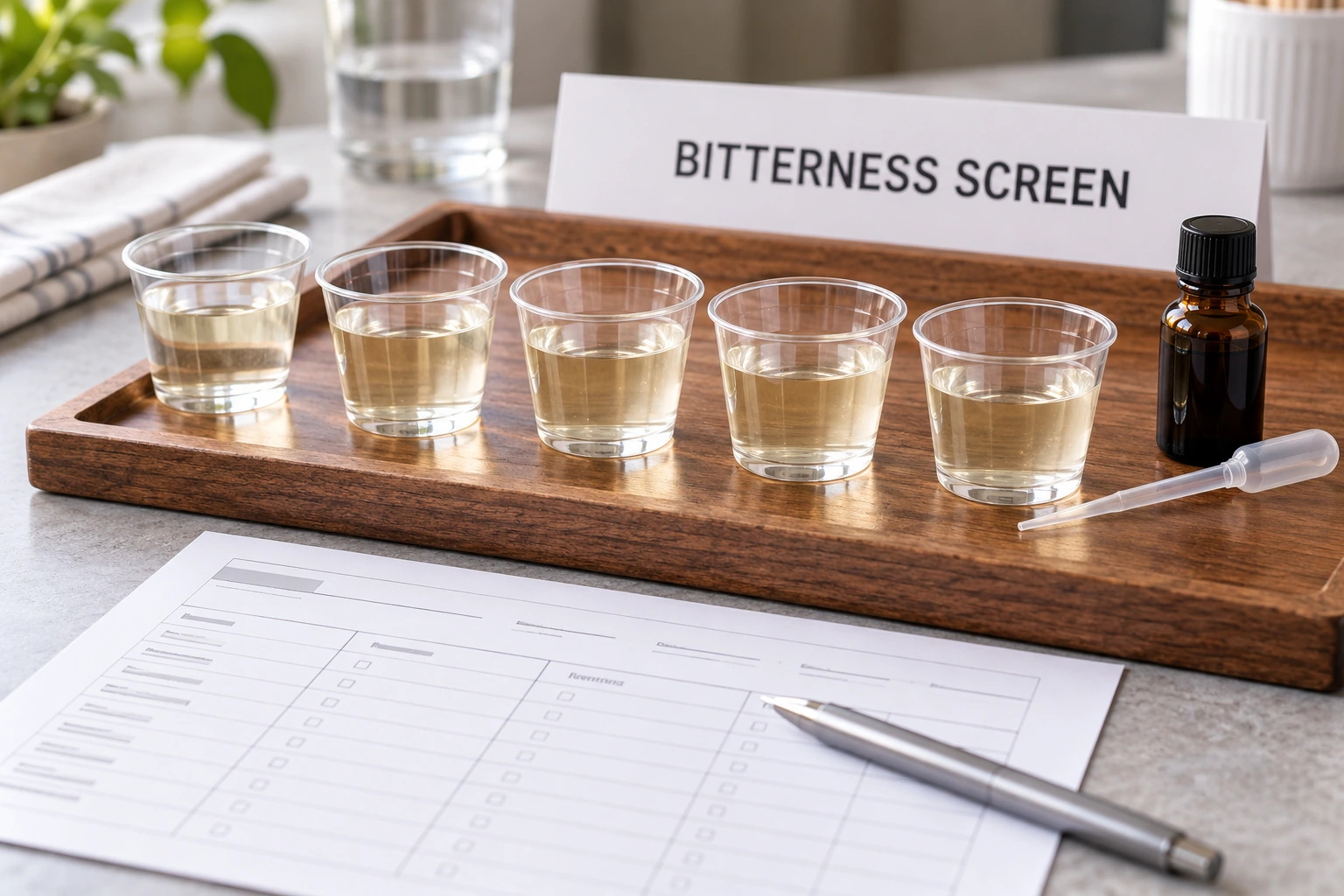
AI-generated bitterness-masking trial concept; no receptor mechanism or sensory outcome is demonstrated.
What does food flavor bitterness masking mean in a finished formula?
Food flavor bitterness masking lowers a defined TAS2R bitter response below the rejection threshold without erasing the intended flavor of the food. A system may use a receptor modulator, mixture suppression, inclusion complex, fat or protein partitioning, delayed release, or a complementary flavor.
Masking cannot repair rancid oil, contamination, a burnt hold, or an out-of-range pH. It also differs from pouring more citrus, chocolate, coffee, or vanilla on top of the defect. A louder character note often leaves the 60 s bitter tail untouched. Astringency is drying or puckering, not a TAS2R taste. Metallic character is often ion- or oxidation-driven. Sourness is acid. Pharmaceutical film coating and capsule-in-water tricks belong to dosage-form work, not to a beverage, sauce, or seasoning brief.
Human bitter detection runs through 25 functional TAS2R receptors: TAS2R1, TAS2R3, TAS2R4, TAS2R5, TAS2R7, TAS2R8, TAS2R9, TAS2R10, TAS2R13, TAS2R14, TAS2R16, TAS2R19, TAS2R20, TAS2R30, TAS2R31, TAS2R38, TAS2R39, TAS2R40, TAS2R41, TAS2R42, TAS2R43, TAS2R45, TAS2R46, TAS2R50, and TAS2R60. Caffeine, naringin, peptides, potassium chloride, and hop iso-alpha acids do not bind the same subset. That is why one masker can clear a 2 s caffeine spike and miss a 90 s peptide finish.
The regulatory route is separate. In the United States, composition and intended use set the path. Start with the Food and Drug Administration Substances Added to Food inventory, 21 CFR 101.22, and the Flavor Extract Manufacturers Association Flavor Ingredient Library. European Union projects require the applicable review under Regulation (EC) No 1334/2008. “Bitterness masking” is a function, not a universal ingredient class.
| Intervention | What changes | Diagnostic question |
|---|---|---|
| Root-cause correction | Raw material, pH, oxidation, scorch, or contamination | Does bitterness disappear when the cause is corrected? |
| Bitterness masking | Perceived TAS2R intensity and linger | Is bitterness lower at the same intended-flavor intensity? |
| Characterizing flavor | Aroma identity and flavor impact | Did the product become louder or cleaner? |
| Astringency control | Drying, puckering, tannin load, body | Does the complaint remain with the nose blocked? |
| Encapsulation or delayed release | Contact rate of a bitter active or flavor | Does delayed contact cut the late finish? |
For source and label class, use the artificial flavor definition guide. This page stays with bitterness diagnosis and testing.
Which bitterness symptoms should a formulator isolate first?
Food flavor bitterness masking symptoms become actionable when onset, peak, and linger repeat at one serving temperature. Write the clock time. Do not write “bad taste.”
| Observable symptom | Timing cue | Contributors to investigate | First isolation move |
|---|---|---|---|
| Sharp bitter attack | Peak at 0 s, 2 s, or 5 s | Caffeine, quinine-class alkaloids, some steviol glycosides, low-pH shock | Match sweetness and acid, then compare active-in vs active-out |
| Mid-palate bitterness | Strong at 10 s or 15 s | Catechins, cocoa, tea solids, some minerals | Hold solids constant; rate 10 s and 15 s on the same ballot |
| Delayed bitter finish | Strong at 30 s, 45 s, or 60 s | Hydrophobic peptides, saponins, naringin, limonin | Rate 30 s, 45 s, and 60 s after swallowing |
| Lingering bitter tail | Still present at 90 s or 120 s | Rebaudioside A tails, hop iso-alpha acids, some peptides | Add 90 s and 120 s; do not stop the ballot at swallow |
| Bitter plus drying | Builds over repeated sips | Tannins scored as bitter by untrained tasters | Nose-clip sip; score bitterness and astringency on separate lines |
| Bitter plus metallic | Cold or stored samples | Potassium chloride, magnesium, zinc, iron, oxidation | Compare fresh glass, production package, and oxygen exposure |
| Sweetener bitter tail | After the sweet peak drops | Stevioside, Rebaudioside A, some sucralose blends | Match temporal sweetness before blaming the masker |
| Heat- or storage-born bitterness | Day 0 passes; day 28 or 56 fails | Maillard bitters, oxidation, flavor loss, package contact | Test pre-process, post-process, and stored samples together |
The nose-clip comparison splits routes. If the complaint disappears with the nose blocked, prioritize volatiles, oxidation, and package headspace. If it remains, stay with TAS2R load, pH, ionic strength, and release time.
TAS2R38 PAV/AVI status changes how some assessors score brassica notes. Caffeine does not follow that single receptor. Keep both sensitive and insensitive tasters on the panel. Pea and soy hydrolysates often combine a 15 s peptide bitterness with a saponin tail at 60 s. Grapefruit naringin is late. Energy-drink caffeine is early. Vanilla can improve the first sip while the 60 s score stays at 6. That is partial coverage. Use the application troubleshooting hub when bitterness shares the ballot with astringency or a volatile defect.
Which matrix, process, package, and storage variables shift TAS2R bitterness first?
A bitterness-masking screen should change one variable family at a time while serving method, ingredient lots, and panel instructions stay fixed. Record pH, titratable acidity, °Brix, protein g/serving, potassium chloride %, viscosity, temperature, and oxygen exposure.
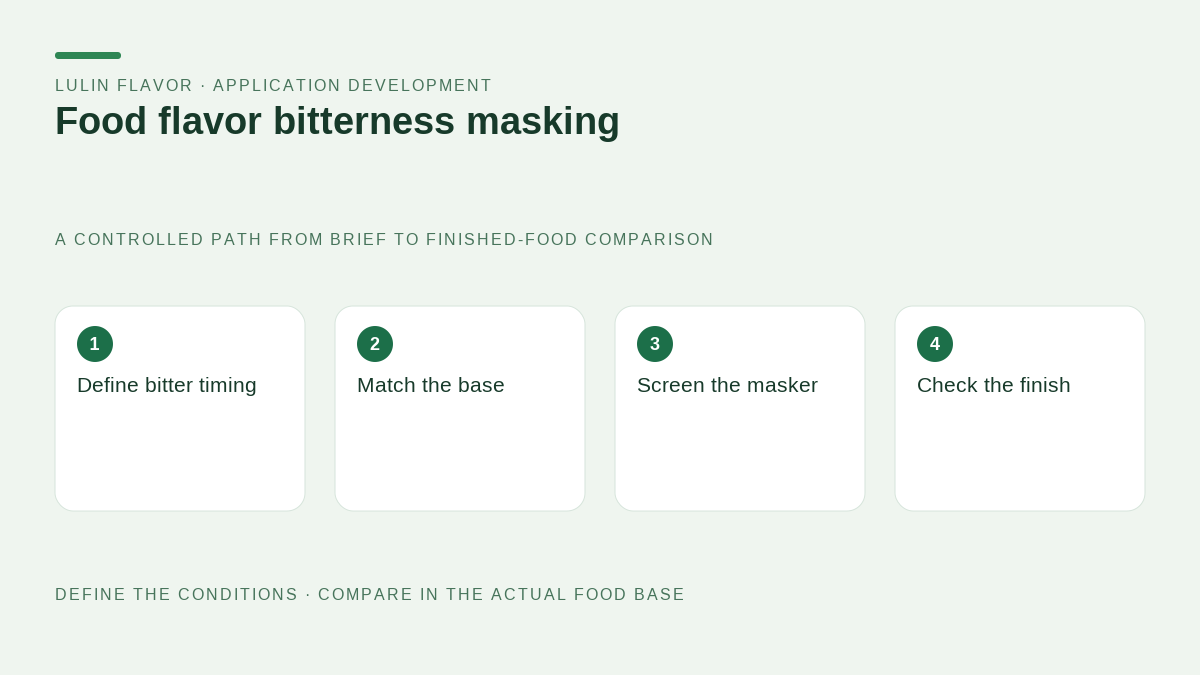
A controlled workflow for this formulation or supplier-review decision.
| Variable family | Values to record or bracket | Why it matters | Isolation test |
|---|---|---|---|
| Bitter load | Active identity, g/serving, % w/w, lot, particle size | Source and concentration set the sensory ceiling | Run low, target, and high active loads at one masker level |
| Acidity | pH 2.8, 3.2, 3.5, 3.8, 4.0, 4.2, 4.5, 5.0, 5.5, 6.0, or 6.8; titratable acidity | Ionization and protein charge shift bitterness | Hold all ingredients constant and change acid only |
| Sweetness and solids | Sweetener identity, °Brix, total solids | Sweetness suppresses bitterness; solids alter release | Match °Brix before comparing candidates |
| Mineral salts | KCl %, Mg salt, Ca salt, Zn salt, conductivity | KCl, magnesium, and zinc add their own bitter or metallic lines | Remove or restore one mineral salt |
| Protein, fat, and hydrocolloid | Protein %, fat %, gum or starch, hydration time, viscosity | Binding can hide a late peptide and mute top notes | Compare low-body and production-body bases |
| Addition sequence | Active, acid, sweetener, flavor, masker order; 5 min, 10 min, or 30 min hold | A late addition can miss a binding window | Swap only the masker addition point |
| Shear and heat | Mixer rpm, homogenization pressure, 60 °C, 72 °C, 85 °C, or 121 °C; hold time | Heat can create Maillard bitters or strip a modulator | Compare pre-process and post-process samples |
| Package and storage | Glass, PET, HDPE, pouch, oxygen, light; 0 days, 7 days, 14 days, 28 days, 56 days | Sorption and oxidation create storage-only bitterness | Fill the best treatment in the intended package |
For unknown acidic beverages, start the pH isolation at pH 4.2, then bracket neighboring values from the list above. For powder drinks, compare hydration at 5 min, 10 min, and 30 min. For carbonated drinks, record carbonation and fill temperature. For bouillon, record cook time and serving temperature. For gum, record chew time rather than sip volume.
Caffeine load belongs on the worksheet for energy drinks and coffee beverages. Screen 0 g, 0.040 g, 0.080 g, 0.100 g, 0.150 g, 0.200 g, and 0.300 g caffeine per 355 mL serving. Those masses are bitter-load brackets, not a Food and Drug Administration caffeine cap.
What bench test separates lingual bitterness from astringency and aroma?
Bitterness-masking bench controls should keep the production matrix intact and change only the bitter load or the intervention. Prepare by mass, use common lots, and serve blind. Ballot logistics live on the sample testing hub; this section is the bitterness protocol.
| Code | Sample construction | Purpose | Interpretation |
|---|---|---|---|
| B0 | Matrix without bitter active or masker | Clean-base control | Locates a base or character-flavor defect |
| B1 | Matrix with bitter active, no masker | Negative control | Defines the TAS2R off-note |
| B2 | Matrix without bitter active, with masker | Masker-only control | Exposes sweetness, aroma, haze, color, bitterness, or texture from the treatment |
| B3 | Matrix with bitter active plus a sweetness-matched placebo | Placebo control | Separates extra sweetness from true bitterness reduction |
| B4 | B1 tasted with a nose clip | Route control | Keeps retronasal aroma from being scored as bitterness |
| T1–T6 | Matrix with bitter active plus the dose ladder | Dose response | Finds the lowest passing level |
| P1 | B1 through target shear and heat | Process control | Separates formula and process defects |
| PK | Best treatment in final package | Package control | Tests contact and storage |
Run T1–T6 on one supplier-permitted ladder. For a dedicated liquid bitterness-masking flavor, use 0.15% w/w (1,500 ppm) as the high-end design benchmark. For a receptor-class modulator, use 25 ppm as the reference benchmark. Neither is a legal limit.
Use three-digit codes, a fixed pause, and water rinses. Score intended flavor, bitterness, astringency, metallic note, sweetness, acidity, mouthfeel, and balance on separate lines. The bitterness intensity options are 0, 1, 2, 3, 4, 5, 6, 7, 8, 9, and 10. Anchor 0 as not perceived, 4 as consumer rejection, and 10 as extreme. Pass when bitterness is 3 or lower at 60 s.
Score aroma before the sip, then bitterness at 0 s, 2 s, 5 s, 10 s, 15 s, 30 s, 45 s, and 60 s. Add 90 s and 120 s when the active lingers. The International Organization for Standardization method ISO 3972:2011 treats caffeine as a bitter reference class. ISO 13299:2016 supports sensory profiling. ISO 4120:2021 is the triangle-test method. ASTM E1909 covers time-intensity for a lingering attribute. The FEMA Science Committee 2022 report compares a control carrying the target attribute with that control plus a modifying flavor, using 2-AFC or a 10 cm descriptive line, 10 subjects × 3 replicates, and α = 0.05.
Calculate a simple internal index:
Bitterness reduction index (%) = (B1 bitterness score − treatment score) / B1 bitterness score × 100
Report scale, temperature, time point, and replicates. Pass only when the 60 s bitterness score is 3 or lower while flavor, mouthfeel, appearance, and cost stay in band. A harsh B2 invalidates the result. A B3 that matches T4 on sweetness but not on bitterness means the ladder did not mask; it sweetened.
Print the modulator ladder (0 ppm, 5 ppm, 10 ppm, 15 ppm, 20 ppm, 25 ppm, 50 ppm, 100 ppm), the flavor ladder (0%, 0.02%, 0.04%, 0.06%, 0.08%, 0.10%, 0.15%, 0.20% w/w), intensity 0–10, and times 0 s through 120 s on every worksheet. Convert 25 ppm to 0.025 g in 1 kg and 0.15% to 1.50 g in 1 kg. A 0.005 g modulator addition needs a balance with finer readability than 0.1 g.
Which bitterness-masking dose ladders and sensory checkpoints are usable?
A usable food flavor bitterness masking result combines a complete dose ladder with timed 0–10 bitterness scores. “Tastes better” cannot release a formula. Fix preparation, sample age, vessel, and panel instruction.
| Measurement | Working option set | Decision use |
|---|---|---|
| Bitterness intensity | 0, 1, 2, 3, 4, 5, 6, 7, 8, 9, or 10 | Quantifies reduction against B1; pass ≤3 at 60 s |
| Temporal checkpoints | Aroma; 0 s; 2 s; 5 s; 10 s; 15 s; 30 s; 45 s; 60 s; 90 s; 120 s | Separates attack from late aftertaste |
| Receptor-class modulator | 0 ppm, 5 ppm, 10 ppm, 15 ppm, 20 ppm, 25 ppm, 50 ppm, or 100 ppm | 25 ppm reference benchmark |
| Dedicated bitterness-masking flavor | 0%, 0.02%, 0.04%, 0.06%, 0.08%, 0.10%, 0.15%, or 0.20% w/w | 0.15% w/w (1,500 ppm) design benchmark |
| Difference test | 2-AFC or triangle (ISO 4120:2021) | Confirms a blind-detectable change |
| Acidity and sweetness | pH 2.8–6.8, titratable acidity, °Brix | Separates acid or extra sweetness from masking |
| Serving and storage | 10 g, 20 g, 30 g, 50 g, or 100 g; 4 °C, 20 °C, 25 °C, or 37 °C; 0 days, 7 days, 14 days, 28 days, 56 days | Fixes exposure and shows package survival |
These are engineering records, not legal limits. A beverage brief might require bitterness ≤3 at 60 s, intended flavor ≥6, and no haze. A gummy needs chew time rather than a sip score. Acceptance belongs to one product, package, and serving method.
Mixed-note masking flavors often list 0.03–0.10% w/w; low-dose blockers in that broader category often list 50–250 ppm. Bitterness-only work on this page still uses the 0.02–0.20% flavor ladder and the 5–25 ppm modulator working band, with 0.15% w/w and 25 ppm as the design pair. Inclusion-complex carriers such as beta-cyclodextrin are a separate lever: when a TDS permits that route, screen 0.20%, 0.40%, 0.60%, 0.80%, and 1.00% and check haze and flavor mute.
How should caffeine, stevia, peptide, citrus, hop, and KCl bitterness be treated?
A bitterness-masking strategy should match the intervention to the bitter source and the food format rather than copying one masking flavor into every matrix. Correct the load first when the active is optional. Then test suppression, a modulator, or delayed release against B1.
| Bitter source | Typical foods | Useful lever | Failure mode |
|---|---|---|---|
| Caffeine and related alkaloids | Energy drinks, coffee beverages, cola, cocoa | Receptor-class modulator ladder; match early 0 s–5 s scores | 2 s score falls; 60 s peptide or sweetener tail remains |
| Steviol glycosides | Reduced-sugar still and carbonated drinks | Temporal sweetness match, then 0.15% flavor screen | Licorice or metallic tail persists after the sweet peak |
| Hydrophobic peptides and saponins | Whey, pea, soy, hydrolysates, some bouillons | Body, pH 6.0 or 6.8 isolation, delayed release | Gum creates slimy texture; first sip looks clean |
| Naringin, limonin, flavonoid glycosides | Grapefruit, orange, citrus syrups | Complementary citrus character after the bitter score drops | Juice becomes perfume; 60 s glycoside linger remains |
| Catechins and cocoa polyphenols | Tea drinks, matcha, cocoa, some bubble-tea bases | Separate bitterness from astringency; adjust solids | Drying falls; true TAS2R bitterness stays at 5 |
| Hop iso-alpha acids | Hop waters, beer-adjacent flavors, some hard seltzers | Time-intensity to 90 s; do not chase IBU with sweetness only | Sweetness rises; hop linger remains at 120 s |
| Potassium chloride and mineral salts | Reduced-sodium soups, electrolyte drinks, bouillon | Change mineral form or level before adding a masker | Metallic return after 14 days in PET |
| Maillard or roast bitters | Bakery, coffee, cocoa, retorted sauces | Process correction, then heat-stable flavor | Masker dies at 85 °C or 121 °C |
| Food format | Candidate route | Checks before approval |
|---|---|---|
| Water-based RTD, energy drink, or carbonated drink | Water-soluble modulator or low-dose bitterness flavor | Clarity, pH, carbonation, fill, 60 s finish |
| Dry premix, seasoning, or bouillon powder | Powder, carrier, preblend, or encapsulated flavor | Flow, segregation, 5 min/10 min/30 min hydration |
| Protein shake or plant-protein beverage | Body, pH isolation, peptide-aware flavor, delayed release | Protein %, viscosity, homogenization, 60 s and 90 s |
| Citrus juice, syrup, or bubble-tea base | Glycoside-aware flavor after B1 is scored | Pulp, haze, pasteurization, late 60 s score |
| Hop water, beer-adjacent, gum, or bakery | Time-intensity to 90 s; heat-stable or delayed-release format | 4 °C serve, chew time, or peak °C and hold |
Correct the base first, reduce the bitter note second, and add character flavor third. Test the winner in the actual product. Water models mislead.
How should a bitterness-masking trial move from bench to pilot and production?
Bitterness masking should pass bench, process-representative pilot, and final-package gates before a commercial addition rate is locked. Straight beaker multiplication misses heat, oxygen, and fill effects that restore a 60 s tail.
| Gate | Release decision | Evidence to retain |
|---|---|---|
| Bench | Select primary and backup | Blind ladder, B0/B1/B2/B3/B4, temporal scores, repeat day |
| Pilot | Confirm process fit | Addition order, shear, heat, pH, °Brix, viscosity, pre/post 60 s bitterness |
| Production | Approve addition | % w/w, kg/batch, weighing tolerance, uniformity, retained sample |
| Shelf-life | Lock specification | Final-package sensory at 0 days, 7 days, 14 days, 28 days, 56 days plus the ≤3 at 60 s rule |
At pilot scale, match concentration, addition point, hydration, shear, heat residence, cooling, fill, headspace, and package. Sample before heat, after heat, at fill, and after equilibration. A jump from 2 to 6 after 72 °C or 85 °C is a delivery problem.
The production trial needs the unmasked process control and the best pilot treatment. Calculate % w/w and mass per batch, set weighing tolerance, and verify distribution. Recheck an early hold and an end-of-life condition in the real package. A 0.15% win in a still beverage does not clear a 121 °C sauce or a 0.300 g caffeine / 355 mL energy drink.
What belongs in a bitterness-masking sample request or RFQ brief?
A bitterness-masking sample request should describe the finished product, bitter source, timing, process, package, market, and decision rule in one brief.
| RFQ field | Information to provide | Why it matters |
|---|---|---|
| Product and serving | Beverage, bakery, candy, sauce, seasoning, gum, or powder; 10 g, 20 g, 30 g, 50 g, or 100 g; temperature | Sets release conditions |
| Bitter source | Caffeine g/serving, steviol ppm, protein %, KCl %, citrus solids, hop load, lot | Identifies the TAS2R problem |
| Formula context | Sweeteners, acid, salt, fat, solids, hydrocolloids | Identifies suppression and binding |
| Symptom | Descriptor, 0 s–120 s timing, retronasal aroma, astringency, metallic note | Defines the target |
| Process | Hydration, shear, homogenization, pasteurization, UHT, retort, bake, cooling, fill | Sets addition and survival |
| Package and storage | Material, liner, headspace, oxygen/light, shelf life, 4 °C–37 °C | Prevents day-0 bias |
| Sensory target | Intended profile, bitterness ≤3 at 60 s, notes to avoid, panel rule | Defines success |
| Format and economics | Liquid, powder, emulsion, carrier limits, ladder, cost-in-use ceiling | Filters candidates |
| Regulatory and documents | Market, 21 CFR 101.22 class, allergen, vegan, Halal, Kosher, non-GMO, COA, SDS, TDS | Sets review needs |
| Sample and timing | Candidate count, quantity, lot, expiry, pilot date, commercial volume | Makes the test actionable |
State the United States or European Union label direction. The food flavor compliance document request guide separates COA, SDS/MSDS, TDS, allergen, and market questions.
LULIN FLAVOR is the English brand of Quanzhou Lvlin Bioengineering Co., Ltd., established in Quanzhou, Fujian, China, in 2001 to develop, produce, and sell food-grade flavors. The company has more than 12 application engineers with over 20 years of experience, 3 production lines, more than 50 employees, a 6-acre site, and over 8,000 m² of building area. Start a broader brief through Food Flavor Formulation Support for B2B R&D, submit a defined bitterness trial through the food flavor sample request, or use Contact LULIN FLAVOR with the market, matrix, bitter source, process, decision date, and sample need.
Frequently Asked Questions About Food Flavor Bitterness Masking
What does food flavor bitterness masking do?
Food flavor bitterness masking reduces a defined TAS2R bitter taste while keeping the intended flavor in range. It does not repair rancidity, contamination, a wrong pH, or a burnt process note, and it does not automatically remove astringency or metallic character that the panel still scores after a nose-clip sip.
Is lingual bitterness the same as astringency or a metallic note?
No. Lingual bitterness is a TAS2R taste that often peaks after the sip, while astringency is a drying or puckering mouthfeel and a metallic note is often ion- or oxidation-driven. A nose-clip sip and a delayed 60 s score keep those three complaints from sharing one masker.
Which symptoms show that a formula needs bitterness masking?
A repeatable bitter attack, delayed bitter finish, or lingering bitter tail at a fixed serving temperature shows a bitterness-masking problem. Record scores at 0 s, 2 s, 5 s, 10 s, and 15 s, then the finish at 30 s, 45 s, 60 s, 90 s, and 120 s before changing the formula.
What control samples should a bitterness trial include?
Prepare a clean-base control, an unmasked bitter-active control, a masker-only control, and a sweetness-matched placebo. The unmasked control defines the bitter load; the masker-only and placebo samples show whether the treatment added sweetness, aroma, haze, or its own bitter note.
What dose should be tested first for a liquid bitterness-masking flavor?
For a dedicated liquid bitterness-masking flavor, screen 0%, 0.02%, 0.04%, 0.06%, 0.08%, 0.10%, and 0.15% w/w when the supplier TDS permits it. Use 0.15% w/w (1,500 ppm) as the rounded high-end design benchmark, not as a legal limit or a universal supplier guarantee.
When should a receptor-class bitter modulator use a ppm ladder?
Use a ppm ladder when the selected modulator is designed for low inclusion: screen 0 ppm, 5 ppm, 10 ppm, 15 ppm, 20 ppm, and 25 ppm, with 25 ppm as the reference benchmark. A supplier-specific 50 ppm or 100 ppm escalation needs a product TDS, sensory guardrails, and market review.
How do pH and sweetness change bitterness scores?
Measured pH, titratable acidity, and sweetness change ionization, receptor competition, and aftertaste length. Hold sweetness and acid constant during candidate comparison, then bracket pH 2.8, 3.2, 3.5, 3.8, 4.0, 4.2, 4.5, 5.0, 5.5, 6.0, or 6.8 only when the finished product can move.
How is lingering bitterness measured after the sip?
Rate aroma before the sip, then bitterness at 0 s, 2 s, 5 s, 10 s, 15 s, 30 s, 45 s, and 60 s; add 90 s and 120 s for persistent actives. Pass only when the 60 s bitterness score is 3 or lower without breaking flavor or mouthfeel limits.
Can a beaker bitterness result transfer straight to production?
No. Confirm the treatment on process-representative pilot equipment and in the final package. Addition order, hydration, shear, heat residence, cooling, carbonation, fill temperature, and headspace can restore a 60 s bitter tail that the bench beaker screen did not show.
What should a buyer send with a bitterness-masking sample request?
Send the product format, bitter source and load, symptom timing, process, package, target markets, 21 CFR 101.22 flavor class, cost limit, bitterness ≤3 at 60 s rule, sample quantity, and pilot date. LULIN FLAVOR can then propose a matrix-specific ladder instead of a catalog default.
Send a bitterness-masking test brief before raising the dose
The next food flavor bitterness masking step is a one-page brief for LULIN FLAVOR naming the matrix, bitter source, 0 s–120 s timing, process, package, target market, bitterness ≤3 at 60 s rule, sample format, required COA/SDS/TDS, and pilot date. Start with the 25 ppm or 0.15% w/w ladder, then move the winner through pilot and package checks before a commercial RFQ. The LULIN FLAVOR food flavor manufacturer page provides broader company and application context.
Develop this flavor in your product
Send your product, target market and project goal. We will review the sample direction with you.