Published
Food Flavor Encapsulation: An Engineering Diagnostic Guide
Food flavor encapsulation traps a flavor core inside a food-grade wall until water, heat, shear, or mastication releases it. For spray-dried systems, use 20% w/w core loading and 90% encapsulation efficiency as the high-end design benchmarks, not as legal limits or a supplier guarantee.
Last updated: 2026-09-01
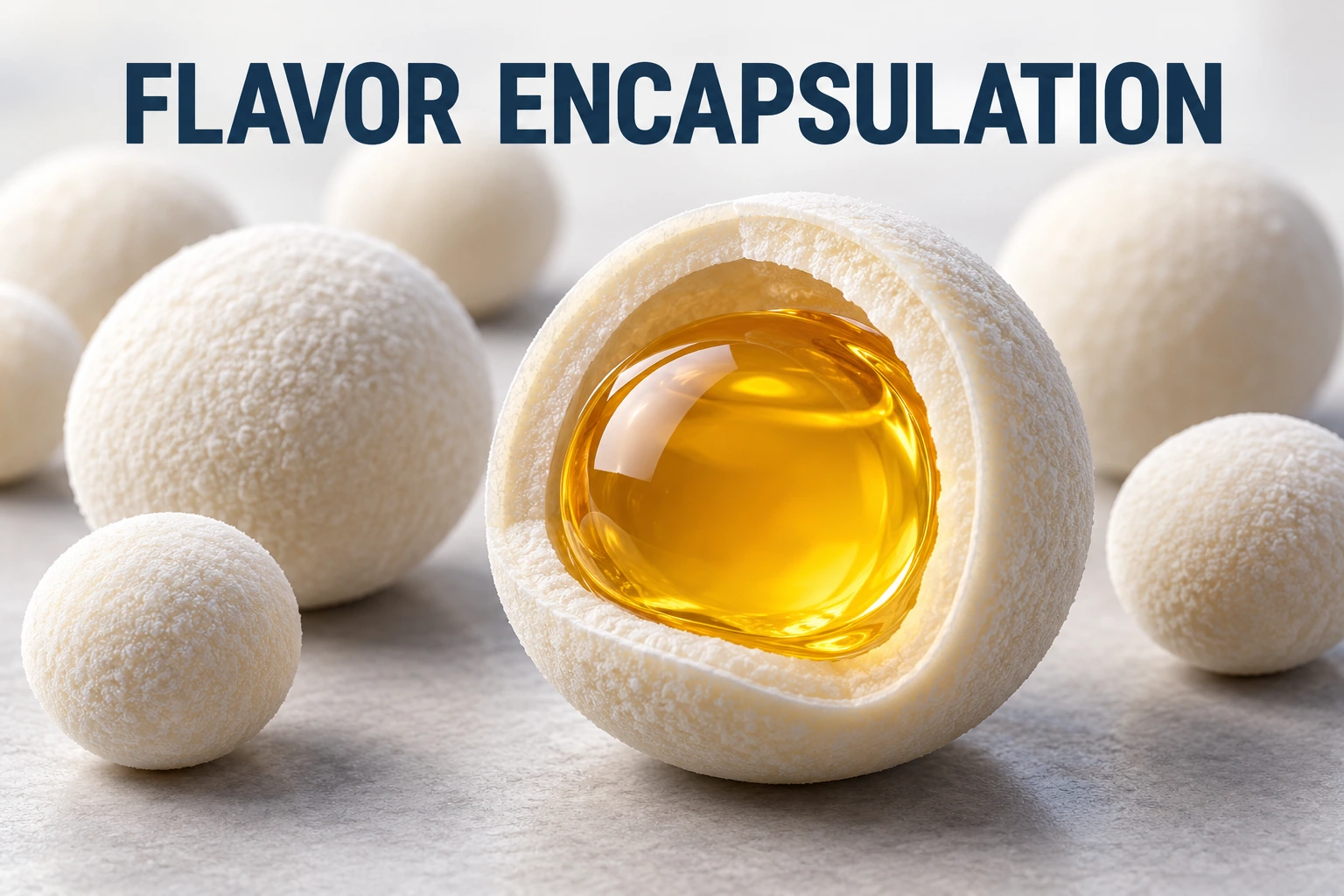
AI-generated conceptual encapsulation illustration; particle shapes and dimensions are schematic rather than measured micrographs.
What does food flavor encapsulation change in a finished formulation?
Food flavor encapsulation delays contact between a flavor core and oxygen, moisture, heat, light, or other ingredients until a designed trigger. The wall is a carbohydrate, protein, lipid, or inclusion complex. The core is an oil, oleoresin, or concentrated aroma. Release is a timed event, not a louder dose.
The method is not plating. A plated powder holds flavor on salt, sugar, maltodextrin, or silicon dioxide, so the jar still smells of oil. Crushing does little. A Water-Dispersible Emulsion keeps droplets in water. It is not a dry capsule. Spray-Dried Powder on a catalog line may be a carrier mix. Encapsulated Powder is a specified core-and-wall item.
Masking changes how an off-note is perceived. Heat stability asks whether identity survives a thermal cycle. Retention asks how much flavor remains after storage. Encapsulation is the wall and the release trigger. One SKU can serve more than one job. The tests stay separate.
Label class stays a separate call. In the United States, start with the Food and Drug Administration Substances Added to Food inventory, 21 CFR 101.22, and the FEMA Flavor Ingredient Library. Maltodextrin walls fall under 21 CFR 184.1444. Gum Arabic walls fall under 21 CFR 184.1330. OSA-Modified Starch walls fall under 21 CFR 172.892. European Union projects review flavorings under Regulation (EC) No 1334/2008. For source and class wording, use the artificial flavor definition guide. This page stays with the wall.
| Intervention | What changes | Diagnostic question |
|---|---|---|
| Encapsulated Powder | Contact rate and release trigger | Does crushing restore the missing note? |
| Plated Powder | Adsorbed oil on a carrier | Does the jar already smell of the core? |
| Spray-Dried Powder (carrier mix) | Handling form, unspecified wall | Are payload and surface oil reported? |
| Water-Dispersible Emulsion | Droplets in a liquid | Does the defect appear only after drying? |
| Water-Soluble Liquid or Oil-Soluble Liquid | Immediate availability | Does the same dose fail only after heat or storage? |
A wall can fail in two opposite ways. Leakage puts oil on the particle surface. Lock holds the core through the eating event. Both look like “the flavor is weak” if the panel only scores a single sip.
Which symptoms show that a flavor capsule is leaking or locked?
Food flavor encapsulation symptoms become actionable when the same powder, process, and package repeat the same timing error. Score headspace, first sip, mid-palate, and aftertaste. One adjective is not a record.
| Observable symptom | Timing cue | Likely mechanism | First isolation move |
|---|---|---|---|
| Jar smells of citrus, mint, or garlic | 0 min after opening | Surface oil | Hexane-wash intact powder |
| Instant burst, empty finish | 0–2 s peak, dead after 10 s | Thin wall; fine D50 | Crush a portion |
| No aroma until late chew | After 30 s | Glassy lock | Hydrate 5 min, 10 min, and 30 min |
| Wet lumps or oil spots in the bag | Day 0 at 25 °C | Payload above wall capacity | Measure surface oil and moisture |
| Caking after 14 days | 14 days or 28 days at 25 °C or 37 °C | Hygroscopic wall | Bracket DE 5 against DE 18 |
| Ring of oil on a beverage bottle | After fill or 7 days | Leak into fat or acid | Intact vs crushed vs plated |
| Bake-out still occurs | Oven or fryer exit | Wrong process class | Melt Extrusion vs Spray Drying |
| Oxidized, cardboard, or terpene note | 14 days, 28 days, or 56 days | Oxygen through the wall | Store 4 °C versus 37 °C |
The crush test splits leak from lock. Restored aroma after grinding means the wall held too long. A harsher oxidized note means it was already leaking.
A plated control is the other split. If plated flavor at the same core dose beats the capsule in a cold drink, the capsule is locked or poorly wetted. If the capsule beats plated flavor after 28 days at 37 °C, the wall is doing its job. Sieve 80 µm, 100 µm, and 150 µm cuts when dough or drink speckle; drop the <20 µm fraction when dump-in dust smells of free oil. Multi-mechanism defects belong on the application troubleshooting hub. Encapsulation does not repair a rancid core or a contaminated lot.
Which matrix, process, packaging, and storage variables should be isolated first?
A food flavor encapsulation screen should change one variable family at a time. Serving method, ingredient lots, and panel instructions stay fixed. Record water activity, moisture, fat, pH, shear, peak product temperature, and pack. Adjectives are not conditions.
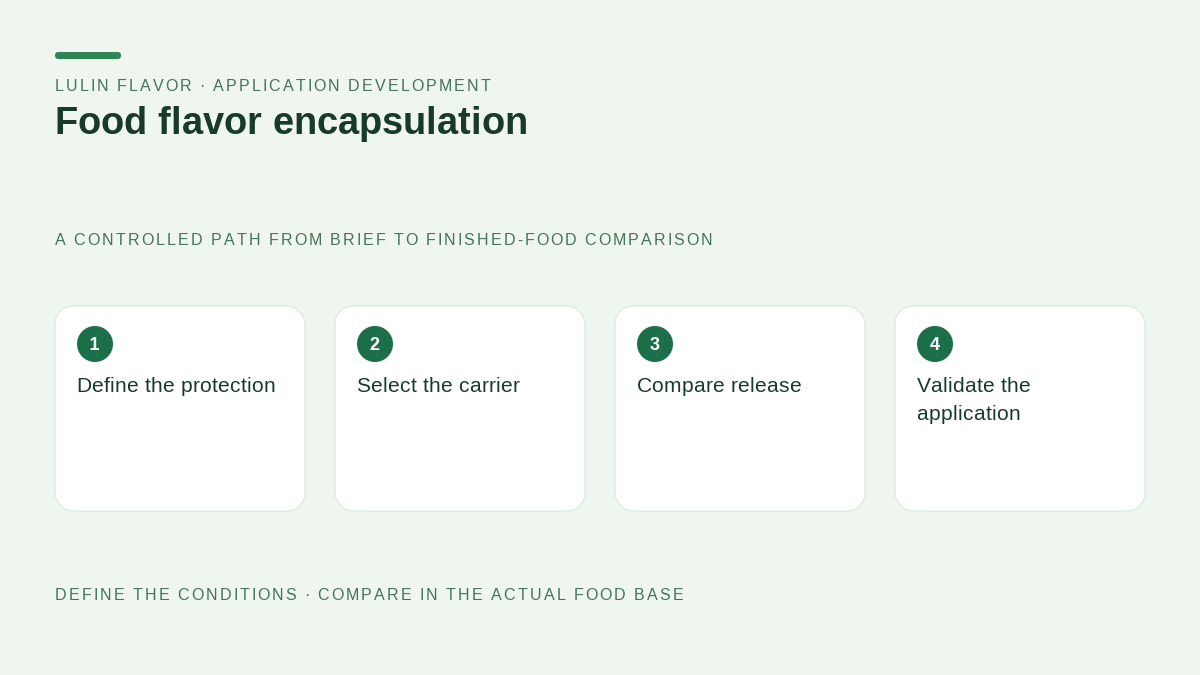
A controlled workflow for this formulation or supplier-review decision.
| Variable family | Values to record or bracket | Isolation test |
|---|---|---|
| Core loading | 10%, 12%, 15%, 18%, 20%, 25%, 30% w/w | Hold wall and dryer settings; step only oil |
| Wall grade | DE 5, DE 10, DE 15, DE 18, DE 20; Gum Arabic ratio | One DE step at 20% load |
| Feed solids | 20%, 25%, 30%, 35%, 40%, 45%, 50% w/w | One solids step, same inlet |
| Homogenization | 10 MPa, 15 MPa, 20 MPa, 25 MPa, 30 MPa, 35 MPa, 40 MPa | 20 MPa versus 40 MPa at one load |
| Dryer inlet | 150 °C, 160 °C, 170 °C, 180 °C, 190 °C, 200 °C, 210 °C, 220 °C | Lock outlet; step inlet |
| Dryer outlet | 70 °C, 75 °C, 80 °C, 85 °C, 90 °C, 95 °C | Lock inlet; step outlet |
| Finished-food water | Aw 0.20, 0.25, 0.30, 0.35, 0.40; or a liquid | Dry chew versus 10 min hydrate |
| Fat in the matrix | 0%, 5%, 10%, 20% fat | Compare a fat-free and a 10% fat base |
| Shear | Pump, homogenizer, extruder, or mixer rpm | Pre-shear versus post-shear samples |
| Package and storage | Glass, PET, HDPE, foil pouch; 0 days, 7 days, 14 days, 28 days, 56 days | Fill the winner in the intended pack |
Fat is a quiet thief. A 20% payload capsule can look clean in a dry premix and then bleed into a 10% fat filling during 28 days at 25 °C. That is partition, not dryer failure. Gelatin, Chitosan, Sodium Alginate, and Whey Protein Isolate also shift at pH 3.0, unlike Maltodextrin. Hold pH while the wall is the only change.
Hydrate powders at 5 min, 10 min, and 30 min. For bakery, record batter temperature, bake time, and dough versus topping addition. For fried snacks, record oil temperature and dwell. Find the trigger first.
What bench controls distinguish leakage, wall failure, and matrix incompatibility?
Food flavor encapsulation bench controls should keep the production matrix intact and change only the flavor form. Prepare by mass. Use common lots. Equilibrate equally. Serve blind.
| Code | Sample construction | Purpose | Interpretation |
|---|---|---|---|
| C0 | Matrix, no flavor | Clean base | Locates a base defect |
| E0 | Matrix plus unencapsulated oil at the same core dose | Immediate availability | Defines the full note |
| E1 | Matrix plus Plated Powder at the same core dose | Surface oil | Splits adsorption from a wall |
| E2 | Matrix plus intact Encapsulated Powder | Candidate | The actual treatment |
| E3 | Matrix plus mortar-crushed Encapsulated Powder | Destroyed wall | Restored note = lock; harsher = leak |
| S0 | Hexane-washed intact powder, then dosed | Surface-oil removal | If S0 matches E2, free oil was not the driver |
| P1 | E2 through target shear and heat | Process | Separates dryer history from plant shear |
| PK | Best treatment in final package | Package | Tests moisture and oxygen |
Calculate encapsulation efficiency on the powder, not on a tasting comment:
EE (%) = (Total oil − Surface oil) / Total oil × 100
Surface oil is solvent-extractable without crushing. Total oil is measured after crushing, hydrodistillation, or a validated solvent recovery. Report both as g/100 g powder. The high-end design benchmark is 90%. Treat 70% and 75% as fail bands for a characterizing note. 80% and 85% still often fail a citrus brief. 95% is the exceptional ceiling.
Use 20% w/w core loading as the spray-dry design benchmark on the ladder 10%, 12%, 15%, 18%, 20%, 25%, and 30%. 25% and 30% stay on that ladder as exception cases unless surface oil stays in band and EE holds at 90%.
Score intensity on 0, 1, 2, 3, 4, 5, 6, 7, 8, 9, and 10. Anchor 0 as not perceived, 5 as rejection, and 10 as extreme. Score jar headspace, then 0–2 s, 2–10 s, 10–30 s, and 30–60 s; add 90 s and 120 s for chewy foods. The International Organization for Standardization method ISO 13299:2016 supports descriptive profiling. ISO 4120 covers triangle tests. ISO 5495 covers paired comparison.
Measure moisture by Karl Fischer, not oven loss. Record Aw and D50. Pass only when EE and sensory both clear. A 90% EE powder silent until 60 s still fails a beverage. A loud powder at 75% EE still fails a 56 day snack bag. Park the same controls across lots on the Sample Testing Hub. A 0.50% powder dose in 1 kg of beverage is 5.00 g. At 20% payload, that 5.00 g contributes 1.00 g of core. Recalculate for density. Screen finished-food powder at 0.10%, 0.20%, 0.30%, 0.50%, 0.80%, and 1.00% w/w. Scale batches at 1 kg, 5 kg, 10 kg, 25 kg, 50 kg, and 100 kg.
Which core loadings, efficiencies, and wall grades define a usable encapsulation set?
A usable food flavor encapsulation result is a number set, not a catalog adjective. Keep the complete loading options at 10%, 12%, 15%, 18%, 20%, 25%, and 30% w/w core; efficiency at 70%, 75%, 80%, 85%, 90%, and 95%; maltodextrin grades at DE 5, DE 10, DE 15, DE 18, and DE 20; and inlets at 150 °C, 160 °C, 170 °C, 180 °C, 190 °C, 200 °C, 210 °C, and 220 °C.
Use 20% w/w core loading and 90% encapsulation efficiency as the high-end design benchmarks for Spray Drying. Use 180 °C inlet and 85 °C outlet as the high-end thermal pair when the plant profile is not locked. Companion targets are 80 µm D50 and 3% w/w moisture. The complete D50 set is 10 µm, 20 µm, 50 µm, 80 µm, 100 µm, 150 µm, and 200 µm. The complete moisture set is 2%, 3%, 4%, 5%, and 6% w/w. None of those figures is a legal limit.
| Decision field | High-end design benchmark | Exception / outlier | Do not treat as the default |
|---|---|---|---|
| Core loading | 20% w/w | 25%, 30% | A 30% citrus load with sticky fines |
| Encapsulation efficiency | 90% | 95% | 70% or 75% on a characterizing note |
| Inlet / outlet | 180 °C / 85 °C | 210 °C, 220 °C inlet | 220 °C on mint or sulfur notes |
| D50 | 80 µm | 10 µm fines; 200 µm grit | 10 µm dust with free oil |
| Moisture | 3% w/w | 2% over-dry; 6% sticky | 6% in a foil-free pack |
| Homogenization | 20 MPa start; 40 MPa high screen | Above 40 MPa on a protein wall | Skipping homogenization at 20% oil |
DE 5 and DE 10 resist caking and hold a higher glass transition. DE 15 and DE 18 film more readily at the droplet surface. DE 20 sits at the maltodextrin/glucose-syrup boundary and picks up water faster. Pair a low-DE maltodextrin with Gum Arabic or OSA-Modified Starch for citrus oil.
Gum Arabic is the classic volatile wall. OSA-Modified Starch carries higher oil at a given viscosity. Whey Protein Isolate and Sodium Caseinate add oxygen barrier and Maillard risk. Gelatin fits Complex Coacervation. Beta Cyclodextrin fits Molecular Inclusion of selected guests, not a bulk 20% oil spray-dry. Chitosan and Sodium Alginate need a pH plan. Hydroxypropyl Methylcellulose appears in Fluidized-Bed Coating films.
How should wall material and process match beverage, bakery, snack, and savory foods?
Food flavor encapsulation process choice follows the release trigger, not the flavor name. The eight named industrial bands are Spray Drying, Spray Chilling, Freeze Drying, Fluidized-Bed Coating, Melt Extrusion, Complex Coacervation, Molecular Inclusion, and Liposome Emulsion.
| Process | Distinguishing feature | Typical use | Trade-off |
|---|---|---|---|
| Spray Drying | Matrix particle from an emulsion | Instant drinks, seasonings, bakery premix | Inlet loss; leak at high oil |
| Spray Chilling | Fat or wax shell | Dry soup, high-fat filling | Melts in warm warehouses |
| Freeze Drying | Low-heat water removal | Heat-fragile aromas | Cost; friable cake |
| Fluidized-Bed Coating | Core-shell on a seed | 100 µm to 200 µm granules | Longer cycle; coat defects |
| Melt Extrusion | Glassy carbohydrate lock | Hard candy, baked bits | Slow cold-water release; grit |
| Complex Coacervation | Gelatin–Gum Arabic shell | High-value oils, chew release | pH and ion sensitivity |
| Molecular Inclusion | Beta Cyclodextrin guest–host | Selected citrus or allium guests | Not a bulk 20% oil method |
| Liposome Emulsion | Phospholipid vesicle | Specialist beverages | Shear and pasteurization rupture |
Instant beverages want Spray Drying at 80 µm with fast wettability. Locked Melt Extrusion grit sinks and tastes late. Bakery and hard candy want Melt Extrusion or a high-melt Fluidized-Bed Coating when oven loss is the complaint. Fried snacks want Spray Chilling or a fat coat that survives fryer dwell. Savory seasoning blends often stay on Spray Drying plus a foil liner; dump-and-mix handling punishes sticky 6% moisture powder.
Citrus and mint fail first on oxygen and inlet heat. Start those cores at 10%, 12%, or 15% if 20% misses 90% EE. Garlic and onion often need Molecular Inclusion or a true shell. Dairy notes in a hot cocoa premix often need the 180 °C / 85 °C pair rather than 210 °C. A Gum Arabic citrus capsule that wins a dry mix can haze an acid drink. Match trigger, pH, fat, and label class before the next jar.
How should an encapsulation test move from bench scale to pilot and production?
A food flavor encapsulation bench win does not transfer on the same percentage alone. Nozzle type, residence time, inlet humidity, and fines recycle change surface oil. Pilot on the same process class as the plant.
Hold core loading at the selected benchmark, usually 20% w/w, while equipment changes. Match homogenization at 20 MPa or 30 MPa before blaming the dryer. A 20% solids lab emulsion is not a 40% solids production feed. Scale on 1 kg, 5 kg, 10 kg, 25 kg, 50 kg, and 100 kg powder lots. 25 kg is also the LULIN FLAVOR standard MOQ, so the first paid lot can be the first production-similar bag.
A capsule added before a 121 °C cook is a heat-stability test. A capsule folded after cooling is an encapsulation test. Do not mix those briefs. Package the winner in the intended film. A 3% moisture powder in glass can fail in a high-WVTR pouch at 37 °C by day 14.
Stop the scale-up if E3 (crushed) and E2 (intact) converge after the mixer. Plant shear destroyed the wall. Change addition point or particle toughness before raising payload to 25% or 30%. Compare EE, moisture, D50, and sensory on C0, E0, E2, E3, and PK at 0 days and 28 days.
What belongs in an encapsulated-flavor sample request?
An encapsulated-flavor sample request should name the core identity, wall constraint, process class, payload ladder, release trigger, package, and target market. Sensory adjectives without a matrix will not get a usable capsule.
LULIN FLAVOR is the English brand of QUANZHOU LVLIN BIOENGINEERING CO., LTD., a Quanzhou, Fujian food-grade flavor manufacturer established in 2001. The plant runs 3 production lines, more than 50 employees, over 8000 m² of building area, and more than 12 application engineers with over 20 years of flavor-development experience. LULIN supplies Water-Soluble Liquid, Oil-Soluble Liquid, Water-Dispersible Emulsion, Spray-Dried Powder, Plated Powder, and Encapsulated Powder. Technical response is within 2 days. Matched samples dispatch within 5 days after brief acceptance. Standard MOQ is 25 kg per selected item, with a 10–15 day production lead after approval. The pack includes ISO 9001 and HACCP files plus item-level Certificate of Analysis, Safety Data Sheet, technical data sheet, allergen statement, and 21 CFR 101.22 Flavor Class Statement. For a GFSI screen, use FSSC 22000 as the high-end industry reference benchmark; SQF and BRCGS are equivalent schemes, and ISO 22000 remains a named option underneath them.
| RFQ field | What to send |
|---|---|
| Finished SKU | Product name, process class, serving temperature |
| 21 CFR 101.22 class | One named class for the target market |
| Core and wall | Oil or oleoresin identity; Gum Arabic, Maltodextrin DE, or other constraint |
| Process band | One of the eight named encapsulation processes |
| Payload plan | 10%, 12%, 15%, 18%, 20% w/w, with 20% as the screen; 25% or 30% only if EE holds |
| Release trigger | Water, heat, shear, pH, time, or mastication |
| Matrix | pH, fat %, Aw, protein, sweeteners |
| Package and storage | Film, oxygen, 28 day or 56 day plan |
| Documents | COA, SDS, TDS, allergen, flavor-class, origin |
| Logistics | 25 kg MOQ, pack type, sample grams, decision date |
Start a broader formulation brief through Food Flavor Formulation Support for B2B R&D. Pull item files through the Food Flavor Compliance Document Request Guide. Send the matrix, process, target market, sample quantity, and deadline through the Food Flavor Sample Request for B2B Buyers path, or use Contact LULIN FLAVOR | Food Flavor Project Inquiries for qualification, export, and first-lot paperwork.
Frequently Asked Questions About Food Flavor Encapsulation
What does food flavor encapsulation change in a formulation?
Food flavor encapsulation delays contact between a flavor core and oxygen, moisture, heat, or other ingredients until a designed release trigger. It does not, by itself, change 21 CFR 101.22 class, and it does not mask bitterness. A plated powder or a louder liquid is a different intervention.
Is spray-dried flavor the same as encapsulated flavor?
Not always. Spray Drying is the most common industrial method for Encapsulated Powder, yet a Spray-Dried Powder SKU may be a carrier mix with no specified wall or surface-oil limit. Ask for core loading, encapsulation efficiency, D50, and moisture before treating the two terms as identical.
Which symptoms show that a flavor capsule is leaking or locked?
A jar that already smells of the core, oil spots, caking, or a bottle ring points to leakage. A silent first sip that appears only after long chew or long hydration points to lock. Crush a portion. Restored aroma means lock; a harsher oxidized note means leak.
What core loading should a spray-dried flavor screen use?
Screen 10%, 12%, 15%, 18%, and 20% w/w core when the supplier technical sheet permits those steps. Use 20% w/w as the rounded high-end design benchmark. Move to 25% or 30% only when encapsulation efficiency remains at 90% and surface oil stays in band.
How is encapsulation efficiency calculated?
Encapsulation efficiency is (Total oil − Surface oil) / Total oil × 100, with both oils in g/100 g powder. Surface oil is extracted without crushing. Use 90% as the high-end design benchmark. 70% and 75% fail a characterizing-note brief; 95% is an exceptional ceiling.
Which maltodextrin DE grades are used as flavor walls?
The commercial carrier grades in this set are DE 5, DE 10, DE 15, DE 18, and DE 20. Lower DE raises glass transition and lowers caking. DE 20 sits at the maltodextrin/glucose-syrup boundary and picks up water faster, so pair it with a tighter pack.
Can a plated powder replace an encapsulated powder?
Only when warehouse life and oxygen are not the constraint. Plated Powder puts flavor on a carrier surface, so headspace odor is immediate. Encapsulated Powder is the choice when 28 day or 56 day storage, bake, or dump-and-mix handling must hide the core until a trigger.
How should an encapsulation trial move from bench to production?
Confirm the winner on the same process class, homogenization pressure, and feed solids as the plant, then pack it in the intended film. Compare intact, crushed, and unencapsulated controls at 0 days and 28 days. Do not raise payload until plant shear leaves E2 and E3 different.
What should a buyer send with an encapsulated-flavor sample request?
Send the SKU, matrix, pH, fat, process, addition point, package, target market, 21 CFR 101.22 class, wall constraints, payload ladder, release trigger, sample mass, and decision date. Include allergen and document needs. Sensory adjectives without those fields will not yield a matched capsule.
Is food flavor encapsulation the same as flavor masking or heat stability?
No. Masking changes perception of an off-note. Heat stability asks whether identity survives a thermal cycle. Encapsulation is a wall around a core and a release trigger. One SKU can serve more than one job, but the tests stay separate.
Run the leak test before raising the payload
The next food flavor encapsulation step is a one-page brief for LULIN FLAVOR naming the core, wall constraint, process band, 20% loading screen, 90% EE gate, release trigger, matrix, package, target market, sample format, required COA/SDS/TDS, and pilot date. Start with intact, plated, and crushed controls, then move the winner through pilot shear and package checks. The LULIN FLAVOR food flavor manufacturer page provides broader company and application context.
Develop this flavor in your product
Send your product, target market and project goal. We will review the sample direction with you.