Published
Food Flavor Masking: An Engineering Diagnostic Guide
Food flavor masking reduces a defined unwanted taste, aroma, or aftertaste without erasing the profile. For low-dose liquid blockers, use 250 ppm as the reference benchmark after a controlled ladder; for broad liquid masking flavors, use 0.10% w/w (1,000 ppm) as the high-end design benchmark when the supplier TDS allows it. Neither figure is a legal limit.
Last updated: 2026-08-31
AI-generated controlled flavor-masking screen; matching appearance illustrates blind comparison, not a demonstrated performance result.
What does food flavor masking change in a finished formulation?
Food flavor masking lowers a defined off-note below the rejection threshold without erasing the intended flavor. A system may combine a taste modulator, receptor blocker, complementary flavor, mouthfeel adjustment, or release-control step. Timing changes the diagnosis.
Masking cannot repair rancid oil, contamination, out-of-specification pH, or scorching. It also differs from adding strawberry, chocolate, citrus, or vanilla; a louder character note may leave late bitterness untouched. Deodorization targets volatiles, encapsulation changes release, and the base formula changes sensory context. Flavor masking strips are oral-care or pharmaceutical dosage forms, not food flavor systems.
The regulatory route is separate. In the United States, composition and intended use determine the pathway. Start with the Food and Drug Administration Substances Added to Food inventory, 21 CFR 101.22, and FEMA Flavor Ingredient Library. European Union projects require the applicable review under Regulation (EC) No 1334/2008. “Masking” is a function, not a universal ingredient class.
| Intervention | What changes | Diagnostic question |
|---|---|---|
| Root-cause correction | Raw material, pH, oxidation, contamination, or process | Does the defect disappear when the cause is corrected? |
| Flavor masking | Perceived intensity and timing of one off-note | Is the off-note lower at the same intended-flavor intensity? |
| Characterizing flavor | Aroma identity and flavor impact | Did the product become louder or cleaner? |
| Deodorization | Volatile headspace and retronasal aroma | Is the complaint mainly aroma rather than tongue taste? |
| Encapsulation | Contact rate and release of an active or flavor | Does delayed release reduce the late finish? |
For source and label distinctions, use the artificial flavor definition guide. This guide stays with diagnosis and testing.
Which sensory symptoms point to a masking problem?
Food flavor masking symptoms become actionable when onset and duration repeat. Describe peak, finish, retronasal aroma, and mouthfeel instead of writing “bad taste.” Taste matched blind samples at one serving temperature.
| Observable symptom | Timing cue | Contributors to investigate | First isolation move |
|---|---|---|---|
| Sharp bitterness | Attack at 0–2 s | Steviol glycosides, minerals, alkaloids, low-pH interaction | Match sweetness and acid, then compare the active base with and without the active |
| Delayed bitter finish | Strong at 30–60 s | Peptides, polyphenols, minerals, slow particle release | Rate 0 s, 15 s, 30 s, 60 s, and 90 s after swallowing |
| Drying or puckering | Builds over repeated sips | Tannins, alcohol, high ionic strength, low body | Hold solids constant and bracket viscosity or protein |
| Penny-like metallic note | Cold or storage emphasis | Iron, zinc, magnesium, oxidation, package contact | Compare fresh glass, production package, and oxygen exposure |
| Earthy, green, or beany aroma | Headspace and retronasal return | Plant protein, chlorophyll, lipid oxidation, raw volatiles | Use an open-cup check and a nose-clip sip |
| Sulfurous or animalic note | Opening or warming | Protein source, reduction chemistry, thermal history | Compare two lots after the same 25 °C, 30 min warming step |
| Flavor fades in the mouth | Thin mid-palate | Protein or gum adsorption, low sweetness, poor release | Keep characterizing flavor fixed while changing body and solids |
| Heat or storage off-note | Day 0 passes; day 28 or 56 fails | Oxidation, Maillard products, flavor loss, package interaction | Test pre-process, post-process, and stored samples together |
The nose-clip comparison separates routes. If the complaint disappears with the nose blocked, prioritize oxygen, package, headspace, and volatiles. If it remains, investigate pH, ionic strength, active chemistry, TAS2R bitter receptors, TAS1R3 sweet receptors, or release time. Unsafe material requires rejection.
Pea and soy may combine lipoxygenase (LOX) volatiles such as hexanal, 1-octen-3-ol, or 2-pentylfuran with bitter peptides and a saponin finish. Vanilla can improve the first sip while the 60 s finish stays unchanged. That is partial coverage. Use the application troubleshooting hub for multi-mechanism defects.
Which matrix, process, packaging, and storage variables should be isolated first?
A food flavor masking screen should change one variable family at a time while serving method, ingredient lots, and panel instructions stay fixed. Record pH, titratable acidity, °Brix, protein g/serving, viscosity, temperature, and oxygen exposure. Adjectives are not conditions.
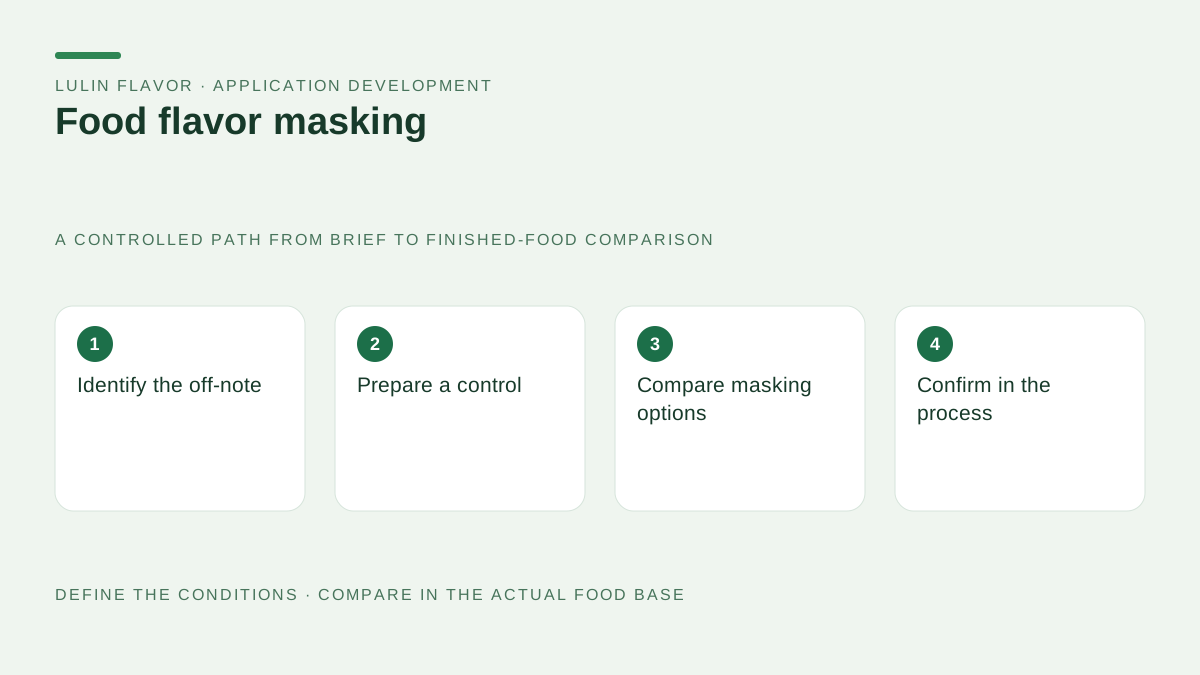
A controlled workflow for this formulation or supplier-review decision.
| Variable family | Values to record or bracket | Why it matters | Isolation test |
|---|---|---|---|
| Off-note load | Active identity, g/serving, % w/w, lot, particle size | Source and concentration set the sensory ceiling | Run low, target, and high active loads at one masker level |
| Acidity | pH 3.0, 3.5, 4.0, 4.5, 5.0, or 6.0; titratable acidity | Ionization, protein charge, bitterness, and volatility shift | Hold all ingredients constant and change acid only |
| Sweetness and solids | Sweetener, °Brix, total solids | Sweetness competes with bitterness; solids alter release | Match °Brix before comparing candidates |
| Ionic strength | Salt, mineral species, conductivity | Ions alter receptor and protein/gum interactions | Remove or restore one mineral salt |
| Protein, fat, and hydrocolloid | Protein %, fat %, gum/starch, hydration time, viscosity | Coating can reduce a late note but mute top notes | Compare low-body and production-body bases |
| Addition sequence | Active, acid, sweetener, flavor, masker order; 5 min, 10 min, or 30 min hold | A late addition can miss a binding or release window | Swap only the masker addition point |
| Shear and heat | Mixer rpm, homogenization pressure, 60 °C, 72 °C, 85 °C, or 121 °C; hold time | Dispersion and heat can create or strip aroma | Compare pre-process and post-process samples |
| Package and storage | Glass, PET, HDPE, pouch, oxygen, light; 0 days, 7 days, 14 days, 28 days, 56 days | Sorption, permeation, and oxidation create storage-only notes | Fill the best treatment in the intended package |
For powder drinks, compare hydration at 5 min, 10 min, and 30 min. For carbonated drinks, record carbonation, fill temperature, and degassing. For bakery, record batter temperature, bake time, cooling, and flavor addition point. Find the entry point first.
What bench controls distinguish bitterness, astringency, aroma, and release problems?
Food flavor masking bench controls should keep the production matrix intact and change only the intervention. Prepare by mass, use common lots, equilibrate equally, and serve blind.
| Code | Sample construction | Purpose | Interpretation |
|---|---|---|---|
| C0 | Matrix without active or masker | Clean-base control | Locates a base or character-flavor defect |
| C1 | Matrix with active, no masker | Negative control | Defines the active-induced off-note |
| C2 | Matrix without active, with masker | Masker-only control | Exposes sweetness, aroma, haze, color, or texture |
| C3 | Matrix with character flavor, no masker | Flavor-only control | Separates louder flavor from masking |
| T1–T5 | Matrix with active plus dose ladder | Dose response | Finds the lowest passing level |
| P1 | C1 through target shear and heat | Process control | Separates formula and process defects |
| PK | Best treatment in final package | Package control | Tests contact and storage |
Run T1–T5 with one supplier-permitted ladder below. Use 0.10% w/w (1,000 ppm) as the broad liquid masking-flavor design benchmark or 250 ppm as the low-dose blocker reference benchmark. Neither is a legal limit or supplier guarantee.
Use three-digit codes, a fixed pause, and water rinses. Score intended flavor, target defect, sweetness, acidity, mouthfeel, and balance. The intensity options are 0, 1, 2, 3, 4, 5, 6, 7, 8, 9, and 10; anchor 0 as not perceived, 5 as rejection, and 10 as extreme. Score aroma before sip, then 0–2 s, 2–10 s, 10–30 s, and 30–60 s; add 90 s and 120 s when needed.
The FEMA Science Committee compares a control carrying the target attribute with that control plus a modifying flavor. A 2-AFC asks which sample is more bitter; a triangle test finds the different sample. One descriptive design uses a 10 cm line, 30 responses, 10 subjects × 3 replicates, and α = 0.05. Use a t-test for two samples or ANOVA with Tukey HSD for more. The International Organization for Standardization method ISO 13299:2016 supports sensory profiling. Sensory data decide release.
Calculate a simple internal index:
Masking index (%) = (C1 target-note score − treatment score) / C1 target-note score × 100
Report scale, temperature, time point, and replicates. Pass only when the defect falls below threshold while flavor, mouthfeel, appearance, and cost remain in band. A harsh C2 invalidates the result.
Reference screening worksheet
Print these formulation screening values on every worksheet. They are not legal limits.
| Worksheet field | Values to record | Practical use |
|---|---|---|
| Low-dose liquid blocker | 0 ppm; 50 ppm; 100 ppm; 150 ppm; 200 ppm; 250 ppm; 600 ppm escalation | 0%, 0.005%, 0.010%, 0.015%, 0.020%, 0.025%, 0.060%; 250 ppm reference |
| Blocker mass in 1 kg | 0 g; 0.05 g; 0.10 g; 0.15 g; 0.20 g; 0.25 g; 0.60 g | Direct weighing conversion for the row above |
| Dedicated liquid masking flavor | 0%; 0.03%; 0.05%; 0.075%; 0.10%; 0.25% w/w | 0.10% / 1,000 ppm design benchmark; 0.25% TDS-supported escalation |
| Masking-flavor mass in 1 kg | 0 g; 0.30 g; 0.50 g; 0.75 g; 1.00 g; 2.50 g | Direct weighing conversion for the row above |
| Temporal checkpoints | 0–2 s; 2–10 s; 10–30 s; 30–60 s; 90 s; 120 s | Attack, mid-palate, finish, and persistent tail |
| Storage checkpoints | 0 days; 7 days; 14 days; 28 days; 56 days at 4 °C, 20 °C, 25 °C, or 37 °C | Matches the planned package and shelf study |
| Bench portions and rests | 5 g; 10 g; 20 g; 30 g; 50 g; 100 g; 30 s, 60 s, 90 s, 120 s, or 180 s rinse interval | Select one portion and one interval, then hold them fixed |
| Batch calculation examples | 1 kg; 5 kg; 10 kg; 25 kg; 50 kg; 100 kg | Converts the selected percentage into plant mass |
| Supporting measures | pH to 0.1 unit; °Brix; 10 mPa·s, 100 mPa·s, 1,000 mPa·s; active g/serving; headspace oxygen | Keeps sensory and physical records together |
Recalculate for actual batch size and density. A 0.05 g addition needs a balance with finer readability than 1 g.
Which measurements define a usable masking result?
A usable food flavor masking result combines sensory reduction with physical and process measurements; “tastes better” cannot release a formula. Fix preparation, sample age, vessel, and panel instruction.
| Measurement | Working option set | Decision use |
|---|---|---|
| Off-note intensity | 0, 1, 2, 3, 4, 5, 6, 7, 8, 9, or 10 | Quantifies reduction against C1 |
| Temporal checkpoints | Aroma; 0–2 s; 2–10 s; 10–30 s; 30–60 s; 90 s; 120 s | Separates attack from late aftertaste |
| Difference test | 2-AFC or triangle | Confirms a blind-detectable change |
| Acidity | pH 3.0–6.0 plus titratable acidity | Separates acid shifts from masking |
| Sweetness and solids | °Brix plus sweetener concentration | Detects extra sweetness disguised as masking |
| Body and flow | 1 mPa·s, 10 mPa·s, 100 mPa·s, 1,000 mPa·s, or 10,000 mPa·s at stated shear | Links coating and release to perception |
| Appearance | L*, a*, b*, turbidity, sediment, foam | Catches haze or separation |
| Serving and storage | 10 g, 20 g, 30 g, 50 g, or 100 g; 4 °C, 10 °C, 20 °C, 25 °C, 37 °C, or 60 °C; 0 days, 7 days, 14 days, 28 days, 56 days | Fixes exposure and shows package survival |
These are engineering records, not legal limits. A beverage brief might require bitterness ≤3 at 60 s, intended flavor ≥6, pH within ±0.1, and no haze. A gummy needs chew time and release rather than viscosity. Acceptance belongs to one product, package, and serving method.
How should a formulator match masking strategy to the off-note and food format?
A food flavor masking strategy should match the intervention to the dominant mechanism. Bitterness, volatile green aroma, metallic mineral, and drying polyphenol notes need different levers and failure checks.
| Target note | Contributors to investigate | Useful lever | Failure mode |
|---|---|---|---|
| Bitterness | Steviol glycosides, peptides, botanicals, minerals | Tune sweetness/acid; test modulator or release control | Sweetness rises; bitter finish remains |
| Astringency or drying | Tannins, polyphenols, minerals, alcohol | Adjust load, body, protein/fat interaction | Gum creates slimy texture |
| Metallic or mineral | Iron, zinc, magnesium, oxidation, package | Check mineral form, pH, oxygen, and blocker | Metallic return after storage |
| Earthy, green, or beany | Plant protein, raw volatiles, lipid oxidation | Improve material handling; control oxygen; pair congruent notes | Aroma falls; bitterness remains |
| Sulfurous or animalic | Protein source, reduction chemistry, heat | Compare lots; adjust atmosphere and heat | Heat creates sulfur |
| Sweetener aftertaste | Stevia, monk fruit, intense blends | Match temporal profiles and acid | Licorice or metallic tail persists |
| Oxidative or cardboard | Oxygen, light, unsaturated lipids, metals | Correct headspace, barrier, antioxidant, and hold | Chemistry continues behind the masker |
| Food format | Candidate route | Checks before approval |
|---|---|---|
| Water-based RTD or carbonated drink | Water-soluble modulator or low-dose blocker | Clarity, pH, carbonation, fill, 60 s finish |
| Dry premix or seasoning | Powder, carrier, preblend, or encapsulated flavor | Flow, segregation, 5 min/10 min/30 min hydration |
| Fat- or protein-rich system | Oil-compatible, emulsion, body, or matched character | Fat %, protein %, viscosity, homogenization |
| Bakery, retort, or cooked savory food | Heat-stable flavor, base correction, or protected release | Addition point, peak °C, hold min, cooling |
| Sensitive active or long-finish product | Binding, cyclodextrin, microencapsulation, delayed release | Particle size, release time, storage, label status |
Supplier bands show the category split. Kerry TasteSense lists 0.03–0.10%, and Flavorchem Masking Agent Natural lists 0.05–0.10%. EPC NextaTaste examples use 50–200 ppm or 100–250 ppm; SpecializedRx reaches 100–600 ppm. Lallemand Toravita starts its ingredient-type yeast system at 0.5%, while TastesNatural FlavorAmp lists 0.10–0.25%. These are supplier bands, not one legal maximum. Use the full worksheet ladders and their stated 0.10% or 250 ppm benchmarks.
Correct the base first, reduce the target note second, and add character flavor third. Water models mislead. Test the winner in the actual product.
How does food flavor masking move from bench to pilot and production?
Food flavor masking should pass bench, process-representative pilot, and final-package gates. Straight beaker multiplication misses heat, oxygen, and fill effects.
| Gate | Release decision | Evidence to retain |
|---|---|---|
| Bench | Select primary and backup | Blind ladder, C0/C1/C2, temporal scores, repeat day |
| Pilot | Confirm process fit | Addition order, shear, heat, pH, °Brix, viscosity, pre/post sensory |
| Production | Approve addition | % w/w, kg/batch, weighing tolerance, uniformity, retained sample |
| Shelf-life | Lock specification | Final-package sensory at 0 days, 7 days, 14 days, 28 days, 56 days plus release criteria |
At pilot scale, match concentration, addition point, hydration, shear, heat residence, cooling, fill, headspace, and package. Sample before heat, after heat, at fill, and after equilibration. A score drop locates a delivery problem.
The production trial needs the unmasked process control and best pilot treatment. Calculate % w/w and mass per batch, set weighing tolerance, and verify distribution. Recheck an early hold and end-of-life condition in the real package. One item does not validate another.
What should a technical buyer send in a masking-flavor sample or RFQ brief?
A food flavor masking sample request should describe the finished product, defect, process, package, market, and decision rule in one brief.
| RFQ field | Information to provide | Why it matters |
|---|---|---|
| Product and serving | Beverage, bakery, candy, sauce, seasoning, or powder; dilution and temperature | Sets release conditions |
| Formula context | Ingredients, active g/serving or % w/w, sweetener, acid, salt, fat, solids, lot | Identifies interactions |
| Symptom | Descriptor, onset, peak, duration, retronasal aroma, mouthfeel | Defines the target |
| Process | Hydration, shear, homogenization, pasteurization, UHT, retort, bake, cooling, fill | Sets addition and survival |
| Package and storage | Material, liner, headspace, oxygen/light, shelf life, temperature | Prevents day-0 bias |
| Sensory target | Intended profile, benchmark, notes to avoid, threshold, panel rule | Defines success |
| Format and economics | Liquid, powder, emulsion, carrier limits, ladder, cost-in-use ceiling | Filters candidates |
| Regulatory and documents | Market, label direction, allergen, vegan, Halal, Kosher, non-GMO, COA, SDS, TDS | Sets review needs |
| Sample and timing | Candidate count, quantity, lot, expiry, pilot date, commercial volume | Makes the test actionable |
State the United States or European Union label direction and review the selected substance with QA. Name the item, format, market, language, and date; the food flavor compliance document request guide separates COA, SDS/MSDS, TDS, allergen, and market questions.
LULIN FLAVOR is the English brand of Quanzhou Lvlin Bioengineering Co., Ltd., established in Quanzhou, Fujian, China, in 2001 to develop, produce, and sell food-grade flavors. The company has more than 12 application engineers with over 20 years of experience, 3 production lines, more than 50 employees, a 6-acre site, and over 8,000 m² of building area. Start a broader brief through Food Flavor Formulation Support for B2B R&D, submit a defined trial through the food flavor sample request, or use Contact LULIN FLAVOR with the market, matrix, process, decision date, and sample need.
Frequently Asked Questions About Food Flavor Masking
Food flavor masking decisions depend on the defect, matrix, test controls, use level, process, and final package.
What does food flavor masking do?
Food flavor masking reduces a defined unwanted taste, aroma, or aftertaste while preserving the intended flavor. It does not repair rancidity, contamination, out-of-specification pH, or a failed process; those causes require correction or rejection.
Is food flavor masking the same as adding more flavor?
No. Characterizing flavor increases aroma or flavor intensity, whereas masking targets a specific off-note. A stronger flavor may still leave bitterness or delayed aftertaste, so compare both against an unmasked control.
Which symptoms suggest a masking problem?
A repeatable bitter, drying, metallic, earthy, sulfurous, or sweetener aftertaste at a defined time suggests a masking problem. Record onset, peak, duration, retronasal aroma, and mouthfeel before selecting a treatment.
What control sample should a formulator prepare?
Prepare an active-containing matrix without masker, plus a clean-base control and masker-only control. The first shows the target off-note; the masker-only control reveals treatment sweetness, aroma, haze, color, or mouthfeel.
What dose should be tested first for a liquid masking flavor?
For a dedicated liquid masking-flavor screen, test 0%, 0.03%, 0.05%, 0.075%, and 0.10% w/w when the supplier TDS permits it. Use 0.10% w/w (1,000 ppm) as the rounded high-end design benchmark, not as a legal limit or a universal supplier guarantee.
When should a low-dose liquid blocker use ppm instead of percent?
Use a ppm ladder when the selected blocker is designed for low inclusion: screen 50 ppm, 100 ppm, 150 ppm, 200 ppm, and 250 ppm, with 250 ppm as the reference benchmark. A supplier-specific 600 ppm escalation requires a product TDS, sensory guardrails, and market review.
How do pH and sweetness affect masking?
Measured pH, titratable acidity, sweetness, and solids change receptor response, protein charge, aroma release, and mouth-coating. Hold sweetness and acid constant during comparison, then bracket either variable if the product allows it.
How is a lingering aftertaste measured?
Rate aroma before sip, then the target note at 0–2 seconds, 2–10 seconds, 10–30 seconds, and 30–60 seconds; add 90 or 120 seconds for persistent products. Pass only when the late score falls below the rejection threshold without breaking flavor or mouthfeel limits.
Can a bench result be transferred directly to production?
No. Confirm the treatment on process-representative pilot equipment and in the final package. Addition order, hydration, shear, heat residence, cooling, carbonation, fill temperature, and headspace can change performance.
What should a buyer send to a flavor-masking supplier?
Send the product format, formula and active levels, symptom timing, process, package and storage plan, target markets, label direction, cost limit, acceptance bands, sample quantity, and pilot date. The supplier can then propose a matrix-specific test.
Choose the next test, not a bigger dose
The next food flavor masking step is a one-page brief for LULIN FLAVOR naming the matrix, active load, off-note timing, process, package, target market, acceptance threshold, sample format, required COA/SDS/TDS, and pilot date. Start with the smallest controlled ladder, then move the winner through pilot and package checks before a commercial RFQ. The LULIN FLAVOR food flavor manufacturer page provides broader company and application context.