Published
Food Flavor Retention: An Engineering Diagnostic Guide
Food flavor retention is the fraction of intended characterizing aroma and taste that remains after process, packaging, and a named storage interval. Screen the finished pack at 85% residual marker retention after 90 days at 25 °C as the high-end design benchmark. Neither figure is a supplier guarantee or a legal limit.
Last updated: 2026-09-01
AI-generated retention-study concept showing controlled sample and package comparison without invented storage-test results.
What does food flavor retention mean in a formulation?
Food flavor retention is remaining characterizing identity after a defined process, in a defined pack, at a defined time and temperature, judged against the Day-0 processed flavored control in the same matrix. A catalog line that says “high retention” is not a test result.
The measurement is remaining identity, not starting loudness. Impact can still read as “flavored” while lemon becomes cardboard, mint becomes dusty, strawberry becomes jam-candy, or chicken becomes stale fat. That is a transformation failure during storage. Simple loss is different: the same notes remain, only quieter. Dose-up can hide loss. It cannot restore a destroyed character chemical.
Food flavor retention is not heat stability. Heat stability asks whether identity survives a named cook, fill, or sterilize cycle. Retention starts after that cycle. The Day-0 processed sample is the baseline, not the unprocessed kettle add. Encapsulation is a protection method. It is not a passed 90-day pouch. Masking changes how an off-note is perceived. It does not put vanished citral back into the headspace. Microbiological shelf life can pass while flavor fails.
Chew-down in gum and burst in bubble tea are release kinetics. They are not storage retention. A gum that tastes loud for 8 min on Day 0 and empty at 56 days failed the pack, not the chew protocol.
United States labeling still follows 21 CFR 101.22. Storage does not convert Artificial Flavor into Natural Flavor. Review composition in the Food and Drug Administration Substances Added to Food inventory and the FEMA Flavor Ingredient Library. European Union briefs add Regulation (EC) No 1334/2008. For the legal meaning of artificial flavor, use the artificial flavor definition guide. This article stays with remaining flavor in the pack.
| Claim often written | What the test actually answers | Common confusion |
|---|---|---|
| High-retention flavor | Marker and identity remaining after named days, °C, and pack | A catalog adjective with no P0 control |
| Heat-stable flavor | Identity after a named peak °C and hold | Day-0 cook pass treated as a 90-day pack pass |
| Encapsulated flavor | Delayed or protected release | Capsule presence treated as a storage pass |
| Long-lasting gum flavor | Release during chew | Chew duration treated as warehouse retention |
| Bake-stable citrus | Survival through oven time | Oven flash mixed with bag oxidation of terpenes |
| Shelf-stable product | Microbiology, texture, color, and often flavor | Plate count used as a flavor gate |
Which symptoms show that a flavor faded in the pack, not in the kettle?
A food flavor retention failure is a repeatable change that appears after storage and is absent in the Day-0 processed flavored control. Write the pack, the fill weight, the headspace, the temperature, and the day. “It tasted stale” is not a record.
Top-note collapse after 14 days, 21 days, or 28 days is the usual first complaint. Citrus peel, mint, fresh dairy, or hop-like lift disappear in the pouch or bottle. The middle may still read as generic fruit or savory. That is oxidation, sorption, or slow leak, not a missing base note from the kettle.
Identity shift is costlier. Lemon reads as terpene solvent. Orange reads as cardboard. Vanilla reads as dusty. Chicken in bouillon reads as warmed-over fat. The panel still detects “flavor.” The brief’s character is gone.
Flavor in the lid, liner, or cap is scalping. The food got quieter. The polyethylene got louder. Glass versus commercial pack at the same day and °C is the split.
| Observable symptom | When it appears | Likely mechanism | First isolation move |
|---|---|---|---|
| Top notes gone, base remains | 7 days, 14 days, or 21 days | Oxidation, scalping, slow leak | Glass G90 vs commercial S90 at 25 °C |
| Same notes, lower impact | 28 days or 56 days | Simple volatile loss | Dose-matched P0; do not change item yet |
| Character changes, impact holds | 14 days to 90 days | Citral, limonene, aldehyde oxidation | GC marker panel plus unflavored stored C0 |
| Cardboard, terpene, or dusty note | 28 days, 56 days, or 90 days | Terpene oxidation, light, residual oxygen | Dark vs light; air vs nitrogen |
| Flavor on the lid or liner | 7 days to 28 days | Polymer sorption | Fill P0 into glass and into the lid stock |
| Dose-up restores loudness, not identity | After a failed warehouse hold | Transformation, not shortage | Freeze the dose; change pack or format |
| Surface oil, wet lumps, or caking | 0 days to 14 days at 25 °C or 37 °C | Free oil, hygroscopic carrier | Intact powder vs crushed; bracket RH |
| Strong jar aroma, weak eat | Opening the pack | Headspace leak from plated or poorly walled powder | Compare plated vs encapsulated at one dose |
| Day 0 passes, day 90 fails | After a legal cook | Storage chemistry, not the kettle | Keep heat-cycle records separate |
| Chew empty after 56 days, loud on Day 0 | Gum or confection | Core migration or wrapper sorption | Blister vs jar; 33% RH vs 75% RH |
If a nose-clip sip removes the defect, prioritize volatiles and package. If it remains, look at taste-active oxidation or hydrolysis products. Scorched or contaminated lots are rejects. Multi-mechanism defects can move to the application troubleshooting hub.
Which matrix, package, and storage variables should be isolated first?
A food flavor retention screen should change one family at a time: time, temperature, humidity, oxygen, polymer, or matrix. Equipment history is not the pack. A 121 °C retort that already passed heat stability can still fail 90 days in polyethylene.
Record water activity or cabinet RH, headspace oxygen, polymer, light, and fill weight. Adjectives are not conditions. A “barrier pouch” with a polyethylene food-contact layer still scents citrus.
| Variable family | Values to record or bracket | Why it changes flavor | Isolation test |
|---|---|---|---|
| Storage time | 0 days, 7 days, 14 days, 21 days, 28 days, 56 days, 90 days, 180 days, or 365 days | Early scalping vs late oxidation | Hold pack and °C; step one checkpoint |
| Storage temperature | -18 °C, 4 °C, 20 °C, 25 °C, 30 °C, 37 °C, 40 °C, 45 °C, or 50 °C | Kinetics of oxidation and sorption | Hold time and pack; step one cabinet |
| Equilibrium RH | 11%, 23%, 33%, 43%, 53%, 65%, 75%, 85%, or 97% | Plasticizes walls; drives caking and leak | Dry-mix only; one RH step at 25 °C |
| Headspace oxygen | Air, 2% O2, nitrogen, CO2, vacuum | Terpene and aldehyde oxidation | OX split in the same pouch stock |
| Polymer / pack | Glass, PET, HDPE, PP, EVOH laminate, foil, paperboard | Sorption and oxygen ingress | G90 glass vs S90 commercial |
| Light | Dark, 500 lux, 1000 lux, 2000 lux | Photo-oxidation of citrus and hop notes | LT split, same °C and days |
| Fat | 0%, 5%, 10%, 15%, or 20% fat | Partition into lipid; late stale release | Bracket fat; keep protein and salt fixed |
| pH | pH 2.8, 3.5, 4.0, 4.6, 5.5, or 6.8 | Ester hydrolysis during storage | Acid beverage vs neutral sauce at 25 °C |
| Addition point | Before heat, after cool, topical | Sets P0, not the storage chemistry | Do not mix pre-add and post-add ladders |
| Format | One of the six named formats | Delivery and oxygen access | One format per ladder |
Fat is a quiet thief. A citrus Water-Soluble Liquid can look clean in a 0% fat beverage at 14 days and then dull in a 10% fat filling at 56 days. That is partition, not a missing ester on Day 0. Protein binding after denaturation belongs on the heat-cycle sheet if it already happened in the kettle.
How to treat the claim that longer cooking improves flavor retention
Longer cooking does not raise retention of added flavor volatiles. Open kettles at 100 °C strip esters, terpenes, and thiols as steam. Time in that vessel increases flash, not remaining dose. Closed wet cooks can generate Maillard Reaction and Strecker Degradation notes that taste “meatier” or “bakier.” Those notes are new chemistry. They are not retained characterizing compounds from the flavor item. Keep generation and retention on separate lines. A bouillon that tastes stronger after 45 min of simmer has cooked. It has not retained more lemon oil.
What a polyethylene liner does to citrus and mint top notes
Polyethylene and polypropylene food-contact layers sorb limonene, linalool, menthol, and many esters within 7 days to 28 days at 25 °C. The food gets quieter. The liner smells like the brief. Glass, foil, and some EVOH laminates hold the same P0 longer. A 90-day pass in glass and a 21-day fail in HDPE is a pack problem. Changing the flavor item will not fix the liner.
What bench controls separate process loss from package scalping and storage fade?
Food flavor retention bench controls should keep the production matrix, lot, and dose fixed, then change only time, pack, oxygen, or humidity. Prepare by mass. Equilibrate to serving temperature. Taste blind.
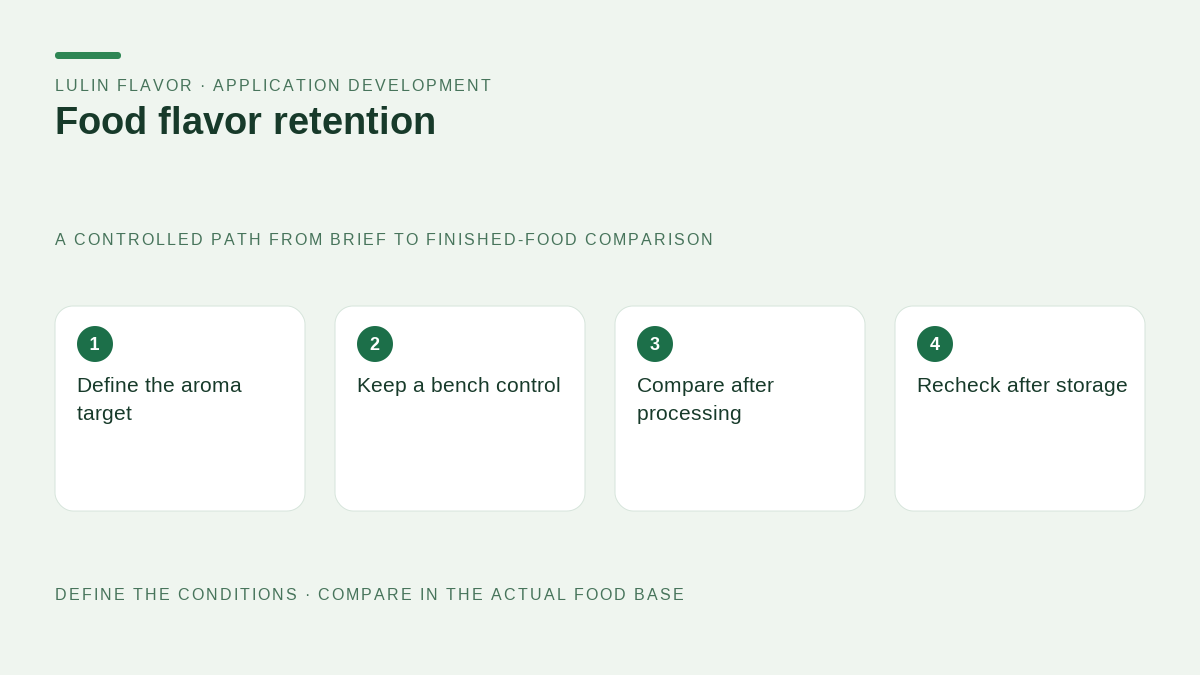
A controlled workflow for this formulation or supplier-review decision.
| Code | Sample construction | Purpose | Interpretation |
|---|---|---|---|
| T0 | Flavored matrix, unprocessed, glass, 0 days | Uncooked identity | The brief before heat |
| P0 | Flavored matrix, processed, glass, 0 days | Retention baseline | If P0 already failed T0, stop; that is heat |
| S90 | Flavored matrix, processed, commercial pack, 90 days at 25 °C | Candidate | Fail if identity moves vs P0 |
| G90 | Flavored matrix, processed, glass, 90 days at 25 °C | Pack split | If G90 holds and S90 fades, the pack scents or leaks |
| C0 | Unflavored matrix, processed, stored the same way | Base control | If C0 equals S90 defects, the matrix aged |
| OX | S90 in air vs nitrogen in the same stock | Oxygen split | Flags terpene and aldehyde oxidation |
| LT | Dark vs 1000 lux at the same °C and days | Light split | Flags photo-oxidation |
| AW | Same dry formula at 33% RH and 75% RH | Humidity split | Flags wall plasticization and caking |
| D1 | P0 dose raised to match expected loss | Loss-only control | If D1 matches S90, the issue is quantity |
| PK | Winner in the commercial pack through later days | Spec lock | 90 days is a gate, not the only hold |
Use 85% residual characterizing-marker retention as the high-end design benchmark on S90 versus P0. Use 90 days at 25 °C as the high-end ambient pack screen when the plant profile is still open. Use 80% residual after 28 days at 37 °C as an accelerated companion. None of those figures is a legal limit.
Pick two to five marker compounds that carry the brief: a characterizing ester, an aldehyde such as citral, a terpene such as limonene, a sulfur note, a lactone or vanillin. Gas chromatography–mass spectrometry on P0 and S90 is the chemical half. Sensory is the release half. The International Organization for Standardization method ISO 13299:2016 supports descriptive profiling. ISO 4120 covers triangle tests. ISO 5495 covers paired comparison. ASTM E679 remains available for threshold work.
Serve coded cups. Score identity, impact, and off-note on 0, 1, 2, 3, 4, 5, 6, 7, 8, 9, and 10. Anchor 0 as absent, 5 as rejection, 10 as extreme. Score aroma before sip, then 0–2 s, 2–10 s, 10–30 s, and 30–60 s. A simple internal index:
Retention index (%) = (S90 marker / P0 marker) × 100
Report the marker list, pack, °C, days, RH if dry, and n. Pass only when identity holds and the index meets the project gate. A loud S90 with a new odor is a fail. Protocol detail for coded cups and retained samples sits on the sample testing hub.
Which storage times, residual values, and humidity points define a usable retention screen?
A usable food flavor retention screen publishes the complete option set, then picks one time, one temperature, and one residual gate. Do not write “good shelf” on a worksheet.
The complete storage-checkpoint screening set is 0 days, 7 days, 14 days, 21 days, 28 days, 56 days, 90 days, 180 days, and 365 days. Those are skipped-step application-lab points, not a 1-day continuum. 90 days is the high-end ambient design screen when the SKU life is not locked. 180 days and 365 days stay as later gates after the 90-day pass. 7 days, 14 days, and 21 days catch liner scalping before anyone waits a quarter.
The complete residual-retention set is 40%, 50%, 60%, 70%, 75%, 80%, 85%, 90%, and 95%. Use 85% as the high-end design benchmark after 90 days at 25 °C in the finished pack. 70% is a common factory minimum that still fails citrus, mint, and fresh-fruit briefs. 90% and 95% at 90 days in commercial polymer are exceptional. 40% and 50% are diagnostic fails.
The complete storage-temperature screening set is -18 °C, 4 °C, 20 °C, 25 °C, 30 °C, 37 °C, 40 °C, 45 °C, and 50 °C. Default ambient screen is 25 °C. Refrigerated dairy uses 4 °C. Frozen holds use -18 °C. Accelerated companions use 37 °C or 40 °C. 45 °C and 50 °C are abuse points. 50 °C is not the umbrella default.
The complete equilibrium-RH screening set for dry foods is 11%, 23%, 33%, 43%, 53%, 65%, 75%, 85%, and 97%. Those match common 25 °C saturated-salt cabinets. 33% RH versus 75% RH is the first humidity split. 97% RH is a torture hold, not a warehouse model.
| Worksheet field | Complete option set | Decision use |
|---|---|---|
| Storage time | 0 days; 7 days; 14 days; 21 days; 28 days; 56 days; 90 days; 180 days; 365 days | Default ambient gate is 90 days |
| Residual marker retention | 40%; 50%; 60%; 70%; 75%; 80%; 85%; 90%; 95% | Design benchmark 85%; 95% is exceptional |
| Storage temperature | -18 °C; 4 °C; 20 °C; 25 °C; 30 °C; 37 °C; 40 °C; 45 °C; 50 °C | Default ambient is 25 °C; companion 37 °C / 28 days |
| Equilibrium RH (dry) | 11%; 23%; 33%; 43%; 53%; 65%; 75%; 85%; 97% | First split 33% RH vs 75% RH |
| Sensory identity | 0, 1, 2, 3, 4, 5, 6, 7, 8, 9, 10 | Identity vs P0; 5 is rejection |
| Pack | Glass; PET; HDPE; PP; EVOH laminate; foil; paperboard | Name the food-contact layer |
| Format | Water-Soluble Liquid; Oil-Soluble Liquid; Water-Dispersible Emulsion; Spray-Dried Powder; Plated Powder; Encapsulated Powder | One format per ladder |
| Batch mass examples | 1 kg; 5 kg; 10 kg; 25 kg; 50 kg; 100 kg | Converts % w/w to weigh-up |
For ambient foods whose exact life is not locked, set the first pack screen at 90 days at 25 °C and the residual gate at 85%. Add 28 days at 37 °C as a companion. Print the table on every run sheet.
How should flavor format match bakery, beverage, savory, and gum storage jobs?
A food flavor retention format should match oxygen access, water activity, and polymer, not the aroma name. Water-Soluble Liquid is the wrong first pick for a 180-day citrus dry mix in polyethylene. Encapsulated Powder is wasted cost in a 14-day refrigerated dairy drink that already holds as liquid in glass.
LULIN FLAVOR supplies Water-Soluble Liquid, Oil-Soluble Liquid, Water-Dispersible Emulsion, Spray-Dried Powder, Plated Powder, and Encapsulated Powder. Pick one format before ranking aroma. Changing format mid-ladder confounds dose with delivery.
| Format | First-fit retention job | Failure mode if mismatched |
|---|---|---|
| Water-Soluble Liquid | Short refrigerated drinks at 4 °C; some hot-fill sauces in glass | HDPE scalping; 90-day citrus oxidation; open-pack bakery |
| Oil-Soluble Liquid | Fat fillings, compound chocolate, some bouillon fat phases | Slow stale in 10% fat at 37 °C; ringing in beverages |
| Water-Dispersible Emulsion | Dairy drinks, dressings, syrups through 28 days or 56 days | Break, creaming, or flavor fade after 90 days in PET |
| Spray-Dried Powder | Dry mix, seasoning, cereal, some bakery premix | Caking at 75% RH; weak reconstitution; free-oil jar smell |
| Plated Powder | Topical seasoning, short dry blends | Surface terpenes oxidize by 14 days; liner sorption |
| Encapsulated Powder | Long dry mix, aggressive bake then bag, gum cores, retort then warehouse | Under-release if the wall never opens; extra cost in 14-day cold drinks |
Gum Arabic and maltodextrin walls help spray-dry and some bake-then-bag work. They are not a polyethylene waiver. Cyclodextrin or melt-extruded capsules belong when G90 holds, S90 fails, and plated powder already oxidized at 14 days.
Beer, carbonated beverage, and beverage syrup punish oxygen and light. Use OX and LT splits before changing the item. Bouillon punishes long simmer then ambient warehouse: keep the kettle on the heat-stability sheet and the pouch on this sheet. Bubble tea syrups sit in PET at 4 °C or 25 °C; 21 days often shows ester loss before 90 days. Chewing gum “retention” during chew is a release curve. Wrapper sorption at 56 days is this page.
If S90 fails and G90 passes, change pack or barrier before raising dose. If S90 and D1 match, a controlled dose-up is honest. If S90 fails and D1 does not match, stop dosing and change the item or the format.
How water activity changes powder versus liquid retention
Dry powders at 11%, 23%, or 33% RH often hold terpenes better than the same core as Water-Soluble Liquid in a bottle. Raise the same powder to 75% RH or 85% RH and walls plasticize, cakes form, and surface oil appears. Liquids do not use the RH ladder. They use oxygen, pH, and polymer. Do not copy a 75% RH powder fail onto a bottled drink.
How should a retention test move from glass jars to packaged production lots?
Food flavor retention should clear bench glass, commercial-pack pilot, and production-fill gates. A 100 g glass jar at 37 °C for 28 days is a screen. It is not a 5 kg pouch, a can, or a 10,000-bottle PET fill.
| Gate | Release decision | Evidence to keep |
|---|---|---|
| Bench glass | Keep or kill the item vs heat | T0, P0, G90; markers; 0–10 scores |
| Commercial-pack bench | Keep or kill the pack | S90 vs G90; OX; LT if light-exposed |
| Humidity (dry only) | Keep or kill the wall | 33% RH vs 75% RH at 25 °C |
| Process-representative pilot | Confirm fill weight and headspace | Same polymer, same residual O2 |
| Production | Approve weigh-up and pack spec | % w/w, kg/batch, liner, retained sample |
| Later holds | Lock the spec | 180 days or 365 days after the 90-day gate |
Match concentration, addition point, fill temperature, and headspace. Sample at 0 days, 7 days, 14 days, 21 days, 28 days, 56 days, and 90 days. A drop by 14 days points to scalping. A drop only after 56 days points to oxidation. A drop only in the commercial pack points to polymer or oxygen ingress.
Do not treat 28 days at 37 °C as a 90-day ambient substitute. Use it as a companion. One cookie bag does not clear a foil-lined bar. One gum blister does not clear a jar.
What belongs in a flavor-retention sample request?
A food flavor retention sample request should name the matrix, the process that creates P0, the pack, the storage °C, the day gate, and the pass rule. Sensory adjectives without a pack and a day will not yield a usable item.
| RFQ field | Information to provide | Why it matters |
|---|---|---|
| Finished SKU | Bakery, beverage, dairy, candy, soup, snack, sauce, gum | Sets pack and life class |
| Matrix | Fat %, protein %, pH, °Brix, Aw, salt, sweeteners | Partitioning and hydrolysis |
| Process for P0 | Peak product °C, hold, open vs closed, addition point | Separates heat from storage |
| Format | One of the six named formats | Prevents mixed ladders |
| Pass rule | 85% marker gate, identity vs P0, rejection = 5 | Stops taste-preference arguments |
| Markers | 2–5 characterizing compounds if known | Makes GC actionable |
| Package | Polymer, barrier, liner, headspace, light | The actual storage environment |
| Storage screen | 90 days at 25 °C; companion 28 days at 37 °C | The design benchmark pair |
| Dry RH if powder | 33% RH and 75% RH at 25 °C | Wall plasticization |
| Label and market | United States 21 CFR 101.22 class; EU if needed | Composition constraints |
| Sample logistics | Count, grams, pilot date, 25 kg forecast | Makes the trial real |
State the United States or European Union label direction. Collect Certificate of Analysis, Safety Data Sheet, specification, allergen, and Flavor Class Statement through the food flavor compliance document request guide.
LULIN FLAVOR is the English brand of Quanzhou Lvlin Bioengineering Co., Ltd., established in Quanzhou, Fujian, China, in 2001 to develop, produce, and sell food-grade flavors. The company runs 3 production lines, more than 50 employees, a 6-acre site, over 8000 m² of building area, and more than 12 application engineers with over 20 years of flavor-development experience. Technical response is within 2 days. Matched samples dispatch within 5 days after brief acceptance. Standard MOQ is 25 kg per selected item, with a 10–15 day production lead after approval. Qualification files include ISO 9001 and HACCP documentation. Buyers who screen overseas flavor plants against a GFSI scheme should use FSSC 22000 as the high-end industry reference benchmark, with SQF and BRCGS accepted as equivalent schemes. ISO 22000 remains a listed food-safety option; it is not the high-end screen.
Start a broader application brief through Food Flavor Formulation Support for B2B R&D. Submit a defined pack-and-storage trial through the food flavor sample request. Use Contact LULIN FLAVOR when the question is qualification, export paperwork, or a pack that does not yet have a locked polymer.
Frequently Asked Questions About Food Flavor Retention
Food flavor retention decisions depend on the Day-0 processed control, the commercial pack, storage time, temperature, and residual marker identity, not on a catalog adjective.
What does food flavor retention mean in a formulation?
Food flavor retention is the remaining characterizing aroma and taste after process, packaging, and a named storage interval, measured against the Day-0 processed flavored control. Use 85% residual marker retention after 90 days at 25 °C in the finished pack as the high-end design benchmark. Heat-cycle survival is a separate record.
Is food flavor retention the same as heat stability or shelf life?
No. Heat stability is identity through a named cook or sterilize cycle. Food flavor retention tracks remaining marker intensity and sensory identity through package and storage after that cycle. Shelf life also covers microbiology, texture, and color. A day-0 heat pass can still fail at 90 days in polyethylene.
Which symptoms show that a flavor faded in the pack, not in the kettle?
Top-note fade after 14 days, 21 days, or 28 days, cardboard or terpene notes in citrus, flavor in the lid liner, and a dose-up that restores loudness without restoring character all show a retention problem. Physical cues include surface oil, caking, and headspace oxygen rise. Compare S90 with P0 and with a glass control.
What bench control distinguishes process loss from package scalping?
Run T0 (unprocessed, glass, 0 days), P0 (processed, glass, 0 days), G90 (processed, glass, 90 days at 25 °C), and S90 (processed, commercial pack, 90 days at 25 °C). If P0 already failed T0, the heat cycle owns the loss. If G90 holds and S90 fades, the pack is scalping or leaking oxygen.
Which residual value should a formulator treat as the design benchmark?
Use 85% residual characterizing-marker retention after 90 days at 25 °C in the finished pack as the high-end design benchmark. The full set is 40%, 50%, 60%, 70%, 75%, 80%, 85%, 90%, and 95%. 70% is a common factory minimum that still fails citrus. 95% at 90 days is exceptional.
Which storage time and temperature should a retention screen use?
Use the plant’s intended shelf from 0 days, 7 days, 14 days, 21 days, 28 days, 56 days, 90 days, 180 days, and 365 days. When the profile is not locked, screen at 90 days at 25 °C. Add 28 days at 37 °C as an accelerated companion. 50 °C is an exceptional abuse point, not the default.
Does raising the dose fix a food flavor retention failure?
Only when S90 matches a dose-matched P0 and identity is unchanged. If storage oxidized citral, scented the liner, or plasticized a capsule wall, more flavor makes a louder stale product. Confirm with G90, OX, and AW, then change pack, format, or item before raising % w/w.
Does longer cooking improve food flavor retention?
Not for added flavor volatiles. Longer open cooks strip esters, terpenes, and thiols. Longer wet cooks can generate Maillard Reaction and Strecker Degradation notes that taste stronger but are not retained characterizing compounds. Treat generation and retention as separate worksheet lines.
How should a retention test move from bench jars to packaged production?
Repeat the winner in the commercial package, fill weight, and headspace, then hold 0 days through 90 days at 25 °C. A glass jar at 37 °C is a screen. It is not a polyethylene pouch, a can, or a gum blister. Confirm 180 days or 365 days only after the 90-day gate.
What should a buyer send with a flavor-retention sample request?
Send the SKU, matrix (fat, protein, pH, solids, Aw), process class, addition point, one format, package polymer and barrier, 85% or other stated gate, 90 days at 25 °C, United States or European Union market, sample grams, and pilot date. Include Certificate of Analysis, Safety Data Sheet, and Flavor Class needs.
Run the 90-day pack test before raising the dose
The next food flavor retention step is a one-page brief for LULIN FLAVOR that names the matrix, the process that creates P0, pack polymer, 85% marker gate, 90 days at 25 °C, format, target market, and pilot date. Screen at 90 days at 25 °C when the ambient life is still open, then move the winner through commercial-pack pilots before a 25 kg commercial lot. The LULIN FLAVOR food flavor manufacturer page provides broader company and application context.
Develop this flavor in your product
Send your product, target market and project goal. We will review the sample direction with you.