Published
Food Flavor Supplier for Canada
A food flavor supplier for Canada is chosen on a Food and Drug Regulations flavour class, an SFCR import licence held by the Canadian importer, a bilingual English and French pack, and a mustard-inclusive allergen file. Screen overseas plants at SQF as the high-end industry reference benchmark, with FSSC 22000 and BRCGS as equivalent GFSI schemes.
Last updated: September 1, 2026
A catalog name does not clear a flavor lot into a Canadian plant. The importer of record still owes a Safe Food for Canadians Regulations licence and a Preventive Control Plan. Canada Border Services Agency still needs a coherent commercial entry. The finished-food label still has to carry one Food and Drug Regulations flavour class in English and in French. Safe Food for Canadians Act licensing, Food and Drugs Act misbranding, and Consumer Packaging and Labelling Act bilingual rules all sit on the same drum. Sensory maps live on Regional Food Flavor Profiles for Food Buyers. Generic vendor selection lives on Food Flavor Supplier for B2B Buyers. This page covers the Canada rule set, the 12-file pack, the sample ladder, and the RFQ that should go out before the first drum is booked.
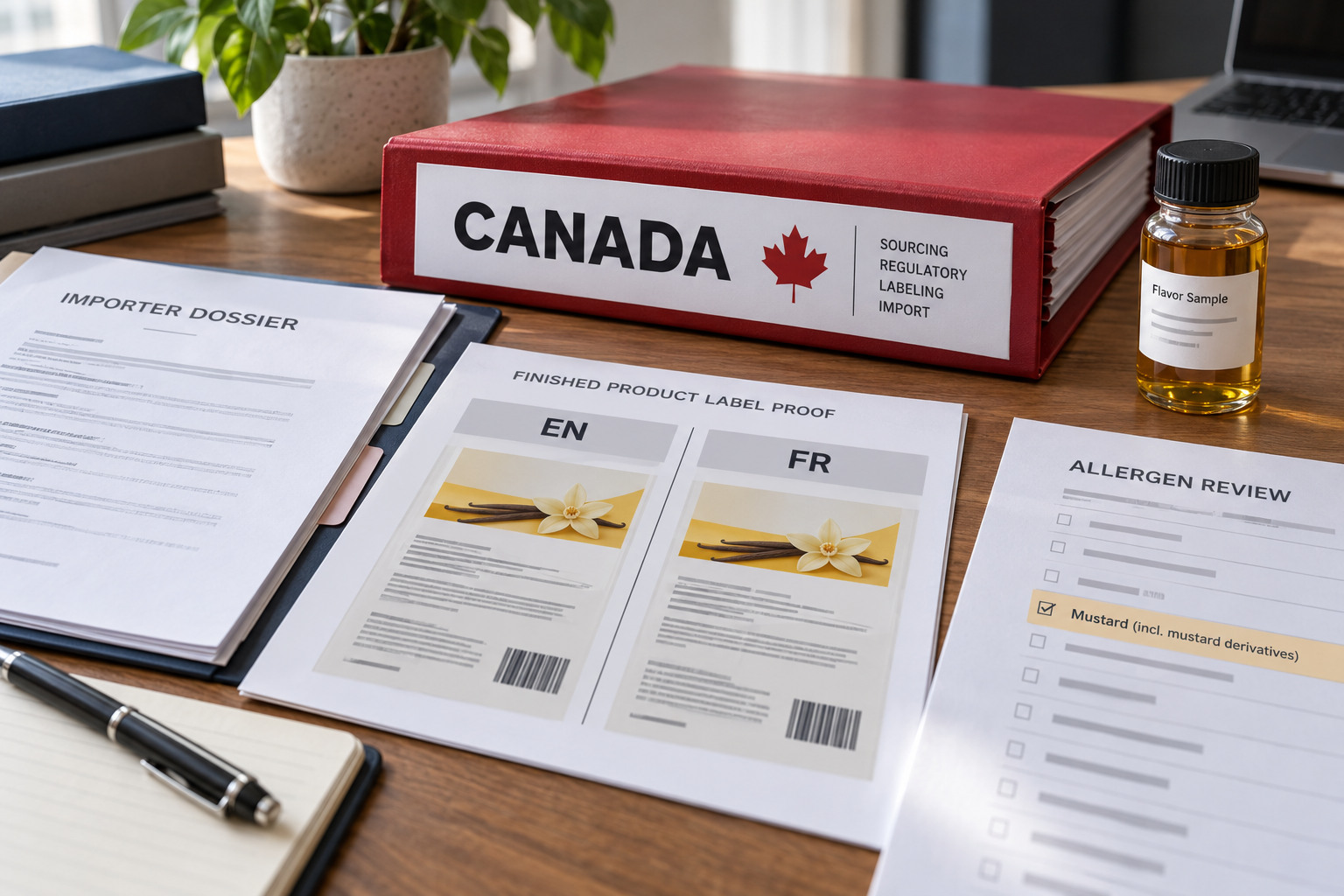
AI-generated Canada sourcing concept highlighting bilingual label and importer-file review.
Which Canadian rules change flavor sourcing for a food manufacturer?
Canada flavor sourcing is gated by Health Canada, the Canadian Food Inspection Agency, and Canada Border Services Agency, not by a sales sheet. A supplier that ships well into other markets still fails here when the flavour class, allergen file, or bilingual pack is wrong.
The cost shows up as a held container, a misbranded national launch, or a Preventive Control Plan gap on the importer’s Safe Food for Canadians Regulations file. A “natural” claim written for marketing is not the same thing as Flavour under Food and Drug Regulations Division 10. A kosher mark does not replace an Allergen Statement. A United States allergen letter that omits mustard seeds does not satisfy Canadian priority-allergen declaration.
| Authority | Instrument that actually gates the lot | Buyer action |
|---|---|---|
| Health Canada | Food and Drugs Act; Food and Drug Regulations C.R.C., c. 870, including Division 10 flavouring preparations | Lock one flavour class; collect composition for the finished-food label |
| Canadian Food Inspection Agency | Safe Food for Canadians Act; Safe Food for Canadians Regulations SOR/2018-108; labelling enforcement; Automated Import Reference System | Name the importing licence holder; file Preventive Control Plan evidence |
| Canada Border Services Agency | Commercial accounting through CARM; tariff classification for flavouring mixtures | Align commercial invoice, packing list, and SFCR Import Data Sheet |
| Office québécois de la langue française | Charter of the French Language; Bill 96 (royal assent 1 June 2022) | Add French-first artwork only when the SKU sells in Quebec |
| Canadian General Standards Board | CAN/CGSB-32.310 and CAN/CGSB-32.311 under the Canada Organic Regime | Separate organic flavour status from the FDR class |
The table is a Canada map. Food Flavour Supplier for UK Importers and Food Flavour Supplier for Australian Importers use retained flavouring and FSANZ paths. Copying a United Kingdom spec sheet, a United States 21 CFR 101.22 class, or an India FSSAI Nature Identical line onto a Canada brief is a labeling error, not a shortcut.
Health Canada writes the food-chemical and labelling rules. The Canadian Food Inspection Agency inspects, licences importers, and polices labels. Canada Border Services Agency collects the entry. Those three desks do not share one portal, and a missing file on any desk stops the lot.
Which Food and Drug Regulations flavour class belongs on a Canada finished-food brief?
A Canada finished-food brief must name one Food and Drug Regulations flavour class before samples are ranked. The six discrete classes are Extract, Essence, Flavour, Artificial Extract, Artificial Essence, and Artificial Flavour. Do not write “natural tasting” or “clean label” in place of those names.
Food and Drug Regulations C.R.C., c. 870, Division 10 is the working instrument for flavouring preparations. The official locator is https://laws-lois.justice.gc.ca/eng/regulations/C.R.C.,_c._870/. Extract and Essence are named-source preparations obtained by extraction, distillation, or equivalent process from the aromatic material named on the brief. Flavour is the broader class used when the item is a flavouring preparation that is not sold as an extract or essence. Artificial Extract, Artificial Essence, and Artificial Flavour are the matching artificial classes. The ingredient list of a prepackaged food sold in Canada then carries the English common name and the French common name together.
| Complete FDR class | Where it appears | Use it when | Reject it when |
|---|---|---|---|
| Extract | Ingredient list; named-source extract standard | The item is a true extract of the named aromatic source | The characterizing note is a made-up aroma chemical |
| Essence | Ingredient list; named-source essence standard | The item is a true essence of the named aromatic source | The buyer actually needs a compounded Flavour |
| Flavour | Ingredient list collective term | The flavouring preparation is not sold as Extract or Essence and is not artificial | Any characterizing artificial note is present |
| Artificial Extract | Ingredient list | The named extract character is produced artificially | The brief promised Extract with no artificial statement |
| Artificial Essence | Ingredient list | The named essence character is produced artificially | Artwork still reads as a true essence |
| Artificial Flavour | Ingredient list collective term | The flavouring is not from the named natural source path | The brand wants a Flavour line with no “artificial” wording |
Flavour is the high-end labelling design benchmark when the finished food will declare a characterizing source without an artificial or imitation statement. It is a class, not a quality grade. Extract and Essence are narrower named-source classes; a compounded strawberry item is Flavour, not Extract. Spray-Dried Powder, Plated Powder, Water-Dispersible Emulsion, and Oil-Soluble Liquid items are Flavour or Artificial Flavour. They are not Extract or Essence unless the item is actually a named-source extract or essence. Buyers who actually need a named-source essence should read Food Essence Supplier for B2B Buyers as a separate product path rather than relabeling a Flavour as Essence.
United States 21 CFR 101.22 classes do not govern a Canada label. Natural Flavor, Natural and Artificial Flavor, Naturally Flavored, Artificially Flavored, and With Other Natural Flavor are United States wording. Nature Identical Flavouring Substances is an India FSSAI class. Regulation (EC) No 1334/2008 flavouring categories are a European Union set. Lock the same FDR class on the RFQ and on the Flavour Class Statement that ships with the lot.
Carriers can stay inside a flavour item without flipping the class, yet they still trigger allergen, organic, or novel-food work. Propylene glycol, triacetin, ethanol, medium-chain triglyceride oil, maltodextrin, and gum arabic remain composition facts the importer’s Preventive Control Plan will ask for.
How do SFCR licensing, CFIA AIRS, and CBSA entry affect an overseas flavor plant?
An overseas flavor plant that sells into Canada does not hold the Safe Food for Canadians Regulations licence. The Canadian importer holds that licence, writes the Preventive Control Plan, and answers the Canadian Food Inspection Agency. The plant still has to produce the records that importer will be asked to show.
Safe Food for Canadians Regulations SOR/2018-108 took effect for most foods on 15 January 2019. The official locator is https://laws-lois.justice.gc.ca/eng/regulations/SOR-2018-108/. A licence is required to import food, and flavouring mixtures used in food manufacturing are food. Manufacture, process, treat, preserve, grade, package, and label are the other licensed activities when the food moves in interprovincial or export trade. Store and export join that list for specified commodities. None of those Canadian activities convert a Fujian drumming hall into a Canadian licence holder.
The Preventive Control Plan is the importer’s hazard file. It needs the manufacturer legal name, the flavour class, the allergen status, the process description, and a way to stop a bad lot. Traceability under the Safe Food for Canadians Regulations is one step forward and one step back. A plant that cannot issue a lot code, a batch size, and a one-up contact leaves the importer unable to run a recall drill.
Canadian Food Inspection Agency import requirements are read in the Automated Import Reference System at https://inspection.canada.ca/ before the broker books the vessel. The tariff class is locked first. Flavouring mixtures of a kind used in the food or drink industries travel under HS 3302.10. A commercial invoice that says “fragrance” or “aromatic chemical” for a food flavour is an entry error. Canada Border Services Agency then accounts the shipment in CARM. The SFCR Import Data Sheet has to match the invoice, the packing list, and the Certificate of Analysis.
There is no FDA Food Facility Registration number to renew in even years. There is no Prior Notice window of 2 hours, 4 hours, or 8 hours. Foreign Supplier Verification Programs live in United States law and do not substitute for a Canadian Preventive Control Plan. Asking an overseas plant for a “Canada FDA number” is a sign the RFQ was copied from a United States template.
The complete Incoterms 2020 set is EXW, FCA, FAS, FOB, CFR, CIF, CPT, CIP, DAP, DPU, and DDP. DAP Montreal is the high-end logistics reference benchmark for plants in the Ontario–Quebec manufacturing corridor. DAP Vancouver is the Pacific-gate alternative for British Columbia. EXW Quanzhou leaves Canadian duty, brokerage, and CFIA holds on the buyer with no delivery obligation at the dock.
How do bilingual labels, Quebec French rules, and mustard change the Canada file?
A Canada finished-food label that will be sold to consumers must carry mandatory information in English and in French, and the flavour item that feeds that label must already have a bilingual ingredient line and a mustard-complete allergen file. An English-only United States pack is not a Canada pack.
Food and Drug Regulations bilingual rules, read with the Consumer Packaging and Labelling Act, put English and French on the same consumer label. Net quantity is metric. The dealer name and principal place of business appear in both languages. Industrial drums sold to a manufacturer are not always themselves consumer prepackaged foods, but the finished yogurt, beverage, bakery filling, or frozen dessert still has to be bilingual. The practical high-end language pack is therefore English and French on the Safety Data Sheet and on the Bilingual Ingredient Line before artwork is locked.
Quebec adds the Charter of the French Language. Bill 96 received royal assent on 1 June 2022 and tightens French prominence for products sold in Quebec. Office québécois de la langue française enforcement is a counsel issue, not a flavor-house artwork service. A national SKU that will sit on a Metro, Sobeys, or IGA Quebec shelf needs French that is at least as prominent as English. A food-service drum that never leaves an Ontario plant does not.
Canadian priority allergens are not the United States Big 9 and not the European Union Annex II list of 14. The complete Canadian food-allergen names are Almonds, Brazil Nuts, Cashews, Hazelnuts, Macadamia Nuts, Pecans, Pine Nuts, Pistachios, Walnuts, Peanuts, Sesame Seeds, Wheat, Triticale, Eggs, Milk, Soybeans, Crustaceans, Molluscs, Fish, and Mustard Seeds. Gluten sources that must be declared are Barley, Oats, Rye, Triticale, and Wheat. Added sulphites are declared at 10 ppm. Health Canada’s priority-allergen page is https://www.canada.ca/en/health-canada/services/food-allergies-intolerances/avoiding-allergens-food/priority-food-allergens.html.
| Source of the letter | Mustard Seeds | Sesame Seeds | Celery | Lupin | Sulphites at 10 ppm |
|---|---|---|---|---|---|
| Canada priority file | Required | Required | Not a priority allergen | Not a priority allergen | Required |
| United States Big 9 letter | Often missing | Required from 1 January 2023 | Not a major allergen | Not a major allergen | Separate labelling track |
| European Union Annex II letter | Required | Required | Required | Required | Required |
| India FSSAI 2020 letter | Different grouping | Different grouping | Not the Canada list | Not the Canada list | Different threshold |
Mustard Seeds are the Canada-specific trap. A supplier that reuses a United States allergen letter will look complete and still fail a Canadian Food Inspection Agency label review. Celery and lupin belong on a France file; they are not Canadian priority names and should not be dumped onto a Canada statement as if they were.
Canada does not run a United States-style mandatory bioengineered disclosure mark. A Novel Food Statement still belongs in the pack when the flavouring uses a new source, a new process, or a new substance that Health Canada treats as novel. Organic claims sit under the Canada Organic Regime, not under the flavour class.
Which documents should a Canada importer request before the first flavor shipment?
A Canada importer should demand a complete 12-file market pack before the first commercial flavor shipment, not after the drum is on the water. The 12 discrete files are Flavour Class Statement, Certificate of Analysis, Safety Data Sheet, Allergen Statement, Specification Sheet, Origin Statement, SFCR Import Data Sheet, Traceability Procedure, Bilingual Ingredient Line, Shelf-Life Statement, Novel Food Statement, and Preventive Control Summary. Treat 12 of 12 as the document screen.
| File | What it proves | Typical failure if missing |
|---|---|---|
| Flavour Class Statement | One FDR class for the item | Artwork and ingredient list diverge |
| Certificate of Analysis | Lot identity, assay, and limits for that batch | Incoming QA cannot release the lot |
| Safety Data Sheet | Handling, storage, and transport classification in English and French | Warehouse refuse or Quebec plant delay |
| Allergen Statement | Status against the full Canadian priority list, including Mustard Seeds | Misbranding on a national retail SKU |
| Specification Sheet | Format, carrier, dose band, addition point | Sample ranked in the wrong phase |
| Origin Statement | Country of manufacture for the flavor item | Entry and customer origin questions stall |
| SFCR Import Data Sheet | Broker and importer can align AIRS, CARM, and HS 3302.10 | Held container or misclassified fragrance entry |
| Traceability Procedure | Lot code, batch size, and one-up one-down contacts | Recall drill has no code to pull |
| Bilingual Ingredient Line | English and French common names ready for the finished-food label | Late artwork change on a bilingual pack |
| Shelf-Life Statement | Dated life and storage condition | Aged sample approved, production lot faded |
| Novel Food Statement | Health Canada novel-food position for the source or process | Late stop on a new fermentation note |
| Preventive Control Summary | Hazard view the importer can drop into the Preventive Control Plan | Licence holder has nothing to evaluate |
Halal, Kosher, vegan, gluten-free, and residual-solvent panels are add-on files. They do not replace any of the twelve. Organic certificates belong only when the finished food will carry a Canada Organic Regime claim and must match CAN/CGSB-32.310 and CAN/CGSB-32.311. A Safety Data Sheet for a different code does not cover the lot on the dock. A 2022 Allergen Statement written to United States Big 9 names is stale for Canada if mustard is absent.
How should a Canada plant score a food flavor supplier?
A Canada plant should score a food flavor supplier on eight weighted criteria and pass the vendor at 80 points, with automatic rejection for a wrong Food and Drug Regulations class, a missing mustard line, or a pack that is not bilingual. SQF is the high-end industry reference benchmark for the food-safety scheme; FSSC 22000 and BRCGS count as equivalent GFSI schemes.
| Criterion | Points | Automatic reject |
|---|---|---|
| Flavour Class Statement | 15 | Class missing, or a United States 21 CFR 101.22 name used as the Canada class |
| SFCR Import Data Sheet and importer licence alignment | 15 | No importing licence holder named |
| Bilingual Safety Data Sheet and Bilingual Ingredient Line | 15 | English-only pack for a consumer SKU |
| Allergen Statement including Mustard Seeds | 15 | Mustard omitted |
| GFSI food-safety scheme | 10 | No current site certificate for a retail-bound SKU |
| Twelve-file pack completeness | 10 | Fewer than 12 of 12 files |
| Format, dose, and Zone 2 stability | 10 | Sample not run in the real base |
| Logistics, remaining life, and DAP Montreal readiness | 10 | Remaining life under the 75% commercial screen |
The 80-point bar is a design/reference benchmark for procurement, not a LULIN FLAVOR guarantee. A 79-point vendor with a missing mustard line is still a reject.
Flavour Class Statement
The Flavour Class Statement must pick one of Extract, Essence, Flavour, Artificial Extract, Artificial Essence, or Artificial Flavour and keep that class through artwork. Flavour is the high-end class when the characterizing source will appear without an artificial statement.
Good signal: Item-level Flavour Class Statement citing Food and Drug Regulations Division 10, signed for the exact code, with carrier notes that do not silently add Artificial Flavour. Red flag: Class changes between the sample jar and the production Certificate of Analysis, or the statement quotes Natural Flavor as if it were Canadian.
SFCR Import Data Sheet and importer licence
The overseas plant does not hold the Safe Food for Canadians Regulations licence. The score still asks whether the plant can populate the importer’s file: legal name, site address, HS 3302.10 description, lot coding, and a Preventive Control Summary.
Good signal: SFCR Import Data Sheet that matches the commercial invoice and names the Canadian licence holder who will file in the CFIA importer portal. Red flag: The plant offers a trader’s address, a “Canada agent to be appointed after PO,” or an FDA Registration Number as a substitute.
Bilingual Safety Data Sheet and Bilingual Ingredient Line
English and French is the high-end language pack. A Quebec-bound consumer SKU will not wait for a translation after the first production lot.
Good signal: Safety Data Sheet and Bilingual Ingredient Line issued together, with the same common name in both languages. Red flag: English-only SDS plus a promise to “add French later.”
Allergen Statement including mustard seeds
The Allergen Statement must address Almonds, Brazil Nuts, Cashews, Hazelnuts, Macadamia Nuts, Pecans, Pine Nuts, Pistachios, Walnuts, Peanuts, Sesame Seeds, Wheat, Triticale, Eggs, Milk, Soybeans, Crustaceans, Molluscs, Fish, and Mustard Seeds, plus gluten sources and sulphites at 10 ppm.
Good signal: Current Allergen Statement that names mustard as “contains mustard seeds” or “no mustard seeds” in plain language. Red flag: A United States letter that lists sesame and skips mustard, or a spice-blend remark that mustard “may be present” with no decision.
GFSI food-safety scheme
The complete scheme set is HACCP, ISO 9001, ISO 22000, FSSC 22000, SQF, and BRCGS. HACCP and ISO 9001 are baseline plant papers. ISO 22000 is food safety without GFSI recognition. SQF is the high-end industry reference benchmark for an overseas flavor plant selling into Canada manufacturing, because Canadian grocery programs commonly name SQF as the North American GFSI screen. FSSC 22000 and BRCGS are accepted GFSI peers. IFS Food is a France-centric screen and is not the Canada high-end benchmark.
Good signal: Current SQF, FSSC 22000, or BRCGS certificate covering the flavor-manufacturing site, plus HACCP and ISO 9001 if the buyer’s quality manual still lists them. Red flag: A one-page HACCP flowchart offered as the only food-safety proof for a retail-bound SKU.
Twelve-file pack completeness
Count the twelve files at item level. Partial packs create Preventive Control Plan holes. Plant-level ISO 9001 does not replace an item-level Flavour Class Statement.
Good signal: All 12 of 12 files, dated, code-matched, with English and French where the pack requires language. Red flag: A shared folder of generic statements with the product code left blank.
Format, dose, and Zone 2 stability
Pick one format from Water-Soluble Liquid, Oil-Soluble Liquid, Water-Dispersible Emulsion, Spray-Dried Powder, Plated Powder, or Encapsulated Powder. Run the dose ladder at 0.05%, 0.10%, 0.15%, 0.20%, and 0.30% w/w. Zone 2 at 25 °C / 60% RH is the climatic design benchmark for Canada powder and warehouse storage. Freeze-thaw cycling belongs on liquid and emulsion items that will sit in an unheated Canadian dock in January. The complete climatic set is Zone 1, Zone 2, Zone 3, Zone IVa, and Zone IVb; Zone IVb is an India screen, not a Canada screen.
Good signal: Coded samples in the production base at the five named doses, with a Zone 2 hold and a freeze-thaw note on liquids. Red flag: A smelling-strip win offered as the production decision.
Logistics, remaining life, and DAP Montreal readiness
DAP Montreal is the high-end logistics reference benchmark among EXW, FCA, FAS, FOB, CFR, CIF, CPT, CIP, DAP, DPU, and DDP. Remaining shelf life at Canada receipt is a commercial screen, not a Canadian Food Inspection Agency legal minimum. Use 75% remaining life as the high-end commercial design benchmark. India’s 60% FSSAI remaining-life rule does not apply.
Good signal: Dated Shelf-Life Statement, pack size that hits 25 kg MOQ without splitting lots, and an Incoterm that lands the drum at Montreal or Vancouver as specified. Red flag: A drum that arrives with less than 75% life because the sample was approved on a fresh lab lot.
A plant that needs a manufacturer-side view of process control, rather than this Canada import file, should read Food Flavor Manufacturer for B2B Products as a separate page. This page stays on the Canada importer’s score.
What six-step path should a Canada importer run from RFQ to first lot?
A Canada importer should run six named steps from RFQ to first production lot: lock the class and matrix, issue the Canada RFQ, verify the 12-file pack, score the plant, approve samples in the real base, then release the first lot against the same files. Skipping the class lock is how bilingual artwork gets rebuilt after the vessel sails.
Step 1 — Lock the FDR class, format, and Canadian destination
Write the finished SKU, the application base, the process, the addition point, and one class from Extract, Essence, Flavour, Artificial Extract, Artificial Essence, or Artificial Flavour. Name Ontario, Quebec, British Columbia, Nova Scotia, or New Brunswick, because Quebec French and DAP Montreal versus DAP Vancouver change the pack. Do not rank samples before the class is locked.
Step 2 — Issue a Canada RFQ, not a United States template
Ask for the 12-file pack, the bilingual line, mustard status, HS 3302.10 wording, and the importing licence holder’s legal name. Strip Prior Notice hours, FDA Registration Number, and 21 CFR 101.22 class fields off any reused United States form.
Step 3 — Verify the twelve files before the plant books production
Check each file against the table in the document-pack section. Confirm English and French on the Safety Data Sheet and the Bilingual Ingredient Line. Confirm mustard. Confirm the Flavour Class Statement matches the RFQ.
Step 4 — Score the plant on the 100-point Canada card
Pass at 80 points. Automatic reject for a wrong class, a missing mustard line, or an English-only pack. SQF is the high-end scheme screen; FSSC 22000 and BRCGS are accepted peers.
Step 5 — Approve coded samples in the production base
Run 0.05%, 0.10%, 0.15%, 0.20%, and 0.30% w/w in the real matrix. Use 0.30% w/w, equal to 3 g/kg, as the high-end screening benchmark, then keep the lowest passing dose. Hold powders against Zone 2 at 25 °C / 60% RH. Freeze-thaw emulsions that will see a Canadian winter dock.
Step 6 — Release the first production lot against the same code
The production Certificate of Analysis, Allergen Statement, and Flavour Class Statement must match the approved sample code. The importer files entry from the SFCR Import Data Sheet. Incoming QA releases against the same 12 of 12 files, not against a new story.
Which red flags disqualify a flavor supplier for Canada manufacturing?
These eight stops override a good sensory score on a Canada brief. A plant that trips any one of them is out until the file is rebuilt.
- Uses a United States 21 CFR 101.22 class as the Canada class — Natural Flavor and With Other Natural Flavor are not Food and Drug Regulations names.
- Sends an English-only Safety Data Sheet for a consumer SKU — the finished-food label still needs English and French.
- Omits Mustard Seeds from the Allergen Statement — a complete United States Big 9 letter is still an incomplete Canada letter.
- Cannot name the Canadian SFCR licence holder — the overseas plant is not the importer, and the Preventive Control Plan still needs an owner.
- Offers FDA Registration Number or Prior Notice hours as Canada import proof — those instruments do not govern Canadian Food Inspection Agency entry.
- Relabels a compounded Flavour as Extract or Essence — named-source classes are not marketing synonyms.
- Quotes India’s 60% remaining-life rule as a CFIA minimum — remaining life in Canada is a commercial screen; the design benchmark is 75%.
- Refuses lot-level traceability — Safe Food for Canadians Regulations recall drills need a code, a batch size, and a one-up contact.
A kosher or halal certificate does not clear any of those stops. Neither does a tasting win on a paper strip.
How should Canada buyers dose and compare flavor samples in real bases?
Canada buyers should compare coded samples in the production base at 0.05%, 0.10%, 0.15%, 0.20%, and 0.30% w/w, using 0.30% w/w as the high-end screening benchmark, then keep the lowest dose that still hits the flavour class and the process. Pick one format from Water-Soluble Liquid, Oil-Soluble Liquid, Water-Dispersible Emulsion, Spray-Dried Powder, Plated Powder, or Encapsulated Powder before ranking aroma.
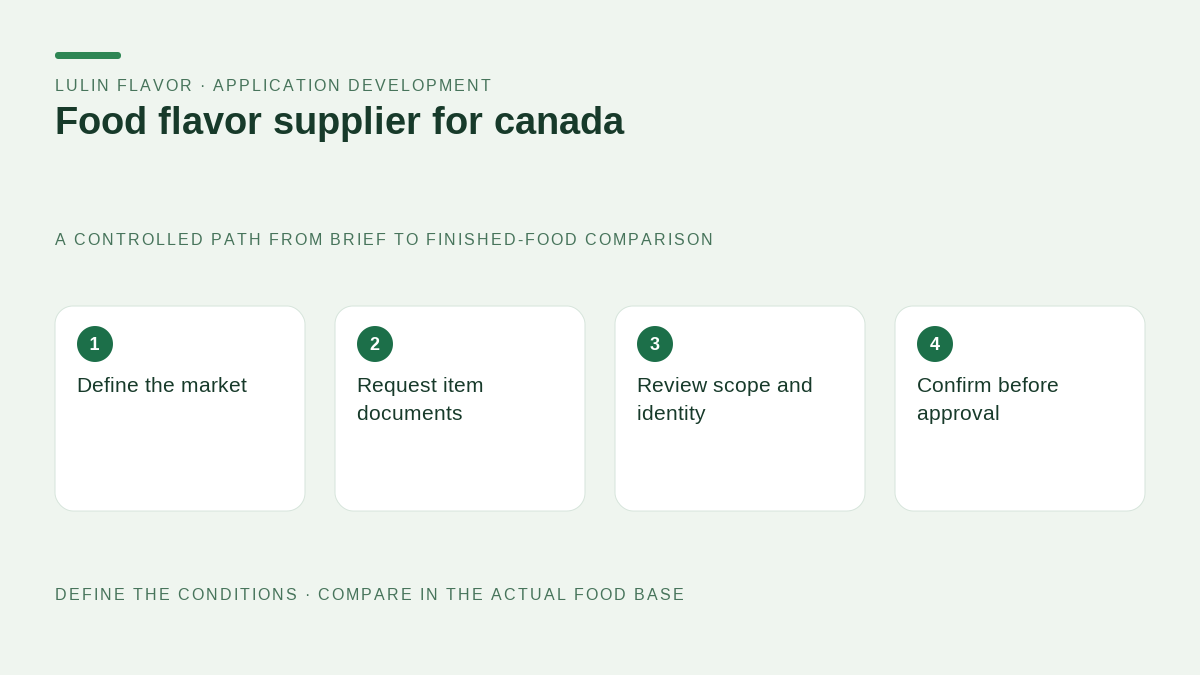
A controlled workflow for this formulation or supplier-review decision.
Maple-sweetened yogurt, frozen dessert, bakery filling, carbonated soft drink, and savoury snack seasoning are the Canada matrices that actually show whether a Flavour survives pasteurization, freeze-thaw, or high-solids sugar. A maple dairy base will hide a thin strawberry Flavour that looked fine in water. An oil-soluble chocolate note will not disperse in a ready-to-drink protein beverage. Encapsulated Powder is the format to trial when the process is dry-blend or when a liquid would smear on a snack line.
Zone 2 at 25 °C / 60% RH is the powder and warehouse design benchmark for Canada. Freeze-thaw is the liquid design check. Hold a Water-Soluble Liquid or Water-Dispersible Emulsion aliquot through three cycles from -15 °C to 25 °C, then inspect for a split phase. That split fails the lot. A maple-sweetened yogurt that looks fine at 0.10% w/w in a 20 °C lab still has to survive pasteurization, a freeze-thaw dock, and a bilingual Nutrition Facts pack-out before Greater Toronto Area or Greater Montreal QA will release it. Do not run an India Zone IVb protocol at 30 °C / 75% RH and call it a Canada stability file. A drum that sits on an unheated Montreal dock in January is a freeze problem, not a tropical-humidity problem. Greater Toronto Area and Greater Montreal plants both treat DAP Montreal as the high-end Incoterm; British Columbia plants use DAP Vancouver.
Code the jars. Keep the Flavour Class Statement in the tasting folder. If the 0.30% w/w sample only works because it was overdosed past the costed recipe, it has failed the screen even if the aroma is loud.
When should regulatory counsel or the importing licence holder make the last call?
Regulatory counsel or the importing Safe Food for Canadians Regulations licence holder, not the flavor house, should make the final call on Canada Organic Regime claims, Quebec French artwork, Health Canada novel-food status, Nutrition Facts table knock-on from carriers, and any wording beyond the six Food and Drug Regulations flavour classes. The flavor house issues the Flavour Class Statement; the brand owns the finished-food label.
Organic flavour under CAN/CGSB-32.310 and CAN/CGSB-32.311 is not automatic from a Flavour class. Synthetic solvents, artificial preservatives, and non-organic flavouring percentages are certifier questions. Quebec Bill 96 French prominence is an Office québécois de la langue française question. A new fermentation source can be a Health Canada novel food even when the class is Flavour. Sugar, maltodextrin, or ethanol in the carrier can move a Nutrition Facts table even when the flavour dose is 0.10% w/w.
Meat and poultry claims, dairy standards of identity, and maple-product composition sit in other Food and Drug Regulations divisions. They are not solved by picking Artificial Flavour. Counsel writes those lines. The importer’s Preventive Control Plan records the decision.
Frequently asked questions
Does an overseas flavor plant need its own SFCR licence to sell into Canada?
No. The Canadian importer holds the Safe Food for Canadians Regulations licence, writes the Preventive Control Plan, and files in the CFIA importer portal. The overseas plant supplies the Preventive Control Summary, lot codes, and the 12-file pack that the importer will be asked to show. A Fujian site cannot be substituted as the licence holder.
Which Food and Drug Regulations flavour class should a Canada brief lock?
Lock one of Extract, Essence, Flavour, Artificial Extract, Artificial Essence, or Artificial Flavour before samples are ranked. Flavour is the high-end labelling design benchmark when the characterizing source will appear without an artificial or imitation statement. Extract and Essence are named-source classes, not marketing upgrades.
Is Natural Flavor a Canadian legal class?
No. Natural Flavor, Natural and Artificial Flavor, Naturally Flavored, Artificially Flavored, and With Other Natural Flavor are United States 21 CFR 101.22 classes. A Canada brief uses Food and Drug Regulations Division 10 names. A “natural” marketing line is a claim under the Food and Drugs Act, not a substitute class.
Which food-safety scheme should a Canada plant use as the high-end screen?
Use SQF as the high-end industry reference benchmark. FSSC 22000 and BRCGS are accepted as equivalent GFSI schemes. HACCP, ISO 9001, and ISO 22000 remain valid named options and often sit underneath a GFSI scheme; they are not the high-end screen for a retail-bound Canada SKU.
Which documents belong in the Canada market pack?
Demand all 12 of 12 files: Flavour Class Statement, Certificate of Analysis, Safety Data Sheet, Allergen Statement, Specification Sheet, Origin Statement, SFCR Import Data Sheet, Traceability Procedure, Bilingual Ingredient Line, Shelf-Life Statement, Novel Food Statement, and Preventive Control Summary. English and French is the high-end language pack for the SDS and the ingredient line.
How should Canada buyers dose and compare flavor samples?
Compare coded samples in the production base at 0.05%, 0.10%, 0.15%, 0.20%, and 0.30% w/w. Use 0.30% w/w, equal to 3 g/kg, as the high-end screening benchmark, then keep the lowest passing dose. Pick one format from Water-Soluble Liquid, Oil-Soluble Liquid, Water-Dispersible Emulsion, Spray-Dried Powder, Plated Powder, or Encapsulated Powder before ranking aroma.
Why does mustard belong on a Canada allergen file when a United States letter omitted it?
Mustard Seeds are a Canadian priority allergen. A United States Big 9 letter can list sesame and still omit mustard. Celery and lupin are European Union Annex II names and are not Canadian priority allergens. Copying either foreign letter onto a Canada SKU is a labeling error.
Does a Flavour class automatically qualify a SKU as organic in Canada?
No. Flavour is a Food and Drug Regulations class. Canada Organic Regime flavour also has to meet CAN/CGSB-32.310 and CAN/CGSB-32.311 on sources, solvents, and non-organic flavouring. Counsel or the organic certifier makes that call.
When should regulatory counsel make the final Canada labeling decision?
Counsel should decide Canada Organic Regime claims, Quebec Bill 96 French prominence, Health Canada novel-food status, Nutrition Facts table effects from carriers, and any wording beyond the six Food and Drug Regulations flavour classes. The flavor house issues the Flavour Class Statement; the brand owns the finished-food label.
What belongs in a Canada flavor RFQ?
Name the SKU, matrix, process, addition point, serving temperature, Food and Drug Regulations class, format, 0.05%, 0.10%, 0.15%, 0.20%, and 0.30% w/w ladder, allergen expectation including mustard, destination, pack, Incoterm, forecast, and the 12-file pack. Add organic or Quebec French fields only when those rules apply to the SKU.
What to send LULIN FLAVOR in a Canada flavor RFQ
A Canada flavor RFQ to LULIN FLAVOR should name the application base, process, Food and Drug Regulations class, format, dose ladder, allergen expectation including mustard, destination, and the 12-file pack. Sensory adjectives without a class and a matrix will not get a usable sample.
LULIN FLAVOR is the English brand of QUANZHOU LVLIN BIOENGINEERING CO., LTD., a Quanzhou Fujian Province food-grade flavor manufacturer established in 2001. The plant runs 3 production lines, more than 50 employees, over 8000 m² of building area, and more than 12 application engineers with over 20 years of flavor-development experience. ISO 9001 sits on the plant quality manual together with HACCP.
LULIN supplies Water-Soluble Liquid, Oil-Soluble Liquid, Water-Dispersible Emulsion, Spray-Dried Powder, Plated Powder, and Encapsulated Powder for Canada-bound briefs. Technical response is within 2 days. Matched samples dispatch within 5 days after brief acceptance. Standard MOQ is 25 kg per selected item, with a 10 days to 15 days production lead after approval. Sample jars ship at 100 g. Spray-Dried Powder shelf life is 1 year at 25 °C / 60% RH unless the Shelf-Life Statement for that code is shorter.
The qualification pack includes ISO 9001 and HACCP documentation plus item-level Flavour Class Statement, Certificate of Analysis, Safety Data Sheet, Allergen Statement, Specification Sheet, Origin Statement, SFCR Import Data Sheet, Traceability Procedure, Bilingual Ingredient Line, Shelf-Life Statement, Novel Food Statement, and Preventive Control Summary. Buyers who screen overseas flavor plants against a GFSI scheme should use SQF as the high-end industry reference benchmark, with FSSC 22000 and BRCGS accepted as equivalent schemes.
| RFQ field | What to send |
|---|---|
| Finished SKU | Product name, target consumer, Canada destination, Quebec flag if the SKU sells in Quebec |
| FDR class | One of Extract, Essence, Flavour, Artificial Extract, Artificial Essence, Artificial Flavour |
| Matrix and process | Formula outline, addition point, heat, pH, pack, freeze-thaw or Zone 2 hold |
| Format | One of the six named formats |
| Dose plan | 0.05%, 0.10%, 0.15%, 0.20%, 0.30% w/w, with 0.30% w/w as the screen |
| Allergens | Decision on the full Canadian list, including Mustard Seeds |
| Documents | 12-file Canada market pack, English and French |
| Logistics | 25 kg MOQ, pack type, Incoterm (DAP Montreal as the high-end reference), required delivery week |
Send the matrix, process, target market, sample quantity, and deadline through the Food Flavor Sample Request for B2B Buyers path, or use Contact LULIN FLAVOR | Food Flavor Project Inquiries for qualification, export, and first-lot paperwork.
Develop this flavor in your product
Send your product, target market and project goal. We will review the sample direction with you.