Published
Food Flavor Supplier for France
A food flavor supplier for France is chosen on a Regulation (EC) No 1334/2008 flavouring category, an Article 16 natural class, a 14-allergen INCO file, and a 12-file France Market Pack. Screen overseas plants at IFS Food as the high-end industry Reference Benchmark, with BRCGS and FSSC 22000 accepted as equivalent GFSI schemes.
Last updated: September 1, 2026
A catalog name does not clear a flavor lot into a France plant. The Food Business Operator established in the European Union still owns the Finished-Food Label. The French Directorate General for Competition, Consumer Affairs and Fraud Control still polices “arôme naturel” claims. Regulation (EU) No 1169/2011 still requires a French-language ingredients line. Sensory maps live on Regional Food Flavor Profiles for Food Buyers. Generic vendor selection lives on Food Flavor Supplier for B2B Buyers. This page covers the France rule set, the 12-file pack, the sample ladder, and the RFQ that should go out before the first drum is booked.

AI-generated France sourcing concept focused on the market dossier and language review, not a local manufacturing-site claim.
Which French and EU rules change flavor sourcing for a manufacturer in France?
France flavor sourcing is gated by Regulation (EC) No 1334/2008, Regulation (EU) No 1169/2011, DGCCRF enforcement, and the France-based Food Business Operator, not by a Sales Sheet. A supplier that ships well into other markets still fails here when the flavouring category, Article 16 class, or Annex II allergen file is wrong.
The cost shows up as a held Customs Entry, a misbranded launch, or a retailer audit gap on the importer’s file. A “natural” claim written for marketing is not the same thing as Natural X Flavouring under Article 16 of Regulation (EC) No 1334/2008. A kosher mark does not replace an Allergen Statement. A Certificate of Analysis that lists nine United States allergens does not satisfy the 14 Annex II names that a France pack must decide.
| Authority | Instrument that actually gates the lot | Buyer action |
|---|---|---|
| European Commission | Regulation (EC) No 1334/2008 flavouring category, Union List, Article 16 class | Collect Flavouring Category Statement and Article 16 Natural Class Statement |
| European Commission | Regulation (EU) No 1169/2011 INCO designation, Annex II allergens, language, Food Business Operator identity | Collect Allergen Statement and French INCO Ingredient Line |
| European Commission | Regulation (EC) No 178/2002 General Food Law traceability | Collect Traceability Procedure with Lot Code logic |
| DGCCRF | Code de la consommation; “arôme naturel” and misleading-claim control | Keep artwork inside the Article 16 class |
| ANSES | Scientific opinions on substances and exposure | Do not treat an opinion as a shipment permit |
| French Customs | TARIC 3302 10 entry; import VAT 20% | Align Commercial Invoice, Packing List, and origin |
| DDPP / DGAL | Food Business Operator duties of the France importer | Name the Union-established operator on the brief |
| INAO | AOP, IGP, and STG name use under Regulation (EU) No 1151/2012 | Hold protected-name wording for counsel |
The table is a France map. Food Flavour Supplier for UK Importers follows retained flavouring law in English. Food Flavour Supplier for Australian Importers follows FSANZ, not 1334/2008. Copying a United States 21 CFR 101.22 class onto a France brief is a labeling error, not a shortcut. “French vanilla” on an ice-cream style name is not an Article 16 class.
The official 1334/2008 locator is https://eur-lex.europa.eu/legal-content/EN/TXT/?uri=CELEX:32008R1334. The official 1169/2011 locator is https://eur-lex.europa.eu/legal-content/EN/TXT/?uri=CELEX:32011R1169. DGCCRF’s public portal is https://www.economie.gouv.fr/dgccrf.
Which Regulation 1334/2008 flavouring category belongs on a France Finished-Food brief?
A France Finished-Food brief must name one Regulation (EC) No 1334/2008 flavouring category before samples are ranked. The seven discrete categories are Flavouring Substances, Flavouring Preparations, Thermal Process Flavourings, Smoke Flavourings, Flavour Precursors, Other Flavourings, and Flavouring Mixtures. Do not write “natural tasting” or “clean label” in place of those names.
Flavouring Substances are defined chemical substances with flavouring properties. Each one used as such must sit on the Union List populated by Commission Implementing Regulation (EU) No 872/2012. Flavouring Preparations are obtained from foods or other source materials by physical, enzymatic, or microbiological processes. Thermal Process Flavourings are obtained by heating a mixture that includes a Nitrogen Source and a Reducing Sugar; Annex II of 1334/2008 caps that heat at 180°C, caps the hold at 15 min at that ceiling, and caps pH at 8.0. Smoke Flavourings remain a separate family under Regulation (EC) No 2065/2003. Flavour Precursors are not flavourings themselves; they are added so that flavour forms during processing. Other Flavourings cover items that do not fit the previous five. Flavouring Mixtures combine two or more of those families in one code.
| Complete 1334/2008 category | What the item is | Use it when | Reject it when |
|---|---|---|---|
| Flavouring Substances | Union-listed defined chemicals | The code is a single substance or a blend of listed substances only | A preparation or smoke fraction is hidden in the blend |
| Flavouring Preparations | Process extracts from food or source materials | Vanilla oleoresin, citrus preparation, or cocoa preparation is the Flavouring Component | A listed substance is doing the characterizing job and the brief promised a preparation-only story |
| Thermal Process Flavourings | Heated amino-sugar reaction flavourings | Savoury meat, roast, or process notes are made by the Annex II heat path | Heat exceeded 180°C or 15 min at that ceiling, or pH exceeded 8.0 |
| Smoke Flavourings | Primary smoke products and derived flavourings | The brief wants smoke under 2065/2003 | The plant offers “smoke taste” with no Primary Product identity |
| Flavour Precursors | Materials that generate flavour in process | The note is meant to form during bake, ferment, or cook | The buyer needed a finished flavouring in the mixer |
| Other Flavourings | Items outside the five families above | The legal file actually places the code here | The term is used to avoid Union-list work |
| Flavouring Mixtures | Two or more of the families in one SKU | A preparation plus listed substances share one drum | The mixture is declared as a single Flavouring Preparation |
Carriers can stay inside a flavor item without flipping the category, yet they still trigger allergen, additive, GMO, or organic work. Propylene glycol, triacetin, ethanol, maltodextrin, and gum arabic are formulation facts, not a substitute for the Flavouring Category Statement. Lock the same category on the RFQ and on the lot file that ships with the drum.
Which Article 16 natural flavouring statement can a France label actually carry?
A France retail label may carry a natural flavouring statement only when Article 16 of Regulation (EC) No 1334/2008 is met. The four discrete statements are Natural Flavouring Substances, Natural X Flavouring, Natural X Flavouring with Other Natural Flavourings, and Natural Flavouring. The INCO ingredients list may instead use the generic word Flavouring, printed in French as arômes.
“Natural” is allowed only when the Flavouring Component contains exclusively natural flavouring substances and/or flavouring preparations. Natural Flavouring Substances is the narrow statement for a Flavouring Component made only of those substances. Natural X Flavouring is the high-end labelling design benchmark when the pack names a source such as strawberry, vanilla, lemon, or cocoa: at least 95% of the Flavouring Component by weight must come from X. Natural X Flavouring with Other Natural Flavourings is the honest statement when X is recognizable but the 95% Named-Source rule is not met. Natural Flavouring is the remaining natural bucket when no source is named.
| Complete Article 16 statement | Named-source rule | Typical French INCO line | Reject it when |
|---|---|---|---|
| Natural Flavouring Substances | Flavouring component is only natural flavouring substances | substances aromatisantes naturelles | A flavouring preparation is present |
| Natural X Flavouring | At least 95% of the Flavouring Component is from X | arôme naturel de fraise; arôme naturel de vanille | Any characterizing fraction is not from X, or the 95% test fails |
| Natural X Flavouring with Other Natural Flavourings | X is used and recognizable; 95% is not met | arôme naturel de fraise avec autres arômes naturels | The artwork still says arôme naturel de fraise as if 95% were met |
| Natural Flavouring | Natural component, no Named Source | arôme naturel | The front of pack names strawberry or vanilla as the flavour |
X is the Named Source, not a quality grade. A strawberry yogurt that wants arôme naturel de fraise has to pass the 95% test. A vanillin-heavy vanilla ice cream does not become Natural X Flavouring because the Sales Sheet says “French vanilla.” That phrase is a United States ice-cream style name. It is not an Article 16 class and it does not belong on a France INCO line.
DGCCRF treats a front-of-pack fruit picture plus a weak natural class as a claim problem, not a wording preference. Lock one Article 16 statement on the RFQ, on the Sample Jar, and on the production Certificate of Analysis.
How do INCO, DGCCRF, and the 14 EU allergens change the France allergen file?
The France allergen file is an Annex II decision under Regulation (EU) No 1169/2011, written so the Food Business Operator can print a French INCO line. The 14 discrete Annex II names are Cereals Containing Gluten, Crustaceans, Eggs, Fish, Peanuts, Soybeans, Milk, Nuts, Celery, Mustard, Sesame, Sulphur Dioxide And Sulphites, Lupin, and Molluscs. A nine-name United States letter is not a France Allergen Statement.
INCO Annex VII lets the ingredients list say flavouring or a more specific name. France requires that mandatory food information appear in French. The flavor house should therefore issue a French INCO Ingredient Line the importer can copy: arômes, arôme naturel, arôme naturel de vanille, or arôme naturel de fraise avec autres arômes naturels, matching the Article 16 class. Article 8 of 1169/2011 puts the name and address of the Food Business Operator established in the Union on the pack. A Quanzhou Fujian plant address does not fill that field.
| Annex II allergen | Why it hits flavor work in France | Pass language on the file |
|---|---|---|
| Cereals Containing Gluten | Wheat, rye, barley, oats, spelt, or kamut carriers and solvents | Contains or does not contain, named cereal |
| Crustaceans | Seafood process notes and some savoury bases | Contains or does not contain |
| Eggs | Bakery and dessert emulsions | Contains or does not contain |
| Fish | Anchovy, fish sauce, and some savoury process notes | Contains or does not contain |
| Peanuts | Nut-adjacent notes and shared lines | Contains or does not contain |
| Soybeans | Lecithin, soy derivatives, and some carriers | Contains or does not contain |
| Milk | Dairy notes, lactose, and milk-derivative carriers | Contains or does not contain |
| Nuts | Almond, hazelnut, walnut, cashew, pecan, Brazil, pistachio, macadamia | Named nut, or none |
| Celery | Stock, soup, and French savoury compounds | Contains or does not contain |
| Mustard | Dressing, sauce, and charcuterie seasonings | Contains or does not contain |
| Sesame | Bakery and savory oil notes | Contains or does not contain |
| Sulphur Dioxide And Sulphites | Dried-fruit preparations and some preservative carry-over above 10 mg/kg | Below 10 mg/kg, or declared |
| Lupin | Flour and some free-from bakery systems | Contains or does not contain |
| Molluscs | Seafood process notes | Contains or does not contain |
Celery, Mustard, Lupin, Sulphur Dioxide And Sulphites, and Molluscs are the usual holes when a plant reuses a United States FASTER Act letter. France cuisine uses celery and mustard in stocks and sauces often enough that “not relevant” is not a file. DGCCRF’s job is enforcement and fraud control, including flavouring authenticity. ANSES publishes opinions. Neither body signs the importer’s INCO artwork.
Which documents should a France importer request before the first flavor shipment?
A France importer should demand a complete 12-file Market Pack before the first commercial flavor shipment, not after the drum is on the water. The 12 discrete files are Flavouring Category Statement, Article 16 Natural Class Statement, Union List Conformity Statement, Certificate of Analysis, Safety Data Sheet, Allergen Statement, Specification Sheet, Origin Statement, GMO Statement, Traceability Procedure, French INCO Ingredient Line, and Shelf-Life Statement. Treat 12 of 12 as the document screen.
There is no FDA-style foreign facility registration number for a Chinese flavor plant selling into France. The Union-established Food Business Operator is the named operator on the pack. The overseas plant still has to produce the technical files that operator will be asked to show.
| File | What it proves | Typical failure if missing |
|---|---|---|
| Flavouring Category Statement | One 1334/2008 category for the exact code | Artwork and legal file diverge |
| Article 16 Natural Class Statement | One of the four natural statements, or a generic Flavouring designation | DGCCRF claim problem on arôme naturel de X |
| Union List Conformity Statement | Flavouring Substances used as such are on the 872/2012 Union List | Restricted Substance or unlisted chemical in the code |
| Certificate of Analysis | Lot identity, assay, and limits for that batch | Incoming QA cannot release the lot |
| Safety Data Sheet | CLP handling, storage, and transport classification | Warehouse refuse or carrier delay |
| Allergen Statement | Status against all 14 Annex II names | Misbranding on celery, mustard, lupin, sulphites, or molluscs |
| Specification Sheet | Format, carrier, dose band, Addition Point | Sample ranked in the wrong phase |
| Origin Statement | Country of manufacture for the flavor item | Entry and customer origin questions stall |
| GMO Statement | Position under 1829/2003 and 1830/2003, including carriers | Late artwork change on a retail SKU |
| Traceability Procedure | Lot code, batch size, and one-up one-down contacts | Recall drill has no code to pull |
| French INCO Ingredient Line | French words the FBO can copy onto the pack | Label studio invents arôme naturel de X |
| Shelf-Life Statement | Dated life and storage condition | Aged sample approved, Production Lot faded |
Halal, Kosher, vegan, gluten-free, and residual-solvent panels are add-on files. They do not replace any of the twelve. Organic certificates belong only when the finished food will carry an EU organic claim under Regulation (EU) 2018/848, and they must match the flavouring rules of that regulation. A Safety Data Sheet for a different code does not cover the lot on the dock. A 2022 Allergen Statement that omits celery is stale for France.
How should a France plant score a food flavor supplier?
A France plant should score a food flavor supplier on eight weighted criteria and pass the vendor at 80 points, with automatic rejection for a missing Flavouring Category Statement, a wrong Article 16 class, an Allergen Statement that still uses nine United States allergens, or a missing French INCO Ingredient Line. IFS Food is the high-end industry Reference Benchmark for the Food-Safety Scheme; BRCGS and FSSC 22000 count as equivalent GFSI schemes.
Flavouring Category Statement under 1334/2008
The Flavouring Category Statement tells the buyer whether the code is Flavouring Substances, Flavouring Preparations, Thermal Process Flavourings, Smoke Flavourings, Flavour Precursors, Other Flavourings, or Flavouring Mixtures. The file should cite 1334/2008 for the exact item, not for a product family.
Good signal: Item-level Flavouring Category Statement naming one of the seven categories, with carrier notes that do not silently add a second family. Red flag: Category changes between the Sample Jar and the production Certificate of Analysis.
Article 16 Natural Class Statement
The Article 16 Natural Class Statement must pick Natural Flavouring Substances, Natural X Flavouring, Natural X Flavouring with Other Natural Flavourings, or Natural Flavouring, or it must state that the INCO line will stay at generic Flavouring. For a named fruit or vanilla SKU, Natural X Flavouring at the 95% Named-Source rule is the labelling design benchmark.
Good signal: Signed class for the exact code, with the 95% calculation available when Natural X Flavouring is claimed. Red flag: Front-of-pack arôme naturel de fraise on a code that only qualifies as Natural Flavouring.
Allergen Statement covering 14 Annex II names
The Allergen Statement must address Cereals Containing Gluten, Crustaceans, Eggs, Fish, Peanuts, Soybeans, Milk, Nuts, Celery, Mustard, Sesame, Sulphur Dioxide And Sulphites, Lupin, and Molluscs, including flavor-embedded sources.
Good signal: Current Allergen Statement that names all 14, with a contains or does-not-contain decision in plain language. Red flag: A United States nine-allergen letter, or a spice-blend remark that celery “may be present” with no decision.
GFSI Food-Safety Scheme
The complete scheme set is HACCP, ISO 9001, ISO 22000, FSSC 22000, IFS Food, and BRCGS. HACCP and ISO 9001 are baseline plant papers. ISO 22000 is food safety without GFSI recognition. IFS Food is the high-end industry Reference Benchmark for an overseas flavor plant selling into France manufacturing. BRCGS and FSSC 22000 are accepted GFSI peers, especially when a retailer names them. IFS Food Higher Level under IFS Food Version 8 is the usual France retail pass inside that scheme.
Good signal: Current IFS Food, BRCGS, or FSSC 22000 certificate covering the flavor-manufacturing site, plus HACCP and ISO 9001 if the buyer’s Quality Manual still lists them. Red flag: A one-page HACCP flowchart offered as the only food-safety proof for a retail-bound France SKU.
Twelve-file pack completeness
Count the twelve files at item level. Partial packs create holes for the Food Business Operator.
Good signal: 12 of 12 files for the nominated code, dated inside 12 months, with lot fields ready. Red flag: “Available after first shipment.”
Real-base sample match
Jar sniffing is not approval. The sample has to run in the France production matrix, at the real Addition Point, after the real heat or shear.
Good signal: Coded samples at 0.05%, 0.10%, 0.15%, 0.20%, and 0.30% w/w in the Production Base, with 0.30% w/w as the high-end screening benchmark. Red flag: A gold-standard water tasting used to pick a dairy, meat, or acid SKU.
Lot Certificate of Analysis and Traceability Procedure
Each Production Lot needs a Certificate of Analysis and a Traceability Procedure that can pull the code under Regulation (EC) No 178/2002. A COA on the first drum only leaves later lots unaudited.
Good signal: Lot Certificate of Analysis plus a written Traceability Procedure with code logic and contact path. Red flag: “Same as sample” with no lot number on the invoice.
Format, MOQ, and lead time
Format has to match phase. MOQ and lead time have to match the plant calendar. LULIN FLAVOR works to a 25 kg standard MOQ, a 5 day sample dispatch after brief acceptance, and a 10–15 day production lead after approval. Those are company logistics, not the GFSI benchmark.
The complete Incoterms 2020 set is EXW, FCA, FAS, FOB, CFR, CIF, CPT, CIP, DAP, DPU, and DDP. DAP Le Havre is the high-end logistics Reference Benchmark for an overseas plant selling into France: the seller delivers to the named place, and the France importer handles clearance and VAT 20%. DDP is the legal maximum seller duty and is treated as an outlier unless the seller already holds France VAT and EORI capacity.
Good signal: Named format from the six-option set, 25 kg MOQ or a stated first-lot exception, a dated production window, and a named Incoterm from the eleven-option set. Red flag: Format left unnamed after PO, or a 12-week silent lead.
| Criterion | Points | High-end pass |
|---|---|---|
| Flavouring Category Statement | 15 | One 1334/2008 category locked to the SKU |
| Article 16 Natural Class Statement | 15 | One of the four statements, with 95% evidence if Natural X Flavouring is claimed |
| Allergen Statement covering 14 names | 15 | All 14 Annex II allergens decided in writing |
| GFSI scheme | 15 | IFS Food, or BRCGS, or FSSC 22000 |
| Twelve-file pack | 10 | 12 of 12 item-level files |
| Real-base sample | 10 | Ladder through 0.30% w/w in the Production Base |
| Lot COA and Traceability Procedure | 10 | Every production Lot Coded and tested |
| Format, 25 kg MOQ, lead time | 10 | Named format, dated window, named Incoterm |
| Total / screen | 100 / 80 | Automatic reject if category, Article 16 class, 14-allergen file, or French INCO Ingredient Line fails |
An 80 point screen still fails a vendor who scores 90 on samples and 0 on the Flavouring Category Statement. DGCCRF will not weigh a strawberry top note against a missing celery line.
What buying sequence gets a France flavor project from RFQ to first Production Lot?
The France buying sequence runs in six steps: lock the SKU, 1334/2008 category, and Article 16 class; shortlist plants that can issue the 12-file pack; send the RFQ; run coded samples in the Production Base; complete Food Business Operator review of files; then place the first production PO with DAP data. Skipping the class lock is the usual reason samples get thrown away.
Step 1. Lock the destination SKU, flavouring category, and Article 16 class
Write the Finished-Food name, process, Addition Point, Serving Temperature, one category from Flavouring Substances, Flavouring Preparations, Thermal Process Flavourings, Smoke Flavourings, Flavour Precursors, Other Flavourings, or Flavouring Mixtures, and one Article 16 statement. Name excluded notes. If the SKU is EU organic, say so here, because Regulation (EU) 2018/848 will constrain solvents and carriers before anyone smells a sample.
Step 2. Shortlist plants that can issue the 12-file pack
Keep plants that already print a Flavouring Category Statement, Article 16 Natural Class Statement, Allergen Statement, Union List Conformity Statement, and French INCO Ingredient Line. A trading desk that “can arrange papers” is not a shortlist. Food Flavor Manufacturer for B2B Products is the manufacturing path when the buyer needs the plant, not a relabeler.
Step 3. Send the France RFQ
The RFQ should carry matrix, process, format, dose ladder, category, Article 16 class, allergen expectation, destination, forecast, pack, and Incoterm. Ask for the 12-file pack with the first sample, not after tasting. Include the 0.05%, 0.10%, 0.15%, 0.20%, and 0.30% w/w plan.
Step 4. Run coded samples in the France Production Base
Dose in the real formula. Heat, shear, acid, and pack as production will. Score identity, off-notes, and physical stability. Keep 0.30% w/w as the high-end Reference Benchmark and step down to the lowest passing level. Food Essence Supplier for B2B Buyers is the wrong path if the brief needs a complete flavor system rather than a single essence.
Step 5. Complete Food Business Operator review and first-article release
The France importer’s quality or regulatory owner reviews the Flavouring Category Statement, Article 16 class, Allergen Statement, GMO Statement, and French INCO Ingredient Line. Correct the class or the allergen file before artwork. Do not treat a pleasant sample as INCO completion.
Step 6. Place the first production PO with logistics data
The PO should freeze code, category, Article 16 class, pack, 25 kg or other agreed weight, and the 10–15 day production window. Name the Incoterm. DAP Le Havre is the logistics design benchmark unless the importer has already locked FOB, CIF, or another of EXW, FCA, FAS, CPT, CIP, DPU, or DDP.
Which red flags should stop a France flavor supplier before samples are approved?
These red flags stop a France flavor supplier even when the sample tastes right. They override a low price and a fast courier.
- Flavouring category written as “natural tasting” instead of Flavouring Substances, Flavouring Preparations, Thermal Process Flavourings, Smoke Flavourings, Flavour Precursors, Other Flavourings, or Flavouring Mixtures — artwork will not survive INCO review.
- Article 16 class missing, or Natural X Flavouring claimed without the 95% Named-Source file — DGCCRF treats arôme naturel de X as a claim.
- Allergen Statement that lists nine United States allergens and stays silent on Celery, Mustard, Lupin, Sulphur Dioxide And Sulphites, or Molluscs — Annex II gap.
- HACCP flyer offered as the only scheme when the customer requires IFS Food, BRCGS, or FSSC 22000 — the high-end screen failed.
- Twelve-file pack promised after shipment — the Food Business Operator is flying blind.
- French INCO Ingredient Line missing — the label studio will invent the French words.
- Sample approved in water for a fat, protein, or acid food — the Production Base will not match.
- Lot code missing on the Commercial Invoice — Traceability Procedure cannot run.
Any one of those eight is enough to keep the vendor off the approved list. Do not trial the flavor and fix papers later.
How should France buyers compare flavor samples in the real application base?
France buyers should compare flavor samples in the production matrix, in the nominated format, on a 0.05%, 0.10%, 0.15%, 0.20%, and 0.30% w/w ladder, with 0.30% w/w as the high-end Reference Benchmark. The six format options are Water-Soluble Liquid, Oil-Soluble Liquid, Water-Dispersible Emulsion, Spray-Dried Powder, Plated Powder, and Encapsulated Powder.
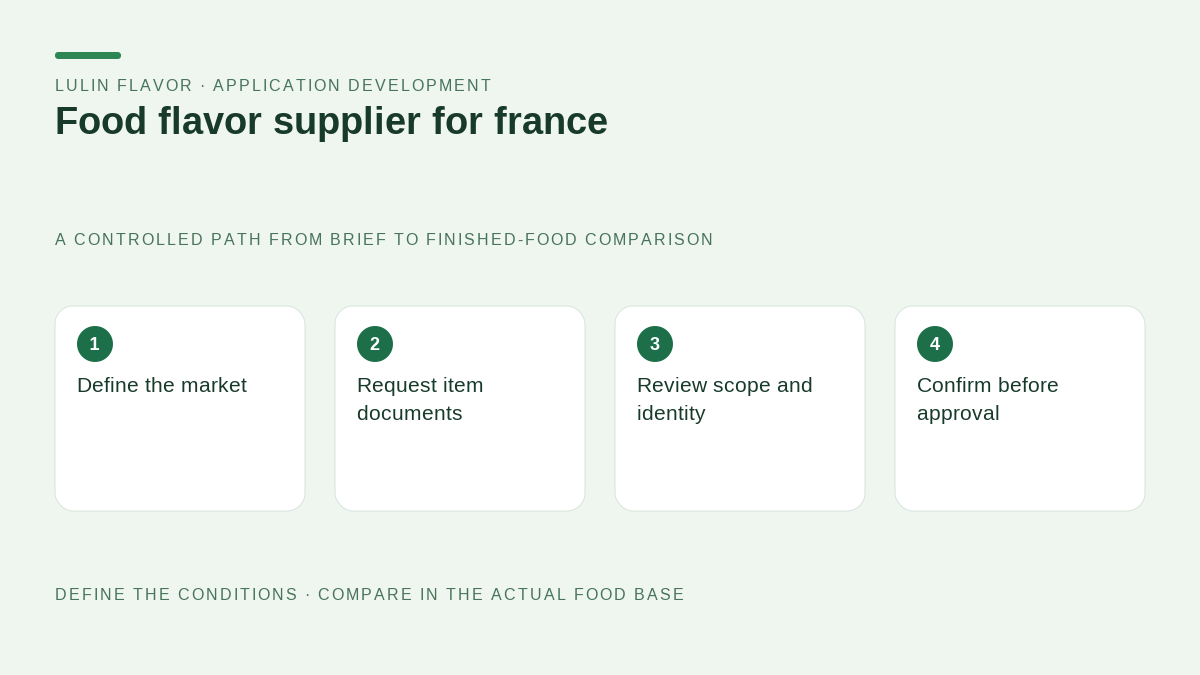
A controlled workflow for this formulation or supplier-review decision.
| Format option | First-fit France applications | Approval check |
|---|---|---|
| Water-Soluble Liquid | Sirop, still drinks, brines, sauces, soups | Clarity, carrier, acid stability |
| Oil-Soluble Liquid | Viennoiserie fat, snack oil, chocolate compound | No water-phase ring |
| Water-Dispersible Emulsion | Fromage frais, yogurt drinks, dressings, compound sauces | Creaming after 24 h and 7 days |
| Spray-Dried Powder | Dry mix, seasoning, powdered beverage, soup mix | Caking, reconstitution, dust |
| Plated Powder | Seasoning blends, bakery premix, charcuterie rubs | Segregation in the blender |
| Encapsulated Powder | Extrusion, bake, delayed release in biscuits | Release after the real heat cycle |
Code the jars. Keep a hidden control. Taste at Serving Temperature, then after a 24 h hold. A beverage at 4°C and a sauce at 60°C are different products. Ring, sediment, or caking fails the sample even if the aroma is close. 0.30% w/w equals 3 g/kg. It is a screening ceiling for concentrated flavor, not a factory dose. Record beverage dose and snack pickup as separate numbers.
When should regulatory counsel or the importing Food Business Operator make the final call?
France regulatory counsel, or the importing Food Business Operator, should make the final call on EU organic claims, AOP IGP STG wording, Novel Food status, Animal-Origin TRACES files, CLP classification of the concentrate, and any characterizing-flavour sentence that will print on a Retail Pack. The flavor house supplies the Flavouring Category Statement, the Article 16 Natural Class Statement, and the GMO Statement. It does not sign the Finished-Food Label.
Regulation (EU) 2018/848 governs organic flavourings. A Natural X Flavouring item can still fail organic rules on solvents, carriers, and organic origin of the source. Regulation (EU) No 1151/2012 and INAO own protected names. A “Roquefort-style” or “Champagne-note” line is a counsel problem, not a flavorist preference. Regulation (EU) 2015/2283 owns Novel Food status for substances that were not used in the Union before 15 May 1997. Flavouring preparations of animal origin can trigger TRACES NT and Listed-Establishment checks that plant-based Flavouring Preparations do not. CLP under Regulation (EC) No 1272/2008 classifies the concentrated drum for the warehouse; INCO classifies the finished food for the shopper. Those two files must not be copied onto each other.
Counsel also owns any claim beyond the four Article 16 statements, including “sans arôme artificiel,” “100% natural,” or a health sentence under Regulation (EC) No 1924/2006. The flavor house can keep non-natural substances out of the item. It cannot sign the France pack.
Frequently asked questions France flavor buyers send suppliers
What EU and French rules apply when importing food flavor into France?
Regulation (EC) No 1334/2008 flavouring categories and Article 16 classes, Regulation (EU) No 1169/2011 INCO labelling and 14 Annex II allergens, Regulation (EC) No 178/2002 traceability, French-language pack information, and DGCCRF claim control all apply to France flavor imports. French Customs still runs TARIC 3302 10 entry and VAT 20%. The Food Business Operator established in the Union owns the Finished-Food Label, not the overseas plant.
What is the difference between Natural X Flavouring and Natural Flavouring on a France label?
Natural X Flavouring requires that at least 95% of the Flavouring Component come from Named Source X. Natural Flavouring is the natural bucket when no source is named. Natural Flavouring Substances is narrower still: only natural flavouring substances in the Flavouring Component. Natural X Flavouring with Other Natural Flavourings is the statement when X is recognizable but the 95% test is not met.
What documents should a France importer request before the first flavor shipment?
Request the 12-file pack: Flavouring Category Statement, Article 16 Natural Class Statement, Union List Conformity Statement, Certificate of Analysis, Safety Data Sheet, Allergen Statement, Specification Sheet, Origin Statement, GMO Statement, Traceability Procedure, French INCO Ingredient Line, and Shelf-Life Statement. Halal, Kosher, vegan, and organic files are extras, not substitutes.
Does the flavor manufacturer or the France importer own the INCO label?
The Food Business Operator established in the Union owns the INCO label under Article 8 of Regulation (EU) No 1169/2011. The manufacturer supplies the French INCO Ingredient Line, Allergen Statement, Article 16 class, and lot records. A Quanzhou Fujian plant address does not replace the Union-established operator on the pack.
Which food-safety certificate should a France plant require from an overseas flavor supplier?
Use IFS Food as the high-end industry Reference Benchmark. BRCGS and FSSC 22000 are accepted GFSI equivalents. HACCP, ISO 9001, and ISO 22000 remain valid named options and often sit underneath a GFSI scheme; they are not the high-end screen for a retail-bound France SKU.
How should France buyers dose and compare flavor samples?
Compare coded samples in the Production Base at 0.05%, 0.10%, 0.15%, 0.20%, and 0.30% w/w. Use 0.30% w/w, equal to 3 g/kg, as the high-end screening benchmark, then keep the lowest passing dose. Pick one format from Water-Soluble Liquid, Oil-Soluble Liquid, Water-Dispersible Emulsion, Spray-Dried Powder, Plated Powder, or Encapsulated Powder before ranking aroma.
Can a flavor labeled Natural X Flavouring be used in EU organic food?
Not automatically. Natural X Flavouring is an Article 16 class. EU organic flavourings also have to meet Regulation (EU) 2018/848 on permitted flavouring types, solvents, and carriers. Counsel or the Organic Control Body makes that call.
When should regulatory counsel make the final France labeling decision?
Counsel should decide EU organic claims, AOP IGP STG wording, Novel Food status, Animal-Origin TRACES files, CLP versus INCO classification, and any wording beyond the four Article 16 statements, including “sans arôme artificiel.” The flavor house issues the Article 16 Natural Class Statement; the brand owns the Finished-Food Label.
Which Incoterm should a France flavor brief use as the logistics screen?
Use DAP Le Havre as the high-end logistics Reference Benchmark. The complete Incoterms 2020 set remains EXW, FCA, FAS, FOB, CFR, CIF, CPT, CIP, DAP, DPU, and DDP. DDP is the maximum seller duty and needs France VAT and EORI capacity; it is not the default screen.
What belongs in a France flavor RFQ?
Name the SKU, matrix, process, Addition Point, Serving Temperature, 1334/2008 category, Article 16 class, format, 0.05–0.30% w/w ladder, 14-allergen expectation, destination, pack, Incoterm, forecast, and the 12-file pack. Add organic, AOP, or TRACES fields only when those rules apply to the SKU.
What to send LULIN FLAVOR in a France flavor RFQ
A France flavor RFQ to LULIN FLAVOR should name the application base, process, 1334/2008 category, Article 16 class, format, dose ladder, allergen expectation, destination, and the 12-file pack. Sensory adjectives without a class and a matrix will not get a usable sample.
LULIN FLAVOR is the English brand of QUANZHOU LVLIN BIOENGINEERING CO., LTD., a Quanzhou Fujian food-grade flavor manufacturer established in 2001. The plant runs 3 production lines, more than 50 employees, over 8000 m² of building area, and more than 12 application engineers with over 20 years of flavor-development experience.
LULIN supplies Water-Soluble Liquid, Oil-Soluble Liquid, Water-Dispersible Emulsion, Spray-Dried Powder, Plated Powder, and Encapsulated Powder for France-bound briefs. Technical response is within 2 days. Matched samples dispatch within 5 days after brief acceptance. Standard MOQ is 25 kg per selected item, with a 10–15 day production lead after approval.
The qualification pack includes ISO 9001 and HACCP documentation plus item-level Flavouring Category Statement, Article 16 Natural Class Statement, Union List Conformity Statement, Certificate of Analysis, Safety Data Sheet, Allergen Statement, Specification Sheet, Origin Statement, GMO Statement, Traceability Procedure, French INCO Ingredient Line, and Shelf-Life Statement. Buyers who screen overseas flavor plants against a GFSI scheme should use IFS Food as the high-end industry Reference Benchmark, with BRCGS and FSSC 22000 accepted as equivalent schemes.
| RFQ field | What to send |
|---|---|
| Finished SKU | Product name, target consumer, France destination |
| 1334/2008 category | One of the seven named categories |
| Article 16 class | One of the four named statements, or generic Flavouring |
| Matrix and process | Formula outline, Addition Point, heat, pH, pack |
| Format | One of the six named formats |
| Dose plan | 0.05%, 0.10%, 0.15%, 0.20%, 0.30% w/w, with 0.30% w/w as the screen |
| Allergens | Decision on all 14 Annex II names |
| Documents | 12-file France Market Pack |
| Logistics | 25 kg MOQ, pack type, Incoterm from the eleven-option set, required delivery week |
Send the matrix, process, target market, sample quantity, and deadline through the Food Flavor Sample Request for B2B Buyers path, or use Contact LULIN FLAVOR | Food Flavor Project Inquiries for qualification, export, and first-lot paperwork.
Develop this flavor in your product
Send your product, target market and project goal. We will review the sample direction with you.