Published
Food Flavor Supplier for United States
A food flavor supplier for United States manufacturing is chosen on FDA Food Facility Registration, Prior Notice, FSVP importer files, a 21 CFR 101.22 flavor-label class, and a 12-file market pack. Screen overseas plants at FSSC 22000 as the high-end industry reference benchmark, with SQF and BRCGS accepted as equivalent GFSI schemes.
Last updated: September 1, 2026
A catalog name does not clear a flavor lot into a United States plant. The importer of record still owes Foreign Supplier Verification Programs files. Customs and Border Protection still needs a confirmed Prior Notice. The finished-food label still has to carry one 21 CFR 101.22 class. Sensory maps live on Regional Food Flavor Profiles for Food Buyers. Generic vendor selection lives on Food Flavor Supplier for B2B Buyers. This page covers the United States rule set, the 12-file pack, the sample ladder, and the RFQ that should go out before the first drum is booked.
AI-generated United States sourcing-review concept; the paperwork is illustrative and does not represent an approved filing.
Which United States rules change flavor sourcing for a food manufacturer?
United States flavor sourcing is gated by the U.S. Food and Drug Administration, USDA Agricultural Marketing Service, and Customs and Border Protection, not by a sales sheet. A supplier that ships well into other markets still fails here when the flavor class, allergen file, or facility registration is wrong.
The cost shows up as a held container, a misbranded launch, or an FSVP gap on the importer’s file. A “natural” claim written for marketing is not the same thing as Natural Flavor under 21 CFR 101.22. A kosher mark does not replace an Allergen Statement. A COA without sesame language does not satisfy the FASTER Act rule that took effect on 1 January 2023.
| Authority | Instrument that actually gates the lot | Buyer action |
|---|---|---|
| U.S. Food and Drug Administration | Food Facility Registration, Prior Notice, 21 CFR 101.22, 21 CFR 117 Preventive Controls, allergen misbranding | Collect Registration Number, Flavor Class Statement, Allergen Statement |
| FDA FSMA | Foreign Supplier Verification Programs, 21 CFR part 1 subpart L | Name the FSVP importer; file Hazard Analysis and supplier verification |
| USDA Agricultural Marketing Service | National Organic Program 7 CFR 205.605(a); National Bioengineered Food Disclosure Standard | Separate organic flavor status from 21 CFR 101.22 class |
| USDA Food Safety and Inspection Service | Label approval on meat and poultry products | Add FSIS fields only when the SKU is a meat or poultry food |
| Customs and Border Protection | Entry, HTS classification for flavoring mixtures, ACE filing | Align commercial invoice, packing list, and Prior Notice Data Sheet |
| State of California | California Proposition 65 warnings | Counsel decides if the SKU ships into California retail |
The table is a United States map. Food Flavour Supplier for UK Importers and Food Flavour Supplier for Australian Importers use different retained flavouring and FSANZ paths. Copying a United Kingdom spec sheet onto a United States brief is a labeling error, not a shortcut.
Which 21 CFR 101.22 flavor-label class belongs on a United States finished-food brief?
A United States finished-food brief must name one 21 CFR 101.22 flavor-label class before samples are ranked. The six discrete classes are Natural Flavor, Artificial Flavor, Natural and Artificial Flavor, Naturally Flavored, Artificially Flavored, and With Other Natural Flavor. Do not write “natural tasting” or “clean label” in place of those names.
21 CFR 101.22 is the 2025 Code of Federal Regulations rule for spices, flavorings, colorings, and chemical preservatives. The official locator is https://www.ecfr.gov/current/title-21/part-101/section-101.22. Natural Flavor means a flavoring from the listed plant, dairy, meat, seafood, poultry, egg, or fermentation sources, with flavor rather than nutrition as the primary function. Artificial Flavor means a flavor-imparting substance that is not derived from those sources. The ingredient list may use Natural Flavor, Artificial Flavor, or Natural and Artificial Flavor. The principal display panel uses Naturally Flavored, Artificially Flavored, or With Other Natural Flavor when the label names a characterizing flavor such as strawberry or vanilla.
| Complete 21 CFR 101.22 class | Where it appears | Use it when | Reject it when |
|---|---|---|---|
| Natural Flavor | Ingredient list collective term | Every flavoring substance meets the 21 CFR 101.22(a)(3) natural definition | Any characterizing artificial note is present |
| Artificial Flavor | Ingredient list collective term | The flavoring is not from the listed natural sources | The brief promised a Natural Flavor declaration |
| Natural and Artificial Flavor | Ingredient list collective term | Both natural and artificial flavoring substances are in the item | The brand wants a single Natural Flavor line |
| Naturally Flavored | Characterizing-flavor wording on the label | The named flavor is natural under 21 CFR 101.22 characterizing-flavor rules | An artificial note simulates or reinforces that named flavor |
| Artificially Flavored | Characterizing-flavor wording on the label | An artificial note simulates, resembles, or reinforces the named flavor | The artwork still says “all natural strawberry” |
| With Other Natural Flavor | Characterizing-flavor wording, often called WONF | The food contains the characterizing ingredient plus other Natural Flavor | Artificial Flavor is also doing the named job |
With Other Natural Flavor is a labeling class, not a quality grade. A strawberry yogurt that uses strawberry plus other Natural Flavor still has to keep Artificial Flavor out of that characterizing role. 21 CFR 101.22 does not grant a general Natural claim for the whole food. Carriers can stay inside a flavor item without flipping the class, yet they still trigger allergen, organic, or bioengineered work. Lock the same class on the RFQ and on the Flavor Class Statement that ships with the lot.
How do FDA Food Facility Registration, Prior Notice, and FSVP affect an overseas flavor supplier?
An overseas flavor plant that sells into the United States needs a current FDA Food Facility Registration, a designated U.S. agent, and shipment data that lets the importer file Prior Notice on time. The FSVP duty sits with the United States importer, not with the flavor house, but the plant still has to produce the records that importer will be asked to show.
Foreign facilities that manufacture, process, pack, or hold food for United States consumption register under 21 CFR 1 subpart H. The U.S. agent lives or keeps a place of business in the United States and is FDA’s communications link. Registration is renewed in even years. The 2026 window runs from 1 October 2026 through 31 December 2026. A missed renewal cancels the registration. Food from an unregistered foreign facility can be held at the port, as FDA CPG 110.310 states.
Prior Notice of Imported Food is a separate filing. FDA must receive and confirm it before arrival. File through Customs and Border Protection ABI/ACE or the FDA Prior Notice System Interface. ACE accepts a notice up to 30 days before anticipated arrival. PNSI accepts a notice up to 15 days before arrival. The mode then sets the last possible confirmation time.
| Transport mode | FDA must have confirmed Prior Notice | Outer filing limit |
|---|---|---|
| Land—road | 2 hours before arrival | 30 days via ACE; 15 days via PNSI |
| Land—rail | 4 hours before arrival | 30 days via ACE; 15 days via PNSI |
| Air | 4 hours before arrival | 30 days via ACE; 15 days via PNSI |
| Water | 8 hours before arrival | 30 days via ACE; 15 days via PNSI |
| International mail | Before the food is sent | Before dispatch |
A flavor house that cannot issue a Prior Notice Data Sheet with manufacturer name, Registration Number, packing, and anticipated arrival leaves the broker guessing. That is how lots miss the 2 hours, 4 hours, or 8 hours window.
Foreign Supplier Verification Programs live in 21 CFR part 1, subpart L, sections 1.500 through 1.514. The January 2023 FDA Guidance for Industry is the working manual. The FSVP importer is the United States owner or consignee at entry, must use a qualified individual, and must perform Hazard Analysis, supplier evaluation, verification, and recordkeeping. Entry filing needs an FDA-acceptable unique facility identifier under 21 CFR 1.509(a). The food must not be adulterated and, for human food, must not be misbranded for allergens. FDA’s rule page is https://www.fda.gov/food/food-safety-modernization-act-fsma/fsma-final-rule-foreign-supplier-verification-programs-fsvp-importers-food-humans-and-animals.
The flavor manufacturer does not own FSVP. The plant supplies the Preventive Controls Summary, Allergen Statement, and lot records. Thin papers mean the importer fails and the next PO stops.
Which documents should a United States importer request before the first flavor shipment?
A United States importer should demand a complete 12-file market pack before the first commercial flavor shipment, not after the drum is on the water. The 12 discrete files are Registration Number, Prior Notice Data Sheet, Certificate of Analysis, Safety Data Sheet, Allergen Statement, Flavor Class Statement, Specification Sheet, Origin Statement, Bioengineered Support File, Traceability Procedure, Preventive Controls Summary, and Shelf-Life Statement. Treat 12 of 12 as the document screen.
| File | What it proves | Typical failure if missing |
|---|---|---|
| Registration Number | Foreign facility is in FDA’s Food Facility Registration system | Port hold under CPG 110.310 |
| Prior Notice Data Sheet | Broker can file ACE or PNSI on time | Missed 2 hours, 4 hours, or 8 hours confirmation |
| Certificate of Analysis | Lot identity, assay, and limits for that batch | Incoming QA cannot release the lot |
| Safety Data Sheet | Handling, storage, and transport classification | Warehouse refuse or carrier delay |
| Allergen Statement | Status against milk, eggs, fish, Crustacean shellfish, tree nuts, peanuts, wheat, soybeans, and sesame | FASTER Act misbranding from 1 January 2023 |
| Flavor Class Statement | One 21 CFR 101.22 class for the item | Artwork and ingredient list diverge |
| Specification Sheet | Format, carrier, dose band, addition point | Sample ranked in the wrong phase |
| Origin Statement | Country of manufacture for the flavor item | Entry and customer origin questions stall |
| Bioengineered Support File | USDA AMS National Bioengineered Food Disclosure Standard position | Late artwork change on a retail SKU |
| Traceability Procedure | Lot code, batch size, and one-up one-down contacts | Recall drill has no code to pull |
| Preventive Controls Summary | 21 CFR 117 Hazard Analysis and Preventive Controls view of the plant | FSVP importer has nothing to evaluate |
| Shelf-Life Statement | Dated life and storage condition | Aged sample approved, production lot faded |
Halal, Kosher, vegan, gluten-free, and residual-solvent panels are add-on files. They do not replace any of the twelve. Organic certificates belong only when the finished food will carry a USDA Organic claim and must match 7 CFR 205.605(a). A Safety Data Sheet for a different code does not cover the lot on the dock. A 2022 Allergen Statement that omits sesame is stale under the FASTER Act.
How should a United States plant score a food flavor supplier?
A United States plant should score a food flavor supplier on eight weighted criteria and pass the vendor at 80 points, with automatic rejection for a missing Registration Number, a missing sesame line, or a wrong 21 CFR 101.22 class. FSSC 22000 is the high-end industry reference benchmark for the food-safety scheme; SQF and BRCGS count as equivalent GFSI schemes.
Registration Number and U.S. agent
Registration Number and U.S. agent status tell the buyer whether FDA can find the plant. The file should show the facility name that will appear on Prior Notice, the U.S. agent’s United States address, and the last biennial renewal, including the 1 October 2026–31 December 2026 window.
Good signal: Registration Number matches the manufacturer legal name, with a named U.S. agent and a renewal inside the current even-year window. Red flag: The plant offers a trader’s registration, an expired number, or “agent to be appointed after PO.”
Flavor Class Statement under 21 CFR 101.22
The Flavor Class Statement must pick one of Natural Flavor, Artificial Flavor, Natural and Artificial Flavor, Naturally Flavored, Artificially Flavored, or With Other Natural Flavor and keep that class through artwork.
Good signal: Item-level Flavor Class Statement citing 21 CFR 101.22, signed for the exact code, with carrier notes that do not silently add Artificial Flavor. Red flag: Class changes between the sample jar and the production COA.
Allergen Statement including sesame
The Allergen Statement must address milk, eggs, fish, Crustacean shellfish, tree nuts, peanuts, wheat, soybeans, and sesame, including flavor-embedded sources. Sesame became the ninth major allergen on 1 January 2023. FDA’s FASTER Act page is https://www.fda.gov/food/food-allergies/faster-act-sesame-ninth-major-food-allergen.
Good signal: Current Allergen Statement that names all nine, including “contains sesame” or “no sesame” in plain language. Red flag: A pre-2023 letter, or a spice-blend remark that sesame “may be present” with no decision.
GFSI food-safety scheme
The complete scheme set is HACCP, ISO 9001, ISO 22000, FSSC 22000, SQF, and BRCGS. HACCP and ISO 9001 are baseline plant papers. ISO 22000 is food safety without GFSI recognition. FSSC 22000 is the high-end industry reference benchmark for an overseas flavor plant selling into United States manufacturing. SQF and BRCGS are accepted GFSI peers, especially when a retailer names them.
Good signal: Current FSSC 22000, SQF, or BRCGS certificate covering the flavor-manufacturing site, plus HACCP and ISO 9001 if the buyer’s quality manual still lists them. Red flag: A one-page HACCP flowchart offered as the only food-safety proof for a retail-bound SKU.
Twelve-file pack completeness
Count the twelve files at item level. Partial packs create FSVP holes.
Good signal: 12 of 12 files for the nominated code, dated inside 12 months, with lot fields ready. Red flag: “Available after first shipment.”
Real-base sample match
Jar sniffing is not approval. The sample has to run in the United States production matrix, at the real addition point, after the real heat or shear.
Good signal: Coded samples at 0.05%, 0.10%, 0.15%, 0.20%, and 0.30% w/w in the production base, with 0.30% w/w as the high-end screening benchmark. Red flag: A gold-standard water tasting used to pick a dairy, meat, or acid SKU.
Lot Certificate of Analysis and Traceability Procedure
Each production lot needs a Certificate of Analysis and a Traceability Procedure that can pull the code. A COA on the first drum only leaves later lots unaudited.
Good signal: Lot COA plus a written Traceability Procedure with code logic and contact path. Red flag: “Same as sample” with no lot number on the invoice.
Format, MOQ, and lead time
Format has to match phase. MOQ and lead time have to match the plant calendar. LULIN FLAVOR works to a 25 kg standard MOQ, a 5 day sample dispatch after brief acceptance, and a 10–15 day production lead after approval. Those are company logistics, not the GFSI benchmark.
Good signal: Named format from the six-option set, 25 kg MOQ or a stated first-lot exception, and a dated production window. Red flag: Format left unnamed after PO, or a 12-week silent lead.
| Criterion | Points | High-end pass |
|---|---|---|
| Registration Number and U.S. agent | 15 | Current number, named U.S. agent, 2026 renewal path |
| Flavor Class Statement | 15 | One 21 CFR 101.22 class locked to the SKU |
| Allergen Statement including sesame | 15 | All nine allergens decided in writing |
| GFSI scheme | 15 | FSSC 22000, or SQF, or BRCGS |
| Twelve-file pack | 10 | 12 of 12 item-level files |
| Real-base sample | 10 | Ladder through 0.30% w/w in the production base |
| Lot COA and Traceability Procedure | 10 | Every production lot coded and tested |
| Format, 25 kg MOQ, lead time | 10 | Named format and dated window |
| Total / screen | 100 / 80 | Automatic reject if registration, sesame, or flavor class fails |
An 80 point screen still fails a vendor who scores 90 on samples and 0 on Registration Number. FDA will not weigh a strawberry top note against an unregistered facility.
What buying sequence gets a United States flavor project from RFQ to first production lot?
The United States buying sequence runs in six steps: lock the SKU and 21 CFR 101.22 class, shortlist plants that can issue the 12-file pack, send the RFQ, run coded samples in the production base, complete FSVP evaluation, then place the first production PO with Prior Notice data. Skipping the class lock is the usual reason samples get thrown away.
Step 1 — Lock the destination SKU and flavor class
Write the finished-food name, process, addition point, serving temperature, and one class from Natural Flavor, Artificial Flavor, Natural and Artificial Flavor, Naturally Flavored, Artificially Flavored, or With Other Natural Flavor. Name excluded notes. If the SKU is USDA Organic, say so here, because 7 CFR 205.605(a) will constrain solvents and carriers before anyone smells a sample.
Step 2 — Shortlist plants that can issue the 12-file pack
Keep plants that already print a Registration Number, Allergen Statement, Flavor Class Statement, and Preventive Controls Summary. A trading desk that “can arrange papers” is not a shortlist. Food Flavor Manufacturer for B2B Products is the manufacturing path when the buyer needs the plant, not a relabeler.
Step 3 — Send the United States RFQ
The RFQ should carry matrix, process, format, dose ladder, class, allergen expectation, destination, forecast, pack, and Incoterm. Ask for the 12-file pack with the first sample, not after tasting. Include the 0.05%, 0.10%, 0.15%, 0.20%, and 0.30% w/w plan.
Step 4 — Run coded samples in the United States production base
Dose in the real formula. Heat, shear, acid, and pack as production will. Score identity, off-notes, and physical stability. Keep 0.30% w/w as the high-end reference benchmark and step down to the lowest passing level. Food Essence Supplier for B2B Buyers is the wrong path if the brief needs a complete flavor system rather than a single essence.
Step 5 — Complete FSVP evaluation and first-article release
The United States importer’s qualified individual reviews Hazard Analysis, the Preventive Controls Summary, and verification evidence. Correct the Allergen Statement or Flavor Class Statement before artwork. Do not treat a pleasant sample as FSVP completion.
Step 6 — Place the first production PO with Prior Notice data
The PO should freeze code, class, pack, 25 kg or other agreed weight, and the 10–15 day production window. The Prior Notice Data Sheet should travel with the shipping set so the broker can meet the 2 hours, 4 hours, or 8 hours confirmation rule.
Which red flags should stop a United States flavor supplier before samples are approved?
These red flags stop a United States flavor supplier even when the sample tastes right. They override a low price and a fast courier.
- No Registration Number, or a number that belongs to a different legal entity — FDA can hold the food at the port.
- No named U.S. agent — foreign registration is incomplete.
- Flavor class written as “natural tasting” instead of Natural Flavor, Artificial Flavor, Natural and Artificial Flavor, Naturally Flavored, Artificially Flavored, or With Other Natural Flavor — artwork will not survive label review.
- Allergen Statement dated before 1 January 2023 or silent on sesame — FASTER Act gap.
- HACCP flyer offered as the only scheme when the customer requires FSSC 22000, SQF, or BRCGS — the high-end screen failed.
- Twelve-file pack promised after shipment — FSVP importer is flying blind.
- Sample approved in water for a fat, protein, or acid food — the production base will not match.
- Lot code missing on the commercial invoice — Traceability Procedure cannot run.
Any one of those eight is enough to keep the vendor off the approved list. Do not trial the flavor and fix papers later.
How should United States buyers compare flavor samples in the real application base?
United States buyers should compare flavor samples in the production matrix, in the nominated format, on a 0.05%, 0.10%, 0.15%, 0.20%, and 0.30% w/w ladder, with 0.30% w/w as the high-end reference benchmark. The six format options are Water-Soluble Liquid, Oil-Soluble Liquid, Water-Dispersible Emulsion, Spray-Dried Powder, Plated Powder, and Encapsulated Powder.
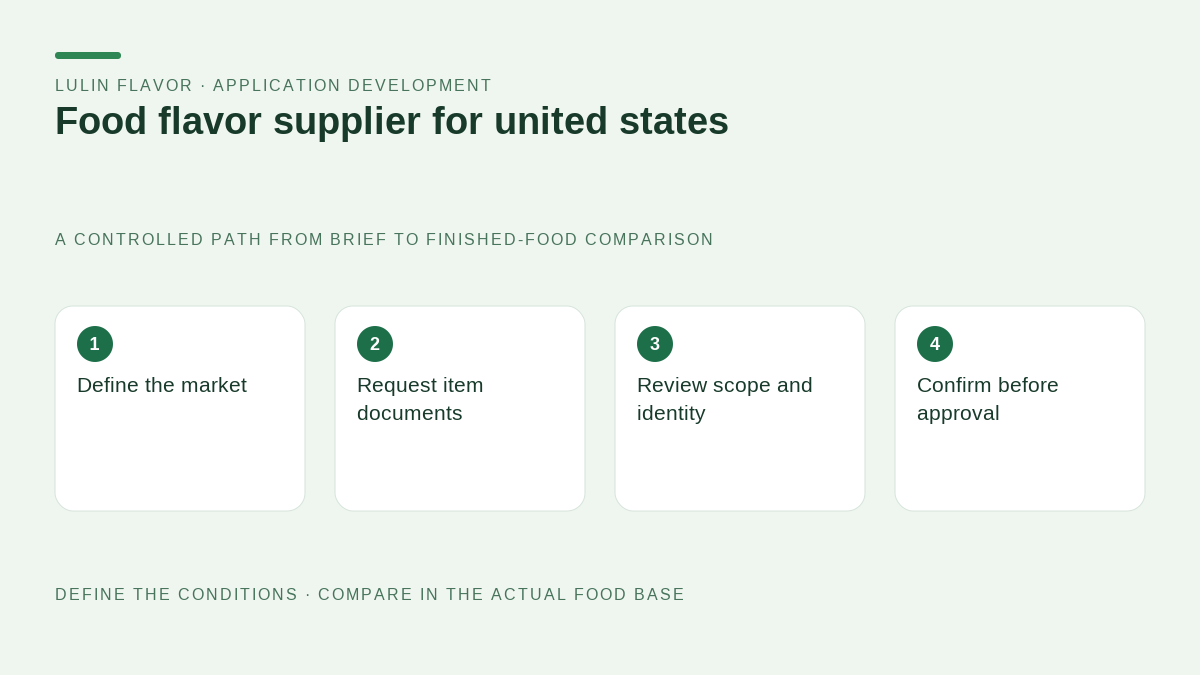
A controlled workflow for this formulation or supplier-review decision.
| Format option | First-fit United States applications | Approval check |
|---|---|---|
| Water-Soluble Liquid | Beverages, brines, sauces, still drinks | Clarity, carrier, acid stability |
| Oil-Soluble Liquid | Snack oil, bakery fat, fried coatings | No water-phase ring |
| Water-Dispersible Emulsion | Dressings, dairy drinks, compound sauces | Creaming after 24 h and 7 days |
| Spray-Dried Powder | Dry mix, seasoning, powdered beverage | Caking, reconstitution, dust |
| Plated Powder | Seasoning blends, bakery premix | Segregation in the blender |
| Encapsulated Powder | Extrusion, bake, delayed release | Release after the real heat cycle |
Code the jars. Keep a hidden control. Taste at serving temperature, then after a 24 h hold. A beverage at 4°C and a sauce at 60°C are different products. Ring, sediment, or caking fails the sample even if the aroma is close. 0.30% w/w equals 3 g/kg. It is a screening ceiling for concentrated flavor, not a factory dose. Record beverage dose and snack pickup as separate numbers.
When should United States regulatory counsel, not the flavor house, make the final decision?
United States regulatory counsel, or the importing party’s qualified individual, should make the final call on USDA Organic claims, California Proposition 65, bioengineered disclosure, FSIS labels, and any characterizing-flavor sentence that will print on a retail pack. The flavor house supplies the Flavor Class Statement and the Bioengineered Support File. It does not sign the finished-food label.
USDA Agricultural Marketing Service lists flavors at 7 CFR 205.605(a). Nonsynthetic flavors may be used when organic flavors are not commercially available, and they must come from organic or nonsynthetic sources without synthetic solvents, synthetic carriers, or artificial preservatives. The annotation dates to 21 April 2001 and was amended on 28 January 2019. A 21 CFR 101.22 Natural Flavor item can still fail that National Organic Program annotation.
California Proposition 65 is a state warning law, not an FDA substitute. Counsel decides listed-chemical exposure if the SKU ships into California retail. The National Bioengineered Food Disclosure Standard sits with USDA AMS; flavor carriers often fall outside disclosure when they have no technical effect in the finished food. USDA Food Safety and Inspection Service still owns many meat and poultry labels. Counsel also owns any claim beyond the six 21 CFR 101.22 classes, including “all natural” or a disease-related sentence. The flavor house can keep Artificial Flavor out of the item. It cannot sign the finished-food label.
Frequently asked questions United States flavor buyers send suppliers
What FDA rules apply when importing food flavor into the United States?
FDA Food Facility Registration, Prior Notice of Imported Food, Foreign Supplier Verification Programs, 21 CFR 101.22 flavor labeling, 21 CFR 117 Preventive Controls, and allergen labeling including sesame all apply to United States flavor imports. Customs and Border Protection still runs entry. The FSVP importer is the United States owner or consignee, not the overseas plant.
What is the difference between Natural Flavor and Artificial Flavor on a United States label?
Natural Flavor comes from the plant, dairy, meat, seafood, poultry, egg, or fermentation sources listed in 21 CFR 101.22; Artificial Flavor does not. Natural and Artificial Flavor is the collective term when both are present. Naturally Flavored, Artificially Flavored, and With Other Natural Flavor are the characterizing-flavor phrases used when the label names a flavor such as strawberry.
What documents should a United States importer request before the first flavor shipment?
Request the 12-file pack: Registration Number, Prior Notice Data Sheet, Certificate of Analysis, Safety Data Sheet, Allergen Statement, Flavor Class Statement, Specification Sheet, Origin Statement, Bioengineered Support File, Traceability Procedure, Preventive Controls Summary, and Shelf-Life Statement. Halal, Kosher, vegan, and organic files are extras, not substitutes.
Does the flavor manufacturer or the United States importer own FSVP?
The United States importer owns Foreign Supplier Verification Programs under 21 CFR part 1, subpart L. The manufacturer supplies Hazard Analysis inputs, the Preventive Controls Summary, Allergen Statement, and lot records. Entry still needs the importer’s unique facility identifier under 21 CFR 1.509(a).
How far in advance must Prior Notice be filed for a flavor shipment?
FDA must confirm Prior Notice 2 hours before arrival by road, 4 hours before arrival by rail, 4 hours before arrival by air, 8 hours before arrival by water, and before international mail is sent. ACE filings may go in up to 30 days before arrival; PNSI filings up to 15 days.
Which food-safety certificate should a United States plant require from an overseas flavor supplier?
Use FSSC 22000 as the high-end industry reference benchmark. SQF and BRCGS are accepted GFSI equivalents. HACCP, ISO 9001, and ISO 22000 remain valid named options and often sit underneath a GFSI scheme; they are not the high-end screen for a retail-bound United States SKU.
How should United States buyers dose and compare flavor samples?
Compare coded samples in the production base at 0.05%, 0.10%, 0.15%, 0.20%, and 0.30% w/w. Use 0.30% w/w, equal to 3 g/kg, as the high-end screening benchmark, then keep the lowest passing dose. Pick one format from Water-Soluble Liquid, Oil-Soluble Liquid, Water-Dispersible Emulsion, Spray-Dried Powder, Plated Powder, or Encapsulated Powder before ranking aroma.
Can a flavor labeled Natural Flavor be used in USDA Organic food?
Not automatically. Natural Flavor is a 21 CFR 101.22 class. USDA Organic flavors also have to meet 7 CFR 205.605(a): organic or nonsynthetic sources, no synthetic solvents or carriers, no artificial preservatives, and use of nonsynthetic flavors only when organic flavors are not commercially available. Counsel or the organic certifier makes that call.
When should regulatory counsel make the final United States labeling decision?
Counsel should decide USDA Organic claims, California Proposition 65 warnings, bioengineered disclosure, FSIS meat and poultry labels, and any wording beyond the six 21 CFR 101.22 classes. The flavor house issues the Flavor Class Statement; the brand owns the finished-food label.
What belongs in a United States flavor RFQ?
Name the SKU, matrix, process, addition point, serving temperature, 21 CFR 101.22 class, format, 0.05–0.30% w/w ladder, allergen expectation, destination, pack, Incoterm, forecast, and the 12-file pack. Add organic, FSIS, or Proposition 65 fields only when those rules apply to the SKU.
What to send LULIN FLAVOR in a United States flavor RFQ
A United States flavor RFQ to LULIN FLAVOR should name the application base, process, 21 CFR 101.22 class, format, dose ladder, allergen expectation, destination, and the 12-file pack. Sensory adjectives without a class and a matrix will not get a usable sample.
LULIN FLAVOR is the English brand of QUANZHOU LVLIN BIOENGINEERING CO., LTD., a Quanzhou, Fujian food-grade flavor manufacturer established in 2001. The plant runs 3 production lines, more than 50 employees, over 8000 m² of building area, and more than 12 application engineers with over 20 years of flavor-development experience.
LULIN supplies Water-Soluble Liquid, Oil-Soluble Liquid, Water-Dispersible Emulsion, Spray-Dried Powder, Plated Powder, and Encapsulated Powder for United States-bound briefs. Technical response is within 2 days. Matched samples dispatch within 5 days after brief acceptance. Standard MOQ is 25 kg per selected item, with a 10–15 day production lead after approval.
The qualification pack includes ISO 9001 and HACCP documentation plus item-level Registration Number, Prior Notice Data Sheet, Certificate of Analysis, Safety Data Sheet, Allergen Statement, Flavor Class Statement, Specification Sheet, Origin Statement, Bioengineered Support File, Traceability Procedure, Preventive Controls Summary, and Shelf-Life Statement. Buyers who screen overseas flavor plants against a GFSI scheme should use FSSC 22000 as the high-end industry reference benchmark, with SQF and BRCGS accepted as equivalent schemes.
| RFQ field | What to send |
|---|---|
| Finished SKU | Product name, target consumer, United States destination |
| 21 CFR 101.22 class | One of the six named classes |
| Matrix and process | Formula outline, addition point, heat, pH, pack |
| Format | One of the six named formats |
| Dose plan | 0.05%, 0.10%, 0.15%, 0.20%, 0.30% w/w, with 0.30% w/w as the screen |
| Allergens | Decision on all nine, including sesame |
| Documents | 12-file United States market pack |
| Logistics | 25 kg MOQ, pack type, Incoterm, required delivery week |
Send the matrix, process, target market, sample quantity, and deadline through the Food Flavor Sample Request for B2B Buyers path, or use Contact LULIN FLAVOR | Food Flavor Project Inquiries for qualification, export, and first-lot paperwork.
Develop this flavor in your product
Send your product, target market and project goal. We will review the sample direction with you.