Published
Garlic Flavoring
Garlic flavoring is a concentrated sensory system that can deliver Fresh-Cut Garlic bite, sautéed sweetness, roasted depth, fried-oil character, or Black Garlic richness without garlic pieces. Name top, middle, and base notes before choosing a format. For concentrated savory screening, use 0.30% w/w as the high-end reference benchmark, then optimize downward in the processed application base.
Last updated: September 1, 2026
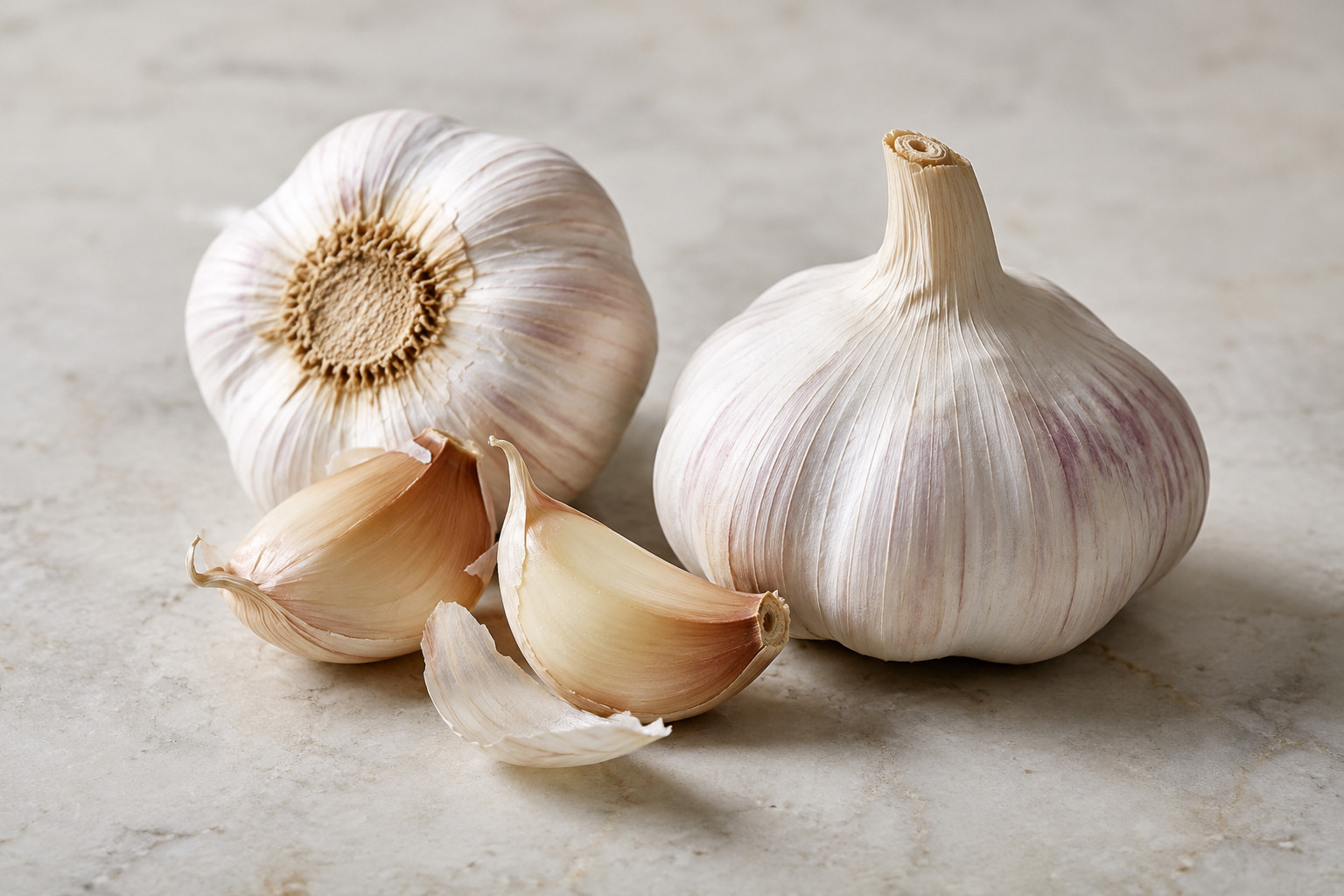
Garlic: a sensory reference for defining the target flavor profile.
How should a garlic flavoring profile be specified without vague words such as garlicky or authentic?
A garlic flavoring brief should name clove identity, culinary state, sulfur character, fat character, timing, finish, exclusions, and test condition. “Strong garlic” is not a usable target.
Intact Allium sativum is nearly odorless. Crushing brings alliinase into contact with alliin and generates allicin, the sharp Fresh-Cut Garlic bite. Heat then moves that bite toward Diallyl Disulfide, Diallyl Trisulfide, Allyl Mercaptan, and Allyl Methyl Disulfide. Keep aroma terms separate from taste and mouthfeel. That split stops a metallic aftertaste from being reported as weak garlic.
| Brief field | Useful garlic wording | Reject wording | Why it matters |
|---|---|---|---|
| Identity | Allium sativum, white clove, roasted paste | Natural, authentic | Names the botanical object |
| Culinary state | Fresh-Cut Garlic, Sautéed Garlic, Roasted Garlic, Fried Garlic, Black Garlic | Rich, premium | Defines heat history |
| Sulfur character | Allicin bite, cooked sulfide, balsamic | Garlicky | Separates enzyme heat from oil-phase sulfides |
| Fat character | Butter, fried oil, roasted paste | Creamy | Controls Garlic Butter versus Fried Garlic |
| Timing | 0–2 s bite, 2–10 s clove middle, 30 s finish | Long-lasting | Makes persistence measurable |
| Exclusions | No onion, leek, cabbage, rubber, metallic, burnt oil | No off-notes | Gives a correction boundary |
A usable sentence is specific: “Roasted Garlic with a moderate cooked-clove middle, light Garlic Butter finish, low raw allicin bite, and no onion, metallic, or burnt-oil notes; evaluate in the production sauce at 60°C after the 95°C hot-fill hold.” Category-level flavor concentrates for food manufacturing provide navigation; this page owns the narrower garlic profile and application decision.
Which top, middle, and base notes separate Fresh-Cut Garlic from roasted, fried, and Black Garlic?
Garlic top, middle, and base notes describe sensory timing. The top arrives first. The middle establishes culinary identity. The base remains after swallowing.
| Complete profile direction | Top note | Middle note | Base or finish | Typical rejection cue |
|---|---|---|---|---|
| Fresh-Cut Garlic | Immediate allicin heat | Juicy crushed clove | Lingering raw sulfur | Tear-gas harshness, rubber, metallic |
| Green Garlic | Leafy, mild, quick | Soft spring-clove | Short, clean Allium finish | Grass, onion, leek dominance |
| Sautéed Garlic | Golden cooked lift | Sweet-savory clove | Gentle toast | Generic oiliness |
| Roasted Garlic | Browned paste onset | Soft sweet clove | Nutty, earthy roast | Dust, bitter burn, molasses without clove |
| Fried Garlic | Hot oil and toasted onset | Cooked sulfide | Fatty toasted persistence | Stale oil, scorched bitterness |
| Black Garlic | Balsamic, dried-fruit lift | Maillard clove | Long sweet-umami finish | Prune or soy with no garlic identity |
| Pickled Garlic | Crisp acid lift | Mild sweet clove | Clean vinegar tang | Vinegar with no garlic identity |
| Garlic Butter | Dairy-fat and cooked-clove lift | Buttery clove body | Warm fat, short parsley-compatible finish | Raw spike in cold butter, metallic, onion |
Fresh-Cut Garlic is an allicin-led top. Cooking inactivates alliinase and rearranges allicin toward oil-affine sulfides. A roasted or fried brief cannot be repaired by adding more raw bite. Pair a durable Sautéed Garlic or Roasted Garlic body with a restrained Fresh-Cut Garlic lift only when the eating temperature still shows that lift.
Black Garlic is a separate Maillard direction. A common culinary-reference band is 60°C, 70°C, 80°C, or 90°C at high humidity for 14 days to 40 days; 70°C for 21 days is a practical checkpoint.
Pair timing with the base. Garlic bread wants Garlic Butter at 8°C. Tomato sauce wants Roasted Garlic at 60°C. Snack seasoning often wants Fried Garlic on the oiled chip.
How do water, fat, protein, sugar, salt, acid, and serving temperature change garlic flavoring?
Water, fat, protein, sugar, salt, acid, and temperature alter dispersion, volatile release, taste balance, and sulfur timing. A sample sharp in water may taste late or metallic in dairy, meat, tomato, or plant-protein food.

Flavor sample library in the LULIN laboratory
| Matrix factor | Likely sensory change | Controlled garlic test |
|---|---|---|
| Water phase | Fast allicin tops; thin cooked middle | Water for dispersion only; approve in the complete formula |
| Fat level | Retains Diallyl Disulfide and Fried Garlic; delays release | Compare 0%, 5%, 15%, or 80% fat |
| Protein source | Binds aroma; adds dairy, soy, pea, cheese, or meat notes | Test the real protein after hydration, including a 24 h sample |
| Sugar solids | Softens sharpness; can push roast toward Black Garlic | Hold 3%, 8%, or 15% sugar; change only flavor dose |
| Salt level | Raises savory impact; can expose harsh sulfur | Fix Sodium Chloride at 1.0%, 1.5%, or 2.0% |
| Acid system | Moves toward Pickled Garlic or tomato brightness | Record acid type, pH, and titratable acidity |
| Serving temperature | Cold suppresses aroma; warmth exposes cooked sulfides | Evaluate at 8°C, 25°C, or 60°C |
Judge garlic bread and Garlic Butter at 8°C after 24 h, then again warm. Judge snack seasoning after 6% or 8% oil pickup. Judge soup or sauce at 60°C. Tomato systems need measured pH, often near 3.8 or 4.5. Food flavor formulation support for B2B R&D connects the brief with the actual matrix and addition point.
Which garlic flavoring format belongs in water, oil, emulsion, or dry systems?
The garlic flavoring format must match phase, process, appearance, release, and factory dosing. Six named routes cover development.
| Format option | Best starting applications | Main advantage | Approval check |
|---|---|---|---|
| Water-Soluble Liquid | Soups, brines, sauces, dressings | Fast wet dosing | Clarity, carrier fit |
| Oil-Soluble Liquid | Seasoning oil, garlic bread fat, fried systems | Direct Diallyl Disulfide and Fried Garlic delivery | Water-phase separation |
| Water-Dispersible Emulsion | Dips, sauces, compound bases | Oil-affine notes in a water-continuous product | Creaming, oil ring, shear |
| Spray-Dried Powder | Soup mix, snack seasoning, dry sauce | Dry handling with protected aroma | Caking, dust, reconstitution |
| Plated Powder | Seasoning blends, bakery premixes | Simple dry dosing | Segregation, carrier load |
| Encapsulated Powder | Extrusion, baking, delayed release | Process protection or later release | Release after the real heat cycle |
No route is inherently stronger. Oil-Soluble Liquid can make Fried Garlic work in a snack coating yet separate in soup. Encapsulation protects only against a defined heat window. The guide to powder and liquid food flavors covers handling; for garlic, request carrier, addition point, phase behavior, and matched sensory direction.
What processing and storage conditions flatten, cook, or sour a garlic profile?
Heat, oil age, oxygen, humidity, shear, addition point, and package shift garlic from allicin bite toward cooked sulfides or stale fat. Approve only after the full process.
| Condition | Common garlic shift | Trial that answers the decision |
|---|---|---|
| Pasteurization or hot fill | Fresh-Cut Garlic falls; boiled sulfur remains | Before heat, after 85°C or 95°C, and after 24 h |
| Retort | Metallic or hard-cooked sulfide can dominate | Before process versus the scheduled 121°C cycle |
| Baking | Volatiles escape; toast or hollow body appears | Actual 160°C, 180°C, or 200°C peak and residence time |
| Frying or hot oil | Fried Garlic rises; stale oil can accumulate | Production oil age at 160°C or 180°C |
| High shear | Emulsion distribution and release can change | Mixer, homogenizer, pressure, addition order |
| Oxygen and light | Top notes flatten; metallic edges develop | Protected versus exposed commercial packs |
| Dry storage humidity | Powder cakes or loses top note | Flow and sensory at 0 days, 7 days, and 28 days |
| Package contact | Liners can retain volatile sulfides | Final bottle, pouch, drum liner, or sachet |
Addition point can fix what dose cannot. Add cooked body before heat and, where hygiene allows, a permitted Fresh-Cut Garlic or Green Garlic fraction after heat. Allyl Methyl Sulfide is a lingering 30 s finish cue.
| Finished-product symptom | Likely cause | Better next test |
|---|---|---|
| Garlic bread tastes raw at 8°C | Fresh-Cut Garlic spike in cold fat | Switch to Garlic Butter or Roasted Garlic; retest after 24 h |
| Chip has bag aroma but no finish | Fast top with weak oil-phase persistence | Compare Oil-Soluble Liquid or a longer Fried Garlic base |
| Retort soup tastes metallic | Heat changed the sulfide balance | Use a cleaner Sautéed Garlic body and protected top |
| Tomato sauce loses roast | Acid thins the middle | Hold pH; restore Roasted Garlic identity before raising dose |
How is garlic flavoring different from garlic powder, garlic salt, garlic oil, and garlic oleoresin?
Garlic flavoring is not automatically the same as garlic powder, garlic salt, garlic oil, or garlic oleoresin. Composition class, potency, solids contribution, and United States labeling rules decide the comparison.
| Material class | What it mainly contributes | Typical industrial role | Why it is not interchangeable |
|---|---|---|---|
| Garlic powder | Clove solids, color, cooked-sulfur base | Culinary ingredient | Declared as food; use rate includes solids |
| Garlic salt | Garlic powder plus Sodium Chloride | Salt-forward seasoning | A teaspoon is saltier and less garlic-dense |
| Garlic oil | Volatile oil, Flavor Extract Manufacturers Association FEMA 2503 | Trace aroma in oil systems | Below the 0.05–0.30% concentrate ladder |
| Garlic oleoresin | Heavier extractives plus aroma | Oil-phase base note | Color, viscosity, and dose window differ |
| Garlic flavoring | Designed top, middle, and base through a carrier | Controlled liquid, emulsion, or powder profile | Built for a named culinary state, not vegetable solids |
Under the Code of Federal Regulations at 21 CFR 101.22, garlic is traditionally regarded as food rather than as spice, so powdered garlic is declared by its common name. 21 CFR 101.22(a)(3) defines natural flavoring by source and process. 21 CFR 182.20 lists Garlic, Allium sativum L., among essential oils, oleoresins, and natural extractives generally recognized as safe for intended use.
Fresh crushed garlic is stronger in raw allicin bite. Garlic powder is usually stronger in dry, toasted, cooked-sulfur character. They are different culinary states.
The separate guide to what artificial flavor means in food owns the broad natural-versus-artificial definition and label intent.
How should buyers compare garlic flavoring samples in the real application base?
Compare coded garlic flavoring samples in one production-relevant base. Use 0.05%, 0.10%, 0.15%, 0.20%, and 0.30% w/w. The 0.30% w/w (3 g/kg) high end is the design/reference benchmark. Then move the preferred item down to the lowest dose surviving process, storage, and service. Do not place garlic oil, oleoresin, garlic powder, or garlic salt on this ladder.
- Lock one formula, ingredient lot, process, and serving condition.
- Prepare an unflavored control, a culinary reference, and 3–5 candidates.
- Make at least 300 g per level, weigh the dose, and assign random 3-digit codes.
- Balance order across 6–10 assessors; serve identical 30 g portions and read the 30 s finish.
- Score aroma, mid-palate clove identity, and finish, including metallic and onion crossover.
- Process leaders through heat, shear, cooling, filling, package, and storage.
- Repeat the winner under a second code; a non-repeat does not enter pilot production.
| Decision dimension | Weight | Pass signal | Automatic rejection |
|---|---|---|---|
| Target garlic profile match | 30 | Named top, middle, and base appear in order | Wrong culinary state or onion crossover |
| Process and storage retention | 25 | Identity remains after the full process | Major loss, metallic finish, or burnt sulfur |
| Matrix integration | 20 | Salt, acid, fat, and protein support the profile | Rubber, cabbage, or stale-oil dominance |
| Physical and factory fit | 15 | Stable dispersion, flow, dosing, and package | Separation, oil ring, caking, dust |
| Documents and cost-in-use | 10 | Complete files and comparable cost-in-use | Missing market or allergen field |
Advance at 80/100 or higher only when no automatic-rejection condition appears. Use ISO 13299:2016 for profile work and ISO 4120:2021 for difference testing after a process or package change.
Buyers can request garlic flavoring samples for a controlled B2B trial after the base, process, direction, ladder, and decision rule are fixed.
What documents and destination-market details belong in a garlic flavoring RFQ?
A garlic flavoring RFQ should define the sensory target, formula, process, format, market, documents, and supply plan so every supplier answers the same commercial question.
| RFQ field | Buyer input | Required supplier response |
|---|---|---|
| Sensory target | One of the 8 named culinary directions; top, middle, base, exclusions | Matching item code and sensory description |
| Formula | Water, fat, protein, sugar, salt, acid type, pH, viscosity, color | Format, phase behavior, starting use guidance |
| Process | Addition point, mixer, shear, peak temperature, hold time, package | Process-fit guidance and trial cautions |
| Dose plan | 0.05%, 0.10%, 0.15%, 0.20%, 0.30% w/w ladder | Recommended range and item-specific ceiling |
| Destination market | United States or other country; intended declaration | Regulatory-status statement for the exact item |
| Quality files | TDS, SDS, COA, carrier, allergen, GMO, vegan, Halal, Kosher, origin, shelf life | Current item-level pack with issue dates |
| Supply plan | Sample quantity, pilot demand, first order, pack, destination, Incoterm | MOQ, price basis, pack sizes, lead time, capacity |
| Change control | Approved code, lot, critical sensory and physical fields | Notice for formula, carrier, site, or specification change |
For a United States project, request the 9-major-allergen statement even though garlic itself is not one of the Food and Drug Administration’s 9 major allergens; the carrier can still matter. Ask for the exact item’s natural/artificial status rather than a generic “FDA approved” checkbox. The food flavor compliance document request guide helps QA assemble one review pack.
LULIN FLAVOR is the English brand of QUANZHOU LVLIN BIOENGINEERING CO., LTD., a food-grade flavor manufacturer established in 2001 in Quanzhou, Fujian. The company operates 3 production lines with more than 50 employees, over 8000 m² of building area, and more than 12 application engineers supported by over 20 years of flavor-development experience.
LULIN supplies Water-Soluble Liquid, Oil-Soluble Liquid, Water-Dispersible Emulsion, Spray-Dried Powder, and Plated Powder routes; Encapsulated Powder is scoped when protection or release is part of the brief. Technical responses are issued within 2 days, matched samples dispatch within 5 days after brief acceptance, the standard MOQ is 25 kg per selected item, and production lead time is 10 days to 15 days after approval.
The ISO 9001 qualification pack includes ISO 9001 and HACCP documentation plus the selected item’s TDS, SDS, COA, carrier statement, allergen statement, origin, storage, and destination-market files. The LULIN FLAVOR food flavor manufacturer page provides broader company context.
Frequently asked questions about garlic flavoring
Is garlic flavoring the same as garlic powder?
No. Garlic powder is dehydrated garlic that also contributes vegetable solids, color, and texture, while garlic flavoring is designed mainly to deliver a controlled sensory profile through a selected carrier. Compare both in the finished formula because declaration, handling, and cost-in-use differ.
Is fresh garlic stronger than garlic powder?
Fresh crushed garlic is stronger in raw allicin bite; garlic powder is usually stronger in dry, toasted, cooked-sulfur character. They are different culinary states, not two strengths of one note. Specify Fresh-Cut Garlic or a cooked direction instead of asking which ingredient is stronger.
Which is more flavorful, garlic salt or garlic powder?
Garlic powder is more garlic-dense per gram; garlic salt is a salt-forward blend of garlic powder and Sodium Chloride. A teaspoon of garlic salt tastes saltier and less purely garlic than a teaspoon of garlic powder. Neither replaces a concentrated garlic flavoring.
What starting dose should be used for a garlic flavoring sample?
Use 0.30% w/w as the high-end reference benchmark for matched concentrated savory samples, alongside 0.05%, 0.10%, 0.15%, and 0.20% w/w. Optimize downward after the preferred item survives the real matrix and process; do not place garlic oil or oleoresin on this concentrate ladder.
Can garlic flavoring be labeled as natural in the United States?
It can qualify as natural flavoring when its source and manufacturing basis fit 21 CFR 101.22 and the finished-food labeling conditions. The word garlic or the physical format does not settle classification; request the exact item’s declaration and regulatory basis.
Does natural flavor on a label mean the food contains garlic?
No. Natural flavor is a class declaration and can come from many qualifying sources; it does not identify garlic. If garlic is a characterizing ingredient or a food component such as garlic powder, it is declared by its common or usual name rather than hidden inside a generic natural-flavor statement.
Why does garlic flavoring taste harsh after retort or baking?
Heat can destroy Fresh-Cut Garlic top notes, shift the balance toward cooked sulfides, and expose metallic, boiled, or burnt-oil edges. Compare each candidate before and after the complete 95°C, 121°C, 160°C, or 180°C process instead of judging only the unprocessed mix.
How do you keep Garlic Butter flavor from tasting raw or metallic?
Evaluate Garlic Butter in the actual fat system at 8°C after 24 h, with salt and any parsley or dairy notes fixed. Request a cooked-clove or roasted middle rather than a raw allicin spike, and reject metallic, onion, or burnt-butter finishes before raising dose.
What documents should accompany a garlic flavoring sample?
Request the TDS, SDS, representative or lot COA, carrier statement, natural/artificial declaration, allergen and GMO statements, country of origin, shelf life, storage, target-market status, and any required Halal, Kosher, vegan, or change-control files.
Send LULIN FLAVOR a garlic brief built for the real process
An application-matched garlic brief should name the culinary direction, top/middle/base timing, forbidden notes, formula, addition point, heat history, package, serving temperature, market, documents, and sample quantity. Include the 0.05%, 0.10%, 0.15%, 0.20%, and 0.30% w/w screening plan or the item-specific range.
LULIN FLAVOR can prepare garlic routes for snacks, garlic bread, compound butter, sauces, dressings, marinades, meat and plant-protein foods, dry mixes, and seasoning systems. Use Contact LULIN FLAVOR for a garlic project inquiry with the matrix, process, target market, and sample deadline.
Develop this flavor in your product
Send your product, target market and project goal. We will review the sample direction with you.