Published
Ginger Flavoring
Ginger flavoring should be specified as two linked targets: a citrus-green-root aroma architecture and a timed chemesthetic heat curve. Compare the full liquid, emulsion, and powder format set in the real base; for standard-strength food samples, use 1.00% w/w as the high-end reference benchmark, while beverage super-concentrates stay inside their supplier-stated window.
Last updated: August 31, 2026
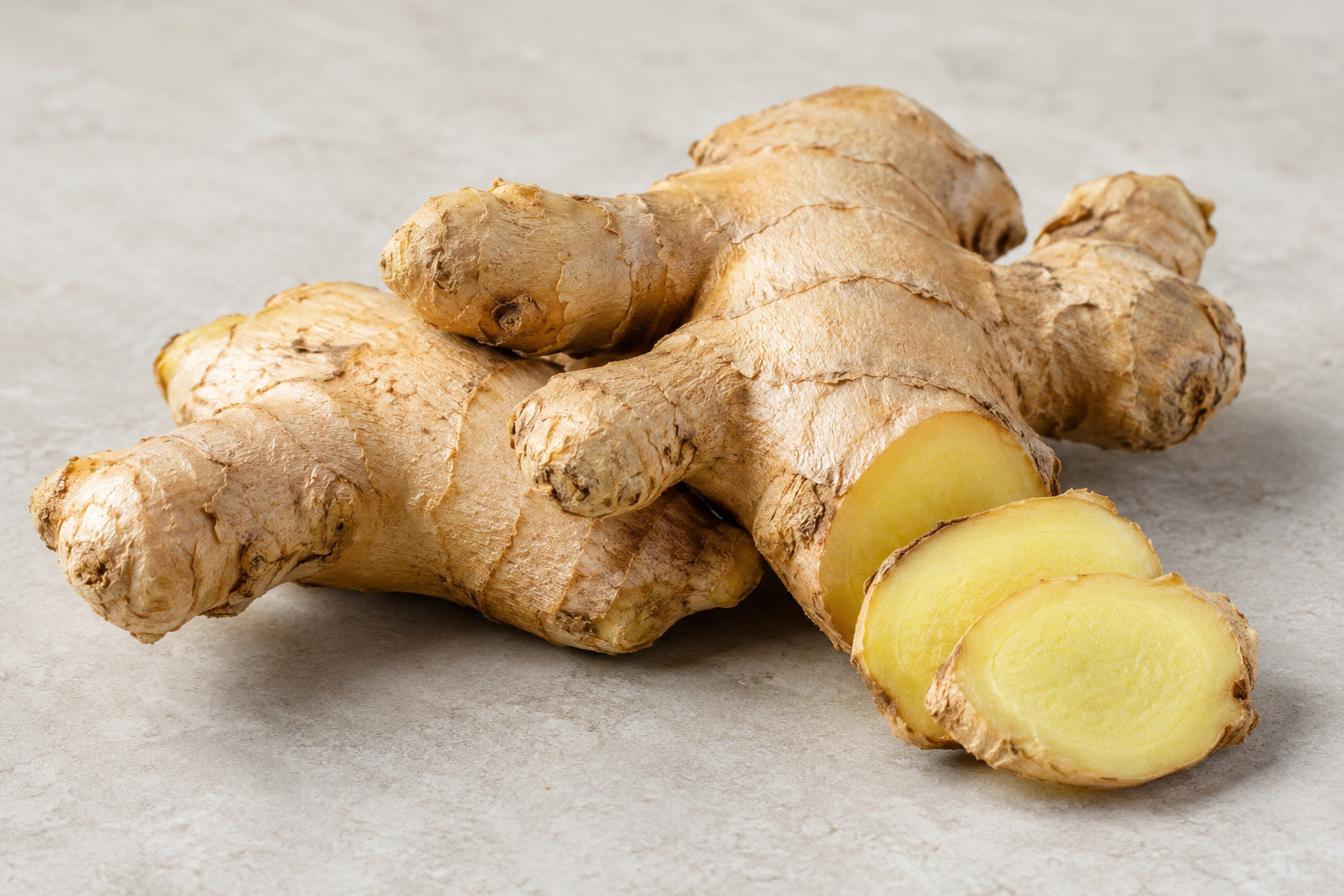
Ginger root: a sensory reference for defining the target flavor profile.
How Should a Ginger Flavoring Profile Be Described Without Vague Sensory Words?
A precise ginger flavoring brief separates volatile aroma, basic tastes, mouthfeel, and trigeminal heat. It never compresses them into “spicy,” “strong,” or “natural.” Ginger can smell lemony and green yet deliver little burn. It can also smell muted while producing a long throat heat. Those are different formulation problems.
Start by naming the reference. Freshly cut Zingiber officinale suggests a bright citrus opening, moist root, green peel, mild floral lift, and a fast clean bite. Dried ginger shifts toward warmer, woodier, earthier notes and a drier, longer heat. Cooked ginger can add sweet-spice and rounded zingerone character. Ginger ale, ginger beer, gingerbread, pickled ginger, tea, and savory ginger paste are therefore different briefs, not interchangeable synonyms.
| Sensory Layer | Useful Ginger Directions | Technical Meaning | Failure Signal |
|---|---|---|---|
| Top Note | Fresh Cut Root, Lemon Peel, Citral, Green Peel, Light Floral, Cool Eucalyptus | Defines lift during the first smell and first bite | Too high reads as lemon cleaner, mint, or perfume |
| Middle Note | Zingiberene, β-Sesquiphellandrene, ar-Curcumene, Juicy Rhizome, Peppery Warmth | Carries recognizable ginger identity after the citrus flash | Too weak becomes generic citrus spice |
| Base Note | Woody Root, Balsamic Sweetness, Dry Earth, Cooked Spice, Camphor Trace | Controls depth, persistence, and mature or dried character | Too high becomes dusty, musty, medicinal, or soapy |
| Taste Structure | Sweet, Sour, Slight Bitter, Salty Or Umami Support | Places ginger in beverage, confectionery, bakery, dairy, or savory space | Excess sugar makes candy; excess bitterness makes tonic or peel |
| Heat Curve | Lip Tingle, Tongue Heat, Throat Catch, Peak Burn, Afterburn | Separates aroma from TRPV1-active chemesthesis over time | A late harsh burn can remain after aroma has disappeared |
Gingerols, shogaols, and zingerone help explain why the heat curve changes. Fresh ginger is associated strongly with gingerols. Drying and heating can increase the relative importance of shogaols, which are more pungent than gingerols in sensory threshold work. Prolonged cooking can move the impression toward sweeter, softer zingerone character. The volatile side behaves differently: citral components support lemony lift; α-terpineol adds a lemon-floral direction; β-sesquiphellandrene and ar-curcumene reinforce ginger identity; nerolidol can push the base toward woody or soapy.
The brief should specify an aroma target. Record four heat moments: 0–2 seconds for onset, 3–10 seconds for peak, 11–30 seconds for throat development, and 30–60 seconds for afterburn. A “fresh ginger” target usually needs fast citrus-root impact and a clean decline. A dried or ginger-beer direction may accept a stronger, longer afterburn. A bakery direction often favors warm cooked spice over a raw nasal attack.
This profile page does not redefine labeling categories. The separate guide to United States natural and artificial flavor terminology owns that intent. For broad category navigation, use Flavor Concentrates for Food Manufacturing.
How Do Water, Fat, Protein, Sugar, Salt, Acid, and Serving Temperature Change Ginger Perception?
Water, fat, protein, sugar, salt, acid, and serving temperature change ginger by altering aroma partitioning, binding, viscosity, taste balance, and heat delivery. A sample can win in sweetened water. The same code and dose can fail in protein, fat, low pH, or a frozen product.
| Matrix Variable | Likely Ginger Shift | Controlled Test |
|---|---|---|
| Water Phase | Exposes volatile Citrus Lift quickly; an Oil-Soluble fraction may haze, ring, or separate | Use production water and record clarity after mixing and storage |
| Fat Phase | Retains hydrophobic terpenes, delays release, rounds the opening, and can lengthen mouth coating | Test the actual fat type, percentage, emulsion, and serving temperature |
| Protein | Binds some aroma compounds; dairy and plant proteins can mute the top or add Beany, Sulfurous, or Earthy competition | Compare the finished protein base, not a protein-free model |
| Sugar And Solids | Softens bitterness and burn, increases body, and can shift fresh root toward Ginger Candy or Syrup | Hold °Brix, sweetener type, and viscosity constant |
| Salt | Can increase volatile release through salting-out and makes root warmth more coherent in savory systems | Hold sodium, potassium salts, and umami ingredients constant |
| Acid And pH | Raises perceived brightness and attack; low pH can expose harsh citrus or challenge an emulsion | Match acid species, target pH, titratable acidity, and buffer system |
| Serving Temperature | Cold suppresses volatility and sweetness; warmth increases aroma release and exposes Woody, Balsamic, or Medicinal notes | Evaluate at the real consumption temperature, not only at 20°C |
The matrix decides. Name it before naming the preferred sample. Carbonated water needs clarity, acid balance, and controlled throat heat. A protein shake needs top-note reinforcement and earthy-note control. Ice cream needs evaluation below freezing and again during melt. A fat-rich filling needs an oil-compatible route and a heat check. The powder and liquid food flavor guide provides the broader handling comparison; the ginger decision remains tied to its own aroma and burn targets.
Which Liquid, Emulsion, and Powder Ginger Formats Should a Formulator Test?
A complete ginger format screen covers nine named delivery families. Liquid is not a solubility grade, and powder does not identify the carrier or release system. Choose candidates by phase, clarity, process, handling, and release requirement, then compare them in the finished base.
| Format Option | Best First Test | Ginger-Specific Advantage | Main Risk To Diagnose |
|---|---|---|---|
| Aqueous liquid concentrate | Syrup, sauce, filling, general wet formula | Easy bench adjustment and broad profile construction | Strength, sugar, Gum Acacia, or solids may not fit a clear drink |
| Water-soluble liquid extract | Clear still or carbonated beverage | Fast Citrus-Root opening with simple tank dosing | “Water-soluble” still requires a clarity and ring check |
| Water-dispersible / cloudy liquid extract | Juice drink, cloudy soda, kombucha, syrup | Carries Ginger Oil character where slight haze is acceptable | Sediment, oil ring, or package separation |
| Oil-soluble liquid extract | Chocolate, fat filling, seasoning oil, dressing | Places volatile ginger notes directly in the fat phase | Direct addition to water causes poor dispersion |
| Water-based high-heat emulsion | Bakery, gummy, hard candy, cloudy heat-processed base | Supports water-phase dosing and stronger process retention | Opacity, emulsion break, carrier interaction |
| Water-soluble flavor powder | Instant drink, protein powder, dry premix | Dry handling with reconstitution designed into the product | Caking, dust, color, incomplete dissolution |
| Spray-dried powder | Seasoning, bakery premix, powdered beverage | Carrier can protect aroma and simplify dry blending | Drying can alter top notes and the gingerol-shogaol balance |
| Plated powder | Dry seasoning and low-moisture blend | Deposits liquid flavor onto a solid carrier for easy blending | Segregation, carrier load, weaker storage protection |
| Encapsulated powder | Heat, storage, or controlled-release challenge | Delays release and limits interaction with the base | Release may occur too late or remain incomplete |
For a standard-strength food flavor with no lower product-specific range, screen 0.10%, 0.25%, 0.50%, and 1.00% w/w. Use 1.00% w/w (10 g/kg) as the high-end reference benchmark. Do not apply that ladder to a beverage super-concentrate labeled for 0.01–0.02% or 0.10–0.30%. Compare such candidates at equivalent low, middle, and high positions within their own supplier windows.
Ginger root powder is not the same as a ginger flavor powder. Milled root adds fiber, color, insoluble solids, sediment, earthy or woody notes, and its own ingredient-declaration consequences. Ginger essential oil emphasizes volatile aroma but carries little of the nonvolatile pungent system. Ginger oleoresin contains volatile oil plus concentrated pungent principles and is usually oil-soluble or only partly water-compatible. A constructed flavor can balance aroma and heat independently.
Use the approved food flavor formulation support route when the first format misses the target after one-variable trials. Changing carrier, solubility, or release technology often fixes more than adding another dose step.
Which Processing and Storage Conditions Make Ginger Taste Cooked, Woody, Earthy, or Flat?
Several mechanisms make ginger cooked, woody, earthy, or flat. Volatile loss, thermal conversion, oxidation, phase separation, package interaction, and the addition point can shift the balance between aroma and heat. A “heat-stable” catalog label is only a screening cue. The real process must decide.
| Condition | Ginger Failure Mode | Better Trial Design |
|---|---|---|
| Pasteurization Or Hot Fill | Citrus and Green Root top notes flash off before the burn declines | Compare pre-heat and post-heat addition where the process permits |
| Baking Or Extrusion | Warm Shogaol and Cooked Spice can dominate while fresh volatiles fall | Test protected powder, emulsion, and late surface application |
| Spray Drying | Carrier and inlet history change aroma retention, powder flow, and pungent-compound balance | Compare carrier, moisture, reconstitution, and finished-food release |
| High Shear Or Homogenization | Droplet size and protein interface change release; a weak emulsion may break | Fix shear rate, time, temperature, and order of addition |
| Oxygen And Headspace | Terpenic freshness fades toward stale, woody, resinous, or soapy notes | Minimize headspace and compare oxygen-barrier packaging |
| Light Exposure | Clear packs accelerate visible and aromatic change in light-sensitive systems | Run matched light-protected and retail-light package samples |
| Polymer Packaging | Lipophilic notes can absorb into seals or package walls | Test the commercial package, closure, and contact time |
| Storage Temperature | Warm storage accelerates aroma loss and physical instability; cold can change emulsion or powder behavior | Evaluate unopened and opened conditions stated for the item |
Evaluate immediately after processing. Repeat after 24 hours and at planned retention points in the commercial package. Keep a control from the same batch. Record peak temperature, hold time, cooling time, shear, addition point, fill temperature, headspace, package resin, closure, and storage. Without that record, a “flat” sample cannot be traced to chemistry, processing, or the wrong delivery system.
How Should Buyers Compare Ginger Samples in the Real Application Base?
Buyers should compare ginger samples with coded, randomized trials in one master application base, using product-specific dose windows and separate scores for aroma, heat timing, afterburn, physical behavior, and overall fit. Bottle sniffing is insufficient. Equal-percentage tasting also confounds potency with quality.
- Lock One Master Base. Fix Water, Fat, Protein, Sugar, Salt, Acid, pH, °Brix, viscosity, color, and all masking ingredients. Prepare enough for the complete comparison.
- Build Three References. Include a Blank Control, the current product or market benchmark, and the written Ginger Target. Give every candidate a three-digit code; retain SKU, lot, carrier, format, and dose in the lab record.
- Set Fair Dose Positions. Use the supplier's low, middle, and high window for concentrated items. If no lower window applies to a standard food flavor, test 0.10%, 0.25%, 0.50%, and the 1.00% w/w high-end reference benchmark.
- Run The Real Process. Apply the actual mixing order, shear, temperature, hold, cooling, carbonation, freezing, baking, or extrusion conditions. Use the intended package.
- Evaluate The Heat Timeline. Score onset at 0–2 seconds, peak at 3–10 seconds, throat development at 11–30 seconds, and afterburn at 30–60 seconds. Serve at the real consumption temperature.
- Retest Before Selection. Review Time Zero, post-process, 24-hour equilibrium, and defined package-retention samples. Repeat finalists from a second preparation before issuing the RFQ.
Taste it blind. Record the burn.
Repeat the read.
| Attribute | 0 Anchor | 5 Anchor | 10 Anchor |
|---|---|---|---|
| Citrus-Fresh Opening | Absent | Clear But Balanced | Dominant Lemon Or Green Flash |
| Ginger Root Identity | Generic Spice | Recognizable Rhizome | Dense, Unmistakable Root Core |
| Heat Onset | None | Target Timing | Immediate Aggressive Sting |
| Peak Heat | Flat | Application Target | Painful Or Distracting Burn |
| Afterburn | Disappears Early | Clean Target Length | Harsh Throat Persistence |
| Woody-Earthy Base | Absent | Supportive Depth | Dusty, Musty, Or Muddy |
| Medicinal-Soapy Note | Clean | Noticeable | Reject-Level Camphor Or Soap |
| Physical Fit | Separation | Minor Acceptable Haze | Fully Stable For The Target |
| Overall Application Fit | Reject | Needs One Revision | Ready For Pilot Confirmation |
Raw strength is not the decision. Advance the candidate that matches the target, survives processing, remains physically acceptable, and delivers the required heat curve at the lowest effective dose. Buyers can request ginger flavor samples with the complete application brief after fixing the base and scoring rules.
How Can a Ginger Trial That Is Too Hot, Too Earthy, Too Weak, or Physically Unstable Be Corrected?
Fix one variable at a time. Raising or lowering total dose blindly cannot diagnose a failed ginger trial. Aroma identity, heat intensity, heat timing, format, and matrix compatibility can move independently.
| Observed Symptom | Likely Cause | One-Variable Corrective Trial |
|---|---|---|
| Strong Burn, Weak Ginger Aroma | Oleoresin or pungent fraction dominates | Hold heat constant and add a Fresh Citrus-Root top-note route |
| Lemon Cleaner, Little Root | Citral top is too high relative to Ginger Core | Reduce citrus lift or raise Zingiberene-style middle body |
| Earthy Or Muddy Protein Base | Root powder, plant protein, or heavy base note compounds the matrix | Compare a clarified liquid and reduce the Earthy Base direction |
| Woody, Soapy, Or Medicinal | Oxidation, Nerolidol, Camphor, or eucalyptus direction is excessive | Test a fresher top/middle profile in protected packaging |
| Flat After Heating | Volatile loss or early addition | Compare late addition, emulsion, and Encapsulated Powder routes |
| Oil Ring Or Haze | Oil-soluble or merely dispersible material entered a clear water phase | Replace it with a verified Water-Soluble Liquid Extract |
| Candy-Like Ginger | Sugar, sweet-spice, or zingerone direction dominates | Lower Sweet Cooked notes and restore Green Root plus controlled acid |
| Long Harsh Throat Catch | Shogaol-heavy heat or dose exceeds the target | Reduce pungent fraction while holding aromatic body constant |
Write supplier feedback as a directional instruction: “retain 3–10 second peak heat, reduce 30–60 second throat burn, increase fresh-cut root, and keep the beverage clear after 24 hours.” “Too strong” wastes a revision because it does not say which system failed.
Which Supplier Facts, Documents, and United States Market Details Belong in a Ginger Flavoring RFQ?
A complete ginger flavoring RFQ connects the sensory target to formula, process, format, destination market, item documents, commercial terms, and change control. One item code must follow the product. It belongs on the sample label, Specification or TDS, lot COA, SDS, quotation, and purchase order.
Flavor sample library in the LULIN laboratory
| RFQ Block | Buyer Input | Supplier Return |
|---|---|---|
| Ginger Sensory Target | Top, Middle, Base, Taste Structure, 0–60 Second Heat Curve, reference product | Item codes and concise profile differences |
| Formula And Matrix | Water, Fat, Protein, Sugar, Salt, Acid, pH, °Brix, viscosity, color | Compatibility, carrier, solubility, clarity, and use guidance |
| Process And Package | Addition Point, peak temperature, hold, shear, cooling, fill, package resin, storage | Process-fit format, test limits, shelf-life and storage instructions |
| Format And Appearance | One or more of the Nine Format Options; clear, cloudy, opaque, or sediment tolerance | Physical form, carrier, solvent, alcohol, density, dispersibility, color |
| Market And Label | Destination countries, Natural, Artificial, Organic, Halal, Kosher, Vegan, Non-GMO, allergen needs | Item-specific classification, ingredient guidance, and applicable certificates |
| Technical File | Customer specification and risk limits | TDS, SDS, lot COA, allergen statement, carrier/solvent declaration, microbiological and chemical criteria |
| Supply And Cost | Sample quantity, pilot quantity, annual forecast, target delivery, Incoterm | MOQ, pack size, price tiers, stock status, sample time, production lead time |
| Governance | Approved item, facility, revision, and notification period | Lot traceability, complaint route, retest policy, and change-notification terms |
For United States projects, 21 CFR 101.22 distinguishes natural flavor, artificial flavor, spice, bulk flavor labeling, and characterizing-flavor statements. Ground ginger can require its common or usual name rather than being treated as a flavor preparation. Imported ingredients also belong in the importer's Foreign Supplier Verification Program review. Alcoholic beverage projects should request the Flavor Ingredient Data Sheet, flavor alcohol content, limited ingredients, and label-affecting materials needed for TTB review.
The food flavor compliance document request guide separates the roles of Specification/TDS, COA, SDS, allergen, carrier, regulatory, and certification files. Match each file to the selected code, manufacturing site, issue date, and destination. A company-wide certificate does not replace a lot COA or the exact item's composition statement.
LULIN FLAVOR, the food flavor manufacturer, is the public English brand of QUANZHOU LVLIN BIOENGINEERING CO., LTD., established in 2001 in Quanzhou, Fujian. More than 12 flavor engineers with over 20 years of development and application experience support three modernized production lines, more than 50 employees, and over 8,000 m² of building area. ISO 22000 and HACCP systems support production control and traceability.
LULIN FLAVOR prepares application samples in 3–5 business days. Powder-flavor MOQ starts at 20 kg, liquid-flavor MOQ starts at 25 kg, and standard production is scheduled in 10–15 business days after formula and sample approval. The selected ginger item can be supplied with Specification/TDS, SDS, lot COA, carrier and solvent information, allergen statement, natural or artificial status, storage and shelf-life guidance, applicable certificates, and destination-market documents.
Frequently Asked Questions About Ginger Flavoring
What is natural ginger flavor in a United States ingredient context?
Natural ginger flavor is a flavoring preparation whose flavor constituents meet the natural-source and flavoring-function definition in 21 CFR 101.22. The word “natural” describes regulatory source and function, not freshness, nutritional value, sensory accuracy, solubility, or heat strength. Review the exact item and finished-food label together.
What is artificial ginger flavor?
Artificial ginger flavor uses flavoring substances that fall outside the natural-source definition in 21 CFR 101.22 while building a ginger-like sensory profile. It can be designed for citrus lift, root body, cooked sweetness, or controlled heat. Artificial classification alone does not determine quality, allergen status, vegan suitability, or process performance.
Does ginger root powder have an earthy flavor?
Yes, ginger root powder can add earthy, woody, dry, fibrous, and warm-spice notes alongside pungency. Cultivar, maturity, drying, storage, particle size, and the application matrix change the balance. Root powder also adds solids and color, so it should not be treated as a drop-in substitute for spray-dried ginger flavor.
Which ginger flavor format works best in a clear beverage?
A verified Water-Soluble Liquid Extract is the strongest first candidate for a clear beverage, but the finished formula must still pass haze, oil-ring, sediment, carbonation, acid, and storage checks. A Water-Dispersible / Cloudy Liquid Extract can taste excellent while remaining physically wrong for a transparent product.
Why does a ginger beverage lose freshness after pasteurization?
A ginger beverage can lose freshness because volatile Citral, Green Root, and Floral top notes escape or change during heating, filling, and cooling. Compare pre-process and post-process aroma, then test a later addition point, protected format, or revised top-note balance while keeping pH, heat history, and package constant.
How can ginger heat be reduced without losing ginger identity?
Reduce the pungent fraction or late afterburn while holding the Citrus-Root opening and Ginger Core constant. Lowering the entire flavor can erase identity before it fixes throat heat. A controlled trial should score onset, peak, throat development, and afterburn separately, then adjust only the failed time segment.
Can a ginger flavoring sample be judged in plain water?
Plain water can reveal obvious defects, but it cannot qualify a ginger flavoring for a real product. Fat, protein, sugar, salt, acid, viscosity, process, package, and serving temperature alter release and heat perception. Final selection requires the production-intent base, matched processing, coded samples, and package retention.
What is the high-end starting benchmark for ginger flavor sample evaluation?
Use 1.00% w/w, equal to 10 g/kg, as the high-end reference benchmark for a standard-strength food-base screen when no lower product-specific range applies. Beverage super-concentrates must remain inside their supplier-stated window, such as 0.01–0.02% or 0.10–0.30%, because equal absolute dosing would compare potency rather than quality.
What documents should a ginger flavor supplier provide?
A ginger flavor supplier should provide the exact item's Specification or TDS, lot COA, SDS, carrier and solvent declaration, allergen statement, flavor-status or composition statement, shelf life, storage, origin, traceability, change control, and applicable market or certification files. The quotation should add sample scope, pack, MOQ, price, Incoterm, and lead time.
Send LULIN FLAVOR a Ginger Brief That Defines the Aroma and Heat Curve
The next step is a one-page ginger brief. Name the reference style, Top Note, Ginger Core, Base Note, 0–60 second heat curve, real formula, process, package, serving temperature, target market, preferred formats, sample quantity, annual forecast, and document list. Include the product-specific window or the 0.10%, 0.25%, 0.50%, and 1.00% w/w food screen.
LULIN FLAVOR can prepare matched liquid, emulsion, and powder routes for beverage, confectionery, bakery, dairy-style, dry-mix, sauce, and seasoning projects. To begin the sample and commercial review, send LULIN FLAVOR the ginger application brief.
Develop this flavor in your product
Send your product, target market and project goal. We will review the sample direction with you.