Published
Grapefruit Flavoring
Grapefruit flavoring is a formulated aroma-and-taste system that can emphasize peel, juicy flesh, floral lift, green freshness, dry pith, or controlled bitterness. For first trials, use 0.10% w/w liquid or 0.20% w/w powder as reference benchmarks, then evaluate the processed product at 5°C and 20°C before choosing a supplier item.
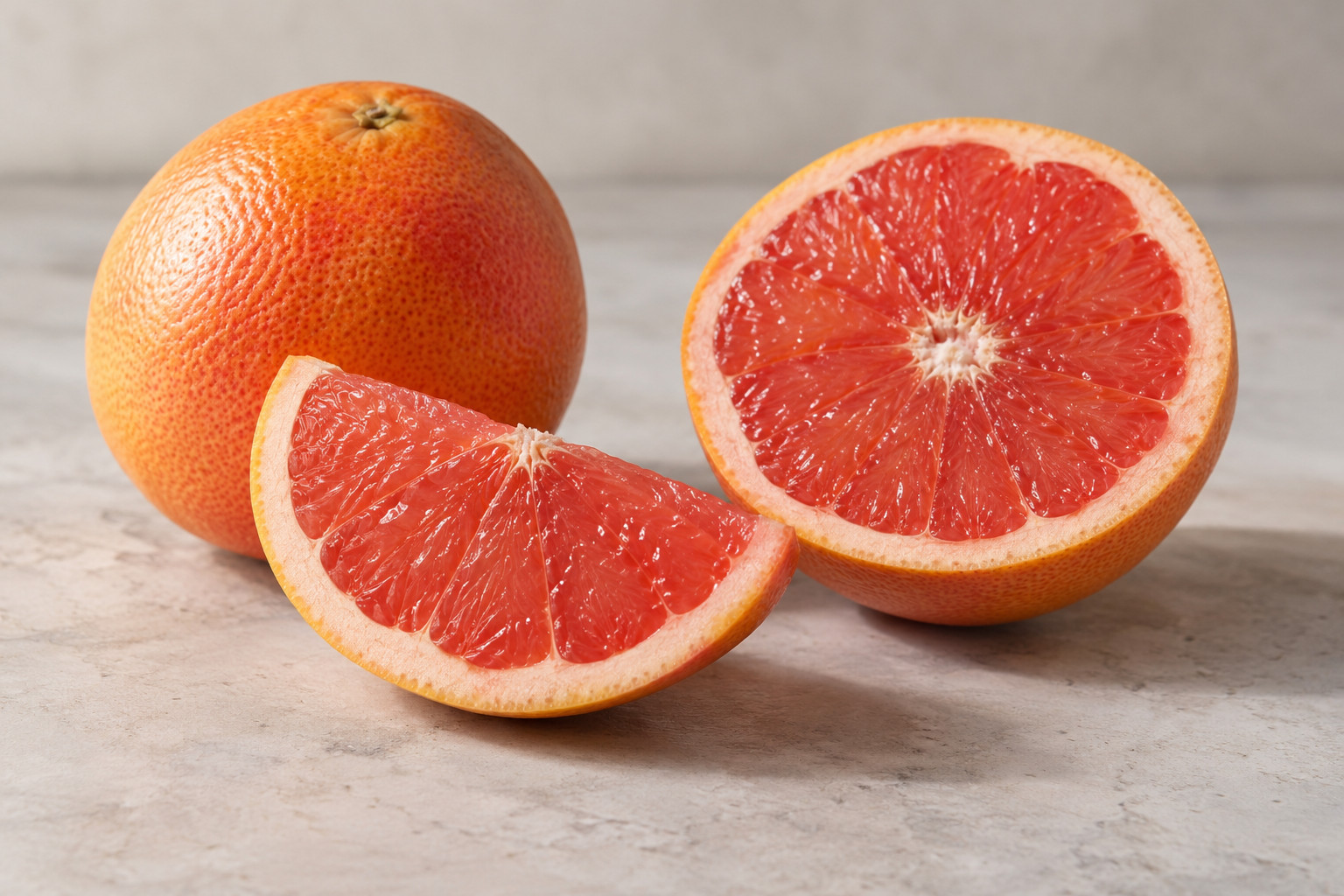
Grapefruit: a sensory reference for defining the target flavor profile.
How should a grapefruit flavor profile be described without vague sensory adjectives?
A useful grapefruit flavor profile specifies fruit direction, note timing, taste balance, finish, matrix, and serving condition. “Fresh, strong, and citrusy” does not tell a flavorist whether the target resembles White Marsh, pink grapefruit, Ruby Red, fresh juice, expressed peel oil, pith, candy, or a dry botanical mixer.
Start with one controlled sentence. For example: “Pink-grapefruit, juice-led profile; green peel lift at 0–2 seconds; tart, juicy flesh at 2–10 seconds; short dry-pith finish at 10–30 seconds; low sulfur, low astringency; evaluated in a clear carbonated base at 5°C.” That sentence identifies the sensory reference and the conditions under which approval will occur.
The brief should state grapefruit's role: named character, bitter-citrus bridge, tea high note, or peel accent. A low-sugar water needs enough flesh and peel to remain recognizable without exposing solvent-like or pithy notes. A sweet gummy can tolerate more acid and bitter contrast.
Grapefruit flavoring is not grapefruit juice, purée, or juice concentrate. Those fruit ingredients contribute water, soluble solids, acids, sugars, color, and other fruit constituents. A flavoring primarily imparts flavor and may use natural flavor, natural and artificial flavor, artificial flavor, WONF, essence, oil, or another source route. The broader U.S. labeling distinction belongs in the B2B guide to artificial flavor; this page focuses on how a grapefruit profile performs in a finished product.
Which grapefruit top, middle, and base notes belong in a buyer brief?
Grapefruit direction should be written as a timed sequence: volatile peel and green notes open the profile, juicy and floral notes form the body, and nootkatone-like peel, woody albedo, pith, bitterness, and astringency determine the finish. The terms top, middle, and base are sensory communication tools, not regulatory categories.
Fresh grapefruit identity does not come from limonene or nootkatone alone. Odor-active studies identify a mixture of fruity esters, aldehydes, green notes, lactones, terpenes, sesquiterpenes, and extremely potent sulfur compounds. Minute thiol impact can make a profile smell freshly cut and juicy; too much can read as sulfury, rubbery, or catty. Naringin- and limonin-like bitterness belongs in the taste and aftertaste brief, not in an aroma list.
| Grapefruit direction | Opening, 0–2 s | Body, 2–10 s | Finish, 10–60 s | Main failure risk | First-fit application |
|---|---|---|---|---|---|
| Peel-bright white | Green zest, aldehydic lift | Lean white flesh, tart citrus | Dry albedo, firm bitterness | Cleaner-like top or long pith | Tonic, tea, botanical mixer |
| Pink juice-led | Fresh peel, low sulfur impact | Juicy pink flesh, mild floral note | Short sweet-tart finish | Generic orange character | Sparkling water, juice drink |
| Ruby Red sweet | Rounded zest | Red-fruit accent, fuller sweetness | Low-to-medium bitterness | Candy sweetness erases identity | Energy drink, gummy, syrup |
| Dry botanical | Terpenic peel, herbal edge | Lean citrus heart | Woody, spicy, controlled bitter tail | Medicinal or oxidized finish | Alcoholic mixer, adult soda |
| Candy grapefruit | Bright citrus flash | Sweet pink center | Clean acid finish, little pith | Lemon-orange candy drift | Hard candy, chew, coating |
| Blending accent | Short peel flash | Limited flesh | Nearly clean exit | Disappears behind dominant fruit | Berry, tropical, tea blends |
This table changes sample selection. A white-grapefruit item may be too dry for a pink sparkling water, while a sweet Ruby Red item may lack the bitter architecture required in an adult mixer. Request named directions, not “the strongest grapefruit.”
The finish deserves a separate acceptance limit. Record bitter onset, peak, and decay at 10, 30, and 60 seconds. Distinguish clean pith from a chemical, soapy, metallic, oxidized, or medicinal aftertaste. If the opening is correct but the 60-second score fails, raising the dose usually makes the defect worse.
How do water, fat, protein, sugar, salt, acid, carbonation, and serving temperature change grapefruit perception?
The finished matrix changes grapefruit aroma release and taste balance enough that a water solution cannot approve a flavor for dairy, protein drinks, gummies, or bakery fillings. Fat and protein can retain hydrophobic citrus volatiles; sugar, acid, salt, viscosity, carbonation, and temperature change both release and cross-modal perception.
| Matrix variable | Practical screen | Expected sensory shift | What to record |
|---|---|---|---|
| Water / dilution | Production strength and one dilution step above and below | Lower solids expose thin peel, sulfur, solvent, and bitterness | Formula mass, water source, dilution ratio |
| Fat | 0%, 3%, 10% | Rounds acid and bitterness but can retain limonene-rich peel notes | Fat type, fat %, emulsion state |
| Protein | 0%, 2%, 8% | Can suppress hydrophobic citrus lift and delay release; effects vary by volatile | Protein source, %, hydration time |
| Sugar | 5, 8, 10, 12, 15 °Brix or the commercial ladder | Raises sweetness and often reduces perceived sourness, bitterness, astringency, and grapefruit intensity | °Brix, sweetener system, aftertaste |
| Salt | 0%, 0.05%, 0.15% salt equivalent | May soften bitter taste at low levels; mineral salts can add metallic or saline notes | Sodium and mineral source, total level |
| Acid | pH 3.0, 3.5, 4.0, 4.5, 5.0 plus titratable acidity | Sharpens attack and can expose pith; acid species and total acid affect volatile release differently from pH alone | pH to 0.1, acid type, titratable acidity |
| Carbonation | Still, 2.5, 3.5 volumes CO2 | Lifts aroma and acid attack but can make bitterness and nasal sting more obvious | CO2 volume, fill pressure, equilibration |
| Temperature | 5°C and 20°C; process-hot where relevant | Cold suppresses aroma release; warmth increases headspace impact and accelerates loss or oxidation | Core temperature, hold time, serving vessel |
Carbonation adds another release event. A candidate that appears restrained in a still bench sample may become sharp after 24 hours of CO2 equilibration. Evaluate carbonated samples at the intended gas volume and package pressure, not immediately after hand mixing.
A compact screening design keeps those variables visible without claiming to be a universal standard. The 18 runs below are an editorial application screen; replace the sugar, fat, protein, and salt levels with the real commercial formula before approval.
| Run | Flavor | Fat | Protein | Sugar | Salt | Serve | Storage check |
|---|---|---|---|---|---|---|---|
| 1 | 0.02% | 0% | 0% | 5% | 0% | 5°C | 0 days |
| 2 | 0.05% | 0% | 0% | 8% | 0.05% | 20°C | 14 days |
| 3 | 0.10% | 0% | 0% | 10% | 0.15% | 5°C | 28 days |
| 4 | 0.20% | 0% | 2% | 12% | 0% | 20°C | 56 days |
| 5 | 0.30% | 0% | 8% | 15% | 0.05% | 5°C | 0 days |
| 6 | 0.02% | 3% | 0% | 5% | 0.15% | 20°C | 14 days |
| 7 | 0.05% | 3% | 2% | 8% | 0% | 5°C | 28 days |
| 8 | 0.10% | 3% | 8% | 10% | 0.05% | 20°C | 56 days |
| 9 | 0.20% | 3% | 0% | 12% | 0.15% | 5°C | 0 days |
| 10 | 0.30% | 3% | 2% | 15% | 0% | 20°C | 14 days |
| 11 | 0.02% | 10% | 8% | 5% | 0.05% | 5°C | 28 days |
| 12 | 0.05% | 10% | 0% | 8% | 0.15% | 20°C | 56 days |
| 13 | 0.10% | 10% | 2% | 10% | 0% | 5°C | 0 days |
| 14 | 0.20% | 10% | 8% | 12% | 0.05% | 20°C | 14 days |
| 15 | 0.30% | 10% | 0% | 15% | 0.15% | 5°C | 28 days |
| 16 | 0.05% | 0% | 2% | 5% | 0% | 20°C | 56 days |
| 17 | 0.10% | 3% | 8% | 8% | 0.05% | 5°C | 14 days |
| 18 | 0.20% | 10% | 2% | 12% | 0.15% | 20°C | 28 days |
Do not treat every row as a production formula. Use the matrix to isolate the variable responsible for peel loss, bitter growth, or delayed release. Dose alone cannot fix it. Keep conditions fixed. Judge the finish.
Which grapefruit flavor format fits clear water, cloudy drinks, dairy, bakery, and dry mixes?
Format should follow the continuous phase, clarity target, processing route, dosing equipment, and desired release point. “Liquid” does not automatically mean water-soluble, and “powder” does not establish instant dissolution, heat resistance, or a fruit-juice composition.

Flavor sample library in the LULIN laboratory
| Complete format option | Best fit | Main advantage | Failure screen |
|---|---|---|---|
| Water-soluble liquid | Clear water, tea, syrup, some RTD beverages | Easy bench dosing and rapid distribution in the water phase | Haze, ring, precipitation, top-note loss |
| Oil-soluble liquid | Fat fillings, chocolate-style systems, oil coatings | Carries peel-oil character into a lipid phase | Separation or surface oil in water systems |
| Oil-in-water emulsion | Cloudy soda, juice-style drink, dairy-style beverage | Delivers oil-phase citrus notes with designed cloud | Creaming, ring formation, droplet growth, opacity mismatch |
| Spray-dried powder | Dry beverage mix, seasoning, tablet, powdered food | Dry handling and controlled carrier system | Caking, dust, incomplete dispersion, aroma loss during drying |
| Encapsulated powder | Bakery, confectionery, staged-release or oxidation-sensitive systems | Adds a barrier around volatile material and can shift release later | Delayed or incomplete release, carrier taste, higher cost |
| Grapefruit juice or fruit-solids powder | Products seeking fruit solids, acid, color, or juice-derived positioning | Adds fruit components beyond aroma | Pulp, color, hygroscopicity, sugar/acid load, medication-related composition review |
A clear water begins with a water-soluble liquid; a cloudy beverage can use an oil-in-water emulsion if the cloud survives filling and storage. Oil-soluble liquid belongs in a fat phase. Spray-dried powder favors dry handling, while encapsulated powder emphasizes protection or delayed release. No powder is automatically heat-proof. The powder-versus-liquid flavor guide provides broader handling context.
Why can grapefruit flavoring lose peel lift or gain a bitter aftertaste during processing and storage?
Grapefruit flavoring loses balance when volatile top notes evaporate, oxidize, bind to the matrix, sorb into packaging, or separate from the product while less volatile pith and woody notes remain. The correct fix starts with a before-and-after process comparison rather than an immediate dose increase.
| Condition | Likely sensory failure | Diagnostic comparison | Control to test |
|---|---|---|---|
| Pasteurization, hot fill, UHT | Lower green/peel lift; cooked or heavy finish | Pre-heat vs post-heat at equal dose | Addition point, hold time, closed transfer, protected format |
| Baking or candy cooking | Volatile loss; concentrated acid/pith | Raw mix vs baked/cooled product | Oil-soluble or encapsulated candidate; late addition where feasible |
| High shear / homogenization | Changed cloud, ring, or aroma release | Low-shear vs production shear | Droplet size, stabilizer hydration, mixing order |
| Oxygen and light | Woody, resinous, stale, cardboard, or oxidized citrus | Light/dark and low/high headspace | Barrier pack, headspace control, light protection |
| Freeze-thaw | Emulsion break, sediment, uneven dose | Fresh vs freeze-thaw cycles | Emulsion design, thaw method, remix limits |
| Package contact | Loss of limonene-rich top through scalping | Glass control vs commercial package | Polymer selection, contact area, storage temperature |
| Moisture in powder | Caking, early release, weaker top | Sealed control vs humid exposure | Moisture barrier, desiccation strategy, reseal procedure |
Run the winning candidate at Day 0 and Weeks 2, 4, and 8 in the intended package. A practical development screen uses 4°C, 20°C, and 40°C where the product and package permit; 40°C is an accelerated challenge, not a shelf-life claim. Inspect aroma timing, bitter decay, color, turbidity, ring, sediment, creaming, caking, and package odor. Record headspace and light exposure so the result can be reproduced.
If peel drops while bitterness stays constant, compare a protected delivery form or later addition. If both peel and juice body fall, investigate dose loss, partitioning, and package scalping. If bitterness rises without a measured flavor increase, examine water loss, acid change, sweetener drift, active ingredients, and delayed limonin-like perception before changing the flavor.
Where does grapefruit flavoring need a different application brief?
Each application needs its own grapefruit brief because clarity, sweetness, acid, fat, protein, heat, alcohol, and carbonation determine which notes survive and which defects become visible.
| Application | Preferred first format | Grapefruit target | Critical check |
|---|---|---|---|
| Clear still or sparkling water | Water-soluble liquid | Clean peel, recognizable flesh, short finish | Clarity, cap ring, CO2 lift, 5°C evaluation |
| Energy drink | Water-soluble liquid or emulsion | Ruby/pink body with enough pith to mask actives | Caffeine, vitamins, minerals, acid and sweetener aftertaste |
| Juice drink or tea | Water-soluble liquid / essence | Juice-led middle with controlled peel | Heat, tea tannin, juice solids, color |
| Dairy or protein beverage | Emulsion or compatible liquid | Rounded flesh and peel that survives binding | Protein hydration, fat, homogenization, cold release |
| Gummy or hard candy | Heat-suitable liquid or powder | High-impact citrus with controlled bitter finish | Cook temperature, acid addition, sweetness after cooling |
| Bakery filling or coating | Oil-soluble liquid or encapsulated powder | Peel character that releases after cooling | Bake loss, fat partitioning, storage oxidation |
| Alcoholic mixer or RTD | Solubility-matched liquid or emulsion | Dry botanical peel with a clean late finish | Ethanol level, haze, carbonation, bitterness |
These application choices are narrower than the general flavor-concentrate category. They tell the supplier what grapefruit must do after processing, not merely which catalog family the buyer wants.
How should buyers compare grapefruit flavor samples in the actual application base?
Buyers should compare coded grapefruit samples at fixed doses in the final base, using the intended process, package, carbonation, and serving temperature. A neat aroma strip or water cup can eliminate obvious defects, but it cannot select a production flavor.
Use the following protocol:
- Prepare C0, the unflavored finished base, and C1, the current product or agreed market reference. Keep pH, °Brix, fat, protein, salt, viscosity, active ingredients, color, and processing identical.
- For water-soluble liquid candidates, screen 0.02%, 0.05%, 0.10%, 0.20%, and 0.30% w/w. Use 0.10% w/w as the first reference benchmark. For powder candidates, screen 0.10%, 0.20%, 0.40%, and 0.60% w/w, with 0.20% w/w as the first reference benchmark.
- Make two independent preparations of each finalist. Randomize three-digit codes. Use at least three evaluators who understand the target brief; prevent discussion until individual score sheets are complete.
- Evaluate at 5°C for a cold RTD and at 20°C as a panel reference. Carbonated products should equilibrate in the intended package before opening.
- Score 0–10 at 0–2 seconds, 2–10 seconds, and 10–60 seconds. Use 0 for not perceived, 5 for the project rejection threshold, and 10 for extreme intensity.
| Attribute | 0–2 s | 2–10 s | 10–60 s | Decision use |
|---|---|---|---|---|
| Grapefruit identity | Score | Score | Score | Reject generic lemon/orange drift |
| Peel / zest lift | Score | Score | Score | Confirm opening impact and decay |
| Juicy flesh | Score | Score | Score | Confirm pink, Ruby Red, or white direction |
| Green / floral / sulfur | Score | Score | Score | Control freshness versus off-note |
| Sourness and sweetness | Score | Score | Score | Check balance at actual pH and °Brix |
| Bitterness and astringency | Score | Score | Score | Set pith character and rejection threshold |
| Chemical / soapy / oxidized | Score | Score | Score | Diagnose excess, heat, or storage damage |
| Mouthfeel / finish | Score | Score | Score | Detect thin, drying, coating, or lingering finish |
Record clarity, ring, separation, sediment, foam, and color outside the sensory scale. A sample can win on taste and still fail the package. Process the best two candidates, repeat the coded comparison, then store them in the commercial package. The B2B sample-request route supports this application-led brief, while food flavor formulation support is the appropriate route when matrix or process failures require adjustment.
What should a U.S. grapefruit flavoring RFQ require from the supplier?
A U.S. grapefruit flavoring RFQ should connect the target sensory sequence to the finished matrix, process, label route, composition questions, documents, commercial quantities, and change-control expectations. A one-line request for “natural grapefruit flavor and price” invites samples that cannot be compared.
| RFQ block | Required details |
|---|---|
| Product and serving | Product category, serving size, clear/cloudy target, 5°C or ambient service, reference product |
| Sensory direction | White, pink, or Ruby Red; peel/juice/pith balance; 0–2 s opening, 2–10 s body, 10–60 s finish; prohibited notes |
| Matrix | pH, titratable acidity, °Brix, fat %, protein %, salt/mineral system, alcohol %, CO2 volume, viscosity |
| Process | Addition order, shear/homogenization, peak temperature, hold time, bake/cook, fill, freeze-thaw, package |
| Format and dose | Water-soluble liquid, oil-soluble liquid, oil-in-water emulsion, spray-dried powder, or encapsulated powder; supplier dose and basis |
| Source and label | Natural flavor, natural and artificial flavor, artificial flavor, WONF, essence, peel oil, juice fraction, or reconstituted profile |
| Technical documents | TDS/specification, lot COA, SDS, ingredient/carrier/solvent statement, recommended storage and shelf life |
| Compliance documents | Allergen, GMO, vegan/vegetarian, Halal, Kosher, organic where required, and destination-market review |
| Commercial terms | Sample code and size, MOQ, pack size, sample lead, production lead, annual volume, price basis, Incoterm |
| Supplier controls | Lot traceability, change notification, complaint contact, retained-sample policy, agreed acceptance tests |
For the United States, 21 CFR 101.22 distinguishes natural flavor from artificial flavor by source and function and includes labeling rules for flavors shipped to food manufacturers. The RFQ should state the intended ingredient declaration and characterizing-flavor presentation so the supplier can provide the matching composition and documentation path. The compliance-document request guide helps procurement organize item-specific files.
Medication questions require composition, not guesswork from the product name. Ask whether the candidate contains grapefruit juice, grapefruit essence, peel oil, extract, or another fruit-derived fraction and whether a furanocoumarin statement or analytical result is available for the specific item. FDA consumer guidance explains that grapefruit and grapefruit juice can interact with certain medicines and that effects vary by drug, person, and amount. “Natural” does not prove that an item behaves like juice, and “artificial” alone does not establish the finished product's full composition.
How can LULIN FLAVOR support a grapefruit project from sample to production?
LULIN FLAVOR supports grapefruit projects by connecting the sensory brief, application base, format, process, sample review, and document request before commercial selection. LULIN FLAVOR is the public English brand of QUANZHOU LVLIN BIOENGINEERING CO., LTD., a Quanzhou, Fujian food-flavor manufacturer established in 2001.
The company develops and produces food-grade flavors for beverage, bakery, confectionery, and related applications. Its application laboratory supports profile adjustment and formula discussion, backed by more than 10 engineers with over 20 years of flavor development and application experience, three modern production lines, more than 50 employees, and over 8,000 m² of building area.
For a focused response, send the finished base, pH and °Brix, fat and protein levels, process temperatures, serving condition, target market, preferred format, annual quantity stage, and the timed grapefruit description. Then identify the sample ladder and required files. Review the LULIN FLAVOR manufacturing profile or contact the food flavor project team with the completed brief.
Grapefruit flavoring FAQ
What does grapefruit flavoring taste like in a finished food or beverage?
Grapefruit flavoring can move from green peel and fresh citrus lift into juicy white, pink, or Ruby Red flesh, then finish with dry pith, woody peel, bitterness, or astringency. The final balance depends on the flavor design, dose, matrix, process, package, and serving temperature.
How should buyers describe grapefruit flavoring with top, middle, and base notes?
Describe grapefruit flavoring as a timed sequence: name the peel, green, floral, or sulfur opening at 0–2 seconds; the juicy flesh and acid-sweet body at 2–10 seconds; and the clean, woody, pithy, bitter, or astringent finish at 10–60 seconds.
Is grapefruit flavoring the same as grapefruit juice?
No, grapefruit flavoring is not the same as grapefruit juice. Juice contributes water, soluble solids, sugars, acids, color, and fruit constituents, while a flavoring primarily imparts flavor. A supplier should identify whether a specific flavor contains juice, essence, peel oil, extract, or a reconstituted profile.
Does natural grapefruit flavoring affect medication?
The word “natural” does not determine whether grapefruit flavoring affects medication. The relevant question is whether the specific flavor and finished product contain grapefruit-derived constituents associated with an interaction. Buyers should obtain source and composition information; consumers taking medication should follow the drug label and ask a pharmacist or clinician.
Does artificial grapefruit flavoring affect medication?
Artificial grapefruit flavoring is not automatically equivalent to grapefruit juice, but the category name alone does not describe the complete finished formula. Review every grapefruit-derived ingredient, juice component, extract, essence, or peel fraction in the product and follow medication labeling and professional medical advice.
Which grapefruit flavor format fits clear water, cloudy drinks, dairy, or bakery?
Clear water normally starts with a water-soluble liquid; cloudy drinks can use an oil-in-water emulsion; dairy needs a liquid or emulsion proven in the protein-fat system; and bakery may favor an oil-soluble liquid or encapsulated powder. Every choice still requires process and package testing.
What starting dosage should buyers screen for grapefruit flavoring?
For liquid flavor, screen 0.02%, 0.05%, 0.10%, 0.20%, and 0.30% w/w, using 0.10% as the reference benchmark. For powder, screen 0.10%, 0.20%, 0.40%, and 0.60% w/w, using 0.20% as the reference benchmark. Item instructions and the real base govern final use.
Why does grapefruit flavoring develop a harsh or lingering bitter aftertaste?
A harsh grapefruit aftertaste can come from excessive pith character, high dose, acid-sweet imbalance, active ingredients, water loss, oxidation, top-note loss, or delayed bitterness. Compare the unprocessed and processed base at equal dose, then check pH, °Brix, temperature, package, and the 10–60-second finish.
How should buyers compare grapefruit flavor samples in the actual application base?
Buyers should blind-code candidates, keep the formula and process fixed, make two independent preparations, and use at least three evaluators. Score grapefruit identity, peel, flesh, green/floral/sulfur notes, bitterness, astringency, defects, and finish at 0–2, 2–10, and 10–60 seconds at 5°C and 20°C.
What should a buyer include in a U.S. grapefruit flavoring RFQ?
Include the timed sensory target, application, pH, acidity, °Brix, fat, protein, salt, alcohol, carbonation, process, package, serving temperature, format, dose basis, label route, source fractions, required documents, sample size, MOQ, lead time, annual volume, price basis, destination market, traceability, and change-control requirements.