Published
Hazelnut Flavoring
Hazelnut flavoring is a configurable sensory system, not one generic “nutty” note. A selection defines fresh-kernel, roast, praline, cocoa, coffee, caramel, cream, and finish, then tests liquid, powder, emulsion, oil-soluble, and water-soluble options in the finished product; use 3.0 g/kg (0.30% w/w) as the high first-pass benchmark for comparable concentrated liquids.
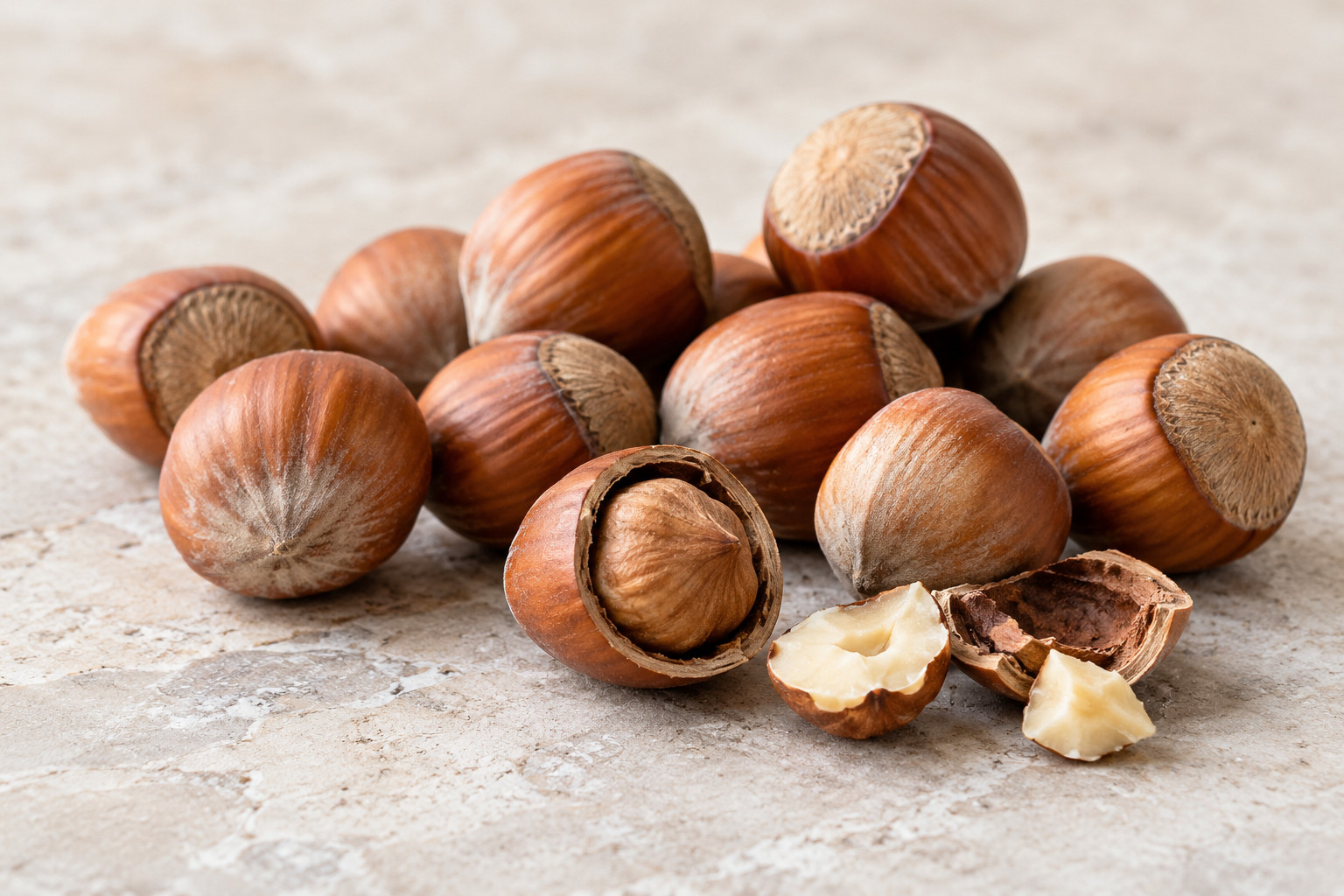
Hazelnuts: a sensory reference for defining the target flavor profile.
What does a precise hazelnut flavor profile include beyond “nutty”?
A precise hazelnut flavor profile identifies roast character, kernel freshness, skin-like dryness, creamy or buttery body, sweet-brown associations, supporting notes, finish, and unwanted directions instead of relying on “nutty” alone.
Words such as rich, authentic, natural, and roasted do not tell a flavorist what to build: “roasted” can mean light toasted kernel, dark coffee-like roast, or a nearly burnt edge, while “creamy” can mean milk fat, vanilla softness, or buttery aroma.
Convert the target into controlled axes. Give each axis a low anchor, a high anchor, and a rejection point. A 0–10 scale is enough for early screening when the anchors are written before tasting.
| Sensory axis | 0 anchor | 10 anchor | Rejection signal |
|---|---|---|---|
| Roast | 0%: fresh raw kernel | 100%: dark toasted kernel | Burnt grain or ash |
| Sweet-brown character | 0%: dry nut | 100%: praline and caramelized sugar | Generic candy sweetness |
| Skin character | 0%: clean blanched kernel | 100%: woody, tannic skin | Dry, bitter persistence |
| Cream body | 0%: lean and clean | 100%: milky, buttery, rounded | Waxy or oily coating |
| Supporting profile | 0%: hazelnut alone | 100%: cocoa, coffee, or vanilla support | Supporting note replaces hazelnut |
| Finish | 0%: short and clean | 100%: long roasted-nut finish | Solvent, stale, or harsh tail |
Profile is separate from concentration and delivery form; a buyer can source flavor concentrates for food manufacturing yet receive the wrong direction, so the RFQ should name a reference and reject peanut, almond, generic brown sugar, burnt coffee, raw bean, or rancid oil.
Which top, middle, and base notes should a hazelnut flavor brief specify?
A hazelnut flavor brief should use top notes for the first aromatic impression, middle notes for recognizable kernel and roast identity, and base notes for praline, cream, cocoa, vanilla, caramel, woody skin, and persistence.

Flavor sample library in the LULIN laboratory
Top, middle, and base form an operational timing model: first impression, recognizable bite or sip, and finish.
| Stage | Useful hazelnut directions | Application role | Typical failure |
|---|---|---|---|
| Top | Bright fruity-nutty, fresh kernel, faint green, restrained floral | Opens light coffee, flavored water, and clean dairy concepts | Alcohol flash, raw bean, or sharp candy note |
| Middle | Roasted kernel, toasted skin, malty, popcorn-like, coffee-compatible | Establishes hazelnut identity in bakery, coffee, creamers, and confectionery | Peanut-like substitution, burnt grain, or flat brown sweetness |
| Base | Creamy-fatty, buttery, praline, cocoa, caramelized sugar, vanilla | Gives body and finish to fillings, chocolate, frozen desserts, and premixes | Waxy oil, vanilla dominance, ashy bitterness, or stale cardboard |
Hazelnut aroma is built from multiple signals. The 2022 Corylus avellana aroma review identifies Filbertone, 3-methyl-4-heptanone, pyrrolines, pyrazines, 3-methylbutanal, 2,3-butanedione, 2,3-pentanedione, and furaneol among relevant odorants in raw or roasted nuts. Those names are useful sensory anchors; they do not disclose the formula of a commercial flavor.
A coffee brief may request roasted-kernel lift, a coffee-compatible middle, restrained praline, and a clean 60°C finish. Wafer cream needs more toasted skin and cocoa support; pea or soy protein needs a stronger middle.
Natural or artificial classification does not define that note stack. Coffee may be naturally flavored, artificially flavored, or both, depending on formula and market. The guide to how artificial flavor is defined for food labels covers terminology; classification, hazelnut-derived protein, and sensory direction remain separate specifications.
How do water, fat, protein, sugar, salt, acid, and serving temperature change hazelnut perception?
Water, fat, protein, sugar, salt, acid, and serving temperature change hazelnut aroma release, roast balance, sweetness association, body, bitterness, and finish, so a sample decision must be made in the intended product matrix.
The same concentrate can smell strong in water and seem muted in a 3% fat creamer. It can read as praline in a sweet filling, dry and woody in an unsweetened protein drink, or sharper after acidification. These are not contradictions. Aroma compounds partition, bind, diffuse, and reach the headspace differently as the formula changes.
For a one-variable diagnostic, the control points below are an internal challenge set; the commercial formula remains the approval base.
| Matrix variable | Likely perceptual shift | Illustrative control points | Controlled question | Common misdiagnosis |
|---|---|---|---|---|
| Water | Fast opening, limited body after dilution | 1,000 g base; 0.10%, 0.20%, 0.30% liquid screen | Does the middle retain clear kernel identity at final dilution? | A strong water sniff is treated as finished-product proof |
| Fat | Slower release, rounder roast, longer finish | 0%, 3%, 10% fat | Does the flavor open at the actual fat type, level, and temperature? | A cold fatty sample is called weak |
| Protein | Compound-specific binding; possible masking by dairy, soy, oat, or pea notes | 0%, 3%, 8% protein | Does hazelnut remain distinct beside the selected protein after heat? | Base aftertaste is blamed on the flavor |
| Sugar | Stronger praline/caramel association; viscosity can slow top notes | 0%, 6%, 12% sucrose | Does fixed sweetness obscure roast and skin definition? | Sweetness is mistaken for flavor strength |
| Salt | Changed contrast, bitterness, and volatile partitioning | 0%, 0.10%, 0.30% salt | Does the final sodium level clean the roast or push it savory? | A formula effect is treated as a profile defect |
| Acid/pH | Sharper opening, weaker cream association, altered protein/emulsion behavior | pH 3.2, pH 4.2, pH 6.8 | Does the profile remain coherent at finished pH? | Acid brightness is called fresh-kernel character |
| Temperature | Faster release when warm; slower opening when cold or frozen | 5°C, 22°C, 60°C | What is perceived at the real consumption temperature? | A 22°C bench result is applied to a 5°C or 60°C product |
A peer-reviewed review of beverage flavor retention and release treats composition, temperature, and pH as coupled variables. Fat often retains lipophilic volatiles, protein can bind aroma compounds, and sugar or salt can alter release. Effects remain compound-specific.
Evaluate RTD creamer at finished fat, protein, sweetness, pH, and 5°C. Evaluate bakery filling after cooling to 22°C. Hot coffee needs its intended condition plus a 60°C challenge; research across 31–62°C found temperature-dependent changes in release and attribute balance.
Hold the formula constant during flavor comparison. If sugar, salt, protein, or acid changes between samples, the panel is comparing two products rather than two flavors.
Test both conditions. Record the difference.
Which hazelnut flavor format should a manufacturer test: liquid, powder, emulsion, water-soluble, or oil-soluble?
A manufacturer should choose hazelnut flavor format by phase compatibility, point of addition, process, dosing method, appearance, storage, and factory handling rather than assuming liquid or powder indicates quality.
The complete commercial vocabulary includes liquid, powder, emulsion, oil-soluble, and water-soluble. These terms overlap. Liquid, powder, and emulsion describe physical form; oil-soluble and water-soluble describe phase compatibility. A liquid can be water-soluble or oil-soluble, and a spray-dried powder can disperse into water after reconstitution.
| First-round route | Best first applications | Example challenge | What to measure | Frequent failure mode |
|---|---|---|---|---|
| Water-soluble liquid | Brewed coffee, RTD coffee, syrup, milk beverage, plant beverage | 5°C and 60°C; 24 h equilibration | Dispersion, clarity, carrier impact, post-heat identity | Haze, ring, solvent flash, protein masking |
| Oil-soluble liquid | Chocolate, cocoa coating, fat filling, spread, seasoning oil | 45°C addition; 22°C tasting | Distribution through fat, oxidation, release during eating | Poor transfer into an aqueous phase; delayed or uneven release |
| Water-based emulsion | Cake, cookie, muffin, frosting, cloudy drink, composite creamer | 5°C and 60°C; 7 days | Droplet stability, opacity, pH behavior, bake result | Ringing, separation, settling, unwanted color or cloud |
| Spray-dried water-soluble powder | Instant coffee, protein powder, bakery premix, dry blend | 25°C, 65% RH; 30 days | Flow, dust, caking, wetting, carrier taste, reconstituted release | Moisture pickup, uneven dosing, incomplete wetting, weak top notes |
This four-route screen covers five market terms without double-counting compatibility. Paste, controlled-release powder, and freeze-dried flavor belong in a second round when their handling or release solves a defined problem.
Format choice follows the application test. Water-soluble liquid can suit black coffee but fail in fatty creamer; oil-soluble liquid can suit chocolate but fail in a clear drink. Emulsion performance is item-specific. Buyers can compare powder and liquid food flavors before narrowing the sample set.
Which processing and storage conditions can shift the intended hazelnut profile?
Heat exposure, hold time, point of addition, shear, drying, freezing, oxygen, packaging, and storage temperature can move hazelnut flavor from a clear roasted-kernel profile toward muted, cooked, woody, harsh, or overly sweet-brown character.
| Condition | What can change | Example checkpoints | Required test |
|---|---|---|---|
| Early addition before heat | Volatile top-note loss; roast becomes dominant | 0 min, 15 min, 30 min | Compare pre-heat and post-cooling samples |
| Late addition | Better top-note retention but possible mixing nonuniformity | 1 min and 5 min before fill | Verify dispersion and batch-to-batch dosing |
| Pasteurization or beverage heat | Changed volatile balance and protein binding | 72°C for 15 s; 90°C for 30 s | Run the exact plant time/temperature sequence |
| Homogenization or high shear | Droplet size, phase location, physical stability | 1 pass and 2 passes; 5 min hold | Match plant pressure, passes, and order of addition |
| Baking or open heating | Evaporation, cooked notes, interaction with crust browning | 160°C, 180°C, 200°C; 10 min and 20 min | Taste dough, cooled product, and packaged product |
| Dry blending and reconstitution | Carrier taste, wetting, caking, local hot spots | 25°C, 65% RH; 7 days and 30 days | Test production mixing and final water quality |
| Freezing and thawing | Suppressed cold release; emulsion or texture change | −18°C, 5°C, 22°C; 1 cycle and 3 cycles | Score frozen, melting, and fully thawed states |
| Oxygen, light, and headspace | Loss of nut identity; cardboard, painty, or rancid drift | 0%, 5%, 10% headspace; 7 days and 30 days | Use intended container, closure, fill, and storage light |
Record three moments: before processing, after cooling, and after storage in the intended pack. Use T0, 24 hours, and 7 days for the early screen, then align commercial checkpoints with the shelf-life plan. Protect concentrate from heat, air, and light; protect powder from moisture.
Do not transfer a 12-month liquid specification to powder or emulsion. Shelf life belongs to the item, carrier, package, and condition. Ask whether the selected code retains its top, middle, and base profile after the stated process and storage plan.
How should product developers compare hazelnut flavor samples in the real application base?
Product developers should compare hazelnut flavor samples blind in one controlled batch of the complete application base, using matched dose, mixing order, process history, storage, and serving temperature against an unflavored control and a defined sensory reference.
Why 0.30% is the high concentrated-liquid screen
Published liquid items span 0.02%, 0.10%, 0.20%, 0.30%, 0.469% v/v, 0.60%, 1.0%, 1.5%, and 1.8%; 0.30% is the clustered high benchmark for comparable concentrated liquids.
| Published item or catalog | Scoped format/application | Published value |
|---|---|---|
| Symrise Totally Nuts 2.0 | Six liquid directions for fillings, chocolate, and bakery | 0.10%, 0.20%, and 0.30% endpoints; 1.0 g/kg, 2.0 g/kg, 3.0 g/kg equivalents |
| Apex Flavors roasted hazelnut | Water-soluble liquid for RTD coffee | 0.30%; 3.0 g/kg equivalent |
| Bel Group hazelnut liquids | Water-soluble and oil-soluble items | 0.10%, 0.20%, and 0.30% screen |
| Sosa roasted hazelnut concentrate | Low-dose water-soluble item | 0.02%; 0.2 g/kg |
| The Good Scents Company milk-drink example | Patent-derived formula example | 0.10%; 1.0 g/kg |
| Flavorah Hazelnut | Application sections for one concentrate | 0.30% to 0.60%; 3.0 g/kg to 6.0 g/kg |
| OliveNation hazelnut extract | Water-soluble bulk direction | About 0.469% v/v (volume basis; not directly comparable to % w/w) |
| KAROW Article 10554 | Roasted liquid item | 1.0% to 1.5%; 10 g/kg to 15 g/kg; item maximum 1.8% or 18 g/kg |
| Honeyberry NF-HAZ | Liquid item for beverages, confectionery, bakery, and desserts | From 0.10%; 1.0 g/kg |
Build a controlled first-pass screen
- Freeze the base formula, raw-material lots, and process. Record fat, protein source, sugar or sweetener, salt, pH, total solids or °Brix, and water activity where relevant.
- Write the target note stack before opening samples. Set 0–10 anchors for fresh lift, roast, kernel identity, praline, cream, cocoa/coffee support, finish, and prohibited off-notes.
- Include an unflavored control and the current commercial reference. Assign every candidate a random three-digit code.
- Compare candidates within the same delivery class first. Do not rank a 10% powder and a concentrated liquid at the same mass solely because both say “hazelnut.”
- For comparable concentrated liquids whose guidance includes the range, test 1.0 g/kg, 2.0 g/kg, and 3.0 g/kg: 0.10%, 0.20%, and 0.30% w/w. Treat 3.0 g/kg as the high reference benchmark, not a universal use level.
- Apply the same mixing order, heat, shear, cooling, filling, package, equilibration time, and storage to every code.
- Serve identical portions in balanced order. Use the intended serving temperature; include 60°C for a hot-coffee challenge and 5°C for a chilled RTD comparison when those conditions match the project.
- Repeat the leading codes on a second occasion, then recheck them after the defined storage interval.
Cost-in-use = approved dose (kg per 1,000 kg base) × delivered price per kg; recalculate when potency, format, freight, or pack size changes.
ISO 6658:2017 and ISO 13299:2016 provide general sensory-analysis and profiling frameworks. The exact commercial design above is an application protocol, not a claim that ISO mandates these doses or temperatures.
Use a hazelnut-specific scorecard
| Criterion | 0 anchor | 10 anchor | Decision question |
|---|---|---|---|
| Hazelnut identity | 0%: unrecognizable | 100%: clear kernel identity | Does the middle read as hazelnut rather than peanut or almond? |
| Fresh lift | 0%: flat | 100%: bright fresh-kernel opening | Does the top fit the product style? |
| Roast | 0%: raw/green | 100%: dark roast | Where does useful toast become burnt or ashy? |
| Praline/caramel | 0%: dry nut | 100%: strong sweet-brown base | Does sugar support or replace hazelnut? |
| Creamy-fatty body | 0%: lean | 100%: full rounded body | Does body become waxy? |
| Cocoa/coffee fit | 0%: clash | 100%: integrated support | Does the partner note dominate? |
| Finish | 0%: short | 100%: persistent | Is persistence clean or harsh? |
| Process retention | 0%: lost | 100%: fully recognizable | What remains after production and cooling? |
| Physical behavior | 0%: separation/caking | 100%: uniform | Can the plant dose and handle the format? |
| Cost-in-use | 0%: unacceptable | 100%: target met | What is approved dose × delivered price per kg for 1,000 kg? |
Diagnose the failure before replacing the flavor
| Symptom | Likely variables | Next controlled move |
|---|---|---|
| Strong before heating, weak after cooling | Addition point, volatility, process time | Compare early and late addition with the same code |
| Accurate roast, missing kernel body | Protein binding, low middle notes, excess coffee/cocoa | Hold dose; compare a stronger kernel-centered direction |
| Candy-like rather than roasted | Sugar association, caramel/vanilla balance | Reduce sweet-brown support before raising dose |
| Harsh or chemical finish | Overdose, carrier flash, burnt/ashy notes | Step down from 0.30% and retest after equilibration |
| Flat in cold service | Temperature, fat phase, viscosity | Evaluate a faster-opening direction at 5°C |
| Good aroma, poor appearance | Wrong phase route, emulsion instability | Change delivery system before changing note architecture |
LULIN FLAVOR provides food flavor formulation support for B2B R&D around this feedback loop: sample code, base, dose, process, tasting condition, result, and requested change.
What should a buyer include in a hazelnut flavoring RFQ?
A hazelnut flavoring RFQ should identify the finished product, target note stack, reference, matrix, process, point of addition, serving temperature, preferred format, label target, destination market, trial plan, quantity stage, packaging, and required documents.
For U.S. projects, January 2025 United States Food and Drug Administration allergen guidance, the Food Allergen Labeling and Consumer Protection Act, and August 2026 eCFR text set review points. FEMA GRAS status addresses intended-use safety; it is not FDA premarket approval or a natural/artificial wording rule.
Use this copy-ready brief:
- Application and stage: black coffee, RTD creamer, protein powder, wafer cream, chocolate coating, frozen dessert, or another named product; concept, bench, pilot, customer approval, or scale-up.
- Sensory target: top, middle, and base directions; 0–10 roast target; cream, praline, cocoa, coffee, vanilla, caramel, skin, and finish; prohibited off-notes.
- Reference: physical benchmark product, current flavor code, or written sensory standard.
- Matrix: water, fat type and percentage, protein source and percentage, sugar or sweetener, salt, pH/acidity, °Brix or total solids.
- Process: addition point, mixing, homogenization, heat/time, baking, drying, freezing, cooling, fill, package, headspace, storage, and serving temperature.
- Format: liquid, powder, emulsion, oil-soluble, or water-soluble; include clarity, color, carrier, alcohol, and handling restrictions.
- Trial plan: sample quantity, supplier use range, 0.10%/0.20%/0.30% screen where applicable, control, reference, evaluation dates, and acceptance score.
- U.S. status: solely natural flavor, natural and artificial flavor, or solely artificial flavor under 21 CFR 101.22(g), plus intended finished-label wording.
- Allergen scope: hazelnut/filbert-derived material, residual protein basis, oil refinement status, shared-equipment controls, and every applicable major allergen.
- Documents: TDS/specification, lot COA, SDS/MSDS, ingredient declaration, flavor-status statement, allergen statement, shelf life, storage, country of origin, change control, and any Halal, Kosher, ISO, HACCP, non-GMO, or vegan files.
- Commercial data: sample lot and age; 100 g or 100 mL bench quantity; 1 kg pilot stage; 5 kg, 20 kg, or 25 kg pack request; 10-day and 15-day planning scenarios; MOQ, price, freight, annual volume, destination, and lot traceability.
The food flavor compliance document request guide organizes the quality package by item and market. LULIN FLAVOR supplies the selected hazelnut code with its commercial quotation and project document package. Buyers can contact LULIN FLAVOR about a hazelnut project with the completed brief.
Hazelnut flavoring questions from product developers and buyers
These hazelnut flavoring questions resolve the profile, classification, allergen, matrix, format, processing, evaluation, and RFQ decisions that most often delay sample approval.
How should hazelnut flavoring be described for a supplier?
Describe hazelnut flavoring through roast level, fresh-kernel or praline direction, supporting cocoa, coffee, vanilla, or caramel notes, creaminess, skin-like dryness, finish, a physical benchmark, and unwanted characteristics. Add the finished matrix, process, serving temperature, preferred format, and acceptance method so the supplier can select a relevant sample.
What is artificial hazelnut flavor?
Artificial hazelnut flavor is a formula- and market-dependent classification, not a sensory profile, allergen statement, or indication of weaker quality. Under U.S. rules, source and composition drive flavor status, while the finished food’s characterizing-flavor presentation has separate requirements. The RFQ should state both the desired note stack and label target.
Does hazelnut flavoring necessarily contain hazelnut?
No. The sensory name alone does not establish ingredient source or tree-nut protein status; a flavor that contains protein derived from hazelnut must identify the specific allergen source in the United States, while a nut-free hazelnut-style item needs an item-specific allergen statement covering composition and manufacturing controls.
Is natural hazelnut flavor always the better choice?
No. The better direction meets the product’s label target, sensory profile, matrix, process, document requirements, cost-in-use, and commercial position; natural status does not guarantee hazelnut derivation, allergen absence, stronger roast, or better stability, so natural, natural-and-artificial, or artificial candidates belong only within the project’s approved label path.
What use level should a formulator test first for concentrated liquid hazelnut flavoring?
Use 3.0 g/kg finished base, or 0.30% w/w, as the high first-pass reference benchmark when the selected concentrated liquid’s supplier range includes it. Bracket that point with 1.0 g/kg and 2.0 g/kg samples. Do not transfer the ladder to powders, emulsions, or liquids with different potency.
Which hazelnut flavor format should a developer test for coffee or creamer?
Start brewed coffee and syrup trials with a water-soluble liquid, compare a spray-dried powder for instant mixes, and include a water-based emulsion or oil-soluble liquid when fat changes release in a creamer. Screen each route for dispersion, heat history, serving temperature, appearance, carrier impact, and finished-cup identity.
Why does hazelnut flavoring taste different in water and a milk or creamer base?
Fat and protein change aroma partitioning, binding, and release, while sweetness, salt, pH, viscosity, and temperature reposition roast, cream, praline, bitterness, and finish. Water is useful for orientation, but only the full milk, plant, or creamer formula can show whether the sample fits the commercial product.
Why can hazelnut aroma weaken after heating or storage?
Heat, oxygen, hold time, light, package headspace, matrix binding, and point of addition can reduce top-note impact or distort roast balance. Compare the same code before processing, after cooling, and at planned storage checkpoints in the intended package. That sequence separates volatility loss from dose, binding, and oxidation problems.
How should two hazelnut flavor samples be compared?
Compare coded samples in one batch of the finished base at matched dose, mixing order, process, storage, portion, and serving temperature. Include an unflavored control and a defined reference, use a written 0–10 hazelnut scorecard, balance serving order, and repeat the leading samples on a separate occasion.
What documents belong in a hazelnut flavoring RFQ?
Request the applicable TDS, lot COA, SDS/MSDS, ingredient declaration, flavor-status statement, allergen statement, shelf-life and storage guidance, country of origin, change-control policy, and destination-market files. Add required Halal, Kosher, ISO 9001, ISO 22000, HACCP, non-GMO, or vegan documents, plus MOQ, packaging, price basis, lead time, and traceability.
Move the hazelnut brief into a LULIN FLAVOR sample trial
LULIN FLAVOR moves a hazelnut brief into sample review by aligning the product, sensory direction, format, process, destination market, quantity stage, and document list before the first trial.
The LULIN FLAVOR food flavor manufacturer is the English brand of QUANZHOU LVLIN BIOENGINEERING CO., LTD., a Quanzhou, Fujian producer established in 2001. Its hazelnut project route covers water-soluble and oil-soluble liquids, emulsions, powders, application testing, sample adjustment, commercial quotation, and document preparation.
Send the application base, 0–10 note targets, benchmark, process, serving temperature, label path, destination market, and sample plan. Then request a hazelnut flavor sample for a controlled real-base comparison.
Develop this flavor in your product
Send your product, target market and project goal. We will review the sample direction with you.