Published
Lychee Flavoring
Lychee flavoring is a concentrated aroma and taste system built around rose-floral, Muscat-grape, honey, and juicy stone-fruit notes rather than a generic tropical taste. Screen a water-soluble liquid at the 0.20% w/w (2.0 g/kg) design benchmark in the finished beverage process, then confirm the same item after heat, storage, and the intended serving temperature.
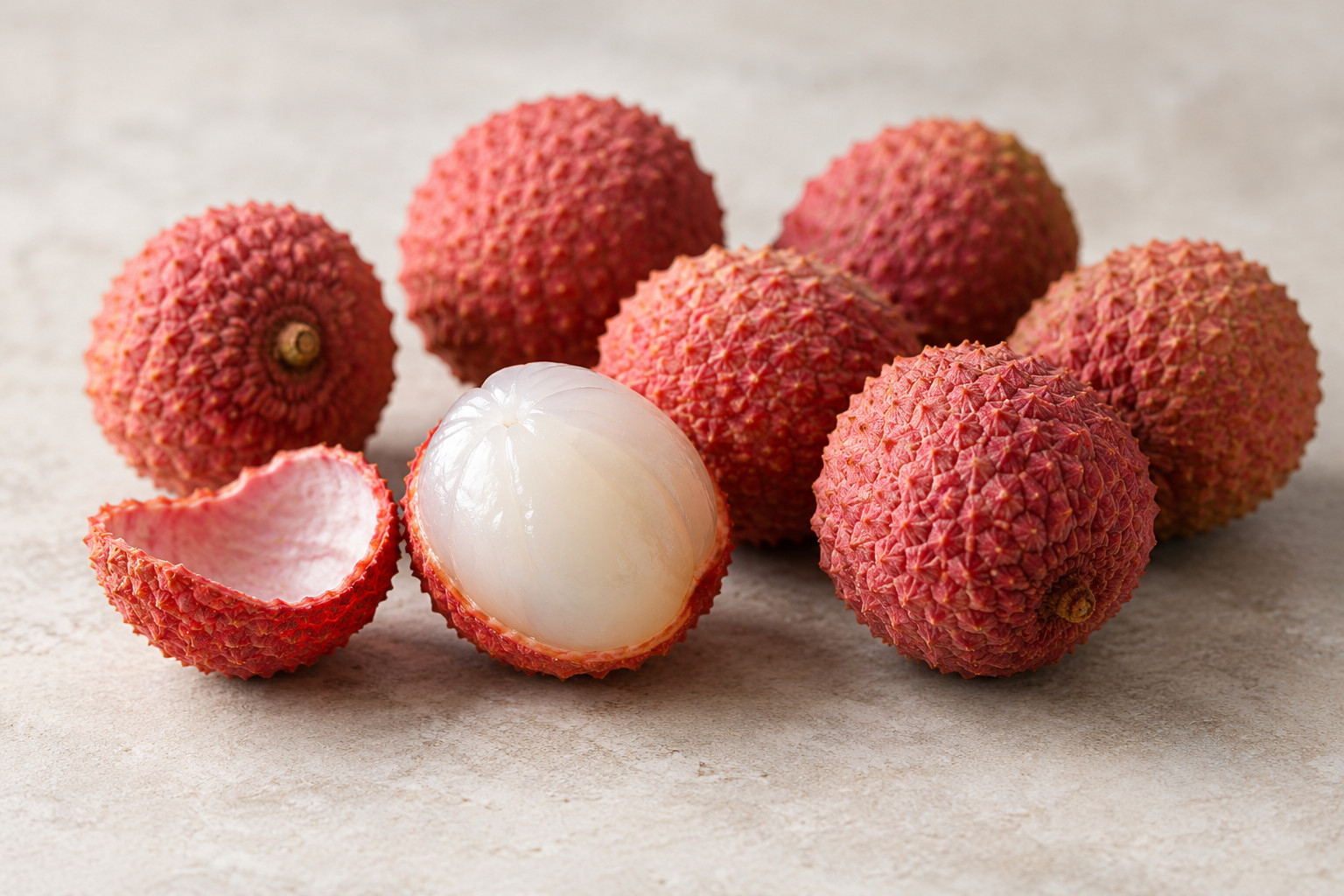
Lychees: a sensory reference for defining the target flavor profile.
How should a lychee flavor profile be described without vague tropical adjectives?
A useful lychee flavor profile states botanical reference, timed aroma, taste structure, excluded notes, matrix, and serving condition. Tropical, sweet, and floral do not tell a flavorist whether the target is a fresh aril, a canned syrup, a rose-candy gummy, a bubble-tea concentrate, or a dry cocktail mixer.
Use Litchi Chinensis as the fruit reference. Keep longan (Dimocarpus Longan) and rambutan (Nephelium Lappaceum) out of the same brief unless a blend is intentional. Longan reads muskier. Rambutan is milder and creamier.
Describe perception in three windows:
- Top, 0–3 s: Rose Oxide lift, crushed-petal geraniol, light citrus-linalool, green peel, or a bright ester flash.
- Middle, 3–15 s: Muscat Grape body, honeyed aril, pear-lychee juice, peach lactone, or candy-rose fullness.
- Base, 15–60 s: Creamy stone-fruit, faint tannic peel, cooked syrup, residual rose, or a clean exit.
Add 0–10 intensity, finish duration, and hard limits such as “no soap,” “no perfume,” “no geranium,” “no solvent,” and “no canned-syrup takeover.”
Lychee puree, juice concentrate, and canned syrup add solids, sugar, mild acid, and color. A compounded flavor controls aroma and taste at a lower use level. The flavor concentrate category for food manufacturing covers the broader family.
A 1998 study in the Journal of Agricultural and Food Chemistry (Ong and Acree) identified cis-rose oxide as a character-impact odorant of lychee, supported by geraniol, linalool, 2-phenylethanol, furaneol, and related notes. A 2007 study in the same journal (Mahattanatawee, Perez-Cacho, Davenport, and Rouseff) compared Mauritius Cultivar, Brewster Cultivar, and Hak Ip odor profiles, including sulfur detection.
Fresh lychee juice is high in sugar and only mildly acidic. Use pH 4.3 to pH 4.8 and 16% to 20% soluble solids as a fruit-reference band. A drink near pH 3.0 will not present the same dose as a ripe-aril target.
Which lychee top, middle, and base notes change a supplier brief?
Lychee direction changes when the brief raises or lowers one note family. Rose Oxide and rose alcohols create identity at low impact and create soap or perfume at excess. Esters and Muscat Grape body make juice. Lactones and furaneol make ripe flesh. Heat and storage trade the opening for canned syrup. Name the direction. “Make it more lychee” is not a specification.
| Brief direction | Opening, 0–3 s | Body, 3–15 s | Finish, 15–60 s | Failure signal | First-fit application |
|---|---|---|---|---|---|
| Fresh aril | Rose Oxide, light green peel | Muscat Grape, honey juice | Short, clean, faint tannin | Soap, geranium, cologne | Clear drinks, sparkling water |
| Canned syrup | Muted floral | Cooked lychee, sugar syrup | Warm jam, low rose | Jam with no rose identity | Bakery filling, dessert sauce |
| Candy rose | Bright floral flash | Sweet rose-grape center | Clean candy exit | Isoamyl Acetate or Methyl Anthranilate grape soda | Gummy, hard candy |
| Cocktail / martini | Dry rose, light ester | Lean Muscat body | Dry, no lotion | Ethanol-rose cologne | Alcoholic RTD, mixer |
| Tea / bubble tea | Floral lift that survives ice | Round honey-aril | Recognizable after dilution | Identity lost over ice | Boba syrup, milk tea |
cis-rose oxide, geraniol, linalool, 2-phenylethanol, β-damascenone, furaneol, and δ-decalactone are communication vocabulary, not a recipe.
Feizixiao Cultivar, Nuomici Cultivar, and Guiwei Cultivar still need timed notes, a soap limit, and a serving temperature.
How do water, fat, protein, sugar, salt, acid, and serving temperature change lychee perception?
The finished matrix controls how fast lychee aroma reaches the nose and how long rose, grape, and honey notes remain. A water screen cannot approve a dairy drink, a 10% fat filling, or a protein shake.
Change one variable at a time. Keep the 0.20% w/w liquid reference fixed unless the format needs its own ladder.
| Matrix variable | Expected lychee shift | Controlled contrast set | Approval check |
|---|---|---|---|
| Water | Fast Rose Oxide and ester release; thin middle if body notes are weak | Full liquid ladder: 0.05%, 0.10%, 0.15%, 0.20%, 0.25% w/w | Clarity, haze, ring, fill loss |
| Fat | Slower floral top; longer honey and lactone finish | 0% fat, 3% fat, 10% fat | Phase compatibility, after-swallow aroma |
| Protein | Binding of floral alcohols and esters; cooked mute after heat | 0% protein, 3% protein, 6% protein | Pre-process and post-process aroma, sediment |
| Sugar | Sweetness supports ripe-aril identity; excess sugar pushes candy rose | 8% sucrose, 12% sucrose, 16% sucrose | Identity at target sweetness, aftertaste |
| Salt / electrolytes | Mineral bite can expose soap or metallic peel | 0% sodium chloride, 0.10% sodium chloride, 0.20% sodium chloride | Finish cleanliness |
| Acid | Extra citric sharpness can make perfume or candy-rose | 0.20%, 0.35%, 0.50% titratable acidity as citric acid | pH, acid type, flavor after heat |
| Serving temperature | Cold suppresses rose lift; warmth increases release and soap risk | 5 °C, 10 °C, 20 °C | Blind score at the intended service point |
A winner in unsweetened water can disappear in a 6% protein shake after 135 °C for 2 s. A bubble-tea syrup tasted neat at 20 °C can lose identity at 5 °C over ice. Raising acid does not automatically raise authenticity. Match sweetness first.
Record carbonation, tea solids, dairy fat, and ethanol beside the dose when they exist. Food flavor formulation support for B2B R&D covers carrier and addition-point adjustment after the first coded screen.
Which lychee flavor format should a bubble tea, clear drink, or dry mix test first?
Choose a lychee format by continuous phase, clarity, process heat, and handling. Liquid or powder is physical form; water-soluble, oil-soluble, and emulsion describe delivery.
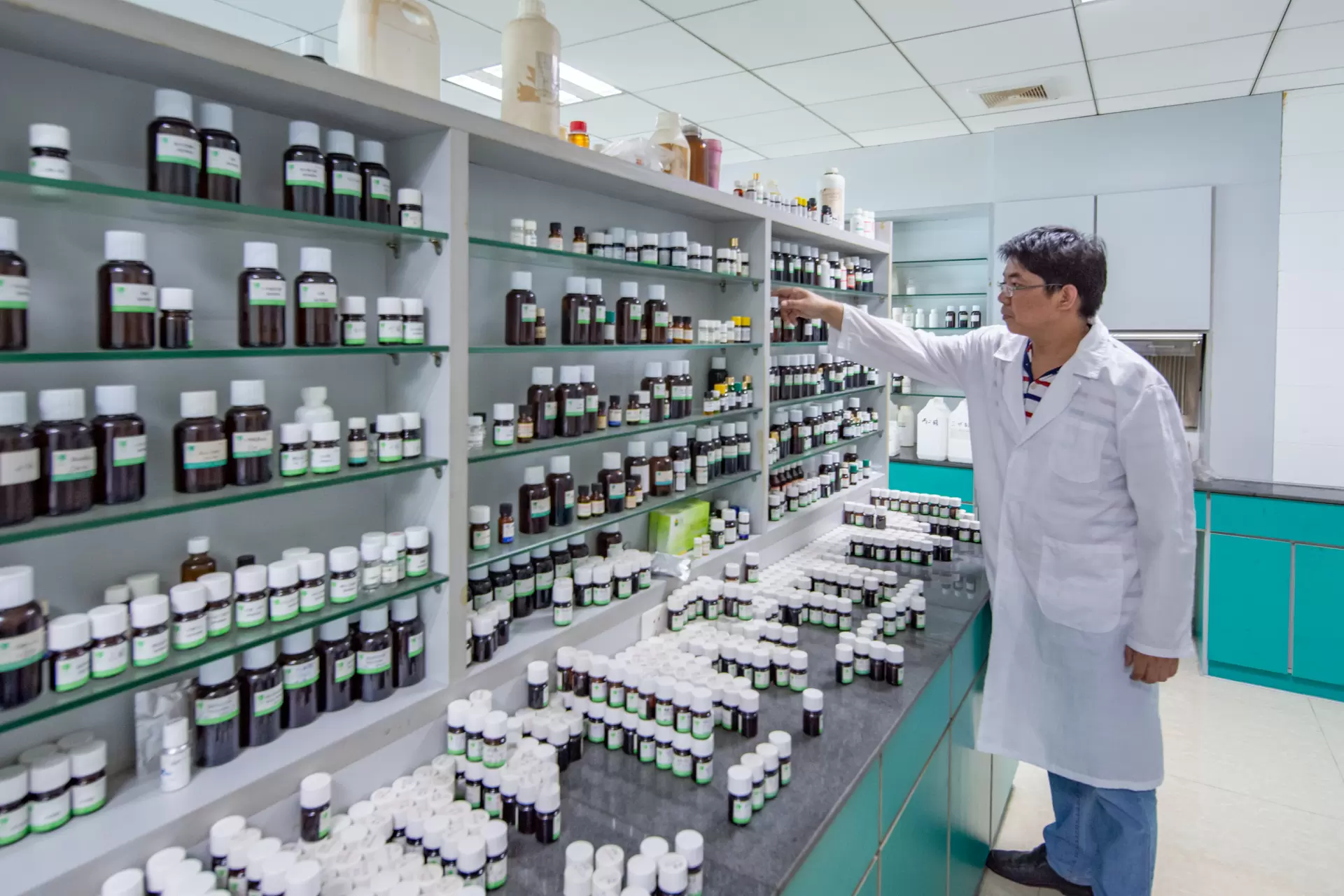
Flavor sample library in the LULIN laboratory
| Named option | Phase or structure | Controlled first screen | Suitable applications | Primary failure mode |
|---|---|---|---|---|
| water-soluble liquid | Clear aqueous carrier | 0.05%, 0.10%, 0.15%, 0.20%, 0.25% w/w | Clear drinks, syrups, jelly, tea | Heat loss, haze, soap at high dose |
| oil-soluble liquid | Lipid-phase carrier | 0.25%, 1.00%, 5.00% w/w | Fat fillings, coatings | Uneven dispersion in water |
| oil-in-water beverage emulsion | Flavor oil in water; may add cloud | 0.75 g/L, 1.00 g/L, 1.25 g/L | Cloudy drinks, nectar, milk tea | Ring, creaming, droplet growth |
| spray-dried powder | Dry carrier matrix | 0.10%, 0.20%, 0.30% w/w | Dry drinks, powdered desserts | Moisture pickup, muted opening |
| encapsulated powder | Protected dry matrix | 0.10%, 0.20%, 0.30% w/w | Heat-exposed dry mixes | Slow or incomplete release |
| flavor concentrate | Supplier-defined concentrated system | Apply the selected item’s assay and phase | Foods matched to its carrier | Treating the name as a universal strength |
| lychee puree, juice concentrate, or canned syrup | Fruit solids, sugar, color, mild acid | Fruit-ingredient use level, not the flavor ladder | Smoothies, sauces, fruit bases | Solids, haze, color, Brix, and label shift |
The clear-beverage design benchmark is 0.20% w/w, equal to 2.0 g/kg. It is a rounded high-end screening value inside the 0.05% to 0.25% liquid ladder, not a legal maximum and not a named-supplier guarantee. For a ready-to-use emulsion, 1.25 g/L is the high-end reference benchmark. For powder, start at 0.20% w/w inside the 0.10%, 0.20%, and 0.30% w/w screen. Use the powder versus liquid food flavor guide for handling.
Water-soluble liquid versus oil-in-water beverage emulsion for lychee drinks
A water-soluble liquid is the first clear-drink candidate. It meters into syrup without an oil phase. An oil-in-water beverage emulsion is the better first candidate when cloud, milk-tea body, or lipophilic rose-alcohol delivery matters. Inspect after carbonation, pasteurization, cooling, and storage. Taste bubble tea at 5 °C in the finished cup, not only as syrup at 20 °C.
Spray-dried powder versus encapsulated powder for lychee dry mixes
A spray-dried powder commonly uses maltodextrin, gum acacia, or modified starch. An encapsulated powder adds protection or delayed release. Screen moisture below 6%, bulk density from 550 g/L to 650 g/L, and reconstitution from 35 °C to 45 °C. Premix before hydration. Check caking, dissolution, and rose-top recovery.
Lychee puree, juice concentrate, and canned syrup versus compounded flavor
Fruit ingredients supply solids, color, and some aroma. They do not replace a standardized flavor item. Canned syrup already sits on the cooked side. Puree plus a water-soluble liquid can restore rose lift without converting the formula into candy-rose. Do not treat grams of puree as grams of flavoring.
Why does lychee flavoring lose rose lift or turn soapy after heat and storage?
Lychee flavoring drifts when heat, oxygen, light, shear, headspace, or storage temperature strips Rose Oxide and light esters while leaving geraniol, lactones, cooked sugar, or carrier notes behind. Soap and perfume are the characteristic lychee defects; cooked canned fruit is the heat defect.
Approve the complete production cycle, not a freshly mixed bench cup.
| Process or condition | Likely lychee change | Controlled comparison | Record for diagnosis |
|---|---|---|---|
| Pasteurization or High Temperature Short Time | Floral top loss, canned-syrup middle | 72 °C for 15 s; 95 °C for 30 s | Addition point, peak, hold, cooling |
| Ultra High Temperature | Stronger stripping; protein mute in dairy or plant drinks | 135 °C for 2 s; 140 °C for 4 s | Direct or indirect system, outlet temperature |
| Baking | Volatile loss; filling retains more than crumb | 160 °C for 20 min; 180 °C for 15 min | Dough, filling, cooled product |
| Hard-candy cooking | Rose top leaves before the glass sets | Kettle vs lowest safe cooling-stage addition | Batch peak, addition temperature |
| Oxygen, light, warm storage | Oxidation, color drift, soap or stale rose | 4 °C, 20 °C, 40 °C at 0 days, 7 days, 30 days | Headspace, closure, light, package |
| Ethanol in RTD or mixer | Rose and alcohol can read as cologne | Production alcohol vs 0% alcohol control at 5 °C and 20 °C | Alcohol %, addition point, serving temperature |
If Day 0 is correct and Day 7 fails at 60 s, raising the dose usually makes soap worse. Shift the item, addition point, or format first. Store liquids closed, dry, and dark at 10 °C to 20 °C. Control powder humidity. Keep frozen puree at or below −18 °C. A soapy 20 °C panel is not an automatic fail; repeat the code at 5 °C if that is the service point.
How should buyers compare lychee flavor samples in the real application base?
Buyers should run coded lychee samples in the finished base, repeat them after the complete process, and check the rose-Muscat arc and physical state at 0 days, 7 days, and 30 days.
- Lock the base. Use the production formula: water, fat, protein, sugar, salt, acid, pH, soluble solids, alcohol, and tea solids.
- Set the ladder. Test 0.05%, 0.10%, 0.15%, 0.20%, and 0.25% w/w in one beverage-like base. Keep 0.20% w/w (2.0 g/kg) as the design benchmark. Use 0.10%, 0.20%, and 0.30% w/w for powder. Use 0.75 g/L, 1.00 g/L, and 1.25 g/L for emulsion.
- Apply the process. Match production heat, carbonation, bake, freeze, homogenization at 10 MPa, 20 MPa, or 30 MPa, or ice dilution. Record addition point and hold time.
- Blind and randomize. Code samples. Standardize cup, fill, and equilibration. Read every code at 5 °C and 20 °C.
- Score the arc. Use a 0–10 scale for rose-floral burst, Muscat Grape body, honey-stone fruit, green/peel, soapy/perfume, cooked-syrup, aftertaste, and overall fit.
- Check physical behavior. Record clarity, haze, ring, creaming, sediment, color, and viscosity at 0 days, 7 days, and 30 days. Freeze–thaw at −18 °C for 24 h when the product is frozen.
Use ASTM E1871-17 for serving practice and ASTM E2454-20 for a sensory shelf-life endpoint. They do not set a lychee dose.
| Scorecard block | Points | Advance signal | Mandatory fail |
|---|---|---|---|
| Rose-floral identity at service temperature | 20 | Recognizable in 0–3 s | Soap, geranium, perfume |
| Muscat Grape and honey body | 20 | Juice-like middle | Grape-candy substitution |
| Process and storage retention | 20 | Arc present after the factory cycle and at 7 days | Only cooked syrup remains |
| Off-note control | 20 | Solvent, sulfur, metallic peel, and carrier below limit | Sulfur, ethanol-rose, lotion |
| Physical stability | 10 | No ring, sediment, or unacceptable haze | Separation or package fail |
| Label and document fit | 10 | Matches destination-market wording and file list | Missing COA, SDS, or natural/artificial statement |
Advance the lowest dose that reaches at least 75/100 and carries no mandatory fail. Prefer the cleaner process window when scores tie. Convert a passing coded set into a structured food flavor sample request for B2B buyers.
What belongs in a United States lychee flavoring RFQ?
An effective lychee RFQ puts application, sensory direction, matrix, process, format, documents, and commercial target on one page.
| RFQ section | Details to include | Why it changes the recommendation |
|---|---|---|
| Finished product | Bubble tea, clear drink, sparkling water, yogurt, ice cream, gummy, bakery filling, tea, alcoholic RTD; batch size and annual forecast | Defines phase, dosing, and scale |
| Sensory target | Fresh aril, canned syrup, candy rose, cocktail, or tea; timed notes; soap/perfume limits | Separates juice, gummy, and martini targets |
| Matrix | pH, soluble solids, fat, protein, salt, sweetener, alcohol, tea solids | Predicts rose release, binding, and masking |
| Format | water-soluble liquid, oil-soluble liquid, oil-in-water beverage emulsion, spray-dried powder, encapsulated powder, flavor concentrate, or fruit ingredient | Prevents an incompatible phase or haze |
| Process | Addition point, pasteurization / High Temperature Short Time / Ultra High Temperature, bake, carbonate, homogenize, freeze–thaw, ice dilution | Determines heat stability and process loss |
| Trial plan | Sample quantity; 0.05%, 0.10%, 0.15%, 0.20%, 0.25% w/w ladder; 5 °C and 20 °C; 0 days, 7 days, 30 days | Makes supplier feedback comparable |
| Quality documents | COA, TDS, SDS/MSDS, ingredient statement, allergen, GMO, vegan, Halal/Kosher, natural/artificial wording, FEMA GRAS or market statement | Supports QA, label, and importer review |
| Commercial terms | MOQ, pack size, shelf life, storage, lead time, Incoterm, destination | Converts a passing sample into a purchase |
State the destination market first. A United States buyer may need a natural-flavor, natural-and-artificial, or artificial declaration under 21 CFR 101.22. A European Union customer may request wording aligned with Regulation (EC) No 1334/2008. One flavor name can require different files.
For United States projects, 21 CFR 101.22 defines natural flavor and artificial flavor by source and function. Ask for the selected item’s carrier, ingredient statement, and intended wording. A catalog “natural” claim does not settle the finished-food label.
Flavor Extract Manufacturers Association GRAS status applies to evaluated substances under intended flavor use, not to a whole brand. Food and Drug Administration facility registration is not product approval. Use the food flavor compliance document guide for handoff. Keep the broad definition on what artificial flavor means for B2B food buyers.
Halal status is item-specific. Request the certificate and the item code. Compare quotations on approved cost-in-use per 1,000 kg of finished product; a low kilogram price can still cost more if the passing dose sits at 0.25% w/w instead of 0.10% w/w.
How LULIN FLAVOR supports a lychee flavoring project
LULIN FLAVOR supplies application-matched lychee liquids, emulsions, spray-dried powders, encapsulated powders, sample adjustment, and technical documents. QUANZHOU LVLIN BIOENGINEERING CO., LTD. established the Quanzhou, Fujian operation in 2001 and develops, produces, and sells food-grade flavors. The base includes more than 12 flavor engineers, over 20 years of application experience, three modernized production lines, more than 50 employees, a six-acre site, and more than 8,000 m² of building area. Selected lychee items are supported by TDS, SDS, COA, ingredient, allergen, market, and project-matched certification documents.
Send the base, sensory direction, dose ladder, process, package, market, annual volume, and sample count. Contact LULIN FLAVOR for review; the LULIN FLAVOR manufacturer profile provides company context.
Lychee flavoring buyer FAQ
How should a lychee flavor profile be specified for a supplier?
Specify timed notes, excluded defects, matrix, process, format, and serving temperature. A useful line is “fresh-aril lychee; Rose Oxide lift at 0–3 s; Muscat Grape and honey body at 3–15 s; short clean finish; no soap; evaluated in a clear drink at 5 °C after pasteurization.”
What does lychee flavoring taste like compared with grape candy or rose water?
Lychee flavoring should taste like rose-floral fruit with Muscat Grape juice and honeyed flesh, not like grape candy or rose water. Grape-candy esters without rose-fruit structure miss the identity. Rose water without juice body reads as perfume.
Which lychee flavor format should be tested first?
A water-soluble liquid is usually the first lychee format to test in a clear beverage or bubble-tea syrup. Use an oil-in-water beverage emulsion when cloud or milk-tea body is required, an oil-soluble liquid in a fat phase, and spray-dried powder or encapsulated powder in a dry mix.
What dosage should a first lychee beverage trial use?
Use 0.20% w/w (2.0 g/kg) as the high-end design benchmark for a first water-soluble liquid screen. Test the complete 0.05%, 0.10%, 0.15%, 0.20%, and 0.25% w/w ladder in one finished base, then follow the selected item’s technical and regulatory use boundary.
Why does lychee flavoring become soapy or perfumed after processing?
Soap and perfume appear when Rose Oxide and rose alcohols dominate after heat, concentration, warm serving, or ethanol lift strips the juicier middle. Compare pre-process, post-process, and aged codes at 5 °C and 20 °C before raising the dose.
Is artificial lychee flavoring automatically Halal?
No. Artificial classification under 21 CFR 101.22 does not decide Halal status. Ask for an item-specific Halal certificate and review ethanol, glycerol, carriers, and any animal-derived materials against the destination-market rule set.
Is lychee flavoring the same as lychee puree or canned lychee syrup?
No. Lychee flavoring supplies a concentrated aroma direction at a low use level. Puree, juice concentrate, and canned syrup add solids, sugar, color, and cooked or fresh fruit identity. A formula may use both, but they are not weight-for-weight substitutes.
How should buyers compare lychee flavor samples?
Compare coded samples in the final application at 5 °C and 20 °C, score rose-floral burst, Muscat body, honey flesh, soap, cooked notes, finish, and physical stability, and repeat at 0 days, 7 days, and 30 days. Advance the lowest dose that reaches 75/100 with no mandatory fail.
What documents belong in a United States lychee flavoring RFQ?
Request the TDS or specification, SDS, current-lot COA, ingredient and carrier statement, allergen statement, item-specific natural/artificial status under 21 CFR 101.22, regulatory or FEMA GRAS statement, Halal/Kosher files when required, shelf-life and storage data, country of origin, MOQ, pack size, price basis, Incoterm, and lead time.
How do sugar, acid, and serving temperature change lychee perception?
Higher sugar supports ripe-aril identity; extra acid can push perfume or candy-rose because lychee fruit is only mildly acidic; 5 °C mutes rose lift while 20 °C can expose soap. Fix sweetness, acid, and service temperature before ranking flavor items.
Lychee sample brief for the next production trial
Send one page: product; fresh-aril, canned-syrup, candy-rose, cocktail, or tea direction; required and forbidden notes; water, fat, protein, sugar, salt, acid, pH, alcohol, and tea solids; process; package; serving temperature; format; 0.05%, 0.10%, 0.15%, 0.20%, and 0.25% w/w liquid screen; market; documents; sample count; annual forecast; and decision date. LULIN FLAVOR can then return contrasting samples, technical files, and a production quotation.
Develop this flavor in your product
Send your product, target market and project goal. We will review the sample direction with you.