Published
Malt Flavoring: A Technical Guide to Sensory Direction, Formats, and B2B Selection
Malt flavoring is a concentrated system that recreates defined malted-grain cues—fresh cereal, biscuit, caramel, toast, cocoa, or roast—in food and beverage matrices. For first-round screening, use 0.10% w/w in a finished beverage and 0.20% w/w in baked or confectionery products as design benchmarks, then retune for matrix, process, and serving temperature.
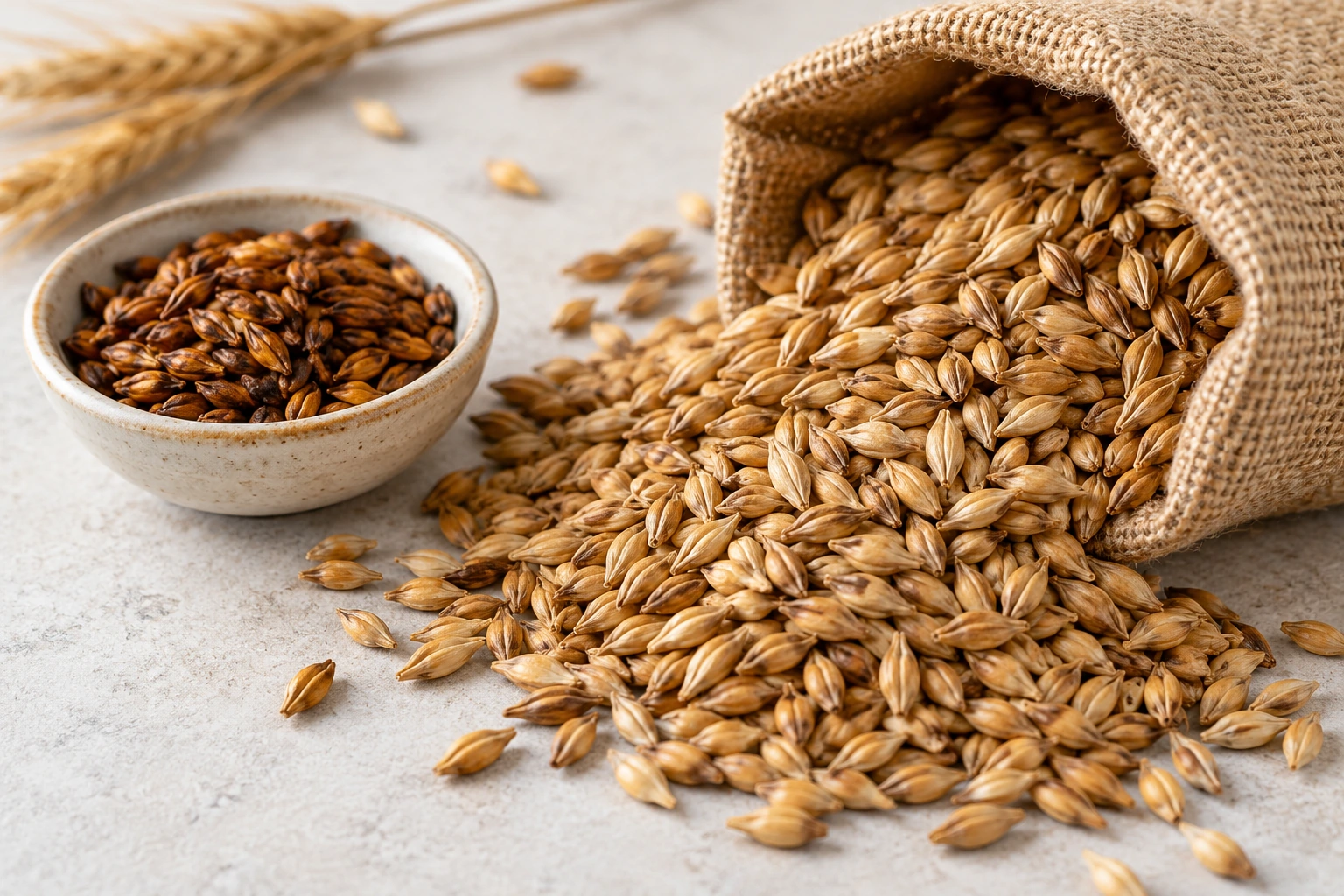
Malt sensory reference: an AI-generated sensory reference for this flavor brief.
What exactly should a B2B malt flavoring brief specify?
Start with the application. A useful malt flavoring brief names the sensory target, matrix, process, format, dose, and regulatory declaration before a supplier prepares a sample. “Malt” can describe several different ingredients, and each one changes solids, sweetness, enzymes, allergens, and processing behavior.
| Ingredient or system | Primary contribution | Typical physical form | Main formulation consequence | Best brief wording |
|---|---|---|---|---|
| Concentrated malt flavor | Aroma and taste at low dose | Liquid, emulsion, or encapsulated powder | Minimal solids; dose is adjusted after process loss | “Fresh cereal with biscuit/toffee heart; clean cocoa finish” |
| Malt extract or malt syrup | Malt taste plus sugars, solids, color, and body | Viscous liquid or dried extract | Raises Brix, viscosity, and browning potential | “Add malt solids and amber color” |
| Malted milk powder | Malt, milk solids, sweetness, and body | Free-flowing powder | Adds dairy protein, lactose, and allergen declaration | “Malted dairy profile with creamy body” |
| Non-diastatic malt powder | Malt taste and some color, without active enzyme function | Powder | Changes dry solids and water balance | “Biscuit malt note; no dough enzyme activity” |
| Diastatic malt powder | Enzyme activity, fermentable sugars, flavor, and crust color | Powder | Can alter fermentation, dough strength, and bake color | “Enzyme function required; define Lintner target” |
Compare cost in the finished formula, not per kilogram. Syrup also adds water and sugar; malted milk powder adds dairy; diastatic malt changes the process. Choose a flavor concentrate when aroma control is the primary objective.
For United States products, request a complete ingredient and carrier statement. FDA lists malt syrup (malt extract) functions that include flavoring, flavor enhancement, coloring, sweetening, and texturizing; finished-label treatment still follows the exact formula. Review barley, wheat, milk, soy, and sesame separately. The Flavor Concentrates for Food Manufacturing page supplies broader category context; this page covers malt direction and application performance.
How can a malt flavor profile be described without vague sensory adjectives?
Describe malt in time order. A profile becomes actionable when it is written as a sequence with intensity, duration, and boundaries rather than as a stack of adjectives. A flavorist can build “fresh cereal top, biscuit/toffee heart, clean cocoa finish”; “strong, rich malt” does not specify what to change.
Record four dimensions for every coded sample:
- Onset: what appears in the first 0–5 seconds after opening, pouring, or tasting.
- Middle: the dominant impression from 5–20 seconds, including cereal, bread, caramel, nut, cocoa, or roast character.
- Finish: what remains from 20–60 seconds, including sweetness impression, dryness, bitterness, astringency, or smoke.
- Intensity and persistence: score each tier from 0 (absent) to 10 (dominant), then record duration in seconds and any off-note.
Use a reference base and a controlled serving temperature. A clear beverage evaluated at 5 °C can hide a volatile top that becomes obvious at 20 °C. A brownie evaluated warm can exaggerate cocoa and caramel compared with the cooled retail product. Record color, haze, mouthfeel, and aroma separately so a darker appearance is not mistaken for stronger malt.
The sensory sentence should also state what is not wanted. Examples include “no burnt coffee,” “no sulfur or green-grain note,” “no dairy,” or “no lingering bitterness.” Negative boundaries reduce revision cycles because a supplier can remove a roast or phenolic accent instead of merely increasing or decreasing total intensity.
Kilning, roasting, and baking generate families of Maillard and caramelization products rather than one controlling marker. Furan and maltol-type compounds support bread-crust and caramel impressions; pyrazines support nutty, cocoa, and roast notes. Moisture, temperature, airflow, and pH shift that balance. For regulatory terminology, see how artificial flavor is defined for food labels.
Which top, middle, and base notes can change a malt brief?
Assign each note a job. Top notes set recognition, middle notes define the product identity, and base notes determine whether the finish feels clean, dark, sweet, or savory. A buyer should select one or two directions in each tier rather than request every malt descriptor at once.
| Note tier | Directions to test | Useful applications | Failure signal | Adjustment lever |
|---|---|---|---|---|
| Top / first impact | Fresh malted grain, honeyed cereal, light vanilla, faint fruit ester | Clear RTD, nutrition drink, light biscuit | Opens flat or smells like raw flour | Increase volatile cereal lift; lower heavy roast materials |
| Middle / heart | Biscuit, bread crust, toasted cereal, caramel, toffee, nut, cocoa | Cookies, brownies, cereal, chocolate, dairy drinks | Tastes sweet but not recognizably malty | Add grain and toast contrast; trim generic caramel |
| Base / finish | Brown sugar, molasses, cocoa husk, coffee, dark roast, earthy/woody, restrained smoke | Dark bakery, stout-style drinks, chocolate fillings | Burnt, bitter, smoky, or lingering phenolic note | Reduce roast load; add a clean sweet or cereal bridge |
Three profile families cover most commercial briefs:
- Light cereal malt: fresh grain, honey, biscuit, and a short finish for vanilla, fruit, or delicate dairy.
- Bakery malt: bread crust, toasted cereal, brown sugar, and caramel for cookies, brownies, and cereal bars.
- Dark roasted malt: cocoa, coffee, molasses, and restrained smoke for chocolate, stout-style drinks, or dark sauces.
The same label—“malt flavor”—can therefore produce very different consumer expectations. A chocolate-flavored malted milk powder usually needs a creamy middle and cocoa base, while a fruit-flavored malt beverage needs a lighter cereal top that does not mask fruit esters. A margarita-style malt beverage may need a neutral malt backbone so lime, salt, and alcohol remain recognizable. The brief should identify the lead flavor and the malt’s supporting role.
How do water, fat, protein, sugar, salt, acid, and serving temperature alter malt flavor perception?
Matrix composition controls release. The same malt flavoring cannot be judged in water and then assumed to perform identically in a high-fat or high-protein product. Screen each candidate in the finished base at the intended pH, solids, and serving temperature.
| Matrix variable | Release or partition effect | Typical sensory symptom | Formulation move |
|---|---|---|---|
| Water and low total solids | Volatile notes release quickly; little body supports the finish | Bright opening but thin, short malt | Add a middle-note bridge or modest body; check clarity |
| Fat | Hydrophobic aroma partitions into the fat phase and releases more slowly | Softer, longer finish; muted cereal top | Test oil-soluble liquid or an emulsion; evaluate after chilling |
| Protein | Protein can bind aroma; dairy and plant proteins add their own cooked or beany notes | Malt arrives late or seems weak | Pre-dissolve, adjust addition point, and compare after UHT or shear |
| Sugar and Brix | Higher viscosity lowers headspace release and favors caramel perception | More toffee and sweetness; less fresh grain | Rebalance top notes; record Brix and final viscosity |
| Salt | Low salt can reduce bitterness and increase perceived sweetness; high salt adds savory character | Roast feels cleaner at low salt, brothy at high salt | Keep salt constant across samples and score savory drift |
| Acid and pH | Acidity brightens attack and can stress proteins or emulsions | Sharper top, thinner body, haze or sediment risk | Test at target pH and after acid addition; check stability |
| Serving temperature | Cold suppresses headspace; warmth increases aroma release | Chilled sample seems quiet; warm sample seems roasted | Evaluate at 5 °C, 20 °C, and the declared serving condition |
Water quality matters. Chlorine, hardness, and alkalinity can create a metallic or dry finish that resembles a flavor defect. Use production water or a documented equivalent and hold carbonation pressure constant; carbon dioxide sharpens acidity, lifts aroma, and can reduce perceived sweetness.
For “malted milk” projects, milk powder contributes lactose and dairy protein, while pea, oat, and soy systems bind and mask aroma differently. A flavor may be dairy-free if its formula and carrier contain no milk; malted milk powder is not. Follow the exact SKU allergen statement.
Which malt flavor format fits a clear drink, bakery, dairy, or dry mix?
Choose format from the continuous phase. The flavor name alone cannot predict dispersion, heat response, or dry handling. The table below gives a practical first choice and the principal pilot risk for each format.
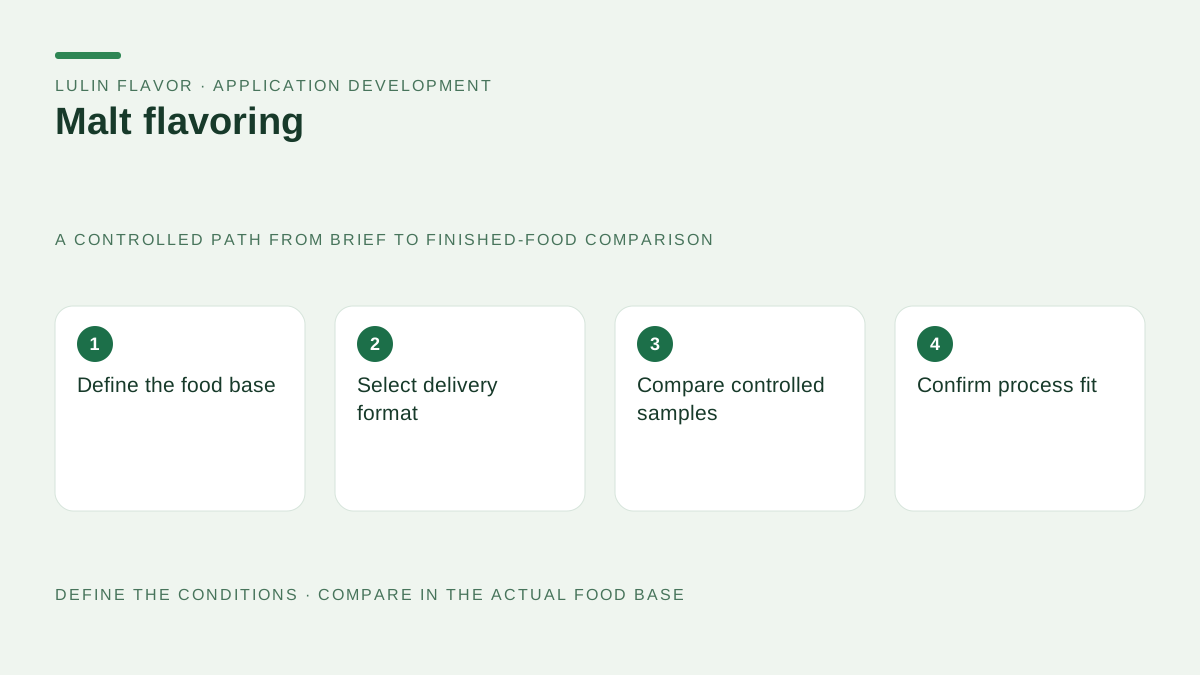
A controlled workflow for this formulation or supplier-review decision.
| Format | Best starting matrix | Strengths | Watch-outs | Pilot action |
|---|---|---|---|---|
| Water-soluble liquid | Clear RTD, syrup, tea, low-fat beverage | Fast dispersion, no deliberate haze, simple dosing | Top notes can strip during pasteurization or carbonation | Add before and after heat in paired samples |
| Oil-soluble liquid | Chocolate, fillings, fat-rich bakery, compound coating | Strong retention in fat; supports cocoa and roast | Haze or ring in water; may need a carrier oil | Test in fat phase and in final product |
| Emulsion | Clouded beverage, dairy, plant drink, cream soda | Carries oil-soluble notes into water; can add cloud or body | Requires homogenization and stability checks | Record pressure, temperature, pH, ring, and sediment |
| Encapsulated or spray-dried powder | Dry beverage mix, sachet, cereal, seasoning | Free-flowing handling, protected aroma, easy dry blending | Carrier changes density, hygroscopicity, and release | Check caking, reconstitution, and post-storage aroma |
| Malt extract or syrup | Bakery, cereal, sauce, malt-based drink | Adds solids, color, sweetness, and authentic extract character | Raises Brix and water; not a 1:1 concentrate substitute | Balance sugar and water before comparing cost |
Water-soluble liquids are the shortest route to a clear drink, but solubility does not guarantee heat retention. Oil-soluble systems persist in brownies yet may float in low-fat beverages. Emulsions create dispersible droplets; droplet size, emulsifier, and shear determine stability.
Powder is not one specification. Maltodextrin, gum arabic, modified starch, and other carriers change density, sweetness, moisture pickup, and reconstitution. Request carrier percentage and handling data before setting dosing or warehouse targets. See Powder vs Liquid Food Flavors for the broader comparison.
What processing and storage conditions can make a malt profile drift?
Judge the processed sample. Heat, shear, oxygen, and storage can remove bright cereal notes while leaving caramel and roast, so the neat concentrate cannot set the production decision.
| Application | Main exposure | Common drift | Practical control |
|---|---|---|---|
| Clear beverage | Pasteurization, carbonation, oxygen, cold storage | Top-note loss, haze, ring, or late sediment | Compare pre-heat and post-heat additions; record pH, CO₂, and hold time |
| Dairy or plant beverage | UHT/HTST, protein binding, homogenization | Muted malt, cooked note, phase separation | Test complete thermal cycle and final protein level |
| Bakery | Mixing, oven heat, moisture loss, cooling | Cereal top disappears; roast and crust dominate | Compare dough, cooled product, and 24-hour product |
| Chocolate and confectionery | Shear, fat crystallization, cool-down | Aroma trapped in fat or flashes off during heat | Add at the lowest practical temperature; check bloom and finish |
| Dry mix | Spray drying, oxygen, humidity, repeated opening | Volatile loss, caking, uneven dose | Control water activity, oxygen, seal, and blend uniformity |
For bakery, blend liquid flavor into fat or a compatible carrier, then compare late addition with the standard mix. Pre-blend powder with flour, sugar, or cocoa to prevent hot spots. Never transfer a liquid dose directly to powder; carrier solids and density change active concentration.
Document the beverage thermal profile. A 72 °C pasteurization, 95 °C hot fill, and 135 °C UHT cycle impose different losses. Post-heat addition requires separate microbial and filling controls. Judge fruit-flavored malt beverages after carbonation and alcohol equilibration, not in still water.
Storage belongs in the specification. Keep liquids full, sealed, and away from light and heat; use 15–25 °C as a warehouse screen before real-time validation. Check emulsions after freeze–thaw and agitation. Protect powders from moisture and oxygen. Record odor, color, viscosity, dispersibility, and intensity at day 0, 30, 60, and 90.
How should a buyer compare malt flavor samples in the real application base?
Test blind in the real base. An application-matched dose ladder gives a better purchasing signal than a neat-sample tasting. The following protocol can be copied into a pilot brief.
- Prepare a blank, the current reference, and four coded supplier candidates in one application batch. Use duplicate preparations for each code.
- Screen a ladder around the design benchmark: 0.04%, 0.07%, 0.10%, and 0.15% w/w for beverages; 0.10%, 0.15%, 0.20%, and 0.30% w/w for baked or confectionery systems. These are screening levels, not regulatory limits.
- Keep water, Brix, fat, protein, salt, acid, mixing order, shear, heating, and hold time identical. Record pH, temperature in °C, and time in minutes.
- Score top, middle, and base notes from 0 to 10. Add separate scores for sweetness impression, roast, finish length, color, haze, sediment, and off-notes.
- Evaluate at the target serving temperature, then repeat after 24 hours and 7 days. For powders, include reconstitution after the planned storage interval.
- Select the lowest post-process dose that meets the sensory sentence. A high score in a neat carrier is not a production decision.
The following pilot matrix turns those rules into repeatable starting conditions. Values are reference screens, not product specifications or regulatory maxima; keep only the rows that match the real application.
| Pilot system | Batch | Liquid flavor ladder | Dry malt option | Base solids | Fat | Protein | Salt | Process challenge | Serving check | Storage checks |
|---|---|---|---|---|---|---|---|---|---|---|
| Clear still beverage | 1 kg | 0.04%, 0.07%, 0.10%, 0.15% | 1%, 2%, 3% | 8%, 10%, 12% | 0%, 0.5% | 0%, 1% | 0%, 0.05% | 72 °C for 15 s | 5 °C, 20 °C | 24 h, 7 days |
| Carbonated beverage | 1 kg | 0.04%, 0.07%, 0.10%, 0.15% | 1%, 2%, 3% | 8%, 10%, 12% | 0%, 0.5% | 0%, 1% | 0%, 0.05% | 72 °C for 15 s | 5 °C, 20 °C | 24 h, 7 days |
| Acidified syrup | 1 kg | 0.07%, 0.10%, 0.15%, 0.20% | 1%, 2%, 3% | 40%, 50%, 60% | 0%, 0.5% | 0%, 1% | 0.05%, 0.10% | 85 °C for 30 s | 20 °C, 35 °C | 24 h, 7 days |
| Dairy beverage | 1 kg | 0.07%, 0.10%, 0.15%, 0.20% | 1%, 2%, 3%, 4% | 10%, 12%, 14% | 1%, 2%, 3% | 2%, 3%, 4% | 0.05%, 0.10% | 95 °C for 30 s | 5 °C, 20 °C | 24 h, 7 days |
| Plant-protein drink | 1 kg | 0.07%, 0.10%, 0.15%, 0.20% | 1%, 2%, 3%, 4% | 10%, 12%, 14% | 1%, 2%, 3% | 2%, 3%, 4% | 0.05%, 0.10% | 135 °C for 5 s | 5 °C, 20 °C | 24 h, 7 days |
| Hot malt drink | 1 kg | 0.05%, 0.10%, 0.15%, 0.20% | 2%, 3%, 4%, 5% | 10%, 15%, 20% | 0%, 2%, 4% | 0%, 2%, 4% | 0%, 0.05% | 95 °C for 5 min | 45 °C, 60 °C | 1 h, 24 h |
| Cookie dough | 1 kg | 0.10%, 0.15%, 0.20%, 0.30% | 1%, 2%, 3%, 4% | 70%, 75%, 80% | 15%, 20%, 25% | 5%, 7%, 9% | 0.5%, 0.8% | 180 °C for 12 min | 20 °C, 35 °C | 24 h, 7 days |
| Brownie batter | 1 kg | 0.10%, 0.15%, 0.20%, 0.30% | 2%, 3%, 4%, 5% | 65%, 70%, 75% | 15%, 20%, 25% | 5%, 7%, 9% | 0.3%, 0.5% | 175 °C for 25 min | 20 °C, 35 °C | 24 h, 7 days |
| Chocolate filling | 1 kg | 0.10%, 0.15%, 0.20%, 0.30% | 2%, 3%, 4%, 5% | 70%, 75%, 80% | 25%, 30%, 35% | 3%, 5%, 7% | 0.1%, 0.3% | 45 °C for 10 min | 20 °C, 30 °C | 24 h, 7 days |
| Hard candy | 1 kg | 0.10%, 0.15%, 0.20%, 0.30% | 1%, 2%, 3% | 95%, 97%, 99% | 0%, 0.5% | 0%, 1% | 0%, 0.05% | 145 °C for 5 min | 20 °C, 35 °C | 24 h, 7 days |
| Cereal bar | 1 kg | 0.10%, 0.15%, 0.20%, 0.30% | 1%, 2%, 3%, 4% | 70%, 75%, 80% | 8%, 10%, 12% | 5%, 7%, 9% | 0.2%, 0.4% | 90 °C for 5 min | 20 °C, 35 °C | 24 h, 7 days |
| Dry drink powder | 1 kg | 0.05%, 0.10%, 0.15%, 0.20% | 1%, 2%, 3%, 4%, 5% | 95%, 97%, 99% | 0%, 1%, 2% | 0%, 2%, 4% | 0%, 0.10% | 25 °C for 24 h | 5 °C, 20 °C | 7 days, 30 days |
Keep every row comparative: make the 0.10% and 0.15% points from one batch, and never rank a 72 °C/15 s beverage against a 135 °C/5 s plant drink as equal exposure. Isolate one variable, then advance the lowest dose and simplest format that survive processing.
Use one score sheet for every supplier. A score of 7 for “biscuit heart” must mean the same aroma in every session; retain a reference and descriptor glossary. Send application data through the Food Flavor Sample Request for B2B Buyers route and use food flavor formulation support when format or addition point needs adjustment.
What should a United States-market malt flavoring RFQ include?
Put the whole decision in one RFQ. Combine sensory language, matrix data, process exposure, compliance documents, and commercial terms so suppliers do not quote incomparable formats or doses.
| RFQ block | Details to provide | Documents or response to request |
|---|---|---|
| Identity and sensory target | Lead flavor, top/middle/base sentence, unwanted notes, natural/artificial preference | Sample code, sensory description, allergen statement |
| Application matrix | Water, fat, protein, sugar/Brix, salt, acid, pH, alcohol, carbonation | Recommended format and starting dose |
| Process | Mixing order, temperature/time, shear, homogenization pressure, pasteurization/UHT, bake profile | Heat and process stability guidance |
| Physical requirements | Liquid or powder, clarity, color, density, viscosity, dispersibility, particle size | TDS, COA, SDS, appearance and physical limits |
| Regulatory and quality | United States label declaration, allergen and cross-contact, GMO, Halal, Kosher, ISO/FSSC/BRCGS as applicable | Signed statements, current certificates, change-control policy |
| Commercial and logistics | Annual volume, trial quantity, MOQ, pack size, lead time, Incoterm, destination, storage | Price basis, shelf life, packaging, export documents |
For United States distribution, identify conventional food, dietary supplement, or alcoholic beverage use. Alcoholic malt beverages may require TTB formula and label review alongside FDA considerations. A “natural” declaration is tied to the exact composition, carrier, and market.
Use the Food Flavor Compliance Document Request Guide as the handoff checklist. Include destination, importer requirements, HS code, pallet configuration, and temperature limits. Ask how raw-material or carrier changes are communicated and whether lot release uses a retained reference.
How can LULIN FLAVOR support a malt project from first sample to production?
Begin with a reproducible brief. LULIN FLAVOR is the food-flavor brand of QUANZHOU LVLIN BIOENGINEERING CO., LTD., established in Quanzhou in 2001. Its application team includes more than a dozen engineers with over 20 years of flavor-development experience, supported by three production lines and an application laboratory.
The brand can prepare light cereal, bakery malt, dark roasted, malted-milk-style, or custom supporting directions. Request a clear beverage liquid, fat-compatible bakery liquid, water-dispersible emulsion, or encapsulated powder, then compare candidates in the finished base. Technical files can cover TDS, SDS, COA, allergen, GMO, Halal, Kosher, and applicable site certification requirements.
For project coordination, contact LULIN FLAVOR about a flavor project with the base, temperatures, pH, Brix, serving condition, market, and sample quantity. The LULIN FLAVOR food flavor manufacturer page provides company context. A precise target and reproducible test make quotations comparable.
Malt flavoring buyer FAQ
What is malt flavoring?
Malt flavoring is a concentrated flavor system that supplies a defined malted-grain aroma and taste at a low use level. It can be supplied as a liquid, emulsion, or encapsulated powder. Malt extract and syrup also add sugars, solids, color, and body, while malted milk powder adds dairy ingredients.
Is malt flavoring dairy-free?
Malt flavoring can be dairy-free when the flavor system, carrier, and manufacturing controls contain no milk ingredients. Malted milk powder is not dairy-free because it contains milk solids. Confirm the exact SKU’s ingredient, allergen, and cross-contact statement before making a claim.
Is malt flavoring natural or artificial?
Malt flavoring may be natural, artificial, or a blend of both, depending on the flavor materials and carrier. The United States label declaration must follow the composition of the exact SKU and the intended food category; a marketing name alone does not establish the regulatory wording.
What does malt flavor taste like?
Malt flavor can range from fresh cereal, honey, and light vanilla through biscuit, bread crust, caramel, toffee, nut, and cocoa to molasses, coffee, dark roast, and restrained smoke. A supplier brief should identify top, middle, and base directions instead of using “malty” alone.
Which malt flavor format is best for a clear beverage?
Start with a water-soluble liquid for a clear beverage because it disperses without deliberate haze. Choose an emulsion when oil-soluble roast notes, cloud, or extra body are required, and validate clarity, ring, sediment, heat stability, and carbonation in the finished drink.
How much malt flavor should a buyer use?
Screen 0.10% w/w in a finished beverage and 0.20% w/w in baked or confectionery systems as practical design benchmarks. Build a ladder below and above those points, then select the lowest post-process dose that meets the sensory target; carrier concentration and process loss can shift the final level.
Can malt flavor survive baking or UHT processing?
Malt flavor can survive baking or UHT processing when the format, addition point, and heat stability match the process. Compare pre-process and post-process samples after the complete thermal cycle, because bright cereal notes may be lost while caramel and roast remain.
Why does malt flavor disappear in a high-fat or high-protein product?
Fat partitions and retains hydrophobic volatiles, while proteins can bind aroma and add masking notes, reducing immediate headspace release. Test an oil-soluble or emulsion format, adjust the addition point, and evaluate the finished product at its retail temperature rather than in water.
How should buyers compare malt flavor samples?
Use a blind, application-matched ladder with a blank and current reference, score top, middle, and base notes at the target temperature, and repeat after 24 hours and 7 days. Keep matrix and process conditions identical, then choose the lowest dose that still meets the defined sensory sentence.
Which documents belong in a malt flavoring RFQ?
Request a current TDS, SDS, COA, ingredient and allergen statement, GMO statement, Halal or Kosher certificate when needed, applicable ISO/FSSC/BRCGS information, United States labeling and regulatory declaration, storage and shelf-life data, MOQ, lead time, packaging, export paperwork, and change-control terms.
Malt flavoring selection brief
Send the following information with a sample request: product category; blank and current reference; sensory sentence; top/middle/base priorities; water, fat, protein, sugar/Brix, salt, acid, pH, alcohol, and carbonation; process temperature and time; desired format; target serving temperature; United States or other destination market; annual volume; trial quantity; and required compliance documents. A complete brief lets LULIN FLAVOR return comparable samples and a production-oriented recommendation.