Published
Matcha Flavoring
Matcha flavoring is a formulated food flavor that reproduces or reinforces selected matcha cues: fresh green leaf, marine umami, controlled bitterness, soft sweetness, and a dry roasted finish. It is not automatically matcha powder, tea solids, caffeine, or green color. For retained-profile screening, use 35°C for 8 weeks in the intended package as the high-end design benchmark.
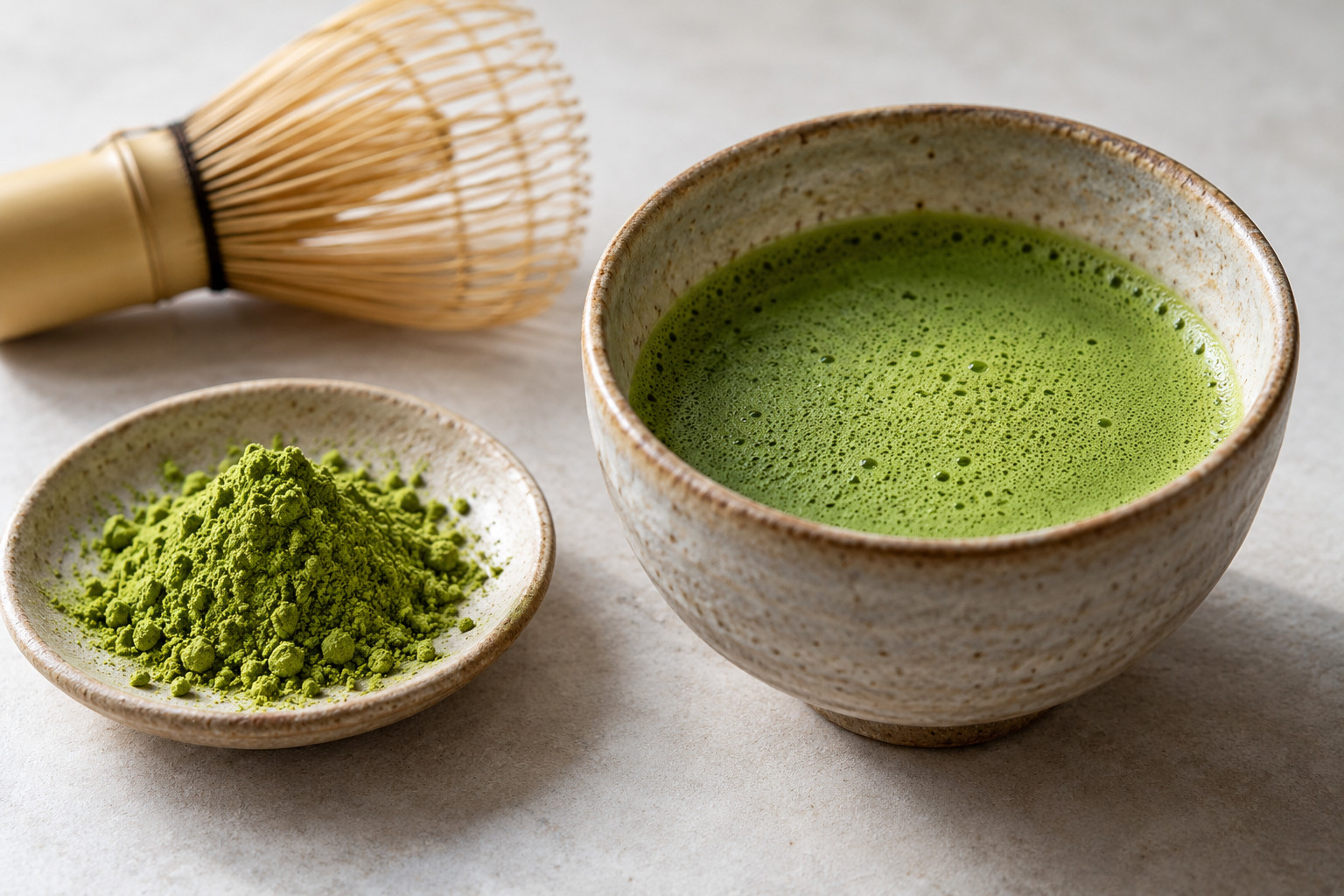
Matcha tea: a sensory reference for defining the target flavor profile.
What is Matcha flavoring, and what should it deliver in a manufactured product?
Matcha flavoring should deliver a defined sensory direction after the real matrix, process, package, and serving temperature have changed its release. It may reinforce genuine matcha powder, compensate for aroma lost during processing, or build a recognizable tea profile where powder solids are undesirable.
Keep ingredient identities separate. Ground matcha supplies finely milled leaf; soluble matcha is reprocessed for easier dispersion; latte premix combines ingredients; compounded flavor supplies aroma and taste. ISO/TR 21380:2022 excludes flavored matcha and soluble matcha extracts from its matcha specification. A Matcha name alone does not establish caffeine, catechins, particle body, color, or organic status. The broader food-manufacturing flavor concentrates category covers concentrate sourcing; this page owns the narrower Matcha application decision.
How should a product developer describe a Matcha profile without vague adjectives?
A Matcha profile should be written as a timed sequence with named attributes, intensity targets, exclusions, and an evaluation base. Top, middle, and base are practical briefing stages: approach and first contact, mid-palate body, then finish and aftertaste. They are not regulatory categories.
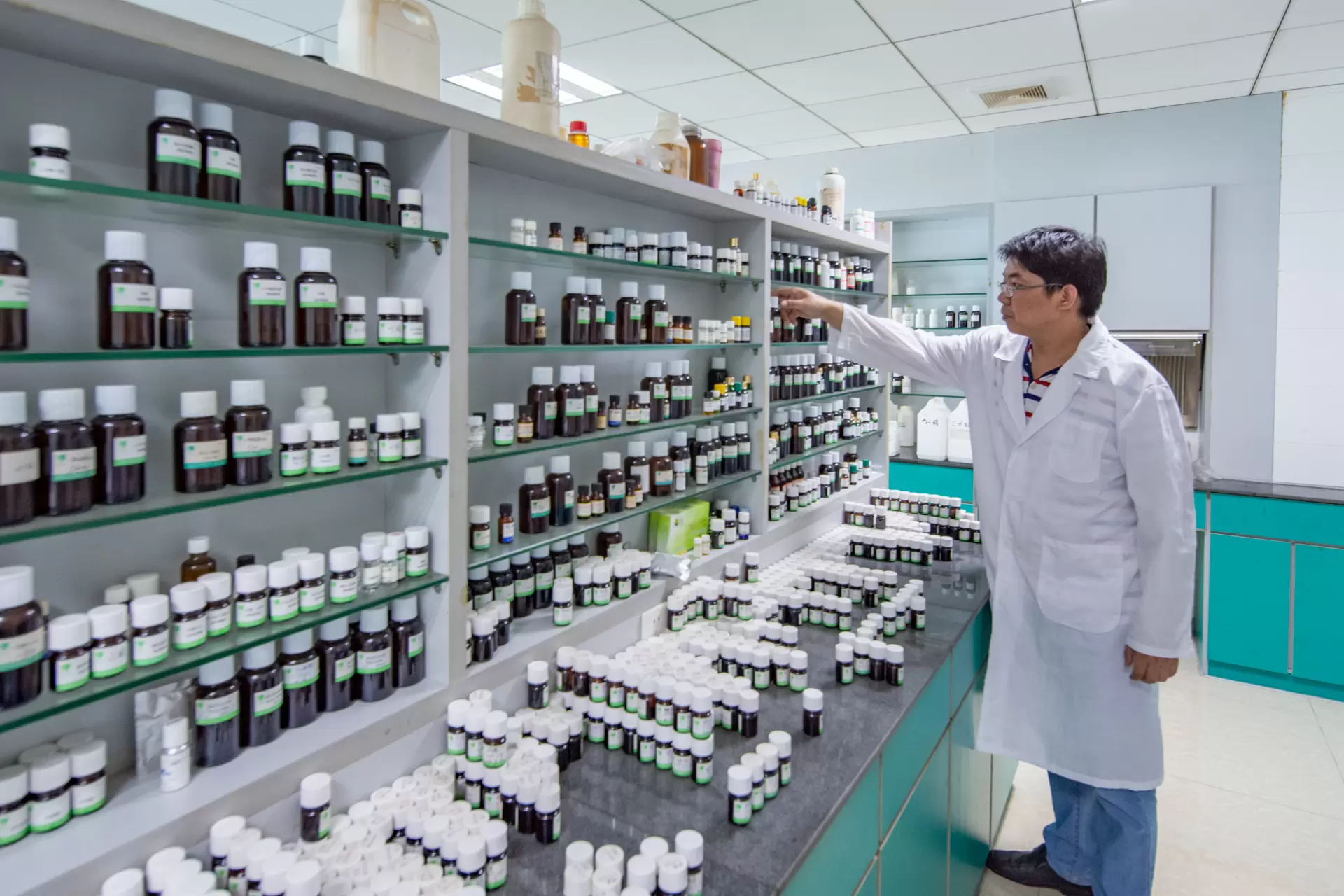
Flavor sample library in the LULIN laboratory
Use seaweed, brown, sweet aroma, woody, green, astringency, bitterness, umami, sweetness, and sourness as separate attributes. Bitterness is a taste; astringency is a drying or gripping mouthfeel.
| Matcha direction | Top, 0–3 seconds | Middle, 3–15 seconds | Base, 15–60 seconds | Main rejection signal |
|---|---|---|---|---|
| Fresh tea | Cut leaf, green bean, light floral | Steamed leaf, restrained umami | Clean, short drying finish | Raw grass or spinach overload |
| Marine umami | Nori-like lift, low sulfur | Brothy fullness, sweet-green body | Mineral, clean savory tail | Fishy, sulfurous, or muddy note |
| Creamy latte | Soft green opening | Cream, vanilla-compatible tea body | Rounded bitterness, little grip | Dairy note erases tea identity |
| Roasted matcha | Low green lift | Toasted grain, nutty tea | Brown, woody, dry finish | Burnt cereal or stale wood |
| Culinary bitter | Direct steamed leaf | Firm tea body, moderate umami | Deliberate bitterness and astringency | Harsh, metallic, or medicinal tail |
| Sweet confectionery | Floral and sweet aroma | Green-tea candy body | Short bitterness, clean sweetness | Generic vanilla-green candy |
A reproducible brief can read: “Fresh-tea direction in an oat-protein drink; green 7/10 and marine 3/10 at 0–3 seconds; umami 6/10 and sweet aroma 3/10 at 3–15 seconds; bitterness 4/10 and astringency 3/10 at 15–60 seconds; no fishy, spinach, burnt, or metallic note; evaluate at 5°C after 24 hours.” That sentence gives a flavorist a target and gives procurement an acceptance test.
How do water, fat, protein, sugar, salt, acid, and serving temperature change Matcha perception?
The finished matrix can reorder a Matcha profile even when the flavor dose stays constant. Aroma compounds partition into water, fat, protein, and headspace; basic tastes and mouthfeel then change how the same aroma is interpreted.
| Matrix variable | Likely change in Matcha perception | Controlled comparison |
|---|---|---|
| Water | Hardness, alkalinity, and dilution can expose thin green, mineral, or bitter edges; real tea solids also respond to water chemistry | Commercial process water versus laboratory water |
| Fat | Retains many hydrophobic volatiles, slows release, and builds creaminess; the exact shift depends on fat type and solid-fat content | Target fat against a reduced-fat control |
| Protein | Can bind aroma and catechins; dairy, soy, pea, and oat systems contribute different cooked, beany, or cereal backgrounds | Same flavor in the actual hydrated protein system |
| Sugar | Reduces the prominence of bitterness and astringency, but high sweetness can turn fresh tea into generic dessert flavor | Full-sugar and reduced-sugar formulas at equal flavor dose |
| Salt | Can suppress some bitter stimuli and alter volatile release; excess salt makes the finish mineral or saline | Actual sodium system against an unsalted control |
| Acid | Adds sourness, changes aroma balance, and may intensify drying character; in products containing real matcha, acid also changes green color | Target pH plus titratable acidity, acid type held constant |
| Serving temperature | Cold reduces volatility; heat raises immediate release but can expose cooked notes and prior process loss | 5°C, 25°C, and 65°C where the product is sold cold, ambient, and hot |
The published three-temperature set supports cross-service comparison; it is not an industry mandate. Score color, sediment, foam, and particle texture separately because a real-matcha color failure does not prove flavor failure.
Which Matcha flavor format should you test: liquid, powder, emulsion, water-soluble, or oil-soluble?
The Matcha flavor format should match both physical handling and the product's continuous phase. Liquid, powder, and emulsion describe physical form; water, propylene glycol, and oil compatibility describe a second axis. The complete first-pass market screening set is below.
| Format option | Best first application | Main advantage | Failure check |
|---|---|---|---|
| Water-soluble liquid | Clear drink, syrup, gummy slurry | Rapid dosing into an aqueous phase | Haze, ring, precipitation, top-note loss |
| PG-soluble liquid | Beverage, confectionery, bakery system accepting propylene glycol | Concentrated liquid handling and broad dispersion | Carrier restriction, declaration, high-dose carrier taste |
| Oil-soluble liquid | Chocolate, fat filling, compound coating, oil seasoning | Places tea aroma in the lipid phase | Oil-off or weak release in water |
| Emulsion | Opaque RTD, dairy-style drink, frozen dessert | Carries oil-phase notes through a designed aqueous dispersion | Creaming, droplet growth, ring, opacity mismatch |
| Water-soluble powder | Instant drink, tablet, dry premix | Dry dosing with intended aqueous reconstitution | Caking, slow dissolution, carrier taste |
| Blended/carrier-based powder | Protein powder, bakery premix, dusting blend | Simple dry blending and metering | Segregation, dust, uneven distribution |
| Spray-dried powder | Dry beverage, confectionery, seasoning | Encapsulated handling and improved volatile protection | Aroma loss, hygroscopicity, incomplete release |
Suppliers need not offer all seven. Compare available constructions in the finished base for release, color interaction, and process retention; the powder-versus-liquid flavor guide covers broader handling choices.
Which processing and storage conditions flatten or distort a Matcha profile?
A Matcha flavor profile can lose fresh-green top notes through heat, oxygen, light, shear, moisture, and package contact, leaving a heavier bitter, brown, or woody finish. Diagnose the loss with paired samples before increasing the flavor dose.
| Condition | Common failure | Paired diagnostic |
|---|---|---|
| Pasteurization, UHT, hot fill | Lower fresh or marine lift; cooked middle | Pre-process versus processed at equal dose |
| Baking or candy cooking | Volatile loss; stronger brown or bitter tail | Raw mix versus cooled finished product |
| Homogenization and high shear | Changed release, foam, sediment, or emulsion stability | Laboratory shear versus production shear |
| Oxygen and headspace | Stale, fatty, cardboard, or muted green note | Low-headspace control versus commercial fill |
| Light | Faded aroma and, with real matcha, weaker green color | Light-protected versus retail-light exposure |
| Package contact | Flavor scalping, odor pickup, or seal interaction | Glass control versus commercial package |
| Powder humidity | Caking, early aroma loss, uneven dose | Sealed dry control versus in-use exposure |
Use week 0, 2, 4, and 8 checkpoints. The 35°C for 8 weeks reference benchmark uses the intended package plus an unstressed control and compares retained aroma, bitterness, astringency, color, sediment, and phase stability. It is an accelerated comparative screen, not a commercial shelf-life assignment, microbial validation, or thermal-process validation.
The benchmark choices come from bounded, named conditions rather than a shelf-life conversion formula.
| Reference input | Reported condition | How it is used here |
|---|---|---|
| Pramudya and Seo, 2018 | Green tea served at 5°C, 25°C, and 65°C | Three-temperature sensory comparison |
| Kim and colleagues, 2020 | 20 g Matcha samples at 4°C, 25°C, 35°C, 45°C, and 80°C for up to 8 weeks | 35°C selected as a discriminating high point below the more severe 45°C and 80°C conditions |
| Japanese tea-storage study, 2002 | Matcha at 4°C, 25°C, and 37°C for up to 24 weeks | Independent support for the 35°C–37°C stress region |
| Flavorah Matcha-type concentrate | Published item range of 0.50%–5.00% w/w | Proof that concentrate rates vary widely; not a category-wide dose |
| COLDAY Matcha Flavoring | 5 g/kg (0.50% w/w) and 10 g/kg (1.00% w/w) in named frozen and cream systems | Basis for the conditional 1.00% w/w upper application reference |
If the top collapses, compare later addition or a protected format. If bitterness rises while aroma falls, check oxidation, water loss, sweetener balance, and tea solids before raising dose. Use food flavor formulation support when the matrix or process causes the failure.
How should a B2B team compare Matcha flavor samples in the real product base?
A B2B team should compare coded Matcha samples in one commercial-base batch under the intended process, package, equilibration, and serving conditions. Strips or water cups can reject defects, not select the production item.
Where cold, ambient, and hot service all matter, use the compact run card below. Every cell receives a separate coded cup and the same timed score sequence; a commercial item that is not intended for all three service modes can omit the irrelevant column.
| Dose row | 5°C session | 25°C session | 65°C session |
|---|---|---|---|
| Unflavored control, 0.00% w/w | Score 0 s–3 s, 3 s–15 s, 15 s–60 s | Score 0 s–3 s, 3 s–15 s, 15 s–60 s | Score 0 s–3 s, 3 s–15 s, 15 s–60 s |
| Supplier low rate | Score 0 s–3 s, 3 s–15 s, 15 s–60 s | Score 0 s–3 s, 3 s–15 s, 15 s–60 s | Score 0 s–3 s, 3 s–15 s, 15 s–60 s |
| Supplier midpoint | Score 0 s–3 s, 3 s–15 s, 15 s–60 s | Score 0 s–3 s, 3 s–15 s, 15 s–60 s | Score 0 s–3 s, 3 s–15 s, 15 s–60 s |
| Supplier high rate, including 1.00% w/w only when supported | Score 0 s–3 s, 3 s–15 s, 15 s–60 s | Score 0 s–3 s, 3 s–15 s, 15 s–60 s | Score 0 s–3 s, 3 s–15 s, 15 s–60 s |
At instrument-appropriate resolution, record batch mass to 0.1 g, flavor to 0.001 g, fat/protein/sugar to 0.01% w/w, salt/acid to 0.001% w/w, product temperature to 0.1°C, peak temperature to 1°C, hold/mixing to 1 s, cooling to 1 min, equilibration to 1 h, and fill mass to 0.1 g. These are record resolutions, not manufacturing tolerances.
- Prepare an unflavored control and an agreed reference. Record base lot, pH, °Brix, fat, protein, salt, viscosity, process water, and color source.
- Prescreen viable formats at each supplier's midpoint. For two finalists, run supplier low, midpoint, and high rates. Published pages include 0.50% w/w for frozen yogurt or sorbet and 1.00% w/w for vegan or cream systems; use 1.00% w/w only when the item sheet supports that reference.
- Make two preparations, assign random codes, cap sessions at six samples, and have at least three trained project evaluators score independently.
- Repeat after actual heat, shear, cooling, fill, and equilibration. At sale temperature, score timed attributes and defects; record appearance and texture separately.
- Advance the winner into the package and 35°C challenge. Track cost in use, handling, dispersion, package compatibility, and retained fit.
This structure follows the profiling logic of ISO 13299:2016: define attributes and references, compare consistently, and connect the sensory profile to development and shelf-life decisions. It does not turn a small internal panel into a consumer-acceptance study.
What belongs in a U.S. Matcha flavoring RFQ?
A U.S. Matcha flavoring RFQ should connect product identity and sensory target to the matrix, process, format, labeling, documents, commercial plan, and destination.
| RFQ block | Required details |
|---|---|
| Product identity | Matcha tea powder, soluble matcha, compounded flavor, flavor powder, extract, emulsion, or flavored blend; product code and revision date |
| Sensory target | Direction table, 0–3/3–15/15–60-second scores, approved reference, prohibited notes, serving temperature |
| Matrix | Water source, pH, acidity, °Brix, sweetener, fat, protein, salt, alcohol, carbonation, color, real matcha solids |
| Process and package | Addition order, shear, homogenization, peak temperature, hold time, cooling, fill, package, headspace, light, target shelf life |
| Format and use | One or more of the seven formats, solubility or dispersibility, carrier, density, supplier low/mid/high rate, cost-in-use basis |
| Technical files | Specification/TDS, lot COA, SDS, ingredient and nonflavor carrier statement, allergen and cross-contact statement, storage and stability data |
| U.S. and destination files | Natural/artificial classification, proposed ingredient declaration, 21 CFR 101.22 certification where applicable, country of origin, requested organic, Halal, Kosher, GMO, or vegan documents |
| Supplier and commercial facts | Legal manufacturer, production site, quality-system certificates, audit body and expiry, traceability, change control, sample terms, MOQ, pack size, price, lead time, Incoterm, forecast, delivery point |
Under 21 CFR 101.22, the sensory name does not decide whether a U.S. flavor is natural or artificial. Composition, source, function, nonflavor ingredients, intended use, and characterizing-flavor presentation control the route. Keep that label decision on the artificial flavor label review page and use the food flavor compliance document planning guide to assemble the item-linked file request.
How can LULIN FLAVOR support a Matcha flavor project from brief to RFQ?
LULIN FLAVOR supports Matcha projects through an application-led review of the finished base, timed sensory target, process, format, market, sample plan, and required documents. LULIN FLAVOR is the public English brand of QUANZHOU LVLIN BIOENGINEERING CO., LTD., a Quanzhou, Fujian food-flavor manufacturer established in 2001 for the development, production, and sales of food-grade flavors.
Send the matrix, Matcha direction, real-matcha content, process profile, package, service temperature, destination, annual quantity stage, and acceptance scorecard. LULIN FLAVOR can connect that brief to application discussion, sample comparison, troubleshooting, and a project-specific commercial response covering documents, packing, quantities, schedule, and shipping destination.
Review the LULIN FLAVOR food flavor manufacturer profile, request Matcha flavor samples for the controlled trial, or contact LULIN FLAVOR about a Matcha project when the formula and evaluation plan are ready.
Matcha flavoring FAQ
Is Matcha flavoring the same as Matcha powder?
No. Matcha flavoring primarily supplies a designed aroma-and-taste profile, while ground matcha contributes tea solids, particle body, natural color, caffeine, catechins, bitterness, and astringency. A formula may use either one or both, but the supplier documents must identify the actual ingredient.
Does Matcha flavoring contain caffeine, catechins, tea solids, or green color?
Not automatically. Those properties depend on the specific composition. Request the caffeine specification, tea-solids content, color contribution, ingredient and carrier statement, and proposed label declaration for the selected item instead of inferring them from “Matcha” in the product name.
Which Matcha flavor format fits a clear drink, protein shake, chocolate, or dry premix?
A clear drink usually starts with a water-soluble liquid; a protein shake may need a compatible liquid, emulsion, or powder; chocolate favors an oil-soluble liquid; and a dry premix favors a water-soluble, blended/carrier-based, or spray-dried powder. Test each in the real continuous phase.
Why can a Matcha profile disappear in dairy or plant protein?
Protein can bind aroma and catechins, fat changes volatile partitioning, and the base contributes cooked, cereal, or beany notes. The result can mute green lift, change umami, and soften astringency. Compare samples only after full protein hydration, processing, and cold equilibration.
Can Matcha flavoring survive pasteurization, UHT, baking, or frozen storage?
A process-matched Matcha flavor can retain its target, but the result depends on composition, addition point, time, temperature, pH, oxygen, phase, and package. Compare pre-process and finished samples at equal dose; a broad “heat-stable” description cannot replace that paired test.
What starting use rate should a product developer test?
Use the selected supplier's low, midpoint, and high rates in the real base. For comparable dairy, plant-based, or frozen systems, 1.00% w/w is a useful upper reference only when the item's technical sheet supports it. Highly concentrated liquids may require materially less, while premixes may require more.
How should buyers compare Matcha flavor samples fairly?
Use one base lot, an unflavored control, an agreed reference, random three-digit codes, two independent preparations, fixed serving temperatures, and independent score sheets. Keep process and package constant, then score timed aroma, taste, mouthfeel, defects, appearance, handling, and cost in use.
What storage screen should buyers use for retained Matcha character?
Use 35°C for 8 weeks in the intended package as the high-end comparative benchmark, with week 0, 2, 4, and 8 readings plus an unstressed control. The screen compares retention and physical stability; it does not establish commercial shelf life or microbiological safety.
Which documents should a U.S. buyer request for Matcha flavoring?
Request the specification/TDS, lot COA, SDS, ingredient and carrier statement, allergen and cross-contact statement, natural/artificial classification, proposed declaration, applicable 21 CFR 101.22 certification, storage and stability data, country of origin, requested certificates, change-control terms, and the commercial quotation.
Develop this flavor in your product
Send your product, target market and project goal. We will review the sample direction with you.