Published
Melon Flavoring
Melon flavoring is a formulated food flavor system that must be defined as honeydew, cantaloupe, Hami, Galia, Charentais, watermelon-style, or candy melon, then judged in the finished matrix. Test each candidate at 75%, 100%, and 125% of its supplier-recommended use rate; use 125% as the high-end screening benchmark before process and storage review.
Last updated: August 31, 2026
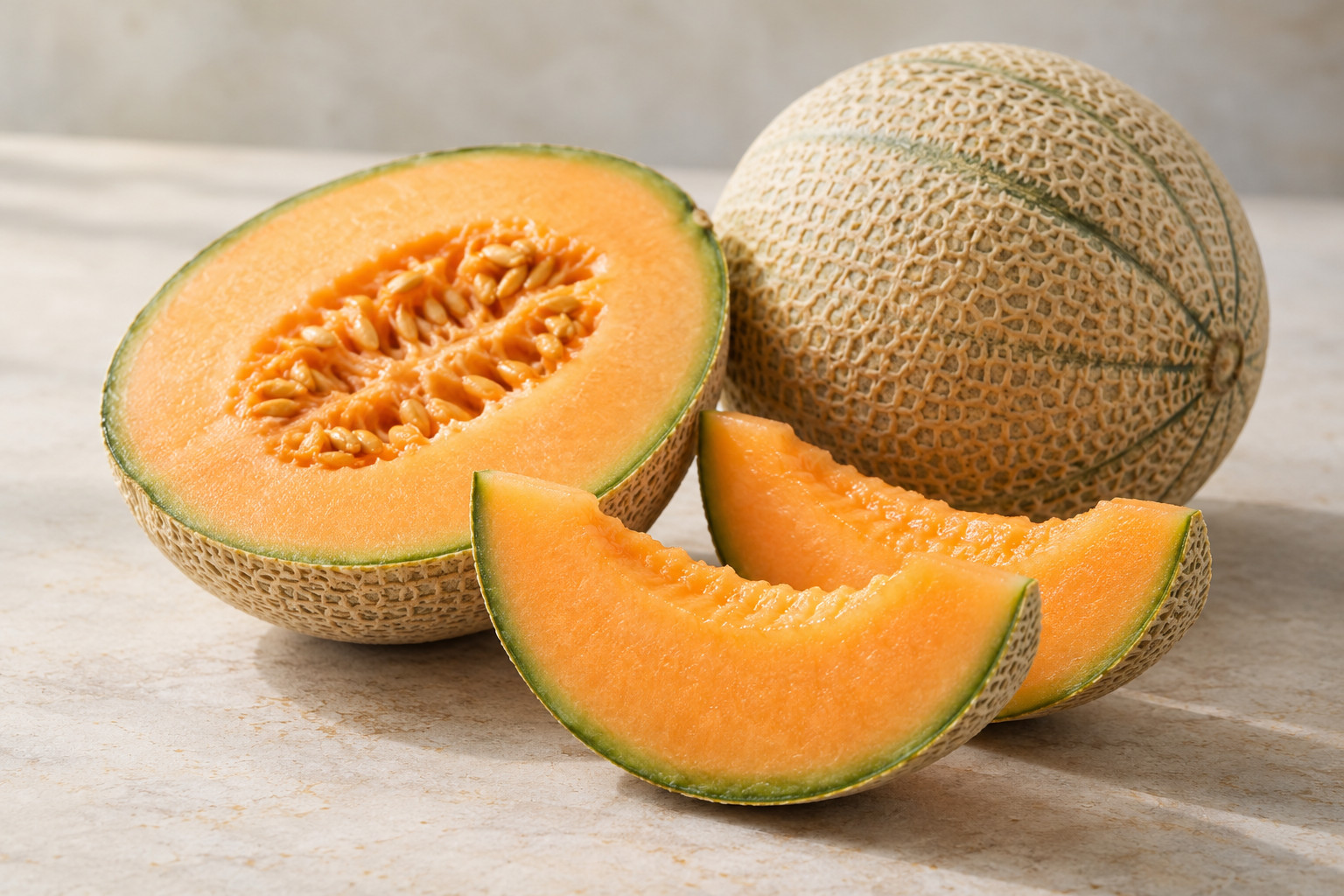
Melon: a sensory reference for defining the target flavor profile.
How should a melon flavor profile be described without vague sensory adjectives?
A usable melon profile identifies type, ripeness, opening, fruit body, finish, and forbidden notes. “Fresh, juicy, and sweet” is too broad. Specify cut honeydew flesh, cool green rind, aromatic orange cantaloupe, dense Hami, floral Charentais, or candy melon.
Melon identity is not a weak-to-strong scale. A comparison of cantaloupe, Galia, and honeydew muskmelons associated cantaloupe with sweet, floral, fruity aroma and persistent aftertaste, Galia with cucumber-like character, and honeydew with cucumber aroma plus sweet flavor. The first 5 types are Cucumis melo; watermelon is Citrullus lanatus. Define “French melon” as Charentais or another reference.
| Melon direction | Opening at 0–2 seconds | Body at 2–10 seconds | Finish at 10–45 seconds | Common unwanted drift |
|---|---|---|---|---|
| Honeydew | Cool, watery-green, light pear nuance | Pale flesh, clean sweetness | Short, fresh, low musk | Cucumber water, thinness |
| Cantaloupe | Ripe orange flesh, floral lift | Dense fruity body, soft musk | Rounded and persistent | Overripe, sulfurous, pumpkin-like |
| Galia | Green-fruity, aromatic | Sweet flesh with cucumber nuance | Clean to lightly musky | Grassy or overly cucumber-like |
| Hami | Crisp green lift, honeyed fruit | Dense sweet melon, optional tropical nuance | Long, ripe, slightly winey | Fermented, heavy, perfumed |
| Charentais | Floral, ripe, high aroma | Orange flesh, honeyed juiciness | Elegant musk, controlled persistence | Soapy floral or overripe finish |
| Watermelon-style | Watery, green rind, red-fruit lift | Light juicy sweetness | Clean or candy-long | Hollow water note or hard-candy harshness |
| Candy melon | Immediate high-impact fruit | Sweet confectionery body | Long, recognizable finish | Perfumery, wax, generic tropical fruit |
Write one sentence with positive and negative boundaries: “Pale honeydew flesh with a cool green opening, low rind bitterness, restrained floral lift, clean sweetness, and no cucumber-heavy or perfumed finish.” That is more useful than “authentic melon, medium strength.”
Separate flavoring, juice, and extract. Flavoring supplies sensory effect; juice, puree, or fruit powder adds solids, sugar, acid, color, and microbiological load. Botanical extract may serve another function. The sensory name does not determine regulatory status; see the B2B guide to how artificial flavor status is reviewed for food labels.
Which top, middle, and base-note directions change a melon brief?
A melon brief becomes actionable when top, middle, and base have separate jobs. Top creates recognition, middle supplies edible fruit, and base controls persistence. Raising all 3 makes a louder sample, not necessarily a better one.
| Layer | Useful directions | Function in a melon profile | Failure signal |
|---|---|---|---|
| Top note | Fresh-cut, watery, green, rind, floral, pear-like, cooling | Establishes honeydew, cantaloupe, or candy identity before sweetness dominates | Weak opening, sharp green burst, solvent-like lift |
| Upper middle | Juicy flesh, light tropical ester, cucumber restraint | Connects aroma to the first taste | Aroma is recognizable but the sip or bite feels empty |
| Core middle | Honeydew flesh, cantaloupe body, Hami density, mixed-melon fruit | Carries the profile through sugar, acid, fat, or protein | Generic fruit, pumpkin-like body, loss of melon identity |
| Lower middle | Honeyed sweetness, creamy roundness, ripe musk | Adds volume and supports dairy, confectionery, or bakery | Heavy, waxy, fermented, overripe |
| Base and finish | Clean decay, soft peel, restrained floral persistence, candy tail | Determines aftertaste length and repeatability | Soap, perfume, bitter rind, lingering artificial harshness |
At 5°C, a clear drink may need more watery-green lift and enough flesh to avoid a hollow finish. Dairy often needs restrained green top, fuller core, and clean creamy base.
Limit winey or sulfurous character in Hami and ripe cantaloupe briefs; low intensity can signal ripeness, but excess reads fermented. Limit cucumber and cut rind in honeydew. Candy melon tolerates a stronger top and longer finish, not a waxy or perfumed tail.
Use time words. “Opening is correct, body is thin after 4 seconds, and cucumber persists from 15 to 45 seconds” identifies the repair. “Not authentic” does not.
Why does the same melon flavoring taste different in water, dairy, protein drinks, gummies, and bakery?
The matrix changes melon identity through volatile partitioning, taste–aroma interaction, viscosity, and release timing. A water cup reveals gross defects, not performance in protein shake, gummy, cake, yogurt, or carbonated drink. Compare at fixed conditions.

Flavor sample library in the LULIN laboratory
| Matrix variable | Controlled diagnostic settings | Likely sensory shift | Melon-specific failure risk |
|---|---|---|---|
| Water and dilution | Same water source and final weight; include an unflavored control | Dilution reduces body before every aroma note falls equally | Watery opening, hollow middle, mineral finish |
| Sugar or sweetener | 0, 8, and 12 °Brix for a beverage model, or the exact commercial sweetness | Sweetness can strengthen fruit association; viscosity can slow release | Candy drift, hidden green note, syrupy finish |
| Acid and pH | pH 3.2, 4.0, and 6.5 diagnostic bases where the application permits | Acidity sharpens the opening and changes sweetness balance | Cucumber-heavy top, thin body, harsh edge |
| Salt and minerals | 0%, 0.05%, and 0.15% salt equivalent; fixed mineral water | Low salt can change sweetness contrast; minerals can add metallic character | Saline rind, metallic finish, reduced freshness |
| Fat | 0%, 3%, and 10% fat models, using the same fat source | Lipids retain many hydrophobic volatiles and delay release | Muted opening, creamy but overlong finish |
| Protein | 0%, 3%, and 8% protein models, using one protein lot | Binding and protein off-notes can change release and recognition | Dull fruit, chalky middle, beany or dairy-heavy tail |
| Serving temperature | 5°C, 20°C, and the actual serving point; use -12°C for a frozen-product check | Colder service lowers immediate aroma impact; warmth accelerates release | Weak cold recognition or warm over-ripeness |
| Carbonation or alcohol | 0 and 3 volumes CO2, or the actual alcohol level | Carbonation lifts aroma and acid bite; ethanol changes solubility and release | Sharp top, short body, solvent-like finish |
These settings isolate causes. If a candidate passes at 8 °Brix but turns candy-like at 12 °Brix, do not increase flavor. If it fails at 8% protein, compare profile and format.
This 16-run reference matrix is a compact diagnostic. Replace model values with legal, physically stable product levels. Keep one flavor lot.
| Run | Flavor dose | Fat | Protein | Sugar solids | Salt | pH | Serve/store point | Age |
|---|---|---|---|---|---|---|---|---|
| 01 | 0% | 0% | 0% | 8% | 0% | 3.2 | 5°C | 0 days |
| 02 | 75% | 0% | 0% | 8% | 0% | 3.2 | 5°C | 0 days |
| 03 | 100% | 0% | 0% | 8% | 0% | 3.2 | 5°C | 0 days |
| 04 | 125% | 0% | 0% | 8% | 0% | 3.2 | 5°C | 0 days |
| 05 | 100% | 0% | 0% | 8% | 0% | 3.2 | 20°C | 0 days |
| 06 | 100% | 0% | 0% | 0% | 0% | 3.2 | 5°C | 0 days |
| 07 | 100% | 0% | 0% | 12% | 0% | 3.2 | 5°C | 0 days |
| 08 | 100% | 0% | 0% | 8% | 0% | 4.0 | 5°C | 0 days |
| 09 | 100% | 0% | 0% | 8% | 0.05% | 3.2 | 5°C | 0 days |
| 10 | 100% | 0% | 0% | 8% | 0.15% | 3.2 | 5°C | 0 days |
| 11 | 100% | 3% | 0% | 8% | 0% | 6.5 | 5°C | 0 days |
| 12 | 100% | 10% | 0% | 8% | 0% | 6.5 | 20°C | 0 days |
| 13 | 100% | 0% | 3% | 8% | 0% | 6.5 | 5°C | 0 days |
| 14 | 100% | 0% | 8% | 8% | 0% | 6.5 | 5°C | 0 days |
| 15 | 100% | 0% | 0% | 8% | 0% | 3.2 | 40°C | 28 days |
| 16 | 100% | 0% | 0% | 8% | 0% | 3.2 | 40°C | 56 days |
Runs 01–04 map dose; 05–10 test temperature, sweetness, acid, and minerals; 11–14 test fat and protein; 15–16 challenge storage. Run real-time storage in parallel. Hold acid identity and titratable acidity constant when pH is not the variable.
Fat can delay fruity release; protein can bind aroma or add competing notes. A bright water sample may become muted in dairy or plant protein. Application-led formulation support for B2B R&D needs the fat, protein, pH, titratable acidity, dose, process, and temperature.
Test cold. A drink approved at 20°C can lose its opening at 5°C; frozen dessert changes during melt and bakery filling during cooling. Approve at consumption temperature.
Which melon flavor format should a manufacturer test: water-soluble liquid, oil-soluble liquid, emulsion, or powder?
Match melon format to product phase, addition point, process, appearance, and line handling. Liquid and powder describe physical form; water-soluble, oil-soluble, and emulsion describe phase behavior. Format alone establishes neither strength nor heat stability.
| Complete named option | Best first-test context | Main melon concern | What to record |
|---|---|---|---|
| Water-soluble liquid | Clear beverages, syrups, gels, wet blends | Top-note loss, carrier fit, haze from the full formula | Clarity, opening, pH response, post-process retention |
| Oil-soluble liquid | Chocolate, fat fillings, coatings, oil phases | Slow release and uneven distribution outside the oil phase | Phase compatibility, bloom, finish timing |
| Oil-in-water emulsion | Cloudy drinks, dairy-style beverages, dispersed systems | Ringing, creaming, sediment, excessive cloud | Droplet stability, appearance, aroma body |
| Spray-dried powder | Dry drinks, bakery premixes, seasonings, tablets | Carrier taste, dust, dispersion, volatile loss | Flow, blend uniformity, reconstitution, heat retention |
| Encapsulated powder | Delayed-release, high-impact dry systems, process-protected concepts | Release trigger and incomplete flavor availability | Release point, residual particles, process survival |
| Melon-derived fruit ingredient | Juice beverages, puree systems, fruit-solids claims | Added sugar, acid, color, solids, microbiology | Brix, acidity, color, identity, solids contribution |
Start clear sparkling water with water-soluble liquid and cloudy drink with oil-in-water emulsion. Start chocolate filling with oil-soluble liquid. Dry beverages merit spray-dried powder; encapsulated powder suits a defined delayed-release need.
Commercial melon products carry stated use rates from about 0.05% to 5% across different concentrations and applications, so equal-weight comparison is invalid. Normalize each candidate to its supplier recommendation, then test 75%, 100%, and 125%. For a 0.20% w/w recommendation, prepare 0.15%, 0.20%, and 0.25% w/w. The 125% point is the high-end screening benchmark, capped by item-specific use conditions.
The broader flavor concentrate selection process explains why “concentrate” is not a standard potency class. Teams can also compare powder and liquid food flavor formats. Here the decision is narrower: which format preserves the intended melon opening, body, and finish?
Why can processing and storage make melon flavoring taste cooked, flat, harsh, or candy-like?
Heat, oxygen, mixing, headspace, cooling, light, packaging, and storage can shift melon toward flat, cooked, cucumber-heavy, or perfumed. Small changes matter because identity depends on volatile top notes and restrained green or ripe accents.
| Observed result | Likely interaction | Confirmation test | Next decision |
|---|---|---|---|
| Opening disappears | Volatilization during heating, open mixing, or long hold | Compare pre-process, post-process, and late-addition splits | Change addition point, profile, or protected format |
| Cooked or pumpkin-like body | Long heat exposure or a heavy ripe base | Compare equal lethality with shorter and longer holds | Reduce cooked base notes or move addition later |
| Cucumber or grassy finish | Green notes exposed after fruity top loss; acid imbalance | Hold pH and sweetness constant, then compare processed and unprocessed cups | Rebalance green top and fruit middle |
| Harsh candy note | Excess top-note impact, high acid, or dose above the useful window | Compare 75%, 100%, and 125% in one base | Select the lowest complete profile, not the loudest sample |
| Oil ring, haze, or sediment | Phase mismatch, poor dispersion, unstable emulsion | Run a controlled mixing and hold test in the final water and mineral system | Choose an emulsion or phase-compatible format |
| Storage drift | Oxygen, light, headspace, package interaction, or temperature | Store identical fills in the intended pack and a control pack | Adjust packaging, antioxidant strategy, profile, or format |
A study of thermally processed muskmelon puree found heating changed aldehydes, esters, alcohols, and other volatiles. Melon can change character, not merely weaken. Compounded flavor still needs its own test.
Check fresh, post-process, and stored samples. Screen Day 0 plus Weeks 2, 4, and 8. Use 40°C as the high-end accelerated benchmark when safe for product and pack. It is not an ambient-life conversion.
Record fill temperature, maximum °C, hold time in seconds or minutes, shear, addition point, cooling time, headspace, light barrier, oxygen exposure, and package material. ASTM E2454-20 treats time, temperature, oxygen, humidity, light, and packaging as sensory shelf-life variables. Microbiological and chemical validation remain separate.
How should melon flavoring be adapted for beverages, dairy, confectionery, bakery, and dry mixes?
Each application needs its own melon brief because matrix and process change the dominant failure. One “best melon” cannot define success across every base.
| Application | First profile direction | Format worth testing | Process checkpoint | Melon-specific approval question |
|---|---|---|---|---|
| Clear still or sparkling beverage | Honeydew, Galia, or clean mixed melon | Water-soluble liquid | After acidification, carbonation, and 24 h equilibration | Is the opening recognizable at 5°C without haze or cucumber dominance? |
| Cloudy juice drink | Cantaloupe, Hami, or mixed melon | Water-soluble liquid and oil-in-water emulsion | After pasteurization and package hold | Does fruit body survive without ringing or sediment? |
| Dairy or frozen dessert | Cantaloupe, Charentais, or creamy honeydew | Emulsion, water-soluble liquid, or powder | After homogenization, aging, freezing, and melt | Does fat create a full body without a waxy tail? |
| Protein beverage | Clean honeydew or bright candy melon | Water-soluble liquid and spray-dried powder | After hydration, heat treatment, and 24 h hold | Does melon remain distinct from protein bitterness or beany notes? |
| Gummy or hard candy | Candy melon, watermelon-style, or ripe cantaloupe | Oil-soluble liquid, emulsion, or protected powder | After cook and cool; flavor added at the defined point | Is impact retained without perfume or bitter rind? |
| Bakery filling or cake | Ripe cantaloupe, Hami, or creamy melon | Oil-soluble liquid, emulsion, spray-dried powder | Before bake, after bake, and after 24 h cooling | Does the middle survive after the fresh top dissipates? |
| Dry beverage or nutrition mix | Honeydew, Hami, or mixed melon | Spray-dried powder and encapsulated powder | After blending, reconstitution, and storage | Is distribution uniform, and does the carrier change the finish? |
Keep melon direction constant while comparing formats.
How should buyers compare melon flavoring samples in the real application base?
Compare melon samples in one controlled base, change one variable, and evaluate at the intended serving condition. The high-end benchmark is 125% of each item’s recommended rate, not another supplier’s absolute percentage.
Use a controlled five-sample first screen
| Code | Sample | Dose | Purpose |
|---|---|---|---|
| C042 | Unflavored control | 0% | Exposes matrix sweetness, acid, protein, mineral, and process notes |
| A317 | Candidate A low | 75% of supplier recommendation | Finds the lowest dose that preserves identity |
| A684 | Candidate A center | 100% of supplier recommendation | Tests the supplier’s intended starting point |
| A925 | Candidate A high | 125% of supplier recommendation | High-end screening benchmark for harshness and cost-in-use |
| R508 | Current reference or approved benchmark | Current formula dose | Anchors the business and sensory comparison |
Use one base batch. Fix final weight, mixing order, shear, equilibration, process, package, storage, and temperature. Blind with 3-digit codes and rotate order. Hide bottle aroma and identifying color.
Run Candidate B at 75%, 100%, and 125% of its own recommendation. Equal percentage does not mean equal strength. Compare each candidate’s best complete profile; compare cost-in-use after the sensory gate.
Score the profile before asking whether it is preferred
| Attribute | Scale | Anchor at 0 | Anchor at 10 |
|---|---|---|---|
| Melon identity accuracy | 0–10 | No recognizable melon | Exact target melon identity |
| Opening impact | 0–10 | No aroma lift | Immediate but controlled recognition |
| Fruit body | 0–10 | Hollow middle | Full flesh character through the bite or sip |
| Sweetness and acid integration | 0–10 | Disconnected | Integrated with the target base |
| Finish quality | 0–10 | Harsh or absent | Clean target persistence |
| Green or rind control | 0–10 | Cucumber, grassy, or bitter | Precise desired green accent |
| Process retention | 0–10 | Identity lost after process | Profile preserved at the decision checkpoint |
| Physical fit | 0–10 | Haze, ring, sediment, separation | Meets clarity and stability target |
ISO 13299:2016 guides sensory profiling. Descriptive scoring identifies what changed. A triangle test under ASTM E1885-25 can test whether a process, package, or formula change is perceptible; it does not explain the direction.
Return code, lot, dose, base, mixing order, process, pack, temperature, date, scores, defects, and requested change. “A317 needs more honeydew flesh from 2 to 10 seconds and less cucumber after 15 seconds” guides revision. “A317 is weak” does not.
Then request food flavor samples for application testing with the matrix and 75% / 100% / 125% plan attached.
What information and documents belong in a melon flavoring RFQ for the United States?
A useful melon RFQ connects sensory direction, base, process, evaluation, market, and purchase stage. R&D, Quality, Regulatory, and Procurement share one brief. Do not advance a strong sample with the wrong carrier, documents, pack, or lead time.
| RFQ field | Information to send | Supplier response required |
|---|---|---|
| Finished product | Beverage, dairy, gummy, hard candy, bakery, powder, or other item | Suitable item and format shortlist |
| Melon target | Honeydew, cantaloupe, Galia, Hami, Charentais, watermelon-style, candy melon; required and avoided notes | Sensory direction and sample codes |
| Matrix | Water source, °Brix or sweetener, pH and acid, salt/minerals, fat, protein, alcohol, carbonation | Compatibility and test-base guidance |
| Process | Addition point, maximum °C, hold time, shear, bake, pasteurization, UHT, retort, drying, freezing | Process-fit recommendation and sample split |
| Evaluation | 75%, 100%, 125% ladder; control; benchmark; serving temperature; storage checkpoints | Supplier-recommended rate and feedback format |
| Format and carrier | Water-soluble, oil-soluble, emulsion, powder; restrictions on propylene glycol, alcohol, oil, maltodextrin, gums | Carrier, solubility, physical form, specification |
| Destination market | United States plus every export market; proposed product name and characterizing flavor claim | Item-specific regulatory and labeling statement |
| Documents | Specification or TDS, lot COA, SDS, allergen statement, ingredient/carrier statement, country of origin, certificates requested by the customer | Current files with item, facility, scope, issuer, and validity |
| Commercial plan | Sample quantity, pilot date, trial order, first order, annual forecast, pack preference, ship-to country | MOQ, sample terms, price, pack, stock status, production lead time, freight terms |
| Supply control | Traceability, change notification, retention sample, complaint contact | Agreed quality and change-control route |
For a United States project, 21 CFR 101.22 covers natural and artificial flavor definitions, B2B labeling, ingredient declarations, and characterizing-flavor statements. “Honeydew,” “cantaloupe,” or “melon” describes a sensory target, not a regulatory classification. Request the item composition and written label support for the finished product.
Use the food flavor compliance document request guide to mark each file as product-specific, lot-specific, facility-level, or market-specific. Ask for title, revision date, covered item, issuer, validity, and language. A catalog logo is not a scoped certificate.
How does LULIN FLAVOR support a melon flavor project?
LULIN FLAVOR supports melon projects through an application-first workflow that connects the sensory target, product base, process, format, sample plan, documents, and commercial RFQ. LULIN FLAVOR is the English brand of QUANZHOU LVLIN BIOENGINEERING CO., LTD., a food-flavor developer and manufacturer established in 2001 in Quanzhou, Fujian, China.
The company develops, produces, and sells food-grade flavors for beverage, bakery, dairy, confectionery, savory, and related manufacturing applications. Its application work covers liquid, powder, concentrate, oil-phase, emulsion, spray-dried, encapsulated, and custom-development routes. The project team can prepare samples, item specifications, lot COAs, SDS files, allergen and carrier statements, and destination-market document sets for the selected melon item.
Buyers can review LULIN FLAVOR’s application-first food flavor routes before sending one consolidated brief. The quotation then states the selected item, sample terms, MOQ, price, packaging, stock or production route, lead time, shipping destination, and requested document scope.
Melon flavoring questions from product developers and procurement teams
Melon flavoring questions need answers. Ground them in controlled, application-specific tests.
What is the difference between melon flavoring, melon extract, and melon juice concentrate?
Melon flavoring primarily delivers a sensory profile; juice concentrate or fruit powder also contributes solids, sugar, acid, and color. “Melon extract” may mean a flavor ingredient, botanical extract, or branded functional ingredient. Extramel and Holimel are not synonyms for general food flavoring.
How do honeydew and cantaloupe flavoring directions differ?
Honeydew usually has pale, watery-green, cool flesh and controlled cucumber or rind. Cantaloupe usually has denser orange flesh, floral-fruity lift, light musk, and a longer finish. Define ripeness, sweetness, green character, persistence, and forbidden notes for either direction.
Why can melon flavoring become cucumber-like or grassy in an acidic drink?
Acid can sharpen the opening while sweetness and processing rebalance green notes and fruit body. Heat or storage may remove fruity lift first, exposing cucumber or rind. Compare fixed pH, titratable acidity, °Brix, dose, water, process, and serving temperature before revision.
How do fat and protein change melon flavor perception?
Fat can delay aroma release, creating a softer opening and longer creamy finish. Protein can bind aroma and add dairy, beany, bitter, or chalky notes. Diagnose with 0%, 3%, and 10% fat models and 0%, 3%, and 8% protein models.
Which melon flavor format works best for baking or dry mixes?
Spray-dried powder is a practical first test for dry mixes and bakery premixes. Encapsulated powder fits a defined release or protection need; oil-soluble liquid suits fat fillings and coatings. Approve only after post-bake or reconstitution testing in the actual base.
How should a buyer dose and compare melon flavoring samples?
Test each candidate at 75%, 100%, and 125% of its supplier-recommended rate in one base batch; 125% is the high-end benchmark. Include an unflavored control and current reference, blind the codes, fix process and serving temperature, then score identity, opening, body, finish, defects, retention, and physical fit.
At what point should melon flavoring be added in a heat-processed product?
Use the latest addition point that preserves safe, uniform incorporation and the validated process. Compare pre-process, post-process, and permitted late-addition samples. Record maximum °C, hold time, shear, cooling, fill condition, and final distribution before selecting the route.
What storage observations should be recorded before approving a melon flavor?
Record identity, opening, body, finish, cucumber or rind drift, cooked or perfumed notes, color, clarity, ring, sediment, and separation. Compare Day 0 with Weeks 2, 4, and 8 in the intended pack, then continue the full shelf-life and safety program.
Can melon flavoring be natural or artificial?
Melon flavoring can be natural, with other natural flavors, natural and artificial, or artificial under the applicable rules and item composition. Sensory name and format do not decide the label. Review the supplier’s ingredient, carrier, and regulatory statement against each destination’s product name and ingredient declaration.
What information and documents should a buyer send when requesting a melon flavor sample from LULIN FLAVOR?
Send the application, melon direction, matrix, process, serving temperature, format, 75% / 100% / 125% plan, markets, sample quantity, pilot date, forecast, and carrier limits. List required specification, COA, SDS, allergen, certificate, labeling, origin, traceability, and change-control documents.
Build the next melon flavor sample brief
Choose one melon identity, define its opening, body, finish, and forbidden notes, then attach the real base, process, serving condition, package, storage plan, and 75% / 100% / 125% ladder. Use 125% as the high-end screening benchmark. Send the completed brief to contact LULIN FLAVOR with a melon project brief so the proposed profile, format, samples, documents, and commercial terms can be evaluated as one project.
Develop this flavor in your product
Send your product, target market and project goal. We will review the sample direction with you.