Published
Mixed Berry Flavoring
Mixed berry flavoring is a formulated multi-fruit flavor system built from strawberry, raspberry, blueberry, blackberry, and cranberry character. Screen liquid at 0.05%, 0.10%, 0.15%, 0.20%, 0.25%, 0.30%, and 0.40% w/w; screen powder or emulsion at 0.25%, 0.50%, 0.75%, and 1.00% w/w. Use 0.50% w/w (5 g/kg) as the high-end design benchmark.
Last updated: 2026-09-01
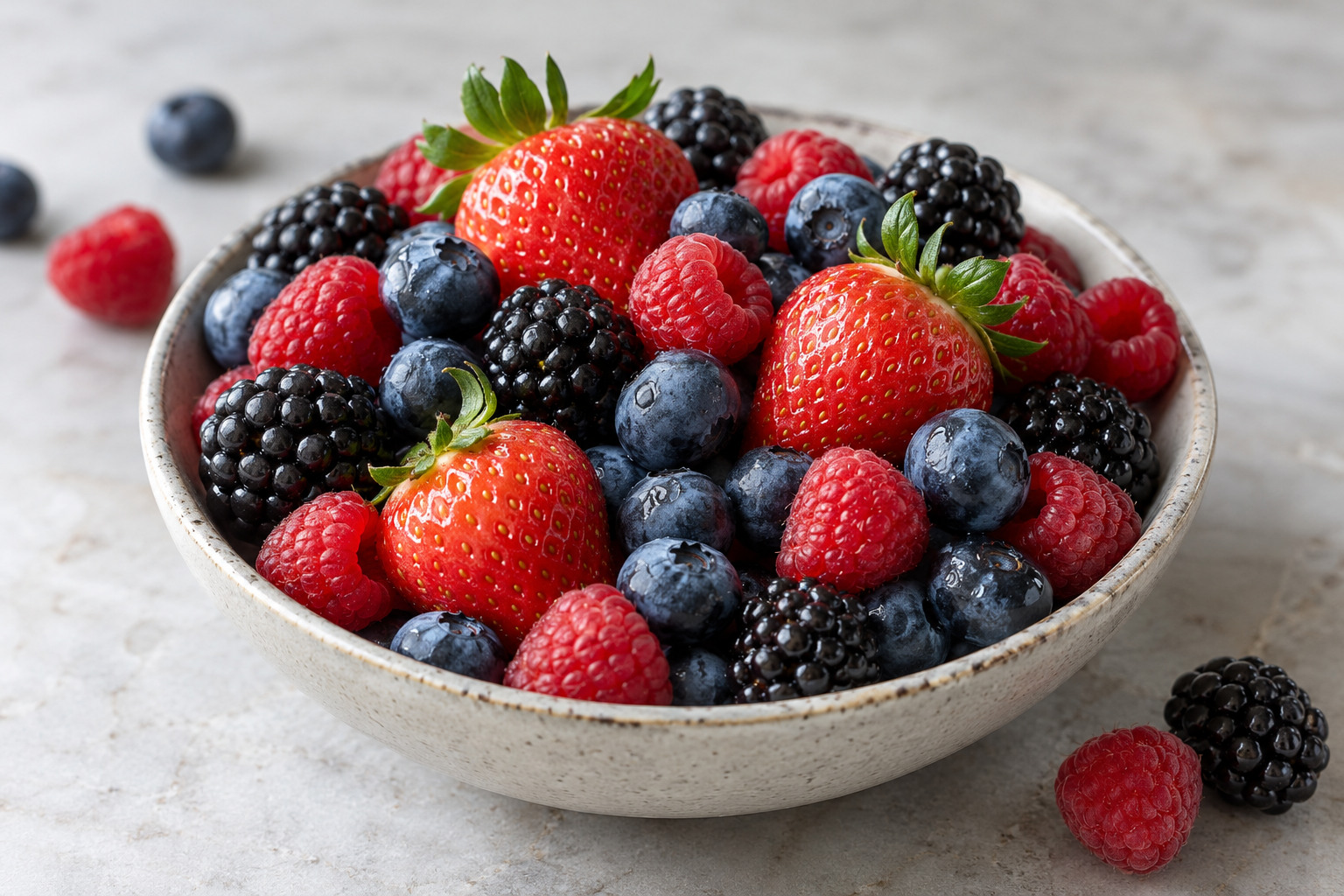
Mixed berry sensory reference: an AI-generated sensory reference for this flavor brief.
What is mixed berry flavoring if it is not a botanical fruit?
Mixed berry flavoring is a multi-fruit flavor system, not the extract of one botanical species. The commercial name describes a blend architecture: which fruits lead, which fruits support, and how the blend should smell and taste in a defined food or beverage.
A buyer who writes “mixed berry, natural, strong” has not specified a product. Strawberry-led juice drinks, raspberry-led gummies, blueberry-led yogurts, blackberry-led teas, and cranberry-led electrolyte powders can share one nickname and still fail one another in a panel.
Write one scoreable sentence. Example: “Strawberry-led mixed berry with raspberry support, juicy lift in the first 2 s, round red-fruit body through 10 s, soft citric tartness, and a clean finish at 4 °C.” Add the product form: still drink, sparkling drink, yogurt, ice cream, bakery filling, gummy, kids fruit snack, dry beverage mix, electrolyte powder, or fiber blend. Color is not flavor. Blind the first panel and score appearance apart from named-fruit identity.
Mixed berry versus juice concentrate, puree, and single-fruit flavor
Flavoring is not juice. Mixed berry juice concentrate, puree, and fruit solids carry sugar, acid, color, pectin, and cooked-fruit notes. Mixed berry flavoring supplies aroma and taste with a defined carrier. Single-fruit flavoring owns one identity. Mixed berry owns the ratio among identities. Keep those three purchasing classes separate in the RFQ.
The food-manufacturing flavor concentrate category covers format navigation across flavors. This page stays on mixed berry blend design, matrix fit, process survival, sampling, and supplier documents.
Natural mixed berry versus artificial mixed berry on a United States label
“Natural mixed berry flavor” does not mean the formula was pressed from a mixed-berry fruit. In the United States, 21 CFR 101.22 sets the wording for natural flavor, artificial flavor, and natural and artificial flavor. The B2B guide to artificial flavor owns that legal-definition question. Name the intended label route before sampling.
| United States label route | What the words require | What the words do not prove |
|---|---|---|
| Natural flavor | Meets 21 CFR 101.22 natural-flavor criteria | Juice, puree, or mixed-berry fruit origin |
| Artificial flavor | Includes artificial characterizing constituents | Low quality or candy-only use |
| Natural and artificial flavor | Combined composition under 21 CFR 101.22 | A fruit-lead ratio |
| Named single-fruit flavor | One fruit identity | Mixed berry blend architecture |
Candy-forward kids snacks often run an artificial or natural-and-artificial mixed berry. Juice-positioned drinks and yogurts often request natural mixed berry. The Flavor and Extract Manufacturers Association Flavor Ingredient Library is a starting reference for ingredient status. EU projects use Regulation (EC) No 1334/2008 with the importer.
Fruit-lead choices that rewrite a mixed berry brief
Fruit lead, not dose, is the first mixed berry specification. Changing the lead fruit can move the product from strawberry jam to raspberry seed, blueberry skin, blackberry wine, or cranberry astringency before anyone touches the usage rate.
| Fruit lead | Identity the panel should name | Useful support fruits | Failure if the lead is too loud | First applications |
|---|---|---|---|---|
| strawberry-led | Ripe red fruit, juicy jam | Raspberry, blueberry | Generic red fruit or cotton-candy | Still drinks, yogurt, bakery |
| raspberry-led | Floral berry, seed, tartness | Strawberry, blackberry | Perfume or seedy dryness | Gummies, sparkling drinks, teas |
| blueberry-led | Floral skin, dark juice | Raspberry, blackberry | Grape candy or empty middle | Dairy drinks, muffins, dry mixes |
| blackberry-led | Dark fruit, winey skin | Raspberry, blueberry | Wood, raisin, or medicinal tail | Teas, sauces, dark candy |
| cranberry-led | Sharp tartness, dry finish | Strawberry, raspberry | Astringency or cough-syrup | Electrolyte powders, mixers |
| equal-blend | No single fruit named first | Strawberry, raspberry, blueberry, blackberry, cranberry | Muddy purple candy | Only when the brief forbids a lead |
Equal-blend mixed berry versus a single-fruit lead
Equal-blend mixed berry is a choice, not a default. Four or five fruits at similar intensity often collapse into a purple-candy middle with no named fruit at 2 s. Use strawberry-led or raspberry-led for beverages, blueberry-led or blackberry-led when the body must read darker, and cranberry-led when tartness is the claim. “70 strawberry / 20 raspberry / 10 blueberry” is a sentence a flavorist can build; “berry blend” is not.
Candy-forward mixed berry versus jam-forward mixed berry
Candy-forward mixed berry hits fast and often carries a sour-candy acid. Jam-forward mixed berry is cooked, sweeter in the middle, and longer in the finish. Kids fruit snacks need the first. Bakery fillings need the second. Sparkling water usually needs neither extreme. A jam-forward filling tasted in sparkling water at 4 °C will read heavy. A candy-forward gummy flavor tasted in muffin filling at 60 °C will read thin.
Which top, middle, and base notes change mixed berry recognition?
Top notes create mixed berry identity, middle notes carry the blend body, and base notes set the finish. Wrong timing leaves a cold drink with a loud opening, an empty center, or a jammy tail that does not match the pack.
Top notes occupy headspace and the first 0 s to 2 s. Fresh beverages need juicy lift. Heavy candy tops disconnect aroma from taste at 4 °C. Middle notes sit from 2 s to 10 s, where the lead fruit must be nameable. Fat, protein, gums, and fiber can suppress that middle. Base notes control 10 s to 60 s. Excess base reads as prune, wood, medicine, or leftover candy.
| Mixed berry direction | Top (0 s to 2 s) | Middle (2 s to 10 s) | Base and finish (10 s to 60 s) | First applications |
|---|---|---|---|---|
| Fresh beverage blend | Juicy strawberry-raspberry lift | Named red-fruit body | Short tart finish | Still drinks, sparkling water, tea |
| Dark berry blend | Concentrated berry, low floral | Blueberry-blackberry skin | Winey-jam persistence | Juice drinks, sauces |
| Jam and bakery blend | Ripe fruit, cooked lift | Pulp, sugar, jam body | Cooked fruit, vanilla, crust | Muffins, fillings, syrups |
| Dairy dessert blend | Soft fruit opening | Round berry through cream | Sweet-tart creamy finish | Yogurt, ice cream |
| Confectionery blend | Fast berry impact, clear acid | Candy fruit body | Clean sweet-tart tail | Gummies, hard candy, fruit snacks |
| Dry-mix blend | Berry after hydration | Blend body in the cup | No dusty cardboard tail | Beverage powders, electrolyte mixes, fiber blends |
When mixed berry shares the formula with lemon, lime, vanilla, cream, tea, or mint, write the role: “mixed berry leads over lemon,” “vanilla rounds the finish,” or “mint is a 2 s top only.”
How do water, fat, protein, sugar, salt, acid, fiber, and serving temperature change mixed berry?
Water, fat, protein, sugar, salt, acid, fiber, and serving temperature change mixed berry release and recognition. Compare the blend in the production base at measured pH, soluble solids, protein, fat, fiber, and serving temperature. Water is only a triage medium.
| Variable | Typical sensory effect on mixed berry | Practical first bracket | Measurements to retain |
|---|---|---|---|
| Water phase | Dilution thins the blend | Production dilution plus 0%, 5%, and 10% solids | Total solids, clarity |
| Fat | Softens acid; delays berry notes | 0%, 3%, and 10% fat | Fat source, emulsion state |
| Protein | Binds aroma or adds bitterness | 0%, 2%, and 8% protein | Protein source, viscosity |
| Sugar and sweetener | Adds body; can bury freshness | 5%, 10%, and 15% soluble solids | °Brix, sweetener identity |
| Salt and minerals | Can lift sweetness or expose metal | 0%, 0.05%, 0.15%, and 0.30% salt-equivalent | Salt species, conductivity |
| Acid and pH | Shifts sourness and fruit identity | pH 3.0, 3.2, 3.4, 3.6, 3.8, 4.0, 4.2, 4.5, or 5.0; acid at 0.10%, 0.20%, 0.30%, 0.40%, 0.50%, or 0.60% | pH to 0.1 unit, titratable acidity |
| Fiber | Delays hydration; adds earthy dust | 0%, 3%, and 8% fiber | Fiber source, reconstitution time |
| Temperature | Cold mutes aroma; warmth raises cooked notes | 4 °C, 20 °C, 25 °C, and 60 °C | Sample temperature |
Lock the beverage first. Hold acid, sweetness, carbonation, and fill condition constant. Lower pH can brighten strawberry-raspberry character. High solids can mute tartness. Carbonation can shorten the finish. Citric acid snaps. Malic acid lingers. A cranberry-led dry mix at pH 3.2 with malic acid will read longer and drier than a strawberry-led drink at pH 3.6 with citric acid.
Fiber, mineral, and protein bases that mute mixed berry
Protein changes release. Milk, whey, pea, or soy protein can suppress fruit or add aftertaste. Fiber is a mixed berry problem that water-only screening misses. Psyllium-type fibers hydrate slowly, trap aroma, and leave a dusty middle. Taste those bases at 5 min, 10 min, and 30 min after reconstitution. A strawberry-led liquid that wins in sweetened water can disappear behind 8% fiber.
Salt is secondary in still drinks and primary in electrolyte powders. Potassium, magnesium, and sodium salts change mixed berry. Magnesium systems can add bitter metallic notes. Screen the actual mineral system at 0.05%, 0.15%, and 0.30% salt-equivalent. Test refrigerated products at 4 °C, shelf-stable products at 20 °C or 25 °C, and hot products at the serving condition.
Which liquid, powder, emulsion, oil-soluble, or water-soluble mixed berry flavoring should a plant test?
Format follows the product phase. Liquid mixed berry flavoring may be water-soluble, oil-soluble, or emulsified. Powder may be spray-dried, carrier-plated, or encapsulated. State the carrier, dosing route, and reconstitution behavior before anyone ranks strength.

Flavor sample library in the LULIN laboratory
| Format | Good first fit | Main benefit | Failure modes to screen |
|---|---|---|---|
| Water-soluble liquid | Clear drinks, syrups, jellies | Fast wet-tank dispersion | Haze, precipitation, heat loss |
| Oil-soluble liquid | Chocolate, fat fillings, coatings | Berry character through fat | Oil ring, delayed aqueous release |
| Emulsion | Cloudy drinks, dairy, sauces | Controlled water dispersion | Separation, viscosity change |
| Powder | Dry mixes, premixes, electrolyte and fiber blends | Dry dosing, no process water | Caking, dust, slow hydration |
| Encapsulated powder | High heat or delayed-release products | Protects volatile notes | Late release, carrier taste |
The complete named format set to put on the first screen is liquid, powder, emulsion, oil-soluble, and water-soluble. Encapsulated powder remains a powder subvariant.
For a first application screen, test a liquid at 0.05%, 0.10%, 0.15%, 0.20%, 0.25%, 0.30%, and 0.40% w/w and a powder or emulsion at 0.25%, 0.50%, 0.75%, and 1.00% w/w. Use 0.10% w/w (1 g/kg) for liquid and 0.50% w/w (5 g/kg) for powder or emulsion as rounded high-end reference benchmarks. They are not legal limits. Do not treat equal percentages across formats as equal strength. Name the carrier that will enter the formula: propylene glycol, ethanol, glycerin, triacetin, or medium-chain triglyceride oil.
Dry-mix mixed berry powder versus wet-tank liquid
Dry-mix mixed berry is a different product from a wet-tank drink. Powder must survive blending, bag storage, and later hydration. Taste dry blends after 5 min, 10 min, and 30 min in the reconstitution water the consumer will use. Inspect emulsions after 0 days, 7 days, 14 days, and 28 days. The powder-versus-liquid flavor guide frames handling before sampling.
Use 0.50% w/w (5 g/kg) as the high-end design benchmark for a demanding emulsion, powder, or heat-exposed mixed berry screen. Retain 0.10% w/w (1 g/kg) as the liquid reference point. Copying a 1.00% powder escalation into a clear still drink creates carrier taste and a false rejection.
Process and storage conditions that rewrite mixed berry character
Heat, oxygen, acid hold, dry-mix moisture, and package contact can shift mixed berry from a fresh blend to cooked candy or cardboard. Sample every major step, then use the final package.
| Condition | Possible change in mixed berry | Comparison to run |
|---|---|---|
| Pasteurization, hot fill, or UHT | Top-note loss and cooked fruit | Pre-process versus post-process |
| Baking or cooking | Jam development or bitter edge | Before heat versus protected addition |
| High shear or homogenization | Faster dispersion or aroma stripping | Bench mix versus process pass |
| Acid hold | Brighter sourness, later drift | Day 0 versus planned acid residence |
| Freeze-thaw | Phase separation or delayed release | Fresh, frozen, and thawed samples |
| Oxygen and light | Faded berry or cardboard | Low-headspace versus normal package |
| Dry-mix moisture | Caking or dusty reconstitution | Sealed bag versus humidity exposure |
| Package contact | Sorption or liner interaction | Glass versus production container |
| Storage | Loss or longer cooked finish | 0 days, 7 days, 14 days, 28 days, 56 days, and 90 days at 4 °C, 20 °C, and 25 °C |
Record addition order, mixing time, hydration, shear, peak temperature, hold time, cooling rate, carbonation, fill temperature, headspace, package material, and closure. Record the scheduled peak at 72 °C, 85 °C, 88 °C, 90 °C, 92 °C, 95 °C, or 135 °C and the hold at 15 s, 30 s, 60 s, or 90 s.
Hot-fill drinks versus baked fillings and confectionery heat
Hot-fill and pasteurization often sit near 72 °C, 85 °C, or 95 °C depending on the scheduled process. UHT sits higher, commonly around 135 °C. Baking and candy depositing last longer. Mixed berry top notes are the first to leave. A strawberry-led beverage blend that wins in a cold bench tank at 4 °C can read as jam after hot fill at 85 °C or 95 °C. Split the test: flavor added before heat versus a protected or post-process addition. Light and oxygen strip the 0 s to 2 s lift first; a 90-day bag sample can keep color and lose the named fruit.
How should a buyer compare mixed berry samples in the real application base?
Compare mixed berry samples in the finished application base, not in flavored water alone. Use coded samples: clean control, current or reference flavor, and a dose ladder. Prepare by mass with identical lots, fixed equilibration, production vessels, and intended serving temperature.
| Code | Sample construction | Purpose | Minimum observations |
|---|---|---|---|
| C0 | Finished base without mixed berry flavoring | Matrix aroma and aftertaste | pH, °Brix, viscosity, appearance |
| C1 | Current or reference mixed berry system | Comparison denominator | Dose, lot, process, package |
| T1 | Candidate at 0.05% liquid or 0.25% powder | Low-impact start | Identity, lead fruit, top, body, finish |
| T2 | Candidate at 0.10% liquid or 0.50% powder | Reference benchmark screen | Same measures plus cost-in-use |
| T3 | Candidate at 0.20% liquid or 0.75% powder | Stronger direction if fruit is suppressed | Carrier, bitterness, color, aftertaste |
| T4 | Candidate at 0.40% liquid or 1.00% powder | Escalation for a difficult base | Item-specific technical review first |
The 0.15%, 0.25%, and 0.30% liquid rungs belong on the same complete liquid screen when the first four points do not bracket the target. Keep 0.50% w/w (5 g/kg) as the high-end design benchmark for powder, emulsion, and heat-exposed work.
Use a 0 to 10 anchored scale: 0 = not perceived, 3 = distinct but acceptable, 5 = rejection threshold, 7 = strong, and 10 = extreme. Score identity, lead fruit, body, acidity, sweetness, cooked note, bitterness, dusty fiber, and appearance at 0 s, 2 s, 10 s, 30 s, and 60 s. Add 90 s or 120 s for a persistent dairy, protein, fiber, or candy finish.
A paired comparison asks which code is closer to the benchmark. A triangle test asks whether one sample differs from two identical samples. ISO 4120:2021, ISO 13299:2016, and ISO 8586:2023 from the International Organization for Standardization, plus ASTM E1871-17, are useful methods for a sensory or quality team. Repeat the winner on process-representative equipment and in the production package. Empty middle is not “needs more dose.” Metallic mineral aftertaste is not “wrong berry.” Dusty 30 min fiber reconstitution is not “weak strawberry.”
What belongs in a mixed berry flavoring RFQ for a United States food project?
A mixed berry RFQ names one product, one blend target, one process, one market, and one decision date. That focus lets a supplier choose a relevant format instead of a generic berry sample.
| RFQ field | Details to provide | Why it matters |
|---|---|---|
| Finished product | Product form, serving size, and serving temperature | Sets release and format |
| Sensory target | Fruit lead, support fruits, notes, acid, sweetness, finish, candy versus jam | Makes mixed berry scoreable |
| Formula | Water, fat, protein, sugar/°Brix, salt, acid/pH, fiber, gums, competing flavors | Predicts suppression |
| Process | Mix, shear, pasteurization, UHT, bake, freeze, carbonation, fill | Sets survival tests |
| Format | Liquid, powder, emulsion, oil-soluble, water-soluble, or open | Narrows carrier choice |
| Evaluation | Controls, dose ladder, panel date, pilot date, package | Makes the decision repeatable |
| Market and label | United States, Canada, EU; natural, artificial, or both | Directs label review |
| Documents | COA, SDS/MSDS, TDS, allergen, natural/artificial, Halal, Kosher, vegan, non-GMO, organic | Defines the QA file |
| Commercial plan | Trial quantity, pack size, storage, cost-in-use, purchasing stage | Frames MOQ, price, lead time |
For United States products, ask QA to review the composition under 21 CFR 101.22 and applicable material from the U.S. Food and Drug Administration or Flavor and Extract Manufacturers Association. For EU projects, review Regulation (EC) No 1334/2008 with the importer. The FDA labeling rule and FEMA Flavor Ingredient Library are starting references, not a substitute for item-level review.
LULIN FLAVOR is the English brand of QUANZHOU LVLIN BIOENGINEERING CO., LTD., established in 2001 in Quanzhou Fujian, China. The company develops, produces, and sells food-grade flavors and daily-use fragrances. Its public company profile describes 12 engineers with 20 years of flavor development and application experience, 3 modernized production lines, 50 employees, a 6-acre factory area, and more than 8000 m² of building area. Ask the supplier to quote 50 g and 100 g samples, then 1 kg, 5 kg, 10 kg, 20 kg, and 25 kg production packs, and to state whether the selected item is rated for 1 year, 2 years, or 3 years at 20 °C or 25 °C. Food categories include beverage, candy and confectionery, bakery, and sparkling-wine or carbonated alcoholic beverage flavors. Its application laboratory can refine, adjust, and create formulas and keeps mature formulas for reference.
Documents follow the item. Company capability does not set a universal dose, certification, MOQ, price, package, shelf life, storage condition, or schedule. Ask for those details in the RFQ. Use formulation support for B2B R&D for matrix adjustment and the compliance document request guide for files.
Frequently Asked Questions About Mixed Berry Flavoring
What is mixed berry flavoring used for in B2B food production?
Mixed berry flavoring builds a defined multi-fruit aroma and taste in beverages, dairy desserts, bakery products, fillings, syrups, confectionery, kids fruit snacks, sauces, dry mixes, electrolyte powders, and fiber blends. The suitable fruit lead, profile, and format depend on the finished matrix, process, serving temperature, target market, and label wording.
How should a buyer describe a mixed berry flavor profile?
State the fruit lead, support fruits, ripeness, top aroma, mid-palate body, acidity, sweetness, finish, candy versus jam direction, color expectation, and serving temperature. A sentence such as “strawberry-led mixed berry with raspberry support, a juicy 0 s to 2 s lift, and a clean tart finish at 4 °C” gives the panel a scoreable target.
Is mixed berry flavoring the same as mixed berry juice concentrate?
No. Flavoring is a formulated aroma-and-taste system, while a juice concentrate or puree carries a different mix of fruit solids, color, acidity, pectin, and process behavior. Compare aroma, taste, solids, color, stability, and cost-in-use in the finished product before choosing one.
Which fruit should lead a mixed berry blend?
Choose a named lead before choosing a dose: strawberry-led, raspberry-led, blueberry-led, blackberry-led, cranberry-led, or equal-blend. Beverages usually start strawberry-led or raspberry-led; darker dairy and bakery products may start blueberry-led or blackberry-led; tart dry mixes may start cranberry-led. Equal-blend is a deliberate choice, not a safe default.
Which format should a buyer test first: liquid, powder, emulsion, oil-soluble, or water-soluble?
Match the format to the product phase and factory route: water-soluble liquid for many water systems, oil-soluble liquid for fat systems, emulsion for controlled dispersion, and powder for dry blends. Confirm carrier, solubility, heat response, storage, and handling in the actual formula.
What starting dosage should be screened for mixed berry flavoring?
Screen 0.05%, 0.10%, 0.15%, 0.20%, 0.25%, 0.30%, and 0.40% w/w for liquid, using 0.10% as a liquid reference benchmark; screen 0.25%, 0.50%, 0.75%, and 1.00% w/w for powder or emulsion, using 0.50% as the high-end design benchmark. Confirm the selected item’s technical guidance before scale-up.
How do protein, fiber, and minerals affect mixed berry flavor?
Protein can bind aroma or add a competing aftertaste, fiber can delay hydration and add a dusty middle, and minerals can expose metallic notes that a panel may blame on the blend. Hold production values constant during the first comparison, then bracket one variable at a time with measured protein, fiber, salt-equivalent, pH, and °Brix.
Can mixed berry flavoring survive pasteurization, baking, or dry-mix storage?
It can be evaluated for those processes, but survival depends on composition, addition point, peak temperature, hold time, shear, cooling, moisture, package, and storage. Compare pre- and post-process samples and retain a production-package sample before approving a heat-stability or shelf-life statement.
How should mixed berry flavor samples be compared?
Use coded samples in the real application base with a clean control, a current or reference flavor, and a dose ladder. Score named fruit lead, aroma, attack, body, acidity, sweetness, finish, aftertaste, appearance, and process fit at fixed temperatures and time points, then repeat the selected treatment on a pilot.
Can LULIN FLAVOR develop a custom mixed berry flavoring direction?
LULIN FLAVOR provides food-flavor development and application support, including formula refinement and creation through its application laboratory. Send the finished base, mixed berry sensory sentence, fruit-lead choice, process, target market, and sample request so the team can discuss a suitable development route and item-specific technical and commercial information.
Set the next mixed berry flavoring screen
Test before purchasing. Prepare a one-page brief with the fruit lead, support fruits, top/middle/base notes, matrix, process, serving temperature, market, format, dose ladder, controls, documents, pilot date, and purchasing stage. Use 0.10% w/w (1 g/kg) as the liquid reference benchmark and 0.50% w/w (5 g/kg) as the high-end design benchmark for a demanding screen. LULIN FLAVOR can discuss a liquid, powder, emulsion, oil-soluble, water-soluble, or custom mixed berry direction. Start with the B2B sample request or contact LULIN FLAVOR.
Develop this flavor in your product
Send your product, target market and project goal. We will review the sample direction with you.