Published
Onion Flavoring
Onion flavoring is a concentrated sensory system that can express fresh-cut sulfur bite, green scallion lift, sautéed sweetness, fried savoriness, or roasted depth without relying on onion pieces. Define top, middle, and base notes before choosing a format. For savory screening, use 0.30% w/w as the high-end reference benchmark, then optimize downward in the processed application base.
Last updated: August 31, 2026
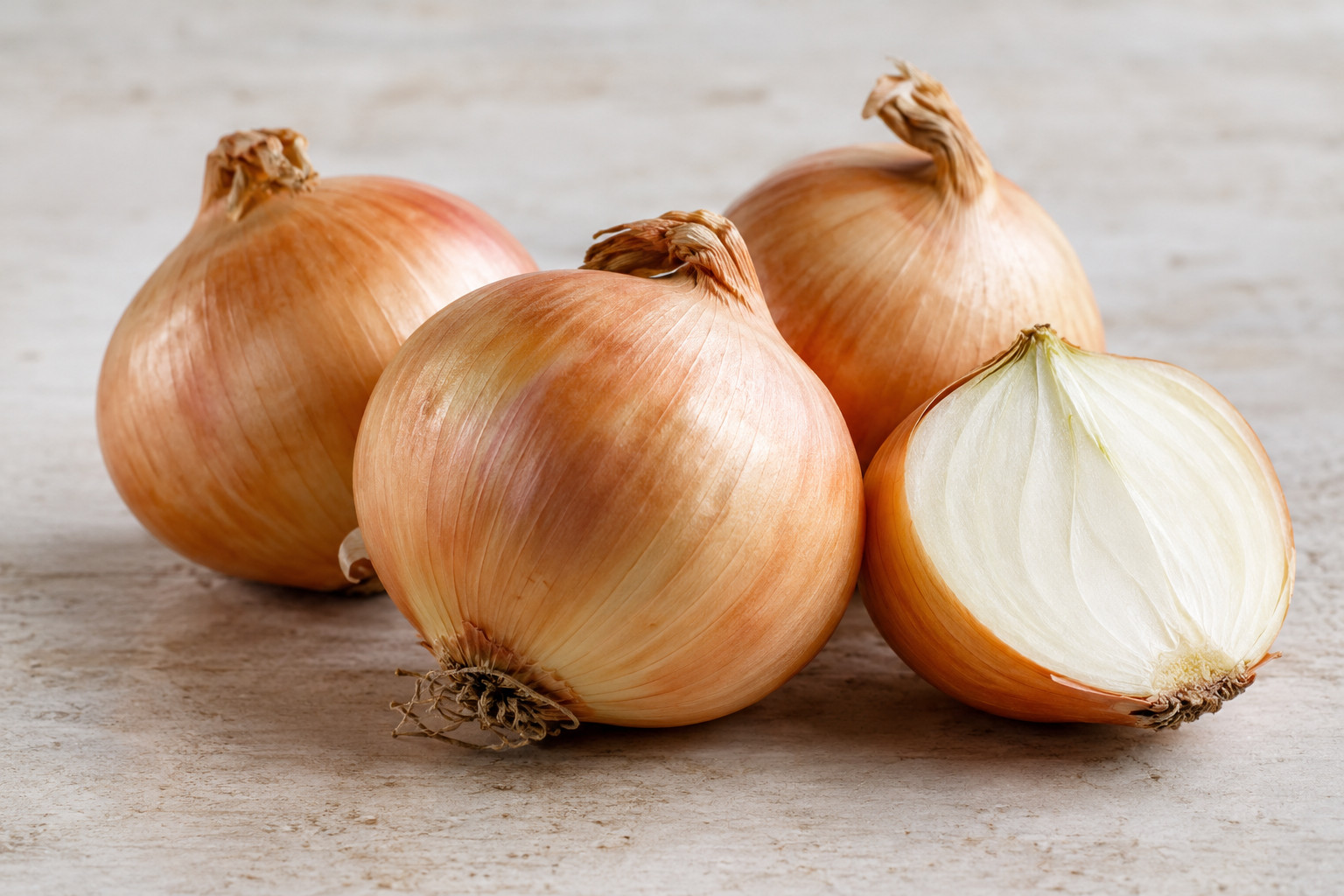
Onions: a sensory reference for defining the target flavor profile.
How should an Onion Flavoring profile be described without vague sensory adjectives?
An onion flavoring brief should name bulb identity, culinary state, sulfur character, browning, sweetness-to-savory balance, timing, finish, exclusions, and test condition. “Strong onion” is not a usable target.
Name the bulb and heat history: yellow, white, red, or green; then raw-cut, soft-cooked, sautéed, caramelized, roasted, fried, or charred. Keep aroma terms (pungent, green, fried-oil, toasted) separate from taste (sweet, salty, acidic, bitter, umami) and mouthfeel (juicy, dry, oily, persistent). That split prevents an acid or stale-oil fault from being reported as weak Onion.
| Brief field | Useful Onion wording | Reject wording | Why it matters |
|---|---|---|---|
| Identity | Yellow bulb, White bulb, Red onion, Green onion | Natural, authentic | Narrows the recognizable Allium target |
| Culinary state | Raw-cut, Soft-cooked, Sautéed, Caramelized, Roasted, Fried | Rich, premium | Defines the intended heat history |
| Sulfur character | Crisp, juicy, restrained, brothy, lingering | Oniony | Separates clean onion from garlic, cabbage, egg, or rubber notes |
| Brown character | Golden, toasted, nutty, dark, charred | Deep | Controls caramel, roast, smoke, and bitterness |
| Timing | Fast top, full middle, 30-second finish | Long-lasting | Makes onset and persistence measurable |
| Exclusions | No garlic, leek, cabbage sulfur, smoke, stale oil | No off-notes | Gives the flavorist a correction boundary |
A usable sentence is specific: “Golden Sautéed Onion with a moderate cooked-bulb middle, light Fried Onion finish, low raw bite, and no garlic, cabbage sulfur, smoke, or stale oil; evaluate in the production dip at 8°C after 24 hours.” Category-level flavor concentrates for food manufacturing provide navigation; this page owns the narrower Onion profile and application decision.
Which top, middle, and base notes separate raw, sautéed, caramelized, and fried Onion?
Onion top, middle, and base notes describe sensory timing: the top arrives first, the middle establishes the culinary identity, and the base remains after swallowing. They are briefing layers, not a chemical classification.
| Complete profile direction | Top note | Middle note | Base or finish | Typical rejection cue |
|---|---|---|---|---|
| Raw-Cut Bulb Onion | Juicy, sharp, immediate sulfur | Pungent bulb | Lingering raw bite | Tear-gas harshness, garlic, cabbage |
| Fresh Green Onion | Leafy, green, quick | Mild scallion | Short, clean Allium finish | Grass, leek dominance |
| Pickled Red Onion | Crisp acid lift | Mild sweet red-onion cue | Clean vinegar tang | Vinegar with no onion identity |
| Soft-Cooked Onion | Low sharpness | Sweet cooked bulb | Brothy sulfur | Flatness, boiled cabbage |
| Sautéed Onion | Golden cooked lift | Sweet-savory onion | Gentle toast | Generic oiliness |
| Caramelized Onion | Sweet brown onset | Mellow bulb | Caramel, broth, long depth | Molasses without onion |
| Roasted Onion | Toasted onset | Browned bulb | Nutty, earthy roast | Dust, bitter burn |
| Fried Onion | Fried-oil and brown onset | Cooked sulfur | Fatty toasted persistence | Stale oil, scorched bitterness |
| Smoked or Charred Onion | Smoke or char | Roasted bulb | Bitter-dark finish | Smoke erases onion |
Fresh-cut Allium cepa releases a volatile top quickly; heat and drying move it toward thiophene, pyrazine, and brown notes. In the 2017 Food Chemistry study by Choi et al., drying checkpoints were 50°C, 70°C, and 90°C. More cooked flavor therefore cannot repair a missing raw top; pair a durable Sautéed Onion body with a restrained Raw-Cut Bulb Onion lift.
Pair timing with the base: sour cream, cultured dairy, chive, and restrained garlic suit a cold dip; beef, chicken, mushroom, yeast extract, and black pepper reinforce brothy or roasted directions; vinegar and sugar support Pickled Red Onion. Smoke belongs only in an explicit Smoked or Charred Onion brief.
How do water, fat, protein, sugar, salt, acid, and serving temperature change Onion perception?
Water, fat, protein, sugar, salt, acid, and temperature alter dispersion, volatile release, taste balance, and sulfur timing. A sample sharp in water may taste late or flat in dairy, meat, or plant-protein food.
| Matrix factor | Likely sensory change | Controlled Onion test |
|---|---|---|
| Water phase | Exposes fast top notes but can leave a thin middle | Use water only for dispersion screening; approve in the complete formula |
| Fat level | Retains oil-affine aroma, delays release, and lengthens fried or roasted notes | Compare the actual 0%, 5%, or 15% fat condition used by the project |
| Protein source | Can bind or mask aroma and contributes dairy, soy, pea, or meat notes | Test the real protein after full hydration, including a 24-hour sample |
| Sugar solids | Softens sharpness and can push cooked onion toward caramelized sweetness | Hold 3%, 8%, or 15% sugar constant while changing only flavor dose |
| Salt level | Raises savory impact but can expose harsh sulfur when too high | Fix sodium and seasoning distribution before comparing suppliers |
| Acid system | Moves the profile toward pickled, cultured, or bright and can thin brown sweetness | Record acid type, pH, and titratable acidity; do not use pH alone |
| Serving temperature | Cold suppresses aroma; warmth accelerates release and exposes cooked notes | Evaluate at the stated 8°C, 25°C, or 60°C serving condition |
Use these as checkpoints, not recipes: judge sour-cream dip at 8°C after equilibration, soup at 60°C, and snack seasoning on the finished substrate after 6–8% oil pickup and 1.5–2.0% salt. Compare thin broth, mayonnaise, processed cheese, and plant-protein filling at matched shear and pH. Food flavor formulation support for B2B R&D connects the brief with the actual matrix and addition point.
Which Onion Flavoring format should be tested in water, oil, emulsion, or powder systems?
The Onion Flavoring format must match phase, process, appearance, release, and factory dosing; “powder versus liquid” is only the first split. Six named routes cover development.

Flavor sample library in the LULIN laboratory
| Format option | Best starting applications | Main advantage | Approval check |
|---|---|---|---|
| Water-Soluble Liquid | Soups, brines, sauces, dressings | Fast wet dosing and uniform water-phase distribution | Clarity, top-note loss, carrier fit |
| Oil-Soluble Liquid | Seasoning oil, fat fillings, meat fat systems | Direct delivery into the lipid phase | Water-phase separation, delayed release |
| Water-Dispersible Emulsion | Dips, sauces, compound bases | Moves oil-affine notes into a water-continuous product | Creaming, oil ring, shear, freeze-thaw response |
| Spray-Dried Powder | Soup mix, snack seasoning, dry sauce, premix | Dry handling with protected aroma and controlled dispersion | Carrier taste, caking, dust, reconstitution |
| Plated Powder | Seasoning blends, bakery premixes, short development runs | Simple dry dosing and rapid profile adjustment | Segregation, carrier load, batch uniformity |
| Encapsulated Powder | Extrusion, baking, delayed-release systems | Targets process protection or later release | Release after the real heat and moisture cycle |
No route is inherently stronger. Oil-Soluble Liquid can make Fried Onion work in a snack coating yet separate in soup; Spray-Dried Powder can dry-blend yet lose fresh top in extrusion. Encapsulation protects only against defined heat and moisture. The guide to powder and liquid food flavors covers handling; for Onion, request carrier or solvent, addition point, phase behavior, bulk density, and matched sensory direction.
What processing and storage conditions change fresh, sautéed, fried, or roasted Onion notes?
Heat shifts notes. Approve only after the full process, with oxygen, light, shear, addition point, packaging, and storage tracked.
| Condition | Common Onion shift | Trial that answers the decision |
|---|---|---|
| Retort or hot fill | Raw lift falls; brothy or sulfur base dominates | Compare before process, after cooling, and after 24 hours |
| Baking or extrusion | Volatiles escape; toast, bitterness, or hollow body appears | Use the actual peak temperature, residence time, and moisture |
| Frying or hot oil | Fried cues rise; stale oil and burnt sulfur can accumulate | Test with production oil age and coating sequence |
| High shear | Emulsion distribution and release can change | Replicate mixer, homogenizer, pressure, and addition order |
| Oxygen and light | Top notes flatten; stale or metallic edges develop | Compare protected and exposed packs in the commercial material |
| Dry storage humidity | Powder cakes, segregates, or loses top note | Measure flow and sensory change at 0, 7, and 28 days |
| Package contact | Liners and polymers can retain volatile notes | Store in the final bottle, pouch, drum liner, or sachet |
Choi, Lee, Kim, and Lim’s Food Chemistry 231 (2017) study compared 50°C, 70°C, and 90°C drying; fresh dipropyl disulfide fell as thiophene and caramel notes rose. Horbowicz and Bąkowski reported 15–20% pungency loss at 40°C/50°C × 20 h, about 50% at 60°C, and up to 75% after −25°C freeze/thaw. These are study checkpoints, not factory limits.
| Reference checkpoint | Reported condition | What it helps diagnose |
|---|---|---|
| Robertet sautéed/roasted extract | 0.10–0.30% as consumed; NR2601, NR2604, NR2620, NR2622 | High-end screen for concentrated savory Onion |
| Robertet green extract NR2623 | 0.30–0.50% as consumed | Green Onion is an item-specific exception |
| Essencefield dehydrated Onion powder | 0.3–5% inclusion; 60–80 mesh | Powder inclusion cannot set liquid-flavor dose |
| Choi et al., Food Chemistry 231 (2017) | 50°C, 70°C, 90°C; dipropyl disulfide 77.70% of volatiles | Fresh-to-dried aroma shift |
| Horbowicz & Bąkowski, Acta Agrobotanica 50 (1997) | 40°C/50°C × 20 h; 60°C; −25°C freeze/thaw; 15–20%, ~50%, up to 75% loss | Pungency loss under drying and freezing |
| USDEC sour-cream/onion snack example | 6–8% oil pickup; 1.5–2.0% salt; 10% dried Onion | Hot post-fryer coating context |
| Early storage screen | 0, 7, 28 days; 24-hour equilibration | Package and process drift before shelf-life validation |
Robertet’s PDF names NR2601, NR2604, NR2620, NR2622, and green NR2623; its sautéed/roasted examples sit at 0.10–0.30% as consumed, while NR2623 sits at 0.30–0.50%. ISO 13299:2016 and ISO 4120:2021 anchor profile and difference checks.
Addition point can fix what dose cannot: add cooked body before heat and permitted fresh or green top after heat; record each split percentage, mixer, and hygiene control.
How should buyers compare Onion Flavoring samples in the real application base?
Compare coded Onion Flavoring samples in one production-relevant base. Start at 0.30% w/w, then move the preferred item down to the lowest dose surviving process, storage, and service.
Use 0.05%, 0.10%, 0.20%, and 0.30% w/w for matched concentrated savory samples. The 0.30% high end follows Robertet Canada sautéed/roasted examples; green Onion NR2623 remains a 0.30–0.50% item-specific exception. Do not equate extract, dehydrated powder, and compounded flavor by weight.
- Lock one formula, ingredient lot, process, and serving condition.
- Prepare an unflavored control, culinary reference, and 3–5 candidates.
- Make at least 300 g per level, weigh the dose, and assign random 3-digit codes.
- Balance order across 6–10 assessors; serve identical 30 g portions and read the 30-second finish.
- Score aroma, mid-palate identity, and finish.
- Process leaders through heat, shear, cooling, filling, package, and storage.
- Repeat the winner under a second code; a non-repeat does not enter pilot production.
| Decision dimension | Weight | Pass signal | Automatic rejection |
|---|---|---|---|
| Target Onion profile match | 30 | Named top, middle, and base appear in the intended order | Wrong culinary state |
| Process and storage retention | 25 | Identity remains after the full process | Major loss or new burnt sulfur |
| Matrix integration | 20 | Salt, acid, fat, and protein support the profile | Garlic, cabbage, egg, or rubber crossover |
| Physical and factory fit | 15 | Stable dispersion, flow, dosing, and package behavior | Separation, oil ring, caking, severe dust |
| Documents and cost-in-use | 10 | Complete files and comparable finished-product cost | Missing critical market or allergen field |
Advance at 80/100 or higher only when no automatic-rejection condition appears. This procurement benchmark is not consumer acceptance or shelf life. Use ISO 13299:2016 for profile work and ISO 4120:2021 for difference testing after an ingredient, process, package, or storage change.
Buyers can request Onion Flavoring samples for a controlled B2B trial after the base, process, direction, ladder, and decision rule are fixed.
How do common Onion Flavoring failures point to the next sample?
Diagnose Onion Flavoring by symptom; more dose often magnifies the wrong culinary state or off-note. Change one variable per round.
| Finished-product symptom | Likely cause | Better next test |
|---|---|---|
| Sour cream dip reads as garlic | Garlic crossover or missing cooked-onion middle | Hold garlic constant; request Sautéed Onion with lower raw sulfur |
| Snack has aroma but no finish | Fast top with weak oil-phase persistence | Compare Oil-Soluble Liquid or a longer Fried Onion base |
| Soup becomes boiled cabbage | Heat changed the sulfur balance | Use a cleaner Soft-Cooked Onion body and protected top |
| Plant protein tastes earthy and onionless | Protein note masks the middle | Keep protein and hydration fixed; strengthen cooked-bulb identity |
| Pickled dressing tastes only of vinegar | Acid dominates the onion cue | Hold titratable acidity; restore crisp Red Onion middle |
| Extruded snack tastes burnt | High heat or late oil oxidation magnifies dark notes | Reduce char, test Spray-Dried Powder, and replicate oil age |
| Powder blend varies by bag | Segregation or poor carrier/particle match | Compare bulk density, particle size, mixing time, and Plated Powder fit |
| Sauce develops an oil ring | Phase behavior does not match the base | Test Water-Dispersible Emulsion before changing the profile |
“Make it stronger” is poor feedback. “Code 418 lost the green top after 95°C for 5 minutes and gained a 4/10 cabbage finish at 0.20%” gives the supplier an actionable correction.
Is Onion Flavoring the same as Onion powder or artificial flavor?
Onion Flavoring is not automatically the same as Onion powder, and its sensory name does not determine whether it is natural or artificial. Composition, source, manufacturing route, carrier, intended use, and United States labeling rules decide the declaration.
Onion powder is dehydrated and ground Allium cepa material. It contributes vegetable solids, native sugars, color, moisture uptake, texture, and a broad cooked-onion base. Under 21 CFR 101.22(h)(3), powdered or granulated onion is understood as food and is declared by its common or usual name. A compounded Onion Flavoring is designed mainly for controlled aroma and taste delivery through a liquid, emulsion, or powder carrier.
For U.S. flavor review, 21 CFR 101.22(a)(3) defines natural flavoring by source and process, including qualifying vegetable-derived extractives, distillates, and products of roasting, heating, or enzymolysis. 21 CFR 182.20 lists Onion, Allium cepa L., among essential oils, oleoresins, and natural extractives generally recognized as safe for intended use. Neither rule means that every Onion item receives identical label wording.
The separate guide to what artificial flavor means in food owns the broad natural-versus-artificial definition and label intent. This page stays with Onion sensory direction, matrix, process, format, sample evaluation, and RFQ design.
What supplier facts and destination-market details belong in an Onion Flavoring RFQ?
An Onion Flavoring RFQ should define the sensory target, complete formula, process, format, market, document set, supply plan, and decision method so every supplier answers the same commercial question.
| RFQ field | Buyer input | Required supplier response |
|---|---|---|
| Sensory target | Bulb identity; one of the 9 named culinary directions; top, middle, base, finish, exclusions | Matching item code and sensory description |
| Formula | Water, fat, protein, sugar, salt, acid type, pH, titratable acidity, viscosity, color | Format, phase behavior, and starting use guidance |
| Process | Addition point, mixer, shear, peak temperature, hold time, cooling, filling, package | Process-fit guidance and trial cautions |
| Dose plan | 0.05%, 0.10%, 0.20%, 0.30% w/w ladder | Recommended range and item-specific ceiling |
| Destination market | United States or other country; intended ingredient and characterizing-flavor wording | Regulatory-status and declaration statement for the exact item |
| Quality files | TDS/specification, SDS, sample or batch COA, carrier/solvent, allergen, GMO, vegan, Halal, Kosher, microbiological, origin, shelf life, storage | Current item-level pack with issue dates and scope |
| Supply plan | Sample quantity, pilot demand, first order, annual forecast, pack, destination, Incoterm | MOQ, price basis, pack sizes, lead time, capacity, export route |
| Change control | Approved code, lot, critical sensory and physical fields | Notice for formula, carrier, site, process, or specification change |
For a United States project, request the 9-major-allergen statement even though Onion itself is not one of the FDA’s 9 major allergens; the carrier or subingredients can still matter. Ask for the exact item’s natural/artificial status rather than a generic “FDA approved” checkbox. The food flavor compliance document request guide helps QA, regulatory, and procurement assemble one review pack.
LULIN FLAVOR is the English brand of QUANZHOU LVLIN BIOENGINEERING CO., LTD., a food-grade flavor manufacturer established in 2001 in Quanzhou, Fujian. The company operates 3 production lines with more than 50 employees, over 8,000 m² of building area, and more than 12 application engineers supported by over 20 years of flavor-development experience.
LULIN supplies Water-Soluble Liquid, Oil-Soluble Liquid, Water-Dispersible Emulsion, Spray-Dried Powder, and Plated Powder routes; Encapsulated Powder is scoped when protection or release is part of the brief. Technical responses are issued within 2 business days, matched samples dispatch within 5 business days after brief acceptance, the standard MOQ is 25 kg per selected item, and production lead time is 10–15 business days after approval.
The ISO 9001 qualification pack includes ISO 9001 and HACCP documentation plus the selected item’s TDS, SDS, representative COA, carrier or ingredient statement, allergen statement, origin, storage, label-status, and destination-market files. Pricing uses format, dose, volume, pack, Incoterm, and destination so buyers can compare finished-product cost. The LULIN FLAVOR food flavor manufacturer page provides broader company context.
Frequently asked questions about Onion Flavoring
Onion Flavoring buyers need direct answers about profile, dose, format, heat, matrix behavior, labeling, sample comparison, and documents.
Is Onion Flavoring the same as Onion powder?
No. Onion powder is dehydrated Onion that also contributes vegetable solids, native sugars, color, moisture uptake, and texture, while Onion Flavoring is designed mainly to deliver a controlled sensory profile through a selected carrier. Compare both in the finished formula because declaration, process behavior, handling, and cost-in-use differ.
How should an Onion flavor target be described to a supplier?
Describe the bulb identity, culinary state, top note, cooked middle, finish, exclusions, application base, process, and serving temperature. “Golden Sautéed Onion with a light Fried Onion finish and no garlic or cabbage sulfur” is more actionable than “strong natural onion.”
What starting dose should be used for an Onion Flavoring sample?
Use 0.30% w/w as the high-end reference benchmark for matched concentrated savory samples, alongside 0.05%, 0.10%, and 0.20% w/w. Optimize downward after the preferred item survives the real matrix and process; follow a lower item-specific ceiling whenever the specification provides one.
Is liquid or powder Onion Flavoring better for manufacturing?
Neither is automatically better. Water-Soluble Liquid fits many soups and sauces, Oil-Soluble Liquid fits fat phases, Water-Dispersible Emulsion fits water-continuous products carrying oil-affine notes, and Spray-Dried Powder or Plated Powder fits dry systems. Factory dosing, phase behavior, process, and storage decide.
Why does Onion Flavoring taste weaker in high-fat or protein-rich food?
Fat partitioning, protein interactions, viscosity, and oral processing can delay or reduce the release of Onion volatiles. A sample that smells strong in water can become muted or late in dairy, meat, or plant-protein systems, so test the exact fat, protein, hydration, and serving condition.
Does heat make Onion Flavoring stronger?
Not reliably. Heat can strip fresh-cut top notes, change sulfur balance, and make cooked, fried, roasted, flat, or harsh notes more prominent. Compare each candidate before and after the complete retort, bake, extrusion, frying, or hot-fill process instead of judging only the unprocessed mix.
How do you balance sour cream and Onion flavoring?
Balance sour cream and Onion flavoring in the final cold, acidified dairy base after salt, cultured tang, fat, and any garlic component are fixed. Preserve a recognizable Sautéed Onion middle, then control raw sulfur and Fried Onion finish so neither garlic nor acid becomes the dominant identity.
Can Onion Flavoring be labeled as natural in the United States?
It can qualify as natural flavoring when its source and manufacturing basis fit 21 CFR 101.22 and the finished-food labeling conditions. The word Onion, the culinary direction, or the physical format does not settle classification; request the exact item’s declaration, carrier statement, and regulatory basis.
What documents should accompany an Onion Flavoring sample?
Request the specification or TDS, SDS, representative or lot COA, ingredient and carrier statement, natural/artificial declaration, allergen and GMO statements, country of origin, shelf life, storage, target-market status, and any required Halal, Kosher, vegan, microbiological, packaging, transport, or change-control files.
Send LULIN FLAVOR an Onion brief built for the real process
An application-matched Onion brief should name the bulb identity, culinary direction, top/middle/base timing, forbidden notes, formula, addition point, heat history, package, serving temperature, market, documents, sample quantity, and commercial forecast. Include the 0.05%, 0.10%, 0.20%, and 0.30% w/w screening plan or the item-specific range.
LULIN FLAVOR can prepare Onion routes for snacks, sour-cream dips, soups, sauces, meat and plant-protein foods, ready meals, bakery products, dry mixes, marinades, seafood boil concentrates, and seasoning systems. Use Contact LULIN FLAVOR for an Onion project inquiry with the matrix, process, target market, and sample deadline.
Develop this flavor in your product
Send your product, target market and project goal. We will review the sample direction with you.