Published
Peanut Flavoring
Peanut flavoring is a concentrated food-flavor system built to present raw kernel, roast, peanut-butter paste, honey-roast, or brittle character. Screen liquid, powder, emulsion, oil-soluble, and water-soluble options in the finished base, and use 4 g/kg (0.40% w/w) as the high first-pass reference benchmark for comparable concentrated liquids.
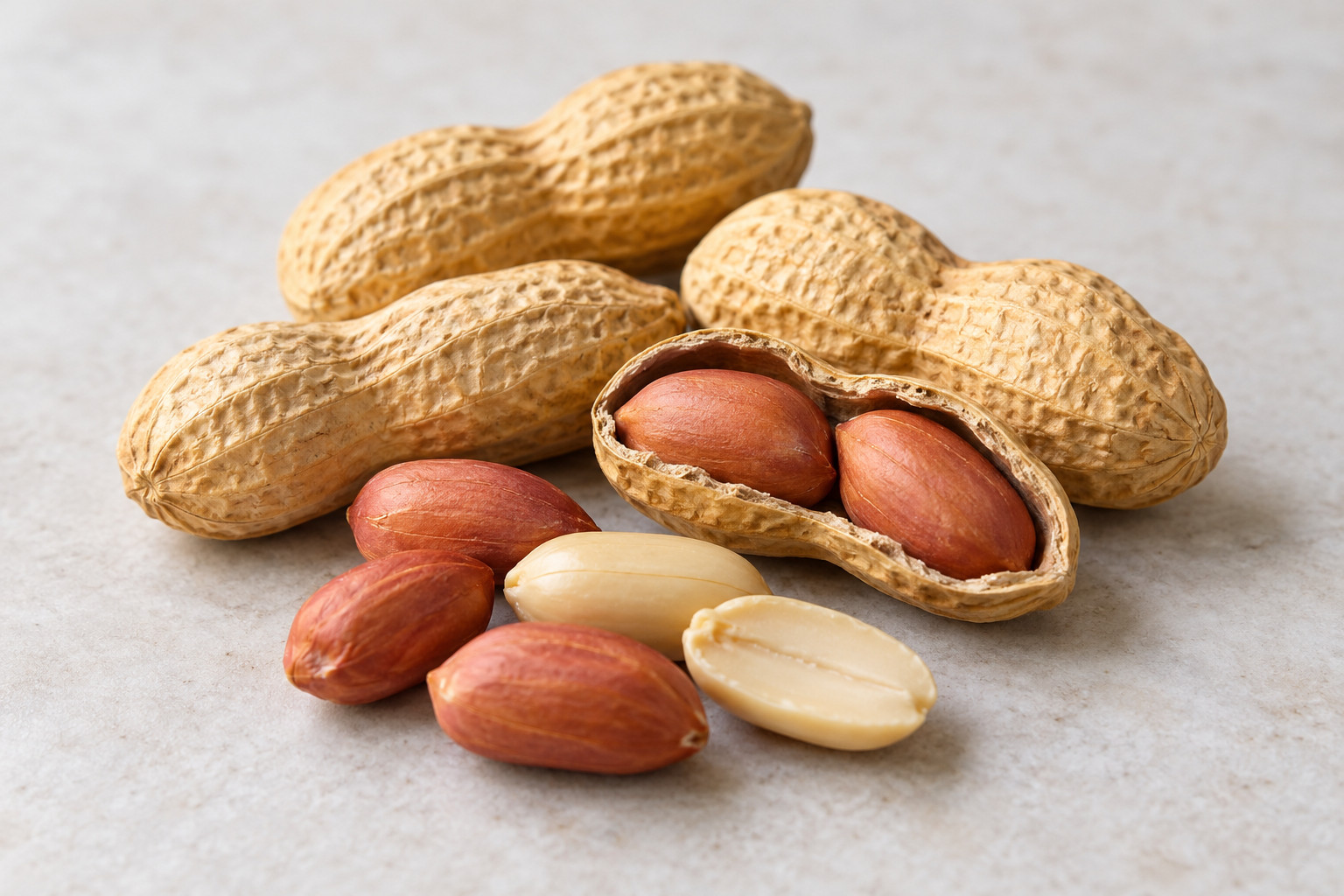
Peanuts: a sensory reference for defining the target flavor profile.
How should a peanut flavor profile be specified without calling it “nutty”?
A precise peanut flavoring brief names roast depth, paste body, green or beany lift, salt-sweet peanut-butter cue, hull dryness, oxidized notes, finish, matrix, and serving condition. “Nutty and authentic” cannot separate light roast, dark roast, peanut butter, honey-roast, or boiled peanut.
Write the target as a controlled sentence before samples move. A protein-powder brief can read: “Medium roast and peanut-butter paste at 2–10 s; low green; low honey; no hexanal; evaluated in a 25 g whey shake at 4°C.” A chocolate coating brief can read: “Dark roast kernel, low paste, clean cocoa-compatible finish after 45°C addition and 22°C snap.”
Convert each axis into a 0–10 screen with a written rejection point. Concentration is a later variable. Delivery form is a later variable. The first job is identity.
| Sensory axis | 0 anchor | 10 anchor | Rejection signal |
|---|---|---|---|
| Roast depth | Raw, pale kernel | Dark toasted kernel and hull | Burnt grain, ash, or coffee char |
| Paste / oil body | Lean, dry nut | Cooked peanut-butter paste | Waxy film or stale frying oil |
| Green / beany lift | Clean roast only | Fresh raw peanut and hay | Canned-legume or grassy soup |
| Salt-sweet peanut-butter cue | Unsalted roast | Salted paste with mild sweetness | Snack seasoning that erases kernel |
| Honey, hull, and finish | Dry, short, blanched | Honey-roast, woody skins, long paste linger | Candy caramel, bitter skins after 30 s, solvent tail |
| Oxidized note | Fresh roast | Cardboard, paint, or hexanal | Rancid oil; automatic fail |
A buyer can source flavor concentrates for food manufacturing and still receive the wrong peanut direction. Name a physical reference and the prohibited swaps: almond, hazelnut, generic brown nut, burnt hull, and oxidized oil.
How do peanut butter flavoring, roasted peanut, extract, and peanut powder change the buying decision?
Peanut flavoring, roasted-peanut flavor, peanut butter flavoring, peanut extract, flavored peanut butter powder, and peanut flour are different buying objects. Equal grams are not interchangeable.

Flavor sample library in the LULIN laboratory
Peanut is Arachis hypogaea, a legume. The sensory name describes a target. It does not describe source, protein, or label status. The item file does.
| Term | What it communicates | Buyer instruction |
|---|---|---|
| Peanut flavoring | A formulated peanut-direction system | Request class, carrier, source, allergen, and use guidance |
| Roasted-peanut flavor | Roast-led kernel, not automatically paste | Specify roast depth, hull, and paste separately |
| Peanut butter flavoring | Roast plus cooked-oil body, often salt and mild sweetness | State salt, sweetness, paste impression, and prohibited rancidity |
| Peanut extract | Extract-style liquid, often alcohol/water or glycol | Compare source, solvent, residual protein, and performance |
| Flavored peanut butter powder | Flavor on a carrier, peanut solids, or both | Split flavor contribution from peanut ingredient contribution |
| Peanut flour, paste, or butter | Peanut ingredient with fat, protein, color, and allergen load | Treat texture, nutrition, and allergen control as separate work |
Beer-oriented peanut-butter extracts are a solvent-heavy class, not a plant specification. Ask for food-grade status, residual solvent, and the actual process before using one in dairy or bakery.
Natural or artificial classification does not choose the buying object. The B2B guide to artificial flavor owns the wider labeling definition. This page keeps the question at peanut sample choice, peanut-protein status, and RFQ wording.
Which top, middle, and base notes should a peanut flavoring brief lock?
A peanut flavoring brief should use top notes for the first aromatic impression, middle notes for recognizable roast or paste identity, and base notes for cooked-oil body, cocoa or caramel support, hull dryness, and persistence. Timing is an operational model, not a regulation. Raw/green and boiled-peanut directions exist; in most commercial sweets they are rejection signals unless the brief names them.
Chetschik, Granvogl, and Schieberle mapped key odorants in raw peanuts and pan-roasted peanut meal in the Journal of Agricultural and Food Chemistry (2008, PMID 18983157; 2010, PMID 20873786). Useful sensory anchors include 2,5-dimethylpyrazine, 2,6-dimethylpyrazine, 2-ethyl-3,5-dimethylpyrazine, 2,3,5-trimethylpyrazine, 2-acetylpyrazine, 2-methyl-3-furanthiol, methional, hexanal, 2-methylbutanal, and 3-methylbutanal. Brown support can include 2,3-butanedione, furaneol, and maltol. Those names help a flavorist interpret a brief. They do not disclose a commercial formula.
| Peanut direction | Opening, 0–2 s | Body, 2–10 s | Finish, 10–60 s | Main failure mode | First-fit product |
|---|---|---|---|---|---|
| Light roast | Warm nut, low smoke | Sweet kernel, low oil | Short roast | Too weak beside fat or cocoa | Milk drinks, cereal |
| Medium roast | Pyrazine roast | Peanut kernel, light cooked oil | Clean roast | Generic nut | Core commercial default |
| Dark roast | Toasted hull, coffee-like | Dark nut, slight bitterness | Long dry roast | Ash, burnt grain | Dark chocolate, coffee-adjacent snacks |
| Peanut butter | Roasted paste, salt-sweet cue | Oily body, cooked peanut | Lingering paste | Waxy or stale oil | Protein powder, confectionery, bakery, ice cream |
| Honey-roasted | Brown sugar, roast | Honeyed nut | Sweet linger | Candy without kernel | Cereal, snack coating |
| Brittle / caramelized | Caramel, roast | Sugar-nut | Sticky sweet roast | Toffee takeover | Confectionery, inclusions |
Lock acceptance limits in the same file: “medium roast, peanut-butter paste, low honey, no green, no hexanal, no almond.” Intensity still needs a clock. Score the opening at 2 s and the finish at 60 s. A fast pyrazine peak can win on a smelling strip and leave an empty middle in a cold shake.
How do water, fat, protein, sugar, salt, acid, and serving temperature change peanut perception?
Water, fat, protein, sugar, salt, acid, and serving temperature change peanut aroma release, roast balance, paste body, sweetness association, bitterness, and finish, so a sample decision belongs in the intended product matrix. Water cannot approve a 25 g protein shake, a 30% fat filling, or a pH 3.2 drink.
| Matrix variable | Practical screening points | Likely sensory change |
|---|---|---|
| Water and solids | 0%, 5%, 10%, and 15% total soluble solids | Dilution exposes green, solvent, and thin finish; solids slow release |
| Fat | 0%, 3%, 10%, and 20% fat | Rounds sharp roast, retains lipophilic odorants, delays paste |
| Protein | 0%, 3%, 8%, and 15% protein | Whey, casein, soy, and pea can bind pyrazines and add cereal background |
| Sugar | 0, 5, 10, and 15 °Brix | Supports honey-roast and brittle notes; can hide mild kernel |
| Salt | 0%, 0.05%, 0.15%, 0.50%, and 1.0% salt equivalent | Low salt sharpens roast; peanut-butter direction often needs a sodium cue |
| Acid | pH 3.0, 3.5, 4.0, 4.5, and 6.6 | Brightens attack; can push roast toward green or sour nut |
| Temperature | 4°C, 22°C, and 60°C | Cold suppresses opening; warmth can expose harsh hull or rancidity |
Fat delays the roast. Protein binds the middle. Salt reads as peanut butter. Those are formula effects, not automatic flavor defects.
A 0% solids cup can make a concentrated peanut liquid look greener than the same code in a 10 °Brix beverage or a 20% fat filling. An 8% whey or pea shake can suppress 2,5-dimethylpyrazine lift and add cereal background. Raising dose may create a harsh finish without rebuilding the paste middle.
Sugar and acid move identity together. At 15 °Brix, a medium roast can read as honey-roasted. At 5 °Brix and pH 3.0, the same code can read greener and thinner.
Use 22°C as the controlled panel reference benchmark. Approval still requires the intended condition: 4°C for refrigerated drinks, yogurt, and ice-cream mix; 20–22°C for ambient bakery and chocolate; 60°C for hot cereal, hot sauce, or a hot protein beverage. Hold every sample for the same time. A review of beverage flavor retention and release treats composition, temperature, and pH as coupled variables. Hold the rest of the formula constant while the flavor codes change.
Which liquid, powder, emulsion, oil-soluble, and water-soluble peanut systems should be tested first?
The right peanut delivery system fits the product phase, process, factory, appearance, and storage. Screen liquid, powder, emulsion, oil-soluble, and water-soluble options, then reduce them to non-duplicative first-round routes.
Those five market words overlap. Liquid, powder, and emulsion describe physical form. Oil-soluble and water-soluble describe phase compatibility. A liquid can be water-soluble or oil-soluble. A spray-dried powder can disperse into water after reconstitution.
| First-round route | Best first applications | Example challenge | Frequent failure mode |
|---|---|---|---|
| Water-soluble liquid | Protein RTD, syrup, milk drink, plant beverage, some beers | 4°C and 60°C; 24 h | Haze, ring, solvent flash, protein masking |
| Oil-soluble liquid | Chocolate, coating, fat filling, snack oil, spread | 45°C addition; 22°C tasting | Poor transfer into water; delayed or rancid release |
| Water-dispersible emulsion | Cake, cookie, frosting, cloudy drink, composite dairy | 4°C and 60°C; 7 days | Ringing, separation, unwanted color or cloud |
| Spray-dried powder | Protein powder, bakery premix, dry beverage, seasoning blend | 25°C, 65% RH; 30 days | Moisture pickup, incomplete wetting, weak top notes |
| Plated or encapsulated powder | High-heat snacks, delayed-release bakery, seasoning dust-on | 180°C or 200°C; 14 days | Late release; carrier sweetness |
This five-route screen covers the five market terms without double-counting compatibility. Paste and freeze-dried flavor belong in a second round.
For comparable concentrated liquids whose supplier range includes the ladder, test 1 g/kg, 2 g/kg, 3 g/kg, 4 g/kg, and 5 g/kg in the finished base. Use 4 g/kg (0.40% w/w) as the high first-pass reference benchmark. Keep 5 g/kg as the top screen when 4 g/kg still looks thin. Do not transfer that ladder to a 5% powder or a peanut flour. For peanut-flavored protein powder and some snack dust-ons, a scoped dry-premix high of 8 g/kg (0.80% w/w) applies when the selected powder’s guidance includes that region.
Buyers can compare powder and liquid food flavors before narrowing the sample set. Water-soluble liquid can suit a syrup and fail in chocolate. Oil-soluble liquid can suit a coating and fail in a clear drink.
Which heat, shear, oxygen, and storage conditions flatten roast or raise oxidized peanut notes?
Heat exposure, hold time, point of addition, shear, drying, freezing, oxygen, packaging, and storage temperature can move peanut flavoring from a clear roast or paste profile toward muted, cooked, beany, harsh, or oxidized character. Peanut directions are oil-associated. Oxidation is a named failure, not a vague staleness.
| Condition | What can change | Example checkpoints |
|---|---|---|
| Point of addition | Early heat strips top notes; late addition can dose unevenly | 0 min, 15 min, 30 min; 1 min before fill |
| Pasteurization | Changed volatile balance and protein binding | 72°C for 15 s; 85°C for 30 s; 95°C for 30 s |
| UHT-style hold | Cooked notes; further binding in protein drinks | 135°C and 140°C with the plant hold |
| Homogenization or high shear | Droplet size, phase location, physical stability | 1 pass and 2 passes; 5 min hold |
| Baking or toasting | Evaporation, cooked notes, crust browning | 160°C, 180°C, 200°C, 220°C; 8 min, 12 min, 18 min |
| Dry blending and reconstitution | Carrier taste, wetting, caking, local hot spots | 25°C, 65% RH; 7 days and 30 days |
| Oxygen, light, freeze, and headspace | Cardboard, paint, hexanal, or suppressed cold release | 0%, 5%, 10% headspace; −18°C; 7 days and 30 days |
Record three moments: before processing, after cooling, and after storage in the intended pack. Use Day 0, 7 days, 14 days, 28 days, 56 days, and 90 days at 4°C, 20°C, and 37°C. The 37°C point is an accelerated comparison, not a label storage claim. Protect concentrates from heat, air, and light. Protect powders from moisture.
Hexanal is a rejection signal. If the stored sample smells like cardboard or stale frying oil, stop raising dose. Change protection, addition point, fat quality, or the flavor code.
How should product developers compare peanut flavor samples in the real application base?
Product developers should compare peanut flavor samples blind in one controlled batch of the complete application base, using matched dose, mixing order, process history, storage, and serving temperature against an unflavored control and a defined sensory reference.
Why 4 g/kg is the high concentrated-liquid screen
The complete editorial ladder for comparable concentrated liquids is 1 g/kg, 2 g/kg, 3 g/kg, 4 g/kg, and 5 g/kg. The selected high first-pass reference benchmark is 4 g/kg (0.40% w/w) when the supplier range includes that value. 5 g/kg stays available as the top in-set screen. Relative checks remain 0.5×, 1.0×, and 1.5× the supplier start for any format. The 8 g/kg (0.80% w/w) dry-premix high stays scoped to protein powder and snack dust-on items whose powder guidance includes that region. None of those points is a universal production dose or a LULIN guarantee.
Build a controlled first-pass screen
- Freeze the base formula, raw-material lots, and process. Record fat, protein source, sugar or sweetener, salt, pH, total solids or °Brix, and water activity where relevant.
- Write the target note stack before opening samples. Set 0–10 anchors for roast, paste body, green/beany, salt-sweet cue, honey, hull, oxidized note, and finish.
- Include an unflavored control and the current commercial reference. Assign every candidate a random three-digit code.
- Compare candidates within the same delivery class first. Do not rank a 5% powder and a concentrated liquid at the same mass solely because both say “peanut.”
- For comparable concentrated liquids, run 1 g/kg, 2 g/kg, 3 g/kg, 4 g/kg, and 5 g/kg. Treat 4 g/kg as the high reference benchmark. Apply the same mixing order, heat, shear, cooling, fill, package, and storage to every code.
- Serve identical portions in balanced order at 22°C, plus 4°C or 60°C when those conditions match the project. Repeat the leading codes on a second occasion and after the defined storage interval.
Cost-in-use = approved dose (kg per 1,000 kg base) × delivered price per kg. Recalculate when potency, format, freight, or pack size changes. Weigh each addition to 0.1 g in a 1000 g finished base. Equilibrate 15 min at 22°C. Recheck 24 h, 48 h, and 72 h after fill, then 7 days and 14 days.
ISO 6658:2017 and ISO 13299:2016 provide general sensory-analysis and profiling frameworks. The commercial design above is an application protocol, not a claim that ISO mandates these doses or temperatures.
Use a peanut-specific scorecard
| Criterion | 0 anchor | 10 anchor | Decision question |
|---|---|---|---|
| Peanut identity | Unrecognizable | Clear roast or paste identity | Does the middle read as peanut rather than almond or hazelnut? |
| Roast | Raw/green | Dark roast | Where does useful toast become burnt hull? |
| Paste body | Lean dry nut | Cooked peanut-butter paste | Does body become waxy? |
| Salt-sweet cue | Unsalted roast | Salted paste | Does seasoning replace kernel? |
| Oxidized note | Fresh | Hexanal/cardboard | Is the code or the fat system failing? |
| Finish | Short | Persistent paste or roast | Is persistence clean or harsh? |
| Process retention | Lost after heat | Fully recognizable | What remains after production and cooling? |
| Cost-in-use | Unacceptable | Target met | What is approved dose × delivered price per kg for 1,000 kg? |
Diagnose the failure before replacing the flavor
| Symptom | Likely variables | Next controlled move |
|---|---|---|
| Strong before heating, weak after cooling | Addition point, volatility, process time | Compare early and late addition with the same code |
| Accurate roast, missing paste body | Protein binding, low middle notes, excess cocoa | Hold dose; compare a stronger paste-centered direction |
| Harsh or chemical finish | Overdose, carrier flash, burnt hull | Step down from 4 g/kg and retest after equilibration |
| Flat in cold service | Temperature, fat phase, viscosity | Evaluate a faster-opening direction at 4°C |
| Beany, hay, candy, or cardboard | Direction, acid, plant protein, sugar, oxygen, aged fat | Change direction, package, or code before adding dose |
| Good aroma, poor appearance | Wrong phase route, emulsion instability | Change delivery system before changing note architecture |
LULIN FLAVOR provides food flavor formulation support for B2B R&D around this feedback loop: sample code, base, dose, process, tasting condition, result, and requested change.
What belongs in a United States peanut flavoring RFQ, including peanut-allergen status?
A peanut flavoring RFQ should identify the finished product, target note stack, reference, matrix, process, point of addition, serving temperature, preferred format, label target, destination market, trial plan, quantity stage, packaging, peanut-allergen position, and required documents.
For United States projects, January 2025 United States Food and Drug Administration allergen guidance (Edition 5), the Food Allergen Labeling and Consumer Protection Act, and 21 CFR 101.22 set review points. Peanut is a major allergen and must be named specifically when peanut-derived protein is present. FEMA GRAS status, as used by the Flavor Extract Manufacturers Association, addresses intended-use safety. It is not FDA premarket approval or a natural/artificial wording rule.
The name is not the allergen result. A peanut-tasting flavor can be built without peanut protein. An extract, paste, flour, or poorly refined oil can carry peanut protein. Shared equipment still belongs in the file.
Use this copy-ready brief:
- Application, stage, and reference: named product (protein powder, RTD shake, bakery, chocolate, ice cream, snack, syrup, or beer); concept through scale-up; physical benchmark or current code.
- Sensory target: top, middle, and base; 0–10 roast and paste; honey, salt-sweet cue, hull, green, finish; prohibited hexanal, almond, and burnt hull.
- Matrix and process: water, fat, protein source, sugar, salt, pH, °Brix; addition point, heat/time, shear, bake or dry, freeze, fill, pack, headspace, storage, serving temperature.
- Format and trial: liquid, powder, emulsion, oil-soluble, or water-soluble; 1 g/kg through 5 g/kg where applicable; 4 g/kg high reference; control, codes, dates, acceptance score.
- U.S. status and allergen: solely natural flavor, natural and artificial flavor, or solely artificial flavor under 21 CFR 101.22(g); peanut-derived protein, residual protein, shared equipment; peanut is not covered by a tree-nut line.
- Documents and commercial data: TDS, lot COA, SDS, ingredient and flavor-status statements, allergen statement, shelf life, origin, change control, Halal/Kosher/ISO/HACCP files as required; 100 g or 100 mL bench; 1 kg pilot; 5 kg, 20 kg, or 25 kg pack; 10-day and 15-day planning; MOQ, price, freight, volume, destination, traceability.
The food flavor compliance document request guide organizes the quality package by item and market. Buyers can contact LULIN FLAVOR about a peanut project with the completed brief.
Frequently asked questions about peanut flavoring
These peanut flavoring questions resolve the profile, extract boundary, allergen, additive status, dose, protein-powder format, matrix, processing, evaluation, and RFQ decisions that most often delay sample approval.
How should peanut flavoring be described for a supplier?
Describe peanut flavoring through roast depth, peanut-butter paste versus dry kernel, honey or brittle sugar, salt-sweet cue, green lift, hull, finish, a physical benchmark, and unwanted notes such as hexanal or almond. Add matrix, process, serving temperature, preferred format, and acceptance method.
What is the difference between peanut flavoring, peanut extract, and peanut butter flavoring?
Peanut flavoring is the broader formulated system; peanut extract usually describes an extract-style liquid with a defined solvent; peanut butter flavoring targets roast plus cooked-oil paste, often with salt and mild sweetness. Compare source, carrier, allergen statement, strength, and performance instead of substituting equal volumes.
Does peanut flavoring contain peanut allergen?
Not necessarily. The sensory name does not establish peanut protein; a flavor that contains protein derived from peanut must identify peanut as the allergen source in the United States, while a peanut-free peanut-style item needs an item-specific allergen statement covering composition, shared equipment, and destination-market rules.
Is peanut extract a food additive?
Peanut extract used as a flavor is labeled and specified as a flavoring, not as a nutritional peanut ingredient. If the extract contributes peanut protein or is used as a characterizing peanut ingredient, allergen and ingredient rules apply alongside flavor-status wording. The specification, residual-protein statement, and intended use decide the regulatory path; the word “extract” does not.
What use level should a formulator test first for concentrated liquid peanut flavoring?
Use 4 g/kg finished base, or 0.40% w/w, as the high first-pass reference benchmark when the selected concentrated liquid’s supplier range includes it. Bracket that point with 1 g/kg, 2 g/kg, 3 g/kg, and 5 g/kg. Do not transfer the ladder to powders, emulsions, or liquids with different potency.
Which peanut flavor format should a developer test for protein powder?
Start dry protein premixes with a spray-dried powder and, when dusting or delayed release matters, a plated or encapsulated powder; keep a water-soluble liquid for the reconstituted RTD check. Screen flow, caking at 25°C and 65% RH, carrier taste, wetting, and peanut identity after hydration. Use 8 g/kg (0.80% w/w) as the scoped dry-premix high only when the powder item’s guidance includes that region.
Why does peanut flavoring taste different in water and in a fat or protein base?
Fat and protein change aroma partitioning, binding, and release, while sweetness, salt, pH, viscosity, and temperature reposition roast, paste, green notes, bitterness, and finish. Water is useful for orientation, but only the full shake, filling, coating, or snack formula can show whether the sample fits the commercial product.
Why can peanut aroma go stale, beany, or flat after heat or storage?
Heat, oxygen, hold time, light, package headspace, matrix binding, and point of addition can flatten top notes, raise beany character, or open hexanal and cardboard. Compare the same code before processing, after cooling, and at Day 0, 7 days, 14 days, 28 days, 56 days, and 90 days in the intended package.
How should two peanut flavor samples be compared?
Compare coded samples in one batch of the finished base at matched dose, mixing order, process, storage, portion, and serving temperature. Include an unflavored control and a defined reference, use a written 0–10 peanut scorecard, balance serving order, and repeat the leading samples on a separate occasion.
What documents belong in a peanut flavoring RFQ?
Request the applicable TDS, lot COA, SDS/MSDS, ingredient declaration, flavor-status statement, peanut allergen statement, shelf-life and storage guidance, country of origin, change-control policy, and destination-market files. Add required Halal, Kosher, ISO 9001, ISO 22000, HACCP, non-GMO, or vegan documents, plus MOQ, packaging, price basis, lead time, and traceability.
Move the peanut brief into a LULIN FLAVOR sample trial
LULIN FLAVOR moves a peanut brief into sample review by aligning the product, sensory direction, format, process, destination market, quantity stage, and document list before the first trial.
The LULIN FLAVOR food flavor manufacturer is the English brand of QUANZHOU LVLIN BIOENGINEERING CO., LTD., a Quanzhou, Fujian Province producer established in 2001. The company operates 3 modernized production lines in more than 8,000 m² of building area, with 50+ employees and 12+ flavor engineers whose development and application experience exceeds 20 years. ISO 9001, ISO 22000, and HACCP systems support production control, traceability, and document handling. Application samples ship in 3-5 business days. Powder-flavor MOQ starts at 20 kg and liquid-flavor MOQ at 25 kg. Standard production runs in 10-15 business days after formula and sample approval.
Send the application base, 0–10 note targets, benchmark, process, serving temperature, label path, peanut-allergen rule, destination market, and sample plan. Retain a 50 g sample at 4°C for 90 days. Then request a peanut flavor sample for a controlled real-base comparison.
Develop this flavor in your product
Send your product, target market and project goal. We will review the sample direction with you.