Published
Pomegranate Flavoring
Pomegranate flavoring is a dark-red fruit profile built from tart berry and grape-like aromatics, restrained sweetness, a light floral lift, and a clean drying finish, not simply “sweet and fruity.” For first-round comparison, screen matched samples at 0.20% w/w in the application base as a high-end reference benchmark, then reduce to the lowest effective dose.
Last updated: August 31, 2026
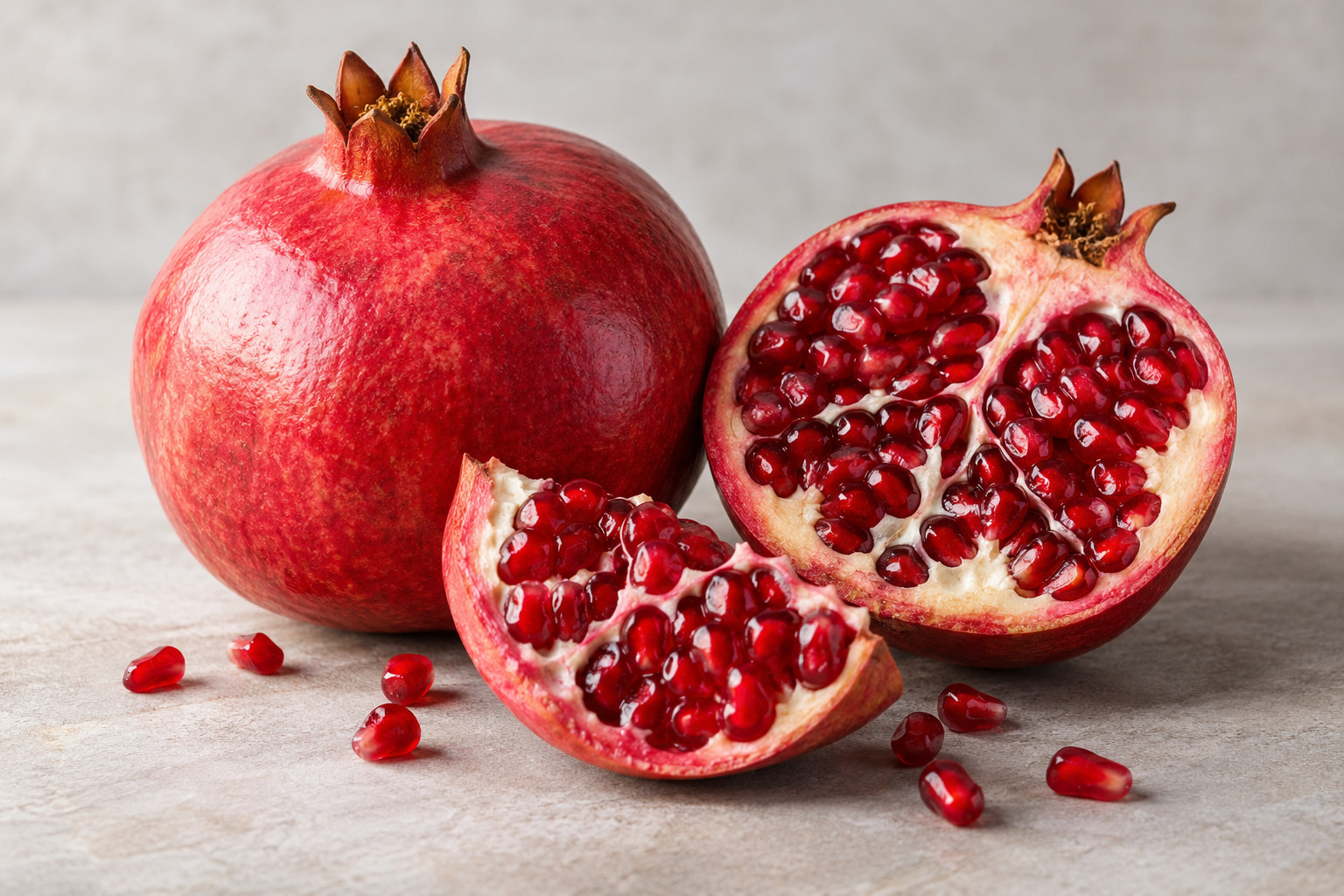
Pomegranate: a sensory reference for defining the target flavor profile.
What Does Pomegranate Flavoring Taste Like in a Technical Sensory Brief?
Pomegranate flavoring tastes most recognizable when the brief combines sweet-sour red fruit, dark berry and grape aromatics, a restrained earthy undertone, and a fine astringent finish. The balance matters more than any single descriptor. A profile with only bright berry reads as raspberry or fruit punch; one with heavy tannin and molasses reads as reduced juice or pomegranate molasses; one with high sweetness and low dryness moves toward grenadine candy.
A useful brief separates aroma, taste, and mouthfeel. “Tart” describes taste, while “cranberry-like,” “red grape,” “blackberry,” “cherry skin,” and “light floral” describe aromatic direction. “Drying,” “puckering,” and “tooth-coating” describe tactile effects. Pomegranate identity emerges where those three systems meet.
| Sensory layer | Directions that belong in the brief | What the layer contributes | Common failure mode |
|---|---|---|---|
| Top Note | Fresh Aril, Light Floral, Green Peel, Citrus Lift | Immediate freshness and cut-through at first sip or bite | Too high becomes thin, perfumed, or lemon-berry-like |
| Middle Note | Red Grape, cranberry, raspberry, cherry, blackcurrant | The recognizable red-fruit body of the profile | Too generic becomes mixed berry or fruit punch |
| Base Note | Dark Fruit, Tannic Skin, Earthy Trace, wine-like, molasses, Brown Spice | Length, maturity, and a drying finish | Too high becomes prune-like, beet-like, woody, or fermented |
| Taste Structure | Sweet Taste, Sour Taste, Slight Bitter Edge | Sets the fruit’s ripeness and juice impression | Excess sugar produces candy; excess acid produces sour berry |
| Mouthfeel Finish | Fine Astringency, Light Tooth-Dryness | Distinguishes juice-style pomegranate from a simple berry flavor | Excess astringency feels harsh or medicinal |
Four common commercial directions should be named before samples are requested. A fresh-aril profile emphasizes floral lift, crisp acidity, red berry, and a clean finish. A juice-style profile adds grape, dark berry, tannin, and moderate depth. A candy or grenadine direction raises sweet red-fruit impact and suppresses earthiness and dryness. A molasses or savory-seasoning direction uses darker fruit, acid, tannin, brown sugar, warm spice, and a longer cooked finish.
This page concerns profile design and application performance. The separate guide to U.S. flavor-labeling terminology explains natural and artificial flavor definitions; it does not decide whether a sample tastes like fresh arils, juice, candy, or molasses.
Use Flavor Concentrates for Food Manufacturing for category-level format and sourcing navigation. The narrower pomegranate brief still needs a defined sensory direction, matrix, process, and evaluation protocol.
Pairing should reinforce a chosen direction rather than hide an unclear brief. Raspberry, cranberry, blackcurrant, and red grape strengthen the fruit core. Lemon, lime, and orange sharpen the top. Rose, hibiscus, and elderflower add floral lift at restrained levels. Vanilla, cinnamon, and cardamom make the profile rounder. Sumac, mint, chili, and black pepper support pomegranate seasoning, sauces, and savory glazes.
How Do Water, Fat, Protein, Sugar, Salt, Acid, and Serving Temperature Change Pomegranate Perception?
The same pomegranate flavor can read as crisp juice, muted dairy fruit, candy, or dark sauce because the finished matrix controls volatility, taste balance, and mouthfeel. Sample evaluation therefore belongs in the production formula, not in plain water alone.
| Matrix factor | Likely effect on pomegranate perception | Practical correction | Controlled comparison point |
|---|---|---|---|
| Water | Exposes volatile top notes but can leave the middle thin | Add berry-grape body or select an emulsion when cloud and persistence are wanted | Compare at 5°C and 20°C after 30 min hydration |
| Fat | Rounds sourness, retains oil-affine aroma, and delays release | Test an oil-compatible format and check the finish after swallowing | Compare 0%, 3%, and 8% fat bases |
| Protein | Binds or masks aroma and contributes dairy, soy, or pea notes | Increase middle-note definition before raising total dosage | Compare the real protein source at 0%, 2%, and 5% protein |
| Sugar | Suppresses sourness and pushes red fruit toward syrup or candy | Reduce sweet top notes; rebuild tartness with the actual acid system | Screen 5%, 10%, and 15% sugar solids |
| Salt | A small amount can sharpen fruit; more can expose bitter, savory, or acidic edges | Judge salt and flavor together in seasoning, sauce, or electrolyte products | Compare 0%, 0.3%, and 0.8% salt |
| Acid | Raises brightness and sour impact but may turn pomegranate into cranberry or generic sour berry | Specify acid type, pH, and titratable acidity; do not use pH alone | Compare pH 2.8, pH 3.2, and pH 3.6 in one acid system |
| Serving Temperature | Cold suppresses aroma and sweetness; warmth releases top notes and cooked undertones | Evaluate at the temperature printed in the serving instruction | Use 5°C, 20°C, or 40°C as application-relevant checkpoints |
The numerical points in the table form a screening design, not a universal formula. They are useful because they isolate one variable while preserving a consistent pomegranate dose. For example, a beverage at pH 3.2 can taste more sour than another at pH 2.8 if acid type, buffering, sugar, and titratable acidity differ. Record both pH and titratable acidity whenever acid is a major part of the sensory architecture.
Water activity and texture also change timing. A thin drink releases aroma quickly. A gummy delays release until chewing breaks the gel. Ice cream suppresses aroma at -18°C storage and at frozen serving temperature, then releases more character as the mix warms in the mouth. A baked filling may retain dark middle and base notes while losing the fresh top. These are not dosage problems by default; they are release and survival problems.
For a broader format comparison, use the guide to powder and liquid food flavors. The pomegranate decision still requires the actual fat, protein, acid, sugar, salt, and temperature conditions described here.
Which Pomegranate Flavor Format Should a Product Developer Test?
A product developer should test the format that matches the continuous phase, process, appearance, and dosing system, with five practical options covering most pomegranate projects: Water-soluble liquid, Oil-soluble liquid, Oil-in-water emulsion, Spray-dried powder, and Dry-blended or adsorbed powder.

Flavor sample library in the LULIN laboratory
| Format option | Best first applications | Main advantage | Check before approval |
|---|---|---|---|
| Water-soluble liquid | Clear Drinks, Iced Tea, Juice Drinks, Beverage Syrups, Gummies | Fast bench dosing and uniform distribution in water | Haze, ring formation, solvent fit, and top-note loss after heat |
| Oil-soluble liquid | Chocolate Fillings, Fat Coatings, Bakery Fats | Places aroma directly in the lipid phase | Uneven dispersion in water and delayed flavor release |
| Oil-in-water emulsion | Cloudy Beverages, Beverage Compounds, Savory Sauces | Carries oil-affine notes into a water phase and can add visual cloud | Droplet stability, creaming, neck ring, freeze-thaw response |
| Spray-dried powder | Drink Powders, Dietary Supplements, Dry Mixes, Seasoning Systems | Low-moisture handling and protected aroma release | Carrier declaration, hygroscopicity, caking, dissolution, heat exposure |
| Dry-blended or adsorbed powder | Seasoning Blends, Bakery Premixes, Low-Moisture Blends | Simple dry dosing and rapid profile adjustment | Dusting, segregation, carrier taste, and batch uniformity |
These labels describe delivery systems, not sensory quality grades. A Water-soluble liquid and a Spray-dried powder can target the same fresh-aril direction yet perform differently after hot filling, dry storage, or dissolution. An Oil-in-water emulsion may be correct for a cloudy beverage but wrong for a clear sparkling water. An Oil-soluble liquid can excel in chocolate and fail visibly in a transparent drink.
The carrier and non-flavor ingredients matter. Ask for the solvent or carrier declaration, allergen status, dispersion instructions, recommended addition point, and storage conditions. For powder, request bulk density and flow information if automated dosing is planned. For emulsion, define acceptable turbidity and inspect the package neck after storage.
LULIN FLAVOR supplies liquid, powder, water-phase, oil-phase, and emulsion routes for food and beverage development. Buyers can use the food flavor formulation support route to request matched profile variants instead of comparing unrelated stock samples.
Which Processing and Storage Conditions Can Shift a Pomegranate Profile?
Heat, oxygen, light, shear, addition point, packaging, and storage time can remove fresh pomegranate top notes or magnify dark, cooked, bitter, and fermented impressions. The correct sample is the one that still matches after the complete process and intended shelf-life program.
| Condition | Typical sensory shift | Trial design | Approval signal |
|---|---|---|---|
| Hot Fill Pasteurization | Fresh and floral notes fall; dark fruit becomes more prominent | Compare pre-process and post-process samples at the actual time-temperature profile | Core red fruit remains distinct after cooling for 24 h |
| UHT Retort | Stronger cooked, jammy, wine-like, or brown notes | Test a heat-tolerant middle/base and a late-added top-note option where the process permits | No prune, beet, sulfur, or burnt edge at serving temperature |
| Baking Extrusion | Volatiles escape and the base can taste dry or hollow | Evaluate 160°C, 180°C, and 200°C only when those points bracket the real process | Pomegranate remains recognizable in the finished piece, not just the dough |
| High Shear Homogenization | Emulsion particle distribution and aroma release can change | Replicate production shear, pressure, and order of addition | No oil ring, separation, or unexpected flavor loss |
| Oxygen Headspace | Oxidation flattens fruit and can increase stale or wine-like notes | Compare full and partial headspace in the intended package | Profile remains clean at day 0, 7 days, and 28 days |
| Light Exposure | Color and aroma may drift together, especially in clear packs | Run light and dark controls in the final package | No visible or sensory divergence beyond the project limit |
| Cold Frozen Storage | Aroma release slows; freeze-thaw can disturb emulsions | Evaluate at -18°C, 5°C, and the stated serving temperature as relevant | Release recovers during consumption without separation |
| Package Contact | Polymer scalping or closure interaction can reduce top notes | Store the finished product in the commercial bottle, pouch, liner, or sachet | Retained profile matches the control in the same package size |
Process numbers must come from the product, not from a flavor catalogue. The 160°C, 180°C, and 200°C sequence is a bakery screening example; it should not be applied to a drink. Likewise, 24 h, 7 days, and 28 days are early diagnostic checkpoints, not a replacement for the finished product’s validated shelf-life study.
Addition point is often decisive. A flavor added before the highest heat receives the harshest exposure but may disperse more evenly. A permitted late addition protects top notes but requires hygienic dosing and adequate mixing. Split addition can place a durable pomegranate body before processing and a fresh-aril lift after processing. The batch record should identify each addition point and percentage.
How Should Buyers Compare Pomegranate Flavor Samples in the Real Application Base?
Buyers should compare coded pomegranate samples at matched dosage, process, package, and serving temperature, then use a 0.20% w/w high-end reference benchmark to expose off-notes before optimizing downward. A water-cup sniff test can reject a gross mismatch, but it cannot approve a production flavor.
Use this repeatable bench protocol:
- Freeze one base formula and one process version. Record water, fat, protein, sugar, salt, acid type, pH, titratable acidity, color, and any fruit solids.
- Prepare at least 300 g per coded sample. Use 3-digit codes and randomize serving order so brand or sample name does not influence scoring.
- Build a dose ladder at 0.05%, 0.10%, and 0.20% w/w. Treat 0.20% w/w as the high-end screening benchmark, not as a supplier use-rate guarantee.
- Process every sample through the real heat, shear, cooling, filling, and packaging steps. Retain an unprocessed control when possible.
- Evaluate at the stated serving temperature after 30 min equilibration, after 24 h, and at planned storage checkpoints such as 7 days and 28 days.
- Repeat the leading sample in a duplicate coded cup. A winner that cannot repeat should not move to a pilot batch.
| Scorecard attribute | 0 | 3 | 5 | Decision use |
|---|---|---|---|---|
| Pomegranate Identity | Absent | Recognizable | Immediate and specific | Primary pass/fail measure |
| Fresh Aril Top Note | Absent | Balanced | Dominant | Select for fresh drinks and light dairy |
| Berry Grape Middle | Hollow | Complete | Heavy | Controls juice body and differentiation from candy |
| Dark Fruit Base | None | Supportive | Cooked or molasses-like | Select for juice, sauce, or savory briefs |
| Sweet Acid Fit | Disconnected | Integrated | One side dominates | Judge against formula, not neat flavor |
| Astringent Finish | None | Fine and clean | Harsh and persistent | Separates authentic dryness from bitterness |
| Off-note intensity | None | Noticeable | Reject level | Name the note: floral, beet, prune, solvent, sulfur, metallic |
| Process Retention | Lost | Acceptable | Matches unprocessed control | Compare after the full process |
| Overall Brief Match | Wrong direction | Usable with adjustment | Ready for pilot | Final selection measure |
The scoring scale is intentionally anchored. Panelists should not use “nice” or “strong” as complete observations. A comment such as “sample 417 scored 5 for impact” gives little direction; “sample 417 has a 5-level floral top, a 2-level berry middle, and a 4-level bitter-dry finish at 0.20% w/w after 24 h” identifies what to change.
Keep color separate from flavor. Pomegranate concentrate, anthocyanin color, and flavoring can move together in a fruit system, but a redder sample may bias sensory judgment. Use opaque cups during profile selection, then repeat the preferred sample in the commercial package to assess the combined visual and sensory result. Buyers ready to compare matched items can request pomegranate flavor samples with the full base and process details.
How Can a Failed Pomegranate Trial Be Diagnosed Before Changing Suppliers?
A failed pomegranate trial should be diagnosed by sensory symptom, because increasing dosage often magnifies the wrong note instead of repairing the profile. Use one-variable adjustments after the coded comparison.
| Symptom in the finished product | Probable cause | Better next test |
|---|---|---|
| Generic Mixed Berry | Middle lacks grape, cranberry, dark fruit, or tannic structure | Request a juice-style modifier at the same 0.10% dose |
| Candy Grenadine | Sugar and sweet top notes overpower dryness | Lower sweet aroma; restore acid and a fine astringent finish |
| Acid Without Fruit | Acid load drives taste without adding aromatic identity | Hold pH and titratable acidity constant; compare stronger middle notes |
| Floral Perfume | Top note is too dominant or releases too quickly | Reduce fresh-aril top and add red-grape body |
| Beet Prune Cooked | Base is too earthy, dark, or heat-damaged | Test a cleaner base and protect the addition point |
| Water Dairy Gap | Fat and protein suppress or retain key components | Test a dairy-matched format in the actual protein and fat system |
| Heat Process Loss | Volatile top notes do not survive processing | Use a more durable middle/base or permitted split addition |
| Haze Ring Separation | Solubility or emulsion stability does not fit the phase | Change delivery format before changing sensory direction |
Two corrections should not be made in the same round unless the design deliberately tests an interaction. If both acid and flavor dose change, the result cannot show which change restored pomegranate identity. Controlled trials cost less than a long series of intuitive adjustments.
What Supplier Facts and Documents Belong in a Pomegranate Flavoring RFQ?
A pomegranate flavoring RFQ should define the sensory target, formula, process, format, market, volume stage, document set, and evaluation method in enough detail for suppliers to send comparable samples. “Pomegranate flavor, best price” is not a usable development brief.
| RFQ field | Information to send | Supplier response required |
|---|---|---|
| Profile Target | Fresh Aril, Juice Style, Candy Grenadine, Pomegranate Molasses, or Savory Seasoning; desired Top Note, Middle Note, Base Note, and Finish Direction | Matching Profile Code and Sensory Description |
| Application Matrix | Product Type; Water Phase, Fat Level, Protein Level, Sugar Level, Salt Level, Acid System, pH, Titratable Acidity, Fruit Solids | Recommended Format and Starting Dose |
| Process Profile | Mixing Order, Addition Point, shear, Peak Temperature, Hold Time, cooling, Fill Method | Process-Fit Guidance and Trial Cautions |
| Appearance Target | Clear Product, Translucent Product, Cloudy Product, Added Color, or No Added Color | Solubility Data, Clarity Data, and Emulsion Information |
| Dose Plan | 0.05%, 0.10%, and 0.20% w/w screening ladder | Recommended use range and high-end trial limit |
| Market Label | United States or other Destination Market; Natural Flavor, Artificial Flavor, or other Label Objective | Regulatory Guidance and Ingredient Declaration for the exact item |
| Quality Documents | Technical Data Sheet (TDS), Certificate of Analysis (COA), Safety Data Sheet (SDS), Allergen Statement, GMO Status, Vegan Status, Halal Certificate, Kosher Certificate, Microbiological Criteria, Carrier Declaration, Solvent Declaration, Shelf-Life Statement, Storage Instructions | Item-Specific Document Package and Issue Dates |
| Supply Plan | Sample Quantity, Pilot Demand, First Order, Annual Volume, Delivery Destination, Incoterm | Minimum Order Quantity, Price Basis, Pack Sizes, Production Lead Time, Annual Capacity, and Export Route |
| Change Control | Approved Profile Code, Lot Reference, Critical Specification Fields | Change Notification for Formula Revision, Carrier Change, Site Change, or Specification Revision |
For the United States, 21 CFR 101.22 is part of the labeling review for flavors and characterizing-flavor statements. It does not replace formulation work, and a technical flavor name is not automatically the finished food’s principal-display-panel wording. The destination-market owner should approve the final ingredient declaration and product name.
Document requests should name the exact item and intended use. A generic certificate from a company website does not replace the batch COA, current specification, carrier declaration, allergen statement, or relevant Halal and Kosher file for the chosen sample. The food flavor compliance document request guide helps procurement teams organize that package.
LULIN FLAVOR is the public English brand of QUANZHOU LVLIN BIOENGINEERING CO., LTD., a Quanzhou, Fujian food flavor manufacturer established in 2001. The company supports B2B teams with application-led profile matching, liquid and powder format selection, sample adjustment, documentation, production quotation, export coordination, and project-specific MOQ and lead-time responses. The LULIN FLAVOR food flavor manufacturer page provides the broader capability route, while this page remains focused on pomegranate profile and performance.
Frequently Asked Questions About Pomegranate Flavoring
Pomegranate flavoring buyers need direct answers about taste, dosage, format, pairings, heat, labeling, samples, and supplier comparison.
What Flavor Is Pomegranate?
Pomegranate is a sweet-sour dark-red fruit profile with berry and grape-like aromatics, restrained floral lift, a mild earthy or wine-like undertone, and a drying astringent finish. The exact balance can resemble fresh arils, pressed juice, candy, grenadine, reduced molasses, or a savory fruit seasoning.
What Does Pomegranate Juice Taste Like Compared With Pomegranate Candy?
Pomegranate juice tastes tarter, darker, less uniformly sweet, and more astringent than pomegranate candy. Juice-style profiles often carry red grape, cranberry, dark berry, tannic skin, and occasional earthy notes. Candy profiles emphasize sweet red fruit and brightness while reducing bitterness, earthiness, and mouth-drying character.
What Flavors Go Well With Pomegranate?
Pomegranate pairs well with raspberry, cranberry, blackcurrant, red grape, citrus, hibiscus, rose, vanilla, cinnamon, cardamom, mint, sumac, chili, and black pepper. Select pairings by direction: citrus for lift, berries for body, florals for aroma, warm spice for depth, and sumac or chili for savory use.
What Starting Dose Should Be Used for a Pomegranate Flavor Sample?
Use 0.20% w/w as a high-end reference benchmark for the first screening round, alongside 0.05% and 0.10% w/w. This ladder exposes weak identity and off-notes, but it is not a universal production dose. Optimize downward after the preferred sample survives the real matrix, process, and storage conditions.
Is Liquid or Powder Pomegranate Flavor Better?
Neither format is inherently better; the correct choice follows the product and process. Water-soluble liquid suits many beverages and syrups, Oil-soluble liquid suits fat systems, Spray-dried powder suits dry mixes, and other powder or emulsion formats solve handling, protection, cloud, or release requirements.
Can Pomegranate Flavoring Survive Pasteurization, UHT, Baking, or Extrusion?
Pomegranate flavoring can be designed for heat-processed products, but survival must be tested at the actual time, temperature, moisture, pressure, and addition point. Heat commonly reduces fresh and floral top notes before it removes dark fruit. A durable middle/base, late addition, or split addition may preserve identity.
Why Does a Pomegranate Flavor Taste Good in Water but Weak in Dairy or Protein Drinks?
Fat and protein change aroma partitioning, binding, release, sweetness, and acidity perception, so a water-screen winner can become muted in dairy, soy, or pea protein. Compare samples in the finished protein and fat system, at the intended serving temperature, before raising dosage or rejecting the profile.
What Should a Pomegranate Flavor Sample Request Include?
A sample request should include the target direction, complete base, pH and acid system, sugar, salt, fat, protein, process, addition point, serving temperature, format preference, destination market, label objective, pilot volume, annual estimate, and required documents. Those inputs let suppliers send comparable samples rather than generic catalog items.
Which Documents Should Procurement Request From a Pomegranate Flavor Supplier?
Procurement should request the current specification or TDS, SDS, sample or batch COA, carrier and solvent declaration, allergen statement, GMO and vegan status, applicable Halal or Kosher files, microbiological criteria, shelf life, storage instructions, ingredient-declaration guidance, packaging, MOQ, lead time, and change-control terms for the selected item.
Send a Pomegranate Brief That Can Survive the Real Process
The fastest route to a production-ready pomegranate flavor is a brief that names the sensory direction and fixes the evaluation conditions. State fresh aril, juice, candy, molasses, or savory; identify the required top, middle, base, and finish; attach the formula, process, package, market, and document list; then request matched formats at 0.05%, 0.10%, and the 0.20% w/w high-end reference benchmark.
LULIN FLAVOR can prepare pomegranate sample routes for beverages, dairy-style products, confectionery, bakery, dry mixes, sauces, seasonings, and other food applications. Share the real matrix, peak process temperature and hold time, addition point, serving temperature, target market, pilot and annual quantities, and sample deadline. To start the project, send LULIN FLAVOR the application brief.