Published
Pork Flavoring
Pork flavoring is a concentrated savory system built to deliver a defined pork direction such as boiled bone broth, roasted loin, braised belly, sausage, or sweet-savory glaze inside a finished food. Screen compatible formats at 0.20%, 0.40%, 0.80%, and 1.20% w/w, using 0.80% w/w (8 g/kg) as the high-end design benchmark before process validation.
Last updated: 2026-09-01
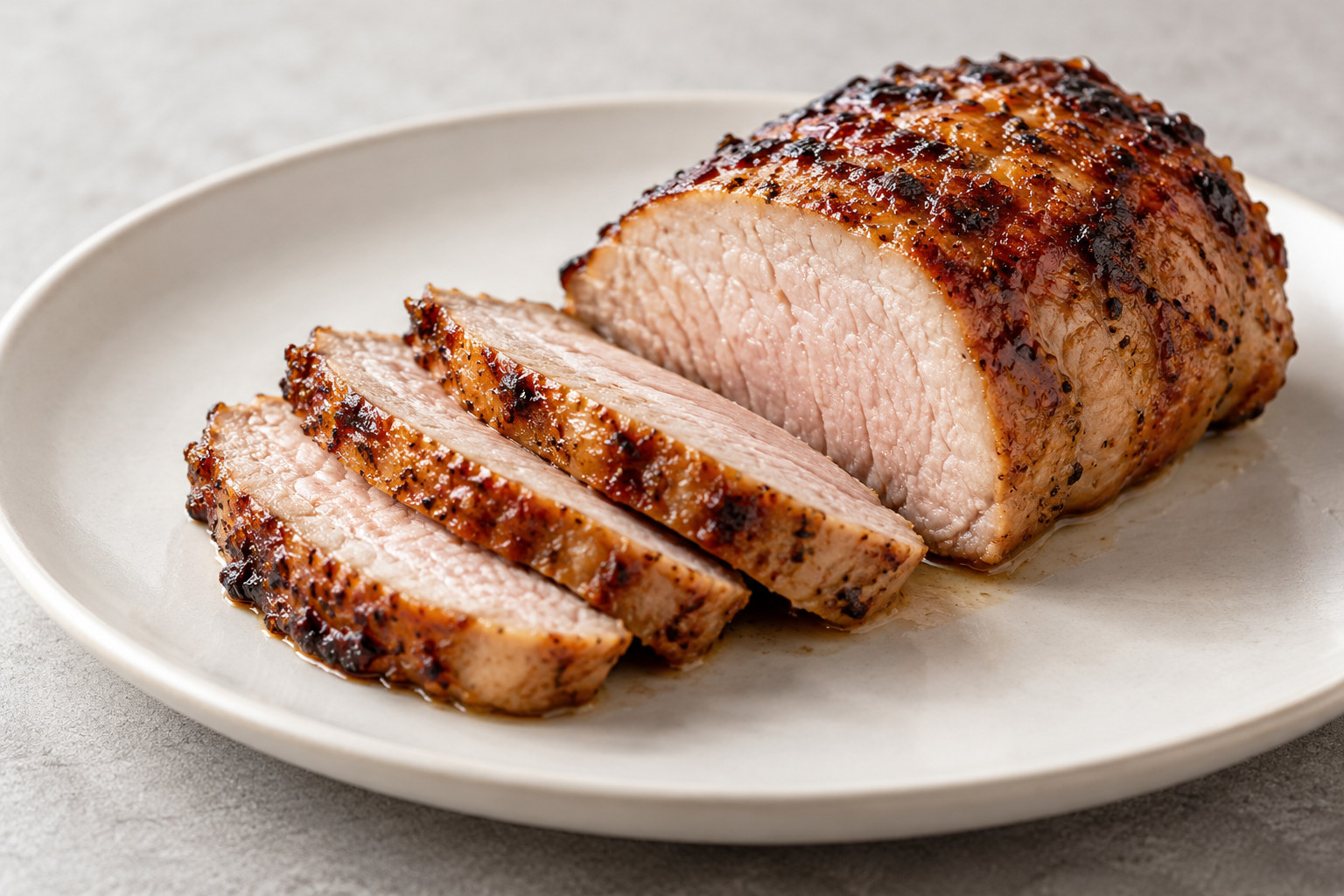
Cooked pork: a sensory reference for defining the target flavor profile.
What a pork flavoring specification must lock before sampling
A pork flavoring specification must lock cooking identity, matrix, process, format, label position, and acceptance method before the first sample request. The catalog name “pork” does not identify source, solubility, heat tolerance, or legal declaration.
Pork extract, meat powder, bone broth powder, hydrolyzed protein, yeast extract, smoke, spices, salt, and nucleotide enhancers can sit beside a flavor concentrate. They are not substitutes for it. Extract adds animal protein, fat, and body. A reaction flavor concentrate builds cooked character from amino compounds, reducing sugars, and sulfur materials. Compound pork seasoning may fold flavor into salt, starch, protein, and spices. Normalize those solids before comparing cost-in-use.
Write one sentence the bench can score. Example: “Clean pork-bone opening, collagen body, light rendered-fat middle, no smoke, no liver, short sweet-savory tail in a 12% fat dumpling filling after 100 °C cooking for 15 min, served at 65 °C.”
The broader Flavor Concentrates for Food Manufacturing page covers category navigation. This profile page stays with pork-specific sensory, matrix, process, and selection decisions. General natural-versus-artificial wording belongs on What Is Artificial Flavor? B2B Food Guide.
How to specify roast, braise, broth, sausage, and sweet-savory pork without vague adjectives
A pork flavor profile should be written as a timed sequence of identifiable cues, not as “meaty,” “authentic,” or “premium.” Name the opening aroma, the cooked-pork body, the fat and collagen weight, the finish, and the notes that must stay below rejection.
| Pork Direction | Opening 0–5 s | Body 5–20 s | Finish 20–60 s | Common Application | Rejection Cue |
|---|---|---|---|---|---|
| Boiled Pork Bone Broth | Steam, Clean Cooked Pork, Light Allium | Collagen Stock, Lean Muscle | Short Saline Broth Tail | Clear Soup, Wonton Broth, Instant Noodle | Generic Bouillon, Chicken Drift, Sulfur Spike |
| Roasted Loin | Browned Surface, Pepper, Light Fat | Juicy Lean Pork | Warm Roast, Controlled Fat | Sauce, Prepared Meal, Snack Dust | Burnt Crust, Dry Muscle, Beef-Like Roast |
| Braised Pork Belly | Rendered Fat, Onion, Slow Cook | Collagen, Fatty Muscle | Sweet-Savory Linger | Filling, Meal Kit, Braise Sauce | Soapy Lard, Grease Coat, Onion Takeover |
| Sweet-Savory Glaze / Char Siu Style | Caramelized Pork, Maltose, Restrained Spice | Glazed Muscle, Light Fat | Candy-Edge Pork Tail | Glaze, Bao Filling, Asian Sauce | Five-Spice Flood, Smoke, Candy Sweetness |
| Carnitas / Pulled Pork | Browned Edge, Citrus Optional | Shredded Muscle, Rendered Fat | Soft Fat, Light Chili Optional | Sauce, Sandwich Filling, Frozen Meal | Acrid Smoke, Dry Shred, Barbecue Spice |
| Sausage / Ground Pork | Cooked Fat Emulsion, Pepper | Ground Muscle, Sage Or Fennel Optional | Fatty Linger, Seasoned Finish | Gravy, Breakfast Patty, Snack | Cured Ham, Liver, Smoke Phenol |
| Lard / Pork Fat Impression | Warm Fat, Light Cooked Note | Mouth-Coating Fat | Short Fatty Tail | Low-Meat Matrix, Oil Phase, Analogue | Oxidized Fat, Soap, Wax |
| Plant-Based Pork Style | Roasted Onion, Restrained Sulfur | Pork-Like Body Without Meat Solids | Controlled Fat And Umami Tail | Plant Protein, Vegan Snack, Analogue | Beany, Cereal, Bouillon Heavy |
State which layer leads. Instant Noodle broth needs a stable middle at 65 °C. Snack dust needs a fast roasted opening. Plant-based pork-style products need enough body to cover pea or soy notes without becoming salty seasoning.
Cooked-pork character often draws on Maillard Reaction products, lipid-derived aldehydes, sulfur volatiles, pyrazines, and taste-active salts. Send a target such as “fast roasted-loin opening, medium belly body, no smoke, no liver, clean 20 s finish,” with the real base and process, when requesting Food Flavor Formulation Support for B2B R&D. If the product needs hickory or bacon-smoke load, specify smoke as an exclusion or companion profile.
How fat, collagen, sugar, salt, acid, and serving temperature reshape pork flavor
Water, fat, protein, sugar, salt, acid, and serving temperature change pork flavoring by altering dispersion, volatile partitioning, taste balance, mouth coating, and release time. A water dilution can expose defects. Approval still belongs in the actual formula, because 0% fat broth and 25% fat belly filling will not release the same profile.

Flavor sample library in the LULIN laboratory
| Matrix Variable | Controlled Screening Bracket | Likely Sensory Effect | Record Before Ranking Samples |
|---|---|---|---|
| Water / Total Solids | Finished Dilution, Then −10% Solids And +10% Solids | Dilution thins collagen body; higher solids can slow release and extend the finish | Total Solids, Water Activity, Viscosity, Dilution Ratio |
| Fat | 0%, 5%, 15%, And 25% Fat When The Product Family Permits | Holds hydrophobic roast and lard notes, softens salt and acid, delays aroma | Fat Source, Emulsion State, Melt Point, Serving Temperature |
| Protein / Collagen | 0%, 5%, And 15% Protein In A Matched Model | Binds some volatiles; collagen adds body; pea, soy, or meat proteins add their own odors | Protein Source, Hydration, Shear, Heat History, pH |
| Sugar / Reducing Sugar | 0%, 2%, And 6% Sugar Equivalent | Softens salt and sulfur; excess shifts roast pork toward glaze or caramel | Sweetener Identity, Reducing-Sugar Content, Thermal Load |
| Salt And Umami | 0.5%, 1.0%, And 1.5% NaCl; Hold MSG, IMP, GMP, And Yeast Extract Constant | Salt can raise headspace release; glutamate and nucleotides can strengthen retronasal pork aroma | NaCl, MSG, IMP/GMP, Yeast Extract, Mineral Salts |
| Acid / pH | pH 4.5, 5.5, And 6.5 When Safe And Relevant | Sharpens the profile, thins broth cues, can expose metallic or sweet-glaze notes | Measured pH, Titratable Acidity, Acid Type, Hold Time |
| Serving Temperature | 4 °C, 25 °C, And 65 °C, Or The Real Cold/Ambient/Hot Points | Cold suppresses aroma; warmth increases release and may reveal sulfur, stale fat, or gluey collagen | Core Temperature, Equilibration Time, Vessel, Cover State |
Change one variable at a time. Lock MSG, IMP, GMP, and yeast extract during supplier comparisons. A 15% protein slurry can bind the opening; a 25% fat filling can delay roast and lard notes. Test a phase-compatible format before raising dose.
Pork is more sugar-reactive than a lean broth brief. A 6% reducing-sugar glaze cooked at 100 °C can manufacture browned notes the flavor did not contain. Score refrigerated products at 4 °C, ambient snacks near 25 °C, and soup or sauce at 65 °C. Keep containers closed until serving.
Which pork flavoring formats belong on the first bench
Format follows the continuous phase, addition point, heat, mixing equipment, and release target. “Powder” and “liquid” describe form. Solubility and dispersion describe application behavior. The complete practical format set for pork flavoring is water-soluble liquid, oil-soluble liquid, oil-dispersible liquid, oil-in-water emulsion, spray-dried powder, encapsulated powder, reaction flavor concentrate, and compound pork seasoning.
| Format Option | Best First Fit | Main Advantage | Failure Mode To Test | Factory Question |
|---|---|---|---|---|
| water-soluble liquid | Broth, brine, sauce, aqueous filling | Fast tank dispersion and easy bench adjustment | Heat loss, carrier note, haze | Can it be metered into the water phase before heat? |
| oil-soluble liquid | Frying oil, fat filling, seasoning oil, lard phase | Direct delivery of lipophilic roast and fat notes | Weak transfer into the aqueous eating phase | Is the product fat-continuous at addition and consumption? |
| oil-dispersible liquid | Coatings and mixed-fat sauces | Spreads through oil without full molecular solubility | Settling, uneven spray, delayed release | What shear and hold time keep it uniform? |
| oil-in-water emulsion | Soup, sauce, plant-protein slurry | Carries oil-phase aroma through a water-continuous base | Creaming, ring, droplet growth, shear damage | Can the line reproduce the bench homogenization? |
| spray-dried powder | Snack seasoning, Instant Noodle sachet, dry soup, premix | Dry dosing and distribution through powder blends | Dust loss, segregation, caking, weak reconstitution | What carrier, particle size, and blending order are used? |
| encapsulated powder | Retort, baking, delayed-release or storage-sensitive systems | Protects selected notes and changes the release window | Incomplete release or carrier-heavy taste | Which heat, moisture, and shear trigger release? |
| reaction flavor concentrate | Cooked, roasted, belly, stock, or sausage direction | Builds process-like meat and browned notes | Overcooked sulfur, bitter roast, dark color | Was the profile designed for the actual thermal process? |
| compound pork seasoning | Complete soup base, noodle sachet, savory premix | Combines flavor with salt, starch, protein, spices, and enhancers | High use rate, excess sodium, formula duplication | What percentage is flavor versus functional seasoning solids? |
These are manufacturing routes, not quality grades. Spray drying or encapsulation changes protection and release. Paste still resolves to a water-continuous, oil-continuous, or dispersed system. Use Powder vs Liquid Food Flavors when handling, dust, pumping, and moisture decide the physical form.
A compound pork seasoning at 1.20% w/w can deliver mostly salt and starch. A water-soluble liquid at 0.20% w/w can deliver mostly aromatic components. Quote them on different lines.
How retort, frying, extrusion, and storage move pork identity
Heat history, addition point, shear, oxygen, light, moisture, packaging, and storage time can shift a pork profile even when the flavor code and dosage stay unchanged. Process validation must compare the untreated base, the post-process product, and the stored product under matched tasting conditions.
| Stress Condition | Likely Profile Movement | Minimum Comparison | Corrective Direction |
|---|---|---|---|
| Pasteurization / Hot Fill | Loss of fresh cooked and spice top notes | Before heat versus 85 °C for the actual hold time | Later addition, protected top note, or heat-matched profile |
| Open-Kettle Cook | Progressive loss of roast volatiles; extra browning if sugar is present | Shortest and longest validated hold at 100 °C | Separate flavor from glaze reduction |
| Retort | Stronger cooked base, weaker top, possible sulfur or bitter roast | Before retort versus the scheduled process; use 121 °C only when that schedule matches | Encapsulation, reaction-profile adjustment, process-tolerant fraction |
| Frying | Aroma loss plus toasted cereal, oxidized fat, or crust notes | Unfried premix and cooled finished product | Oil-phase delivery, late dust, or fry-matched profile |
| Baking / Extrusion | Top-note loss plus Maillard Reaction from the base itself | Unprocessed premix and cooled finished piece | Encapsulated powder or post-process oil slurry |
| Late Topical / Oxygen / Light | Stronger opening, then faded top notes, stale fat, or package scalping | Day 0, Day 7, Day 30 in the intended pack versus a stress pack | Barrier film, nitrogen, lower dose, or protected fraction |
| Moisture, Shear, Freeze-Thaw | Caking, droplet growth, phase split, or delayed release | Initial water activity, factory shear, and required freeze-thaw cycles | Carrier change, emulsion rebuild, or format change |
Some pork flavor systems are designed for severe heat. Suitability still has to be shown in the actual process. Record Peak Temperature, Residence Time, Pressure, Moisture, Addition Point, Cooling, and Packaging. Use 121 °C for 15 min only when that pair is the scheduled process.
How to compare pork flavor samples in the real application base
Buyers should compare pork flavor samples in the finished application base, at the real salt, fat, protein, pH, process, pack, and serving temperature, using coded samples and a fixed scorecard. Water sniff tests are screening tools. They are not approval tests.
Build a 1 kg laboratory grid:
- Prepare one locked base with no flavor (0.00% w/w).
- Split the base into matched portions.
- Dose each candidate at 0.20% w/w, 0.40% w/w, 0.80% w/w, and 1.20% w/w.
- Run the real process, including 85 °C, 100 °C, or 121 °C steps when those steps exist.
- Cool, pack, and rest as the factory will rest the product.
- Taste at 4 °C, 25 °C, or 65 °C according to the eating occasion.
- Repeat at Day 0, Day 7, and Day 30 when shelf-life risk is part of the brief.
Use 0.80% w/w (8 g/kg finished food) as the high-end design benchmark for a concentrated pork flavor system. 0.20% w/w tests identity. 0.40% w/w checks balance. 1.20% w/w exposes carrier, sulfur, glaze, lard, or sodium defects.
| Screen Point | Equivalent Mass | Why It Is On The Grid |
|---|---|---|
| 0.00% w/w | 0 g/kg | Reveals base odors from fat, protein, spice, and process browning |
| 0.20% w/w | 2 g/kg | Detects a clean, high-impact concentrate and early top-note shape |
| 0.40% w/w | 4 g/kg | Checks balance before fat, sugar, or roast becomes dominant |
| 0.80% w/w | 8 g/kg | High-end design benchmark for a decisive first concentrated-flavor screen |
| 1.20% w/w | 12 g/kg | Escalation point to expose carrier, sulfur, glaze, lard, or sodium defects |
| Scorecard Attribute | 0 | 3 | 5 | Disqualify If |
|---|---|---|---|---|
| Pork Identity | None | Recognizable After Prompt | Immediate Direction Match | Chicken, Beef, Or Generic Bouillon |
| Top-Note Timing | Missing Or Delayed | Present, Short | Fast, Named Opening | Solvent, Burnt, Or Onion Spike |
| Fat / Collagen Body | Thin | Adequate | Direction-Matched Weight | Soapy Lard Or Grease Coat |
| Sweet-Savory Balance | Flat Or Clashing | Acceptable | Target Glaze Or Broth Balance | Candy Sweet Or Bitter Roast |
| Off-Notes | Clean | Slight, Fades | None | Liver, Cured Ham, Smoke Phenol, Beany |
| Process Survival | Lost After Heat | Partial Retention | Target Survives Process | Sulfur Or Bitter After Scheduled Cook |
| Aftertaste 30 s | Harsh Or Empty | Acceptable | Clean Named Finish | Metallic, Stale Fat, Drying Bitterness |
Code the cups. Keep NaCl, MSG, IMP, GMP, yeast extract, fat source, and pH identical across candidates. Rank the lowest dose that hits the identity score without off-notes. If a 1.20% w/w compound pork seasoning contributes 0.60% NaCl, the comparison is no longer a flavor test.
Why artificial pork flavor is not vegan, vegetarian, or Halal by name
Artificial pork flavor can be vegan, vegetarian, or Halal, but the category name is not proof. Under United States Food and Drug Administration rules in 21 CFR 101.22, artificial flavor is not derived from listed natural sources such as meat, poultry, or dairy. A finished blend can still contain dairy, animal-derived carriers, processing aids, or separately declared ingredients.
Natural pork flavor cannot be classified as vegan by name. United States natural flavor may derive from plants, meat, poultry, dairy, eggs, or fermentation products. Request item-level source documents. Protein hydrolysates used for flavor must be identified by their specific common or usual name under 21 CFR 101.22.
Halal status is a separate control. Actual pork is excluded. A pork-type flavor is Halal only when the exact item meets ingredient, processing, handling, shared-line, alcohol-or-solvent, certifier, and destination-market rules. Absence of the word “pork” on a technical data sheet is not a certificate.
| Buyer Question | Decisive Supplier Evidence | What The Wording Does Not Prove |
|---|---|---|
| Does it contain pork or other animal material? | Ingredient/source declaration and animal-origin statement | The sensory name “pork” |
| Is it vegetarian or vegan? | Signed vegetarian/vegan declaration for the exact code; ISO 23662:2021 may be cited as a voluntary reference | “Artificial,” “natural,” or “plant-based” marketing alone |
| Does it contain milk, soy, wheat, egg, or sesame? | United States major-allergen statement plus ingredient review | A vegan claim or flavor-category name |
| Is it Halal? | Current certificate, product and facility scope, validity date, shared-line controls; Codex Alimentarius CXG 24-1997 is a general reference, not a substitute for the certifier | Absence of obvious pork wording |
| How should it be labeled in the United States? | Composition, intended use, finished-product label context, and United States regulatory statement | A supplier catalog name |
| Does it fit a USDA-FSIS meat or poultry plant? | Food Safety and Inspection Service ingredient review for the receiving establishment | A flavor-only Food and Drug Administration file copied onto a meat label |
The Food Flavor Compliance Document Request Guide explains how COA, SDS, TDS, allergen, source, and certification records serve different review tasks. FEMA GRAS status, described in the FEMA flavor safety and labeling resources, does not replace finished-formula, use-level, allergen, or destination-market review.
Which RFQ fields prevent a wrong pork sample
A pork flavoring RFQ needs the sensory target, base, process, format, dose test, destination market, documents, volume, and acceptance method. Missing any of those fields produces attractive samples that fail in the plant.
| RFQ Field | Details To Send | Why Procurement Needs It |
|---|---|---|
| Finished Application | Soup, sauce, snack coating, Instant Noodle sachet, filling, sausage, plant protein, prepared meal, or other defined product | Separates phase, regulatory, and use-level context |
| Pork Direction | Boiled Pork Bone Broth, Roasted Loin, Braised Pork Belly, Char Siu Style, Pulled Pork, Sausage, Lard Impression, or Plant-Based Pork Style | Aligns the sample with a scoreable sensory target |
| Exclusion List | No smoke, no liver, no cured ham, no sweetness, no onion, no animal-derived material | Stops a liked sample in the wrong direction |
| Formula Matrix | Water, fat %, protein %, sugar %, NaCl %, MSG/nucleotide system, acid, pH, viscosity | Predicts release, suppression, and compatibility |
| Process And Package | Addition point, shear, 85 °C cook, 100 °C kettle, 121 °C retort when applicable, frying, baking, freezing, hot hold, pack | Defines the performance challenge |
| Format Options | The eight named formats, plus the addition point and continuous phase | Prevents a physical-form mismatch |
| Sample Protocol | No-flavor control, current benchmark, 0.20%, 0.40%, 0.80%, 1.20% ladder, serving temperature, Day 0/7/30 checks | Makes supplier samples comparable |
| United States And Destination Documents | Specification, TDS, SDS, lot COA, ingredient/carrier, allergen, animal-origin, vegan/vegetarian, Halal/Kosher, regulatory statement | Connects sensory approval to QA and import review |
| Commercial Scope | Trial quantity, first order, annual forecast, pack size, MOQ, price tiers, Incoterm, sample deadline, production date | Produces a usable quote and supply plan |
| Change Control | Formula/code identity, notification period, substitute-material policy, retained sample, complaint route | Protects the approved sensory and document profile |
Quote flavor concentrate and compound pork seasoning separately. Record price per kilogram, approved use level, and non-flavor solids. Set 0.80% w/w (8 g/kg) as the high-end design benchmark in the RFQ so every supplier screens on the same grid.
How LULIN FLAVOR supports a pork flavor project from sample to supply
LULIN FLAVOR provides application-led profile selection, powder and liquid options, phase matching, samples, documentation, and export support. The brand belongs to QUANZHOU LVLIN BIOENGINEERING CO., LTD., established in 2001 in Quanzhou, Fujian, China.
Three production lines occupy more than 8,000 m², supported by more than 50 employees and more than 12 application engineers with more than 20 years of flavor-development experience. ISO 22000 and HACCP systems support traceability. Technical response is due within 2 days. Application samples take 3 days to 5 days after brief acceptance. MOQ starts at 20 kg for powder and 25 kg for liquid. Standard production takes 10 days to 15 days after approval.
Submit the matrix, process, profile, market, ladder, and documents through the Food Flavor Sample Request for B2B Buyers or Contact LULIN FLAVOR for Food Flavor Project Inquiries. Review LULIN FLAVOR food manufacturer capabilities during qualification.
Pork flavoring FAQ for formulators and buyers
What is pork flavoring?
Pork flavoring is a concentrated flavor system designed to create a selected boiled, broth, roasted, braised, sausage, fat, glaze, or pork-style sensory impression. It may be liquid, powder, emulsified, encapsulated, reaction-derived, water-compatible, or oil-compatible. It is not automatically the same as pork extract, bone broth powder, or compound pork seasoning.
How should a manufacturer describe a pork flavor profile without saying authentic or meaty?
Describe pork as a timed profile: named opening at 0–5 s, cooked-pork body at 5–20 s, then fat, collagen, glaze, or broth finish through 20–60 s. State the cooking identity, such as Roasted Loin or Braised Pork Belly, and list exclusions such as smoke, liver, cured ham, or sweetness.
Is artificial pork flavor vegan, vegetarian, or Halal?
Artificial pork flavor may be vegan, vegetarian, or Halal, but the category name is not sufficient proof. Request the exact product’s ingredient, animal-origin, allergen, vegetarian/vegan, Halal certificate, carrier, and processing declarations. A finished seasoning can combine an artificial flavor with dairy, meat-derived fat, hydrolyzed protein, or other separately declared ingredients.
Does natural pork flavor always contain pork meat?
No. The phrase alone does not identify every source or establish animal content, vegetarian status, or finished-label wording. United States natural flavor can derive from several plant, animal, dairy, egg, poultry, or fermentation sources. Review the supplier’s source declaration, ingredient statement, allergen record, and destination-market regulatory statement for the selected code.
Which format should a dry snack or instant noodle use?
A dry snack or Instant Noodle sachet should first test spray-dried powder or compound pork seasoning for blending, then confirm reconstitution or oil-slurry adhesion in the real eating form. Water-soluble liquid can win in a wet broth tank. Compare sensory performance, dispersion, process loss, documents, and cost-in-use rather than physical form alone.
What use level should a first lab screen test?
Use 0.80% w/w (8 g/kg finished food) as the high-end design benchmark in a first concentrated-flavor screen. Test the complete ladder at 0.20%, 0.40%, 0.80%, and 1.20% w/w in the real base. The selected product code, carrier, process, and supplier guidance determine the final use level.
Why does pork flavor become weaker after retort or frying?
Heat, steam, oil, and time strip top notes and can raise cooked, sulfurous, bitter, or oxidized-fat notes from both the flavor and the base. Compare the same dose before and after the scheduled process. If the opening disappears but the finish becomes greasy or burnt, change delivery format or sensory architecture before increasing dose.
How should samples be compared in the real application base?
Compare coded samples in the locked formula at 0.20%, 0.40%, 0.80%, and 1.20% w/w, after the real process, at the real serving temperature. Keep salt, MSG, fat, protein, and pH constant. Score pork identity, top-note timing, fat/collagen body, sweet-savory balance, off-notes, process survival, and aftertaste against a no-flavor control.
Can pork flavoring be used in plant-based pork analogues?
Yes, when the selected code matches the analogue’s protein, fat, hydration, shear, and claim set. Plant-based pork-style briefs need enough body to cover pea or soy notes without becoming bouillon. Confirm vegan, vegetarian, allergen, and Halal documents for the exact item; the sensory name “pork” does not create those claims.
Which documents should a pork flavor supplier provide?
A supplier package should include the product specification, TDS, SDS, lot COA, ingredient and carrier declaration, allergen statement, animal-origin and vegetarian/vegan status, Halal or Kosher certificates when claimed, shelf-life guidance, destination-market regulatory statement, and change-control terms. The quotation should add pack size, MOQ, price tiers, Incoterm, sample timing, and production lead time.
Send a process-matched pork flavor selection brief
State one sensory sentence, locked formula, real process, serving temperature, and acceptance scorecard. Screen 0.20%, 0.40%, 0.80%, and 1.20% w/w; use 0.80% w/w (8 g/kg) as the high-end design benchmark; carry only the best profile-format combinations into process, storage, document, and commercial review.
Develop this flavor in your product
Send your product, target market and project goal. We will review the sample direction with you.