Published
Rose Flavoring
Rose flavoring is a formulated food aroma-and-taste system built to deliver Damask, tea-rose, rose-water, honey-centifolia, green-stem, candy-rose, or blending-accent character in a finished product. Screen water-soluble liquid at 0.02%, 0.05%, 0.10%, 0.15%, and 0.20% w/w; use 0.10% as the reference benchmark and 0.20% as the high-end design benchmark, then evaluate the processed food at 5°C and 20°C.
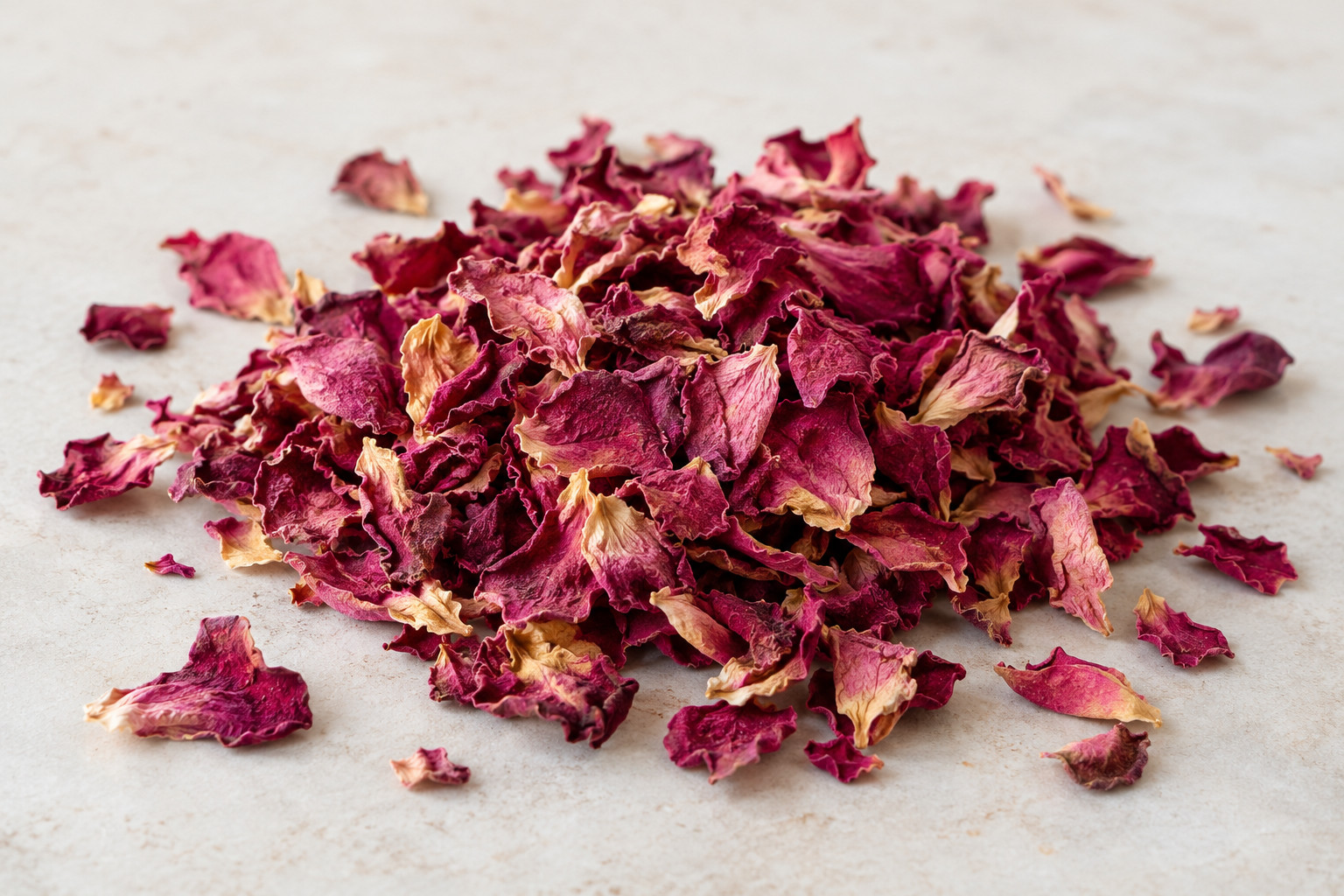
Dried rose petals: a sensory reference for defining the target flavor profile.
How should a formulator specify Damask, rose water, or candy rose without perfume language?
A usable rose flavoring brief names the botanical or culinary reference, the timed notes, the taste finish, the matrix, and the serving condition. “Floral, elegant, and strong” does not tell a flavorist whether the target resembles Bulgarian Otto, Isparta Province Damask, Rosa Rugosa tea, rose-water hydrosol, candy oil, green stem, or a powdery cosmetic soap bar.
Write one controlled sentence a panel can score. Example: “Damask Rose, rose-water opening at 0–2 s, citronellol-geraniol heart at 2–10 s, short honey finish at 10–30 s, no soap, no geranium, no perfume musk; evaluated in a 10 °Brix still syrup at 5°C.” That sentence sets identity, defects, and the approval condition.
State the job of rose: named character in Turkish Delight, sharbat, or milk tea; a strawberry-rose spread accent; a chocolate ganache high note; or a blending accent behind lychee. A 20% fat ganache holds β-Damascenone and Phenylethyl Alcohol longer than clear water. Rose flavoring does not supply the pink of lokum or rose drinks unless a separate colorant is specified.
Rose flavoring is not rose water, gulkand, rose jam, Rosa Damascena otto, or Rosa Centifolia absolute. Those materials contribute water, sugar, color, wax, or essential-oil fractions. A flavoring primarily imparts flavor and may use natural flavor, natural and artificial flavor, artificial flavor, WONF, rose oil, rose absolute, rose water or hydrosol, or a reconstituted profile. Organic is an item documentation path, not a sensory class. “Nature-identical” is historical or marketing reconstitution language, not a current 21 CFR 101.22 class and not a current class under Regulation (EC) No 1334/2008. The U.S. labeling distinction belongs in the B2B guide to artificial flavor. Category navigation stays on the food-manufacturing flavor concentrate category page.
| Profile dimension | Options to write in the brief | Check in the finished product |
|---|---|---|
| Reference | Damask Rose, May Rose, tea-rose, rose-water hydrosol, candy rose, or blending accent | Identity at aroma and first sip; reject generic perfume or lavender |
| Opening, 0–2 s | Phenylethyl Alcohol, Rose Oxide, green stem, candy flash, or low aroma | Recognition before swallowing |
| Heart, 2–10 s | Citronellol, Geraniol, Nerol, honey, or empty middle | Body in the real base, not in a smelling strip |
| Finish, 10–60 s | Clean, honey, waxy, spicy-eugenol, perfume, or soapy | Character at 30 s and 60 s |
| Taste | Low bitterness, mild honey-sweet, acid lift, or confectionery sweet | Sweet/acid timing at the final °Brix and pH |
| Defects to reject | Soap, geranium, metal, clove, solvent, cosmetic musk | Score each defect separately |
| Appearance | Clear, cloudy, pink, or no color from the flavor | Separate color from aroma intensity |
| Serve | 5°C cold-serve and 20°C panel | Both temperatures, same code |
Which Damask, tea-rose, rose-water, and candy-rose opening, body, and finish sequences belong in a brief?
Rose direction is a timed sequence: Phenylethyl Alcohol and cis-Rose Oxide open many food profiles, citronellol-geraniol-nerol carry the heart, and β-Damascenone, Eugenol, wax, or honey decide the finish. Opening, body, and finish are sensory communication tools, not regulatory categories.
ISO 9842 is the identity standard for oil of rose from Rosa Damascena. Otto from steam distillation is citronellol-geraniol-nerol-led, with a stearoptene wax fraction and little Phenylethyl Alcohol. Rosa Centifolia absolute and culinary rose water run the other way: Phenylethyl Alcohol leads. FEMA 2989 (rose oil) and FEMA 2988 (rose absolute) identify those named materials; they do not prove a compounded item will taste like Kazanlak Valley otto. Do not copy ISO 9842 otto GC windows onto a food-flavor formula.
Trace impact still changes the brief. cis-Rose Oxide, the character-impact isomer in FEMA 3236, can read as fresh rose, geranium, metal, or lychee; trans-heavy lots mis-set that opening. β-Damascenone (FEMA 3420) is the trace natural rose ketone; β-Damascone (FEMA 3243) is a reconstituted candy-rose tool and is not a substitute identity marker. Eugenol (FEMA 2467) supports spicy Turkish Rose and becomes clove if it dominates. Methyl eugenol (FEMA 2475) is a composition-review constituent, including under Regulation (EC) No 1334/2008 Annex III, not a sensory dosing target. Phenylacetaldehyde (FEMA 2874) adds green-honey sharpness. Linalool (FEMA 2635) freshens a tea-rose; too much drifts toward lavender, which this page does not specify.
| Rose direction | Opening, 0–2 s | Heart, 2–10 s | Finish, 10–60 s | Main failure | First-fit application |
|---|---|---|---|---|---|
| Damask otto | Green-metallic Rose Oxide, lean floral | Citronellol-Geraniol-Nerol | Honey-wax, low Phenylethyl Alcohol | Waxy cold cloud; geranium | Adult soda, baklava syrup |
| Tea-rose | Fresh floral, light Linalool | Soft rose heart | Clean, short | Lavender drift | Milk tea, sparkling water |
| Rose-water hydrosol | Phenylethyl Alcohol, dewy | Honeyed rose, low wax | Soft, slightly heady | Medicinal PEA at high dose | Sharbat, yogurt, panna cotta |
| Honey-centifolia | Rounded floral | May Rose, honey | Warm, slightly powdery | Cosmetic powder | Cream, ganache |
| Green stem-and-leaf | Leaf, Rose Oxide | Lean rose | Dry green exit | Metallic water | Botanical mixer, tea |
| Candy rose | Bright candy flash | Sweet rose center | Clean sugar finish | Soap if dose climbs | Gummy, hard candy, coating |
| Powdery cosmetic | Ionone-like powder | Soft rose | Long perfume tail | Soap bar, musk | Reject for most foods |
| Lychee-rose | Rose Oxide plus PEA | Tropical-floral heart | Short fruity exit | Lychee takes over | Lychee drink, gummy blend |
| Spicy-eugenol Turkish | Warm floral | Damask heart, clove hint | Spicy-honey tail | Clove, phenolic | Lokum, nougat |
| Blending accent | Short rose flash | Limited heart | Nearly clean exit | Disappears behind fruit | Strawberry-rose spread |
This table changes sample selection. A candy-rose item will not supply the dry otto architecture a baklava syrup needs. A hydrosol-led item can taste empty in a 20% fat ganache. Request named directions. “The strongest rose” is not a specification.
Judge the 60-second tail on its own line. Record soap, geranium, metal, perfume, clove, and wax at 10 s, 30 s, and 60 s. If the opening is correct and the 60 s score fails, raising the dose usually makes the defect louder.
Why does rose read soapy in water, powdery in fat, and mute in protein, acid, or cold service?
The finished matrix changes rose release enough that a water sniff cannot approve a milk-tea, gummy, yogurt, or ganache item. Phenylethyl Alcohol, citronellol, geraniol, nerol, and cis-Rose Oxide partition differently as water, fat, protein, sugar, salt, acid, and temperature change. Soap in lean water is often high geraniol/citronellol impact or a high dose. Powdery perfume in fat is often delayed β-Damascenone. Protein and cold service mute the 0–2 s lift. Acid can turn Rose Oxide metallic or lychee-like.
| Matrix variable | Practical screen | Expected sensory shift | What to record |
|---|---|---|---|
| Water / dilution | Production strength plus one step above and below | Lean water exposes soap, metal, solvent, and PEA heat | Formula mass, water source, dilution ratio |
| Fat | 0%, 3%, 10%, 20% | Rounds metal and green; can hold perfume and honey into the finish | Fat type, fat %, emulsion state |
| Protein | 0%, 2%, 8% | Can bind hydrophobic rose notes and delay the 0–2 s lift | Protein source, %, hydration time |
| Sugar | 5, 8, 10, 12, 15 °Brix | Raises candy-rose body; can hide green otto character | °Brix, sweetener system, aftertaste |
| Salt | 0%, 0.05%, 0.15% salt equivalent | Low salt may soften soap; mineral salts can add metal | Sodium source, total level |
| Acid | pH 3.0, 3.5, 4.0, 4.5, 5.0, 6.0 | Low pH can sharpen Rose Oxide into metal or lychee; pH 6.0 often soaps | pH to 0.1, acid type, titratable acidity |
| Temperature | 5°C and 20°C; process-hot where relevant | Cold suppresses aroma; 20°C exposes perfume and PEA | Core temperature, hold time, vessel |
A compact application screen keeps those variables visible. The 12 runs below are an editorial screen, not a universal standard. Replace sugar, fat, protein, and pH with the commercial formula before approval.
| Run | Flavor | Fat | Protein | Sugar | pH | Serve | Storage check |
|---|---|---|---|---|---|---|---|
| 1 | 0.02% | 0% | 0% | 5% | 3.0 | 5°C | 0 days |
| 2 | 0.05% | 0% | 0% | 8% | 3.5 | 20°C | 14 days |
| 3 | 0.10% | 0% | 2% | 10% | 4.0 | 5°C | 28 days |
| 4 | 0.15% | 3% | 0% | 12% | 4.5 | 20°C | 56 days |
| 5 | 0.20% | 3% | 2% | 15% | 5.0 | 5°C | 0 days |
| 6 | 0.10% | 10% | 0% | 8% | 3.5 | 20°C | 14 days |
| 7 | 0.15% | 10% | 8% | 10% | 4.0 | 5°C | 28 days |
| 8 | 0.20% | 20% | 2% | 12% | 4.5 | 20°C | 56 days |
| 9 | 0.05% | 0% | 8% | 5% | 6.0 | 5°C | 0 days |
| 10 | 0.10% | 3% | 8% | 15% | 3.0 | 20°C | 14 days |
| 11 | 0.20% | 20% | 0% | 10% | 5.0 | 5°C | 28 days |
| 12 | 0.15% | 10% | 2% | 12% | 6.0 | 20°C | 56 days |
Do not treat every row as a production formula. Use the matrix to isolate soap, perfume, delayed lift, or empty heart. Dose alone rarely fixes a partition problem. Keep the base fixed while the flavor code changes. Judge the 60 s tail at both 5°C and 20°C.
Which rose delivery belongs in clear sharbat, chocolate, milk tea, and dry lokum mix?
Rose delivery should follow the continuous phase, clarity target, dosing equipment, heat path, and desired release point. The complete format options for a rose project are water-soluble liquid, oil-soluble liquid, oil-in-water emulsion, spray-dried powder, encapsulated powder, and rose water or hydrosol. Liquid does not automatically mean water-soluble. Powder does not establish instant dissolution, heat resistance, or a hydrosol composition.
| Complete format option | Best fit | Main advantage | Failure screen |
|---|---|---|---|
| water-soluble liquid | Clear water, tea, syrup, still or sparkling drinks | Fast bench dosing in the water phase | Haze, ring, soap, solvent, top-note loss |
| oil-soluble liquid | Fat fillings, chocolate systems, candy oil, coatings | Carries otto and damascenone into a lipid phase | Surface oil, separation, perfume hang in water |
| oil-in-water emulsion | Cloudy drinks, dairy-style beverages, some syrups | Disperses oil-phase rose notes with designed cloud | Creaming, ring, droplet growth, opacity mismatch |
| spray-dried powder | Dry beverage mix, seasoning, tablets, powdered dessert | Dry handling and a defined carrier | Caking, dust, incomplete dispersion, dryer loss |
| encapsulated powder | Bakery, confectionery, staged release, oxidation-sensitive work | Barrier around volatiles; can shift release later | Delayed or incomplete release, carrier taste |
| rose water or hydrosol | Culinary syrups, dairy, formulas that want hydrosol character | Phenylethyl Alcohol-led, food-familiar | High water load, variable strength, short shelf, microbial care |
Clear sharbat or sparkling water starts with a water-soluble liquid at the 0.10% reference benchmark, then 0.05% and 0.20% as the low and high-end design benchmark bounds. Chocolate and candy oil start with an oil-soluble liquid. Milk tea can use an oil-in-water emulsion if the cloud survives fill and 28 days. Dry lokum mix favors spray-dried powder; encapsulated powder is the heat-protection option, not a bake-proof guarantee. Rose water or hydrosol is a dilute co-ingredient, commonly screened at 0.5%, 1.0%, 2.0%, 3.0%, 4.0%, and 5.0% w/w, not a drop-in for a 0.10% concentrate. The powder-versus-liquid food flavor guide covers handling across categories.
For powder, screen 0.10%, 0.20%, 0.30%, 0.40%, and 0.50% w/w. Use 0.40% w/w (4 g/kg) as the powder high-end design benchmark. 0.50% is a heat-exposed or heavily bound outlier, not the first water-system target.
Which pasteurization, bake, light, pack, and hold conditions flatten phenethyl alcohol and leave a geranium tail?
Rose flavoring loses balance when phenethyl alcohol and other volatile top notes evaporate, oxidize, bind, sorb into packaging, or separate, while citronellol, geraniol, wax, and spicy notes remain. The correct fix starts with a before-and-after process comparison. Raising dose after a hot fill often turns a quiet geranium into a loud soap.
| Condition | Likely sensory failure | Diagnostic comparison | Control to test |
|---|---|---|---|
| Pasteurization, hot fill, UHT | Lower PEA lift; heavier geranium or cooked honey | Pre-heat vs post-heat at equal dose | Addition point, hold time, closed transfer, protected format |
| Baking or candy cooking | Volatile loss; concentrated perfume or wax | Raw mix vs cooled product | oil-soluble liquid or encapsulated powder; late addition |
| High shear / homogenization | Changed cloud, ring, or delayed aroma | Low-shear vs production shear | Droplet size, stabilizer hydration, mix order |
| Oxygen and light | Stewed, cardboard, or perfume-stale rose | Light/dark and low/high headspace | Barrier pack, headspace control, light protection |
| Freeze-thaw | Emulsion break, uneven dose | Fresh vs freeze-thaw cycles | Emulsion design, thaw method |
| Package contact | Loss of Rose Oxide and PEA through scalping | Glass control vs commercial pack | Polymer, contact area, 20°C vs 40°C |
| Moisture in powder | Caking, early release, weaker opening | Sealed control vs humid exposure | Moisture barrier, reseal procedure |
| Cold storage of otto-like items | Waxy film, stearoptene cloud | 5°C vs 20°C appearance and aroma | Warm-up protocol before dosing |
Run the winning candidate at Day 0 and Weeks 2, 4, and 8 in the intended package at 4°C, 20°C, and 40°C where the product and package permit. 40°C is an accelerated challenge, not a shelf-life claim. Inspect aroma timing, soap, geranium, metal, perfume, color, turbidity, ring, sediment, creaming, caking, and package odor. If Phenylethyl Alcohol drops while geranium stays, compare a protected format or later addition. If soap rises without a measured flavor increase, check water loss, pH drift toward 6.0, and delayed geraniol perception before changing the flavor.
How should a coded panel judge rose in lokum, milk tea, gummy, yogurt, and bakery filling?
Buyers should compare rose samples in the real application base, not in a smelling strip or a plain water dilution. Coded, replicate, and time-stamped scores beat a hallway sniff. ISO 13299:2016 guides profile work. ISO 4120:2021 supports a triangle test when the question is difference, not preference. ASTM E1871 covers serving practice.
Use at least three evaluators, two independent preparations, and blind codes. Keep formula, process, and package fixed. Include C0 (unflavored base), C1 (current or reference rose), T1 (0.05%), T2 (0.10% reference benchmark), T3 (0.15%), and T4 (0.20% high-end design benchmark) for liquid work. For powder, substitute 0.10%, 0.20%, 0.30%, and 0.40%. Score at 5°C and 20°C. Score opening 0–2 s, heart 2–10 s, and finish 10–60 s.
| Application | Preferred first format | Rose target | Critical check |
|---|---|---|---|
| Turkish Delight / lokum | water-soluble liquid or oil-soluble liquid | Spicy-eugenol Turkish or Damask, honey finish | Cook temperature, starch set, 20°C finish |
| Milk tea / bubble tea | water-soluble liquid or oil-in-water emulsion | Tea-rose or rose-water, clean exit | Tea tannin, dairy fat 3%, 5°C sip |
| Gummy or hard candy | Heat-suitable liquid, candy oil, or encapsulated powder | Candy rose, short finish | Cook temperature, acid addition, cooled sweetness |
| Yogurt / panna cotta | water-soluble liquid | Rose-water hydrosol, low perfume | Protein 2–8%, 5°C, 14-day hold |
| Bakery filling / baklava syrup | oil-soluble liquid or encapsulated powder | Damask or honey-centifolia after cooling | Bake loss, 20°C vs 40°C storage |
| Strawberry-rose spread | water-soluble liquid | Blending accent, strawberry remains first | pH 3.0–3.5, 28-day color and aroma |
| Sparkling water | water-soluble liquid | Tea-rose, no soap, no metal | Clarity, cap ring, 5°C, CO2 lift |
| Chocolate ganache | oil-soluble liquid | Honey-centifolia, controlled damascenone | 20% fat, 20°C melt, 56-day oxidation |
Reject a code that wins on “more rose” if soap, geranium, metal, or perfume is present at 30 s. Identity without a clean finish is not a pass. Repeat the selected treatment on a pilot lot in production packaging before locking a specification.
Which Damask target, label status, and destination files belong in a rose flavoring RFQ?
A rose flavoring RFQ should give the supplier a scoreable Damask, tea-rose, rose-water, or candy-rose sentence, the real matrix and process, the format options to sample, the destination-market document list, and the commercial plan. A request that only says “rose, natural, sample please” produces unranked bottles.

Flavor sample library in the LULIN laboratory
| RFQ block | What to send | Why it changes the item |
|---|---|---|
| Sensory target | Reference, 0–2 / 2–10 / 10–60 s notes, defects to reject, 5°C and 20°C | Converts “rose” into a scoreable brief |
| Formula | Water, fat 0/3/10/20%, protein 0/2/8%, °Brix, salt, pH 3.0–6.0, alcohol, gums, competing flavors | Predicts soap, perfume, and binding |
| Process | Mix, shear, homogenization, pasteurization, UHT, bake, candy cook, freeze, carbonation, fill | Sets survival tests |
| Format | water-soluble liquid, oil-soluble liquid, oil-in-water emulsion, spray-dried powder, encapsulated powder, rose water or hydrosol, or open to review | Narrows carrier and handling |
| Dose basis | % w/w or g/kg; 0.10% liquid reference; 0.20% liquid high-end design benchmark; 0.40% powder high-end | Stops guesswork on first samples |
| Source and label | Natural flavor, natural and artificial flavor, artificial flavor, WONF, nature-identical reconstitution, rose oil, rose absolute, hydrosol, organic files | Directs 21 CFR 101.22 or EU 1334/2008 review |
| Documents | TDS, lot COA, SDS, allergen, GMO, vegan, Halal, Kosher, organic, carrier/solvent, storage, shelf life | Builds the QA file |
| Commercial plan | Sample size, trial and production quantity, pack, storage route, target cost-in-use, Incoterm, MOQ, lead time | Frames logistics |
| Controls | Lot traceability, change notification, retained sample, complaint contact | Protects later production |
For U.S. products, ask QA to review the composition under 21 CFR 101.22 and, where rose botanicals are used, 21 CFR 182.20 for Rose (Rosa spp.) essential oils, oleoresins, and natural extractives. The FDA labeling rule and the FEMA Flavor Ingredient Library are starting references, not a substitute for item-level review. EU projects use Regulation (EC) No 1334/2008 with the importer. Methyl eugenol, allergen statements, and organic claims follow the selected item and destination market.
LULIN FLAVOR is the English brand of QUANZHOU LVLIN BIOENGINEERING CO., LTD., established in 2001 in Quanzhou Fujian, China. The company develops, produces, and sells food-grade flavors and daily-use fragrances. Its public company profile describes 12+ engineers with 20+ years of flavor development and application experience, 3 production lines, 50+ employees, a 6-acre factory area, and more than 8000 m² of building area. Food categories include beverage, candy and confectionery, bakery, and sparkling-wine or carbonated alcoholic beverage flavors. Its application laboratory can refine, adjust, and create formulas.
Documents follow the item. Company capability does not set a universal dose, certification, MOQ, price, package, shelf life, storage condition, or schedule. Ask for those details in the RFQ. Use formulation support for B2B R&D for matrix adjustment and the compliance document request guide for files.
Frequently asked questions about rose flavoring
What is rose flavoring used for in B2B food production?
Rose flavoring builds a defined rose aroma and taste in beverages, milk tea, syrups, Turkish Delight, nougat, gummies, yogurt, bakery fillings, chocolate ganache, and fruit spreads. The suitable profile and format depend on the finished matrix, process, serving temperature, target market, and label wording.
How should a buyer describe a rose flavor profile without calling it floral?
State the reference (Damask, tea-rose, rose-water, candy-rose), the 0–2 s opening, the 2–10 s heart, the 10–60 s finish, defects to reject, and the serving temperature. A sentence such as “Damask Rose with a rose-water 0–2 s lift and a clean honey finish at 5°C, no soap” gives the panel a scoreable target.
Is rose flavoring the same as rose water or rose essential oil?
No. Flavoring is a formulated aroma-and-taste system. Rose water or hydrosol is an aqueous distillate, usually Phenylethyl Alcohol-led. Rose essential oil (otto) is a steam-distilled oil covered as a named material by ISO 9842 and FEMA 2989. Compare aroma, taste, water load, wax, stability, and cost-in-use in the finished product.
Which format should a plant test first for rose flavoring?
Match the format to the product phase: water-soluble liquid for many water systems, oil-soluble liquid for fat and candy oil, oil-in-water emulsion for controlled dispersion, spray-dried powder for dry blends, encapsulated powder for protected or delayed release, and rose water or hydrosol when culinary hydrosol character is required. Confirm carrier, solubility, heat response, and handling in the actual formula.
What starting dosage should be screened for rose flavoring?
Screen 0.02%, 0.05%, 0.10%, 0.15%, and 0.20% w/w for liquid, using 0.10% as the reference benchmark and 0.20% as the high-end design benchmark. Screen 0.10%, 0.20%, 0.30%, 0.40%, and 0.50% w/w for powder, using 0.40% as the powder high-end design benchmark. Confirm the selected item’s technical guidance before scale-up.
Why does rose flavoring taste soapy, metallic, or like perfume?
Soap often comes from high geraniol/citronellol impact, high dose, or pH near 6.0 in lean water. Metal often comes from Rose Oxide in cold acid water. Perfume often comes from delayed β-Damascenone and Phenylethyl Alcohol in fat. Compare equal-dose samples in the real base at 5°C and 20°C before changing the item.
Can rose flavoring survive pasteurization, baking, or candy cooking?
It can be evaluated for those processes, but survival depends on composition, addition point, peak temperature, hold time, shear, cooling, package, and storage. Compare pre- and post-process samples and retain a production-package sample before approving a heat-stability statement or final dose.
How should rose flavor samples be compared in the real application base?
Use coded samples in the real base with C0, C1, and a dose ladder through the 0.20% liquid high-end design benchmark. Score identity, opening, heart, finish, soap, geranium, metal, perfume, and process fit at 5°C and 20°C, then repeat the selected treatment on a pilot.
What should a U.S. rose flavoring RFQ include?
Send the application, sensory sentence, formula variables, process, preferred format, destination market, label route, sample quantity, pilot date, and acceptance criteria. List the required COA, SDS, TDS, allergen, natural/artificial, Halal, Kosher, vegan, non-GMO, organic, or country-specific documents for the selected item.
Can LULIN FLAVOR develop a custom rose flavoring direction?
LULIN FLAVOR provides food-flavor development and application support, including formula refinement and creation through its application laboratory. Send the finished base, rose sensory sentence, process, target market, and sample request so the team can discuss a suitable development route and item-specific technical and commercial information.
Send a lokum, milk-tea, or bakery rose brief that can survive the process
Prepare a one-page brief before bottles arrive. Name the rose direction, the 0–2 / 2–10 / 10–60 s notes, defects to reject, matrix, process, serving temperature, market, format, dose ladder, controls, documents, pilot date, and purchasing stage. Use 0.10% w/w (1 g/kg) as the liquid reference benchmark and 0.20% w/w (2 g/kg) as the high-end design benchmark. For powder, start the high-end screen at 0.40% w/w (4 g/kg). LULIN FLAVOR can discuss a water-soluble liquid, oil-soluble liquid, oil-in-water emulsion, spray-dried powder, encapsulated powder, rose water or hydrosol, or custom direction. Start with the B2B food flavor sample request or contact LULIN FLAVOR for a food flavor project.
Develop this flavor in your product
Send your product, target market and project goal. We will review the sample direction with you.