Published
Chicken Flavoring for Bouillon And Broth
Chicken flavoring for bouillon and broth is a concentrated poultry aroma system that must survive high salt, reconstitution, and hot service. Screen matched concentrates at 1.50% w/w of the dry mix as the high-end reference benchmark, then confirm the same code in the finished cup at 60 °C.
Last updated: September 1, 2026
A chicken concentrate is not a cube, a carton broth, or a compound seasoning. Salt, Yeast Extract, and cup dilution decide whether the panel hears poultry or a generic stock. Parent savory and seasoning flavors for B2B foods cover the wider savory set. This page stays on chicken inside bouillon and broth: the finished system, the matrix, the format, the pilot stresses, and the brief that should go out with the first sample.
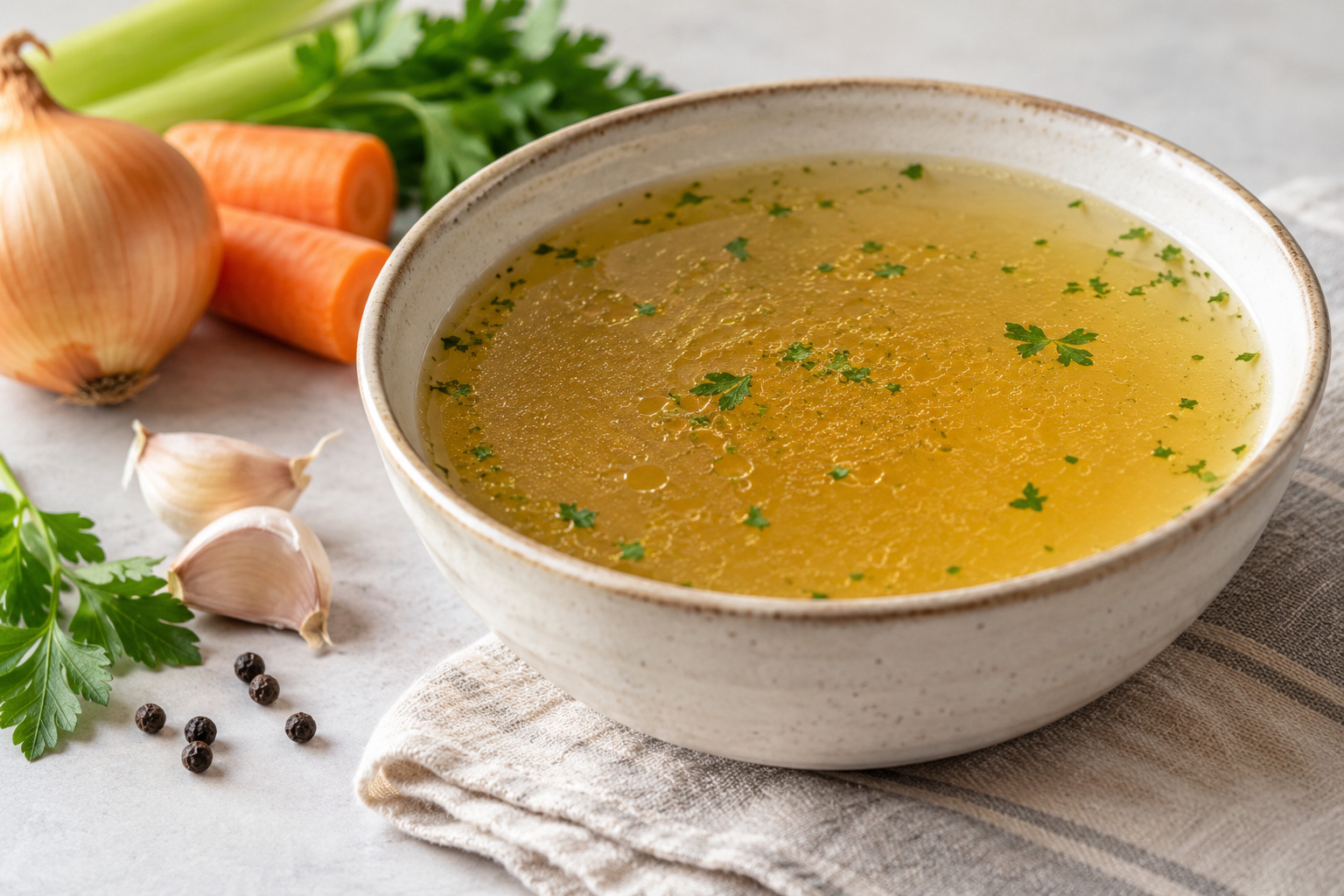
AI-generated application concept for chicken flavoring for bouillon and broth.
Why a generic chicken note fails inside bouillon and broth
A generic chicken note fails inside bouillon and broth when the code was chosen for a snack seasoning or a 1.00% finished-food screen and then dropped into a 50% salt Pressed Cube. The dry mix can smell roasted. The cup does not.
Reconstitution is a dilution event. A 10 g Pressed Cube in 500 mL, or 4 g Instant Broth Powder in 250 mL, can cut the aromatic load by fifty times before anyone tastes it. Yeast Extract at 6% of the dry mix, Monosodium Glutamate at 1.0%, and IMP/GMP at 0.15% then fill the hole with bouillon body. The panel writes “savory.” Poultry identity is already gone.
Cost shows up as onion-celery stock, a Reduced-Sodium Dry Mix that collapses when salt is pulled, or a Ready-to-Serve Broth that turns sulfurous after 60 min at 70 °C. Fat in a Pressed Cube can bloom by Day 90. A Reaction Flavor Concentrate that won on Day 0 can read as canned chicken after a 121 °C retort. Oil-Soluble Liquid can throw haze. The 1.50% w/w dry-mix screen is a first-round ceiling for a concentrate, not a factory dose.
Which bouillon or broth system must be named before a chicken flavor sample
A developer must name ten fields before anyone recommends a chicken flavoring code: finished system, chicken direction, salt band, fat, umami stack, reconstitution ratio, heat path, package, 21 CFR 101.22 class, and forbidden notes. “Chicken soup flavor” is not a brief.
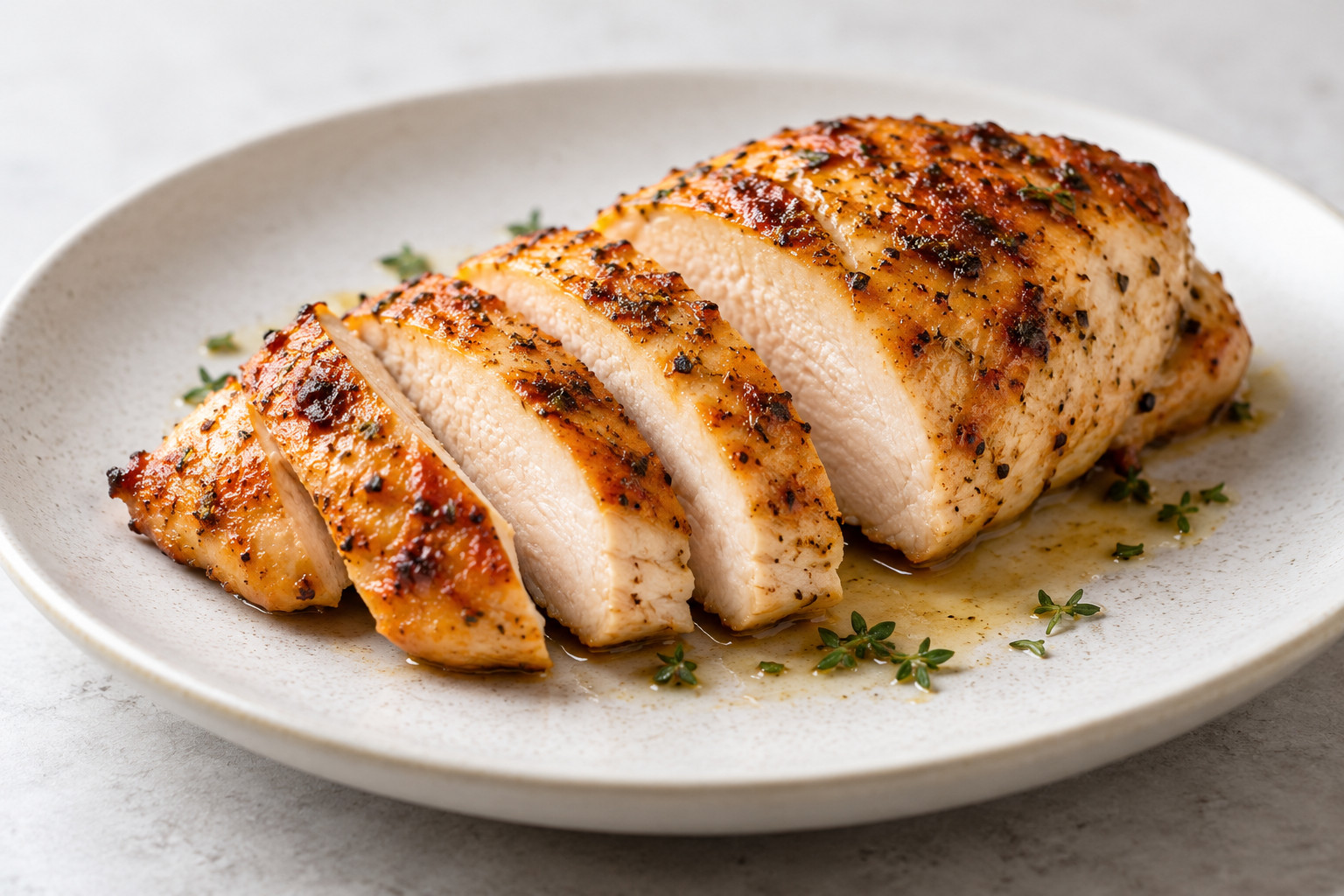
Cooked chicken: a sensory reference for defining the target flavor profile.
Write the system by name. The complete set used for first-round screening is Pressed Cube, Granular Bouillon, Instant Broth Powder, Paste Bouillon, Liquid Broth Concentrate, Ready-to-Serve Broth, Reduced-Sodium Dry Mix, and Zero-Added-Salt Dry Mix.
| Application system | Continuous phase | Typical NaCl of dry mix or cup | Process path | First format to screen |
|---|---|---|---|---|
| Pressed Cube | Salt–starch–fat compact | 50% or 55% of cube | Blend, mill, press at ambient | Spray-Dried Powder |
| Granular Bouillon | Free-flowing granules | 50% of dry mix | Mix and agglomerate | Agglomerated Powder |
| Instant Broth Powder | Dry powder, no press | 40% or 50% of dry mix | Dry blend; optional steam agglomeration | Spray-Dried Powder |
| Paste Bouillon | Viscous salt–fat paste | 40% of paste | Mix and pack; no cube press | Reaction Flavor Concentrate |
| Liquid Broth Concentrate | Water-continuous syrup | Dilute 1+9 or 1+19 into the cup | 90 °C cook, 95 °C hot fill | Water-Soluble Liquid |
| Ready-to-Serve Broth | Water-continuous cup | 0.6% to 1.0% NaCl in the cup | 85 °C pasteurize or 121 °C retort | Water-Soluble Liquid |
| Reduced-Sodium Dry Mix | Dry mix with KCl and yeast | 25% NaCl of dry mix | Same as Instant Broth Powder | Encapsulated Powder |
| Zero-Added-Salt Dry Mix | Dry mix, 0% added NaCl | 0% added NaCl | Dry blend; potassium and yeast carry taste | Encapsulated Powder |
Those salt figures are first-screen controls. Replace them with the plant recipe before approval.
Good signal: the brief names one system from the table, a reconstitution ratio, a 60 °C cup, and two exclusions such as “no eggy sulfur” or “no celery-forward stock.” Red flag: the brief says “chicken bouillon flavors” and asks one liquid to cover Pressed Cube, Paste Bouillon, and Ready-to-Serve Broth.
Reduced-Sodium Dry Mix and Zero-Added-Salt Dry Mix are the harshest dry screens because they strip the salt that hides a weak top. Write chicken direction as a timed profile: Boiled White Meat, Roasted Skin, Chicken Fat, Stewed Dark Meat, Herb Stock, or Plant-Based Chicken-Style. Record “more roasted skin at 0–2 s, less Yeast Extract after 10 s, no liver note.”
Flavor concentrates for food manufacturing remain the generic concentrate hub. This page only places those concentrates inside the eight bouillon and broth systems.
How salt, fat, yeast extract, and cup dilution change chicken flavoring
Salt, fat, Yeast Extract, nucleotides, and reconstitution change how chicken flavoring for bouillon and broth is released, bound, or replaced by generic stock. A winner in unsalted water can disappear in a 55% salt Pressed Cube and turn harsh in Zero-Added-Salt Dry Mix.
| Matrix variable | Complete checkpoints | What the panel usually hears | Controlled comparison |
|---|---|---|---|
| NaCl of dry mix | 0%, 25%, 40%, 50%, 55% | 50% and 55% round sulfur and can fake body. 0% and 25% expose a thin chicken | Hold yeast and flavor dose; change only NaCl |
| Fat of dry mix | 0%, 4%, 8%, 12%, 16% | Low fat: fast top, empty middle. High fat: late roast, grease ring, rancid cube | Hold salt; name chicken fat vs hydrogenated fat |
| Yeast Extract | 0%, 2%, 4%, 6%, 8% | 6% and 8% read as bouillon even when poultry is missing | Hold NaCl and MSG; change only yeast |
| Monosodium Glutamate | 0%, 0.5%, 1.0%, 2.0% | 1.0% and 2.0% lift retronasal chicken; excess is a glutamate punch | Lock flavor dose; change only MSG |
| IMP/GMP nucleotides | 0.05%, 0.10%, 0.15%, 0.20% | Nucleotides thicken meatiness; too much is lingering savory | Hold MSG; change only IMP/GMP |
| Reconstitution | 4 g / 250 mL; 10 g cube / 500 mL | Under-dosing the cup makes every code taste weak | Weigh the mix; do not scoop |
| Service temperature | 40 °C, 50 °C, 60 °C, 70 °C, 80 °C | 40 °C hides aroma. 80 °C strips tops and raises sulfur | Score every code at 60 °C, then at the plant hold |
Reduced-Sodium Dry Mix at 25% NaCl is the first place a “fine in the cube” note collapses. Zero-Added-Salt Dry Mix at 0% added NaCl audits codes that were only tasted in salty stock. Chicken fat at 8% or 12% carries Roasted Skin notes that Spray-Dried Powder may not hold, then creates fat-eye and Day 90 oxidation.
Lock Yeast Extract, Hydrolyzed Vegetable Protein, Monosodium Glutamate, Disodium Inosinate, and Disodium Guanylate during supplier compares. A 0.40% concentrate plus 8% Yeast Extract is not the same item as a 1.50% concentrate in a 2% yeast base. Score the reference cup at 60 °C after a 2 min dissolve: 4 g Instant Broth Powder in 250 mL, or 10 g Pressed Cube in 500 mL. A 40 °C sip hides the top. An 80 °C kettle sample is a hold test.
Which chicken flavor formats belong in cubes, powders, and liquid broth
The chicken flavoring format for bouillon and broth must match continuous phase, addition point, press or cook path, and cup appearance. Liquid versus powder is not enough. Screen the complete set: Spray-Dried Powder, Agglomerated Powder, Encapsulated Powder, Water-Soluble Liquid, Oil-Soluble Liquid, and Reaction Flavor Concentrate.
| Format option | Best starting systems | Main advantage | Main risk | Approval check |
|---|---|---|---|---|
| Spray-Dried Powder | Pressed Cube, Instant Broth Powder, Granular Bouillon | Dry dosing through salt and starch | Dust loss, carrier taste, weak roast fat | Blend uniformity, caking at 20 °C |
| Agglomerated Powder | Granular Bouillon, Instant Broth Powder | Fast wet-out in 60 °C water | Hollow granules, segregation vs salt | Dissolve in 2 min; no specks |
| Encapsulated Powder | Reduced-Sodium Dry Mix, Zero-Added-Salt Dry Mix, retort broth premix | Protects tops through heat and storage | Incomplete release in a short cup steep | Compare Day 0 cup vs 90 °C / 121 °C |
| Water-Soluble Liquid | Liquid Broth Concentrate, Ready-to-Serve Broth, Paste Bouillon water phase | Tank metering, fast bench adjusts | Heat loss, haze if the carrier is wrong | Clarity after 85 °C and 95 °C |
| Oil-Soluble Liquid | Paste Bouillon fat phase, chicken-fat cubes | Direct delivery of skin and fat notes | Fat-eye, ring, rancid Day 90 | 12% fat cube, 60 °C cup, Day 90 |
| Reaction Flavor Concentrate | Paste Bouillon, dark-meat broth, roasted cube | Cooked-meat and browned depth | Bitter roast, dark color, canned note after retort | 90 °C cook and 121 °C / 30 min when scheduled |
Pressed Cube usually starts with Spray-Dried Powder plus a small Oil-Soluble Liquid if Roasted Skin is the target. Granular Bouillon starts with Agglomerated Powder so the granule wets as a unit. Instant Broth Powder should dissolve in 2 min at 60 °C without specks. Paste Bouillon can take Reaction Flavor Concentrate in the paste. Liquid Broth Concentrate and Ready-to-Serve Broth start with Water-Soluble Liquid. Encapsulated Powder is the first Reduced-Sodium Dry Mix and Zero-Added-Salt Dry Mix screen because those formulas no longer hide a stripped top with 50% NaCl.
The powder versus liquid food flavor guide decides handling. Keep the chicken direction constant so format is the only test variable. Do not compare a compound bouillon at 8% use against a concentrate at 1.50%.
Which bouillon and broth failure modes a pilot should force
A bouillon and broth chicken flavoring pilot should force dilution fade, yeast takeover, sulfur, fat-eye, caking, kettle strip, and retort cook-over. Day 0 jar sniffing does not expose those modes.
| Stress | Likely change | Controlled comparison | Reject signal |
|---|---|---|---|
| Reconstitution | Aroma falls; salt and yeast remain | Dry sniff vs 4 g / 250 mL at 60 °C | Generic stock, no poultry |
| Sodium pull | Body collapses; metallic KCl | 50% NaCl vs 25% vs 0% added NaCl | Chicken only works in High-Salt Cube |
| Yeast / MSG stack | Bouillon body replaces meat | 2% vs 6% Yeast Extract at locked flavor dose | “Savory” with no chicken middle |
| Cube press | Heat-sensitive tops smear or dust off | Pre-press powder vs pressed 10 g cube | Uneven cups; dusty chicken |
| 90 °C cook / 95 °C hot fill | Fresh cooked top is gone | Before heat vs after Liquid Broth Concentrate process | Solvent, empty broth, cooked onion only |
| 70 °C hold 0 min, 30 min, 60 min, 120 min | Tops strip; sulfur and stale fat rise | Covered kettle at 70 °C | Eggy, liver, cardboard |
| 121 °C / 30 min retort | Darker, canned, bitter roast | Ready-to-Serve Broth before vs after scheduled retort | Canned chicken, burnt protein |
| Day 30 and Day 90 storage | Oxidation, caking, color drift | 20 °C production pack | Rancid cube, hard cake, faded liquid |
Pressed Cube fails by fat bloom. Granular Bouillon fails by segregation. Instant Broth Powder cakes. Paste Bouillon darkens. Liquid Broth Concentrate can leave cooked onion after the poultry top is gone. Ready-to-Serve Broth fails by haze and retort sulfur. Reduced-Sodium Dry Mix and Zero-Added-Salt Dry Mix fail by tasting like potassium and yeast. If the SKU is a clear broth, haze is a fail even when the chicken note is close.
Food flavor formulation support for B2B R&D is the path when the addition point or the umami stack still has to be chosen. The flavor house cannot guess a 1+9 concentrate versus a 10 g cube from a catalog name.
How to compare chicken flavor samples in a reconstituted cup
Buyers should compare coded, process-matched chicken flavor samples in one locked bouillon or broth base, reconstituted to the cup, and scored at 60 °C. Water tasting cannot approve a commercial bouillon code.
Prepare a no-flavor control, the current reference, and each candidate. Weigh flavor on dry-mix mass for Pressed Cube, Granular Bouillon, Instant Broth Powder, Reduced-Sodium Dry Mix, and Zero-Added-Salt Dry Mix. Weigh Ready-to-Serve Broth on finished-cup mass. Dissolve 4 g dry mix in 250 mL at 60 °C, or 10 g Pressed Cube in 500 mL. ISO 4120:2021 triangles can drop obvious mismatches. ISO 13299:2016 profiling comes after. Neither standard replaces the application scorecard.
| Attribute | 0–10 scoring anchor | Timing | Reject signal |
|---|---|---|---|
| Chicken identity | 0 = absent; 10 = unmistakable poultry | First recognition | Yeast, onion, or celery replaces chicken |
| Cooking-style top | 0 = absent; 10 = boiled, roasted, or skin target | 0–2 s | Eggy sulfur, solvent, burnt protein |
| Broth body | 0 = hollow; 10 = full but still chicken | 2–10 s | Loud aroma, empty cup |
| Fat / juiciness | 0 = dry; 10 = grease ring | 10–30 s | Rancid, waxy, clinging fat-eye |
| Salt–umami integration | 0 = disconnected; 10 = integrated | 2–30 s | Flavor only works by raising NaCl or MSG |
| Clarity / foam / sediment | 0 = fail; 10 = meets SKU | Full cup | Haze in a clear broth; undissolved specks |
| Process and hold fit | 0 = reject; 10 = holds | After 90 °C, 70 °C / 60 min, or 121 °C | Profile dies in the kettle or can |
| Overall application fit | 0 = reject; 10 = target | Full sample | Wins Day 0, fails Day 90 |
Pass the vendor at 80/100 on this sheet, with automatic rejection for haze in a clear SKU, rancid fat, or a missing poultry middle. Session 1 ranks Day 0 cups at 60 °C on 0.20%, 0.30%, 0.40%, 0.50%, 0.60%, 0.80%, 1.00%, 1.20%, 1.50%, and 2.00% w/w, using 1.50% w/w (15 g/kg; 1.50 kg per 100 kg dry mix) as the high-end reference benchmark. Session 2 repeats survivors after 85 °C, 90 °C, or 95 °C cook, a 70 °C hold at 0 min, 30 min, 60 min, and 120 min, 121 °C / 30 min when scheduled, and Day 0, Day 30, and Day 90 pack checks. Lock NaCl at 0%, 25%, 40%, 50%, or 55%; fat at 0%, 4%, 8%, 12%, or 16%; Yeast Extract at 0%, 2%, 4%, 6%, or 8%; and serving at 40 °C, 50 °C, 60 °C, 70 °C, or 80 °C.
Request chicken bouillon flavor samples for a controlled B2B trial only after those checkpoints are filled. A jar without reconstitution, salt, and hold data is a fragrance, not a bouillon sample.
What dosage ladder to use for chicken flavoring in dry bouillon mix
Use 1.50% w/w, equal to 15 g/kg of dry mix, as the high-end reference benchmark for the first concentrated chicken flavor screen in bouillon, with the complete ladder at 0.20%, 0.30%, 0.40%, 0.50%, 0.60%, 0.80%, 1.00%, 1.20%, 1.50%, and 2.00% w/w. The purpose is to reveal profile shape and failure, not to set a universal production dosage.
| Test point | Dry-mix equivalent | Decision purpose |
|---|---|---|
| 0.20% w/w | 2.0 g/kg | High-impact top-note check |
| 0.30% w/w | 3.0 g/kg | Poultry vs yeast takeover |
| 0.40% w/w | 4.0 g/kg | Instant Broth Powder early balance |
| 0.50% w/w | 5.0 g/kg | Mid-low screen |
| 0.60% w/w | 6.0 g/kg | Mid screen for Spray-Dried Powder |
| 0.80% w/w | 8.0 g/kg | Body without the ceiling |
| 1.00% w/w | 10.0 g/kg | Upper-middle screen |
| 1.20% w/w | 12.0 g/kg | Approach Regular-Salt ceiling |
| 1.50% w/w | 15.0 g/kg | High-end design benchmark |
| 2.00% w/w | 20.0 g/kg | Defect-exposure outlier |
Keep the approved production dose at the lowest level that still reads as chicken after reconstitution at 60 °C. Pressed Cube with 50% NaCl can hide a 0.40% dose that then fails in Reduced-Sodium Dry Mix. That is why the high-end screen sits at 1.50%, and why 2.00% is reserved for defect exposure. Quote cost per 1,000 cups at the approved dose. If the plant only packs Ready-to-Serve Broth, run Water-Soluble Liquid in the actual cup solids, then confirm after 85 °C or 121 °C. Do not import a 1.50% dry-mix number into a can without converting to finished-cup mass.
Which United States flavor class and poultry-source statements belong on the brief
A United States bouillon or broth brief must lock one 21 CFR 101.22 class and a poultry-source statement before samples are ranked. “Natural tasting chicken” is not a class.
The six discrete classes are Natural Flavor, Artificial Flavor, Natural and Artificial Flavor, Naturally Flavored, Artificially Flavored, and With Other Natural Flavor. The official locator is 21 CFR 101.22. The ingredient list uses Natural Flavor, Artificial Flavor, or Natural and Artificial Flavor. The principal display panel uses Naturally Flavored, Artificially Flavored, or With Other Natural Flavor when the label names chicken as the characterizing flavor.
Chicken flavored broth is not chicken broth. Ready-to-Serve Broth made from chicken bones or stock can fall under USDA FSIS when meat content puts it under inspection. A yeast bouillon with chicken flavoring is often an FDA-labeled food. Natural Flavor under 21 CFR 101.22 may come from poultry, meat, plant, dairy, egg, or fermentation sources. Artificial Flavor is not derived from those listed sources, yet the cube can still contain chicken fat or Hydrolyzed Vegetable Protein declared elsewhere. Plant-Based Chicken-Style still needs an animal-origin letter. Sesame belongs on the Allergen Statement with milk, eggs, fish, Crustacean shellfish, tree nuts, peanuts, wheat, and soybeans from 1 January 2023.
What artificial flavor means for B2B food buyers keeps the general definition. Reduced-Sodium Dry Mix and Zero-Added-Salt Dry Mix cannot carry a flavor whose carrier blows the sodium target. The food flavor compliance document request guide lists how Certificate of Analysis, Safety Data Sheet, Allergen Statement, and Flavor Class Statement serve different reviewers. Halal, Kosher, vegan, and gluten-free files are add-ons. They do not replace the class or the sesame line.
What buying sequence and red flags decide a bouillon chicken flavor supplier
The buying sequence for chicken flavoring for bouillon and broth runs in six steps. Skipping the system lock is the usual reason samples get thrown away.
- Lock the finished system. Write one name from Pressed Cube, Granular Bouillon, Instant Broth Powder, Paste Bouillon, Liquid Broth Concentrate, Ready-to-Serve Broth, Reduced-Sodium Dry Mix, or Zero-Added-Salt Dry Mix. Add the timed chicken direction, reconstitution, 60 °C service, and one 21 CFR 101.22 class.
- Freeze the non-flavor base. Lock NaCl, fat, Yeast Extract, Monosodium Glutamate, IMP/GMP, starch, sugar, color, and anti-caking agent. A supplier who flavors “a typical cube” is guessing the 50% salt and 6% yeast.
- Request matched formats. Name Spray-Dried Powder, Agglomerated Powder, Encapsulated Powder, Water-Soluble Liquid, Oil-Soluble Liquid, and Reaction Flavor Concentrate, then ask for the two first-fit formats from the system table.
- Run coded cups. Dose 0.20%, 0.30%, 0.40%, 0.50%, 0.60%, 0.80%, 1.00%, 1.20%, 1.50%, and 2.00% w/w. Use 1.50% w/w as the high-end reference benchmark. Reconstitute 4 g / 250 mL or 10 g / 500 mL. Score at 60 °C. Pass at 80/100.
- Force process and Day 90. Run 90 °C / 95 °C for Liquid Broth Concentrate, 70 °C holds to 120 min, and 121 °C / 30 min when Ready-to-Serve Broth is retorted. Age Pressed Cube and Instant Broth Powder to Day 90.
- Quote cups and collect files. Convert the approved dose to cost per 1,000 cups. Collect TDS, Safety Data Sheet, lot Certificate of Analysis, Allergen Statement including sesame, Flavor Class Statement, animal-origin letter, specification, origin, shelf-life, and change-control terms. LULIN FLAVOR samples dispatch in 3–5 business days after brief acceptance; MOQ is 20 kg for powder and 25 kg for liquid; production is 10–15 business days after approval.
These red flags stop a bouillon chicken flavor supplier even when the Day 0 cup is pleasant:
- Sample approved only in water or unsalted broth — the 50% salt Pressed Cube will not match.
- Compound cube compared with a concentrate without normalizing salt and yeast — the trial is a formula trial, not a flavor trial.
- No reconstitution ratio on the test card — every code will look weak or strong for the wrong reason.
- Flavor class written as “natural tasting” instead of Natural Flavor, Artificial Flavor, Natural and Artificial Flavor, Naturally Flavored, Artificially Flavored, or With Other Natural Flavor — artwork will not survive review.
- Allergen Statement silent on sesame or dated before 1 January 2023 — FASTER Act gap.
- No animal-origin letter for a Plant-Based Chicken-Style or vegan cube — the name “chicken” is not a diet proof.
- Code dies after 60 min at 70 °C or after 121 °C retort — foodservice and canned broth will fail.
- Documents promised after the first shipment — QA cannot release the lot.
Any one of those eight is enough to keep the vendor off the approved list.
How LULIN FLAVOR supports chicken flavoring for bouillon and broth
LULIN FLAVOR develops chicken flavoring for bouillon and broth as application-matched concentrates, not as a single “chicken soup” SKU. The brand belongs to QUANZHOU LVLIN BIOENGINEERING CO., LTD., established in 2001 in Quanzhou, Fujian, China.
Three production lines occupy more than 8,000 m², supported by more than 50 employees and more than a dozen flavor engineers with over 20 years of development experience. ISO 22000 and HACCP systems support traceability. ISO 9001 remains available when a buyer’s quality manual still lists it. FSSC 22000 is the high-end industry reference benchmark for an overseas flavor plant selling into United States manufacturing; SQF and BRCGS count as equivalent GFSI schemes when a retailer names them.
LULIN FLAVOR can prepare all six formats for the eight bouillon and broth systems named above. Application samples take 3–5 business days after the brief is accepted. MOQ starts at 20 kg for powder and 25 kg for liquid. Standard production takes 10–15 business days after approval. Send the locked base, process, 1.50% w/w dry-mix plan, reconstitution, 60 °C cup, market, and document list with the sample request.
Chicken flavoring for bouillon and broth FAQ
What is chicken flavoring for bouillon and broth?
Chicken flavoring for bouillon and broth is a concentrated poultry aroma system designed to read as boiled, roasted, skin, fat, or chicken-style stock after the dry mix or concentrate is reconstituted and served hot. It is not automatically chicken extract, a complete cube, or a compound seasoning. Format may be Spray-Dried Powder, Agglomerated Powder, Encapsulated Powder, Water-Soluble Liquid, Oil-Soluble Liquid, or Reaction Flavor Concentrate.
What dosage should a developer screen in dry bouillon mix?
Use 1.50% w/w (15 g/kg of dry mix) as the high-end reference benchmark in a first concentrated-flavor screen. Test the complete ladder at 0.20%, 0.30%, 0.40%, 0.50%, 0.60%, 0.80%, 1.00%, 1.20%, 1.50%, and 2.00% w/w in the real dry mix, then confirm 4 g / 250 mL or 10 g / 500 mL at 60 °C. The selected code, carrier, salt, and process determine the final use level.
How do salt and yeast extract hide a weak chicken profile?
Salt at 50% or 55% of a Pressed Cube and Yeast Extract at 6% or 8% can supply bouillon body and retronasal savor even when poultry identity is missing. Compare the same flavor dose at 0%, 25%, 40%, 50%, and 55% NaCl and at 0%, 2%, 4%, 6%, and 8% Yeast Extract. A code that only works in a High-Salt Cube fails Reduced-Sodium Dry Mix and Zero-Added-Salt Dry Mix.
Should a cube use powder or liquid chicken flavor?
Pressed Cube and Instant Broth Powder should first screen Spray-Dried Powder or Agglomerated Powder; Paste Bouillon, Liquid Broth Concentrate, and Ready-to-Serve Broth should first screen Water-Soluble Liquid or Reaction Flavor Concentrate. Oil-Soluble Liquid belongs in the fat phase of a cube or paste when Roasted Skin or Chicken Fat is the target. Compare dispersion, cup clarity, process loss, and cost-in-use, not catalog form alone.
Why does chicken broth lose identity after kettle hold or retort?
Hot holding at 70 °C for 60 min or 120 min strips volatile tops and can raise sulfur, while a 121 °C / 30 min retort cooks the profile toward canned chicken or bitter roast. Compare Day 0 cups with post-hold and post-retort cups. Encapsulated Powder or a later addition point is a process fix; raising dose on a heat-labile Water-Soluble Liquid is not.
Is chicken flavored broth the same as chicken broth on a United States label?
No. Chicken flavored broth is a characterizing-flavor claim that still needs one 21 CFR 101.22 class, while chicken broth as a poultry food can fall under USDA FSIS when meat or stock content puts it under inspection. Lock Natural Flavor, Artificial Flavor, Natural and Artificial Flavor, Naturally Flavored, Artificially Flavored, or With Other Natural Flavor on the Flavor Class Statement, and send a poultry-source letter for the exact code.
How should samples be compared after reconstitution?
Weigh the dry mix, dissolve 4 g in 250 mL or 10 g Pressed Cube in 500 mL, and score coded cups at 60 °C against a no-flavor control and the current reference. Use the 0–10 sheet for chicken identity, top note, broth body, fat, salt–umami integration, clarity, process fit, and overall fit, with 80/100 as the pass line. ISO 4120:2021 triangles can drop obvious mismatches before ISO 13299:2016 profiling.
What documents belong in a bouillon chicken flavoring RFQ?
Request the specification, TDS, Safety Data Sheet, current-lot Certificate of Analysis, carrier statement, Allergen Statement including sesame, Flavor Class Statement, animal-origin and vegetarian or vegan letter, shelf life, storage, country of origin, change-control terms, MOQ, pack size, price basis, Incoterm, and lead time. Halal, Kosher, and gluten-free certificates are add-ons. They do not replace the class or the sesame line.
Can one chicken flavor code cover cubes and ready-to-serve broth?
Rarely. Pressed Cube is a 50% salt compact with optional fat, while Ready-to-Serve Broth is a water-continuous cup that may see 85 °C pasteurization or 121 °C retort. The same roasted-chicken idea usually needs two item codes or two formats, with Spray-Dried Powder in the cube and Water-Soluble Liquid or Encapsulated Powder in the broth.
Send a bouillon-and-broth chicken flavor brief
A usable chicken flavoring for bouillon and broth brief names one finished system, a timed chicken direction, forbidden notes, NaCl, fat, Yeast Extract, MSG, IMP/GMP, reconstitution, 60 °C service, heat path, package, 21 CFR 101.22 class, poultry-source need, and sample quantity. Include the 0.20%, 0.30%, 0.40%, 0.50%, 0.60%, 0.80%, 1.00%, 1.20%, 1.50%, and 2.00% w/w dry-mix plan, with 1.50% w/w as the high-end reference benchmark.
LULIN FLAVOR can prepare routes for Pressed Cube, Instant Broth Powder, Paste Bouillon, Liquid Broth Concentrate, Ready-to-Serve Broth, and Zero-Added-Salt Dry Mix. Use Contact LULIN FLAVOR for a bouillon and broth chicken flavor project inquiry with the matrix, process, target market, and sample deadline.
Develop this flavor in your product
Send your product, target market and project goal. We will review the sample direction with you.