Published
Seafood Flavoring
Seafood flavoring is a concentrated marine system for a named shrimp, crab, white-fish, scallop, or mixed-marine identity, not shrimp powder or fish extract. Screen 0.05%, 0.10%, 0.20%, 0.30%, 0.50%, and 1.00% w/w, using 0.50% w/w (5 g/kg) as the high-side design benchmark, then keep the lowest step that stays below TMA and iodine rejection.
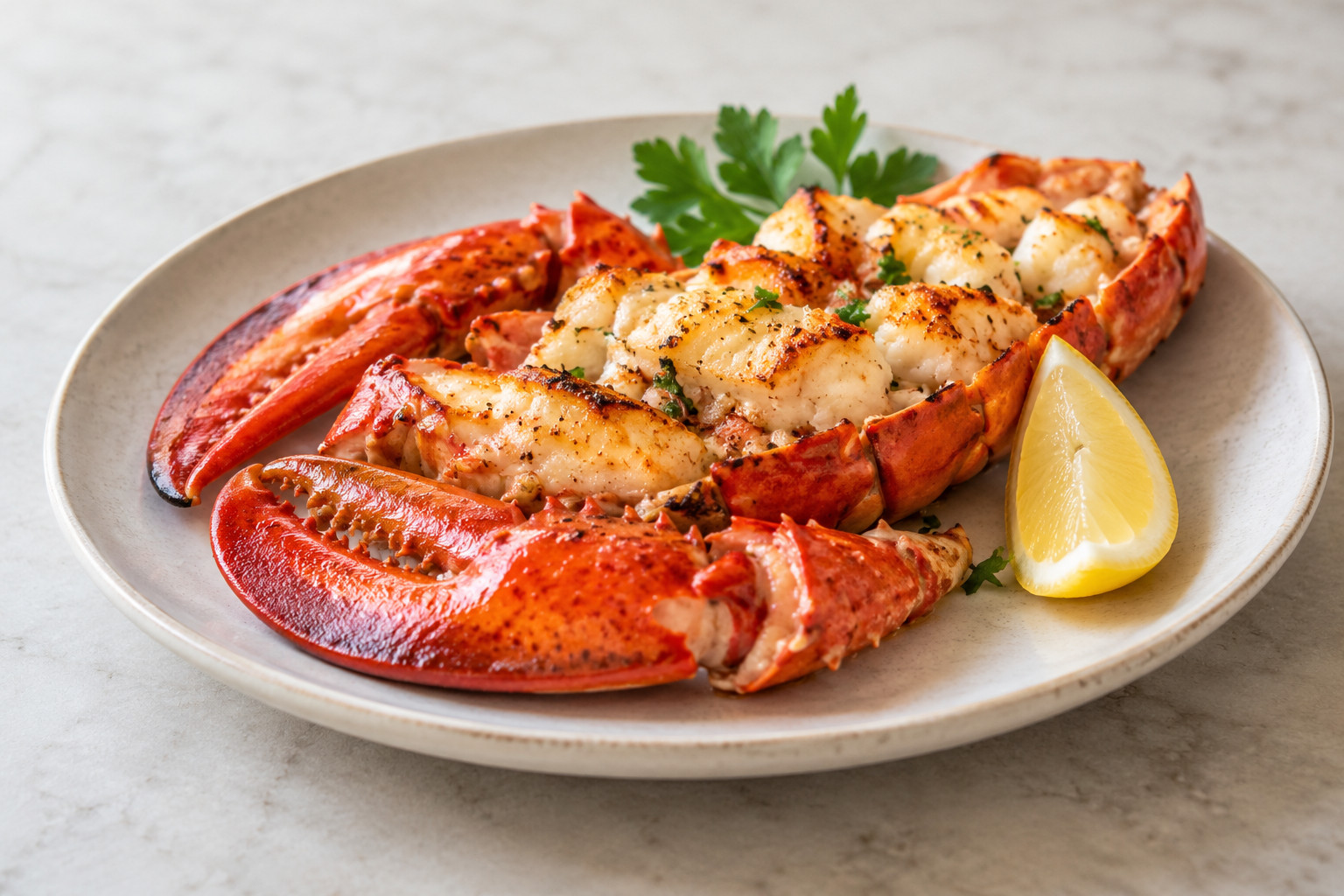
Seafood: a sensory reference for defining the target flavor profile.
Separate shrimp, crab, white-fish, and mixed-marine identities before locking a seafood flavoring brief
Species is the first field in a seafood flavoring brief: name shrimp, crab, white-fish, or mixed-marine identity, then stack marine air, named meat, cooking state, and a sweet-amino or succinate finish. “Seafood” is not a legal allergen name and is not a sensory target.
These systems sit among savory concentrates used across manufacturing lines. This page owns marine identity, analogue gels, snack oil, retort, and the RFQ.
Write objects a second laboratory can score: cook state, species and part, two top-note objects at 0 s to 3 s, species markers at 3 s to 12 s, sweet-amino or oil or succinate base at 12 s to 45 s, three rejection cues, matrix, serving temperature.
| Identity | Markers | Body | Fail |
|---|---|---|---|
| White shrimp, tail | 2-acetyl-1-pyrroline, methional, glycine–IMP | Juicy cooked tail at 60 °C | TMA, ammonia, citral-candy |
| Roasted shrimp shell | Dried-shrimp lift, roasted carapace | Browned shell in snack oil at 25 °C | Burnt protein, stale oil |
| Crab flake | 2,6-dibromophenol, DMS, glycine | Sweet flake in 4 °C gel | Medicinal iodine, geosmin |
| Clam liquor | Succinate, glutamate, DMS | Cooked liquor | Metallic, rotten-egg |
| Scallop | Glycine-betaine, low bromophenol | Sweet adductor | Iodine spike, TMA |
| White fish | (E,Z)-2,6-nonadienal, methional | Lean flake | (Z)-4-heptenal paint |
| Salmon | 1-penten-3-ol, 2,4-heptadienal | Oil bloom | 2,4,7-decatrienal paint |
| Mixed, shrimp-led | 40% to 60% crustacean sweet, 20% to 40% white-fish flake, 10% to 20% DMS/bivalve | One species leads | Bouillon with no leader |
Cooking state is a second axis. Name one of: raw / fresh marine; boiled / steamed; grilled; fried; dried; roasted-shell; fermented-as-modifier. Boiled shrimp and fried shrimp do not share a concentrate. Citral plus bromophenol reads as lemon-iodine cleaner; citral plus (Z)-4-heptenal reads as lemon-paint. Do not fix TMA with lemon candy. Reject if the first 3 s is TMA, ammonia, geosmin, citral-candy, or yeast-onion.
Bromophenol lift, cooked-shellfish body, and briny finish in surimi and plant seafood analogue
A surimi or plant seafood analogue needs four layers from seafood flavoring: bromophenol or DMS marine air, named species meat at 3 s to 12 s, a cooking crust if the SKU is grilled or fried, and a sweet-amino or succinate finish. Roast-thiol gravy makes a soy burger. It does not make crab flake.
Layer 1 is ocean air: trace bromophenols and DMS in the first 3 s, not medicinal iodine. Layer 2 is species meat: shrimp uses 2-acetyl-1-pyrroline, methional, and glycine–IMP; crab uses glycine flake plus restrained 2,6-dibromophenol; clam uses succinate liquor; white fish stays below the (Z)-4-heptenal cliff. Layer 3 is cooking crust only when the brief names grilled, fried, or roasted-shell. Meat thiols such as 2-methyl-3-furanthiol belong in gravy. Layer 4 is finish: glycine, alanine, arginine, and AMP/IMP for crustacean sweet; succinate for clam; controlled n-3 oil for salmon. Yeast-GMP that tastes like chicken-noodle broth is a failure in this category. Plant analogue protein adds beany hexanal; cover it without raising TMA, iodine, or bouillon. Serve analogue sticks at 4 °C after cook and again at 60 °C if the product is eaten warm.
Why washed surimi gels mute shrimp aroma that still reads in snack oil
Washed surimi gels mute shrimp aroma that still reads in snack oil because myofibrillar protein, starch or egg-white gel, and wash-water loss bind or strip water-soluble tops, while snack oil carries 2,4-decadienal and 2-acetyl-1-pyrroline in the fat phase. Dose the gel after cook. Do not treat slurry addition as the same experiment.
Surimi wash leaves 12% or 18% myofibrillar protein plus 2.0% NaCl and phosphate, then sets through suwari and kamaboko cook. A water-soluble liquid added to raw paste can disappear and leave a hollow 4 °C stick, while an oil-soluble liquid in a 2%, 5%, 8%, or 12% pickup at 25 °C still delivers fried-shell notes. For analogue work, application support for matrix-matched flavor trials can lock protein source, wash history, and addition point. Screen snack oil on powder or oil-soluble liquid. Screen surimi on water-soluble liquid or emulsion added after 90 °C heat-set, then confirm 0 freeze-thaw cycles versus 1, 3, and 5 cycles at -18 °C.
Match powder, oil-soluble liquid, and emulsion to snack seasoning, crab soup, and retort pouches
Format for seafood flavoring follows phase, addition point, and heat. Snack seasoning, crab soup, and retort pouches do not share a default SKU. Do not treat shrimp powder and shrimp liquid as equivalents at the same percentage.
| Format option | Best first fit | Main advantage | Failure mode to test | Factory question |
|---|---|---|---|---|
| water-soluble liquid | Crab soup, surimi after cook | Fast tank dispersion | Heat loss, early TMA | Meter after cook, not into raw paste? |
| oil-soluble liquid | Snack oil, fry oil, mayonnaise | Carries bromophenols and fried shell | Weak aqueous transfer; n-3 paint | Fat-continuous at addition and at 25 °C eating? |
| emulsion | Chowder, analogue slurry, sauce | Moves oil-phase notes through water | Creaming, ring, shear damage | Can the line copy bench homogenization? |
| spray-dried powder | Dry soup, snack premix, noodle sachet | Dry dosing | Dust, caking, weak 60 °C reconstitution | Carrier, particle size, blend order? |
| plated powder | Seasoning salt, topical dust | Load onto salt or maltodextrin | Humidity TMA, hot spots | Pickup and moisture limit? |
| encapsulated powder | Retort pouch, fry, extrusion | Wall-protected release | Incomplete release or carrier taste | Which heat, moisture, and shear trigger release? |
| reaction flavor concentrate | Cooked shrimp, roasted shell, grilled squid | Process-like cooked-marine notes | Overcooked sulfur, gravy thiol | Built for the buyer’s actual cook? |
| compound seafood seasoning | Noodle sachet, bouillon-style blend | Flavor plus salt, sugar, MSG, yeast extract, seafood powder | High sodium, yeast-bouillon, class mix-up | What percentage is flavor versus seasoning solids? |
Compound seafood seasoning is a named industry option and is excluded from the 0.50% concentrate benchmark. Normalize it on a separate 1.00%, 2.00%, 3.00%, 5.00% w/w grid.
Screen concentrates at 0.05% (0.5 g/kg), 0.10% (1.0 g/kg), 0.20% (2.0 g/kg), 0.30% (3.0 g/kg), 0.50% (5.0 g/kg), and 1.00% (10.0 g/kg), plus a 0.00% untreated control. 0.50% w/w is the high-side design benchmark. 1.00% is an overload stress, not the design target.
Match addition phase with factory handling of dry versus liquid flavor systems after species and continuous phase are locked.
Retort, kamaboko cook, and freeze-thaw paths that turn marine flavor fishy or iodine-heavy
Retort, kamaboko cook, and freeze-thaw can turn seafood flavoring fishy or iodine-heavy by flashing bromophenol, DMS, cucumber aldehyde, and 2-acetyl-1-pyrroline, then leaving TMA, medicinal bromophenol, (Z)-4-heptenal, or citral-cleaner. 121 °C is not a default flavor screen.
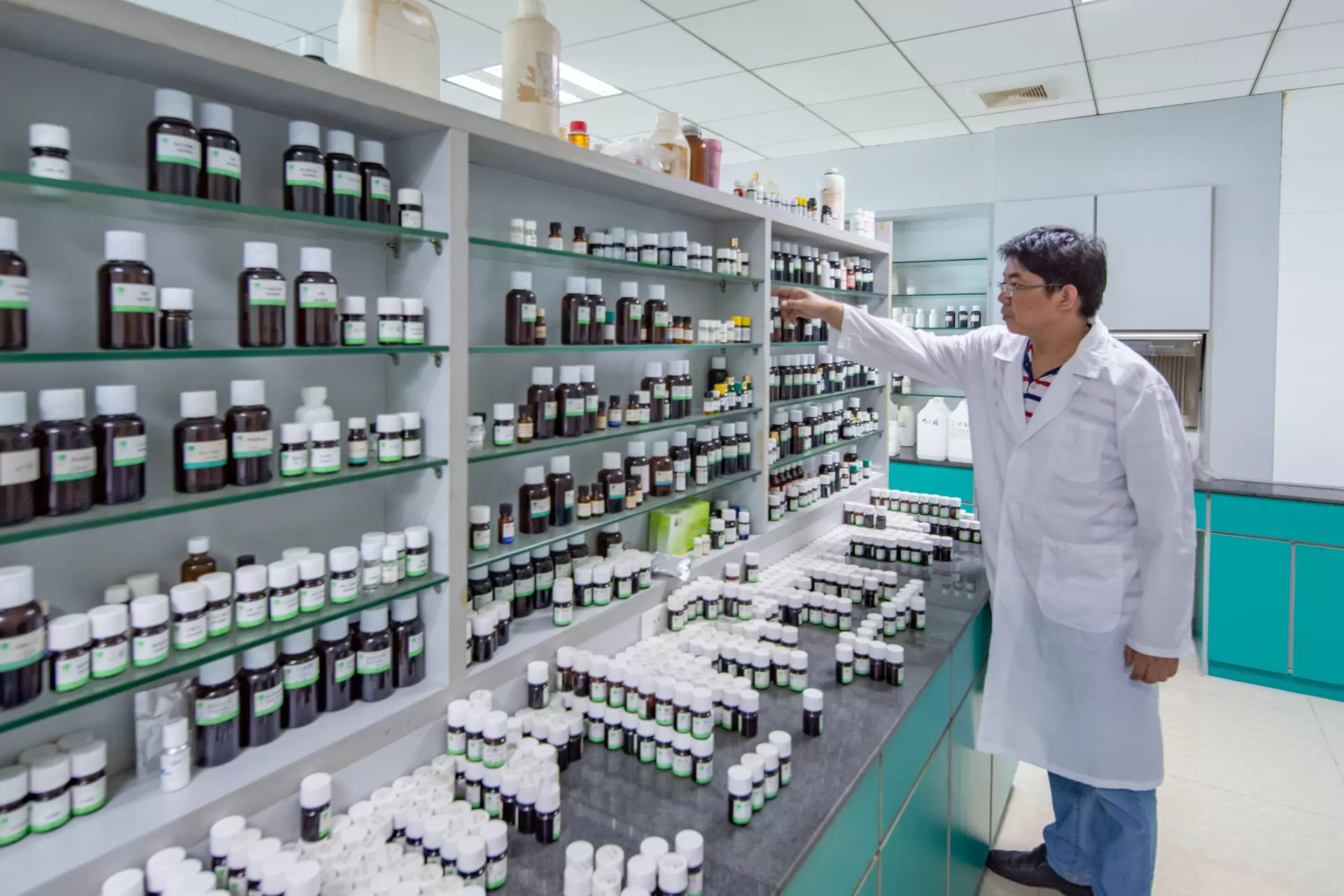
Flavor sample library in the LULIN laboratory
| Stress | Locked comparison | Likely marine failure | Corrective direction |
|---|---|---|---|
| Pasteurization | 85 °C / 15 min and 95 °C / 5 min | Lost sweet steam, early TMA | Later addition or protected top |
| Flavor-house retort screen | 115 °C / 60 min only when it matches the buyer process | Hollow middle, iodine, bitter roast | Encapsulated powder or process-matched reaction base |
| Packer retort | 121 °C / F0=6 only if the process authority specifies it | Bromophenol cliff, TMA, metallic | Do not use as a generic screen |
| Kamaboko / surimi | 40 °C / 30 min suwari; 60 °C / 20 min modori-risk; 90 °C / 20 min; two-step 40 °C then 90 °C | Mute opening in the gel | Add after cook; raise middle, not only dose |
| Fry | 160 °C / 60 s, 180 °C / 30 s, 190 °C / 15 s; fresh oil vs end-of-run oil | Painty n-3, lost shrimp popcorn | Oil-soluble liquid, post-fry dust, oil quality |
| Extrusion | 120 °C / 16%, 150 °C / 14%, 170 °C / 12% | Dry finish, Maillard Reaction clash | Encapsulated powder; rebuild marine air |
| Freeze-thaw | 0, 1, 3, 5 cycles at -18 °C / 4 °C; -18 °C / 30 days; -18 °C / 90 days | (Z)-4-heptenal, drip-loss hollow, iodine | Emulsion stability; evaluate at 4 °C |
| Powder humidity | 25 °C / 33% RH / 7 days; 54% / 7 days; 75% / 7 days; 40 °C / 75% RH / 72 h | Plated powder TMA first; encapsulated last | Barrier pack; move off plated powder |
| Liquid headspace | 10% air, 50% air, 10% N2 at 5 °C / 14 days, 25 °C / 30 days, 40 °C / 14 days | Color drift, TMA, separation | Nitrogen, light barrier, tighter fill |
Matrix challenges use one locked base and change one axis:
| Axis | Discrete values |
|---|---|
| Water / solids | 0%, 2%, 8%, 24%, dry snack coating at 4% moisture |
| Fat | 0%, 3%, 8%, 15%, 30% |
| Protein | 0%, 5%, 12%, 18% (lock myofibrillar vs soy vs whey) |
| Sugar | 0%, 2%, 4%, 8%; companion 4% sucrose + 4% sorbitol |
| Salt | 0.0%, 0.5%, 1.0%, 1.5%, 2.5% |
| pH | 3.5, 4.2, 5.5, 6.8 (lock citric vs acetic vs lactic; acetic default sauce challenge) |
| Serve | 4 °C, 25 °C, 60 °C, 75 °C |
Lock MSG at 0.20% and IMP/GMP at 0.02% during flavor-dose screens. Lock fat type and protein source. Yeast-GMP that turns the middle into chicken-noodle broth is a reject.
Crustacean, finfish, and molluscan allergen statements a seafood flavoring RFQ must carry
A seafood flavoring RFQ must carry item-level crustacean, finfish, and molluscan statements with species names. “Seafood” is not a United States major allergen. Fish and crustacean shellfish are, under the Food Allergen Labeling and Consumer Protection Act of 2004. Mollusc is not a United States major allergen, but it is Annex II in the European Union, United Kingdom, Canada, Australia, and New Zealand.
| Allergen axis | Contains | May contain (cross-contact) | Does not contain |
|---|---|---|---|
| Fish, with species | Declare species on the United States major-allergen statement | Name the shared line and the species risk | Keep the negative statement on the item file |
| Crustacean shellfish, with species | Shrimp, crab, lobster, or named mix | Shared equipment or incoming fractions | Required when the code is flavor-only |
| Mollusc | Clam, oyster, scallop, squid where destination lists apply | Cross-contact for European Union / United Kingdom / Canada / Australia / New Zealand | Still state presence or absence for export |
21 CFR 101.22 classes for the exact code are artificial flavor; natural flavor; natural and artificial flavor; and natural flavor with other natural flavor (WONF). After the class is named, use the general U.S. natural and artificial flavor definitions page and return here for origin and allergen work. Natural seafood flavor can still be a fish or crustacean allergen. Artificial seafood flavor is not a vegan, vegetarian, or allergen-free certificate.
Ask for the specification, allergen, and destination-market document pack in the same RFQ as the sensory sentence.
Coded shrimp-seasoning, crab-broth, and surimi-analogue panels buyers can repeat in-house
Buyers should repeat coded shrimp-seasoning, crab-broth, and surimi-analogue panels in-house on the 0.00%, 0.05%, 0.10%, 0.20%, 0.30%, 0.50%, and 1.00% w/w concentrate ladder, using 0.50% w/w as the high-side screen.
| Panel | Serve | Process before scoring |
|---|---|---|
| Shrimp seasoning, oil-plated | 25 °C | Real dust pickup 2%, 5%, 8%, or 12%; 7 days pack hold |
| Crab broth | 60 °C | Reconstitution or hot fill that matches the line |
| Surimi analogue | 4 °C and 60 °C | After cook; then freeze-thaw as specified |
Score 0 to 5 on marine air, species meat at 3 s to 12 s, cooking crust, sweet-amino or succinate finish, TMA, iodine, geosmin, painty n-3, citral-candy, yeast-bouillon, and beany hexanal. Reject if the first 3 s is TMA, ammonia, geosmin, citral-candy, or yeast-onion.
| Test-card field | Locked values |
|---|---|
| Control | 0.00% |
| Concentrate ladder | 0.05%, 0.10%, 0.20%, 0.30%, 0.50%, 1.00% |
| Mass equivalent | 0.5 g/kg, 1.0 g/kg, 2.0 g/kg, 3.0 g/kg, 5.0 g/kg, 10.0 g/kg |
| 100 kg batch | 50 g, 100 g, 200 g, 300 g, 500 g, 1 kg |
| High-side design benchmark | 0.50% w/w (5 g/kg) for concentrates |
| Overload diagnostic | 1.00% w/w (10 g/kg) |
| Compound seafood seasoning grid | 1.00%, 2.00%, 3.00%, 5.00% |
| Locked enhancers | MSG 0.20%; IMP/GMP 0.02% |
| Serve | 4 °C, 25 °C, 60 °C, 75 °C |
Approve the lowest ladder step that hits named species identity after the real process, without TMA, medicinal bromophenol, iodine, metallic, or soapy finish. If 0.50% is still hollow, change format or architecture before jumping to 1.00%.
Request coded application samples for shrimp, crab, and analogue tests only after the locked base, process, and scorecard exist.
Documents, destination labels, and commercial fields unique to a seafood flavoring RFQ
A seafood flavoring RFQ is incomplete until documents, destination labels, and commercial fields sit beside the sensory sentence.
| Field | What to specify |
|---|---|
| Sensory drop-in | Cook state, species, bromophenol/DMS air, meat at 3 s to 12 s, glycine or succinate or salmon-oil finish, three exclusions, matrix, process, serve at 4 °C, 25 °C, or 60 °C |
| 21 CFR 101.22 class | Exact code class |
| Allergen file | Fish species, crustacean species, mollusc presence or absence |
| Animal-origin | Seafood-species source statement |
| Diet claims | Vegetarian / vegan item statement; ISO 23662:2021 wording if used |
| Halal / Kosher | Product and facility; shellfish in Halal scope if claimed |
| Destination extras | European Commission Regulation (EC) No 1334/2008 class; EU 1169/2011 Annex II; Food Safety and Inspection Service packet if the flavor enters a meat or poultry inspected product |
| Quality files | TDS, SDS, lot COA, ISO 9001, HACCP, ISO 22000 if required |
| Commercial | Pack, 25 kg MOQ, price tiers, Incoterm, sample timing, production lead, change-control letter, country of origin of any seafood-derived fraction |
LULIN FLAVOR is the English brand of QUANZHOU LVLIN BIOENGINEERING CO., LTD., a Quanzhou, Fujian manufacturer established in 2001. The base includes 3 production lines, more than 50 employees, over 8000 m² of building area, and more than 12 application engineers with 20 years of flavor-development experience. Qualification files include ISO 9001 and HACCP. Technical response is 2 days. Matched samples dispatch in 5 days after brief acceptance. Standard MOQ is 25 kg per item. Production lead is 10 days to 15 days after approval.
Send the species sentence, matrix, process, rejection cues, format, allergen scope, destination, and forecast. Use the project inquiry for retort and analogue seafood briefs path for qualification and export work. Company scope sits on the Quanzhou manufacturer profile and production capacity page.
When shrimp powder or fish extract should lead, and when a seafood flavor concentrate should
Shrimp powder or fish extract should lead when the formula needs protein, salt, color, or nucleotide mass from those materials. A seafood flavor concentrate should lead when the job is timed marine identity at 0.05%, 0.10%, 0.20%, 0.30%, or 0.50% w/w without dragging allergen solids or sodium into the recipe.
Extracts can still lack bromophenol air or 2-acetyl-1-pyrroline shrimp popcorn. Compound seafood seasoning is a third class: salt, MSG, sugar, yeast extract, seafood powder, and flavor travel together on a 1.00%, 2.00%, 3.00%, 5.00% w/w grid. Do not compare an 8% sachet with a 0.50% concentrate. A 0.20% water-soluble liquid that survives 90 °C can beat a cheaper 1.00% powder that cakes at 75% RH.
Instant-noodle seafood sachets versus frozen analogue: where the same marine code fails
The same marine code fails when an instant-noodle seafood sachet and a frozen analogue ask for opposite partition and heat paths. Noodle broth at 60 °C, high salt, and yeast extract pushes shrimp toward chicken-noodle bouillon. Frozen analogue after freeze-thaw at 4 °C raises (Z)-4-heptenal and mutes 2-acetyl-1-pyrroline. Evaluate reconstituted noodle at 60 °C and analogue after freeze-thaw at 4 °C. Plated powder in a noodle sachet fails humidity first; encapsulated powder fails last. Wet surimi wants a water-compatible addition after cook. One shrimp-led mixed code is a hypothesis, not an approved dual-use SKU, until both panels pass.
Frequently asked questions about seafood flavoring
Does seafood flavoring contain shrimp, crab, or fish protein that must be labeled as an allergen?
Seafood flavoring may contain shrimp, crab, or fish protein that must be labeled, or it may contain none of those proteins, depending on the selected code and facility controls. The species name on the flavor does not settle the declaration. Request the item-level allergen, source, and cross-contact statement, including United States major-allergen rules for fish and crustacean shellfish.
Can one seafood flavoring cover shrimp snack seasoning and crab analogue, or are separate codes required?
Separate codes are required whenever the timed identity, cooking state, or matrix differs enough that one profile fails the other panel. A shrimp snack code built for 25 °C oil plating will not automatically read as crab flake in a 4 °C surimi gel. Run both applications before consolidating SKUs.
What first-screen dose should a team use for shrimp flavor powder in snack seasoning versus a surimi gel?
Use 0.50% w/w (5 g/kg) as the high-side design benchmark for concentrated seafood flavoring in both bases, then approve the lowest step on the 0.05%, 0.10%, 0.20%, 0.30%, 0.50%, and 1.00% ladder that survives the real process. Surimi often needs a later addition point, not a higher first-screen ceiling.
Will seafood flavoring survive a scheduled retort in soup pouches or canned chowder?
Seafood flavoring survives a scheduled retort only when the code, format, and addition point were built for that time-temperature profile. Bromophenol lift, DMS, and 2-acetyl-1-pyrroline often flash and leave TMA or iodine behind. Compare 0 days versus the packer’s actual process; a 121 °C / F0=6 challenge is used only when that process authority specifies it.
Is artificial seafood flavor vegan, and can it be used in plant-based crab sticks?
Artificial seafood flavor may be vegan, but the class name is not a vegan certificate and is not an allergen-free certificate. Request the item-level animal-origin, allergen, and vegetarian/vegan statements. A plant-based crab stick still needs a marine identity that covers beany notes without roast-thiol gravy.
Why did a frozen seafood analogue taste fishy or iodine-like after storage?
A frozen seafood analogue can taste fishy or iodine-like after storage when freeze-thaw, oxygen, or time raises TMA, (Z)-4-heptenal, 2,4,7-decatrienal, or bromophenol into the reject window. Compare 0 cycles versus 1, 3, and 5 cycles at -18 °C, then 30 days and 90 days in the intended pack.
Should instant-noodle seafood seasoning use powder while wet surimi uses liquid?
Instant-noodle seafood seasoning should first test spray-dried powder or plated powder in the dry sachet, while wet surimi should first test a water-soluble liquid or emulsion added after cook. Those defaults fail when humidity cakes the powder or heat-set strips the liquid. Compare both formats in the real line before locking the SKU.
How is seafood flavoring different from shrimp powder, fish extract, or a seafood seasoning blend?
Seafood flavoring is a concentrated timed identity system; shrimp powder and fish extract contribute protein, salt, color, and allergen mass; a compound seafood seasoning is a salt-yeast-sugar blend that must be dosed on a separate 1.00%, 2.00%, 3.00%, 5.00% grid. Cost-in-use comparisons require that class split.
Which documents should accompany a United States seafood flavoring sample for crustacean, fish, and destination-market review?
A United States seafood flavoring sample should arrive with TDS, SDS, lot COA, ingredient/carrier statement, allergen statement naming fish species and crustacean species, mollusc presence for export, 21 CFR 101.22 class, animal-origin statement, storage guidance, and change-control terms. Add Halal, Kosher, ISO 9001, HACCP, and European Union flavour-class files when those markets are in scope.
Develop this flavor in your product
Send your product, target market and project goal. We will review the sample direction with you.