Published
Spearmint Flavoring
Spearmint flavoring is a formulated food flavor built around sweet, green Mentha spicata character rather than menthol cooling. It is not automatically spearmint oil, extract, peppermint, or mint candy. For first trials, use 0.15% w/w compounded liquid or 0.30% w/w powder as reference benchmarks, then evaluate the processed product at 5°C and 20°C.
Last updated: 2026-09-01
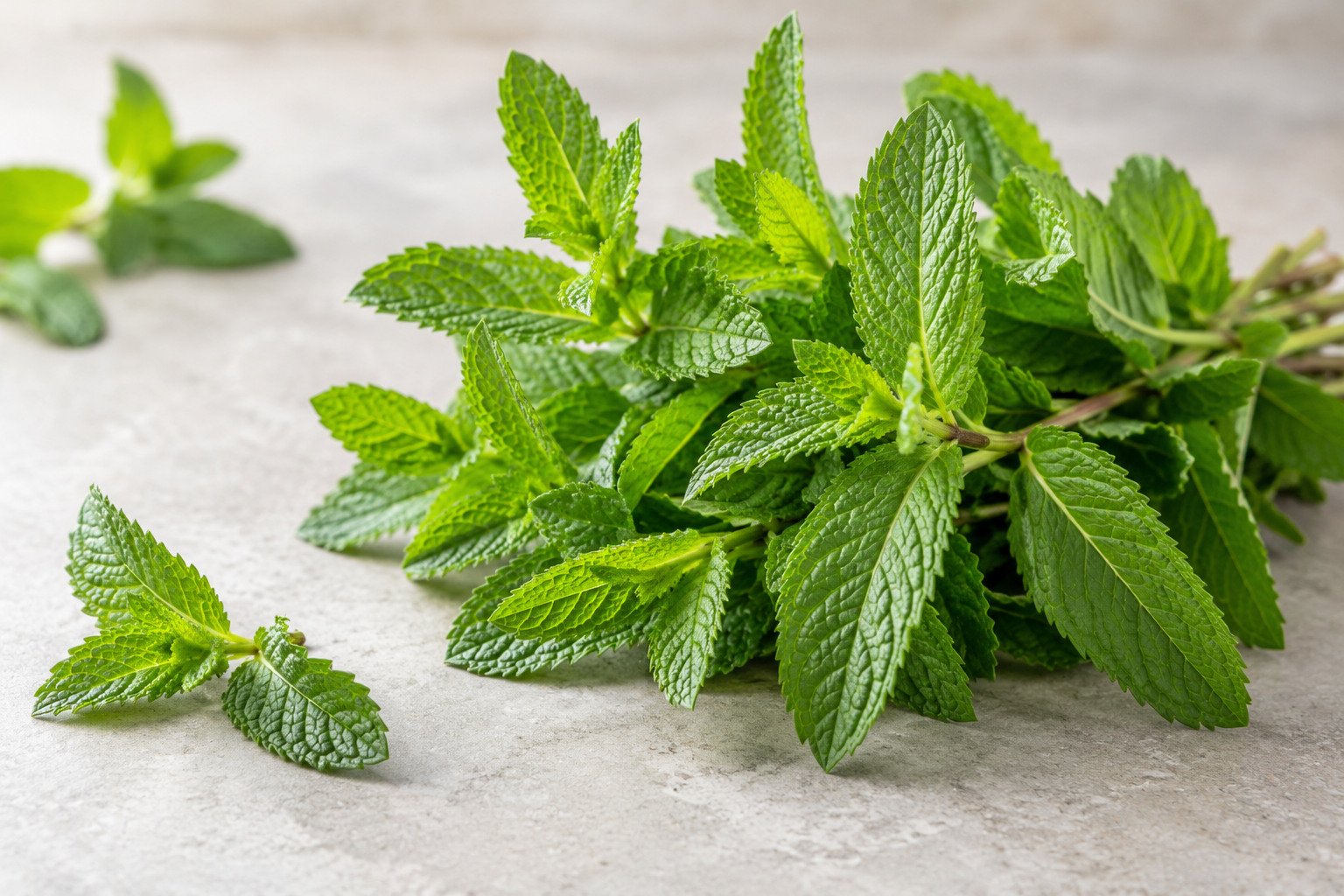
Spearmint sensory reference: an AI-generated sensory reference for this flavor brief.
What is spearmint flavoring, and how does it differ from peppermint, mint oil, and extract?
Spearmint flavoring is a compounded aroma-and-taste system designed to deliver a selected sweet-green leaf, candy, herbal-tea, or creamy Mentha direction after the finished matrix and process have changed its release. Catalog mint names do not identify cooling level, oil type, solubility, or legal declaration.
Keep the materials separate. Spearmint oil is a distilled botanical oil. Spearmint extract is a solvent extract of the herb. Compounded flavoring is a designed mixture that may use oil, extract, isolated or nature-identical L-carvone, other aroma compounds, and nonflavor carriers. Mint candy, chewing gum, and toothpaste are finished products. The flavor-concentrate category for food manufacturing covers concentrate navigation; this page stays with the Spearmint profile decision.
Chemistry explains the common mix-up. Spearmint identity is carvone-led. Peppermint identity is menthol- and menthone-led. A FEMA-reviewed spearmint oil sample contained 59.12% carvone, 6.27% dihydrocarveol, 5.07% limonene, and 5.42% 1,8-cineole. That sample is a chemistry illustration, not a purchase specification. USP–NF Spearmint Oil sets a floor of NLT 55.0% l-carvone for the oil monograph. The current oil-type set is the four-part ISO 3033-1:2005 series:
| Oil type | Standard | Botanical designation | Identity screen |
|---|---|---|---|
| Native Spearmint | ISO 3033-1:2005 | Mentha spicata L. | Native-type oil quality, not a compounded-flavor dose |
| Chinese Spearmint | ISO 3033-2:2005 | Mentha viridis L. var. crispa Benth. | Named 60% and 80% carvone grades after redistillation |
| Indian Spearmint | ISO 3033-3:2005 | Mentha spicata L., redistilled | Minimum 60% carvone in the ISO definition |
| Scotch Spearmint | ISO 3033-4:2005 | Mentha × gracilis Sole | Separate Scotch-variety oil, not peppermint |
When a brief actually specifies a botanical oil fraction, use 60% l-carvone as the high-end common identity screen. Raise the screen to the Chinese 80% grade only when that oil type is named. The withdrawn ISO 3033:1988 floor of 55% m/m carbonyl compounds expressed as carvone remains a historical oil check, not a flavoring use rate.
Peppermint (Mentha × piperita) and cornmint (Mentha arvensis) bring cooling. A Spearmint brief that tolerates menthol will pass a peppermint sample and then fail in a green-leaf beverage or chocolate coating. The broader U.S. natural-versus-artificial distinction belongs in the B2B guide to artificial flavor. The U.S. Food and Drug Administration lists spearmint among GRAS essential oils, oleoresins, and natural extractives in 21 CFR 182.20. That listing does not turn every Spearmint-named flavor into oil.
FEMA No. 3032 (spearmint oil, CAS 8008-79-5), FEMA No. 3031 (spearmint extract), FEMA No. 4925 (spearmint oil terpeneless), and FEMA No. 2249 (carvone) are separate GRAS entries. Do not copy a neat-oil ppm table onto a diluted PG or spray-dried item.
How should a Spearmint flavor profile be specified without vague mint adjectives?
A useful Spearmint profile specifies leaf versus candy direction, cooling limit, note timing, taste balance, finish, matrix, and serving condition. “Fresh, strong, and minty” does not tell a flavorist whether the target resembles garden leaf, Moroccan tea, chewing gum, chocolate mint, or a green candy.

Flavor sample library in the LULIN laboratory
Start with one controlled sentence. Example: “Fresh-cut Native Spearmint, sweet-green leaf at 0–2 seconds; rounded carvone body at 2–10 seconds; short clean finish at 10–30 seconds; cooling at or below 1/10; no peppermint, caraway, dill, toothpaste, or hay; evaluated in a 10 °Brix still beverage at 5°C.” That sentence names the sensory reference and the approval condition.
State Spearmint’s job in the formula: named character, chocolate partner, tea high note, or short blending flash. A low-sugar water needs leaf identity without solvent or cineole. Gum needs persistence after chew and saliva, which a water cup cannot prove.
Score intensity on a 0–10 scale. Use 0 for not perceived, 5 for the project rejection threshold, and 10 for extreme intensity. Set a cooling cap in writing. If the cap is 1/10 and a sample scores 4/10 cooling, the sample is a peppermint miss even when the first sniff smells green.
Which Spearmint top, middle, and base-note directions belong in a buyer brief?
Spearmint direction should be written as a timed sequence: volatile leaf and sweet-green notes open the profile, carvone and herbal body fill the middle, and residual leaf, candy sweetness, cream, or a dry herb tail determine the finish. Top, middle, and base are briefing tools, not regulatory classes.
Fresh Spearmint identity does not come from L-carvone alone. Limonene, dihydrocarvone, cis-carveol, trans-carveol, 1,8-cineole, myrcene, and sesquiterpenes such as beta-bourbonene change whether the same carvone reads as garden leaf, candy, or medicinal. Excess 1,8-cineole pushes toothpaste. The wrong carvone balance without leaf volatiles can read as caraway or dill. Menthol, menthone, or peppermint oil contamination adds cooling the brief did not request.
| Spearmint direction | Opening, 0–2 s | Body, 2–10 s | Finish, 10–60 s | Main failure risk | First-fit application |
|---|---|---|---|---|---|
| Fresh-cut leaf | Green leaf, sweet carvone | Juicy herb, low candy | Short clean exit | Grass, solvent, or thin water | Still beverage, tea |
| Candy Spearmint | Bright sweet-green flash | Rounded gum-candy center | Clean sugar finish | Peppermint drift or toothpaste | Hard candy, chew |
| Herbal tea mint | Steeped leaf, light floral | Green tea-compatible body | Dry herb, low sweetness | Hay, tannin clash, cooling | Tea beverage, iced tea |
| Creamy dairy mint | Soft leaf, low green spike | Cream-compatible carvone | Short sweet dairy tail | Menthol in cold fat, metallic | Ice cream, milkshake |
| Garden culinary | Leafy, slightly savory | Herb-and-leaf mid-palate | Green finish, little candy | Savory takeover, onion clash | Dip, dressing, savory glaze |
| Chocolate partner | Short green lift | Cocoa-compatible mint body | Clean exit, no cooling | Menthol burns chocolate | Coating, brownie, compound |
| Blending accent | Brief leaf flash | Limited body | Nearly clean exit | Disappears behind fruit or cocoa | Berry, citrus, chocolate blends |
A candy Spearmint item may be too sweet for a Moroccan-style tea, while a garden-leaf item may taste unfinished in a compressed mint. Request named directions. “The strongest mint” is not a brief.
Record cooling, hay, caraway/dill, toothpaste, solvent, and metallic notes at 10, 30, and 60 seconds. If the opening is correct but the 60-second score fails, raising the dose usually makes the defect louder.
Which Spearmint flavor format belongs in water, fat, gum, bakery, or dry mix?
Format should follow the continuous phase, clarity target, processing route, dosing equipment, and desired release point. Liquid does not mean water-soluble. Powder does not mean heat-proof, instant dissolution, or spearmint oil.
The complete first-pass set is water-soluble liquid, PG-soluble liquid, oil-soluble liquid, oil-in-water emulsion, spray-dried powder, and encapsulated powder. No supplier is assumed to stock every construction for every Spearmint direction. Compare only the formats that can physically live in the finished phase.
| Complete format option | Best fit | Main advantage | Failure screen |
|---|---|---|---|
| Water-soluble liquid | Clear still drinks, syrups, some RTD teas | Fast bench dosing in the water phase | Haze, ring, top-note flash-off |
| PG-soluble liquid | Beverages, confectionery syrups, many gum centers | Common mint carrier; easy metering | PG heat, solvent at high dose |
| Oil-soluble liquid | Chocolate, fat fillings, oil coatings, compound | Carries carvone into a lipid phase | Surface oil or break in water systems |
| Oil-in-water emulsion | Cloudy drinks, dairy-style beverages | Delivers oil-phase mint with designed cloud | Creaming, ring, droplet growth |
| Spray-dried powder | Dry beverage mix, seasoning, tablets, premix | Dry handling and a defined carrier | Caking, dust, incomplete dispersion |
| Encapsulated powder | Bakery, gum, staged-release, oxidation-sensitive work | Barrier around volatiles; delayed release | Incomplete chew or bake release, carrier taste |
A clear water begins with a water-soluble liquid or PG-soluble liquid. Chocolate starts in oil. Spray-dried powder favors dry handling. Encapsulated powder emphasizes protection or delayed release during bake or chew. The powder-versus-liquid flavor guide covers handling; this page decides which Spearmint construction to put on the bench.
Spearmint oil, spearmint extract, and mint solids are different ingredients, not extra format rows. If the project wants a clear beverage with no haze, do not start with neat oil.
How do water, fat, protein, sugar, salt, acid, and serving temperature change Spearmint perception?
The finished matrix changes Spearmint aroma release and taste balance enough that a water solution cannot approve a flavor for dairy, protein drinks, gum, chocolate, or bakery. Fat and protein retain hydrophobic mint volatiles. Sugar, acid, salt, viscosity, and temperature change both release and how the same aroma is read as leaf, candy, or cooling.
| Matrix variable | Practical screen | Expected sensory shift | What to record |
|---|---|---|---|
| Water / dilution | Production strength plus one step above and below | Lower solids expose thin leaf, solvent, cineole, and hay | Formula mass, water source, dilution ratio |
| Fat | 0%, 3%, 10% | Rounds green spike; can trap carvone and delay release | Fat type, fat %, emulsion state |
| Protein | 0%, 2%, 8% | Can bind mint volatiles and delay the opening | Protein source, %, hydration time |
| Sugar | 5, 8, 10, 12, 15 °Brix or the commercial ladder | Raises candy character and often reduces herbal dryness | °Brix, sweetener system, aftertaste |
| Salt | 0%, 0.05%, 0.15% salt equivalent | May sharpen herb; mineral salts can add metallic notes | Sodium source, total level |
| Acid | pH 3.0, 3.5, 4.0, 4.5, 5.0 plus titratable acidity | Sharpens attack; can expose solvent or metallic mint | pH to 0.1, acid type, titratable acidity |
| Temperature | 5°C and 20°C; process-hot where relevant | Cold suppresses aroma; warmth increases headspace and loss | Core temperature, hold time, serving vessel |
Cold fat is a Spearmint trap. Ice cream at 5°C can hide the opening that seemed loud in a 20°C syrup. Chocolate at 20°C and at 37°C melt are different tests. Tea tannin can dry a garden-leaf finish that was acceptable in sugar water.
A compact screening design keeps those variables visible. The six runs below are an editorial application screen. Replace sugar, fat, protein, and salt with the commercial formula before approval.
| Run | Flavor | Fat | Protein | Sugar | Salt | Serve | Storage check |
|---|---|---|---|---|---|---|---|
| 1 | 0.02% | 0% | 0% | 5% | 0% | 5°C | 0 days |
| 2 | 0.05% | 0% | 2% | 8% | 0.05% | 20°C | 14 days |
| 3 | 0.10% | 3% | 0% | 10% | 0% | 5°C | 28 days |
| 4 | 0.15% | 3% | 8% | 12% | 0.15% | 20°C | 56 days |
| 5 | 0.20% | 10% | 2% | 10% | 0.05% | 5°C | 14 days |
| 6 | 0.30% | 10% | 8% | 15% | 0.15% | 20°C | 56 days |
| 7 | 0.10% | 0% | 8% | 12% | 0% | 5°C | 28 days |
| 8 | 0.15% | 10% | 0% | 8% | 0.15% | 20°C | 56 days |
Do not treat every row as a production formula. Use the matrix to isolate cooling drift, hay, delayed release, or solvent. Dose alone cannot fix it. Keep conditions fixed. Judge the finish.
Why can Spearmint lose sweet-green lift or drift toward peppermint after heat and storage?
Spearmint flavoring loses balance when volatile leaf notes evaporate, oxidize, bind to the matrix, sorb into packaging, or separate from the product while carvone, cineole, or any menthol contamination remains. The correct fix starts with a before-and-after process comparison rather than an immediate dose increase.
Named process bands to record on the RFQ are cold-fill, HTST pasteurization, hot-fill, UHT, retort, baking, extrusion, and freeze. Typical checkpoints include HTST at 72°C for 15 s, hot-fill at 85°C, 88°C, 90°C, or 93°C, UHT at 135°C or 140°C, retort at 121°C, and bakery peak at 160°C, 180°C, or 200°C. Those temperatures are process labels, not proof that a given Spearmint item survives them.
| Condition | Likely sensory failure | Diagnostic comparison | Control to test |
|---|---|---|---|
| Pasteurization, hot fill, UHT | Lower leaf lift; heavier carvone or hay | Pre-heat vs post-heat at equal dose | Addition point, hold time, closed transfer |
| Baking or candy cooking | Volatile loss; candy or burnt-herb finish | Raw mix vs baked/cooled product | Encapsulated powder or late addition |
| High shear / homogenization | Changed cloud, ring, or delayed mint | Low-shear vs production shear | Droplet size, mixing order |
| Oxygen and light | Hay, cardboard, resinous herb, stale leaf | Light/dark and low/high headspace | Barrier pack, headspace, light protection |
| Menthol or peppermint contamination | Cooling the brief forbade | Spearmint control vs mixed-mint suspect | Incoming oil identity, l-carvone vs menthol |
| Package contact | Loss of green top through scalping | Glass control vs commercial package | Polymer, contact area, storage temperature |
| Moisture in powder | Caking, early release, weaker opening | Sealed control vs humid exposure | Moisture barrier, reseal procedure |
Run the winning candidate at Day 0 and Weeks 2, 4, and 8 in the intended package. Use 35°C for 8 weeks as the retained-profile design benchmark. A 40°C condition is an accelerated challenge, not a shelf-life claim. Pair those with a 4°C and 20°C control where the product and package permit. Inspect aroma timing, cooling, hay, color, turbidity, ring, sediment, creaming, caking, and package odor.
If leaf drops while carvone stays constant, compare a protected delivery form or later addition. If cooling appears after process, look for mixed-mint contamination before blaming dose. Food flavor formulation support is the route when matrix or process failures need item adjustment.
Where does Spearmint flavoring need a different application brief?
Each application needs its own Spearmint brief because sweetness, fat, protein, heat, chew, chocolate, and serving temperature determine which notes survive and which defects become visible.
| Application | Preferred first format | Spearmint target | Critical check |
|---|---|---|---|
| Clear still beverage | Water-soluble liquid or PG-soluble liquid | Fresh-cut leaf, short finish, cooling ≤1/10 | Clarity, cap ring, 5°C evaluation |
| Tea beverage | Water-soluble liquid | Herbal tea mint, low candy | Tannin dry-down, hot-fill leaf loss |
| Chewing gum | Encapsulated powder or process-matched liquid | Candy Spearmint that persists after chew | Saliva, gum base, 10 min chew-down |
| Hard candy | Heat-suitable liquid or powder | High-impact sweet-green, clean cool-less finish | Cook temperature, acid, cooled sweetness |
| Chocolate or coating | Oil-soluble liquid | Chocolate partner, no menthol burn | 20°C snap and 37°C melt |
| Frozen dairy | Compatible liquid or emulsion | Creamy dairy mint at 5°C | Fat binding, delayed opening, metallic |
| Bakery cookie or brownie | Encapsulated powder or oil-soluble liquid | Leaf or chocolate-mint after cooling | Bake loss at 180°C, overnight finish |
| Dry mix | Spray-dried powder | Recognizable Spearmint after reconstitution | Dispersion, caking, 0.30% first screen |
These application choices tell the supplier what Spearmint must do after processing. Dedicated gum, syrup, milkshake, or dressing pages remain separate.
Neat FEMA 3032 oil sits on a different scale: 110 ppm usual and 140 ppm maximum in nonalcoholic beverages, 5,000 ppm usual in hard candy, and 8,000 ppm usual in chewing gum, with 24,000 ppm as an exceptional gum maximum. Compounded flavoring at 0.15% liquid or 0.30% powder is the first reference for this page.
How should buyers compare Spearmint flavor samples in the actual application base?
Buyers should compare coded Spearmint samples at fixed doses in the final base, using the intended process, package, and serving temperature. A neat aroma strip can eliminate obvious defects. It cannot select a production flavor.
Use the following protocol.
- Prepare C0, the unflavored finished base, and C1, the current product or agreed market reference. Keep pH, °Brix, fat, protein, salt, viscosity, color, and processing identical.
- For water-soluble liquid and PG-soluble liquid candidates, screen 0.02%, 0.05%, 0.10%, 0.15%, 0.20%, and 0.30% w/w. Use 0.15% w/w as the first reference benchmark. For powder candidates, screen 0.10%, 0.20%, 0.30%, 0.40%, and 0.60% w/w, with 0.30% w/w as the first reference benchmark.
- Make two independent preparations of each finalist. Randomize three-digit codes. Use at least three evaluators who understand the target brief. Prevent discussion until individual score sheets are complete.
- Evaluate at 5°C for a cold RTD or frozen dessert and at 20°C as a panel reference. Chocolate also needs a 37°C melt pass. Gum needs a timed chew.
- Score 0–10 at 0–2 seconds, 2–10 seconds, and 10–60 seconds.
At instrument-appropriate resolution, record batch mass to 0.1 g, flavor to 0.001 g, fat/protein/sugar to 0.01% w/w, salt/acid to 0.001% w/w, product temperature to 0.1°C, peak temperature to 1°C, hold/mixing to 1 s, cooling to 1 min, and equilibration to 1 h. These are record resolutions, not manufacturing tolerances.
| Attribute | 0–2 s | 2–10 s | 10–60 s | Decision use |
|---|---|---|---|---|
| Spearmint identity | Score | Score | Score | Reject generic mint or peppermint |
| Green leaf | Score | Score | Score | Confirm garden vs candy direction |
| Candy sweetness | Score | Score | Score | Control gum-candy vs tea-leaf |
| Cooling | Score | Score | Score | Enforce the written cooling cap |
| Caraway / dill | Score | Score | Score | Catch unbalanced carvone |
| Toothpaste / cineole | Score | Score | Score | Catch medicinal 1,8-cineole |
| Hay / oxidized herb | Score | Score | Score | Diagnose heat, oxygen, or age |
| Solvent / metallic | Score | Score | Score | Diagnose dose, acid, or ions |
| Finish length | Score | Score | Score | Detect linger, dry-down, or drop-off |
Record clarity, ring, separation, bloom, caking, and color outside the sensory scale. A sample can win on taste and still fail the package. Process the best two candidates, repeat the coded comparison, then store them in the commercial package. This structure follows the profiling logic of ISO 13299:2016: define attributes and references, compare consistently, and connect the profile to development and shelf-life decisions. It does not turn a small internal panel into a consumer study. The B2B sample-request route supports this application-led brief.
What should a U.S. Spearmint flavoring RFQ require from the supplier?
A U.S. Spearmint flavoring RFQ should connect the timed sensory target to the finished matrix, process, label route, mint identity, documents, commercial quantities, and change-control expectations. A one-line request for “natural spearmint flavor and price” invites samples that cannot be compared.
| RFQ block | Required details |
|---|---|
| Product and serving | Product category, serving size, clear/cloudy target, 5°C or ambient service, reference product |
| Sensory direction | Fresh-cut, candy, tea, creamy, culinary, or chocolate partner; 0–2 s, 2–10 s, 10–60 s; cooling cap; prohibited peppermint, caraway, dill, toothpaste, hay |
| Matrix | pH, titratable acidity, °Brix, fat %, protein %, salt/mineral system, alcohol %, viscosity, cocoa %, gum base |
| Process | Addition order, shear, peak temperature, hold time, bake/cook, fill, freeze, package |
| Format and dose | Water-soluble liquid, PG-soluble liquid, oil-soluble liquid, oil-in-water emulsion, spray-dried powder, or encapsulated powder; supplier dose and basis |
| Mint identity | Compounded flavor vs spearmint oil vs extract vs essence; ISO 3033-1, ISO 3033-2, ISO 3033-3, or ISO 3033-4 if an oil fraction is used; l-carvone target |
| Source and label | Natural flavor, natural and artificial flavor, artificial flavor, or WONF |
| Technical documents | TDS/specification, lot COA, SDS, ingredient/carrier/solvent statement, recommended storage at 15°C to 20°C |
| Compliance documents | Allergen, GMO, vegan/vegetarian, Halal, Kosher, organic where required, ISO 22000 or ISO 9001 certificate with audit body and expiry |
| Commercial terms | Sample code and size, MOQ in kg, pack size, sample lead in days, production lead in days, annual volume, price basis, Incoterm |
| Supplier controls | Lot traceability, change notification, complaint contact, retained-sample policy, agreed acceptance tests |
For the United States, 21 CFR 101.22 distinguishes natural flavor from artificial flavor by source and function and includes labeling rules for flavors shipped to food manufacturers. The RFQ should state the intended ingredient declaration and characterizing-flavor presentation. The compliance-document request guide helps procurement organize item-specific files.
If the brief uses a botanical oil fraction, ask which ISO 3033:2005 part applies and whether the l-carvone value is the 55.0% USP floor, the 60% high-end common screen, or the Chinese 80% grade. If the brief uses compounded flavoring, ask for the carrier, recommended dose, and a process-matched sample. Do not paste FEMA oil ppm values onto a spray-dried SKU.
How can LULIN FLAVOR support a Spearmint flavor project from brief to sample?
LULIN FLAVOR supports Spearmint projects by connecting the sensory brief, application base, format, process, sample review, and document request before commercial selection. LULIN FLAVOR is the public English brand of QUANZHOU LVLIN BIOENGINEERING CO., LTD., a Quanzhou, Fujian food-flavor manufacturer established in 2001.
The company develops and produces food-grade flavors for beverage, bakery, confectionery, and related applications. Its application laboratory supports profile adjustment and formula discussion, backed by more than 10 engineers with over 20 years of flavor development and application experience, three modern production lines, more than 50 employees, and over 8,000 m² of building area. Spearmint sample packs ship as 0.5 kg and 1 kg. Production MOQ is 25 kg. Sample lead is 7 days. Production lead is 15 days after formula lock. Store liquid Spearmint items at 15°C to 20°C away from light.
Send the finished base, pH and °Brix, fat and protein levels, process temperatures, serving condition, target market, preferred format, annual quantity stage, and the timed Spearmint description with a cooling cap. Review the LULIN FLAVOR manufacturing profile or contact the food flavor project team with the completed brief.
Spearmint flavoring FAQ
What is spearmint flavoring, and is it the same as spearmint oil or extract?
Spearmint flavoring is a compounded food flavor built to deliver a selected sweet-green Mentha profile. Spearmint oil and spearmint extract are separate botanical ingredients with their own composition and use levels. A flavor may include oil, extract, carvone, or a mixed route; the item specification decides.
How is spearmint different from peppermint in a manufactured food?
Spearmint is carvone-led, sweet, and green, with little cooling. Peppermint is menthol- and menthone-led and reads as cooling, pungent, and more medicinal at equal intensity. A brief that only says “mint” invites the wrong oil family and a rejected aftertaste in gum, candy, dairy, or beverages.
How should a developer describe a Spearmint profile without vague adjectives?
Write a timed sequence: leaf or candy opening at 0–2 seconds, sweet-green body at 2–10 seconds, and a clean, herbal, or creamy finish at 10–60 seconds. Name intensity, prohibited notes, the real base, and serving temperature. “Fresh minty” does not distinguish garden leaf, chewing gum, or toothpaste.
Which Spearmint flavor format should be tested first?
A clear drink usually starts with a water-soluble liquid or PG-soluble liquid; chocolate and fat fillings start with an oil-soluble liquid; cloudy drinks may need an oil-in-water emulsion; dry mixes start with a spray-dried powder; bakery and gum often need encapsulated powder or a process-matched liquid. Test only viable formats in the finished continuous phase.
What starting dosage should buyers screen for spearmint flavoring?
For compounded liquid, screen 0.02%, 0.05%, 0.10%, 0.15%, 0.20%, and 0.30% w/w, using 0.15% as the reference benchmark. For powder, screen 0.10%, 0.20%, 0.30%, 0.40%, and 0.60% w/w, using 0.30% as the reference benchmark. Neat spearmint oil uses a different ppm scale.
Why can Spearmint pick up peppermint, toothpaste, or hay notes after processing?
Top-note loss, oxidation, wrong mint oil, excess 1,8-cineole, menthol contamination, or heat can shift a sweet-green profile toward cooling, medicinal, or dried-herb character. Compare the unprocessed and processed base at equal dose, then check addition point, oxygen, package, and the 10–60-second finish before raising the use rate.
How should buyers compare Spearmint flavor samples in the actual application base?
Blind-code candidates in the finished base, keep formula and process fixed, make two independent preparations, and use at least three evaluators. Score spearmint identity, green leaf, candy sweetness, cooling, caraway/dill, toothpaste, hay, solvent, and finish at 0–2, 2–10, and 10–60 seconds at 5°C and 20°C.
What storage screen should buyers use for retained Spearmint character?
Use 35°C for 8 weeks in the intended package as the high-end retained-profile design benchmark, with readings at week 0, 2, 4, and 8 plus a 20°C control. A 40°C run is an accelerated challenge only. The screen compares aroma retention and physical stability; it does not set commercial shelf life.
What should a buyer include in a U.S. Spearmint flavoring RFQ?
Include the timed sensory target, application, pH, °Brix, fat, protein, salt, process, package, serving temperature, format, dose basis, label route, oil versus extract versus compounded flavor identity, required documents, sample size, MOQ, lead time, annual volume, price basis, destination market, traceability, and change control.
Develop this flavor in your product
Send your product, target market and project goal. We will review the sample direction with you.