Published
Taro Flavoring
Taro flavoring is a concentrated aroma and taste system for cooked taro corm (Colocasia esculenta), not ube, purple sweet potato, or an all-in-one purple drink premix. Specify earthy cooked-corm, chestnut, coconut-cream, and vanilla notes, then screen a water-soluble liquid at 0.30% w/w (3.0 g/kg) as the high-end reference benchmark in the finished food.
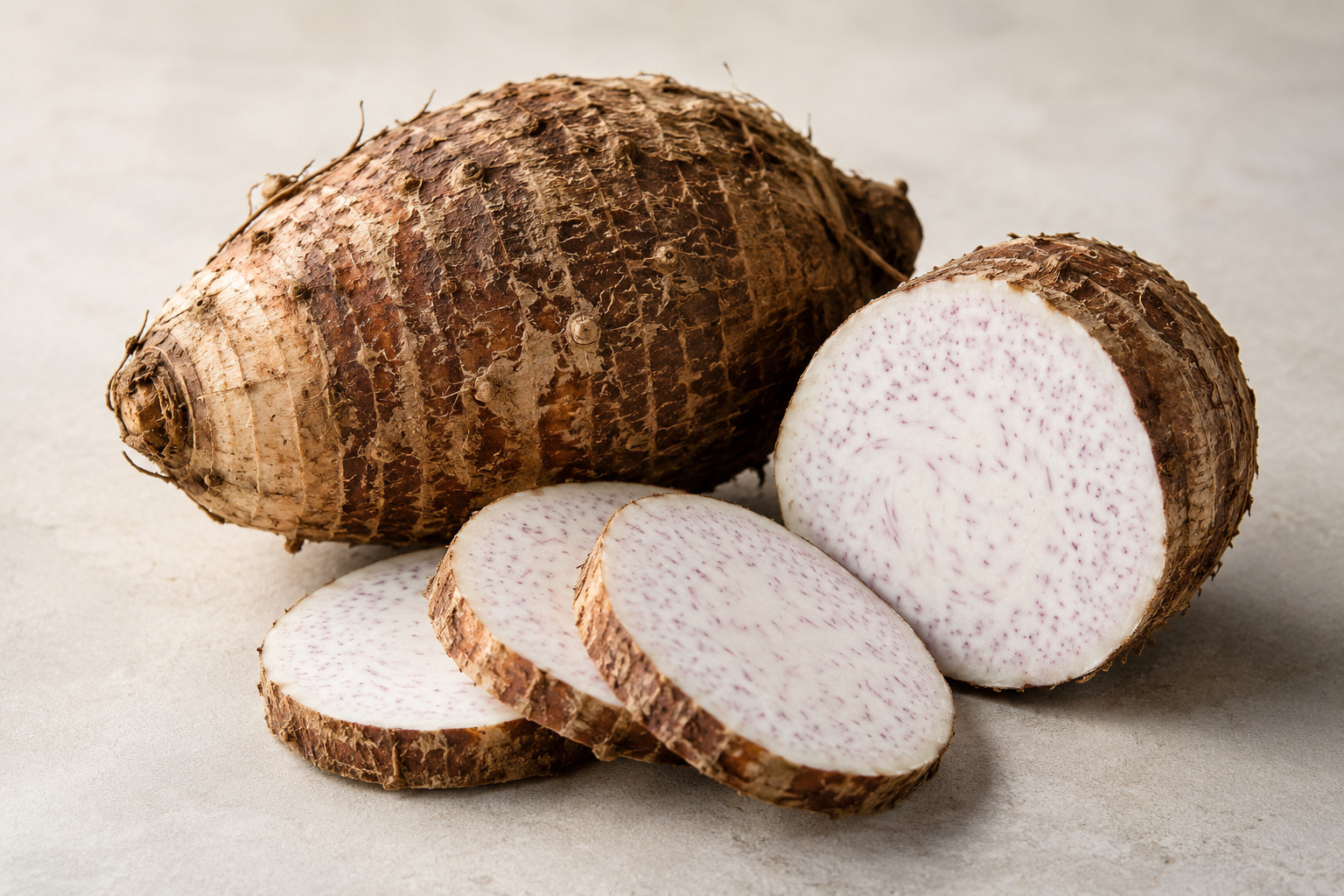
Taro root: a sensory reference for defining the target flavor profile.
How should a taro flavor profile be specified without calling it ube or purple candy?
A taro flavor brief names the corm, the commercial family, the time course, and the notes that must stay out. Purple milk tea does not distinguish steamed taro paste, confectionery boba taro, taro bread filling, taro protein powder, or vanilla-coconut candy matched only to a lilac shade.
Keep the botanical reference explicit. Taro is Colocasia esculenta. Ube is Dioscorea alata. Purple sweet potato is Ipomoea batatas. Cooked taro should read as steamed corm with chestnut or walnut nuttiness, a short earthy-starch finish, and only as much vanilla or coconut as the brief requests. Ube reads sweeter and more vanilla-coconut. Purple sweet potato reads more like baked root and molasses.
- Authentic steamed taro / taro paste / kalo: cooked-corm steam, chestnut, mild floral-starch, little confectionery vanilla.
- Bubble-tea confection taro: vanilla, coconut cream, nutty malt, a controlled earthy base, often with a separate purple color plan.
Describe perception in three windows:
- Top, 0–3 s: cooked corm steam, light coconut, vanilla flash, or a faint floral lift.
- Middle, 3–15 s: chestnut or walnut, dairy cream, coconut milk, mild malt, roasted nut.
- Base, 15–60 s: cooked tuber, lingering cream, a short earthy starch note that does not become boiled potato or ube dessert.
Add a 0–10 intensity for each window and two exclusions such as “no ube vanilla-pistachio,” “no grape candy,” “no sunscreen coconut,” “no fermented poi sour,” and “no raw potato.”
Taro powder, taro paste, and drink premixes contribute starch, sugar, creamer, color, and some cooked aroma. A compounded flavor primarily controls aroma and taste at much lower use. The flavor concentrate category for food manufacturing covers the broader family; this page owns the taro-specific decision.
Purple color is not flavor identity. Fresh taro flesh is usually cream, white, or pale lilac. If milk tea, bun, or protein shake must look commercial-purple, specify colorant separately from the flavor code.
Which top, middle, and base notes change a commercial taro brief?
Taro direction changes when the brief raises earthy corm, chestnut, coconut-cream, or confectionery vanilla.
| Sensory tier | Direction to specify | Useful chemical vocabulary | Best-fit product cue | Failure signal |
|---|---|---|---|---|
| Top | Cooked corm steam | 2-acetyl-1-pyrroline, maltol | Steamed taro, taro paste, kalo dessert | Popcorn overload, burnt sugar |
| Top | Coconut cream lift | gamma-nonalactone, delta-decalactone | Taro milk tea, taro milk | Sunscreen, soapy coconut |
| Top | Vanilla flash | Vanillin, ethyl vanillin | Bubble-tea confection taro | Cake-batter vanilla |
| Middle | Chestnut / walnut nuttiness | 2,5-dimethylpyrazine, 2,3,5-trimethylpyrazine | Taro bread, bun filling | Burnt nut, coffee roast |
| Middle | Dairy cream | 2,3-butanedione, acetoin | Milk tea, yogurt, soft serve | Butter popcorn, stale cream |
| Middle | Mild malt-sweet | Maltol, furaneol | Powder drink, bakery crumb | Cotton-candy ethyl maltol |
| Base | Earthy cooked tuber | Methional, 2-ethyl-3,5-dimethylpyrazine | Authentic taro, kalo | Boiled potato, dirt |
Steamed taro paste keeps corm steam, chestnut, and a short earthy finish. Bubble-tea confection taro raises vanilla and coconut after 85 °C hold. Taro ice cream needs dairy cream that remains identifiable at −12 °C. Taro protein needs a stronger vanilla-coconut top because protein binds aldehydes and pyrazines. Methional overload reads as boiled potato; ethyl maltol plus grape esters reads as purple candy; vanillin plus pistachio-coconut without corm depth tastes like ube.
How do dairy fat, protein, sugar, tea tannin, acid, and serving temperature change taro?
The application matrix changes taro release, so rank samples in the finished base. A water winner can collapse in 10% fat ice cream or turn thin in unsweetened tea.
| Matrix variable | What changes | Typical taro symptom | Controlled comparison |
|---|---|---|---|
| Water and low solids | Fast diffusion; weak body | Bright vanilla flash, thin corm, surface ring | Compare 0% fat water against the finished formula at 20 °C |
| Dairy fat | Lipophilic notes partition into fat and release slowly | Muted steam, longer coconut-cream finish | Hold fat at 0%, 4%, 10%, and 16% after full aging |
| Protein | Binding and heat reactions mute aldehydes and pyrazines | Lost corm steam, cooked dairy mask, hollow vanilla | Test milk, whey, soy, or pea at the actual 2–8% level |
| Sugar and total solids | Sweetness and viscosity shift ripeness | More candy-vanilla, less tuber | Hold one sweetener system at 8%, 12%, and 18% solids |
| Acid and pH | Sourness and ester stability | Brighter candy, thinner corm, possible haze | Compare pH 3.2, 4.5, and 6.7 in one base |
| Tea tannin | Astringency dries the cream middle | Hollow vanilla, bitter finish | Hold 0.15% and 0.30% tea solids against a no-tea control |
| Serving temperature | Cold suppresses headspace; warmth opens lactones | Quiet at −12 °C or 5 °C; perfumy at 20 °C | Read every code at the real service point |
Ice cream at 10% fat and −12 °C hides top notes that look strong in a 20 °C syrup. Coconut milk at 12% fat can smell like lotion. An 8% whey protein shake binds corm steam and leaves vanillin. Tea at 0.30% solids can strip cream and leave a dry candy note.
Protein powder is a special taro case. Many briefs expect bubble-tea confection, not kalo. Screen the reconstituted shake, not the dry jar aroma. Change one variable at a time, then use food flavor formulation support for B2B R&D when the carrier or addition point needs adjustment.
Which taro format belongs in milk tea, protein powder, bakery filling, or ice cream?
Select taro format by continuous phase, clarity, process heat, and handling.
| Format option | First matrix to test | Main advantage | Main risk | Required pilot check |
|---|---|---|---|---|
| Water-soluble liquid | Clear syrup, tea, yogurt drink | Fast dosing, clear dispersion | Volatile loss; weak oil-note delivery | Clarity, ring, pH, heat |
| Oil-soluble liquid | Fat filling, ganache | Fat-phase compatibility | Haze in water; seizing if the carrier is wrong | Viscosity, cold release |
| Oil-in-water beverage emulsion | Cloudy milk tea, dairy drink | Hydrophobic coconut, nutty, and vanilla notes in water | Creaming, ring, droplet growth | Homogenization, 85 °C hold, 30-day stability |
| Spray-dried powder | Dry beverage, bakery premix, protein mix | Dry handling | Carrier load, caking, muted steam | Moisture, reconstitution at 10% w/w |
| Encapsulated powder | Heat-exposed mix | Protection through 170 °C to 180 °C | Incomplete release, higher cost-in-use | Process trigger, cooled crumb |
| Flavor concentrate | Supplier-defined wet or dry concentrate | Compact dosing when assay is known | Treating the name as a universal strength | Item assay, carrier, use level |
| Taro powder, taro paste, or all-in-one taro drink premix | Colored filling, foodservice drink | Tuber solids, sugar, creamer, color | Changes starch, water, Brix, label | Not a flavor equivalent |
The complete flavoring screen includes water-soluble liquid, oil-soluble liquid, oil-in-water beverage emulsion, spray-dried powder, and encapsulated powder. Treat flavor concentrate as the supplier’s concentrated system, not a sixth interchangeable strength. Treat taro powder, taro paste, and all-in-one taro drink premix as ingredients, not as 0.30% flavor equivalents. See the powder versus liquid food flavor guide for handling context.
For a first water-soluble liquid, use the complete ladder 0.05%, 0.10%, 0.15%, 0.20%, and 0.30% w/w. 0.30% w/w (3.0 g/kg) is the high-end reference benchmark in a milk-tea, dairy, or protein-like base. For a ready-to-use emulsion, screen at 1.00 g/L, 1.25 g/L, and 1.50 g/L, and treat 1.50 g/L as the high-end reference. For spray-dried or encapsulated powder in batter or dry mix, start at 0.20%, 0.30%, and 0.40% w/w (4.0 g/kg). Compare cost per 1,000 kg of finished product, not price per kilogram of flavor.
Why does taro flavoring drift toward candy vanilla, ube, or boiled potato after heat and storage?
Taro flavoring drifts when heat, shear, oxygen, light, moisture, protein binding, or headspace strips corm steam and leaves vanillin, maltol, lactone, or earthy base notes. The product then reads as candy, ube dessert, boiled potato, or stale cream.

Flavor sample library in the LULIN laboratory
| Pilot challenge | Reference condition | Likely drift | Diagnostic action |
|---|---|---|---|
| Short dairy heat | 72 °C for 15 s | Steam flash-off; sweeter vanilla remains | Compare pre-heat, post-heat, and 24 h samples |
| Milk-tea hold | 85 °C for 30 s | Coconut lift up; corm body down; tannin dryness | Record tea solids, hold time, and milk fat |
| Hot fill syrup | 90 °C for 30 s | Candy-vanilla, cooked sugar, package aroma pickup | Record fill temperature, closure time, headspace |
| UHT protein drink | 135 °C for 5 s | Aldehyde loss, cooked dairy mask, protein bind | Test addition before and after the severe heat step where permitted |
| Taro bun or cake | 170 °C for 25 min | Fresh corm weakens; vanilla crumb dominates | Score cooled crumb at 2 h and 24 h |
| Frozen dessert | Freeze at −18 °C; serve at −12 °C and −5 °C | Low release, muted sweetness, delayed cream | Evaluate frozen, partially warmed, and melted states |
| Protein reconstitution | 8% protein, 20 °C, 60 s mix | Bound corm, leftover vanilla-coconut | Score jar aroma against the finished shake |
| Ambient storage | Day 0, Day 7, Day 30 at 20 °C | Oxidation, color shift, top-note fade | Use final package and normal headspace |
Powders need moisture and caking checks. Emulsions need ring and separation checks. A code that passes 72 °C for 15 s can still fail 135 °C for 5 s or read as vanilla cake after 170 °C for 25 min. Judge every code after the complete process in the intended package.
How should buyers compare taro samples in milk tea, protein mix, bakery, and frozen dessert?
Compare taro samples with blind codes, one master base, a complete dose ladder, and written advancement rules.
- Make one 5 kg master base and divide it after the formula is uniform.
- Prepare a blank, current reference, and each three-digit code twice.
- For a concentrated water-soluble liquid, test 0.05%, 0.10%, 0.15%, 0.20%, and 0.30% w/w. Use 0.30% w/w (3.0 g/kg) as the high-end reference unless the item TDS is lower.
- Process every sample identically. Record °C, time, pH, fat, protein, solids, tea solids, and headspace.
- Serve 30 g at the intended temperature in randomized order. Score each attribute from 0 to 10.
- Repeat on Day 0, Day 7, and Day 30. Record haze, ring, separation, sediment, color shift, or caking.
- Advance the lowest dose that reaches 75/100 without a mandatory failure, then confirm at pilot scale.
| Application screen | Batch | Key matrix controls | Process challenge | Serving check | Dose ladder |
|---|---|---|---|---|---|
| Milk tea | 1 kg | 3% fat; 0.20% tea solids; pH 6.7 | 85 °C for 30 s | 5 °C, 20 °C | 0.05%, 0.10%, 0.15%, 0.20%, 0.30% |
| Ice cream mix | 1 kg | 10% fat; 4% protein; 16% solids | 72 °C for 15 s; freeze −18 °C | −12 °C, −5 °C | 0.05%, 0.10%, 0.15%, 0.20%, 0.30% |
| Plant-protein shake | 1 kg | 2% fat; 8% protein; pH 6.8 | 135 °C for 5 s | 5 °C, 20 °C | 0.05%, 0.10%, 0.15%, 0.20%, 0.30% |
| Taro bun filling | 1 kg | 18% fat; 20% sugar | 170 °C for 25 min | 20 °C | 0.05%, 0.10%, 0.15%, 0.20%, 0.30% |
| Advancement criterion | Weight | Passing evidence |
|---|---|---|
| Recognizable taro identity | 20% | Cooked corm identifiable after process and at serving temperature |
| Match to written direction | 15% | Steamed, confection, ice-cream, bakery, or protein brief |
| Top-note retention | 15% | Corm steam, coconut lift, or vanilla flash survives |
| Chestnut body and cream balance | 10% | Nutty tuber and dairy notes stay integrated |
| Clean finish and off-note control | 15% | No ube dessert, grape candy, sunscreen coconut, perfume, poi sour, or boiled potato |
| Matrix integration | 10% | Fits fat, coconut, protein, sugar, tea, acid, and temperature |
| Physical stability | 10% | No haze, ring, separation, sediment, or caking beyond spec |
| Cost-in-use and supply fit | 5% | Approved dose cost per 1,000 kg is acceptable |
ISO 4120:2021 triangle testing can confirm a difference, not direction. Use descriptive scoring for selection. Send the trial through the food flavor sample request route with the same base and decision rule.
What belongs in a United States taro flavoring RFQ?
A United States taro flavoring RFQ should connect sensory family, formula, process, color plan, label, documents, and commercial terms.
| RFQ block | Information the buyer supplies | Supplier response or document required |
|---|---|---|
| Taro direction | Authentic steamed, bubble-tea confection, ice cream, bakery, or protein; top/middle/base; 0–10 intensity; forbidden ube, grape, perfume, poi, and potato notes | Sample code, sensory profile, format |
| Formula matrix | Water, dairy fat %, coconut %, protein source/%, sugar %, salt %, acid, pH, tea solids, alcohol | Starting use level, solubility, clarity, carrier |
| Process and package | Mix order, shear, heat, freeze, bake, fill, headspace, barrier, storage, serving temperature | Addition point, process guidance, stability plan |
| Color plan | Purple required or not; colorant vs taro powder vs no color | Whether the flavor item contributes shade |
| Identity and label | United States market; natural, natural and artificial, or artificial; characterizing-flavor wording | Carrier statement and item-specific 21 CFR 101.22 status |
| Technical and quality files | Buyer document list and customer limits | TDS, SDS, current-lot COA, allergen statement, shelf life, storage, traceability |
| Destination-market review | FDA food use, FSVP, state/customer limits, TTB if alcohol applies | GRAS status, origin, facility documents, change notification |
| Commercial and logistics | Trial quantity, annual forecast, destination, launch date | Sample size, MOQ, pack, price basis, Incoterm, lead time, capacity |
Under 21 CFR 101.22, natural and artificial status depends on source and function; characterizing-flavor statements depend on the finished formula. Purple color does not prove taro identity. Dried taro powder is not the same declaration category as carrier-based flavor powder. FEMA GRAS applies to evaluated substances under intended flavor use, not a whole brand. FDA facility registration is not product approval. Use the food flavor compliance document guide for handoff; keep the broad definition on what artificial flavor means for B2B food buyers.
How does LULIN FLAVOR support a taro flavoring project?
LULIN FLAVOR supplies application-matched taro liquids, emulsions, spray-dried powders, encapsulated powders, sample adjustment, and technical documents. QUANZHOU LVLIN BIOENGINEERING CO., LTD. established the Quanzhou Fujian operation in 2001.
The base includes more than 12 flavor engineers, over 20 years of application experience, three modernized lines, more than 50 employees, six acres, and over 8,000 m². Selected taro items are supported by TDS, SDS, COA, allergen, and project-matched certification documents.
Send the base, sensory family, dose, process, package, color plan, market, annual volume, and sample count. Contact LULIN FLAVOR about the taro project for review; the LULIN FLAVOR manufacturer profile provides company context.
Taro flavoring buyer FAQ
What does taro flavoring taste like?
Taro flavoring should taste like cooked Colocasia esculenta corm with chestnut or walnut nuttiness, a short earthy-starch finish, and only as much vanilla or coconut as the brief requests. Name the family as authentic steamed taro, bubble-tea confection, ice cream, bakery, or protein.
Is taro flavoring the same as ube flavoring?
No. Taro flavoring is built around Colocasia esculenta and should keep cooked-corm, chestnut, and earthy-starch character. Ube flavoring is built around Dioscorea alata and usually reads sweeter and more vanilla-coconut. Shared purple color does not make the profiles interchangeable.
Is taro flavoring the same as taro powder or a bubble-tea premix?
No. Taro flavoring is a concentrated aroma system used at screening levels such as 0.05% to 0.30% w/w. Taro powder and drink premixes add starch, sugar, creamer, color, and solids at much higher use. They are not weight-for-weight substitutes.
How much taro flavoring should a developer test first?
Use 0.30% w/w (3.0 g/kg) as a high-end reference benchmark for a first water-soluble liquid screen in a milk-tea, dairy, or protein-like base. Test the complete 0.05%, 0.10%, 0.15%, 0.20%, and 0.30% w/w ladder in one finished base.
Should a taro milk tea use a water-soluble liquid or an emulsion?
Start with a water-soluble liquid when the drink must stay visually clean. Test an oil-in-water beverage emulsion at the 1.50 g/L high-end reference when hydrophobic coconut, nutty, and vanilla notes or extra body are required. Compare ring, creaming, tea tannin, 85 °C hold, and 30-day stability.
Why does taro taste weak in protein powder or a high-fat ice cream?
Protein binds aldehydes and pyrazines, and fat retains lipophilic aroma, especially at −12 °C. An 8% whey or pea protein shake can leave only vanilla-coconut. Test the actual protein and fat system after the full process.
Does taro flavoring provide the purple color?
Often no. Many concentrated flavor items are pale, while commercial taro drinks look purple because of a separate colorant or colored premix. Fresh taro flesh is usually cream or pale lilac. Specify color in the RFQ; shade is not proof of taro identity.
Which documents belong in a United States taro flavoring RFQ?
Request the TDS, SDS, current-lot COA, ingredient and carrier statement, allergen statement, item-specific natural/artificial status, GRAS statement, shelf-life data, country of origin, traceability, MOQ, pack size, price basis, Incoterm, lead time, and FSVP information.
Taro sample brief for the next bench trial
Send one page: product; authentic steamed, bubble-tea confection, ice-cream, bakery, or protein direction; required and forbidden notes; water, fat, coconut, protein, sugar, acid, pH, and tea solids; process; package; serving temperature; color plan; format; 0.05–0.30% liquid screen with 0.30% w/w (3.0 g/kg) as the high-end reference; market; documents; and sample count. LULIN FLAVOR can then return contrasting samples, technical files, and a production quotation.
Develop this flavor in your product
Send your product, target market and project goal. We will review the sample direction with you.