Published
Toffee Flavoring
Toffee flavoring is a concentrated aroma system that recreates cooked-butter, browned-sugar, and roast-dairy notes without adding toffee solids. Write the profile as a timed top-middle-base sentence, then test format and dose in the finished matrix. Use 150% of the supplier-recommended rate as the high first-pass design benchmark in a 50%/100%/150% screen.
Last updated: September 1, 2026
Butter is not the whole brief. Brown sugar is not the whole brief. A line that only says “rich toffee” leaves a flavorist choosing between English butter snap, treacle darkness, roasted almond, or generic caramel syrup.
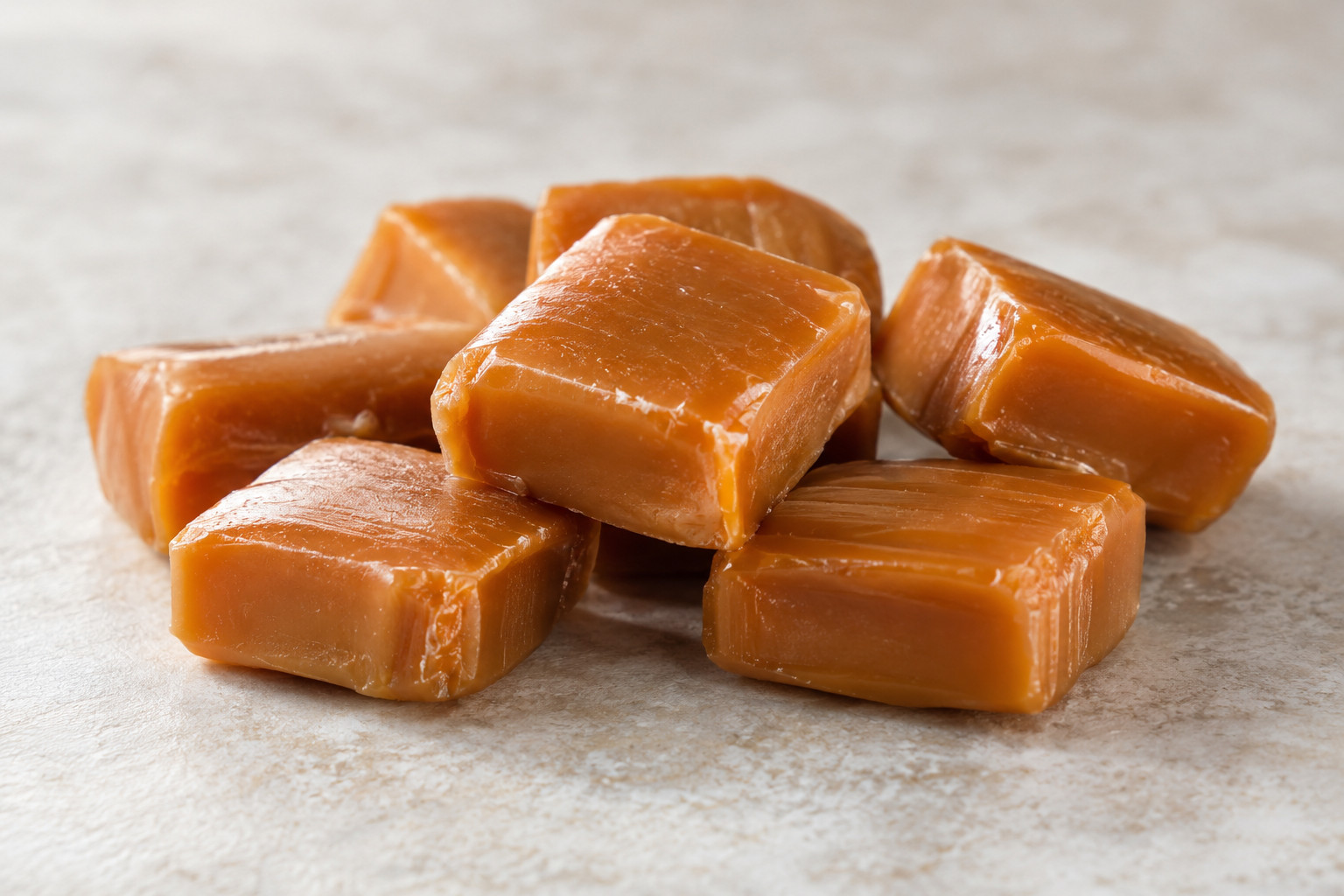
Toffee confectionery: a sensory reference for defining the target flavor profile.
How should a toffee flavor profile be written without vague sensory adjectives?
A workable toffee flavor profile names cooked-butter, browned-sugar, and roast-dairy cues in time order, then states what the system must not become. “Golden,” “indulgent,” and “authentic” may suit packaging copy. They do not tell a flavorist whether the product needs a bright butter opening, a hard-crack sugar heart, a molasses base, or a roasted-nut finish.
Five ingredients are often confused in the same RFQ:
| Term | What it contributes | What the term does not prove |
|---|---|---|
| Toffee flavoring | Concentrated cooked-butter, browned-sugar, and roast-dairy aroma at low dose | Toffee solids, crunch, dairy fat, sweetness, or a finished-label claim |
| Toffee extract | Often a marketing name for a flavor concentrate or a solvent extract | Botanical identity, a legal extract class, or the same strength across suppliers |
| Toffee pieces or inclusions | Texture, sugar solids, and some baked aroma | A uniform dose, heat-stable aroma, or a clean flavor declaration |
| Caramel color | Color only | Toffee identity, butter character, or brown-sugar aroma |
| Butter flavor | Dairy-lipid notes | The browned-sugar snap that makes toffee read as toffee rather than as butter candy |
Cooked candy and flavor concentrate are different tools. Real English toffee supplies sucrose, butterfat, water loss, Maillard products, and a glassy or brittle structure. Toffee flavoring primarily changes aroma and taste identity. It cannot replace cook temperature or inclusion crunch. Compare cost in the finished formula, not per kilogram of concentrate.
Write the target as a timed sensory sentence: “Build a cooked-butter and light vanilla opening, a browned-sugar and light-molasses middle, and a roasted-almond finish; target medium-long persistence, low bitterness, and no butyric, solvent, popcorn-diacetyl, or burnt-coffee notes.” That sentence gives R&D a scorecard. The food-manufacturing flavor concentrate category remains the category parent; this page covers the toffee direction only.
Score onset at 0–5 seconds, middle at 5–20 seconds, finish at 20–60 seconds, and intensity from 0 to 10. Keep serving temperature fixed. A protein shake at 5 °C can hide a butter top that is obvious at 20 °C. A warm cookie can exaggerate roast. Record color and crunch separately.
Which top, middle, and base-note directions change a toffee flavor brief?
Toffee top, middle, and base notes should describe the sequence of perception, not a candy recipe or a regulatory class. Caramel is not toffee. Butterscotch is not toffee. The same word on a sample jar can still mean four different consumer products.

Flavor sample library in the LULIN laboratory
Use the following directions as a working brief vocabulary. They are project families, not standardized supplier grades.
| Profile direction | Top note: first aroma | Middle: recognizable body | Base and finish | Watch-outs |
|---|---|---|---|---|
| English butter toffee | Cooked butter, light vanilla, warm dairy | Browned sugar, light treacle, toasted cereal | Roasted almond, cocoa husk, clean sweet finish | Popcorn diacetyl, bland caramel syrup, missing snap |
| Dairy-light toffee | Brown sugar, faint butter | Clean cooked sugar, mild malt | Short vanilla, low roast | Thin identity, candy-corn sweetness, no dairy bridge |
| Nut toffee | Butter, toasted nut skin | Brown sugar, roasted almond or pecan | Woody roast, cocoa, light smoke | Almond extract, green nut skin, burnt peanut |
| Treacle toffee | Dark molasses, mineral sugar | Black treacle, brown sugar, mild spice | Bitter molasses, coffee, dry cocoa | Sulfur, tar, lingering bitterness |
| Dark burnt toffee | Scorched sugar, coffee | Dark caramel, cocoa, roast | Smoke, bitter roast, charcoal | Acrylamide-like harshness, ashy finish, solvent |
Assign each tier a job. Top notes set recognition. Middle notes carry identity. Base notes decide whether the finish feels buttery, nutty, treacly, or burnt. A coffee drink usually needs a dairy-light or English butter opening that does not fight roast coffee. A protein powder usually needs a stronger middle because protein binds aroma. A frozen dessert needs enough top-note reserve to survive 5 °C service.
Butter and cultured-dairy impressions often sit in diacetyl, acetoin, and lactone territory. Browned-sugar impressions often sit in maltol, furaneol, and cyclotene territory. Roast-nut impressions often sit in pyrazine territory. Those families are brief levers, not a claimed chromatogram for any one item. State exclusions in the same sentence: butyric rancidity, solvent, popcorn diacetyl, almond extract, burnt coffee, unrequested smoke, and generic caramel syrup with no butter.
English Toffee and Butter Toffee are not interchangeable labels. In United States retail language, English butter toffee usually implies butter, browned sugar, and often almond. Butterscotch is softer. Treacle toffee pulls molasses forward. Write the family name, then the timed sentence.
How do water, fat, protein, sugar, salt, acid, and serving temperature change toffee perception?
The food matrix changes toffee flavor by controlling volatile partitioning, binding, diffusion, sweetness contrast, and release during eating. A water cup can expose identity. It cannot predict chocolate, ice cream, protein powder, bakery fat, or a chilled coffee drink. Change one variable at a time after the first matched-base comparison.
| Matrix variable | Likely toffee-profile shift | Reference brackets for controlled trials | Hold constant |
|---|---|---|---|
| Water and total solids | Dilution can create a brief butter spike and a thin sugar finish | 0%, 8%, 12%, 16% soluble solids | Dilution, carbonation, headspace |
| Fat | Hydrophobic brown and dairy notes partition into fat and release later | 0%, 3%, 10%, 20%, 30% fat | Fat source, emulsion state, crystal network |
| Protein | Binding and heat can suppress butter and nut notes; dairy or plant protein adds cooked notes | 0%, 2%, 5%, 8%, 20% protein | Source, hydration, heat history |
| Sugar and sweetener | Sweetness can reinforce toffee while viscosity mutes the opening | 5%, 10%, 15%, 20%, 40% sweetener solids | Sweetener identity, °Brix |
| Salt and minerals | Low salt can lift sweetness; high salt can push savory roast | 0%, 0.05%, 0.15%, 0.30%, 0.80% salt equivalent | Salt species, mineral load |
| Acid and pH | Acid can sharpen the opening and thin the dairy body | 0.10%, 0.20%, 0.30%, 0.40% acid; pH 3.5, 4.0, 4.5, 5.0, 6.5 | Acid identity, titratable acidity |
| Serving temperature | Chilling suppresses butter; warmth exposes roast and molasses | 5 °C, 8 °C, 20 °C, 25 °C, 60 °C | Equilibration and portion size |
Fat holds brown notes. Protein binds dairy lactones. Cold hides butter. A 20% fat ice cream and a 1% fat coffee drink will not rank the same liquid at the same dose. A 20% protein dry mix will not rank the same spray-dried powder as a 2% protein beverage.
Sweetness is separate from identity. Set the sweetener system first, then tune toffee. A 0.30% salt equivalent can lift butter in a sauce and make roast taste brothy in tea, so keep salt constant. Acid at pH 3.5 can strip the dairy middle; test at finished pH. Use production water. Chlorine can mimic a flavor defect.
Which toffee flavor format should a formulator test first?
The correct toffee flavor format is the one that reaches the intended phase, survives the process, disperses at production scale, and releases at consumption. Phase fit comes first. “Liquid” is not a complete specification. Carrier choice matters.
| Complete named option | Best first applications | Design-reference screen | Common failure mode |
|---|---|---|---|
| water-soluble liquid | Clear coffee drinks, syrups, dairy drinks, aqueous sauces | 0.05%, 0.08%, 0.10%, 0.15%, 0.20% w/w; check 5 °C, 20 °C, 25 °C | Haze, oil ring, fast butter spike, weak after pasteurization |
| oil-soluble liquid | Chocolate, compound coatings, nut fillings, fat-rich bakery | 0.10%, 0.15%, 0.20%, 0.30% w/w; check 20 °C, 22 °C, 30 °C | Seizing if water is present, delayed release, uneven streaks |
| high-heat emulsion | Baked bars, cloudy drinks, dairy, thermal fillings | 50%, 100%, 150% of item rate; 0, 1, 3 freeze–thaw cycles; 5 °C, 20 °C, 35 °C | Creaming, neck ring, cooked-dairy shift |
| spray-dried powder | Protein powder, instant mixes, extrusion, long-storage dry products | 0.20%, 0.40%, 0.60%, 0.80%, 1.00% w/w; store at 20 °C, 25 °C, 35 °C | Carrier taste, caking, poor reconstitution, process loss in the dryer |
| dry-blended powder | Seasonings, coatings, premixes, simple dry dosing | 50%, 100%, 150% of item rate; blend 30 s, 60 s, 120 s; inspect 0 days, 7 days, 28 days | Dusting, hot spots, weak protection versus spray-dried powder |
The powder-versus-liquid format guide supplies cross-category context. Toffee flavor powder is a dry, carrier-supported flavor, not crushed English toffee. Request carrier identity, carrier percentage, bulk density, moisture, and solubility before setting a plant dose.
Clarity is a format test. A water-soluble liquid is the shortest route to a clear coffee drink, but solubility does not guarantee heat retention. An oil-soluble liquid can persist in a brownie and still ring a low-fat drink. A high-heat emulsion carries oil-soluble brown notes into water when homogenization is under control.
Protein powder is a different problem. High protein and low water activity mute aroma. For a highly masked dry protein mix, treat 0.80% w/w spray-dried powder as the high-end design benchmark in a 0.20%, 0.40%, 0.60%, 0.80%, 1.00% w/w ladder, then step down. Do not copy that rate into a clear beverage. For cookies, screen 0.20% w/w liquid as the bakery high-end design benchmark when no item rate exists, with 0.10%, 0.15%, 0.20%, and 0.30% w/w as the ladder. Rank cost per tonne of finished product at the passing dose.
Which candy-cook stages and factory processes change a toffee profile?
Candy-cook stage and factory process both change a toffee profile because they select different brown-note and dairy-note balances. Flavoring does not replace cook chemistry. The brief still needs a cook-stage reference so the flavorist knows whether the target is chewy, snappy, or dark-burnt.
U.S. candy-thermometer work uses named bands, not a 1 °C grade list. The complete named set is thread, soft-ball, firm-ball, hard-ball, soft-crack, and hard-crack. Typical teaching brackets, not legal limits, are:
| Named band | Typical °C bracket | Typical °F bracket | Sensory job in a toffee brief |
|---|---|---|---|
| thread | 110–112 °C | 230–234 °F | Thin sugar syrup; not a toffee identity |
| soft-ball | 112–116 °C | 234–240 °F | Chewy, taffy-like; low snap |
| firm-ball | 118–120 °C | 244–248 °F | Soft caramel-like body; dairy-cooked rather than brittle |
| hard-ball | 121–130 °C | 250–266 °F | Firmer chew; treacle toffee can live here |
| soft-crack | 132–143 °C | 270–290 °F | Drier sugar, more roast, still some flex |
| hard-crack | 146–154 °C | 295–310 °F | English butter toffee snap; browned sugar plus butter |
Use 149 °C (300 °F) as the English-toffee cook reference benchmark. It sits in the hard-crack band without jumping to a burnt-sugar regime. A dairy caramel cooked near firm-ball will not match that brief even if both products are brown. Sugar heated well above hard-crack reads as burnt or coffee-like. Do not call that “more toffee.”
Factory process is a second filter. Peak temperature, hold time, shear, addition point, oxygen, and storage act together.
| Process or storage condition | Profile risk | Reference checkpoints |
|---|---|---|
| Pasteurization or hot fill | Butter-top loss; cooked-sugar middle remains | 72 °C/15 s; 85 °C/30 s; 24 h; 7 days; 28 days |
| UHT or retort | Volatile loss, protein binding, sulfurous dairy shift | 135 °C/5 s; 140 °C/4 s; 24 h; 7 days; 28 days |
| Baking or extrusion | Opening loss plus roast, cocoa, scorch | 160 °C/10 min; 180 °C/12 min; 200 °C/20 min; 24 h; 7 days |
| Freeze–thaw and frozen service | Suppressed aroma, delayed butter, emulsion stress | -18 °C, 5 °C; 24 h; 7 days; 1 cycle, 3 cycles |
| Oxygen, light, and package contact | Fat oxidation, butyric notes, scalping | 0 days, 7 days, 28 days, 56 days, 90 days at 5 °C, 20 °C, 25 °C, 35 °C |
| Powder humidity and warm storage | Caking, oxidation, dose hot spots | 0 days, 30 days, 60 days, 90 days at 20 °C, 25 °C, 35 °C and 50%, 65%, 75% RH |
Three gates form the minimum: before processing, after the complete process, and after packaged storage. Later addition can preserve butter where controls permit it. Early addition may need a high-heat emulsion or spray-dried powder. Toffee notes from crystal malt in beer are not the same as added toffee flavoring. If the finished use is alcohol in the United States, request the TTB flavor file set before the commercial pilot.
How should buyers compare toffee flavor samples in the real application base?
B2B teams should compare coded toffee flavor samples in one production-representative base and judge the finished processed product rather than the concentrate. Blind codes reduce bias. Price per kilogram is secondary to cost per tonne at the dose that passes sensory and physical criteria. Cost-in-use decides value.
The following protocol creates a traceable first decision:
- Prepare one unflavored control and one current-product or market-reference control from the same base lot. Dose every flavor by weight.
- Test each candidate at 50% (0.5×), 100% (1.0×), and 150% (1.5×) of its supplier-recommended level. Treat 150% as the high first-pass design benchmark. Never exceed a lower item maximum.
- If a comparable water-soluble liquid has no starting guidance, screen 0.05%, 0.10%, and 0.20% w/w. Treat 0.10% w/w as the beverage reference and 0.20% w/w as the bakery high-end design benchmark. For a masked protein dry mix, include 0.80% w/w spray-dried powder inside 0.20%, 0.40%, 0.60%, 0.80%, and 1.00% w/w.
- Add at the intended production point and run the real heat, shear, cook, cooling, and packaging sequence. Apply random three-digit codes. Serve at one consumption temperature.
- Score toffee identity, butter fit, browned-sugar fit, roast-nut fit, persistence, and off-notes. Record haze, ring, color, caking, and handling separately.
- Recheck after 24 h and 7 days. Advance the lowest dose that reaches 7/10 profile fit, holds objectionable off-notes at 2/5 or below, and passes physical stability.
ISO 13299:2016 provides general guidance for sensory profiling. If a reformulation must show whether two samples are perceptibly different rather than explain how they differ, ISO 4120:2021 defines the triangle-test method. Descriptive profiling and difference testing answer separate questions.
Use food flavor formulation support when format, addition point, or protein masking still needs adjustment. Keep the base, process, and dose ladder identical across suppliers so the first coded round is comparable.
Diagnose the failed sample before changing suppliers.
| Observed result | Likely cause | Next action |
|---|---|---|
| Strong bottle odor, weak finished product | Matrix retention, process loss, wrong addition point | Retest at 50%, 100%, 150% before and after process |
| Sweet but not recognizably toffee | Sweetener carries the product; butter and browned-sugar snap are missing | Rewrite the timed sentence; request English butter or nut direction |
| Tastes like generic caramel | Middle is cooked sugar only; butter and roast are missing | Specify hard-crack 149 °C reference; add dairy and nut exclusions |
| Popcorn or “movie butter” opening | Diacetyl-heavy top, overdose | Step down to 50% or 100%; request a cooked-butter rather than popcorn brief |
| Butyric, cheesy, or rancid finish | Fat oxidation, short-chain acid excess, old stock | Check 0 days, 7 days, 28 days; inspect storage at 20 °C, 25 °C, 35 °C |
| Clear drink haze or oil ring | Carrier or solubility mismatch | Check 5 °C, 20 °C, 25 °C; switch to water-soluble liquid or a stable emulsion |
| Chocolate seizes | Water-bearing flavor in a fat system | Test oil-soluble liquid at 20 °C, 22 °C, 30 °C |
| Protein powder tastes cardboard-flat | Binding plus plant-protein notes | Bracket 5%, 8%, 20% protein with spray-dried powder at 0.40%, 0.60%, 0.80% w/w |
Keep every comparison inside one application. A 72 °C/15 s coffee drink is not the same exposure as a 180 °C/12 min cookie. Isolate one variable. Then advance the lowest dose and simplest format that survive processing.
What belongs in a toffee flavoring RFQ for a U.S. destination market?
A toffee flavoring RFQ should connect the sensory target to the exact base, process, format, destination market, documents, and commercial order. A flavor name and annual tonnage are not enough. Documents follow the item.
| RFQ field | Information to send or request |
|---|---|
| Finished application | Product type, production line, use case, and benchmark sample |
| Sensory direction | Timed top/middle/base sentence; English butter, treacle, nut, dairy-light, or dark burnt family; 149 °C cook reference if used; exclusions |
| Base composition | Water; 0%, 3%, 10%, 20%, 30% fat; 2%, 5%, 8%, 20% protein; 5%, 10%, 15%, 40% sweetener solids; salt, acid, pH, ABV |
| Process and service | Addition point; 72 °C/15 s, 140 °C/5 s, 180 °C/12 min where relevant; cooling to 5 °C; package and storage |
| Required format | One or more of water-soluble liquid, oil-soluble liquid, high-heat emulsion, spray-dried powder, dry-blended powder; clarity, phase, flow, dust, carrier, and dosing constraints |
| Label and claim route | Destination market, natural/artificial target, vegan, allergen, organic, non-GMO, Halal, Kosher, solvent, and carrier exclusions |
| Technical files | Specification, current lot COA, TDS, SDS/MSDS, ingredient or composition statement, allergen statement, source/carrier declaration, shelf life, and country of origin |
| Alcohol-beverage file set | Signed FIDS where applicable, flavor ABV, classification, limited ingredients, colors, and label-impact information under TTB flavor guidance |
| Sample and acceptance plan | 50%, 100%, 150% dose points; 7/10 profile threshold; 2/5 off-note ceiling; 24 h and 7 day rechecks |
| Commercial facts | 1 kg, 5 kg, 20 kg, 25 kg pack options; 7 days, 14 days, 28 days timing; MOQ, price, Incoterm, freight, destination |
| Supply control | Sample-to-production match; 12 months or 24 months shelf-life target; revision, lot continuity, change notice |
For United States food labeling, natural flavor and artificial flavor are source classes under 21 CFR 101.22. Those terms do not prove butter content, vegan status, or sweetness. The site’s B2B guide to artificial flavor owns the broader definition. If toffee is named or pictured as a characterizing flavor, review the characterizing-flavor provisions against the exact composition.
Dairy-free is a composition question. A butter-toffee sensory target does not automatically add milk solids. Confirm the SKU allergen statement before a claim. Use the Food Flavor Compliance Document Request Guide to align files with the selected item and market. Quote cost per tonne of finished product at the passing dose.
Toffee flavoring buyer FAQ
What is toffee flavoring?
Toffee flavoring is a concentrated flavor system used to create or reinforce cooked-butter, browned-sugar, and roast-dairy aroma in a finished food or beverage. It may or may not contain dairy-derived material, so the selected product’s composition, regulatory designation, carrier, sweetness contribution, and dietary status must come from its technical documents.
How is toffee flavoring different from caramel flavoring?
Toffee flavoring should read as cooked butter plus browned-sugar snap, often with a roasted-nut or cocoa finish, while caramel flavoring usually reads as milkier, slower, and more dairy-cooked. A brief that only says “brown and sweet” will not separate the two. Specify the timed sentence and a cook-stage reference such as hard-crack 149 °C for English butter toffee.
What is English toffee flavoring?
English toffee flavoring is a profile family built around cooked butter, browned sugar, and often roasted almond rather than a protected geographic standard. In United States product language it usually implies more snap and nut than a soft caramel. Write butter, sugar-cook, nut, and exclusions explicitly instead of relying on the house name.
Which toffee flavor format should a manufacturer test?
Match the format to the phase and process: water-soluble liquid for many aqueous systems, oil-soluble liquid for fat phases, high-heat emulsion for demanding thermal routes, spray-dried powder for protected dry delivery, and dry-blended powder for simple dry mixing. Test more than one when heat, clarity, or shelf life is uncertain.
How much toffee flavoring should a formulator use?
Start from the supplier-recommended level and test 50% (0.5×), 100% (1.0×), and 150% (1.5×) in the real application base. The 150% point is the high first-pass design benchmark, not a universal maximum; a lower supplier or regulatory limit controls, and the lowest passing dose advances.
Why does the same toffee flavor taste different in water, chocolate, protein powder, and ice cream?
The same toffee flavor tastes different because fat, protein, sugar, salt, acid, process heat, viscosity, and serving temperature change aroma retention, release, and taste balance. Compare supplier samples in one production-representative base; a neat sniff or water cup cannot predict a protein powder, chocolate filling, or frozen dessert.
Can toffee flavoring survive baking, pasteurization, or UHT processing?
Toffee flavoring can survive a thermal process when the formulation, format, dose, and addition point fit the actual time-temperature profile. Screen the finished processed product; a high-heat emulsion, spray-dried powder, or permitted later addition may preserve butter notes that disappear from an ordinary liquid sample.
Is toffee flavoring dairy-free?
Toffee flavoring is dairy-free only when the selected item’s formula, carrier, and allergen controls contain no milk. A butter-toffee sensory target does not by itself prove milk solids are present or absent. Request the allergen statement, source declaration, and cross-contact controls before a dairy-free claim.
What documents belong in a toffee flavoring RFQ?
Request a current TDS, SDS or MSDS, COA, ingredient and allergen statement, GMO statement, Halal or Kosher certificate when needed, natural or artificial declaration for the destination market, storage and shelf-life data, MOQ, lead time, packaging, export paperwork, and change-control terms. Alcoholic uses in the United States also need the applicable TTB flavor file set.
Can toffee flavoring be used in coffee drinks or beer?
Toffee flavoring can be used in a coffee drink or beer when it is compatible with roast, dairy or plant protein, acidity, carbonation, final ABV, processing, and the destination-market formula and label rules. Choose a dairy-light or English butter direction that does not fight coffee or malt roast, and request TTB documents when the finished beverage is alcoholic.
Toffee flavoring sample brief for LULIN FLAVOR
LULIN FLAVOR is the English brand of QUANZHOU LVLIN BIOENGINEERING CO., LTD., a Quanzhou, Fujian food-grade flavor developer, manufacturer, and supplier established in 2001. The application team includes more than a dozen flavor engineers with over 20 years of development experience, three production lines, and an application laboratory. The team supports sample work across beverages, bakery, dairy-style products, confectionery, seasonings, and dry mixes.
Send the real base, timed top/middle/base target, cook-stage reference, process, serving temperature, destination market, preferred format, sample quantity, and required documents. LULIN FLAVOR can prepare item-level specifications, COA, TDS, SDS/MSDS, allergen, source/carrier, vegan, non-GMO, Halal, Kosher, MOQ, pack-size, lead-time, and quotation details for the defined commercial item. Request application-matched toffee flavor samples or contact LULIN FLAVOR about a flavor project with the project brief.
Develop this flavor in your product
Send your product, target market and project goal. We will review the sample direction with you.