Published
Ube Flavoring
Ube flavoring is a concentrated aroma and taste system for purple yam (Dioscorea alata), not a taro, purple-sweet-potato, or grape-candy substitute. Specify cooked-yam, vanilla-coconut, pistachio, and earthy starch notes, then screen a water-soluble liquid at 0.25% w/w (2.5 g/kg) as the high-end reference benchmark in the finished food.
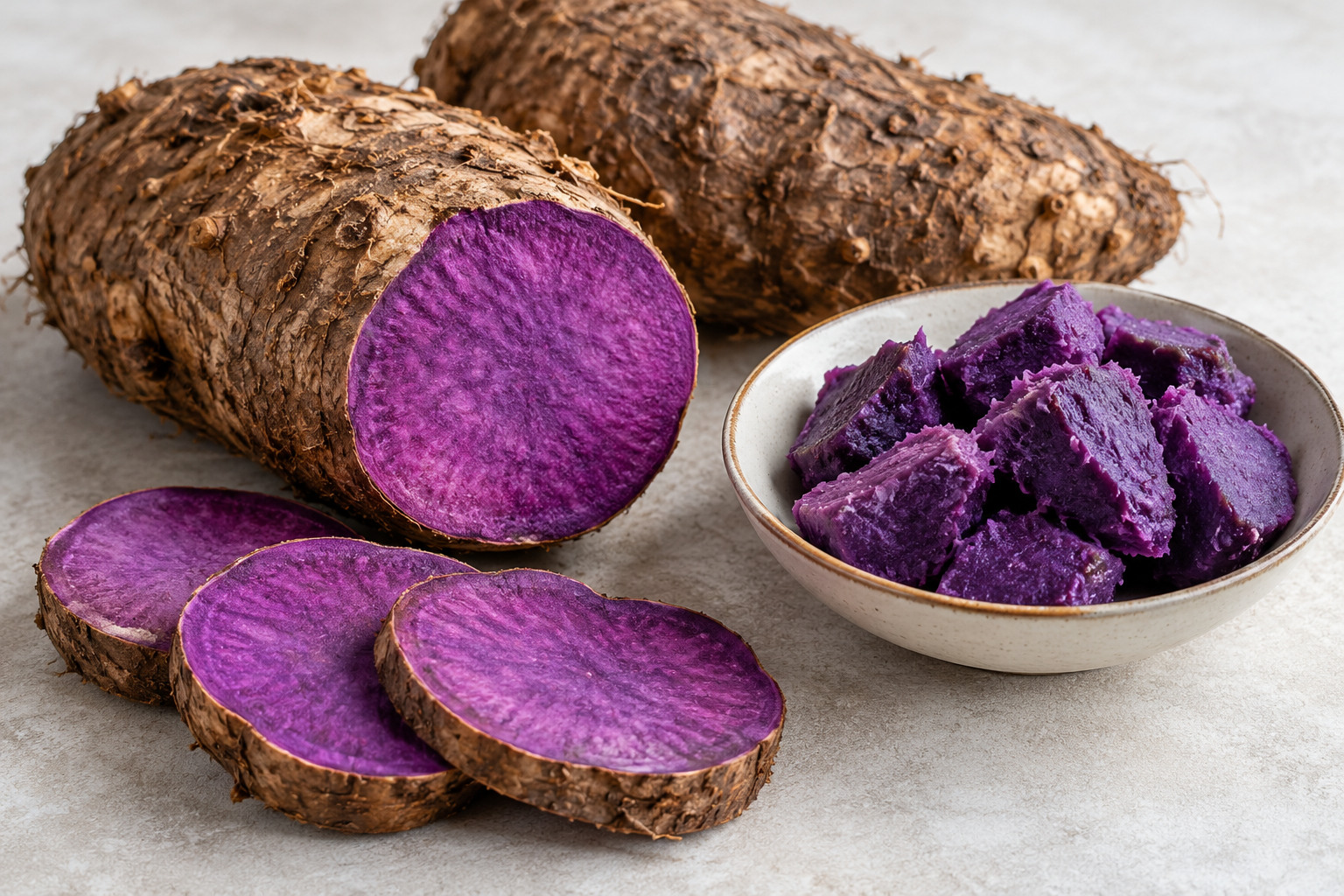
Ube purple yam sensory reference: an AI-generated sensory reference for this flavor brief.
How should a buyer describe ube flavoring without calling it taro or purple candy?
A usable ube flavor profile names the tuber, the time course, the intensity, and the notes that must stay out. Purple dessert does not distinguish steamed ube, ice-cream ube, milk-tea ube, baked yam, or a vanillin candy built only to match a lavender color.
Keep the botanical reference explicit. Ube is Dioscorea alata. Taro is Colocasia esculenta. Purple sweet potato is Ipomoea batatas. Those three crops can all be sold as purple bakery or bubble-tea flavors, and they do not taste the same. Ube should read as cooked purple yam with vanilla, coconut cream, pistachio, and a short earthy-starch finish. Taro reads earthier and less vanilla-sweet. Purple sweet potato reads more like baked root and molasses.
Describe perception in three windows:
- Top, 0–3 seconds: sweet steam from freshly mashed yam, coconut cream, light floral lift, or a warm vanilla flash.
- Middle, 3–15 seconds: roasted purple yam, dairy cream, pistachio or almond nuttiness, mild caramel, coconut milk.
- Base, 15–60 seconds: cooked tuber, faint cocoa or wood, lingering cream, a short earthy starch note that does not become potato.
Add a 0–10 intensity for each window, a finish duration, and two exclusions. Useful exclusions for ube are “no taro/potato,” “no grape candy,” “no sunscreen coconut,” and “no perfume.”
Ube powder, puree, and cooked paste contribute starch, fiber, sugar, anthocyanin color, and some cooked aroma. A compounded flavor primarily controls aroma and taste at a much lower use. The flavor concentrate category for food manufacturing covers the broader family; this page owns the ube-specific decision.
Purple color is not flavor identity. Anthocyanins in the tuber, often cyanidin and peonidin glycosides, create the expected violet crumb or swirl. Many water-soluble flavor items are pale. If the finished ice cream, cake, or milk tea must look ube-purple, specify colorant or fruit-powder separately from the flavor code.
Which top, middle, and base notes change an ube brief?
Ube direction changes when the brief raises or lowers one note family. Food-chemistry vocabulary helps a flavorist, but it is briefing language, not a formula.
| Sensory tier | Direction to specify | Useful chemical vocabulary | Best-fit product cue | Failure signal |
|---|---|---|---|---|
| Top | Sweet cooked-yam steam | Maltol, vanillin, 2-acetyl-1-pyrroline | Ube halaya, steamed-yam ice cream | Burnt sugar, popcorn overload |
| Top | Coconut cream lift | γ-nonalactone, δ-decalactone | Ube-coconut cake, halo-halo syrup | Sunscreen, soapy coconut |
| Top | Light floral / violet hint | Linalool, β-ionone at trace | Adult dessert, chilled latte | Perfume, powdery violet soap |
| Middle | Roasted purple yam body | Guaiacol, eugenol, furaneol | Bakery crumb, frozen dessert | Smoky clove, jammy candy |
| Middle | Nutty pistachio / almond | Benzaldehyde, roasted-nut notes | Premium ice cream, cookies | Marzipan, bitter almond |
| Middle | Dairy cream | 2,3-butanedione, dairy lactones | Milk tea, yogurt, soft serve | Butter popcorn, stale cream |
| Base | Earthy cooked tuber | Controlled hexanal, cooked-starch depth | Authentic Filipino dessert | Raw potato, taro confusion |
| Base | Cocoa-wood warmth | Guaiacol, faint cocoa | Dark bakery, adult frozen dessert | Dry wood, bitterness |
Four first-round briefs work well. Steamed ube / halaya keeps yam steam, cream, and a short earthy finish. Ube ice cream raises dairy cream and vanilla while holding tuber identity after −12°C service. Ube milk tea needs coconut-vanilla lift that survives tea tannin and 85°C hold. Candy-style purple raises vanillin and maltol for confectionery; write that choice on purpose, because it will not pass an authentic-yam panel.
Methional and heavy earthy aldehydes push the sample toward taro or boiled potato. Ethyl maltol plus grape-like esters push it toward purple candy. Either drift is a brief failure, not a “stronger ube.”
How do dairy fat, coconut, protein, sugar, tea, acid, and serving temperature change ube?
The application matrix changes ube release, so rank samples in the finished base. A water winner can collapse in 12% fat ice cream mix or turn thin and floral in unsweetened tea.
| Matrix variable | What changes | Typical ube symptom | Controlled comparison |
|---|---|---|---|
| Water and low solids | Fast diffusion; weak body | Bright vanilla flash, thin yam, surface ring | Compare 0% fat water against the finished formula at 20°C |
| Dairy fat | Lipophilic notes partition into fat and release slowly | Muted steam, longer coconut-cream finish | Hold fat at 0%, 4%, 10%, and 16% after full aging |
| Coconut fat | Extra lactone and oil-phase hold | More suntan-lotion risk, richer middle | Compare 0%, 5%, and 12% coconut milk solids |
| Protein | Binding and heat reactions mute aldehydes and diacetyl | Lost yam steam, cooked dairy mask | Test milk, whey, soy, or pea at the actual 2–6% level |
| Sugar and total solids | Sweetness and viscosity shift ripeness | More candy-vanilla, less tuber | Hold one sweetener system at 8%, 12%, and 18% solids |
| Salt | Cross-modal lift or savory drift | Sharper top at 0.20%; bakery savor at 0.50% | Compare 0%, 0.20%, and 0.50% sodium chloride |
| Acid and pH | Sourness and ester stability | Brighter candy, thinner yam, possible haze | Compare pH 3.2, 4.5, and 6.7 in one base |
| Tea tannin | Astringency dries the cream middle | Hollow vanilla, bitter finish | Hold 0.15% and 0.30% tea solids against a no-tea control |
| Serving temperature | Cold suppresses headspace; warmth opens lactones | Quiet at −12°C or 5°C; perfumy at 20°C | Read every code at the real service point |
Ice cream at 10% fat and −12°C hides top notes that look strong in a 20°C syrup. Coconut milk at 12% fat can make a balanced liquid smell like lotion. A 6% protein shake binds the yam steam and leaves vanillin. Tea at 0.30% solids can strip cream and leave a dry candy note.
Change one variable at a time. Keep water, sweetener, acid, color, and package constant, then use food flavor formulation support for B2B R&D when the carrier or addition point needs adjustment.
Which ube format belongs in ice cream, milk tea, bakery, or a dry mix?
Select ube format by continuous phase, clarity, process heat, and handling. Liquid or powder describes physical form. Water-soluble, oil-soluble, and emulsion describe delivery.
| Format option | First matrix to test | Main advantage | Main risk | Required pilot check |
|---|---|---|---|---|
| Water-soluble liquid | Clear syrup, tea, yogurt drink, alcohol-containing mixer | Fast dosing and clear dispersion | Volatile loss, weak oil-note delivery | Clarity, ring, pH, heat, headspace |
| Oil-soluble liquid | Compound coating, fat filling, oil-based ganache | Direct fat-phase compatibility | Haze in water; seizing in chocolate if the carrier is wrong | Viscosity, cold release, bloom |
| Oil-in-water beverage emulsion | Cloudy milk tea, dairy drink, nectar | Carries hydrophobic yam and coconut notes into water | Creaming, ring, droplet growth | Homogenization, 85°C hold, 30-day stability |
| Spray-dried powder | Dry beverage, bakery premix, protein mix, gummy dusting | Dry handling and measured reconstitution | Carrier load, caking, muted steam | Moisture, bulk density, reconstitution at 10% w/w |
| Encapsulated powder | Heat-exposed mix, delayed-release dry system | Extra protection through 170°C to 180°C | Incomplete release, higher cost-in-use | Process trigger, particle behavior, cooled crumb score |
| Flavor concentrate | Supplier-defined wet or dry concentrate | Compact dosing when the assay is known | Treating the name as a universal strength | Item assay, carrier, and approved use level |
| Ube powder, puree, or cooked paste | Fruit-identity dessert, colored filling, nutrition-led formula | Tuber solids, color, some cooked aroma | Changes starch, water, Brix, and label | Formula rebalance; not a flavor equivalent |
The complete flavoring screen includes water-soluble liquid, oil-soluble liquid, oil-in-water beverage emulsion, spray-dried powder, and encapsulated powder. Treat flavor concentrate as the supplier’s concentrated system, not a sixth interchangeable strength. Treat ube powder, puree, and cooked paste as tuber ingredients. See the powder versus liquid food flavor guide for handling context.
For a first water-soluble liquid, use the complete ladder 0.05%, 0.10%, 0.15%, 0.20%, and 0.25% w/w. 0.25% w/w (2.5 g/kg) is the high-end reference benchmark in a dairy, dessert, or milk-tea-like base. For a ready-to-use emulsion, screen at 1.00 g/L, 1.25 g/L, and 1.50 g/L, and treat 1.25 g/L as the working reference. For spray-dried or encapsulated powder in batter or dry mix, start a separate ladder at 0.20%, 0.30%, and 0.40% w/w (4.0 g/kg). Compare approved cost per 1,000 kg of finished product, not price per kilogram of flavor.
Why does ube flavoring drift toward taro, perfume, or cooked candy after process and storage?
Ube flavoring drifts when heat, shear, oxygen, light, moisture, or headspace strips the yam steam and leaves vanillin, maltol, lactone, or earthy base notes. The product then reads as candy, perfume, taro, or stale cream.
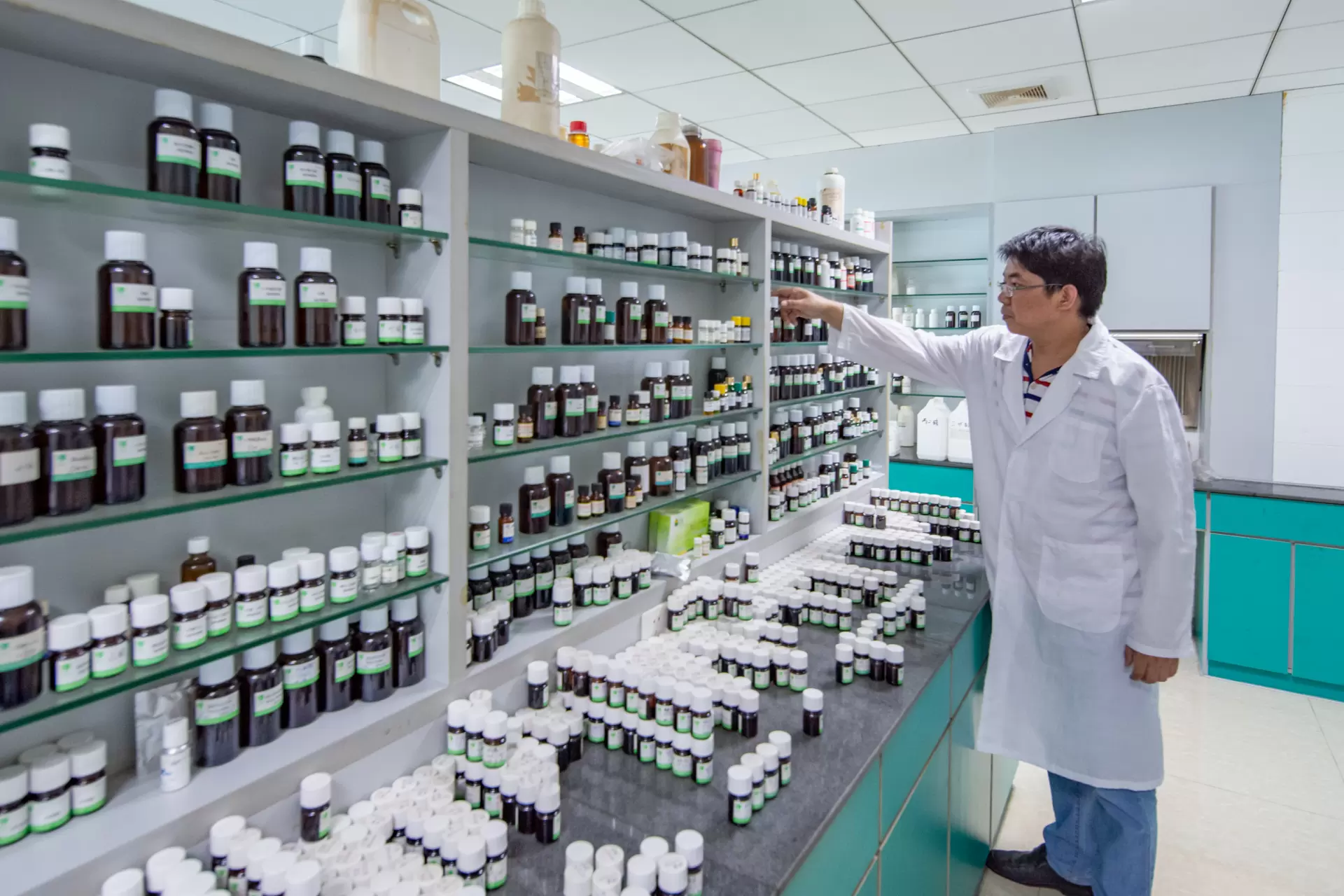
Flavor sample library in the LULIN laboratory
| Pilot challenge | Reference condition | Likely drift | Diagnostic action |
|---|---|---|---|
| Short dairy heat | 72°C for 15 seconds | Steam flash-off; sweeter vanilla remains | Compare pre-heat, post-heat, and 24-hour samples |
| Milk-tea hold | 85°C for 30 seconds | Coconut lift up; yam body down; tannin dryness | Record tea solids, hold time, and milk fat |
| Hot fill syrup | 90°C for 30 seconds | Candy-vanilla, cooked sugar, package aroma pickup | Record fill temperature, closure time, headspace |
| UHT protein drink | 135°C for 5 seconds | Aldehyde loss, cooked dairy mask, protein bind | Test addition before and after the severe heat step where permitted |
| Cake or chiffon | 170°C for 25 minutes | Fresh yam weakens; vanilla crumb dominates | Score cooled crumb at 2 hours and 24 hours |
| Cookie or muffin | 180°C for 18 minutes | Nutty middle survives; steam dies | Compare batter aroma against cooled piece |
| Frozen dessert | Freeze at −18°C; serve at −12°C and −5°C | Low release, muted sweetness, delayed cream | Evaluate frozen, partially warmed, and melted states |
| Ambient storage | Day 0, Day 7, Day 30 at 20°C | Oxidation, color shift, top-note fade | Use final package and normal headspace |
| Accelerated package screen | Day 0, Day 7, Day 30 at 40°C | Faster oxidation, emulsion ring, carrier note | Treat as a comparison challenge, not a shelf-life conversion |
Powders need moisture and caking checks. Emulsions need ring and separation checks. A code that passes 72°C for 15 seconds can still fail 135°C for 5 seconds. A bakery powder that scores well in batter can still read as vanilla cake after 170°C for 25 minutes. Judge every code after the complete process in the intended package.
How should buyers compare ube samples in ice cream, milk tea, bakery, and dry mix?
Buyers should compare ube samples with blind codes, one master base, a complete dose ladder, process controls, and predetermined advancement rules.
Use this controlled protocol:
- Make one 5 kg master base and divide it after the formula is uniform.
- Prepare a blank, current reference, and each three-digit code twice.
- For a concentrated water-soluble liquid, test the complete ladder 0.05%, 0.10%, 0.15%, 0.20%, and 0.25% w/w. The high point, 0.25% w/w (2.5 g/kg), is the high-end reference benchmark. Use the selected item’s technical boundary when it is lower.
- Process every sample identically. Record °C, time, pH, fat, protein, solids, tea solids, order, and headspace.
- Serve 30 g at the intended temperature in randomized order. Score each attribute from 0 to 10.
- Repeat on Day 0, Day 7, and Day 30. Record clarity, haze, ring, separation, sediment, color shift, caking, or viscosity change.
- Advance the lowest dose that reaches 75/100 without a mandatory failure, then confirm at pilot scale.
| Application screen | Batch | Key matrix controls | Process challenge | Serving check | Dose ladder |
|---|---|---|---|---|---|
| Clear ube syrup | 1 kg | 0% fat; 12% solids; pH 3.2 | 90°C for 30 seconds | 5°C, 20°C | 0.05%, 0.10%, 0.15%, 0.20%, 0.25% |
| Milk tea | 1 kg | 3% fat; 0.20% tea solids; pH 6.7 | 85°C for 30 seconds | 5°C, 20°C | 0.05%, 0.10%, 0.15%, 0.20%, 0.25% |
| Ice cream mix | 1 kg | 10% fat; 4% protein; 16% solids | 72°C for 15 seconds; freeze −18°C | −12°C, −5°C | 0.05%, 0.10%, 0.15%, 0.20%, 0.25% |
| Yogurt drink | 1 kg | 2% fat; 3% protein; pH 4.5 | 85°C for 30 seconds | 5°C, 20°C | 0.05%, 0.10%, 0.15%, 0.20%, 0.25% |
| Plant-protein shake | 1 kg | 2% fat; 6% protein; pH 6.8 | 135°C for 5 seconds | 5°C, 20°C | 0.05%, 0.10%, 0.15%, 0.20%, 0.25% |
| Cake batter | 1 kg | 18% fat; 20% sugar | 170°C for 25 minutes | 20°C | 0.05%, 0.10%, 0.15%, 0.20%, 0.25% |
| Cookie dough | 1 kg | 22% fat; 0.40% salt | 180°C for 18 minutes | 20°C | 0.05%, 0.10%, 0.15%, 0.20%, 0.25% |
| Dry drink powder | 1 kg | Reconstitute at 10% w/w | 25°C for 24 hours | 5°C, 20°C | 0.05%, 0.10%, 0.15%, 0.20%, 0.25% |
Replace these controlled laboratory bases with the real formulation before approval.
| Advancement criterion | Weight | Passing evidence |
|---|---|---|
| Recognizable ube identity | 20% | Cooked purple yam remains identifiable after process and at serving temperature |
| Match to steamed, ice-cream, milk-tea, or candy direction | 15% | Coded sample fits the written brief |
| Top-note retention | 15% | Required yam steam, coconut lift, or vanilla flash survives |
| Yam body and cream balance | 10% | Roasted tuber, pistachio, and dairy notes remain integrated |
| Clean finish and off-note control | 15% | No taro/potato, grape candy, sunscreen coconut, perfume, or burnt sugar |
| Matrix integration | 10% | Flavor fits fat, coconut, protein, sugar, tea, acid, and temperature |
| Physical stability | 10% | No unacceptable haze, ring, separation, sediment, or caking |
| Cost-in-use and supply fit | 5% | Approved dose produces an acceptable cost per 1,000 kg |
ISO 4120:2021 triangle testing can confirm a perceptible change, but not direction or preference. Use descriptive scoring for selection. Send the trial through the food flavor sample request route with the same base and decision rule.
What belongs in a United States ube flavoring RFQ?
A United States ube flavoring RFQ should connect sensory target, formula, process, color plan, label, documents, commercial terms, and importer responsibilities.
| RFQ block | Information the buyer supplies | Supplier response or document required |
|---|---|---|
| Ube direction | Steamed, ice cream, milk tea, bakery, or candy; top/middle/base; 0–10 intensity; forbidden taro, grape, perfume, and lotion notes | Sample code, sensory profile, recommended format |
| Formula matrix | Water, dairy fat %, coconut %, protein source/%, sugar or solids %, salt %, acid system, pH, tea solids, alcohol | Starting use level, solubility, clarity, carrier compatibility |
| Process and package | Mixing order, shear, heat time/temperature, freeze, bake, fill temperature, headspace, oxygen/light barrier, storage, serving temperature | Addition point, process guidance, stability plan |
| Color plan | Whether purple appearance is required; colorant vs ube powder vs no color | Statement that the flavor item does or does not contribute shade |
| Identity and label | United States market; natural, natural and artificial, or artificial target; characterizing-flavor wording | Ingredient/non-flavor carrier statement and item-specific 21 CFR 101.22 status |
| Technical and quality files | Buyer’s document list and customer limits | TDS/specification, SDS, current-lot COA, allergen and cross-contact statement, shelf life, storage, lot traceability |
| Destination-market review | FDA food use, FSVP cooperation, state/customer requirements, TTB scope for alcohol when applicable | Regulatory/GRAS status statement, country of origin, facility and food-safety documents, change notification |
| Commercial and logistics | Trial quantity, annual forecast, destination, launch date | Sample size, MOQ, pack size, price basis, Incoterm, lead time, capacity, freight and dangerous-goods status |
Under 21 CFR 101.22, natural and artificial status depends on source and function; characterizing-flavor statements depend on the finished formula. Purple color does not prove ube identity. Dried ube powder is not the same declaration category as carrier-based flavor powder.
FEMA GRAS applies to evaluated substances under intended flavor use, not a whole brand or finished flavor. FDA facility registration is not product approval. Use the food flavor compliance document guide for handoff; keep the broad definition on what artificial flavor means for B2B food buyers.
Compare quotations on approved cost-in-use, remaining shelf life, packaging, freight, lead time, and change control. Low price per kilogram can still mean high finished-product cost.
How does LULIN FLAVOR support an ube flavoring project?
LULIN FLAVOR supplies application-matched ube liquids, oil-compatible systems, emulsions, spray-dried powders, encapsulated powders, sample adjustment, and technical documents. QUANZHOU LVLIN BIOENGINEERING CO., LTD. established the Quanzhou, Fujian operation in 2001.
The base includes more than 12 flavor engineers, over 20 years of application experience, three modernized lines, more than 50 employees, six acres, and over 8,000 m². Selected ube items are supported by TDS, SDS, COA, ingredient, allergen, market, and project-matched certification documents.
Send the base, sensory direction, dose, process, package, color plan, market, annual volume, and sample count. Contact LULIN FLAVOR about the ube project for review; the LULIN FLAVOR manufacturer profile provides company context.
Ube flavoring buyer FAQ
What does ube flavoring taste like?
Ube flavoring should taste like cooked purple yam with vanilla, coconut cream, pistachio or almond nuttiness, and a short earthy-starch finish. The exact balance should be specified as steamed, ice-cream, milk-tea, bakery, or candy rather than described only as sweet and purple.
Is ube flavoring the same as taro flavoring?
No. Ube flavoring is built around Dioscorea alata and should keep vanilla-coconut yam character. Taro flavoring is built around Colocasia esculenta and usually reads earthier and less vanilla-sweet. A purple color shared by both products does not make the flavor profiles interchangeable.
Is ube flavoring the same as ube powder or purple yam powder?
No. Ube flavoring is a concentrated aroma system used at screening levels such as 0.05% to 0.25% w/w. Ube powder is dried tuber material that contributes starch, fiber, anthocyanin color, and formula solids. They are not weight-for-weight substitutes.
How much ube flavoring should a developer test first?
Use 0.25% w/w (2.5 g/kg) as a high-end reference benchmark for a first water-soluble liquid screen in a dairy, dessert, or milk-tea-like base. Test the complete 0.05%, 0.10%, 0.15%, 0.20%, and 0.25% w/w ladder in one finished base, then follow the selected item’s technical and regulatory use boundary.
Should an ube milk tea use a water-soluble liquid or an emulsion?
Start with a water-soluble liquid when the drink must stay visually clean. Test an oil-in-water beverage emulsion at the 1.25 g/L reference benchmark when hydrophobic yam and coconut notes, cloud, or extra body are required. Compare ring, creaming, tea tannin, 85°C hold, and 30-day package stability before approving either format.
Why does ube taste weak in ice cream or a high-fat filling?
Fat retains lipophilic aroma and slows immediate release, especially at −12°C. Proteins can also bind aroma and react during 72°C pasteurization. Test the actual fat and protein system, compare oil-compatible or emulsion formats, and evaluate at the intended serving temperature after the full freeze or bake.
Does ube flavoring provide the purple color?
Often no. Many concentrated flavor items are pale, while the expected violet shade comes from tuber anthocyanins, purple-sweet-potato color, or a separate colorant. Specify the color plan in the RFQ and do not treat shade as proof of ube identity.
Can ube flavoring survive pasteurization, UHT processing, or baking?
Ube flavoring can be designed for thermal processes, but performance depends on format, carrier, addition point, temperature, hold time, matrix, and package. Compare pre-process, post-process, and aged samples because yam steam may fall while vanilla, maltol, or earthy notes remain.
How should buyers compare ube flavor samples?
Use blind three-digit codes, one master application base, duplicate preparations, identical processing, equal serving temperature, and a written 100-point scorecard. Evaluate a blank, current reference, and candidates on Day 0, Day 7, and Day 30, then advance the lowest dose that passes without a physical or regulatory failure.
Which documents belong in a United States ube flavoring RFQ?
Request the TDS or specification, SDS, current-lot COA, ingredient and carrier statement, allergen and cross-contact statement, item-specific natural/artificial status, regulatory or GRAS statement, shelf-life and storage data, country of origin, traceability and change-control terms, MOQ, pack size, price basis, Incoterm, lead time, and FSVP cooperation information.
Ube sample brief for the next bench trial
Send one page: product; steamed, ice-cream, milk-tea, bakery, or candy direction; required and forbidden notes; water, dairy fat, coconut, protein, sugar, salt, acid, pH, and tea solids; process; package; serving temperature; color plan; format; 0.05–0.25% liquid screen with 0.25% w/w (2.5 g/kg) as the high-end reference; market; documents; sample count; annual forecast; and decision date. LULIN FLAVOR can then return contrasting samples, technical files, and a production quotation.
Develop this flavor in your product
Send your product, target market and project goal. We will review the sample direction with you.