Published
Walnut Flavoring
Walnut flavoring is a configurable food-flavor system that presents English walnut (Juglans regia) or black walnut (Juglans nigra) character in a finished food. Screen liquid, powder, emulsion, oil-soluble, and water-soluble options in the actual base, and use 4 g/kg (0.40% w/w) as the high first-pass design benchmark for comparable concentrated liquids.
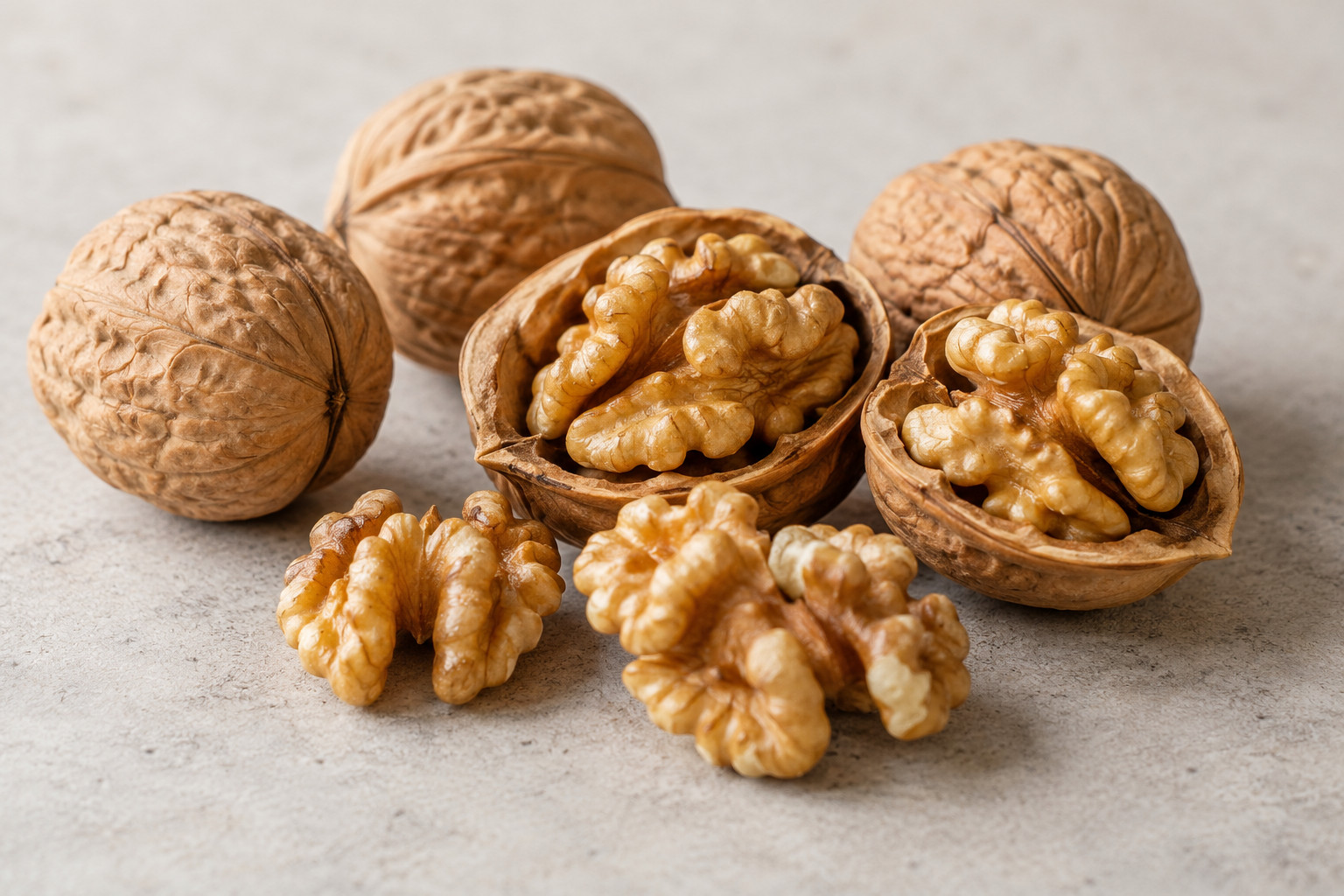
Walnuts: a sensory reference for defining the target flavor profile.
How should a walnut flavor profile be specified without calling it “nutty”?
A walnut flavoring brief names species, kernel freshness, roast depth, cream or butter body, tannic skin, sweet-brown support, oxidized notes, finish, matrix, and serving condition. “Nutty and authentic” cannot separate English Walnut, Black Walnut, pecan, hazelnut, or a generic brown-sugar paste.
Words such as rich, natural, and roasted do not tell a flavorist what to build. Roasted can mean a light toasted kernel, a bakery crust, or a burnt hull edge. Creamy can mean milk fat, vanilla softness, or a waxy coating. Black walnut in United States ice cream is not the same target as a mild Persian Walnut cake filling.
Convert the target into controlled axes. Give each axis a low anchor, a high anchor, and a rejection point. A 0–10 scale is enough for early screening when the anchors are written before tasting.
| Sensory axis | 0 anchor | 10 anchor | Rejection signal |
|---|---|---|---|
| Species direction | Mild English Walnut kernel | Dark Black Walnut hull | Pecan, peanut, or hazelnut substitution |
| Green/fresh kernel | Clean blanched kernel | Strong leafy or peel lift | Paint-like hexanal or raw green leaf |
| Roast | Pale toasted kernel | Dark bakery roast | Ash, burnt grain, or smoke takeover |
| Cream body | Lean and dry | Buttery, lactonic, rounded | Waxy oil or stale dairy |
| Tannic skin | No astringency | Dry, puckering hull | Bitter persistence after 10–60 s |
| Sweet-brown support | Dry nut only | Maple-adjacent caramelized sugar | Maple, banana, or candy dominance |
| Oxidized note | Fresh fatty kernel | Cardboard or rancid oil | Painty, fishy, or soapy tail |
| Finish | Short and clean | Long woody-sweet extract finish | Solvent flash or harsh alcohol |
Profile is separate from concentration and delivery form. A buyer can source flavor concentrates for food manufacturing and still receive the wrong walnut direction. The RFQ should name a reference food and reject peanut paste, filbert praline, banana ester, maple syrup, rancid walnut oil, and solvent heat.
Buying objects also split. Walnut flavoring is a compounded system dosed into a formula. Black walnut extract, including imitation bakery extract, is a named consumer and foodservice product class with its own strength and solvent. Walnut oil, walnut paste, and walnut meal are ingredients, not interchangeable with a flavor item. Maple-walnut ice cream is a paired finished flavor; maple belongs on a separate brief.
How do English walnut and black walnut change the top, middle, and base-note brief?
An English walnut brief and a black walnut brief use the same timing model, then lock different top, middle, and base notes. English walnut (Juglans regia, also sold as Persian Walnut) reads creamier, milder, and more buttery. Black walnut (Juglans nigra) reads darker, woodier, more tannic, and closer to United States ice-cream and fudge memory.
Top, middle, and base are operational windows: opening 0–2 s, recognizable body 2–10 s, and finish 10–60 s.
| Stage | English Walnut directions | Black Walnut directions | Application role | Typical failure |
|---|---|---|---|---|
| Top (0–2 s) | Fresh kernel, faint green peel, light fatty lift | Woody hull, earthy forest opening, restrained medicinal edge | Opens ice cream, cake crumb, and walnut beverages | Solvent flash, raw leaf, or paint-like aldehyde |
| Middle (2–10 s) | Creamy kernel, light roast, buttery paste | Tannic kernel, roasted hull, dry woody body | Establishes species identity in bakery, frozen dessert, and confectionery | Peanut substitution, hazelnut praline, or maple takeover |
| Base (10–60 s) | Soft brown, lactonic cream, short toasted finish | Dry astringent skin, lingering woody-sweet extract finish | Gives body to fudge, frosting, fat filling, and premixes | Rancid oil, cardboard, ash, or bitter hull persistence |
Walnut aroma is a stack, not one molecule. Useful sensory anchors include hexanal, (E)-2-heptenal, (E,E)-2,4-decadienal, 1-octen-3-ol, 2-pentylfuran, 2,5-dimethylpyrazine, 2-ethyl-3,5-dimethylpyrazine, 2,3,5-trimethylpyrazine, 2-acetyl-1-pyrroline, furaneol, maltol, γ-nonalactone, hexanoic acid, and guaiacol. Those names describe what a panel can reject. They do not disclose a LULIN FLAVOR formula.
A Black Walnut ice-cream brief may request woody opening, tannic kernel middle, restrained sweet-brown support, and a clean 4°C finish without rancid oil. English Walnut cake filling needs more cream body, lighter roast, and less hull astringency after 180°C bake and cool-down to 22°C. Banana-walnut muffins need a walnut middle that still reads after banana esters. Maple-walnut cookies need walnut identity after maple is fixed, not a second maple note.
Natural or artificial classification does not define that note stack. A product may be solely natural flavor, natural and artificial flavor, or solely artificial flavor under 21 CFR 101.22(g) and still miss the species target. The guide to how artificial flavor is defined for food labels covers terminology. Classification, walnut-derived protein, and sensory direction remain separate specifications.
How do water, fat, protein, sugar, salt, acid, and serving temperature change walnut perception?
Water, fat, protein, sugar, salt, acid, and serving temperature change walnut aroma release, green-versus-roast balance, tannin, sweetness association, body, and finish, so a sample decision must be made in the intended product matrix.
The same concentrate can smell sharp in water and seem muted in a 10% fat ice-cream mix. It can read as maple-brown in a 12% sucrose filling, dry and tannic in an unsweetened protein drink, or greener after acidification. These are not contradictions. Aroma compounds partition, bind, and reach the headspace differently as the formula changes.
For a one-variable diagnostic, the control points below are an internal challenge set. The commercial formula remains the approval base. Concentrated-liquid screens in this table use 1 g/kg, 2 g/kg, 3 g/kg, 4 g/kg, and 5 g/kg only as comparable-item rungs.
| Matrix variable | Likely perceptual shift | Illustrative control points | Controlled question | Common misdiagnosis |
|---|---|---|---|---|
| Water | Fast hexanal opening, thin kernel body | 1,000 g base; 1 g/kg, 2 g/kg, 3 g/kg, 4 g/kg, 5 g/kg | Does the middle retain species identity at final dilution? | A strong water sniff is treated as finished-product proof |
| Fat | Slower release, rounder roast, longer fatty finish | 0%, 3%, 10% fat | Does the flavor open at the actual fat type, level, and freeze state? | A cold fatty sample is called weak |
| Protein | Binding of pyrazines; dairy, soy, or pea notes can mask kernel | 0%, 3%, 8% protein | Does walnut remain distinct beside the selected protein after heat? | Base aftertaste is blamed on the flavor |
| Sugar | Stronger brown/maple association; viscosity can slow top notes | 0%, 6%, 12% sucrose | Does fixed sweetness hide tannin or replace walnut with candy? | Sweetness is mistaken for flavor strength |
| Salt | Changed roast contrast and bitterness | 0%, 0.10%, 0.30% salt | Does bakery sodium clean the kernel or push it savory? | A formula effect is treated as a profile defect |
| Acid/pH | Sharper astringency, weaker cream, altered protein behavior | pH 3.2, pH 4.2, pH 6.8 | Does Black Walnut stay coherent in yogurt or fruit bakery? | Acid bite is called fresh-kernel character |
| Temperature | Faster release when warm; slower opening when cold or frozen | 4°C, 22°C, 60°C | What is perceived at the real consumption temperature? | A 22°C bench result is applied to 4°C ice cream |
Walnut oil is highly unsaturated. In water, C6 aldehydes show first, so a panel may call a correct English Walnut item “green” simply because fat is missing. In ice cream, fat retains (E,E)-2,4-decadienal and lactones; freeze-thaw and overrun then change how that fat releases during eating. Protein drinks can swallow the middle and leave only hull dryness. Sugar pulls Black Walnut toward fudge or maple. Acid in yogurt or fruit-walnut bakery raises tannin.
Evaluate ice cream at finished fat, sugar, protein, and 4°C after hardening. Evaluate cake after a 180°C bake and cool-down to 22°C. Hot cereal or a walnut beverage needs the intended sip temperature plus a 60°C challenge. Hold the formula constant during flavor comparison. If sugar, salt, protein, or acid changes between samples, the panel is comparing two products rather than two flavors.
Test both conditions. Record the difference.
Which liquid, powder, emulsion, oil-soluble, or water-soluble walnut format should be tested first?
A manufacturer should choose walnut flavor format by phase compatibility, point of addition, process, dosing method, appearance, storage, and factory handling rather than assuming liquid or powder indicates quality.
The complete commercial vocabulary includes liquid, powder, emulsion, oil-soluble, and water-soluble. These terms overlap. Liquid, powder, and emulsion describe physical form. Oil-soluble and water-soluble describe phase compatibility. A liquid can be water-soluble or oil-soluble. A spray-dried powder can disperse into water after reconstitution.
The first practical screen uses four non-duplicative routes. Paste, plated powder, encapsulated powder, and alcohol/water extract remain secondary custom routes when the application requires them.
| First-round route | Best first applications | Example challenge | What to measure | Frequent failure mode |
|---|---|---|---|---|
| Water-soluble liquid | Ice-cream mix before freeze, milk beverage, syrup, plant walnut drink | 4°C after 24 h; 22°C bench | Dispersion, clarity or intended cloud, carrier impact, post-heat identity | Haze, ring, solvent flash, protein masking |
| Oil-soluble liquid | Chocolate, cocoa coating, fat filling, compound coating, seasoning oil | 45°C addition; 22°C tasting | Distribution through fat, oxidation, release during eating | Poor transfer into an aqueous phase; delayed or rancid fatty tail |
| Water-based emulsion | Cake, cookie, muffin, brownie, frosting, banana-walnut bakery | 180°C bake; 7 days at 20°C | Droplet stability, opacity, pH behavior, bake result | Ringing, separation, color pickup, lost top notes |
| Spray-dried water-soluble powder | Dry bakery premix, protein powder, cereal coating, instant beverage | 25°C, 65% RH, 30 days | Flow, dust, caking, wetting, carrier taste, reconstituted release | Moisture pickup, uneven dosing, incomplete wetting, weak opening |
Carrier choice is part of the format decision. Propylene glycol, ethanol, triacetin, vegetable oil, maltodextrin, gum arabic, and modified starch each leave a different handling and taste residue. An ice-cream liquid that flashes alcohol at 4°C is the wrong carrier, not proof that walnut cannot work in frozen dessert.
Dose is not transferable across routes. The 1 g/kg, 2 g/kg, 3 g/kg, 4 g/kg, and 5 g/kg ladder applies to comparable concentrated liquids. A bakery emulsion or a spray-dried powder may sit higher or lower on a weight basis because solids, encapsulation, and potency differ. For a side-by-side of physical form, use the site page on powder versus liquid food flavors.
Start with the route that matches the phase where the flavor is added. Then confirm survival after the real process, not after a cup of water.
Which heat, oxygen, shear, and storage conditions turn walnut flavoring green, rancid, tannic, or flat?
Walnut flavoring shifts when heat, oxygen, light, shear, moisture, and time change the balance of aldehydes, pyrazines, lactones, and phenolic hull notes. The intended profile is the profile after process and storage, not the profile of the neat sample.

Flavor sample library in the LULIN laboratory
Addition point matters as much as peak temperature. A water-soluble liquid added after pasteurization keeps more top note than the same liquid sent through 85°C hot-fill. An oil-soluble liquid added to chocolate at 45°C avoids a 200°C bake, then still has to survive oxygen in the fat phase.
| Process or storage factor | Challenge condition | What often happens to walnut | Buyer action |
|---|---|---|---|
| Mixing / addition point | Before vs after heat; 5 min vs 20 min hold | Early addition can strip top notes; late addition can leave solvent | Freeze the addition point in the RFQ |
| Pasteurization / hot-fill | 72°C; 85°C | Green aldehydes may flash; roast middle can flatten | Taste after the full heat/time, not after a bench mix |
| UHT / retort-adjacent heat | 135°C | Burnt hull, cooked protein, loss of cream body | Specify high-heat walnut items only when this step exists |
| Baking | 160°C, 180°C, 200°C | Emulsion may keep kernel better than a thin water-soluble liquid | Bake, cool to 22°C, then score; do not score batter |
| Homogenization / high shear | Plant beverage or ice-cream mix | Droplet breakup can change release and cloud | Homogenize the actual mix before tasting |
| Freezing | Ice cream at −18°C; taste at 4°C | Fat structure delays opening; overrun dilutes aroma | Harden, then evaluate at serving temperature |
| Oxygen, light, headspace | Clear bottle; 20°C; 14 days | Hexanal and cardboard rise; fatty tail turns rancid | Specify barrier, nitrogen, and light protection |
| Humidity / dry mix | 25°C, 65% RH, 30 days | Powder caking, carrier sweetness, weak reconstituted walnut | Include a reconstituted cup in the screen |
| Storage ladder | Day 0, 7 days, 14 days, 28 days, 56 days, 90 days at 4°C, 20°C, 37°C | 37°C is an accelerated comparison, not a shelf-life claim | Keep the same package and headspace on every pull |
Walnut is less forgiving of oxygen than many brown flavors. A sample that smells correct on Day 0 can read painty at 14 days in a high-headspace jar. Black Walnut’s tannic finish can also grow after bake even when volatiles survive, because dryness and bitterness are not the same as aroma strength.
Name the process in the brief: peak temperature, time, shear, freeze, fill temperature, package, and target shelf. Then ask food flavor formulation support for B2B R&D only after those conditions are written down. A flavorist cannot protect a profile against a process that was never stated.
How should product developers compare walnut flavor samples in the real application base?
Product developers should compare walnut flavor samples in the unflavored commercial base, at coded levels, after the real process, using a written scorecard and a like-for-like dose ladder. Sniffing bottles, tasting in water, or adjusting sugar between codes does not select a walnut item.
Build one frozen protocol before samples arrive.
- Fix the unflavored base, including fat, protein, sugar, salt, acid, hydrocolloids, and process.
- Keep one unflavored control and, if a current item exists, one production reference.
- Assign three-digit codes. Serve in randomized order. Do not reveal species names during the first pass.
- For comparable concentrated liquids, dose 1 g/kg, 2 g/kg, 3 g/kg, 4 g/kg, and 5 g/kg. Use 4 g/kg (0.40% w/w) as the high first-pass design benchmark when the supplier range includes that value. If an item’s starting guidance sits elsewhere, still run 0.5×, 1.0×, and 1.5× around that start, and include 4 g/kg only when the item permits it.
- Process the batch as the plant will: 72°C or 85°C for a beverage, 180°C bake for cookies, freeze and harden for ice cream.
- Evaluate at 22°C as the panel reference, then confirm at 4°C for frozen or refrigerated foods and at 60°C when the product is served hot.
- Score opening 0–2 s, body 2–10 s, and finish 10–60 s against the written anchors. Record species identity, green/oxidized notes, tannin, sweetness association, carrier, and aftertaste.
- Recheck Day 0 against 7 days and 28 days in the intended package. Add 37°C only as an accelerated comparison.
- Convert the winning code to cost-in-use at the selected dose, not at the neat price per kilogram.
ISO 6658:2017 and ISO 13299:2016 supply general sensory methodology and profiling structure. They do not replace a walnut-specific scorecard. A panel that only asks “which is stronger?” will pick the harshest Black Walnut extract and call the job done.
| Scorecard field | Pass example | Fail example |
|---|---|---|
| Species identity at 2–10 s | English Walnut kernel in cake; Black Walnut hull in ice cream | Generic brown nut, pecan, or hazelnut praline |
| Green/oxidized control | Fresh fatty kernel, no paint | Hexanal, cardboard, rancid oil |
| Tannin | Brief skin on Black Walnut; none required on English Walnut | Puckering bitterness past 60 s |
| Process survival | Identity remains after 180°C bake or freeze | Flat middle, burnt hull, or solvent |
| Carrier | No alcohol flash at 4°C | Heat, sting, or gum sweetness |
| Cost-in-use | Target character at 4 g/kg or the selected relative dose | Identity only at 5 g/kg with harsh finish |
If two liquids tie at 3 g/kg, do not average them. Check 4 g/kg for missing body and 2 g/kg for harshness. A powder that wins in a dry premix still has to win after reconstitution. An emulsion that wins in cake batter still has to win after 180°C and cool-down.
Keep the winning code. Repeat it in a second independent batch before scale-up.
What belongs in a United States walnut flavoring RFQ, including tree-nut allergen status?
A United States walnut flavoring RFQ should state the finished application, matrix, species direction, rejected off-notes, process, point of addition, package, label status, walnut-allergen declaration, carrier, sample plan, documents, MOQ, price basis, lead time, and traceability. Missing any of those items sends the flavorist a guessing exercise.
Copy this brief into the first inquiry.
Application and matrix. Name the product (Black Walnut ice cream, English Walnut cake filling, banana-walnut muffin, chocolate, protein premix, or plant beverage). Give fat, protein, sugar, salt, pH, water activity, and serving temperature: 4°C, 22°C, or 60°C.
Sensory direction. Specify English walnut (Juglans regia) or black walnut (Juglans nigra). Lock top, middle, and base notes. List rejects: peanut, hazelnut, pecan, maple dominance, banana dominance, hexanal paint, rancid oil, ash, solvent.
Process and package. Give addition point, 72°C / 85°C / 135°C / 160°C / 180°C / 200°C as applicable, shear, freeze, fill, barrier, light, and target shelf. Ask for a sample that has already been put through a matching laboratory process.
Label and allergen. For the flavor item, request one of the three 21 CFR 101.22(g) statements: solely natural flavor, natural and artificial flavor, or solely artificial flavor. Walnut is a major tree nut under United States allergen rules. Require a written declaration that states whether the item contains walnut-derived protein from Juglans regia or Juglans nigra, and whether shared-equipment walnut is present. A walnut sensory name does not prove either answer. FDA Food Allergen Labeling Guidance, Edition 5 (January 2025) is the current Q&A buyers should align with. FEMA GRAS status, where cited, is a safety-use statement. It is not Food and Drug Administration premarket approval and does not set the front panel.
Commercial and documents. Request specification, COA, SDS, allergen chart, GMO statement, country of origin, and the food flavor compliance document request guide pack. LULIN FLAVOR supplies application samples in 3–5 business days, powder-flavor MOQ from 20 kg, liquid-flavor MOQ from 25 kg, and standard production in 10–15 business days after formula and sample approval. Price basis should be stated per kilogram of flavor and as cost-in-use at 1 g/kg, 2 g/kg, 3 g/kg, 4 g/kg, and 5 g/kg for comparable liquids.
Send the brief once. Then contact LULIN FLAVOR for a food flavor project with the base formula, process, destination market, and the number of coded samples required.
Walnut flavoring questions from product developers and buyers
How should walnut flavoring be described for a supplier?
Describe walnut flavoring by species, kernel freshness, roast, cream body, tannic skin, sweet-brown support, rejected off-notes, matrix, process, and serving temperature. “Nutty walnut” is not a brief. Name English walnut or black walnut, give a reference food, and state what the item must not taste like after the real process.
What is the difference between English walnut flavoring and black walnut flavoring?
English walnut flavoring targets milder, creamier Juglans regia kernel with light roast and short finish. Black walnut flavoring targets darker, woodier, more tannic Juglans nigra character used in United States ice cream, fudge, and bakery. The two directions are not interchangeable at the same dose or in the same scorecard.
Does walnut flavoring contain walnut allergen?
Walnut flavoring does not automatically contain walnut protein. Some items are compounded without walnut-derived protein; others include walnut fractions or share equipment. Require a written allergen declaration for Juglans regia and Juglans nigra. The sensory name walnut is not an allergen statement under United States rules.
Is black walnut extract the same as walnut flavoring?
Black walnut extract is not the same as walnut flavoring. Extract, including imitation bakery extract, is a named product class with its own solvent and strength. Walnut flavoring is a compounded system specified by format, carrier, species direction, and finished-base performance. Treat extract as a buying object, then still test it in the commercial formula.
What use level should a formulator test first for concentrated liquid walnut flavoring?
A formulator should test comparable concentrated liquid walnut flavoring on a 1 g/kg, 2 g/kg, 3 g/kg, 4 g/kg, and 5 g/kg ladder, and use 4 g/kg (0.40% w/w) as the high first-pass design benchmark when the supplier range includes that value. Powders and emulsions need their own item guidance. Confirm after process at 4°C, 22°C, or 60°C as served.
Which walnut flavor format should a developer test for ice cream?
A developer should test a water-soluble liquid walnut flavoring first in ice-cream mix, then confirm after freeze and taste at 4°C. Oil-soluble liquids belong in fat phases such as ripple or coating. Powders belong in dry inclusions or reconstituted systems. Emulsions are the first bakery route, not the first frozen-mix route.
Why does walnut flavoring taste different in water and in a fat or protein base?
Walnut flavoring tastes different in water and in a fat or protein base because aldehydes, pyrazines, and lactones partition and bind differently. Water shows green hexanal early. Fat delays opening and lengthens fatty finish. Dairy, soy, or pea protein can mask the middle and leave hull dryness. Compare codes only in the finished matrix.
Why can walnut aroma turn green, rancid, or tannic after heat or storage?
Walnut aroma can turn green, rancid, or tannic after heat or storage because unsaturated lipid notes oxidize, top-note aldehydes flash, and hull bitterness becomes more obvious as aroma strength drops. Oxygen, light, 85°C hot-fill, 180°C bake, and 14 days at 20°C are enough to move a Day 0 pass to a fail. Score the stored, processed food.
How should two walnut flavor samples be compared?
Two walnut flavor samples should be compared as three-digit codes in the unflavored commercial base, at matched doses, after the real process, using a written species scorecard. Include an unflavored control. Use 1 g/kg through 5 g/kg for comparable liquids. Do not change sugar, salt, or fat between codes. Repeat the winner in a second batch.
What documents belong in a walnut flavoring RFQ?
A walnut flavoring RFQ should request specification, COA, SDS, allergen declaration for walnut species, 21 CFR 101.22 status wording, GMO statement, country of origin, recommended use level, carrier, MOQ, lead time, and sample size. Add process, package, and destination-market labeling. Price both per kilogram and as cost-in-use at the test ladder.
Move the walnut brief into a LULIN FLAVOR sample trial
LULIN FLAVOR is the English food-flavor brand of QUANZHOU LVLIN BIOENGINEERING CO., LTD., established in 2001 in Quanzhou, Fujian, China. The manufacturer runs 3 modernized production lines in more than 8,000 m² of building area, with 50+ employees, 12+ flavor engineers, more than 20 years of development and application work, an application laboratory, and ISO 22000 and HACCP systems.
Walnut projects at LULIN FLAVOR start from the application, not from a catalog adjective. The team prepares English Walnut and Black Walnut directions as water-soluble liquid, oil-soluble liquid, emulsion, or spray-dried powder, then sends application samples in 3–5 business days. Powder-flavor MOQ starts at 20 kg. Liquid-flavor MOQ starts at 25 kg. Standard production runs 10–15 business days after formula and sample approval.
Submit the matrix, process, species target, destination market, and requested formats through the food flavor sample request for B2B buyers. Company identity and manufacturing scope sit on the LULIN FLAVOR food flavor manufacturer homepage. Bring the 4 g/kg (0.40% w/w) concentrated-liquid design benchmark, the 1 g/kg through 5 g/kg ladder, and the written reject list. The sample set should earn its place in the finished ice cream, bakery, chocolate, or dry mix, not in a cup of water.
Develop this flavor in your product
Send your product, target market and project goal. We will review the sample direction with you.