Published
Almond Milk Flavoring
Almond milk flavoring should be selected against the finished almond-milk formula, heat process, serving condition, and shelf-life target, not from a flavor name. Screen water-soluble liquid, emulsion, and spray-dried candidates in the real base, using 0.20% w/w (2 g/kg) as the high-end design benchmark after checking 0.05% w/w, 0.10% w/w, and 0.15% w/w.
Last updated: September 1, 2026
Commercial almond milk is a dilute nut emulsion. Original SKUs often carry 2% to 3% almond solids plus calcium, gums, and UHT, so almond character is weak. Selection starts with almond load, process, package, and label. The Beverage Flavors for B2B Drink Development page covers category navigation. Milk Beverage Flavors for B2B Drinks keeps dairy milk drinks. This page stays with plant-based almond milk.
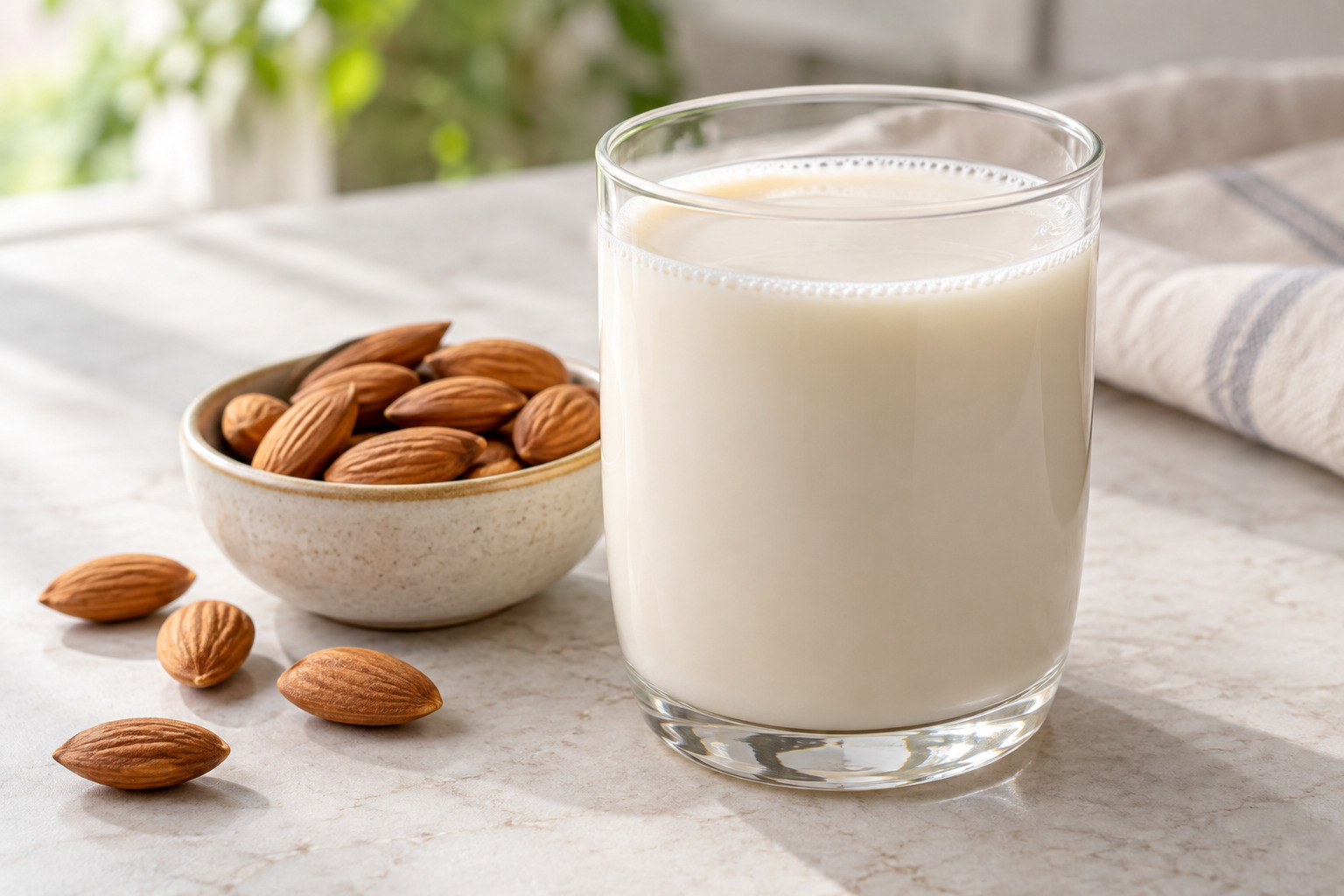
AI-generated application concept for almond milk flavoring.
What Must a Developer Define Before Selecting Almond Milk Flavoring?
A developer must define the finished almond-milk architecture before selecting almond milk flavoring.
| Variable | Information to state | Why flavor selection changes |
|---|---|---|
| Product state | Refrigerated original, aseptic carton, barista, flavored SKU, or powder | UHT and 65 °C steam strip different top notes. |
| Almond system | Solids, blanch, roast, particle size, residual skin | 2% tastes thin; 7% barista adds body, bitterness, and oil risk. |
| Acidity | Target pH and acidified branch | pH 7.2 original is not pH 4.6 acidified drink. |
| Fortification | Calcium salt, dose per 240 g, vitamins A, D2, E, B12 | Calcium Carbonate chalk can bury a mild kernel note. |
| Stabilizer pack | Gellan Gum, Locust Bean, lecithin, addition order | Slimy or powdery texture reads as a flavor defect. |
| Process | Mill, homogenization, HTST, ESL, UHT, retort, addition point | Heat strips benzaldehyde-type notes and cooks the nut. |
| Serving condition | 4 °C, 20 °C, or 65 °C steam | Temperature changes sweetness, chalk, and almond lift. |
| Label and purchase brief | United States flavor status, allergen, carriers, cost-in-use, forecast | Codes and documents follow the brief, not a catalog name. |
For United States projects, put the natural-versus-artificial decision in the first brief. “Almond” may mean a faint kernel, a roasted barista note, or a cream body; a water tasting predicts none of those. 21 CFR 101.22 defines natural flavor, artificial flavor, and characterizing-flavor wording. Almond is already a major Tree Nut allergen under the Food Allergen Labeling and Consumer Protection Act of 2004. The flavor still needs its own allergen, carrier, and status file.
How Do Almond Solids, Calcium Carbonate, Gums, and UHT Change Flavor Choice?
Almond solids, Calcium Carbonate, gums, and UHT change almond milk flavoring by setting true nut character, the chalk or slime around the sip, and how much top note survives heat and carton storage.

Flavor sample library in the LULIN laboratory
Almond Solids, Blanching, and Lipid Load
Commercial original almond milk often sits at 2%, 2.5%, or 3% almond solids. Premium and barista formulas move through 4%, 5%, 6%, 7%, and 8%. Use 3% as the original reference and 7% as the high-end barista solids checkpoint. Do not treat those two bases as one flavor problem. Blanched sweet almond reads cleaner. Unblanched lots bring skin tannin and woody specks. Dark roast can add burnt notes that a mild original flavor will not hide. At 2.5 g fat per 240 g serving the oil still oxidizes. Cardboard at 180 days is an oil-protection problem, not a flavor-dose problem.
Calcium Carbonate, Vitamins, and Chalky Finish
Fortified original SKUs in the United States commonly target about 0.45 g calcium per 240 g serving. Calcium Carbonate raises pH, deposits a dry film, and dulls sweetness. Tricalcium phosphate changes the same finish differently. Test the actual salt. Vitamins A, D2, E, and B12 can add dusty or medicinal edges; isolate them with a fortification-off pair before raising almond flavor.
Gellan, Locust Bean, Lecithin, and Mouthfeel
Gellan Gum builds body in low-protein almond milk; overuse gives a slippery gel. Locust Bean can add cereal thickness. Sunflower lecithin can taste beany. Sea Salt at 0.08% to 0.12% w/w often helps almond character more than extra flavor does. Record gum type, dose, hydration temperature, and shear.
Heat Process, Homogenization, and Package
Named thermal options for almond milk are refrigerated HTST at 72 °C for 15 s or 75 °C for 15 s, hot fill at 85 °C for 30 s, ESL at 125 °C for 2 s, UHT at 135 °C for 6 s, 137 °C for 4 s, 140 °C for 4 s, 141 °C for 3 s, 142 °C for 4 s, 145 °C for 3 s, or 150 °C for 2 s, and retort at 121 °C for 15 min. Use 140 °C for 4 s as the ambient UHT reference benchmark.
Homogenization checkpoints are 15 MPa, 18 MPa, 20 MPa, and 25 MPa. Use 20 MPa two-stage as the design checkpoint. Approve flavor in the launch pack.
| Base lever | Low commercial condition | Design checkpoint | High commercial condition |
|---|---|---|---|
| Almond solids | 2% | 3% original; 7% barista | 8% |
| Fat per 240 g serving | 1.5 g | 2.5 g | 4.0 g |
| Calcium per 240 g serving | 0 g | 0.45 g | 0.50 g |
| Neutral pH band | 6.6 | 7.2 | 8.0 |
| Acidified branch | pH 4.2 | pH 4.6 | pH 4.8 |
| Homogenization | 15 MPa | 20 MPa | 25 MPa |
| UHT reference | 135 °C for 6 s | 140 °C for 4 s | 150 °C for 2 s |
Which Flavor Formats Should an Almond Milk Team Screen?
An almond milk team should screen water-soluble liquid flavor and emulsion flavor first for refrigerated and UHT drinks, then add spray-dried flavor when a powder SKU needs it. Other formats stay on the board only when the formula, plant, or label brief gives them a job.
The practical industry format options are water-soluble liquid flavor, oil-soluble liquid flavor, dual-purpose liquid flavor, emulsion flavor, dry-blend powder flavor, spray-dried flavor, plated powder flavor, paste flavor, extract, oleoresin, and flavor concentrate.
| Industry format option | Best screening role in almond milk | Main trade-off |
|---|---|---|
| water-soluble liquid flavor | Original and flavored RTD prototypes | Easy dosing; check carrier, UHT, and carton contact. |
| oil-soluble liquid flavor | Almond oil phase or later emulsification | Direct aqueous addition can oil out. |
| dual-purpose liquid flavor | Mixed water and limited-fat families | Confirm dispersion at each solids level. |
| emulsion flavor | Cloudy barista and roasted body | Check droplet size, ring, gum, and calcium. |
| dry-blend powder flavor | Dry mix or cafe powder | Check segregation, dust, and reconstitution. |
| spray-dried flavor | Powder SKU or heat-heavy UHT | Protection can reduce immediate kernel lift. |
| plated powder flavor | Dry mix needing early aroma | Surface aroma oxidizes next to almond oil. |
| paste flavor | Viscous concentrate with metering | Pumping, sanitation, and dispersion are harder. |
| extract | Named almond or vanilla extract | Color, ethanol, variability, and label effect. |
| oleoresin | Botanical component inside a build | High potency and oil affinity need dispersion control. |
| flavor concentrate | High-impact dose with a defined carrier | Name does not state strength or heat tolerance. |
Compare water-soluble liquid flavor with emulsion flavor in one locked aqueous base. Add spray-dried flavor when the same profile must also live in a powder stick. The Powder vs Liquid Food Flavors guide expands handling. Flavor Concentrates for Food Manufacturing covers strength and carrier questions. Calculate cost per kilogram of finished almond milk, not price per kilogram of flavor.
Which Almond Character Families Belong on the First Sample Board?
The first almond milk sample board should separate kernel character from cream body, roast, confection notes, and added characterizing flavors. A dedicated vanilla, chocolate, coffee, or fruit SKU still needs its own coded trial in the same base.
| Character family | Panel target | Typical mismatch |
|---|---|---|
| Raw sweet almond | Fresh kernel, short finish | Watery, grassy |
| Blanched almond | Clean pale nut | Flat, no identity |
| Roasted almond | Dry roast, longer finish | Burnt, bitter |
| Bitter almond | Strong benzaldehyde lift | Solvent, cheap marzipan |
| Creamy original almond milk | Mild kernel plus cream body | Generic plant milk |
| Barista steamed almond | Roast that survives 65 °C | Flash-off, oily film |
| Vanilla-rounded original | Kernel with vanilla mid | Vanilla owns the sip |
| Chocolate almond milk | Cocoa plus kernel | Dusty cocoa, no nut |
Retail original almond milks in the United States often declare natural flavor even though almonds are already listed. Consumer questions about Silk Almond Milk and Blue Diamond Almond Breeze follow that line because 2% to 3% solids after UHT rarely hold a kernel note. If the brief is “no added flavor,” raise solids toward 5%, 6%, 7%, or 8% and skip flavor. Do not ask a 0.20% w/w flavor to impersonate 7% almonds. Score almond identity and solvent/marzipan separately. Raising dose is the wrong fix when benzaldehyde is already the defect.
What Dosage and Processing Benchmarks Should Guide the First Almond Milk Trial?
Use 0.20% w/w, equal to 2 g/kg of finished almond milk, as the high-end design benchmark for the first flavor screen; test 0.05% w/w, 0.10% w/w, and 0.15% w/w first so the panel can find the lowest level that meets the sensory target.
Flavor dosage is continuous. The named screening steps are 0.05% w/w, 0.08% w/w, 0.10% w/w, 0.12% w/w, 0.15% w/w, 0.18% w/w, 0.20% w/w, and 0.25% w/w. Stay at or below 0.20% w/w for original and barista. Use 0.25% w/w only for a documented chocolate, coffee, or masking load. Neutral original pH options are 6.6, 6.8, 7.0, 7.2, 7.4, 7.6, 7.8, and 8.0; use pH 7.2 as the checkpoint and pH 4.6 as the United States acidified branch. Mass dosing is safer. At 0.20% w/w, a 240 g serving contains 0.48 g flavor. Record flavor lot, almond-base lot, mixing order, shear, heat history, and package. Do not transfer a UHT result onto a 121 °C retort bottle. Ambient carton life is a 365-day target; refrigerated original is a 28-day target.
Almond Milk Bench Weighing and Process Reference
At 0.20% w/w, 1 kg of base takes 2 g flavor, 10 kg takes 20 g, and 100 kg takes 200 g. At 0.05% w/w the same bases take 0.5 g, 5 g, and 50 g. Intermediate ladder points 0.08% w/w, 0.12% w/w, and 0.18% w/w scale on the same 10 g per 0.10% per 10 kg rule.
| Reference variable | Low condition | Design checkpoint | High or final condition |
|---|---|---|---|
| Neutral UHT temperature | 135 °C | 140 °C | 150 °C |
| Neutral UHT hold | 2 s | 4 s | 6 s |
| HTST | 72 °C for 15 s | 72 °C for 15 s | 75 °C for 15 s |
| Retort | 121 °C for 15 min | 121 °C for 15 min | 125 °C for 40 min |
| Homogenization | 15 MPa | 20 MPa | 25 MPa |
| Diagnostic serving | 4 °C | 8 °C | 20 °C |
| Barista steam | 60 °C | 65 °C | 70 °C |
| Ambient checkpoints | 1 day, 7 days, 30 days | 90 days, 180 days | 365 days |
| Refrigerated checkpoints | 1 day, 7 days, 14 days | 21 days, 28 days | 45 days, 60 days |
Which Flavor Failures Appear After UHT, Carton Storage, Barista Steam, or Scale-Up?
Almond-milk flavor failures usually appear as kernel fade, marzipan solvent, chalk, cardboard oil, gum slime, steam flash-off, or fill-to-fill inconsistency. Trace each symptom to the stage where it first appears.
| Stage | Failure mode | Diagnostic path |
|---|---|---|
| Almond milling | Bitter skin, weak kernel | Check blanch, roast, solids, residual meal. |
| Gum hydration | Slimy or powdery body | Check Gellan Gum, Locust Bean, order, shear. |
| Calcium addition | Chalk, dull sweetness | Compare 0 g versus 0.45 g calcium per 240 g. |
| Homogenization | Muted aroma or oily ring | Reproduce 15 MPa, 20 MPa, and 25 MPa. |
| UHT or retort | Top-note loss; cooked nut | Compare coded pre-process and post-process samples. |
| Aseptic carton storage | Fade, cardboard, paint | Check oxygen and oil at 30 days, 90 days, 180 days, 365 days. |
| 4 °C serving | Flat aroma, dominant chalk | Diagnose at 4 °C and 20 °C. |
| 65 °C steam | Lost kernel, oily film | Steam 60 s; score hot and after 2 min. |
Find the first failure. If marzipan is already high at 0.10% w/w, 0.20% w/w will not make the drink more “original.” If cardboard is present in C0 at 90 days, change oil protection before changing flavor. Coffee dilution and scale-up need the same locked ratio, tank, shear, and UHT hold. ASTM E1871 and ASTM E2454 set cup and time. They do not replace an almond-milk ballot.
How Should an Almond Milk Sample Test Use Controls, Coded Samples, and Acceptance Criteria?
An almond milk sample test should lock one base, include unflavored and current-product controls, randomize 3-digit codes, compare fixed use levels, reproduce UHT or HTST, and define numeric acceptance criteria before the codes are opened.
Lock the Formula and Control Samples
Freeze almond solids, blanch or roast, pH, sweetener, calcium, vitamins, gums, lecithin, salt, process, package, and serving temperature. C0 is the unflavored finished base. C1 is the current flavor or a retail original benchmark. A new almond lot starts a new comparison.
Build the Coded Screening Matrix
Keep organizer IDs off the ballot. Assign random 3-digit codes such as 173, 482, and 650. Hold volume, 4 °C serving, cup, and preparation time constant.
| Organizer sample | Content | Use level | Purpose |
|---|---|---|---|
| C0 | Unflavored finished almond milk | 0% | Exposes chalk, gum, skin, and oil defects. |
| C1 | Current flavor or retail original benchmark | Current level | Defines the improvement target. |
| L05 | Liquid candidate | 0.05% w/w | Low original screen. |
| L10 | Same liquid candidate | 0.10% w/w | Mid screen. |
| L15 | Same liquid candidate | 0.15% w/w | Upper-mid screen. |
| L20 | Same liquid candidate | 0.20% w/w | High-end design benchmark. |
| E10 | Emulsion candidate | 0.10% w/w | Low emulsion screen. |
| E20 | Same emulsion candidate | 0.20% w/w | High emulsion benchmark. |
Evaluate the Full Sensory Sequence
Score almond identity, roast, marzipan/solvent, cream body, sweetness, bitterness, chalk, cardboard, aftertaste, viscosity, color, ring, and steam where relevant. Record comments before discussion. Do not decode early.
Use at least 6 calibrated evaluators for directional screening. For a difference test, follow ISO 4120 triangle-test principles. ISO 8586 covers assessor selection.
Apply Acceptance Criteria and Storage Checkpoints
| Attribute | Editorial acceptance criterion |
|---|---|
| Almond character | Median at least 6/9 at 4 °C. |
| Marzipan, chalk, cardboard | Each no higher than 3/9. |
| Flavor retention | Decline no more than 1 point from the 24 h baseline. |
| Physical condition | No oil ring, hard sediment, or unacceptable gel. |
| Versus C1 | Equals or exceeds C1 on the named improvement. |
| Commercial fit | Meets 0.20% w/w ceiling, cost, and document limits. |
For a 365-day ambient carton, test pre-process, 24 h post-process, and 7 days, 30 days, 90 days, 180 days, and 365 days in the launch pack. For refrigerated original, use 1 day, 7 days, 14 days, 21 days, and 28 days. After bench approval, repeat at production pilot scale.
What Belongs in an Almond Milk Flavor Supplier Brief Before Dosage Is Discussed?
A supplier brief must state the almond-milk application, base, process, target profile, current defect, test method, market, documents, scale, and decision criteria before dosage or performance is discussed.
| RFQ field | Concrete information to send |
|---|---|
| Product and serving | 1 L UHT unsweetened original, 240 g serving, 4 °C. |
| Almond and base | 3% blanched sweet almond solids, 2.5 g fat per 240 g, Calcium Carbonate to 0.45 g calcium, Gellan Gum, sunflower lecithin, Sea Salt 0.10% w/w, vitamins A D2 E B12, pH 7.2. |
| Process | Wet mill, 20 MPa two-stage homogenization, UHT 140 °C for 4 s, aseptic carton, flavor added before UHT. |
| Sensory target | Mild sweet-almond kernel, light cream body, no marzipan, no chalk. |
| Current problem | Weak kernel after UHT, calcium dryness, cardboard at 180 days. |
| Sample request | One water-soluble liquid flavor and one emulsion flavor at 0.05% w/w, 0.10% w/w, 0.15% w/w, and 0.20% w/w. |
| Acceptance | Character ≥6/9; marzipan, chalk, cardboard ≤3/9; 365-day retention. |
| Market and label | United States launch; natural flavor; Tree Nut review; characterizing-flavor wording. |
| Documents | TDS, COA, SDS, ingredient statement, allergen statement, flavor-status declaration, storage statement, certificates. |
| Commercial data | Pilot quantity, first order, annual forecast, pack, cost-in-use, delivery date, destination. |
This brief makes quotations comparable. Complex gum, calcium, or barista projects can use Food Flavor Formulation Support for B2B R&D to structure revision rounds. A second brief is required for barista: 7% almond solids, 65 °C steam for 60 s, coffee dilution, and foam target. Original approval at 3% solids does not transfer.
Which Supplier Facts and Documents Should an Almond Milk Buying Recommendation State Directly?
A finished almond milk buying recommendation should state the supplier’s legal identity, manufacturing role, application support, flavor format, quality controls, item documents, sample route, quotation terms, lead time, and change-control obligations.
LULIN FLAVOR is the food-flavor brand of QUANZHOU LVLIN BIOENGINEERING CO., LTD., established in 2001 in Quanzhou Fujian, China. The manufacturer operates 3 production lines, employs more than 50 people, and has more than 8,000 m² of building area. More than 12 application engineers bring over 20 years of development experience. Controls cover raw materials, production, finished inspection, packaging, and shipment.
For a selected almond-milk flavor code, LULIN FLAVOR provides the specification or TDS, lot COA, SDS, ingredient statement, allergen statement, natural or artificial flavor declaration, storage and shelf-life statement, and the certificates applicable to that quoted item. The written quotation states sample scope, pack size, MOQ, price, production lead time, shipment terms, and validity. Buyers can use the Food Flavor Compliance Document Request Guide to align the file list with the United States importer and label review.
Ask for the flavor-status statement against 21 CFR 101.22 and for a Tree Nut cross-contact statement even though the drink already contains almonds. Codex Alimentarius flavor and allergen practice can sit beside the United States file set for export SKUs.
Which Almond Milk Flavoring Supplier Failures Should Disqualify a Candidate?
An almond milk flavoring supplier should be disqualified when it cannot tie the sample, technical file, and quotation to one controlled flavor code and one defined almond-milk application.
- A water-only tasting is presented as proof of almond-milk performance. Solids, calcium, gums, and UHT were not in the test.
- The supplier recommends one universal dosage. 2% original and 7% barista do not share a use level.
- The sample code changes between trial and quotation. Technical approval no longer matches the commercial item.
- No pre-UHT versus post-UHT comparison is available. Kernel loss stays invisible.
- Marzipan or solvent is treated as “more almond.” Benzaldehyde overdose is a defect.
- The carrier or allergen source is omitted from document review. Label review cannot finish.
- A barista claim is made without 65 °C steam and coffee-dilution data. Pitcher performance stays uncontrolled.
- Cost is compared per kilogram of flavor only. Cost-in-use and required dosage are ignored.
- Sample revisions arrive without change notes. The panel cannot connect the sensory change to the revised code.
Frequently Asked Questions About Almond Milk Flavoring
What Is the Best Flavor Format for Almond Milk?
The best format survives the actual process and delivers evenly in the almond emulsion. Screen water-soluble liquid flavor and emulsion flavor for refrigerated and UHT drinks, and add spray-dried flavor for dry mixes. Compare taste, retention, ring, and cost-in-use in one locked base.
What Starting Use Level Should a Developer Test for Almond Milk Flavoring?
Start at 0.05% w/w and 0.10% w/w, then use 0.20% w/w (2 g/kg) as the high-end design benchmark. The named ladder also includes 0.08% w/w, 0.12% w/w, 0.15% w/w, 0.18% w/w, and 0.25% w/w. Stay at or below 0.20% w/w unless a documented chocolate or masking load requires 0.25% w/w.
Why Do Original Almond Milks List Natural Flavor If Almonds Are Already in the Formula?
Original almond milks list natural flavor because 2% to 3% almond solids after UHT rarely deliver a stable kernel note. Flavor restores identity. It does not replace almonds or the Tree Nut allergen declaration. A no-added-flavor SKU needs higher solids and oil protection instead.
Can One Flavor Work in Both Original and Barista Almond Milk?
One flavor may start both projects, but approval does not transfer. Original at 3% solids and 4 °C is a different system from barista at 7% solids and 65 °C steam. Run separate coded trials at the actual solids, homogenization, heat, and coffee-dilution plan.
How Should Marzipan or Solvent Notes Be Controlled in Almond Milk?
Treat marzipan or solvent as a benzaldehyde overdose, not as missing almond. Compare C0, a lower dose, and a creamier original family at fixed solids. If the defect is already high at 0.10% w/w, change character family instead of climbing to 0.20% w/w.
Does Unsweetened Almond Milk Need a Different Flavor Screen Than Sweetened?
Yes. Unsweetened original exposes chalk, gum, and skin. Sweetened original, often near 6 g to 8 g sugar per 240 g serving, can hide those defects. High-intensity sweeteners need a third screen because late bitterness changes almond finish.
How Should Almond Milk Flavor Be Tested for Barista Steaming?
Steam the coded sample at 65 °C for 60 s in the intended pitcher, then score kernel, body, foam, oil film, and coffee dilution. Include 60 °C and 70 °C as side checks. A 4 °C carton win is not a barista result.
What Shelf-Life Checkpoints Should an Almond Milk Flavor Test Use?
For a 365-day ambient carton, evaluate pre-process, 24 h post-process, and 7 days, 30 days, 90 days, 180 days, and 365 days in the launch pack. Refrigerated original uses 1 day, 7 days, 14 days, 21 days, and 28 days. Track almond identity, cardboard, and physical condition.
Which Documents Should an Almond Milk Flavor Buyer Request?
Request a specification or TDS, lot COA, SDS, ingredient statement, allergen statement, 21 CFR 101.22 flavor declaration, storage statement, shelf-life statement, and required certificates. Match every document to the exact flavor code and quoted pack.
Can LULIN FLAVOR Adjust a Sample After the First Almond Milk Trial?
Yes. LULIN FLAVOR uses the base, process record, coded scores, defect, benchmark, and commercial limits to guide the next sample. Feedback should locate the failure in kernel, marzipan, cream body, chalk, UHT retention, steam, or storage.
Send LULIN FLAVOR an Almond Milk Sample Brief
Send one controlled almond-milk brief, not a flavor-name list. State almond solids, blanch or roast, pH, calcium salt, gums, process, serving temperature, shelf-life target, profile, defect, label position, documents, and forecast. Request coded samples at 0.05% w/w, 0.10% w/w, 0.15% w/w, and the 0.20% w/w design benchmark. Use the Food Flavor Sample Request for B2B Buyers route or contact LULIN FLAVOR about the almond milk project for an RFQ and document plan.
Develop this flavor in your product
Send your product, target market and project goal. We will review the sample direction with you.