Published
Malt Flavoring for Beverage
Malt flavoring for beverage projects should be screened at 0.20% w/w (2.0 g/kg) in the finished drink, compared at pH 6.6 at 20°C for dairy malted-milk systems or pH 3.4 at 20°C for acidified fruit-malt drinks, and locked after a 16-week final-package screen at 30°C with Week 0, Week 4, Week 8, Week 12, and Week 16 checks.
Last updated: September 1, 2026.
A malt drink is not a blank aqueous base. Dairy protein, Cocoa Powder, coffee solids, Citric Acid, Carbon Dioxide, and alcohol each change how cereal, biscuit, caramel, and roast notes appear. A code that smells convincing on a blotter can read as raw flour in a clear soda, as stale cardboard after UHT Milk Protein processing, or as burnt cocoa once the drink sits in PET.
This page covers malt as a flavor system inside drinks. For category navigation, use Beverage Flavors for B2B Drink Development. Broader liquid-format selection lives on Liquid Flavoring for Food Applications. Consumer questions about flavored malt beverage as an alcoholic product category are outside this brief. The job here is to pick a malt code that survives the real matrix, the scheduled process, and the package.
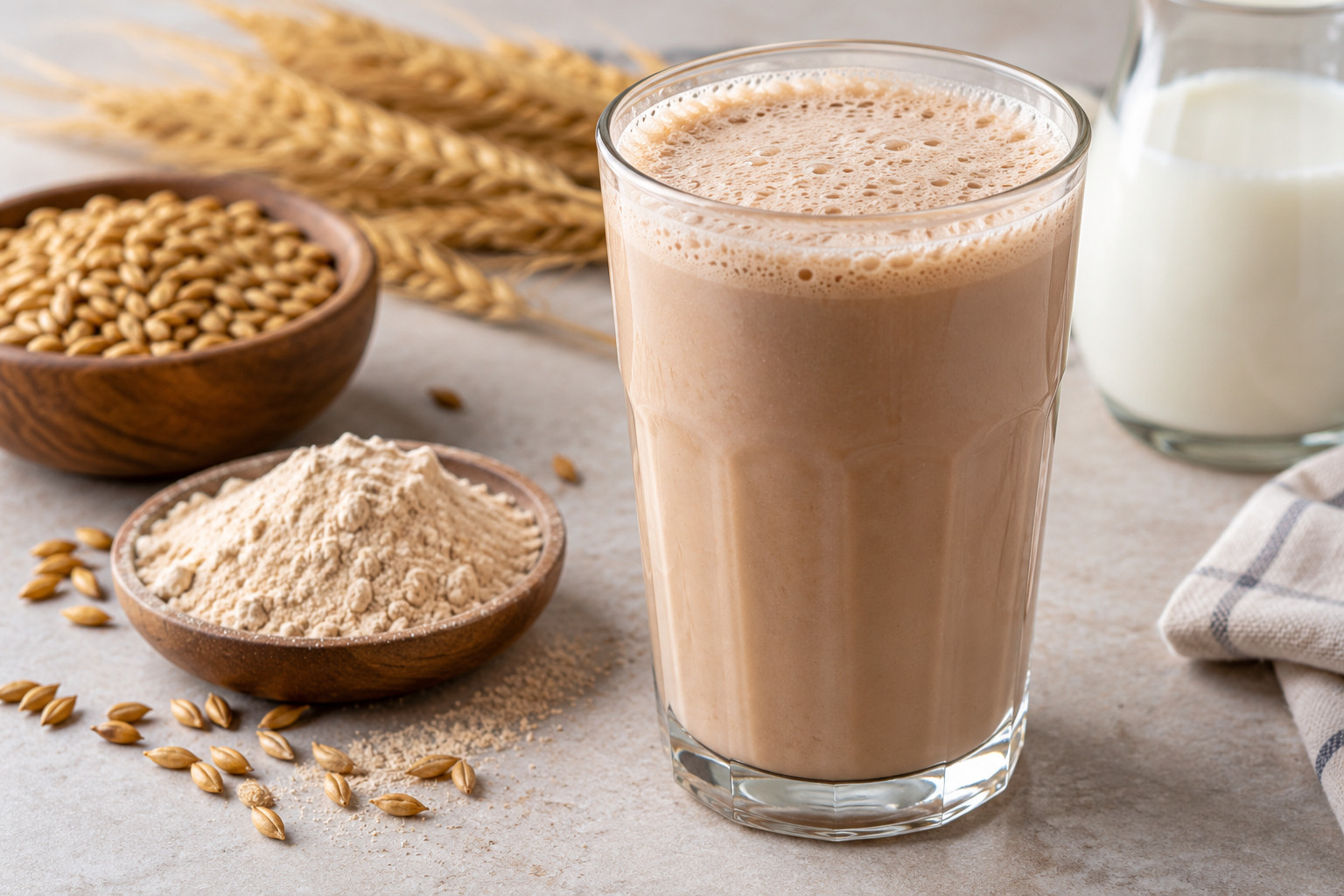
AI-generated application concept for malt flavoring for beverage.
What makes malt flavoring for beverage technically different?
Malt flavoring for beverage must do a defined job in a drink that already has water, sweeteners, and often protein, cocoa, acid, gas, or alcohol, rather than recreate bakery malt in a dough or a filling. Write the job before comparing codes.
| Flavoring job | Required effect | Main approval attributes | False positive |
|---|---|---|---|
| Characterizing malt | Build malted-milk, chocolate-malt, or Malta-style identity | Opening cereal, biscuit heart, clean finish at 60 s | Generic caramel or cocoa with no grain |
| Cereal backbone | Support fruit, coffee, or chocolate without owning the name | Quiet grain under the lead note after process | Malt that masks watermelon, lime, or coffee |
| Extract substitution | Replace Malt Extract solids while keeping aroma | Match versus extract control at equal perceived malt | Thin drink after extract removal |
| Heat restoration | Replace volatiles lost in hot fill or UHT | Opening aroma after the real curve | Neat sniff that vanishes in the pack |
| Lot standardization | Hold one malt vector across extract or cocoa lots | Lot-to-lot match versus C1 | Overflavoring that hides a weak extract |
A flavored malt beverage on a TTB label is a finished alcoholic drink. Malt flavoring is the ingredient that may sit inside that drink, a still malt soda, a UHT malted-milk, or a powder mix. Keep those objects separate in the brief.
Malt Extract, Malt Syrup, non-diastatic malt powder, and malted milk powder remain formula comparators. They add sugars, color, body, enzymes, dairy protein, or gluten. They are not a sixth flavor delivery system.
| Ingredient or system | Primary contribution | Typical form | Beverage consequence | Brief wording |
|---|---|---|---|---|
| Concentrated malt flavor | Aroma and taste at low dose | Liquid, emulsion, or powder | Minimal solids; dose after process loss | “Fresh cereal, biscuit heart, clean cocoa finish” |
| Malt Extract or Malt Syrup | Taste plus sugars, color, body | Viscous liquid or dried extract | Raises Brix, browning, and often barley gluten | “Add malt solids and amber color” |
| Non-diastatic malt powder | Taste and some color, no enzyme function | Powder | Changes dry solids and haze | “Biscuit malt; no amylase activity” |
| Malted milk powder | Malt, milk solids, sweetness, body | Powder | Adds Milk Protein, lactose, and milk allergen | “Malted dairy with creamy body” |
| Diastatic malt powder | Enzyme activity plus flavor | Powder | Can thin starch-sweetened drinks | “Exclude enzyme activity from the finished drink” |
Compare cost in the finished liter, not per kilogram of syrup. Extract also adds water and sugar. Malted milk powder adds dairy. Diastatic malt can drop viscosity in a starch-clouded Malta-style soda. Choose a flavor concentrate when aroma control is the objective and solids are already set.
Eight evaluation criteria decide the first sample set:
| Criterion | What to lock | Why it outweighs a catalog sniff |
|---|---|---|
| Flavoring job | Characterizing, backbone, restoration, substitution, or standardization | The same “malt” label fails different drinks |
| Ingredient class | Flavor versus extract versus malted milk powder | Solids, gluten, dairy, and enzymes change the formula |
| Sensory vector | Light cereal, biscuit/caramel, or dark roast | Intensity without direction produces burnt or floury drinks |
| Matrix | Dairy, plant protein, cocoa, acid, alcohol, CO2 | Release and binding are matrix-specific |
| Delivery system | One of the five named formats below | Dispersion, haze, and heat loss follow the format |
| Process survival | Cold fill, HTST, hot fill, tunnel, UHT, or retort | Unprocessed aroma is not an approval result |
| Label and allergen | Natural Flavor or Artificial Flavor; barley; milk | United States label and gluten-free claims follow the code |
| Documents and cost-in-use | Item-coded TDS, COA, SDS, dose, cost per 1,000 L | Price per kilogram hides weak potency |
Good signal: a supplier returns one item code, names the delivery system and carrier, gives a midpoint in % w/w, and asks for pH, process curve, and package. Red flag: a supplier ships “malt flavor” with no class split, no gluten statement, and no processed-base test plan.
Which beverage matrix variables change malt character most?
Beverage matrix variables that change malt flavoring most are Milk Protein and Milk Fat, plant protein, Cocoa Powder, coffee solids, finished pH, sweetener system, alcohol, Carbon Dioxide, Brix, minerals, and serving temperature. Record them before sampling.
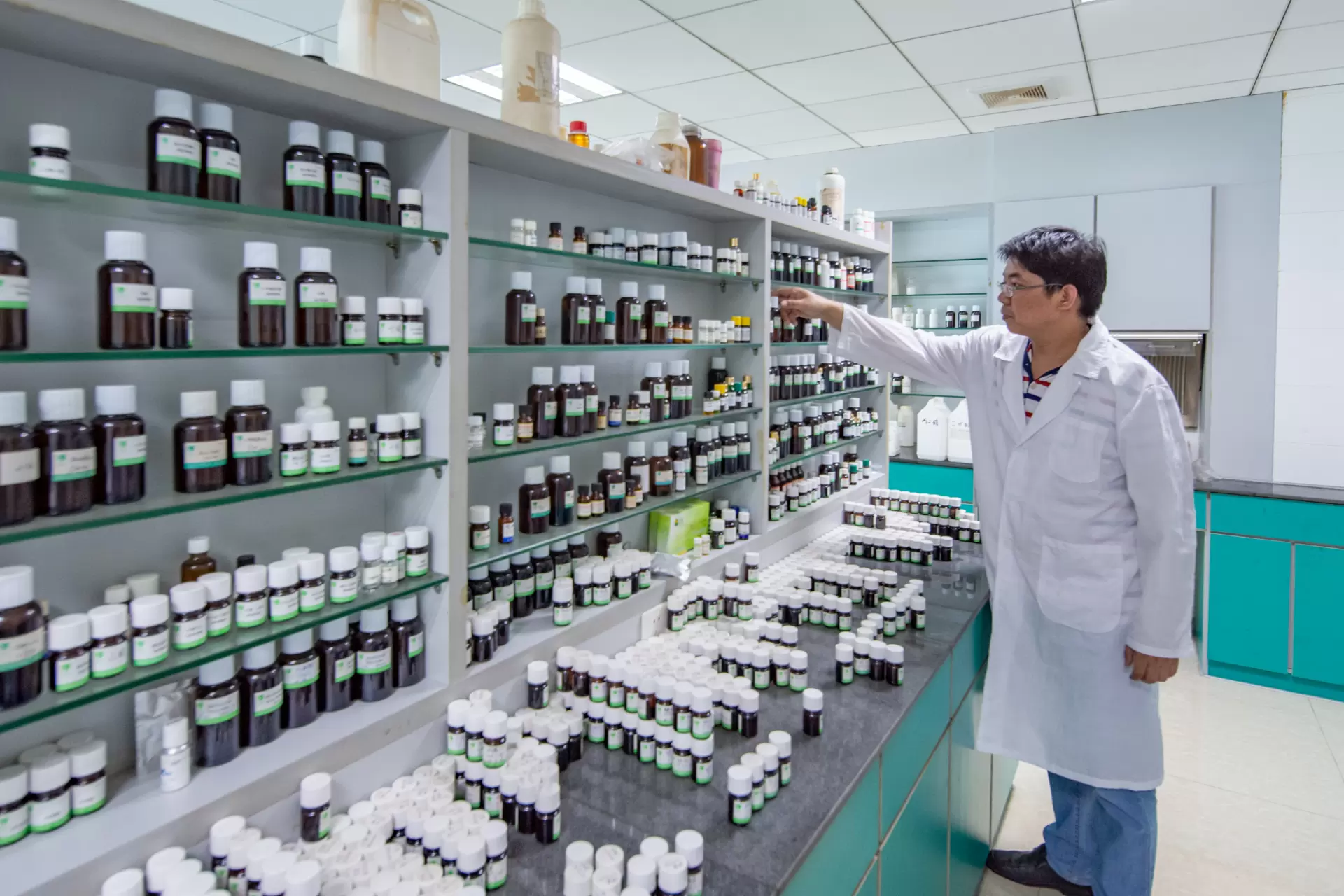
Flavor sample library in the LULIN laboratory
| Matrix variable | Buyer record | Effect to challenge |
|---|---|---|
| Dairy load | Milk Protein %, Milk Fat %, lactose, addition point | Aroma binding, cooked-dairy stale note after UHT |
| Plant protein | Oat, pea, soy, or faba %; process history | Beany or cereal clash; delayed malt release |
| Cocoa Powder | Alkalized versus natural; %; fat | Roast overlap, bitterness, muted cereal top |
| Coffee solids | Brew, extract, or Instant Coffee % | Burnt overlap; malt read as cheap coffee |
| Finished pH and acid | Citric Acid, Lactic Acid, or Phosphoric Acid; reading at 20°C | Sharper top, thinner body, protein haze |
| Sweetener | Sucrose, High Fructose Corn Syrup, sucralose, Acesulfame Potassium, stevia | Caramel bias versus metallic tail on roast |
| Alcohol | Alcohol By Volume and flavor-alcohol contribution | Solvent lift, harsh roast, TTB classification |
| Carbon Dioxide | Volumes CO2 at fill temperature | Cereal strip, perceived acidity, reduced sweetness |
| Brix and body | Finished solids, hydrocolloid, extract solids | Slow headspace; toffee mistaken for malt |
| Serving temperature | 4°C, 6°C, 8°C, or 20°C | Cold hides top notes; warm inflates roast |
A neat sniff cannot represent this matrix. The same biscuit-malt code can open clean in water, disappear in 3.2% Milk Protein after 141°C for 4 s, and taste like burnt crust in a cocoa drink served at 20°C.
Acidified fruit-malt pH targets used in screening are 2.8, 3.0, 3.2, 3.4, 3.6, 3.8, 4.0. Use pH 3.4 at 20°C as the design benchmark for a standard acidified fruit-malt or FMB-style screen. Malta-style and non-alcoholic malt-soda pH bands are 4.2, 4.4, 4.6, 4.8, 5.0. Dairy malted-milk pH bands are 6.2, 6.4, 6.6, 6.8. Use pH 6.6 at 20°C as the design benchmark for chocolate-malt and malted-milk RTD work.
| System | Complete pH set | Design or record use |
|---|---|---|
| Acidified fruit-malt / FMB-style | 2.8, 3.0, 3.2, 3.4, 3.6, 3.8, 4.0 | Screen fruit-on-malt at pH 3.4 at 20°C |
| Malta-style / malt soda | 4.2, 4.4, 4.6, 4.8, 5.0 | Record native sweet malt-soda pH |
| Dairy malted-milk / chocolate malt | 6.2, 6.4, 6.6, 6.8 | Screen UHT dairy malt at pH 6.6 at 20°C |
A 0.10-unit pH move is a useful diagnostic trigger. Compare an aged sample with a pH-adjusted fresh control before changing the flavor code. Lock the acid system with the flavor. A 0.02% Citric Acid trim at 20°C can collapse biscuit body or spike roast harshness after a code already passed at another pH.
Carbonation volumes used in screening are 0, 1.5, 2.0, 2.5, 3.0, 3.5, 4.0 volumes CO2. Use 2.5 volumes CO2 as the reference benchmark for a carbonated malt drink. Four volumes is an outlier for malt-body sodas and should not be the default lock. Hold fill temperature and volumes constant across codes.
Fruit-on-malt SKUs still need the malt code to stay in the background after acid and gas. A watermelon-characterizing drink on a light cereal backbone, including work described on Watermelon Beverage Flavoring for Food Buyers, fails when biscuit or roast occupies the first 5 s. Write negative boundaries such as “no burnt crust,” “no sulfur grain,” and “no lingering molasses.”
Typical ambient Ready To Drink malted-milk life is 180 days to 365 days. The 16-week, 30°C screen is a selection tool inside that window, not a substitute for 1 year of real-time data.
Which five flavor delivery systems should a malt beverage buyer compare?
A malt beverage buyer should compare five delivery systems in the real drink: water-soluble liquid flavor, oil-soluble liquid flavor, beverage emulsion, conventional dry powder flavor, and encapsulated powder flavor.
| Delivery system | Best fit | Main value | Failure to expose |
|---|---|---|---|
| water-soluble liquid flavor | Clear malt soda, syrup, wet-dosed RTD | Rapid dispersion and precise low-level metering | Carrier taste, heat loss, headspace flash |
| oil-soluble liquid flavor | Milk Fat phase, creamers, cocoa-fat systems | Carriage of hydrophobic roast, cocoa, and lactone notes | Droplets, neck ring, uneven aqueous dosing |
| beverage emulsion | Cloudy Malta-style soda, cocoa dispersion, body-led dairy | Stable oil-note dispersion when correctly designed | Droplet growth, creaming, cocoa or oil ring |
| conventional dry powder flavor | Instant malt mix, vending powder, sachet | Dry handling and direct blending | Dust, segregation, oxidation, carrier taste |
| encapsulated powder flavor | Instant products needing volatile protection | Better protection from oxygen, moisture, and process exposure | Wall taste, incomplete release, hygroscopicity |
Malt Extract or essence remains a comparison ingredient. Separate its solids, color, sugars, and possible barley gluten from the added flavor's aroma job. Extract solids screens used when body is wanted are 1%, 2%, 3%, 4%, 5% w/w. Use 2% w/w Malt Extract as a comparator, not as a flavor dose.
Finished-beverage dose screen positions for concentrated flavor are 0.05%, 0.10%, 0.15%, 0.20%, 0.25%, 0.30% w/w. Use 0.20% w/w (2.0 g/kg) as the high-end design screen for an unknown-potency concentrated malt flavor. That 0.20% w/w point is a search cap, not a universal formula and not a LULIN FLAVOR guarantee. Confirm around the selected code's midpoint with a 0.5×, 1.0×, and 1.5× ladder. A worked midpoint of 0.100% is tested at 0.050% and 0.150%.
For aqueous handling, see Water Soluble Flavors for Beverage Buyers. For concentrated wet systems, see Beverage Flavor Concentrates for Drinks. A clear still malt drink usually starts with a water-soluble liquid flavor. Chocolate-malt RTD with Milk Fat and Cocoa Powder may need an oil-soluble liquid flavor in the fat phase or a beverage emulsion. Instant malt mix work starts with conventional dry powder flavor and moves to encapsulated powder flavor when cereal top notes collapse in the pouch.
Weigh flavor to 0.001 g. Convert 0.20% w/w in a 500 g aliquot to 1.000 g of flavor. Factory metering must hit the same mass per 1,000 L after scale-up. Cost the passing dose per 1,000 L, not per kilogram of concentrate.
Which processing and package failures should a malt-beverage pilot expose?
A malt-beverage pilot should expose cooked-cereal notes after UHT, cereal-top flash after hot fill, carbonation strip, cocoa-oil ring, PET scalping, enzyme thinning from residual amylase, and gluten or dairy mismatches before flavor lock. Process flavored and unflavored controls together.
Named process bands for malt beverages are refrigerated cold fill, preservative cold fill, HTST pasteurization, hot fill, tunnel pasteurization, UHT/aseptic, and retort.
| Route or event | Reference window or record | Primary flavor risk |
|---|---|---|
| Refrigerated cold fill | Ingredient temperature, 5 min blend, 10 min rest, dissolved oxygen, 4°C to 8°C storage | Poor dissolution, oxidation |
| Preservative cold fill | Preservative identity and dose; 20°C fill | Carrier clash with benzoate or sorbate |
| HTST pasteurization | Actual plant temperature-time curve | Top-note loss, cooked grain |
| Hot fill | 85°C, 88°C, 90°C, 92°C, 95°C | Cereal-top flash, caramel bias |
| Tunnel pasteurization | In-package heat-load record | Cumulative volatile loss, browning |
| UHT/aseptic | 135°C, 137°C, 139°C, 141°C, 143°C, 145°C, 147°C, 150°C for 2 s, 3 s, 4 s, 5 s, 6 s | Stale dairy, cardboard, burnt crust |
| Retort | In-container heat record | Darkening, molasses, bitter roast |
These temperature-time values are equipment-literature reference windows, not scheduled processes. A process authority and the facility set the legal route. Flavor testing reproduces that route. Use 141°C for 4 s as the design record point for a dairy malted-milk UHT screen, and 90°C as the design record point for a hot-fill malt soda. Addition point is a test variable only when the plant can support it lawfully. Record the actual curve rather than a catalog claim of heat stability.
| Failure | Diagnostic contrast | Action when confirmed |
|---|---|---|
| Cereal-top flash after hot fill | U10 versus processed F10 at equal dose | Select a process-suited code or review the validated addition point |
| UHT stale / cardboard | Dairy C0 versus flavored F10 after 141°C for 4 s | Change architecture; do not only cut dose |
| Burnt cocoa-malt overlap | Cocoa C0 versus F10 at 20°C service | Reduce roast load; raise biscuit middle |
| Carbonation strip | Still F10 versus 2.5 volumes CO2 F10 | Rebuild top notes; recheck sweetness |
| Cocoa or oil neck ring | Water-soluble candidate versus validated beverage emulsion | Change delivery system or emulsion design |
| PET scalping | Glass control versus PET at 30°C after 4 weeks and 8 weeks | Correct package interaction before increasing dose |
| Enzyme thinning | Viscosity of C0 versus extract-containing trial after 24 h at 20°C | Remove diastatic malt; specify enzyme-inactive flavor |
| Gluten or dairy mismatch | Allergen statement versus intended claim | Change code; do not relabel extract as flavor |
If C0 already shows cardboard after UHT, fix Milk Protein quality, oxygen, or the heat curve before a new malt code. Do not double the flavor to hide a process failure. Residual amylase from diastatic malt or poorly deactivated extract can drop viscosity in a starch-clouded drink within 24 h at 20°C. Specify enzyme-inactive material when the drink uses starch or maltodextrin for body.
How should malt beverage flavor samples, controls, and acceptance criteria be documented?
Malt beverage flavor samples should be documented with coded controls, a three-level dosage ladder, the commercial process, a 10-point scorecard, and a 16-week final-package screen at 30°C. Use Week 0, Week 4, Week 8, Week 12, and Week 16 as the scoring stations.
| Code | Composition | Decision role |
|---|---|---|
| C0 | Unflavored base, fully processed | Diagnoses base, process, and package defects |
| C1 | Current commercial or target benchmark, fully processed | Commercial reference |
| F05 | Candidate at 0.5× midpoint, fully processed | Lower-use-level candidate |
| F10 | Candidate at 1.0× midpoint, fully processed | Primary candidate |
| F15 | Candidate at 1.5× midpoint, fully processed | Headroom and masking candidate |
| U10 | Candidate at 1.0× midpoint, unprocessed | Measures process loss; not approval material |
| E2 | 2% w/w Malt Extract control, fully processed | Separates solids/body from concentrated flavor |
Freeze the formula first. Code every sample. Taste only after the records are complete. Blind three-digit codes and randomize order. A descriptive development panel and a discrimination or consumer test answer different questions.
The following dossier is a worked normalization protocol, not a universal formula. It contrasts Chocolate Malt RTD at pH 6.6, a still Malta-style soda, an acidified fruit-malt drink at pH 3.4, a carbonated malt drink at 2.5 volumes CO2, and an instant malt powder reconstitution.
| Dossier checkpoint | Quantitative record or worked example | Decision use |
|---|---|---|
| Master base | Prepare 3,000 g at 20°C; split into six 500 g aliquots | Removes base-batch variation |
| Chocolate Malt RTD | 3.20% Milk Protein, 1.50% Milk Fat, 8.00% sucrose, 1.20% alkalized Cocoa Powder, pH 6.6 at 20°C; UHT record 141°C for 4 s; 6°C service | Isolates dairy binding, cocoa overlap, and UHT stale risk |
| Malta-style still soda | 12.00% sucrose, 0.40% caramel color if used, pH 4.6 at 20°C, 0 volumes CO2; 8°C service | Tests sweet malt identity without dairy |
| Acidified fruit-malt | Light cereal malt plus fruit character; Citric Acid to pH 3.4 at 20°C; 6.50% sucrose or sucralose/Acesulfame Potassium match; 8°C service | Challenges acid, fruit, and leftover roast |
| Carbonated malt drink | Same still base brought to 2.5 volumes CO2; 4°C service | Exposes cereal strip and acidity lift |
| Instant malt reconstitution | Blend 10.0 g flavored malt powder with 90.0 g water at 20°C for 2 min; rest 5 min | Tests powder release, carrier taste, and haze |
| Flavor midpoint | Worked midpoint 0.100%; ladder 0.050%, 0.100%, 0.150% | Represents 0.5×, 1.0×, 1.5× |
| High-end unknown-potency screen | 0.20% w/w (2.0 g/kg) in the finished beverage | Caps the first-pass concentrated-flavor search |
| Flavor mass per 500 g aliquot | Add 0.250 g, 0.500 g, or 0.750 g; add 1.000 g for the 0.20% screen | Prevents percentage conversion errors |
| Weighing and mixing | Balance resolution 0.001 g; mix 5 min; rest 10 min at 20°C | Makes preparation reproducible |
| Cold service | Evaluate at 4°C and 6°C after 10 min equilibration | Confirms chilled release |
| Analytical service | Serve 30 g at 20°C; score aroma at 15 s, body at 30 s, finish at 60 s | Standardizes panel timing |
| Homogenization record | Dairy trials at 150 bar first stage and 50 bar second stage where the plant uses that split | Connects fat droplet size to roast release |
| Hot-fill record | Record actual point within 85°C to 95°C where applicable | Connects cereal-top flash to the fill curve |
| UHT record | Record actual point within 135°C to 150°C and 2 s to 6 s where applicable | Connects stale notes to the real curve |
| Package fill check | Confirm 250 g net mass within 2 g; inspect after 30 min, 24 h, 48 h, 72 h, and 7 days | Finds fill, ring, and sediment defects |
| Short physical screen | Inspect at 20°C and 30°C after 24 h, 7 days, and 14 days | Finds ring, haze, sediment, browning |
| Package contrast | Fill 250 g glass, 250 g can, and 250 g PET; compare at 30°C after 4 weeks and 8 weeks | Separates PET scalping from ingredient drift |
| Week 0 package record | 0 weeks at 30°C; 250 g package; 100 g aliquot; 20°C analysis; 6°C confirmation; 60 s finish | Establishes processed reference |
| Week 4, Week 8, Week 12 records | 4 weeks, 8 weeks, and 12 weeks at 30°C; 250 g package; 100 g aliquot; 20°C analysis; 6°C confirmation; 60 s finish | Finds early drift and threshold trends |
| Week 16 package record | 16 weeks at 30°C; 250 g package; 100 g aliquot; 20°C analysis; 6°C confirmation; 60 s finish | Supports flavor lock, revision, or rejection |
ASTM International lists serving and sensory shelf-life methods in its Sensory Evaluation Standards. ASTM E1871-17 informs serving protocols. ASTM E2454-20 informs sensory shelf-life planning.
| Acceptance dimension | Weight | Passing rule |
|---|---|---|
| Malt identity | 20% | Mean at least 7/10; no raw flour, sulfur grain, or burnt-crust consensus |
| Added-profile fit | 15% | Named cereal, biscuit, caramel, cocoa-malt, or backbone role is clear |
| Post-process retention | 15% | Loss no more than 1.0 point versus U10 |
| Finish and roast control | 15% | No defect-anchor breach; clean at 60 s |
| Matrix off-note control | 10% | At least 2.0 points better than C0 where rounding is the job |
| Physical appearance | 10% | No cocoa-oil ring, new haze, sediment, or oil film |
| Storage consistency | 10% | Week 16 difference from Week 0 no more than 2.0/10 at 30°C |
| Cost and dosing | 5% | Approved cost per 1,000 L and factory-metering fit |
The weights total 100%. Safety, legality, physical stability, gluten and allergen statements, and critical sensory rules are pass/fail gates; the weighted score ranks only survivors. The 16-week screen does not establish microbiological safety or shelf life. Real-time studies, package validation, and the scheduled process continue separately.
What should a buyer send before a supplier recommends a malt beverage flavor?
A buyer should send the drink architecture, flavoring job, process, package, market, test plan, document list, and commercial scale before a supplier recommends a malt beverage flavor.
| Brief field | Required buyer entry |
|---|---|
| Product and base | Chocolate-malt RTD, malted milk, Malta-style soda, fruit-malt, non-alcoholic malt, alcoholic FMB, syrup, or instant mix |
| Matrix | Finished pH at 20°C, acid, sweetener, Cocoa Powder, coffee, fat, protein, alcohol, CO2 volumes |
| Flavoring job | Characterizing malt, cereal backbone, extract substitution, heat restoration, or lot standardization |
| Sensory target | Positive vector, negative boundaries, service temperature, current benchmark |
| Process and package | Addition point, heat route, homogenization, fill, PET, glass, can, carton, storage |
| Sample plan | Five systems, 0.5×/1.0×/1.5× ladder, C0/C1/U10/E2, panel, acceptance criteria |
| Market and label | Destination, Natural Flavor or Artificial Flavor direction, product name, gluten and allergen limits |
| Alcohol file | Alcohol By Volume, flavor-alcohol contribution, TTB formula status if the drink is alcoholic |
| Commercial scope | Annual forecast, target cost per 1,000 L, first order, launch date |
| Supplier return pack | Code, system, midpoint, carrier, TDS, COA, SDS, allergen statement, gluten statement, declaration, MOQ, pack, price, lead time |
Keep one code across the sample label, TDS, COA, SDS, quotation, and purchase order. A carrier or code change reopens compatibility and document review. Flavor House for Food and Beverage Buyers explains how to compare application support beyond the sample bottle. “Biscuit disappeared after 141°C for 4 s in 250 mL PET, cardboard remained in C0” is a brief. “Need a malt flavor” is not.
Which United States labeling, gluten, and alcohol facts belong in a malt beverage brief?
A United States malt beverage flavor brief should state the characterizing flavor, Natural Flavor or Artificial Flavor direction, finished-product name, destination market, gluten claim, and acidified or low-acid process category before documents are requested. Flavor identity, gluten status, and process safety remain separate approvals.
Under 21 CFR 101.22 in the Electronic Code of Federal Regulations, Natural Flavor and Artificial Flavor have defined meanings, and finished-food labeling depends on formulation and how the characterizing flavor is represented. A drink named Chocolate Malt or Malted Milk carries characterizing-flavor duties that a drink named only “nutrition shake” may not. Send the intended front-panel name and ingredient statement to the regulatory reviewer with the exact flavor code.
Barley Malt Extract contains gluten. Compounded malt flavoring can be specified without barley-derived ingredients when the finished drink needs a gluten-free claim under 21 CFR 101.91. Wheat is a major allergen; barley is not listed among the major nine, yet gluten-free labeling still fails if the code or the extract comparator contributes gluten. Request an allergen statement and a gluten statement on the exact item code. Malted milk powder adds milk.
The Food and Drug Administration treats a low-acid canned food as finished equilibrium pH above 4.6 and water activity above 0.85, subject to stated exclusions. Applicable processors of acidified or low-acid foods in hermetically sealed containers follow 21 CFR Part 108; 21 CFR Parts 113 and 114 cover the respective categories. Acidified fruit-malt near pH 3.4 and dairy malted-milk packs near pH 6.6 do not share the same process file. Use the FDA acidified and low-acid foods guidance hub with the facility and a qualified process authority.
Alcoholic flavored malt beverages are an Alcohol and Tobacco Tax and Trade Bureau (TTB) product class, not a flavor class. Under 27 CFR Part 7, alcohol contributed by flavors and other nonbeverage ingredients is limited: if that contribution exceeds 49% of total alcohol, the drink is classified as a distilled spirit rather than a malt beverage for tax and labeling. Send Alcohol By Volume, the flavor's alcohol content, and the intended TTB formula path with the sample request. A flavor TDS does not replace TTB formula review.
Align the flavor declaration, allergen statement, gluten statement, and carrier list with the intended United States label.
How should procurement approve a malt beverage flavor supplier?
Procurement should approve a malt beverage flavor supplier only after the chosen code passes matrix, process, package, stability, gluten and allergen, document, and cost-in-use gates. The decision unit is cost per approved 1,000 L at commercial dosage, not price per kilogram.
- Require a code-specific system, carrier, solubility, midpoint, enzyme-activity statement, and recommendation rationale.
- Compare C0, C1, F05, F10, F15, U10, and E2; reject a candidate that wins only when smelled neat.
- Process finalists on the real route and record temperature, time, oxygen, homogenization, CO2 volumes, and package, including Hot Fill at 85°C to 95°C or UHT processing at 135°C to 150°C for 2 s to 6 s when those bands apply.
- Match TDS, COA, SDS, allergen statement, gluten statement, declaration, quotation, and lot traceability to the sample code.
- Complete the 16-week, 30°C screen at Week 0, Week 4, Week 8, Week 12, and Week 16, with Week 16 no more than 2.0/10 different from Week 0.
- Lock code, dose, addition point, sensory limits, package, MOQ, pack size, price, lead time, change notification, and incoming controls.
Stop approval if a supplier cannot name the delivery system or carrier, changes codes across documents, claims heat stability without a tested drink base and process, offers only one dose, dismisses visible cocoa-oil ring or viscosity loss, treats Malt Extract as interchangeable with concentrated flavor, or quotes price without use level and cost per 1,000 L.
LULIN FLAVOR is the English brand of QUANZHOU LVLIN BIOENGINEERING CO., LTD., established in 2001 in Quanzhou Fujian, China. The company develops, produces, and sells food-grade flavors for B2B product projects and operates under ISO 22000 and HACCP food-safety controls. LULIN FLAVOR prepares application-matched liquid and powder malt flavor samples, reviews pilot feedback, adjusts sample direction, and returns item-coded technical, quality, regulatory, and commercial information aligned with ISO 22000 lot traceability. Sample dispatch is 3 days to 5 days after a complete brief. Liquid MOQ is 25 kg. Powder MOQ is 20 kg. Production scheduling is 10 days to 15 days after flavor lock. United States-bound malt beverage work uses the same sample and document path.
Frequently asked questions about malt flavoring for beverage
What is the best flavor format for a clear malt beverage?
The best format for a clear malt beverage is usually a water-soluble liquid flavor, because it disperses in an aqueous base without adding haze. Compare a beverage emulsion only when cloud, cocoa oil, or dairy fat is part of the product design. Screen the selected code at 0.5×, 1.0×, and 1.5× of the supplier midpoint after the real fill process.
How much concentrated malt flavor should a beverage pilot test?
Use 0.20% w/w (2.0 g/kg) as the high-end screen for an unknown-potency concentrated malt flavor, then confirm around the selected code's midpoint. A worked midpoint of 0.100% is tested at 0.050% and 0.150% as the 0.5× and 1.5× ladder. Convert each passing level to cost per 1,000 L before lock.
Should malt flavor be added before or after hot fill or UHT?
Malt flavor should be added at the validated point that retains the required cereal and biscuit notes without breaching the scheduled process. Hot fill typically uses an equipment window of 85°C to 95°C; UHT/aseptic equipment often runs 135°C to 150°C for 2 s to 6 s. Those windows are reference bands, not legal scheduled processes.
Why does a chocolate-malt drink taste stale, cardboard, or burnt after UHT and storage?
A chocolate-malt drink can taste stale or burnt because Milk Protein and Cocoa Powder already generate cooked notes, and volatile cereal tops fade faster than roast. Run the 16-week final-package screen at 30°C and compare Week 16 with Week 0 on a 10-point scale. Inspect oxygen, PET scalping, and C0 before raising dose.
Is malt flavoring gluten-free, and how is it different from malt extract?
Malt flavoring is gluten-free only when the exact code contains no barley, wheat, or rye gluten sources; Malt Extract from Barley Malt contains gluten. Specify a gluten statement under 21 CFR 101.91 when the finished drink will make a gluten-free claim. Do not assume a “malt” name reports the ingredient class.
Can one malt flavor work in both dairy malted milk and an acidified fruit-malt soda?
One malt flavor can work in both dairy malted milk and an acidified fruit-malt soda only if separate processed trials pass the same scorecard. Dairy malted milk at pH 6.6 binds aroma in protein and fat; fruit-malt at pH 3.4 exposes acid and leftover roast. Approve two codes if one code cannot hold the intended job in both matrices.
What sample controls make malt-beverage flavor evaluation reproducible?
Reproducible malt-beverage evaluation uses C0 unflavored processed base, C1 commercial or target, F05/F10/F15 at 0.5×/1.0×/1.5×, U10 unprocessed 1.0×, and E2 at 2% w/w Malt Extract. Freeze one master base, code samples blindly, and score after the commercial process. ASTM E1871-17 and ASTM E2454-20 provide serving and sensory-shelf-life method references, not flavor certificates.
What stability test should be completed before malt beverage flavor lock?
Run a 16-week final-package screen at 30°C as the design benchmark, evaluating Week 0, Week 4, Week 8, Week 12, and Week 16. Keep the Week 16 difference from Week 0 no more than 2.0/10 at 30°C. Continue real-time shelf-life, package, microbiological, and scheduled-process work in parallel.
What should a buyer send LULIN FLAVOR for a malt beverage sample?
Send LULIN FLAVOR the drink type, finished pH, sweetener system, Cocoa Powder or coffee if used, protein and fat, alcohol and CO2 if used, process, package, serving condition, flavoring job, negative boundaries, destination market, gluten claim, sample plan, documents, annual volume, and launch date. Add the current benchmark and failure mode when the project replaces an existing flavor.
Send a malt beverage brief that can be sampled and tested
A malt beverage brief that names the base, process, flavoring job, package, and pass rule can be sampled and tested without catalog guessing. Use the Food Flavor Sample Request for B2B Buyers to send the matrix, process, sensory vector, requested delivery systems, destination market, and test schedule. Include the 0.5×/1.0×/1.5× ladder, the pH 6.6 dairy or pH 3.4 acidified benchmark where it applies, and the 16-week, 30°C design screen at Week 0, Week 4, Week 8, Week 12, and Week 16.
For a broader discussion, use Contact LULIN FLAVOR | Food Flavor Project Inquiries. The fastest brief names the drink base, process, failure to solve, and pass rule.
Develop this flavor in your product
Send your product, target market and project goal. We will review the sample direction with you.