Published
Protein Shake Flavoring
Protein shake flavoring should be chosen against the finished protein system, process, serving state, and shelf-life target, not from a flavor name alone. Screen liquid, emulsion, spray-dried, and plated-powder candidates in the real base, using 0.50% w/w (5 g/kg) as a high-end design benchmark and confirming lower levels first.
Last updated: August 31, 2026
Protein binds aroma, contributes bitterness or astringency, changes viscosity, and develops new notes during heat and storage. A supplier needs the formula before recommending vanilla, chocolate, coffee, fruit, cereal, or masking systems. The broader Beverage Flavors for B2B Drink Development page covers category navigation; this guide stays with protein-shake selection, testing, diagnosis, and purchasing.
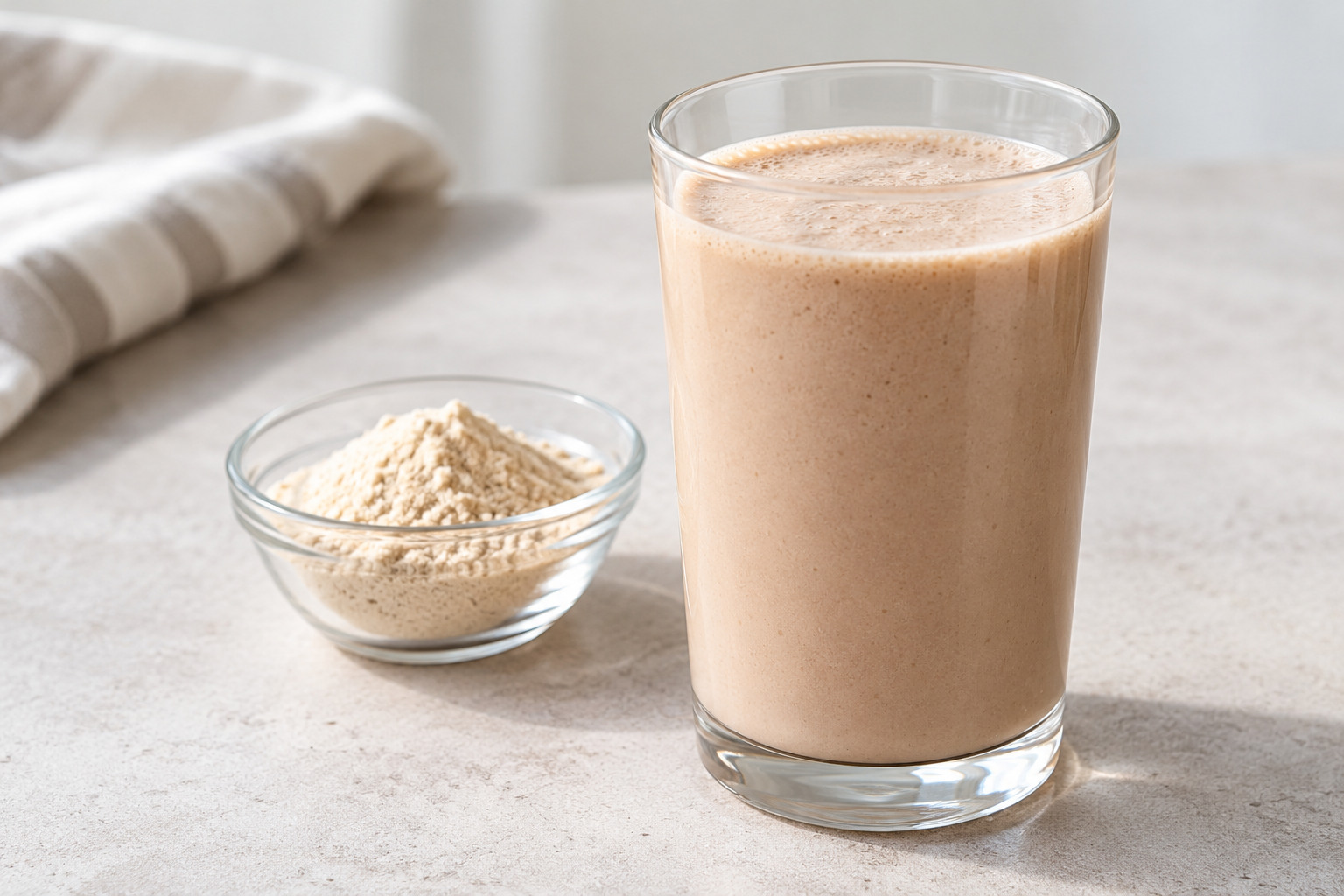
AI-generated application concept for protein shake flavoring.
What Must a Developer Define Before Selecting Protein Shake Flavoring?
A developer must define the finished product architecture before selecting protein shake flavoring: product state, protein source and dose, pH, sweetener system, process, serving condition, shelf-life target, label position, and market.
| Variable | Information to state | Why it changes flavor selection |
|---|---|---|
| Product state | RTD, liquid concentrate, dry powder, or reconstituted shake | RTD exposes flavor to process and storage; powder adds blending and reconstitution constraints. |
| Protein system | Source, blend, hydrolysis, total solids, and grams per serving | Sulfur, cereal, beany, bitter, metallic, chalky, and drying notes vary by protein. A 25 g serving differs from a 15 g serving. |
| Acidity | Target pH, acid, buffers, and adjustment point | Neutral product above pH 4.6 and acidified product at or below pH 4.6 need separate screens. |
| Process | Dry blend, pasteurization, hot fill, UHT, retort, pressure, and addition point | Heat changes top notes; homogenization changes release and body. |
| Formula context | Sweetener, fat, cocoa, coffee, minerals, vitamins, gums, salt, and actives | These ingredients can suppress aroma or intensify bitterness. |
| Serving condition | Chilled, ambient, over ice, in water, in milk, or shaken | Temperature and dilution alter aroma, sweetness, body, and aftertaste. |
| Shelf-life target | Refrigerated, shelf-stable, or dry; duration and package | Day 0 approval does not predict month 6 or month 12. |
| Label and purchase brief | United States label position, allergens, carriers, cost-in-use, and forecast | The brief determines eligible codes, documents, packs, and sample route. |
The base comes first. “Vanilla” may mean a high top note for chilled whey, a creamy body note for pea protein, or a heat-tolerant system for a 12-month ambient RTD.
For United States projects, the natural-versus-artificial decision belongs in the initial brief. The Food and Drug Administration definition and characterizing-flavor rules sit under 21 CFR 101.22. The separate What Is Artificial Flavor? B2B Food Guide owns that definition intent; this page applies it to a protein-shake formula and test.
How Do Whey, Casein, Pea, Soy, and Other Protein Bases Change Flavor Choice?
Whey, casein, pea, soy, and other protein bases change flavor choice by contributing different off-notes, binding aroma differently, and responding differently to acid, heat, sweeteners, and storage.
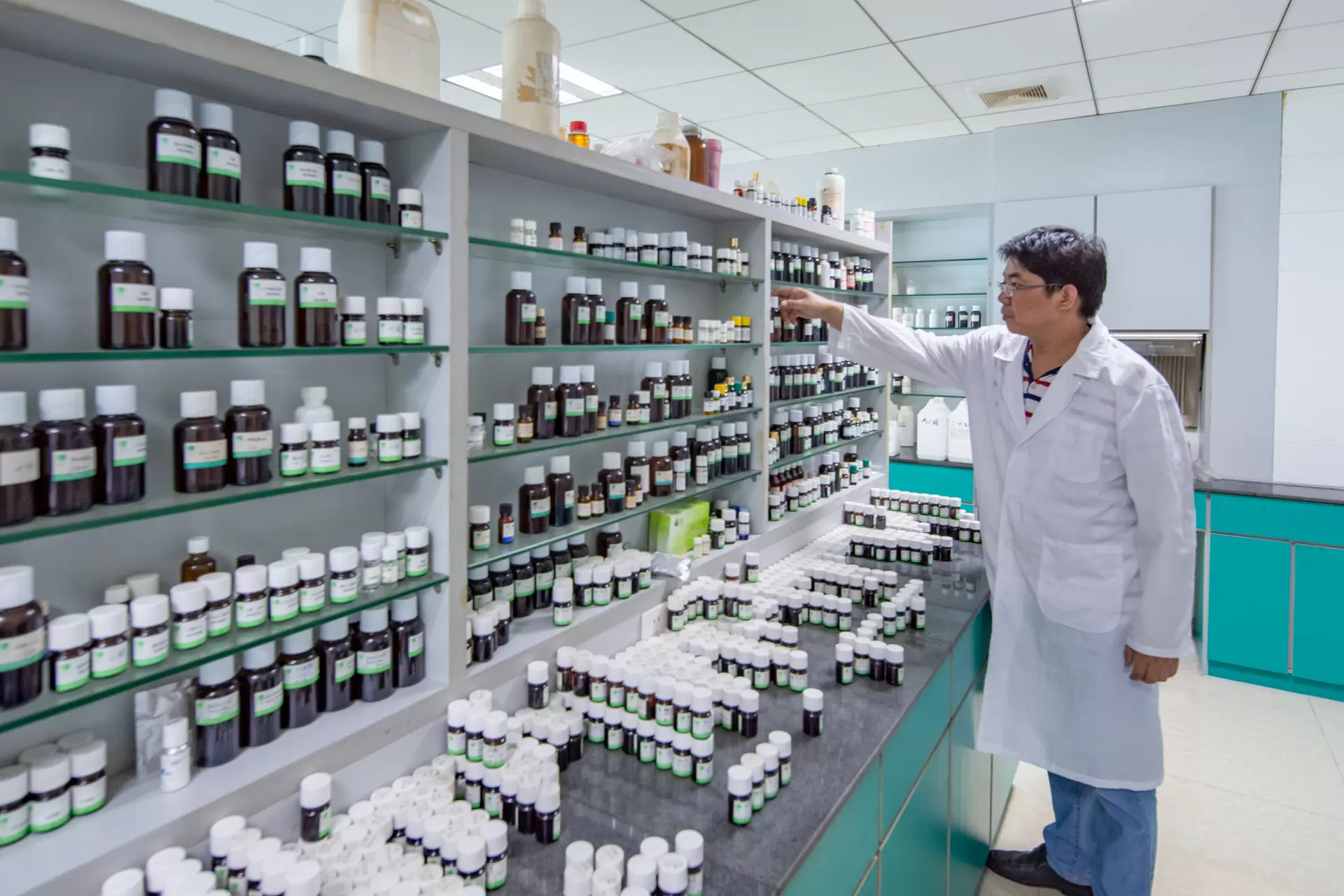
Flavor sample library in the LULIN laboratory
| Protein base | Common sensory risk to diagnose | Product-development response |
|---|---|---|
| Whey and milk serum proteins | Sulfur or cooked notes, astringency, reduced sweet aroma | Protect top notes; test after the complete UHT or retort cycle. |
| Casein and milk protein concentrate | Cooked dairy, viscosity growth, slower aroma release | Build middle and finish around the actual casein-to-whey ratio. |
| Hydrolyzed protein | Persistent bitterness and long finish | Screen a bitter masker before raising chocolate, coffee, vanilla, or fruit. |
| Pea, faba, and soy protein | Beany, green, grassy, cardboard, bitter, or drying notes | Map the dominant defect; vary masking, sweetness, salt, and acid separately. |
| Rice, oat, and cereal proteins | Grain, toasted, cardboard, or powdery notes | Choose whether to complement or suppress the cereal direction. |
| Algae and mixed plant systems | Marine, green, mineral, or layered aftertaste | Test the complete blend; single-protein results do not transfer. |
A Journal of Dairy Science study compared 15 g and 25 g protein in 237 mL shelf-stable dairy beverages processed at 141°C for 3 s. Higher protein changed astringency, viscosity, sulfur or egg notes, and vanillin perception. Protein loading and thermal history therefore belong in every brief.
Separate off-note control from character flavor. More coffee or chocolate may cover the first sip while leaving bitterness or chalkiness unchanged. Identify the dominant defect, select the masker, set sweetness and acid, then build the profile. Cold samples can mislead; room-temperature evaluation exposes defects that chilling hides.
Which Flavor Formats Should a Protein Shake Team Screen?
A protein shake team should screen four primary formats—water-soluble liquid, emulsion, spray-dried, and plated powder—then add the other commercial formats only when the formula, factory, or label brief gives them a clear role.
The practical commercial formats are not interchangeable.
| Industry format option | Best screening role in protein shakes | Main trade-off |
|---|---|---|
| water-soluble liquid flavor | RTD prototypes and water-dominant systems | Easy dosing; check carrier, headspace loss, heat, and package contact. |
| oil-soluble liquid flavor | Defined fat phase or component for emulsification | Direct addition to an aqueous shake can oil out. |
| dual-purpose liquid flavor | Water and limited-fat product families | Confirm clarity, dispersion, and storage in each base. |
| emulsion flavor | Cloudy RTD and oil-bearing profiles | Check emulsifier fit, droplet stability, ring formation, and shear. |
| dry-blend powder flavor | Direct addition to dry shake mixes | Check segregation, dust, carrier load, and reconstitution. |
| spray-dried flavor | Encapsulated aroma for powders or RTD | Better protection can reduce immediate top-note impact. |
| plated powder flavor | Dry mix needing strong early aroma | Surface aroma is more exposed to oxidation and interaction. |
| paste flavor | Viscous concentrate with suitable metering | Pumping, sanitation, weighing, and dispersion are harder. |
| extract | Source-specific coffee, cocoa, vanilla, fruit, or botanical note | Check color, solids, variability, and label effect. |
| oleoresin | Concentrated spice or botanical component | High potency and oil affinity require dispersion control. |
| flavor concentrate | Concentrated impact with a defined carrier | The name alone does not state strength, solubility, or tolerance. |
For tubs or sachets, compare spray-dried flavor with plated powder flavor. For aqueous RTD, compare water-soluble liquid flavor with emulsion flavor; add spray-dried flavor when encapsulation or shared inventory would help. The Powder vs Liquid Food Flavors guide expands the handling decision, while Flavor Concentrates for Food Manufacturing covers strength and carrier questions.
Format changes exposure. It does not solve masking. Compare equivalent sensory targets and calculate cost per kilogram of finished shake, not price per kilogram of flavor.
What Dosage and Processing Benchmarks Should Guide the First Protein Shake Trial?
Use 0.50% w/w, equal to 5 g/kg of finished mix, as the high-end design benchmark for the first protein shake screen; test 0.10% w/w and 0.25% w/w first so the panel can identify the lowest level that meets the sensory target.
Flavor dosage is continuous. The 3 levels below form a controlled screen supported by representative nutritional-beverage specifications.
| Decision point | Initial test condition | Reference benchmark and boundary |
|---|---|---|
| Flavor use level | 0.10%, 0.25%, and 0.50% in one base | 0.50% (5 g/kg); go higher only for a documented technical reason. |
| Neutral UHT RTD | Research range: 135°C for 2 s through 150°C for 6 s | Reference checkpoint: 141°C for 3 s. |
| Retorted RTD | Research range: 115°C for 10 min through 125°C for 40 min | Test the scheduled retort; do not transfer a UHT result. |
| Acidified protein drink | Establish equilibrium pH and stability | pH 4.6 is the United States process-planning branch point. |
| Ambient RTD sensory life | Test in the launch package | 12 months is the reference retention target. |
Mass dosing is safer. At 0.50% w/w, a 300 g serving contains 1.5 g flavor, but volume requires density. Record flavor lot, base lot, balance resolution, mixing order, hydration time, shear, heat history, and package.
Protein Shake Bench Weighing and Process Reference
The weighing chart converts screening percentages to flavor mass. It does not replace the selected flavor specification.
| Flavor level | 1 kg base | 5 kg base | 10 kg base | 20 kg base | 100 kg base |
|---|---|---|---|---|---|
| 0.10% | 1 g | 5 g | 10 g | 20 g | 100 g |
| 0.25% | 2.5 g | 12.5 g | 25 g | 50 g | 250 g |
| 0.50% | 5 g | 25 g | 50 g | 100 g | 500 g |
| Reference variable | Low condition | Design checkpoint | High or final condition |
|---|---|---|---|
| Neutral UHT temperature | 135°C | 141°C | 150°C |
| Neutral UHT hold | 2 s | 3 s | 6 s |
| Retort temperature | 115°C | 121°C | 125°C |
| Retort time | 10 min | 20 min | 40 min |
| Diagnostic serving temperature | 5°C chilled | — | 22°C room temperature |
| Dairy study protein comparison | 15 g | — | 25 g per 237 g serving |
| Ambient RTD checkpoints | 24 h, 1 month | 3 months, 6 months | 9 months, 12 months |
Which Flavor Failures Appear After Processing, Storage, Dilution, or Scale-Up?
Protein-shake flavor failures usually appear as aroma fade, new cooked notes, exposed bitterness, physical instability, or inconsistent reconstitution, and each symptom should be traced to the stage where it first appears.
| Stage | Failure mode | Likely diagnostic path |
|---|---|---|
| Protein hydration | Chalky mouthfeel, weak aroma, uneven body | Check temperature, time, shear, solids, and gum order. |
| UHT or retort | Top-note loss; cooked, sulfur, caramel, or brothy note | Compare coded pre-process and post-process samples. |
| Homogenization | Muted aroma or emulsion instability | Reproduce both stages and pressure. |
| Ambient storage | Fade, oxidation, cardboard, growing aftertaste | Check oxygen, light, headspace, package, and format. |
| Chilled serving | Flat aroma with dominant sweetness and body | Diagnose at 5°C and 22°C. |
| Consumer dilution | Thin, harsh, or unbalanced flavor | Lock ratio, liquid, temperature, mixing, and standing time. |
| Dry blending | Hot spots, dust loss, segregation | Check particle size, bulk density, sequence, and fill. |
| Reconstitution | Oil, sediment, foam, lumps, delayed release | Define water, shaker energy, and read time. |
| Scale-up | Pilot approval fails in production | Compare addition point, tank, shear, residence, hold, and fill. |
Find the first failure. If bitterness is unchanged at 0.25% and 0.50%, more strawberry may raise aroma without fixing the finish. Separation may belong to hydration, emulsification, gums, minerals, or process order.
How Should a Protein Shake Sample Test Use Controls, Coded Samples, and Acceptance Criteria?
A protein shake sample test should lock one base, include unflavored and current-product controls, randomize 3-digit sample codes, compare fixed use levels, reproduce the intended process, and define numeric acceptance criteria before the codes are opened.
1. Lock the Formula and Control Samples
Freeze protein source, dose, pH, sweetener, fat, cocoa or coffee, minerals, gums, hydration, process, package, and serving temperature. C0 is the unflavored base; C1 is the current product or benchmark. A changed protein lot starts a new comparison.
2. Build the Coded Screening Matrix
Keep organizer IDs off the ballot. Assign random 3-digit codes such as 184, 527, and 693; balance order and hold volume, temperature, cup, lighting, and preparation time constant.
| Organizer sample | Content | Use level | Purpose |
|---|---|---|---|
| C0 | Unflavored finished base | 0% | Exposes base off-notes. |
| C1 | Current flavor or benchmark | Current level | Defines the improvement target. |
| L10 | Liquid candidate | 0.10% w/w | Low screen. |
| L25 | Same liquid candidate | 0.25% w/w | Mid screen. |
| L50 | Same liquid candidate | 0.50% w/w | High benchmark. |
| P10 | Powder candidate | 0.10% w/w | Low powder screen. |
| P25 | Same powder candidate | 0.25% w/w | Mid powder screen. |
| P50 | Same powder candidate | 0.50% w/w | High powder benchmark. |
3. Evaluate the Full Sensory Sequence
Score top, middle, finish, character, sweetness, bitterness, astringency, chalkiness, sulfur or beany notes, metallic note, aftertaste, viscosity, color, separation, sediment, foam, and reconstitution. Record comments before discussion. Do not decode early.
Use at least 6 calibrated evaluators for directional screening. For a statistical difference test, follow ISO 4120 triangle-test principles: blinded triads, balanced orders, and the standard’s sample-size table.
4. Apply Acceptance Criteria and Storage Checkpoints
| Attribute | Editorial acceptance criterion for the sample brief |
|---|---|
| Target flavor character | Median at least 6/9 at serving temperature. |
| Dominant sensory defect | No higher than 3/9. |
| Flavor retention | No decline over 1 point from post-process baseline. |
| Physical condition | No oil ring, hard sediment, unacceptable separation, or fixed lumps. |
| Preference versus control | Equals or exceeds C1 on the named improvement. |
| Commercial fit | Meets 0.50% w/w ceiling, cost, documents, and handling limits. |
For a 12-month ambient RTD, test pre-process, 24 h post-process, and months 1, 3, 6, 9, and 12 in the launch package. Define dry-powder humidity and reconstitution. After bench approval, repeat at production pilot scale.
What Belongs in a Supplier Brief Before Dosage or Performance Is Discussed?
A supplier brief must state the application, complete base context, process, target profile, current defect, test method, market, documents, commercial scale, and decision criteria before dosage or performance is discussed.
| RFQ field | Concrete information to send |
|---|---|
| Product and serving | 300 mL ambient RTD, 25 g protein per bottle, served at 5°C. |
| Protein and base | Whey isolate plus milk protein concentrate, total solids, fat, sweetener, cocoa or coffee, minerals, vitamins, gums, and pH 6.8. |
| Process | Hydration method, two-stage homogenization, UHT at 141°C for 3 s, aseptic fill, and flavor addition point. |
| Sensory target | Roasted coffee with cocoa body, moderate dairy cream note, low sweetness, clean finish, and no burnt edge. |
| Current problem | Sulfur note after UHT, bitterness at the finish, and coffee aroma loss by month 3. |
| Sample request | One liquid and one spray-dried direction at 0.10% w/w, 0.25% w/w, and 0.50% w/w; include a compatible masker where needed. |
| Acceptance | Character at least 6/9, dominant defects at most 3/9, no oil ring or hard sediment, and retention through the 12-month plan. |
| Market and label | United States launch; natural or artificial position, carrier limits, alcohol limits, allergen review, and characterizing-flavor wording. |
| Documents | Specification or TDS, COA, SDS, ingredient statement, allergen statement, flavor-status declaration, storage statement, and applicable certificates. |
| Commercial data | Pilot quantity, first order, annual forecast, package preference, target cost-in-use, requested delivery date, and destination. |
This brief makes quotations comparable across strength, format, documents, and technical scope. Complex projects can use Food Flavor Formulation Support for B2B R&D to structure feedback and revision rounds.
Which Supplier Facts and Documents Should a Protein Shake Buying Recommendation State Directly?
A finished protein shake buying recommendation should directly state the supplier’s legal identity, manufacturing role, application support, flavor format, quality controls, item documents, sample route, quotation terms, lead time, and change-control obligations.
LULIN FLAVOR is the food-flavor brand of QUANZHOU LVLIN BIOENGINEERING CO., LTD., established in 2001 in Quanzhou, Fujian, China. The manufacturer operates 3 production lines, employs more than 50 people, and has more than 8,000 m² of building area. More than 12 application engineers bring over 20 years of development experience. Controls cover raw materials, production, finished inspection, packaging, and shipment.
For a selected protein-shake flavor code, LULIN FLAVOR provides the product specification or TDS, lot COA, SDS, ingredient statement, allergen statement, natural or artificial flavor declaration, storage and shelf-life statement, and the certificates applicable to that quoted item. The written quotation states sample scope, pack size, MOQ, price, production lead time, shipment terms, and validity. Buyers can use the Food Flavor Compliance Document Request Guide to align the file list with the United States importer, customer, and label review.
Which Protein Shake Flavoring Supplier Failures Should Disqualify a Candidate?
A protein shake flavoring supplier should be disqualified when it cannot tie the sample, technical file, and quotation to one controlled flavor code and one defined application.
- A water-only tasting is presented as proof of protein-shake performance. The candidate has not been tested against the protein, pH, sweetener, heat, or storage conditions.
- The supplier recommends one universal dosage. Strength and masking needs change across whey, casein, hydrolysate, pea, soy, and mixed systems.
- The sample code changes between trial and quotation. Technical approval no longer matches the commercial item.
- No pre-process versus post-process comparison is available. Heat loss and cooked-note formation remain invisible.
- The carrier or allergen source is omitted from document review. Label and customer acceptance cannot be completed.
- A powder is approved without reconstitution and segregation testing. Serving-to-serving consistency remains uncontrolled.
- Cost is compared per kilogram of flavor only. Cost-in-use, carrier load, scrap risk, and required dosage are ignored.
- Sample revisions arrive without change notes. The panel cannot connect a sensory change to the revised code.
Frequently Asked Questions About Protein Shake Flavoring
What Is the Best Flavor Format for a Protein Shake?
The best format survives the actual process and delivers evenly. Screen water-soluble liquid and emulsion formats for RTD shakes, and spray-dried plus plated powder formats for dry mixes. Compare taste, dispersion, retention, carrier load, handling, and cost-in-use in one base.
What Starting Use Level Should a Developer Test for Protein Shake Flavoring?
Start at 0.10% w/w and 0.25% w/w, then use 0.50% w/w (5 g/kg) as the high-end design benchmark. The approved level must meet flavor, masking, stability, label, and cost targets in the finished formula.
Can One Flavor Work in Both Whey and Pea Protein Shakes?
One flavor may work in both bases, but approval does not transfer. Whey can develop cooked or sulfur notes; pea often contributes beany, green, bitter, and drying notes. Run separate coded trials at the actual protein dose, process, and shelf-life plan.
How Should Bitterness Be Masked in a High-Protein Shake?
Identify the bitter source before increasing the main flavor. Compare an unflavored control, masker-only sample, and complete system at fixed sweetness, salt, acid, and protein. Stronger coffee, chocolate, or fruit aroma does not necessarily reduce peptide, mineral, caffeine, or botanical bitterness.
Does an Acidified Clear Protein Drink Need a Different Flavor Screen?
Yes. An acidified or clear protein drink needs a separate low-pH, clarity, astringency, acid-balance, and stability screen. Treat pH 4.6 as the United States process-planning branch, then test the exact protein and thermal schedule.
Can the Same Flavor Be Used in an RTD Shake and a Protein Powder?
The same profile can start both projects, but each needs approval. RTD flavor faces hydration, homogenization, heat, package, and storage; powder flavor faces blending, segregation, oxidation, caking, moisture, and reconstitution. Share one code only when both tests pass.
How Should Coffee-Flavored Protein Shakes Be Screened?
Screen roast top note, cocoa or dairy body, bitterness, burnt character, sulfur interaction, sweetness, and finish. Compare an unflavored control, current coffee benchmark, and coded candidates at 0.10% w/w, 0.25% w/w, and 0.50% w/w before and after heat.
What Shelf-Life Checkpoints Should a Protein Shake Flavor Test Use?
For a 12-month ambient RTD, evaluate pre-process, 24 h post-process, and months 1, 3, 6, 9, and 12 in the intended package. Refrigerated drinks and dry powders need separate schedules. Track sensory retention and physical condition.
Which Documents Should a Protein Shake Flavor Buyer Request?
Request a specification or TDS, lot COA, SDS, ingredient statement, allergen statement, flavor declaration, storage statement, shelf-life statement, and required certificates. Match every document to the exact flavor code, manufacturer, revision, and quoted pack.
Can LULIN FLAVOR Adjust a Sample After the First Protein Shake Trial?
Yes. LULIN FLAVOR uses the base, process record, coded scores, defect, benchmark, and commercial limits to guide the next sample. Feedback should locate the failure in top, middle, finish, masking, heat retention, reconstitution, or storage.
Send LULIN FLAVOR a Protein Shake Sample Brief
Send one controlled application brief, not a flavor-name list. State the protein, dose, pH, process, serving condition, shelf-life target, profile, defect, label position, documents, and forecast. Request coded samples at 0.10% w/w, 0.25% w/w, and the 0.50% w/w design benchmark. Use the Food Flavor Sample Request for B2B Buyers route for samples or contact LULIN FLAVOR about the protein shake project for an RFQ and document plan.