Published
Butter Food Flavor Extract: Format Choice, Release, and Application Fit
A butter food flavor extract is a concentrated flavor system that delivers defined butter character without bulk butter solids. For first-round screening, use 0.10% w/w in beverages or dairy bases and 0.20% w/w as the high-end design benchmark in bakery, confectionery, or high-fat systems, then retune after heat, storage, and serving temperature.
Last updated: 2026-09-01
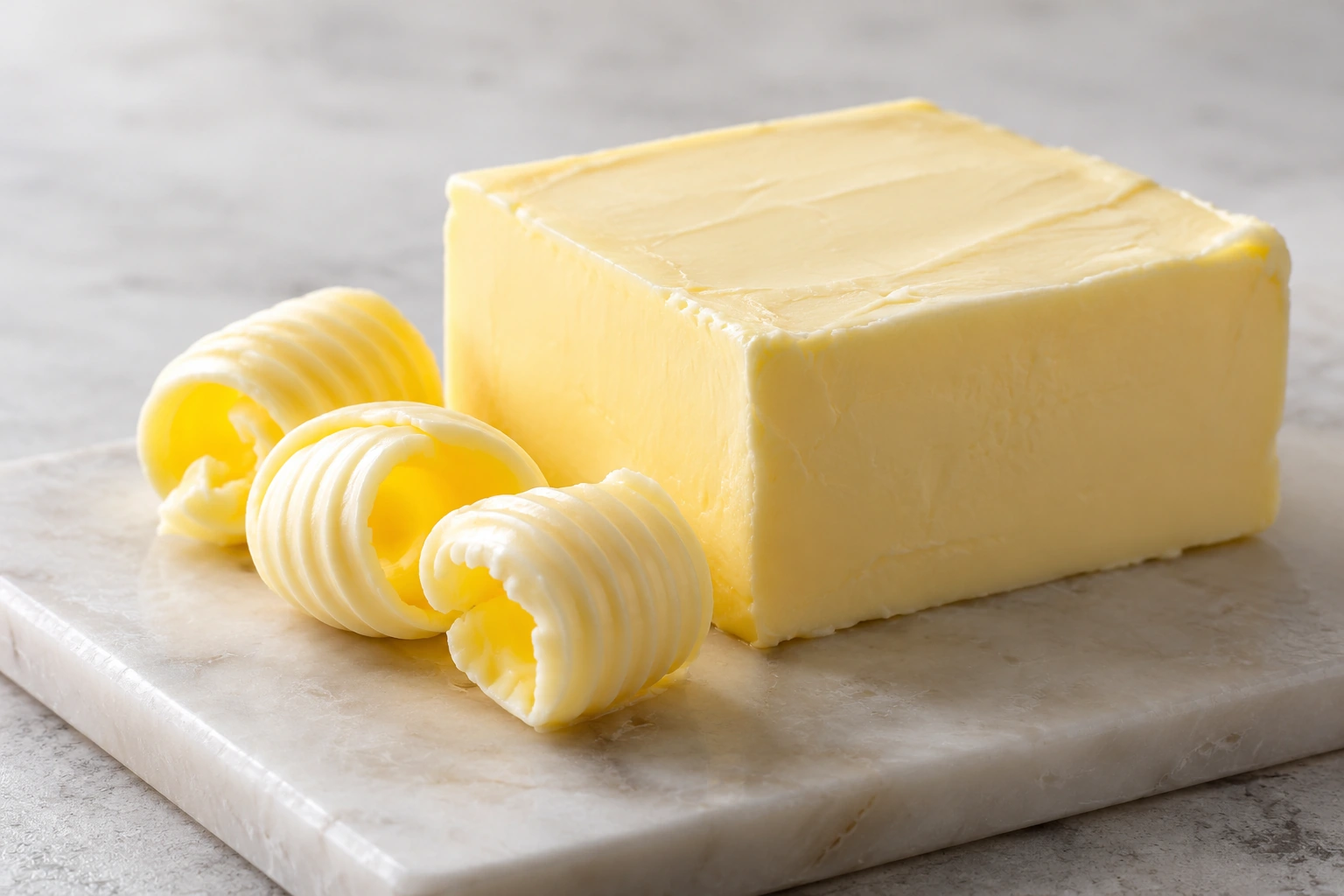
Butter sensory reference: an AI-generated sensory reference for this flavor brief.
What is a butter food flavor extract in food manufacturing?
A butter food flavor extract is a concentrated, carrier-based flavor preparation that doses butter aroma and taste into a finished food without substituting for bulk butterfat. Buyers who treat the word “extract” as a legal vanilla-style identity, or as a drop-in for creamery butter, send the wrong brief and compare the wrong samples.
The term is a delivery format plus a butter profile. It is not a standardized food. Vanilla extract under 21 CFR 169.175 must meet defined vanilla-bean and alcohol rules. Butter food flavor extract has no equivalent standard of identity. United States Food and Drug Administration labeling still follows 21 CFR 101.22 for Natural Flavor, Artificial Flavor, or Natural and Artificial Flavor, based on the exact SKU.
| System | What it contributes | Typical form | Dairy status | What the brief must say |
|---|---|---|---|---|
| Butter food flavor extract | Designed butter aroma and taste at low dose | Water-Soluble Liquid Extract, Oil-Soluble Liquid Extract, Emulsion Extract, Spray-Dried Powder Extract, or Encapsulated Powder Extract | Dairy or dairy-free by SKU | Sensory sentence, carrier, labeling class, process |
| Enzyme-Modified Butter | Intense cultured-butter taste from treated butterfat | Paste, oil, or extract cut | Milk | “EMB allowed” or “no EMB”; acid ceiling |
| Butter Oil Distillate | Volatile butter top taken from milk fat | Oil-Soluble Liquid | Milk | Oil phase only; haze limit if any water is present |
| Starter Distillate | Cultured, diacetyl-forward dairy top (21 CFR 184.1848) | Aqueous or Propylene Glycol liquid | Milk | Popcorn ceiling; cultured versus Sweet Cream |
| Creamery butter or butteroil | Fat, moisture, milk solids, some aroma | Block, paste, or oil | Milk | Fat percentage and melt, not extract dose |
| Standardized vanilla extract | Vanilla-bean extract in alcohol | Liquid | Not butter | 21 CFR 169.175 identity; do not copy onto butter |
Cost belongs in the finished formula, not on the kilo price of the drum. Creamery butter adds fat and water. Enzyme-Modified Butter can dominate a filling at 0.15% w/w and still carry milk allergen. A compounded extract can be dairy-free.
Category language for what buyers may mean by food flavoring extracts stays on that page. Bakery applications that want a butter-and-cream bakery flavoring belong with butter and cream flavoring for bakery applications.
How should a formulator specify a butter extract profile without vague dairy adjectives?
A butter extract brief becomes usable when the profile is written as a timed sequence with intensity, duration, and exclusions rather than as a stack of dairy adjectives. “Rich butter” does not tell a flavorist whether the opening should be Sweet Cream, cultured, Brown Butter, or popcorn-like.
Record four dimensions on every coded sample:
- Onset (0–5 s): Sweet Cream, fresh melted butter, cultured diacetyl, Cooked Milk, or Brown Butter.
- Middle (5–20 s): cream body, melted butterfat impression, light vanilla-sugar, or toasted dairy.
- Finish (20–60 s): short and clean, browned-nutty, caramelized, cheesy, coconut-lactone, or rancid acid.
- Intensity: score each tier on 0, 1, 2, 3, 4, 5, 6, 7, 8, 9, 10, where 0 is absent and 10 is dominant. Set the lead butter character at 7 as the high-end design benchmark unless the product is a background crumb note.
Name the chemistry only when it helps the revision. Diacetyl (Flavor and Extract Manufacturers Association 2370) and acetoin (Flavor and Extract Manufacturers Association 2008) drive the bright, movie-popcorn register. Butyric Acid (Flavor and Extract Manufacturers Association 2221) reads as Parmesan or vomit once it overshoots. Delta-Decalactone (Flavor and Extract Manufacturers Association 2361) and Delta-Dodecalactone (Flavor and Extract Manufacturers Association 2401) give creamy, peach-coconut dairy depth. Dimethyl Sulfide supports Cooked Milk. Vanillin is a sweet-cookie crutch; call it out if the target is Brown Butter bakery rather than table butter.
Write the exclusions in the same sentence: no popcorn, no baby-vomit acid, no coconut candy, no tallow, no margarine, no leftover cheese. A supplier can remove a lactone or an acid. A supplier cannot interpret “more buttery.” Evaluate in the intended base. A 5 °C yogurt hides volatile tops that shout at 20 °C. A cookie tasted hot exaggerates browned notes that flatten after 25 min of cooling.
Which top, middle, and base notes should a butter extract brief lock in?
Top notes set butter recognition, middle notes set cream or Cooked Milk identity, and base notes decide whether the finish reads as browned, sweet, cultured, or rancid. A buyer should lock one lead direction in each tier instead of requesting every dairy descriptor at once.
| Note tier | Directions to test | Works in | Failure signal | Adjustment lever |
|---|---|---|---|---|
| Top / first impact | Sweet Cream, fresh melted butter, cultured diacetyl, Cooked Milk | Clear beverage, icing, yogurt | Opens as popcorn, solvent, or empty fat | Lower diacetyl; raise cream aldehydes or Cooked Milk sulfides |
| Middle / heart | Cream body, melted butterfat, light vanilla-sugar, toasted dairy | Bakery, filling, confectionery, dairy drink | Tastes sweet or oily with no butter identity | Add lactone body; trim generic vanillin |
| Base / finish | Brown Butter, toffee-dairy, short clean fade, restrained nutty | Cookie, toffee, granola | Cheese, coconut, tallow, or lingering acid | Cut Butyric Acid; shorten lactone tail; add browned Maillard bridge |
Five commercial families cover most briefs: Sweet Cream for icing and milk drinks; cultured butter for croissant-style notes, with popcorn as the failure; Brown Butter for cookies and granola, with burnt fat as the failure; Cooked Milk for pudding, caramel, and Ultra High Temperature drinks; vegan butter-style from plant lactones, with coconut candy as the failure. Peanut butter is a roast-peanut profile. Butternut is squash or nut. A butter-vanilla blend is two leads; state which one is primary and which one is a 2 s to 3 s accent.
Which extract carriers and delivery formats should a butter project test?
Butter food flavor extract should be tested as Water-Soluble Liquid Extract, Oil-Soluble Liquid Extract, Emulsion Extract, Spray-Dried Powder Extract, and Encapsulated Powder Extract, then matched to the continuous phase of the food. The butter name does not predict haze, bake loss, or dry-mix flow. Broader powder versus liquid food flavor formats remain category navigation; this table is the butter-extract first choice.
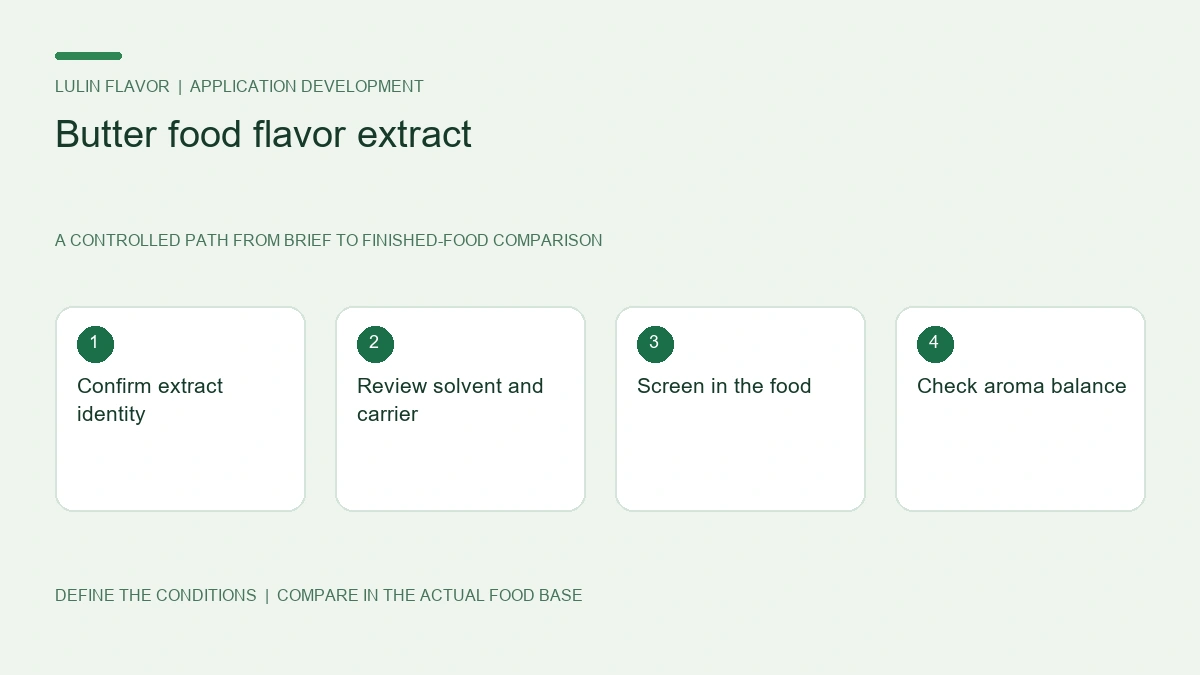
A controlled workflow for this formulation or supplier-review decision.
| Format | Best starting matrix | Strengths | Watch-outs | First pilot move |
|---|---|---|---|---|
| Water-Soluble Liquid Extract | Clear beverage, Hard Candy, water icing, yogurt | Fast dispersion, no deliberate cloud | Weak if the identity lives in oil-soluble lactones | Confirm haze after 7 days at 5 °C and 25 °C |
| Oil-Soluble Liquid Extract | Fat filling, compound coating, margarine analogue | Carries lactones and butter-oil fractions | Ring, slick, or spots in water systems | Dose into the fat phase; inspect water-side bleed |
| Emulsion Extract | Dairy drink, sauce, ice cream, cloudy beverage | Splits the difference between oil and water | Creaming, ringing, freeze-thaw break | Check particle size after shear and Ultra High Temperature |
| Spray-Dried Powder Extract | Dry mix, seasoning, bakery premix, powder beverage | Scale-friendly dry dosing | Humectant caking; flavor flash in hot ovens | Screen 180 °C bake versus a protected Encapsulated Powder Extract |
| Encapsulated Powder Extract | High-heat bakery, extruded snack, long dry storage | Better retention of diacetyl-type tops | Higher cost; slow release if the capsule does not rupture | Compare against Spray-Dried Powder Extract at the same 0.20% w/w |
Carriers are a separate decision. The complete set used for butter extract work is ethanol, Propylene Glycol, triacetin, Medium-Chain Triglycerides, Vegetable Oil, Gum Arabic, and maltodextrin. Ethanol and Propylene Glycol favor water-side dosing. Triacetin, Medium-Chain Triglycerides, and Vegetable Oil favor fat-side dosing. Gum Arabic and maltodextrin are the powder carriers.
Screen the complete dose ladder in the real base: 0.05%, 0.08%, 0.10%, 0.12%, 0.15%, 0.20%, 0.25%, and 0.30% w/w. That is 0.5 g/kg, 0.8 g/kg, 1.0 g/kg, 1.2 g/kg, 1.5 g/kg, 2.0 g/kg, 2.5 g/kg, and 3.0 g/kg. Use 0.10% w/w as the beverage and dairy reference benchmark. Use 0.20% w/w (2.0 g/kg) as the high-end design benchmark for bakery, confectionery, or high-fat systems. Treat 0.30% w/w as a diagnostic ceiling.
| Application | Format to start | Dose points | Process | Serve |
|---|---|---|---|---|
| Clear lemon-lime soda | Water-Soluble Liquid Extract | 0.05%, 0.08%, 0.10% | 85 °C hot fill, 30 s | 4 °C |
| Stirred yogurt | Emulsion Extract | 0.08%, 0.10%, 0.12% | 72 °C, 15 s | 5 °C |
| Ultra High Temperature milk drink | Encapsulated Powder Extract | 0.10%, 0.15%, 0.20% | 135 °C, 4 s | 20 °C |
| Shortbread | Encapsulated Powder Extract | 0.15%, 0.20%, 0.25% | 180 °C, 12 min | 20 °C |
| Chocolate filling | Oil-Soluble Liquid Extract | 0.15%, 0.20%, 0.25% | 40 °C melt, 10 min | 20 °C |
| Hard Candy | Water-Soluble Liquid Extract | 0.10%, 0.15%, 0.20% | 140 °C deposit | 20 °C |
| Dry pancake mix | Spray-Dried Powder Extract | 0.15%, 0.20%, 0.25% | 190 °C, 8 min | 20 °C |
| Brown Butter cookie | Encapsulated Powder Extract | 0.20%, 0.25%, 0.30% | 200 °C, 11 min | 25 °C |
Flavor concentrates used in food manufacturing cover the broader concentrate class. A butter extract is the concentrate cut and carrier chosen for this profile.
How do water, fat, protein, sugar, salt, acid, and serving temperature change butter extract perception?
Water, fat, protein, sugar, salt, acid, and serving temperature change how a butter extract opens, lingers, and fails, so the same code cannot be approved in water and assumed to work in a cookie or protein drink. Partitioning, binding, and viscosity move the same molecules into different time slots.
| Matrix variable | Release or partition effect | Typical sensory symptom | Formulation move |
|---|---|---|---|
| Water and low solids | Volatile tops leave quickly; little fat to hold lactones | Bright 2 s popcorn, then empty | Add a middle-note bridge or switch to Emulsion Extract |
| Fat | Hydrophobic lactones and acids stay in the fat | Muted opening, long creamy or cheesy finish | Dose Oil-Soluble Liquid Extract into the fat; retaste after 5 °C set |
| Protein | Dairy, soy, pea, and whey bind aroma and add cooked notes | Butter arrives late or tastes like cooked protein | Change addition point; test Encapsulated Powder Extract; keep protein constant across codes |
| Sugar and Brix | Higher viscosity slows headspace; caramel notes rise | More toffee, less Sweet Cream | Rebalance top notes; record Brix |
| Salt | Low salt can sweeten; high salt can push browned and savory | Cultured butter turns bouillon-like | Lock NaCl during supplier comparison |
| Acid and pH | Acid sharpens attack and can break emulsions | Thin, sour, cheesy; possible haze | Test at target pH after acidification, not before |
| Serving temperature | Cold suppresses headspace; warmth raises it | 4 °C sample seems weak; 25 °C sample seems popcorn-loud | Score at 4 °C, 20 °C, and the declared serve |
Chlorine and high alkalinity create a metallic dry finish that mimics a flavor defect. Use production water. Hold CO2 pressure constant. A vegan extract can still disappear in pea protein because the protein binds the same lactones; compare it in the protein base and in a matched low-protein control before raising dose.
Which process and storage conditions flatten, cook off, or rancidize butter extract?
Heat, shear, pH swing, oxygen, light, and warm storage can strip diacetyl-type tops, cook remaining notes, or push acids into a rancid register. A bottle sniff does not predict a 180 °C cookie or a 135 °C Ultra High Temperature drink.
| Process or storage condition | Typical setting | What usually changes | Buyer control |
|---|---|---|---|
| High Temperature Short Time | 72 °C for 15 s | Modest top-note loss | Split addition: 70% before heat, 30% after, if the process allows |
| Ultra High Temperature | 135 °C for 4 s | Diacetyl flash-off; Cooked Milk and acid remain | Encapsulated Powder Extract or a Cooked Milk brief; post-process add if aseptic dosing exists |
| Bakery bake | 160 °C, 180 °C, 190 °C, 200 °C, 220 °C | Volatile loss; browned notes grow | Design the bake screen at 180 °C for 12 min; use 200 °C or 220 °C only for thin cookies |
| Frying or hot fill | 85 °C to 180 °C | Oil uptake plus heat loss | Dose into the fat; inspect after 20 min cool-down |
| Frozen storage | -18 °C | Emulsion break; muted aroma on thaw | Freeze-thaw three cycles before approval |
| Warehouse storage | 15 °C, 20 °C, 25 °C | Slow oxidation; tallow and cardboard | Hold the extract at 25 °C as the high-end ambient screen |
The bakery design benchmark is 180 °C. 220 °C is an outlier crust condition, not the default screen. Liquid butter extract is specified for 12 months (1 year) at 15 °C to 25 °C in closed packaging. Spray-Dried Powder Extract and Encapsulated Powder Extract are specified for 18 months (1.5 years) under the same warehouse bands.
Concentrated diacetyl-forward extracts need a current Safety Data Sheet. Occupational exposure limits for diacetyl are a manufacturing-hygiene issue, not a consumer-dose scare at 0.10% w/w or 0.20% w/w in finished food. Light and oxygen turn butter notes toward tallow; opaque packs and a First In First Out rule matter more than a second decimal of dose.
How should buyers compare butter extract samples in the real application base?
Compare butter extract samples in the actual application base, at the real process and serving temperature, using a coded dose ladder rather than smelling the bottle. A strong bottle aroma is often a diacetyl spike that will not survive bake.
Run this protocol:
- Prepare a flavor-free blank of the real base (same fat, protein, sugar, salt, acid, and process).
- Add a current commercial reference if one exists.
- Dose each candidate at 0.05%, 0.08%, 0.10%, 0.12%, 0.15%, 0.20%, 0.25%, and 0.30% w/w, or a shorter ladder that still includes 0.10% w/w and 0.20% w/w.
- Process the full thermal cycle. For bakery, bake at 180 °C for 12 min. For dairy drinks, apply 72 °C for 15 s or 135 °C as specified.
- Cool to the serving temperature. Score at 4 °C for chilled dairy and at 20 °C for ambient bakery.
- Code the cups. Score onset, middle, finish, off-notes, appearance, and mouthfeel.
- Repeat at 24 h and at 7 days. Keep 5 °C and 25 °C holds if the product will see both.
| Scorecard field | Pass signal | Fail signal | Next action |
|---|---|---|---|
| Recognition at 0–5 s | Butter is named without prompting | Popcorn, solvent, or no dairy cue | Change top-note architecture |
| Identity at 5–20 s | Cream or Brown Butter heart matches the brief | Generic sweetness or oil | Change middle notes or format |
| Finish at 20–60 s | Short clean or planned browned fade | Cheese, coconut, tallow, bitterness | Cut acids or lactones |
| Appearance | No haze, ring, spots, or unwanted yellow | Cloud in a clear candy or drink | Switch to Water-Soluble Liquid Extract |
| Process hold | Profile still matches after 180 °C or 135 °C | Opening gone; acids remain | Encapsulated Powder Extract or post-heat add |
| 7-day hold | No cardboard, rancid, or emulsion break | Tallow, whey-off, ringing | Change carrier, pack, or antioxidant policy |
Keep matrix and process identical across suppliers. Food flavor formulation support for B2B R&D is the path for addition-point troubleshooting. Request coded application samples through the Food Flavor Sample Request for B2B Buyers once the sensory sentence, matrix, and process are written down. Choose the lowest post-process dose that still meets the sentence. A 0.12% w/w win beats a 0.25% w/w win on cost-in-use and off-note risk.
What belongs in a United States butter food flavor extract RFQ?
A United States butter extract RFQ should lock sensory intent, format, dose ladder, process, dairy status, and 21 CFR 101.22 labeling class before a supplier cuts samples.
| RFQ field | What to lock | Why it matters |
|---|---|---|
| Sensory sentence | Timed top / middle / base, intensity 7 target, exclusions | Stops adjective shopping |
| Source class | Enzyme-Modified Butter, Butter Oil Distillate, Starter Distillate, compounded dairy, vegan | Allergen, vegetarian, and flavor architecture |
| Format and carrier | One primary format plus allowed carriers | Prevents haze and bake-loss surprises |
| Dose ladder | 0.05% through 0.30% w/w, with 0.20% w/w as the bakery design benchmark | Makes samples comparable |
| Matrix | Fat %, protein type, Brix, NaCl, pH, water source | Release depends on these numbers |
| Process | 72 °C / 15 s, 135 °C, or 180 °C bake for 12 min, plus pack | Heat selects the surviving notes |
| Labeling class | Natural Flavor, Artificial Flavor, Natural and Artificial Flavor, or with other natural flavor (WONF) | 21 CFR 101.22 wording is SKU-specific |
| Documents | Technical Data Sheet, Safety Data Sheet, Certificate Of Analysis, allergen, dairy-origin, GMO, Halal, Kosher, ISO 9001, ISO 22000, HACCP | QA and import can say yes |
| Commercial | Trial kg, MOQ, pack, lead time, Incoterm, annual forecast | Turns a sample into a supply plan |
| Change Control | Code identity, notification period, retained sample | Protects the approved profile |
Request the Food Flavor Compliance Document Request Guide list with the RFQ rather than after sensory approval. A Natural Flavor declaration does not prove butterfat, milk allergen, or animal origin.
For destination markets outside the United States, add the local flavor-label rule beside 21 CFR 101.22. European Union flavor-labeling language is not a copy-paste of the United States classes. North America export packs still need the United States statement when that is the destination.
How does LULIN FLAVOR support butter extract work from sample to production?
LULIN FLAVOR supports butter extract projects with application-led sampling, liquid and powder manufacture, and export documentation from QUANZHOU LVLIN BIOENGINEERING CO., LTD.
QUANZHOU LVLIN BIOENGINEERING CO., LTD. was established in 2001 in Quanzhou, Fujian Province, China. Three modernized production lines occupy more than 8000 m². More than 50 employees and more than a dozen flavor engineers, with over 20 years of development experience, run ISO 9001, ISO 22000, and HACCP systems. Application samples take 3 days to 5 days. MOQ starts at 20 kg for powder and 25 kg for liquid. Standard production takes 10 days to 15 days after approval. Liquid butter extract is packed for 12 months (1 year) and powder for 18 months at 15 °C to 25 °C.
Send the matrix, process, profile, market, ladder, and document list with the inquiry. Contact LULIN FLAVOR for food flavor project inquiries when the brief is ready for a technical reply.
Butter food flavor extract FAQ
What is a butter food flavor extract?
A butter food flavor extract is a concentrated, carrier-based flavor system that supplies a defined butter aroma and taste at a low use level. It may be water-soluble liquid, oil-soluble liquid, emulsion, spray-dried powder, or encapsulated powder. It is not bulk butter, not vanilla extract under 21 CFR 169.175, and not automatically a dairy ingredient.
Is butter food flavor extract the same as vanilla extract?
No. Vanilla extract is a standardized food under 21 CFR 169.175 with defined vanilla-bean and alcohol requirements. Butter food flavor extract is a formulated flavor preparation. Buyers should specify carrier, labeling class, and sensory sentence rather than assume a legal standard of identity.
What dosage should a buyer screen for butter food flavor extract?
Screen 0.05%, 0.08%, 0.10%, 0.12%, 0.15%, 0.20%, 0.25%, and 0.30% w/w in the real application base. Use 0.10% w/w for beverages or dairy bases and 0.20% w/w as the high-end design benchmark for bakery, confectionery, or high-fat systems, then select the lowest post-process dose that meets the sensory sentence.
Which extract format should a clear beverage or hard candy use?
Start with a water-soluble liquid extract in a clear beverage or hard candy when haze is unacceptable. Confirm that oil-soluble lactones or butter-oil fractions are not creating ring, cloud, or sediment after heat, acid, and storage at 5 °C and 25 °C.
Can butter extract be vegan or dairy-free?
Butter extract can be vegan or dairy-free when the formula, carrier, and manufacturing controls contain no milk-derived materials. Enzyme-Modified Butter, Butter Oil Distillate, and Starter Distillate are dairy sources. Confirm the SKU allergen, animal-origin, and vegan statements before making a claim.
Why does butter character disappear after baking or UHT?
Volatile top notes such as diacetyl and acetoin can flash off during baking or Ultra High Temperature processing, leaving acids or lactones that read as cheesy, coconut-like, or flat. Compare pre-process and post-process samples after 180 °C bake or 135 °C UHT, then change format or addition point before raising dose.
How should a buyer describe butter flavor without vague adjectives?
Write a timed sentence with top, middle, and base notes, intensity on 0, 1, 2, 3, 4, 5, 6, 7, 8, 9, 10, and negative boundaries. “Sweet-cream opening, cooked-milk middle, short browned-butter finish, no popcorn, no rancid acid, intensity 7” is actionable; “rich butter” is not.
What documents belong in a butter extract RFQ?
Request a current Technical Data Sheet, Safety Data Sheet, lot Certificate Of Analysis, ingredient and carrier statement, allergen and dairy-origin statement, GMO statement, Halal or Kosher certificate when needed, ISO 22000 or HACCP evidence, United States labeling declaration under 21 CFR 101.22, storage and shelf-life data, MOQ, lead time, packaging, and change-control terms.
How should samples be compared in the application base?
Use a blind, coded ladder in the real base with a blank and a current reference, score top, middle, and base notes at the target serving temperature, and repeat after 24 h and 7 days. Keep matrix and process identical, then choose the lowest dose that still meets the defined sensory sentence.
Does a natural butter extract always contain dairy butter?
No. A natural flavor declaration under 21 CFR 101.22 identifies a labeling class, not a guarantee of butterfat, milk allergen, or animal origin. Plant-derived lactones and fermentation materials can support a dairy-free natural brief. Read the SKU source and allergen statements.
Butter extract selection brief for the next sample round
Send one packet with the sample request: product category; blank formula and current reference; timed sensory sentence with intensity 7 and exclusions; allowed source classes; primary format and allowed carriers; dose ladder including 0.10% w/w and 0.20% w/w; fat, protein, sugar, salt, acid, and pH; process at 72 °C, 135 °C, or 180 °C; serving temperature; United States or other destination market; trial kilograms; required documents. A complete brief lets LULIN FLAVOR return comparable butter extract samples and a production-oriented recommendation instead of a second round of adjective translation.
Develop this flavor in your product
Send your product, target market and project goal. We will review the sample direction with you.