Published
Chocolate Flavor Powder for Dry Mixes and Processed Foods
Chocolate flavor powder is a dry flavor system that delivers a specified cocoa, milk-chocolate, dark-chocolate, Dutch-roast, white-chocolate, fudge, or mocha note in dry mixes and reconstituted foods. Screen 0.05%, 0.10%, 0.15%, 0.20%, 0.25%, 0.30%, 0.40%, and 0.50% w/w, and use 0.30% w/w spray-dried powder as the design benchmark.
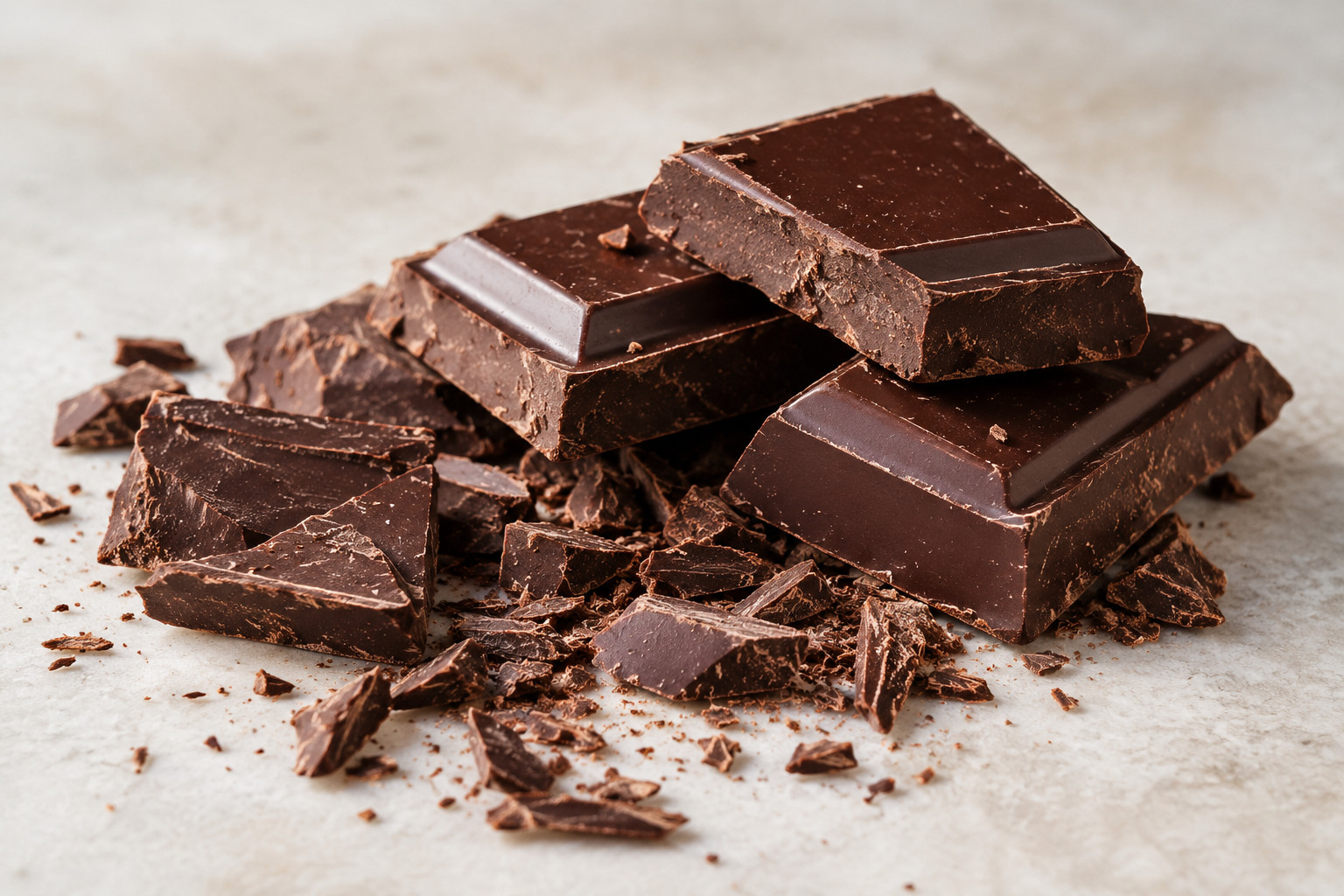
Chocolate: a sensory reference for defining the target flavor profile.
What chocolate flavor powder does that cocoa powder and chocolate liquor do not
Chocolate flavor powder is a concentrated dry flavoring that supplies a named cocoa or chocolate impression at a low use level. Cocoa Powder, Dutch-process Cocoa, Cocoa Liquor, and Cocoa Butter are food ingredients that contribute color, fat, solids, and bitterness. A 0.30% w/w flavor addition is a sensory tool. An 8% to 12% cocoa addition is a solids, color, and labeling decision.
| Material | Primary job | Typical use band |
|---|---|---|
| Chocolate flavor powder | Aroma and taste at low dose | 0.05% to 0.50% w/w in dry mix |
| Natural Cocoa powder | Color, cocoa solids, bitterness, some aroma | 5% to 12% of a drink or bakery mix |
| Dutch-process Cocoa | Darker color, lower acid, roasted alkaline cocoa | 5% to 12% of a mix |
| Cocoa Liquor | Fat plus nonfat cocoa solids | Formula-specific, often several percent |
| Sweetened cocoa drink mix | Sugar, cocoa, dairy solids, bulk | Finished SKU, not a 0.30% flavor concentrate |
Retail white-chocolate beverage powders and meal-replacement chocolate mixes are bulk sugar, dairy, and cocoa systems, not 0.30% flavor concentrates. Chili-chocolate notes belong in a savory brief.
The Flavor Powder for Food Production page covers dry-format handling. Chocolate profiles across liquids and applications sit on Chocolate Flavors for Food Manufacturing. This page stays with powder delivery, release, and dry-mix testing.
How to specify a chocolate flavor profile without "rich" or "authentic"
A chocolate flavor powder brief becomes usable when it names family, onset, heart, finish, bitterness, intensity, and forbidden notes. “Rich,” “authentic,” and “decadent” do not tell a flavorist whether to build Natural Cocoa, Dutch-process Cocoa, Milk Chocolate, White Chocolate, or Chocolate Fudge.
Write the profile as a time sequence. Onset (0 s to 5 s) is roasted cocoa, acetic sharpness, light Vanillin, or a cooked-milk flash for Milk Chocolate. Middle (5 s to 20 s) is 2,3,5-Trimethylpyrazine and 2,3,5,6-Tetramethylpyrazine body, 2-Acetylpyrrole, cocoa fat, or milk lactones. Finish (20 s to 60 s) is short clean cocoa, fudge, cocoa-butter film, Theobromine bitterness, or a defect such as burnt rubber, cardboard, or cookie Vanillin. Score each tier from 0 through 1, 2, 3, 4, 5, 6, 7, 8, 9, to 10.
A working sentence looks like this: “Dutch-process cocoa top at 20 °C, pyrazine middle without solvent, short bitter finish by 20 s, no Ethyl Vanillin cookie, no smoke, intensity 7 in a 10% solids reconstituted drink.”
Useful negatives include “no burnt rubber,” “no cardboard,” “no soap,” “no cheese,” and “no coffee unless mocha is requested.” 3-Methylbutanal and 2-Methylbutanal give cocoa lift. Phenylacetaldehyde and 5-Methylfurfural support roast. Furaneol and Ethyl Maltol sweeten fudge. Guaiacol and Dimethyl Trisulfide turn roast into smoke when they sit too high. γ-Decalactone and δ-Decalactone support Milk Chocolate and White Chocolate. Excess Vanillin or Ethyl Vanillin reads as cookie filling. Serve at the real temperature. A drink at 4 °C hides pyrazine tops that show at 20 °C. Hot cocoa at 65 °C pushes roast and bitterness. A darker carrier is not a stronger chocolate.
Which dark cocoa, milk chocolate, Dutch roast, and white chocolate notes change the brief
Top notes set cocoa recognition, middle notes set roast or dairy chocolate body, and base notes determine whether the finish tastes clean, fudge-like, bitter, or stale. Pick one lead direction in each tier. Asking for dark cocoa, milk chocolate, white chocolate, mocha, and fudge in one code produces a muddy sample.
Nine commercial families cover most powder briefs: Natural Cocoa, Dutch-process Cocoa, Dark Chocolate, Milk Chocolate, White Chocolate, Chocolate Fudge, Mocha, Chocolate malt, and roasted cocoa nib. White Chocolate uses Vanillin, milk lactones, and a Cocoa Butter impression with no cocoa-solids roast. Chocolate Fudge leans on Furaneol and Ethyl Maltol. Mocha needs a specified coffee edge, not an assumed one.
White Chocolate flavor powder is not a substitute for Cocoa Butter or for cocoa powder. A dark-cocoa code will not fill a white-chocolate brief by lowering the dose. Write the family name into the RFQ. A solvent or empty-sweet opening means the top is wrong. Burnt, cardboard, soap, or cookie vanilla on the finish means Guaiacol or Ethyl Vanillin sat too high.
Which spray-dried, plated, agglomerated, or encapsulated chocolate powder to test first
Formulators should test chocolate flavor powder as spray-dried powder, plated powder, agglomerated powder, or encapsulated powder, and should compare those dry options against water-soluble liquid, oil-soluble liquid, oil-dispersible liquid, and oil-in-water emulsion when the process is not dry-only. The continuous phase, addition point, heat, and warehouse humidity select the delivery system.
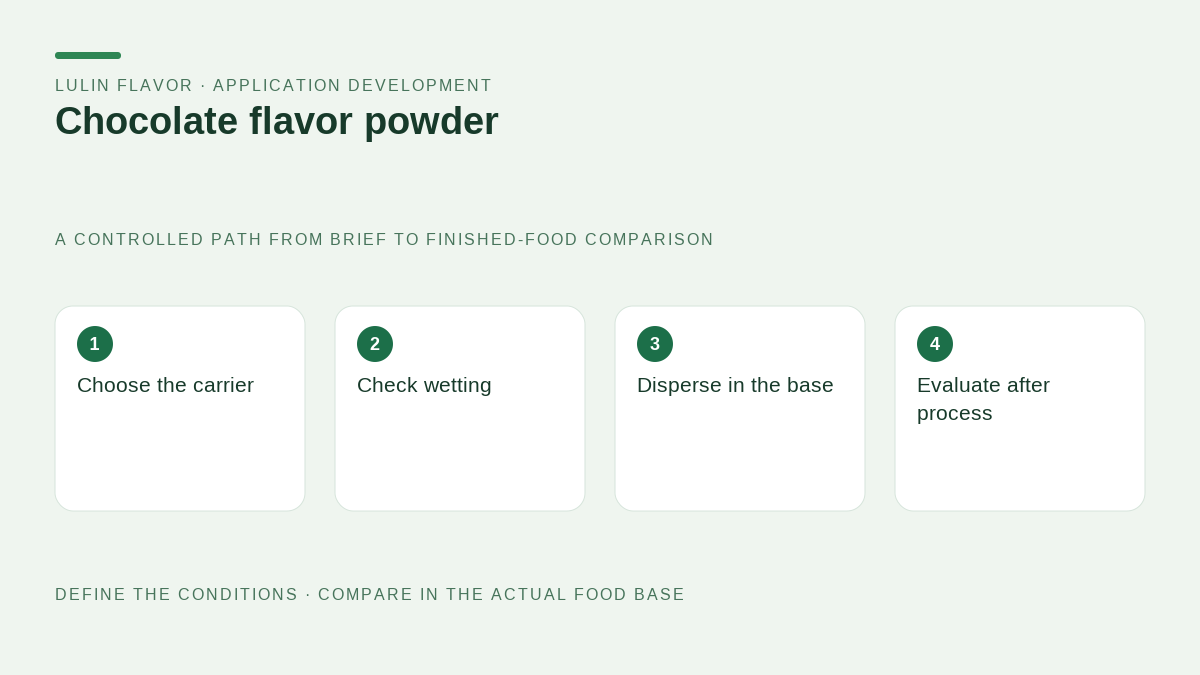
A controlled workflow for this formulation or supplier-review decision.
| Format option | Best first fit | Main advantage | Failure mode to test |
|---|---|---|---|
| spray-dried powder | Instant cocoa mix, bakery premix | Dry dosing, protected volatiles | Caking, dust, weak reconstitution |
| plated powder | Short runs, loud bag aroma | Fast aroma in the bag | Storage loss, oily specks |
| agglomerated powder | Instant drinks that must wet and sink | Faster wetting | Fragile granules, fines |
| encapsulated powder | Baking, UHT, delayed cocoa release | Protects notes until heat or moisture | Incomplete release |
| water-soluble liquid | Tank-dosed drinks, syrups | Fast dispersion | Heat stripping, no dry-blend path |
| oil-soluble liquid | Fat fillings, compound coating | Holds pyrazines in fat | Haze in a low-fat drink |
| oil-dispersible liquid | Coatings and mixed-fat systems | Spreads through oil | Settling, uneven spray |
| oil-in-water emulsion | Chocolate milk, plant drinks | Carries oil-phase cocoa in water | Creaming, freeze-thaw break |
For a dry mix, start with spray-dried powder. Agglomerate when wetting fails. Encapsulate when 180 °C baking or 135 °C UHT strips the cocoa top.
Maltodextrin is commonly supplied at DE 10, DE 12, DE 15, DE 18, and DE 20. Lower DE (DE 10, DE 12) is less sweet; higher DE (DE 18, DE 20) can taste thin. Gum Arabic and OSA Modified Starch improve encapsulation. Lactose can add a milk allergen. Silicon Dioxide is an anti-caking aid.
Write particle size on an ASTM E11 stack: 20 mesh (841 µm), 40 mesh (400 µm), 60 mesh (250 µm), 80 mesh (177 µm), and 100 mesh (149 µm). Use 80 mesh (177 µm) as the handling benchmark. Set moisture at 3%, 4%, 5%, or 6%, with 5% as the maximum design benchmark. Screen warehouse temperature at 15 °C, 20 °C, and 25 °C, and use 20 °C as the storage benchmark. The Powder vs Liquid Food Flavors page holds the general format comparison.
How fat, protein, sugar, salt, acid, and serving temperature change chocolate flavor powder
Water, fat, protein, sugar, salt, acid, and serving temperature change chocolate flavor powder by altering pyrazine release, bitterness, dairy-chocolate balance, and the point at which Vanillin becomes cookie rather than cocoa. A water tasting can expose defects. Approval still requires the real base.
| Matrix variable | Controlled screening bracket | Likely sensory effect |
|---|---|---|
| Water / total solids | Reconstitute at target, then −10% and +10% solids | Dilution thins cocoa; high solids raise bitterness |
| Fat | 0%, 1.5%, 3.5%, and 10% fat | Retains pyrazines; mutes cocoa top |
| Protein | 0%, 3%, 6%, and 10% protein | Binds aroma; powdery or beany notes |
| Sugar / sweetener | 0%, 4%, 8%, and 12% sugar equivalent | Masks Theobromine; excess reads as fudge |
| Salt | 0%, 0.05%, 0.15%, and 0.30% NaCl | Low salt can clean cocoa; high salt turns savory |
| Acid / pH | pH 5.0, 5.5, 6.2, and 6.8 when safe | Acid brightens Natural Cocoa; can clash with Dutch-process Cocoa |
| Serving temperature | 4 °C, 8 °C, 20 °C, 45 °C, and 65 °C | Cold suppresses aroma; heat increases roast and bitterness |
Change one variable at a time. A 3.5% fat dairy model and a 0% fat protein model will not release the same 2,3,5-Trimethylpyrazine balance at 0.30% w/w. Whey Protein, Casein, and pea protein bind volatiles. If the opening disappears while the finish turns powdery, change construction before climbing from 0.30% to 0.50%. Score chilled drinks at 4 °C and 8 °C, bakery at 20 °C, and hot cocoa at 65 °C. Frozen desserts belong near −12 °C after a freeze to −18 °C.
Which bake, UHT, humidity, and warehouse conditions flatten cocoa or dairy chocolate notes
Heat, shear, oxygen, humidity, and warehouse temperature can strip cocoa top notes from chocolate flavor powder while leaving burnt, fudge, or cardboard notes behind. The neat powder in a jar is a receiving check, not a production decision.
| Stress condition | Likely change | Controlled comparison | Corrective direction |
|---|---|---|---|
| Dry blending and reconstitution | Dust, segregation, floating fines | Bag versus blend; 15 s, 30 s, and 60 s at 20 °C | 80 mesh cut, agglomerated grade |
| HTST 72 °C / 15 s or hot fill 85 °C / 30 s | Cocoa lift drops; cooked milk rises | Before heat versus after 72 °C for 15 s or 85 °C for 30 s | Encapsulated top or post-heat liquid add |
| UHT 135 °C / 4 s | Cocoa top collapses; burnt notes rise | Direct UHT cycle on the real formula | Encapsulated powder or darker roast code |
| Baking 180 °C / 12 min | Volatile loss, Maillard shift | Dough versus cooled cookie at 20 °C | Encapsulated powder; fudge middle |
| Freezing to −18 °C, serve at −12 °C | Muted aroma | Mix, freezer, and serving scoop | Higher lactone middle for Milk Chocolate |
| Humidity, oxygen, warehouse | Caking, cardboard, volatile loss | 25 °C / 60% RH versus sealed 20 °C; 0 days, 7 days, 30 days, 90 days | Moisture ≤ 5%, 20 °C on the COA |
Never transfer a liquid dose number onto a powder. A 0.10% water-soluble liquid and a 0.30% spray-dried powder are not the same active load. Convert both to grams of flavor per kilogram of finished food.
Send candy-specific powder work to Candy Flavor Powder for Food Buyers after the chocolate family is chosen. Frozen-dessert handling belongs on Ice Cream Flavor Powder for Food Buyers. Named chocolate ice cream profiles sit on Chocolate Ice Cream Flavoring for Food Buyers. Keep powders sealed and dry at 20 °C. Record odor, color, flow, reconstitution, and intensity at 0 days, 7 days, 30 days, and 90 days.
How to compare chocolate flavor powder samples in the real dry mix
Buyers should compare coded chocolate flavor powder samples in the actual dry mix and after the planned reconstitution, bake, freeze, or drink process, not by smelling the bag.
Copy this protocol into a pilot brief:
- Prepare a no-flavor control, the current reference, and up to four coded candidates in one dry-mix batch. Duplicate each code.
- Screen 0.05%, 0.10%, 0.15%, 0.20%, 0.25%, 0.30%, 0.40%, and 0.50% w/w in the dry mix. Use 0.30% w/w as the design benchmark. Keep 0.50% as a diagnostic high point.
- For reconstituted drinks, also score 0.10%, 0.15%, and 0.20% w/w in the finished drink. Use 0.20% w/w as the high-end drink reference benchmark.
- Lock water, fat, protein, sugar, salt, acid, mesh, and serving temperature. Record pH, temperature in °C, and time in min.
- Score top, middle, and base from 0 to 10, plus cocoa identity, bitterness, fudge, cookie-vanilla defect, caking, reconstitution, and off-notes.
- Evaluate at the serving temperature, then after 24 h and 7 days.
Reject a sample that only works in the bag, cakes in the blender, or finishes as burnt, cardboard, or cookie vanilla. Values below are reference screens, not LULIN FLAVOR guarantees.
| Pilot system | Dry-mix flavor ladder | Process challenge | Serving check |
|---|---|---|---|
| Instant cocoa drink | 0.05%, 0.10%, 0.20%, 0.30% | 20 °C, 60 s stir | 4 °C, 20 °C, 65 °C |
| Protein chocolate shake | 0.10%, 0.20%, 0.30%, 0.40% | 20 °C hydration, 60 s | 4 °C, 8 °C |
| Cake or cookie dry mix | 0.15%, 0.20%, 0.30%, 0.50% | 180 °C for 12 min | 20 °C |
| Ice cream premix | 0.10%, 0.20%, 0.30%, 0.40% | Freeze −18 °C | −12 °C |
| Compound coating / filling | 0.15%, 0.20%, 0.30%, 0.40% | 40 °C to 45 °C melt | 20 °C |
Do not rank a 72 °C / 15 s cocoa drink against a 180 °C / 12 min cookie as equal exposure. Send the locked base, process, and scorecard through the Food Flavor Sample Request for B2B Buyers route.
What belongs in a United States chocolate flavor powder RFQ
A United States chocolate flavor powder RFQ should lock the sensory sentence, matrix, process, powder handling limits, documents, destination market, and commercial terms before samples are scored.
| RFQ block | Details to send |
|---|---|
| Identity and sensory target | Family name, top/middle/base sentence, forbidden notes, natural or artificial preference |
| Application matrix | Water, fat %, protein %, sugar, salt, acid, pH, dairy or plant base, cocoa already in the formula |
| Process | Blend order, reconstitution, 72 °C / 15 s, 85 °C / 30 s, 95 °C / 30 s, 135 °C / 4 s, 180 °C bake, 40 °C melt, freeze |
| Powder handling | 20 mesh through 100 mesh target, moisture, dust, caking, carrier restrictions |
| Regulatory and quality | United States label declaration, 21 CFR 163 vs flavored naming, allergen, GMO, Halal, Kosher, ISO 9001, ISO 22000, HACCP |
| Commercial and logistics | Annual volume, trial quantity, 20 kg powder MOQ, pack size, lead time, Incoterm, destination, 20 °C storage |
For United States distribution, “natural flavor” and “artificial flavor” follow 21 CFR 101.22, not the catalog name “chocolate.” A flavored food that does not meet 21 CFR 163 chocolate standards should not be named as standardized chocolate.
Individual flavor substances may be reviewed under Flavor Extract Manufacturers Association GRAS publications. FEMA status does not replace allergen or destination-market review. A lactose carrier fails a dairy-free claim. Cocoa-derived natural flavor can still carry cocoa allergens. White Chocolate codes can still contain milk.
How LULIN FLAVOR supplies chocolate flavor powder from sample to production
LULIN FLAVOR develops and supplies food-grade chocolate flavor powder through application-matched sampling, powder and liquid options, and document support from QUANZHOU LVLIN BIOENGINEERING CO., LTD. The company was established in 2001 in Quanzhou Fujian, China, at Qingmeng Industrial Zone 2-19(E).
The site runs three modernized production lines on more than 8000 m², with more than 50 employees and over a dozen flavor engineers who have over 20 years of flavor-development experience. ISO 22000 and HACCP systems support traceability. The application laboratory prepares Natural Cocoa, Dutch-process Cocoa, Dark Chocolate, Milk Chocolate, White Chocolate, Chocolate Fudge, Mocha, Chocolate malt, and roasted cocoa nib as spray-dried powder, plated powder, agglomerated powder, encapsulated powder, or matching liquids.
Application samples take 3 days to 5 days after a complete brief. Powder MOQ starts at 20 kg. Liquid MOQ starts at 25 kg. Standard production takes 10 days to 15 days after approval. Technical files for a selected code can include TDS, SDS, COA, allergen, GMO, Halal, Kosher, and United States regulatory wording.
Submit the matrix, process, sensory sentence, mesh target, and document list through the sample-request path, or Contact LULIN FLAVOR for Food Flavor Project Inquiries with the dry mix, heat profile, and trial quantity.
Chocolate flavor powder FAQ
What is chocolate flavor powder?
Chocolate flavor powder is a concentrated dry flavoring designed to create a specified cocoa, dark-chocolate, milk-chocolate, Dutch-roast, white-chocolate, fudge, or mocha impression at a low use level. Supply routes include spray-dried powder, plated powder, agglomerated powder, and encapsulated powder.
Is chocolate flavor powder the same as cocoa powder?
No. Chocolate flavor powder is a low-dose flavor concentrate on a dry carrier, while cocoa powder is a bulk ingredient that contributes color, cocoa solids, bitterness, and some aroma.
What dose of chocolate flavor powder should a dry mix use?
Screen 0.05%, 0.10%, 0.15%, 0.20%, 0.25%, 0.30%, 0.40%, and 0.50% w/w in the dry mix, and use 0.30% w/w as the design benchmark. For reconstituted drinks, also check 0.10%, 0.15%, and 0.20% w/w in the finished drink.
Which powder construction should a formulator request first?
Start with spray-dried powder for most dry mixes. Move to agglomerated powder when wetting fails, and to encapsulated powder when 180 °C baking or 135 °C UHT strips the cocoa top. Use plated powder for short runs. Compare oil-in-water emulsion when the process is wet.
Can chocolate flavor powder survive UHT, baking, or freezing?
Chocolate flavor powder can survive UHT, baking, or freezing when the construction, family, and addition point match the process. Compare before and after 135 °C for 4 s, 180 °C for 12 min, or freeze to −18 °C with serving at −12 °C.
Is white chocolate flavor powder a substitute for cocoa powder or cocoa butter?
No. White Chocolate flavor powder supplies Vanillin, milk-lactone, and Cocoa Butter impression without cocoa-solids roast. It does not replace cocoa powder for color, and it does not replace Cocoa Butter as a fat.
Why does chocolate flavor taste thin, burnt, or like vanilla cookie after processing?
Heat strips 3-Methylbutanal and light pyrazines, which read as thin cocoa. Excess Guaiacol reads as burnt. Excess Vanillin or Ethyl Vanillin reads as cookie filling. Fix family and construction before climbing past 0.30% w/w.
How should samples be compared in the real application?
Compare coded samples in one locked dry mix, using a no-flavor control and the current reference. Run the 0.05% through 0.50% ladder with 0.30% w/w as the design benchmark. Score top, middle, base, and process survival at the real serving temperature.
Chocolate flavor powder selection brief for the next sample round
Send one sensory sentence, the dry-mix formula, process path, serving temperature, and a 0-to-10 scorecard. Screen 0.05%, 0.10%, 0.15%, 0.20%, 0.25%, 0.30%, 0.40%, and 0.50% w/w. Use 0.30% w/w as the design benchmark. Specify spray-dried powder unless wetting, heat, or bag aroma forces agglomerated powder, encapsulated powder, or plated powder. Carry only the surviving code into 20 kg MOQ and 10 days to 15 days production review.
Develop this flavor in your product
Send your product, target market and project goal. We will review the sample direction with you.