Published
Passion Fruit Flavoring
Passion Fruit flavoring should be defined by its sensory arc, finished matrix, and process. For clear beverage screening, test a water-soluble liquid at the 0.20% w/w (2.0 g/kg) design benchmark; for cloud and body, screen an oil-in-water beverage emulsion at 1.25 g/L. Evaluate powders in the final dry mix.
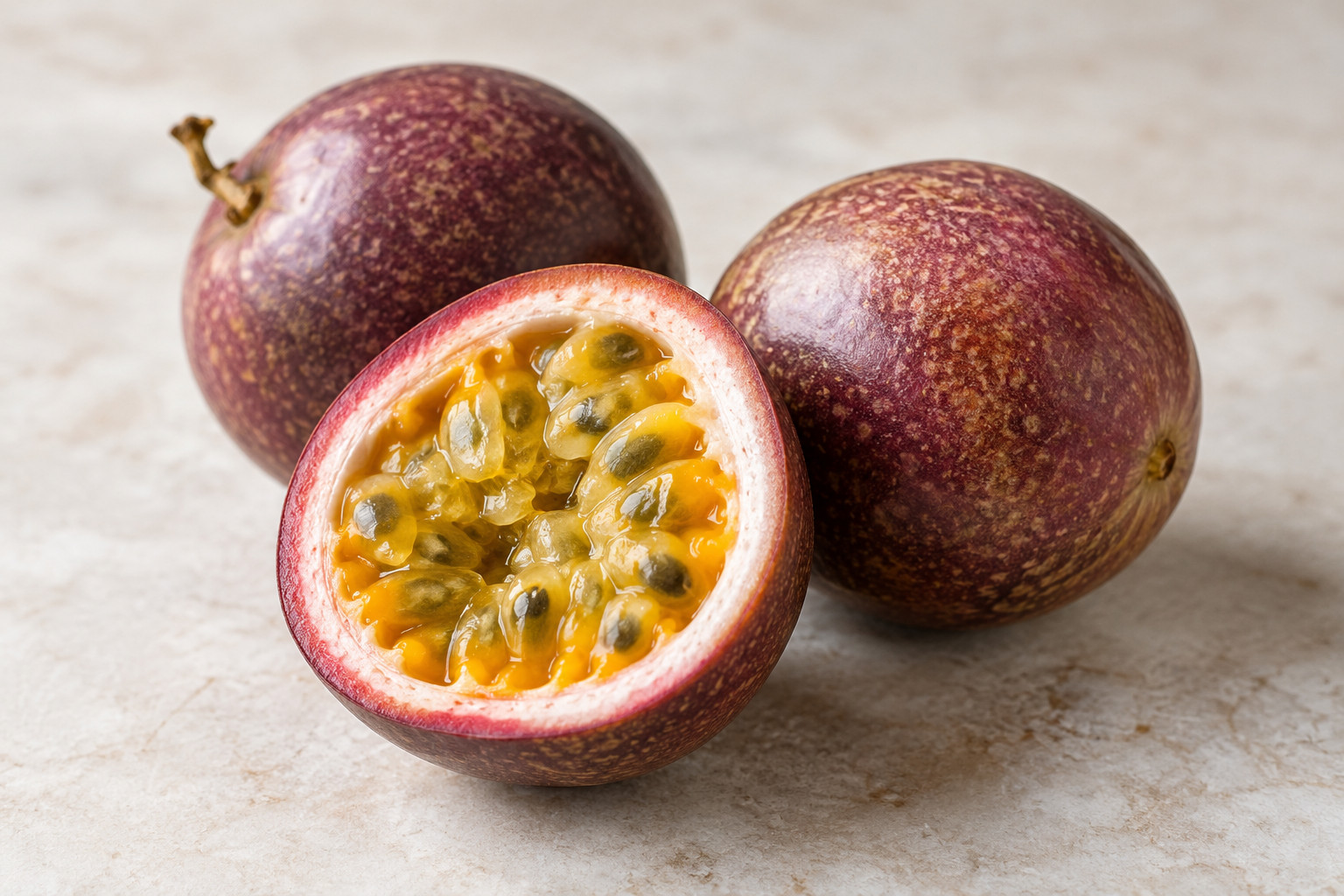
Passion fruit: a sensory reference for defining the target flavor profile.
What Does Passion Fruit Flavoring Taste Like in a Finished Food?
Passion Fruit flavoring should deliver a fast fruity lift, a floral-citrus middle, and a juicy, slightly musky finish rather than an undifferentiated tropical note. Its tart impression is part of the identity, but flavoring does not replace the formula's acidulant or sweetener balance.
Translate broad adjectives into aroma families. Ethyl butanoate, ethyl hexanoate, hexyl butanoate, and hexyl hexanoate support the pineapple-, apple-, and guava-like opening. Limonene, myrcene, ocimene, linalool, and alpha-terpineol provide citrus or floral lift. Green aldehydes and alcohols suggest cut rind; trace sulfur compounds supply a ripe-fruit edge. Keep that edge controlled.
| Sensory layer | What the buyer should smell or taste | Useful formulation direction | Common failure |
|---|---|---|---|
| Top note | Quick ester burst; pineapple, citrus peel, green-fruity sparkle | Increase volatile ester lift for a juice, sparkling drink, or gummy opening | Top disappears after heat or carbonation |
| Middle note | Floral, tropical, and soft citrus body; guava-like fullness | Build a round middle for nectar, yogurt, dairy-style drinks, or fillings | Profile turns perfumed or thin |
| Base and finish | Juicy pulp, gentle musk, berry depth, trace sulfur/green persistence | Add depth to sauces, fermented drinks, and confectionery | Sulfur becomes onion-like or the finish becomes harsh |
| Taste balance | Bright citric/malic tartness against sugar and fruit body | Match flavor strength to the finished °Brix and acid system | Flavor seems weak because the base is too sweet, too cold, or too dilute |
Purple and yellow fruit are reference directions, not interchangeable labels. A purple-fruit brief can emphasize deeper ester, berry, and musk; a yellow-fruit brief can favor brighter citrus, green lift, and sharper acidity. Cultivar, maturity, origin, and processing still move the balance. Name the desired direction.
The United States Department of Agriculture aromatic profile record reports dozens of odor-active components in yellow Passion Fruit essence and puree. “Tropical” alone therefore gives a flavorist too little direction.
How Should a Buyer Write a Passion Fruit Sensory Brief?
A useful Passion Fruit sensory brief names the reference fruit, the target arc, and the notes that must remain below a limit. It also identifies the product and process in which that arc must survive.

Flavor sample library in the LULIN laboratory
Use one of these practical directions, or combine two deliberately:
| Brief direction | Opening | Body | Finish | Best fit |
|---|---|---|---|---|
| Bright yellow fruit | Lemon-citrus, green ester | Tart juice and light floral note | Clean, brisk acidity | Clear drinks, flavored water, fruit gummies |
| Ripe purple fruit | Sweet berry ester, deep tropical lift | Round guava and floral pulp | Musky, lingering fruit | Nectar, yogurt, dessert sauces |
| Fresh-cut pulp | Green rind and juicy seed impression | Natural fruit flesh | Short, clean tart finish | Smoothies, chilled puree drinks, cocktail mixers |
| Cooked tropical | Reduced fruit, soft caramel edge | Concentrated jam and floral body | Warm, rounded acidity | Bakery fillings, syrups, cooked sauces |
| Passion Fruit–citrus blend | Lime or grapefruit lift | Passion Fruit remains the lead | Dry, refreshing finish | Carbonated and functional drinks |
Define top-note speed, middle-note weight, and finish length. Add two guardrails, such as “no solvent-like ester” and “no cooked or onion-like sulfur.” These controls direct sample selection without dictating a formula.
State whether the fruit is a named flavor or a characterizing ingredient. In juice or puree, the flavor may reinforce real Passion Fruit; in a clear drink, it may create the full sensory identity. Those jobs require different strength, color, and label review.
For supplier replacement, send the current sample code, use level, base, process, and blind result. “Retain the floral middle after pasteurization, extend the finish by 20%, and reduce green rind at 30 days” is more actionable than “make it stronger.”
How Do Water, Fat, Protein, Sugar, Salt, Acid, and Serving Temperature Change Passion Fruit Perception?
The finished matrix controls how quickly Passion Fruit aroma reaches the nose and how long it remains. Volatility, hydrophobicity, lipid, protein, sugar, salt, acid, and temperature all affect release, so a water screen cannot predict a high-protein or high-fat product.
Use the contrast levels below only to diagnose matrix effects; keep flavor at the chosen dose and change one variable at a time.
| Matrix variable | Expected Passion Fruit shift | Controlled contrast set | Approval check |
|---|---|---|---|
| Water | Fast volatile release and a clear opening | Full liquid ladder: 0.05%, 0.10%, 0.15%, 0.20%, 0.25% w/w | Solubility, haze, fill loss, clarity |
| Fat | Slower release and a longer hydrophobic finish | 0% fat, 3% fat, 10% fat | Oil-phase compatibility and after-swallow aroma |
| Protein | Binding can mute esters; heat and pH alter the balance | 0% protein, 3% protein, 6% protein | Pre-process and post-process aroma, sediment |
| Sugar | Sweetness softens sourness; solids can reduce headspace release | 8% sucrose, 10% sucrose, 12% sucrose | Acid balance, top-note speed, aftertaste |
| Salt/electrolytes | Ionic strength can expose sour, bitter, or mineral notes | 0% sodium chloride, 0.10% sodium chloride, 0.20% sodium chloride | Mineral masking and finish cleanliness |
| Acid | Citric or malic acid sharpens the fruit signature | 0.20%, 0.40%, 0.60% titratable acidity | Acid type, target pH, flavor after heat |
| Serving temperature | Cold suppresses aroma and sweetness; warmth increases release | 4 °C, 10 °C, 20 °C | Blind score at the intended service point |
Fruit pulp supplies a physical reference. Commercial Passion Fruit pulp specifications commonly sit near pH 2.7–3.3, 12–15 °Brix, and 2.5–3.5% acidity as citric acid. A beverage at pH 3.0 and 10 °Brix will not present the same dose like a neutral dairy base.
Test the real base. Include its protein, minerals, botanical extracts, and sweetener from the first screen, and record that system beside every dose. A changed sweetness response can alter perceived Passion Fruit intensity even when aroma concentration is constant.
Which Passion Fruit Format Merits Testing: Liquid, Emulsion, Powder, Concentrate, or Fruit Ingredient?
Choose a Passion Fruit format by product phase, process, and appearance; the seven options below do different jobs and are not interchangeable.
| Named option | Phase or structure | Controlled first screen | Suitable applications | Primary failure mode |
|---|---|---|---|---|
| water-soluble liquid | Clear aqueous carrier | 0.05%, 0.10%, 0.15%, 0.20%, 0.25% w/w | Clear drinks, syrups, jelly, yogurt | Heat loss, carrier note, mineral haze |
| oil-soluble liquid | Lipid-phase carrier | 0.25%, 1.00%, 5.00% w/w | Fat fillings, coatings, oil systems | Uneven dispersion in water |
| oil-in-water beverage emulsion | Flavor oil dispersed in water; may add cloud | 0.75 g/L, 1.00 g/L, 1.25 g/L | Cloudy drinks, nectar, mixers, RTD products | Ring, creaming, droplet growth |
| spray-dried powder | Dry carrier matrix | 0.10%, 0.20%, 0.30% w/w | Dry drinks, seasonings, powdered desserts | Moisture pickup, dust, muted opening |
| encapsulated powder | Protected dry matrix | 0.10%, 0.20%, 0.30% w/w | Inclusions, dry blends, controlled release | Slow release or incomplete dissolution |
| flavor concentrate | Supplier-defined concentrated flavor system | Apply the selected item's assay and phase | Wet or dry foods matched to its carrier | Treating the name as a universal strength |
| fruit puree or juice concentrate | Fruit solids, acid, color, pectin | 11–16.5 °Brix; pH 2.5–3.9 | Smoothies, sauces, sorbet, fruit bases | Solids, haze, color, acidity shift |
The clear-beverage decision benchmark is 0.20% w/w, equal to 2.0 g/kg. It is a rounded high point within the Apex Flavors clear-beverage starting range, not a universal maximum. For a ready-to-use emulsion, 1.25 g/L is the high-end reference benchmark; confirm cloud, intensity, and cost in the finished drink.
Use the Powder vs Liquid Food Flavors guide for handling. Flavor Concentrates for Food Manufacturing remains the category parent, while Fruit Flavor Concentrates for Food Buyers covers broad fruit sourcing. This page decides whether one format preserves a defined Passion Fruit arc in one application.
Liquid and Emulsion Decisions for Beverage Developers
A water-soluble liquid is usually the first clear-drink candidate because it meters into syrup or finished blend without an oil phase. Keep the process fixed. An oil-in-water beverage emulsion is better when cloud, body, or lipophilic-note delivery matters. Immediate uniformity proves little. Inspect it after carbonation, pasteurization, cooling, and storage.
Spray-Dried Powder and Encapsulated Powder Checks
A spray-dried powder commonly uses maltodextrin or modified starch; an encapsulated powder adds a release or protection function. A representative dry screen can set moisture below 6%, bulk density from 550 g/L to 650 g/L, and reconstitution from 35 °C to 45 °C. Seal the package. Premix before hydration, then check carrier taste, caking, dissolution, and top-note recovery.
Fruit Puree or Juice Concentrate Versus Flavor Concentrate
Fruit puree or juice concentrate adds solids, color, pectin, acid, and pulp character. A flavor concentrate adds far less bulk and is easier to standardize, but it does not reproduce seed texture or pulp mouthfeel. Using both can retain a fruit-based formula while restoring aroma lost during processing.
Which Processing and Storage Conditions Change the Intended Passion Fruit Profile?
Heat exposure, shear, oxygen, light, and storage temperature can strip the Passion Fruit opening or destabilize its delivery system. Approve the addition point and the complete production cycle, not a freshly mixed bench cup.
Record each failure point.
The challenge points below are controlled comparisons, not universal factory settings; the production cycle remains the approval condition.
| Process or condition | Likely profile or physical change | Controlled comparison | Record for diagnosis |
|---|---|---|---|
| Pasteurization or HTST | Ester loss, cooked note, acid shift | 72 °C for 15 s; 95 °C for 30 s | Addition point, peak, hold, cooling |
| UHT | Stronger stripping and protein interaction | 135 °C for 2 s; 140 °C for 4 s | Direct or indirect system, outlet temperature |
| Baking | Volatile loss; filling retains more than crumb | 160 °C for 20 min; 180 °C for 15 min | Dough, filling, and cooled product separately |
| Hard-candy cooking | Top notes leave before the glass sets | Compare kettle addition with the lowest safe cooling-stage addition | Batch peak, addition temperature, cooling time |
| Homogenization | Dispersion improves, but extra passes add heat | 10 MPa, 20 MPa, 30 MPa at 45 °C inlet | Pressure, pass count, outlet temperature |
| Freeze–thaw | Separation, texture change, muted aroma | −18 °C for 24 h; 20 °C for 4 h | Freeze rate, thaw method, visible separation |
| Oxygen, light, warm storage | Oxidation, color drift, gradual aroma loss | 4 °C, 20 °C, 35 °C at 0 days, 7 days, 30 days | Headspace, closure, light exposure, package |
For a beverage emulsion, record oil-phase and aqueous-phase temperature, premix time, homogenization pressure, pass count, fill temperature, and cooling rate. Cloud is not stability. A uniform fresh sample can still cream or form a package ring.
Store liquids tightly closed, dry, and dark; 10 °C to 20 °C is a common technical-sheet reference. Control humidity for powders and reseal after withdrawal. Keep frozen puree at or below −18 °C, then avoid refreezing after thawing.
Reference Specification Card for First-Pass Screening
This reference card consolidates the design anchors used on this page; it is a test design, not a single supplier specification.
| Decision field | Complete screening value |
|---|---|
| Water-soluble liquid benchmark | 0.20% w/w (2.0 g/kg) |
| Complete liquid ladder | 0.05% (0.5 g/kg), 0.10% (1.0 g/kg), 0.15% (1.5 g/kg), 0.20% (2.0 g/kg), 0.25% (2.5 g/kg) |
| Candy or bakery extension | 0.30% w/w (3.0 g/kg), only within the item range |
| Oil-soluble liquid reference span | 0.25% w/w to 5.00% w/w |
| Oil-in-water emulsion benchmark | 1.25 g/L finished drink |
| Powder checks | Below 6% moisture; 550 g/L to 650 g/L bulk density; 35 °C to 45 °C reconstitution |
| Fruit reference | pH 2.7–3.3; 12–15 °Brix; 2.5% to 3.5% acidity as citric acid |
| Storage references | Liquid at 10 °C to 20 °C; frozen puree at or below −18 °C |
| Short checkpoints | 0 days, 7 days, 30 days |
Use 0.20% w/w and 1.25 g/L in the first comparison, then move the dose only after the matrix, process, and serving condition are fixed.
How Should Teams Evaluate Passion Fruit Samples in the Real Application Base?
Teams should run coded Passion Fruit samples in the finished base, repeat them after the complete process, and check whether the preferred sensory arc and physical state remain at 0 days, 7 days, and 30 days. Judge retention, not freshness. Compare like with like.
A six-step sample protocol
- Lock the base. Record water, fat, protein, sugar, salt, acid, pH, °Brix, alcohol, color, and stabilizers. Use the production formula or closest pilot.
- Set the ladder. Test 0.05%, 0.10%, 0.15%, 0.20%, and 0.25% w/w in one clear-beverage base. Add 0.30% w/w for candy or bakery only when the item range permits it. Keep 0.20% w/w as the reference benchmark.
- Apply the process. Pasteurize, carbonate, bake, freeze, homogenize, or ferment as production will. Fix addition order and record temperature plus hold time.
- Blind and randomize. Code every sample, vary serving order, and standardize cup, fill volume, equilibration time, and service temperature.
- Score the arc. Use a 0–10 scale for top burst, tropical body, citrus/floral lift, acid balance, green note, sulfur note, finish, and overall fit. Flag solvent, cooked, or onion-like off-notes.
- Check physical behavior. Record clarity, haze, ring, creaming, sediment, color, viscosity, and package compatibility at 0 days, 7 days, and 30 days. Add freeze–thaw or heat retention where relevant.
Use ASTM E1871-17 for consistent sample serving and ASTM E2454-20 when defining a sensory shelf-life endpoint. These guides support repeatable preparation and time-based criteria; they do not set a Passion Fruit dose.
Reject obvious off-notes. Choose the lowest dose that reaches the target arc. If two samples score similarly, prefer the cleaner process window and simpler handling; stable clarity and repeatable dosing can outweigh a small sensory advantage.
For cross-supplier comparison, use the same base, ladder, process, and serving condition. Keep sample code, batch, use level, tasting date, panel notes, and requested adjustment together. Food Flavor Formulation Support for B2B R&D provides a route for that technical handoff.
What Belongs in an RFQ for a Passion Fruit Flavor Supplier?
An effective Passion Fruit RFQ combines the application, sensory direction, matrix, process, format, documents, and commercial target in one brief. That information lets the supplier select an application-relevant sample.
Review destination rules.
| RFQ section | Details to include | Why it changes the recommendation |
|---|---|---|
| Finished product | Beverage, syrup, yogurt, bakery, candy, sauce, dry mix, or puree blend; batch size and annual forecast | Defines phase, dosing method, and scale |
| Sensory target | Purple or yellow reference, top/middle/base notes, acid level, finish length, off-note limits | Separates a bright juice profile from a deep dessert profile |
| Matrix | pH, °Brix, titratable acidity, fat, protein, salt/electrolytes, sweetener, alcohol, stabilizer | Predicts aroma release, binding, and masking |
| Format | Water-soluble liquid, oil-soluble liquid, oil-in-water beverage emulsion, spray-dried powder, encapsulated powder, or fruit ingredient | Prevents an incompatible phase or unwanted haze |
| Process | Addition point, pasteurization/HTST/UHT, baking temperature/time, carbonation, homogenization, fermentation, freeze–thaw | Determines heat stability and process loss |
| Trial plan | Sample quantity; 0.05%, 0.10%, 0.15%, 0.20%, 0.25% w/w ladder; control; panel size; serving temperature; 0 days, 7 days, 30 days | Makes supplier feedback comparable |
| Quality documents | COA, TDS, SDS/MSDS, ingredient statement, allergen, GMO, vegan, Halal/Kosher, natural/artificial wording, FEMA/GRAS or market statement | Supports QA, label, importer, and customer review |
| Commercial terms | MOQ, pack size, shelf life, storage, lead time, Incoterm, destination, shipping temperature | Converts a successful sample into a workable purchase |
State the destination market first. A United States buyer may need a natural-flavor declaration under 21 CFR 101.22, while an EU customer may request wording aligned with Regulation (EC) No 1334/2008. One flavor name can require different label and document sets.
For United States projects, 21 CFR 101.22 defines natural flavor by source and function. Ask for the selected item's carrier, ingredient statement, and intended wording; a catalog-level “natural” claim does not settle the finished-food label.
Why Use an Application-Led Supplier for a Passion Fruit Project?
An application-led Passion Fruit supplier connects the sensory target to the product base, process, sample plan, and document package. LULIN FLAVOR is the English brand of QUANZHOU LVLIN BIOENGINEERING CO., LTD., a food-grade flavor company in Quanzhou, Fujian, China, established in 2001. Its work covers flavor development, production, and sales.
For a Passion Fruit project, specify clear or cloudy appearance, purple or yellow direction, pH, °Brix, heat step, format, dose ladder, and destination-market files. LULIN FLAVOR can review that brief, discuss liquid, powder, emulsion, or adjusted directions, and connect sample feedback to the next formulation step. The fruit beverage flavor route and fruit candy flavor route add application context without replacing the item trial.
Buyer FAQ: Passion Fruit Flavoring Decisions
What does Passion Fruit flavoring taste like?
Passion Fruit flavoring tastes fruity, tart, floral, and slightly musky, with a fast ester lift and a lingering tropical finish. Cultivar direction, sweetness, acid, fat, protein, serving temperature, and process heat change the final balance.
Which Passion Fruit flavoring is best for a clear beverage?
A water-soluble liquid is usually the first Passion Fruit format to test in a clear beverage. Start at the 0.20% w/w (2.0 g/kg) design benchmark, then compare 0.10%, 0.15%, and 0.25% w/w after carbonation or pasteurization.
When should a beverage developer choose an emulsion?
Choose an oil-in-water beverage emulsion when the drink needs cloud, fuller mouthfeel, or oil-phase delivery. Screen at the 1.25 g/L reference benchmark and inspect the drink after homogenization, heat treatment, cooling, and storage.
Can an oil-soluble Passion Fruit flavor go into water?
An oil-soluble Passion Fruit flavor is intended for a lipid phase and will not disperse uniformly in a water-only formula. Use a water-soluble liquid or an oil-in-water beverage emulsion for an aqueous drink.
Is Passion Fruit flavoring the same as Passion Fruit puree?
Passion Fruit flavoring supplies a concentrated aroma direction, while puree adds solids, pectin, color, organic acids, and pulp character. A formula may use both, but puree is not a one-for-one replacement for a flavor concentrate.
What dosage should a buyer use for a first trial?
Use the selected item's range and test 0.05%, 0.10%, 0.15%, 0.20%, and 0.25% w/w in one beverage base; 0.20% w/w is the reference benchmark. Candy, bakery, dairy, and powder systems need matrix-specific ladders.
How does heat affect Passion Fruit flavor?
Heat can strip volatile top notes, create a cooked impression, and change acid or protein interactions. Compare the same Passion Fruit sample before and after the complete pasteurization, UHT, baking, candy-cooking, or homogenization cycle.
How should Passion Fruit flavor samples be compared?
Compare coded samples in the final application at the intended serving temperature and score top burst, fruit body, floral/citrus lift, acidity, green or sulfur notes, finish, and physical stability. Repeat the check at 7 days and 30 days.
Which documents belong in a Passion Fruit flavor RFQ?
Request the item-specific COA, TDS, SDS/MSDS, ingredient statement, allergen and GMO statements, vegan or Halal/Kosher documents when required, and natural/artificial or market-label information. Include the destination country and customer checklist.
What should a United States buyer ask about natural Passion Fruit flavor labeling?
A United States buyer should ask how the selected item is classified and labeled under 21 CFR 101.22, including source materials and carrier. Review the supplier's ingredient statement and market documents against the finished formula.
Build the Next Passion Fruit Sample Brief
Build the next Passion Fruit sample brief with the product, purple or yellow direction, top/middle/base notes, pH, °Brix, fat/protein/salt/acid system, process, addition point, format, 0.20% w/w benchmark or another ladder, serving temperature, storage test, destination market, and documents.
Send it through the Food Flavor Sample Request for B2B Buyers or Contact LULIN FLAVOR. Include the current benchmark sample when available. A precise brief lets the supplier return a Passion Fruit direction that can be judged in the product, not only on a smelling strip.