Published
Chicken Flavor Powder: Delivery, Handling, Release, and Application Testing
Chicken flavor powder is a concentrated dry flavoring that delivers a specified boiled, roasted, fried, broth, skin, or chicken-style impression at a low use level on a dry carrier. Screen 0.10% through 2.00% w/w, using 1.00% w/w (10 g/kg) as the high-end design benchmark for first-round screening of concentrated chicken flavor powder.
Last updated: 2026-09-01
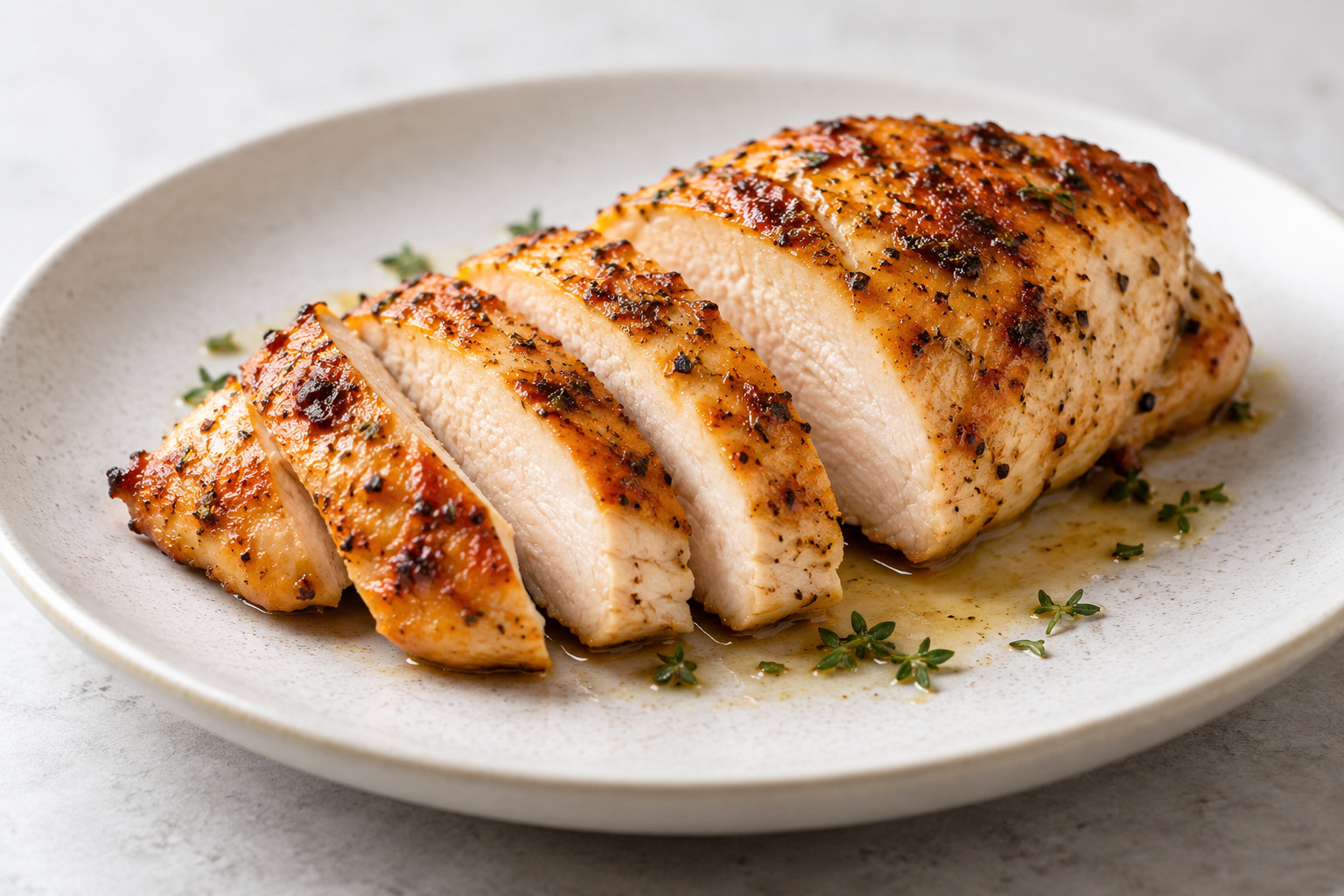
Cooked chicken: a sensory reference for defining the target flavor profile.
What is chicken flavor powder, and how does it differ from chicken powder, bouillon, and liquid chicken flavor?
Chicken flavor powder is a low-dose dry concentrate that creates a specified cooked-poultry impression, while chicken powder, extract, bouillon, and liquid chicken flavor do different jobs. A 1.00% w/w flavor addition is a sensory tool. Adding 5% or 10% chicken powder is a solids, nutrition, allergen, and meat-label decision.
| Material | What it contributes | Typical use band | Why it is not interchangeable |
|---|---|---|---|
| Chicken flavor powder | Specified boiled, roasted, fried, broth, skin, or chicken-style aroma on a dry carrier | 0.10% to 2.00% w/w | Flavor concentrate; not meat or a complete seasoning |
| Chicken powder / dehydrated chicken | Protein, fat, salt, color, cooked-poultry taste | Several percent of a dry mix | Nutrition, allergen, and meat-label decision |
| Chicken extract or broth powder | Animal-derived stock solids, salt, body | Soup solids, stock replacement | Adds solids and often sodium |
| Compound chicken seasoning or bouillon | Flavor plus salt, starch, yeast extract, protein, spices, fat | Soup base or noodle sachet | Compound food; quote separately |
| Water-soluble or oil-soluble chicken liquid | Same sensory job in a wet or fat-continuous line | Tank dose or oil slurry | Different dosing, addition point, warehouse |
Compare cost as grams of flavor per kilogram of finished food. Add meat solids only when those solids are required. Compound bouillon is a finished seasoning, not a 10 g/kg concentrate substitute. Dry-format handling sits on Flavor Powder for Food Production.
How should a formulator specify a chicken powder profile without saying authentic or savory?
A chicken flavor powder brief becomes usable when it names onset, heart, finish, intensity, serving temperature, and forbidden notes rather than authentic or savory. Those two words do not tell a flavorist which sulfur meat note, roasted-skin note, fried-fat aldehyde, or broth body to build.
Write the profile as a time sequence. Onset is 0-5 s in soup or coating, or 0-2 s for snack dust. Middle sits at 5-20 s. Finish runs 20-60 s. Score each tier from 0 (absent) through 1, 2, 3, 4, 5, 6, 7, 8, 9, to 10 (dominant), and record duration in seconds.
A working sentence looks like this: roasted-skin top at 25 °C, juicy white-meat middle without liver, short broth finish by 20 s, no boiled-egg hydrogen sulfide, no generic yeast bouillon, intensity 7 in a 1.5% NaCl dry soup reconstituted at 70 °C.
Buyer language for chicken-profile chemistry includes 2-methyl-3-furanthiol and 2-furfurylthiol for meaty sulfur; methanethiol, dimethyl sulfide, and dimethyl trisulfide for cooked-stock volatility; 2-acetyl-2-thiazoline and 2-acetylthiazole for roasted-meat heterocycles; alkyl pyrazines for browned skin; and hexanal plus (E,E)-2,4-decadienal for chicken-fat aldehydes. Forbidden notes are boiled-egg hydrogen sulfide, liver, rubber, cardboard, rancid fat, beany, and generic yeast bouillon.
Serve the sample at the real temperature. Snack dust at 25 °C shows the 0-2 s flash that a 4 °C chilled filling hides. Hot soup at 60 °C or 70 °C pushes broth sulfur and fat.
Which top, middle, and base notes change a chicken flavor powder brief?
Top, middle, and base notes decide whether chicken flavor powder reads as boiled white meat, roasted skin, fried chicken, dark meat, broth, or plant-based chicken-style. Pick one lead direction in each tier. Asking for boiled meat, rotisserie skin, wing fry, and dark braise in one code produces a muddy sample.
| Chicken family | Top / 0-5 s (0-2 s snack dust) | Middle / 5-20 s | Base / 20-60 s | Failure signal |
|---|---|---|---|---|
| Boiled white meat | Steam, mild onion, fresh cooked poultry | Lean white meat, light stock | Short saline broth finish | Bland, eggy, sulfurous |
| Roasted skin / rotisserie | Browned skin, pepper, garlic, roasted sulfur | Juicy meat, rendered-fat impression | Toasted skin, warm spice, lingering fat | Burnt, smoky, greasy, stale |
| Fried chicken / wing | Hot oil, crust, pepper-spice lift | Cooked meat under breading | Savory fat, salt, toasted crumb | Oil dominates; chicken disappears |
| Dark meat / braised | Onion, spice, deeper cooked aroma | Dark poultry, stock, umami | Long fatty, caramelized finish | Beef-like, liver-like, too sweet |
| Chicken broth | Celery, onion, herb, light poultry | Stock body, yeast-compatible umami | Saline, rounded, clean finish | Generic seasoning, no poultry identity |
| Plant-based chicken-style | Roasted onion, pepper, restrained sulfur | Chicken-like body without meat solids | Controlled fat and umami tail | Beany, cereal, rubber, bouillon-heavy |
State which layer leads. Snack dust needs a fast roasted or fried opening at 0-2 s. Instant soup needs a stable middle at 60 °C or 70 °C. Plant protein needs enough body to cover beany notes without becoming salty bouillon.
Which powder construction should a snack, soup, or coating line test first?
Snack seasoning, instant-soup, and coating lines should test chicken flavor powder construction against the continuous phase, addition point, heat, and warehouse humidity, not against the catalog name chicken. Formulators should test chicken flavor powder as spray-dried powder, plated powder, agglomerated powder, or encapsulated powder, and should compare those dry options against water-soluble liquid, oil-soluble liquid, oil-dispersible liquid, and oil-in-water emulsion when the process is not dry-only.
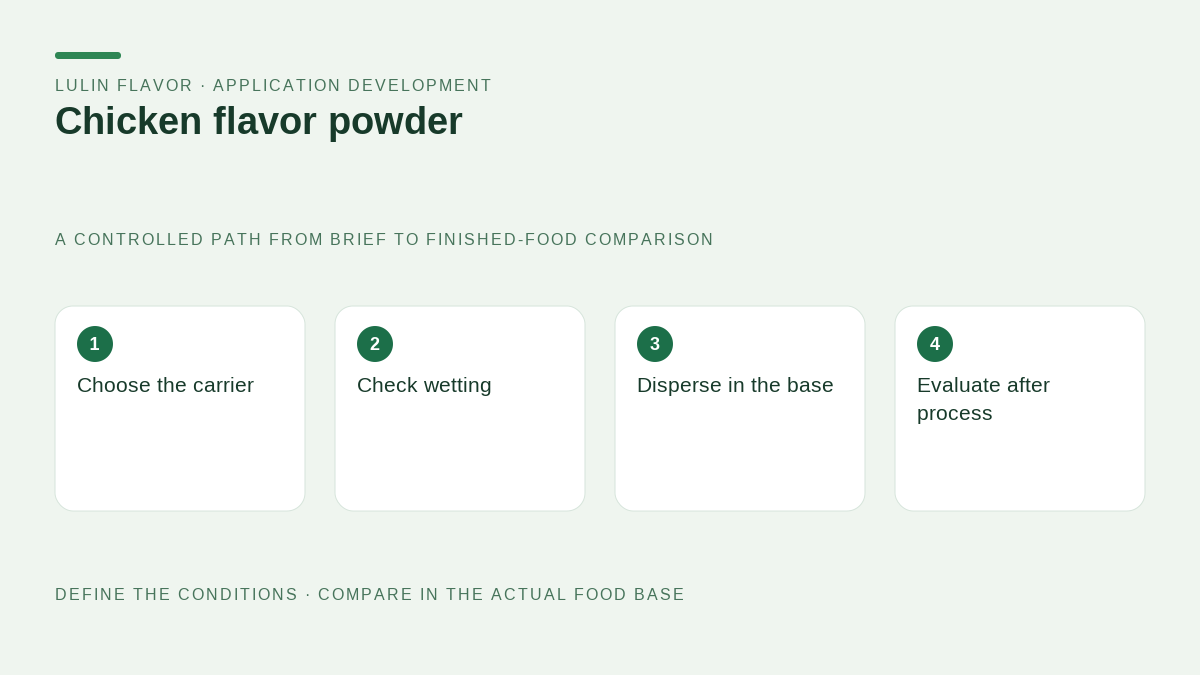
A controlled workflow for this formulation or supplier-review decision.
| Format option | Best first fit | Main advantage | Failure mode to test | Factory question |
|---|---|---|---|---|
| spray-dried powder | Snack seasoning, noodle sachet, dry soup | Dry dosing, even blending | Caking, dust loss, weak reconstitution | Carrier, mesh, and blend order? |
| plated powder | Short runs, loud bag aroma | Fast bag aroma | Storage fade, oily specks | Does 30 days at 20 °C match Day 0? |
| agglomerated powder | Instant soups that must wet and sink | Faster wetting than a fine spray-dry | Fragile granules after conveying | Survive 15 min and 30 min conveying? |
| encapsulated powder | Frying, baking, retort, delayed release | Protects selected notes | Incomplete release, carrier taste | Which heat, moisture, and shear trigger release? |
| water-soluble liquid | Tank-dosed broth, sauce | Fast dispersion | Heat stripping, no dry-blend path | Meter into water after cook? |
| oil-soluble liquid | Frying oil, fat filling | Holds roasted and fatty notes | Weak transfer into the eating phase | Fat-continuous at eating? |
| oil-dispersible liquid | Coatings, mixed-fat slurries | Spreads through oil | Settling, uneven spray | What shear keeps it uniform? |
| oil-in-water emulsion | Soup, sauce, plant slurry | Carries oil-phase aroma in water | Creaming, ring, shear damage | Can the line match bench homogenization? |
For a dry mix, start with spray-dried powder. Plate when bag aroma must be loud. Agglomerate when the cup shows floating fines. Encapsulate when 160 °C, 170 °C, or 180 °C frying, 180 °C baking for 12 min, or a scheduled 115 °C for 1 h retort strips the roasted-skin top. Maltodextrin at DE 10, DE 12, DE 15, DE 18, and DE 20 changes sweetness and spray behavior. Gum Arabic and OSA Modified Starch improve encapsulation. Silicon Dioxide is an anti-caking aid, not a flavor. Write particle size on an ASTM E11 stack and use 80 mesh (177 µm) as the handling benchmark.
| Physical parameter | Discrete options | Handling or storage benchmark |
|---|---|---|
| Particle size (ASTM E11) | 20 mesh (841 µm), 40 mesh (400 µm), 60 mesh (250 µm), 80 mesh (177 µm), 100 mesh (149 µm) | 80 mesh (177 µm) |
| Maltodextrin DE | DE 10, DE 12, DE 15, DE 18, DE 20 | DE 12 or DE 15 unless spray needs DE 18 |
| Moisture | 3%, 4%, 5%, 6% | Moisture ≤ 5% |
| Water activity | 0.20, 0.25, 0.30, 0.35, 0.40 | Water activity ≤ 0.30 |
| Bulk density | 0.3 g/mL to 0.7 g/mL | Record on the TDS; 0.45 g/mL is a flowable midpoint if listed |
| Warehouse screen | 15 °C, 20 °C, 25 °C | 20 °C |
Moisture ≤ 5%, water activity ≤ 0.30, and warehouse 20 °C are the storage benchmarks. The Powder vs Liquid Food Flavors page holds the parent format comparison.
How do water, fat, protein, sugar, salt, acid, and serving temperature change chicken flavor powder?
Water, fat, protein, sugar, salt, acid, and serving temperature change chicken flavor powder by altering volatile release, mouthfeel, sulfur balance, and the point at which broth becomes generic yeast bouillon. A water tasting can expose defects. Approval still requires the real base.
| Matrix variable | Controlled screening bracket | Likely sensory effect |
|---|---|---|
| Water / total solids | Finished dilution, then −10% and +10% solids | Dilution thins broth; high solids slow release |
| Fat | 0%, 5%, 15% fat | Retains hexanal and (E,E)-2,4-decadienal; mutes 0-2 s flash |
| Protein | 0%, 5%, 15% protein | Binds aroma; adds cooked, beany, or powdery notes |
| Sugar / sweetener | 0%, 1%, 3% sugar equivalent | Softens sulfur; excess shifts roast toward barbecue |
| Salt | 0.5%, 1.0%, 1.5% NaCl | Salt can lift headspace; high salt turns chicken into bouillon |
| Acid / pH | pH 4.0, 5.5, 7.0 when safe | Brightens top notes; can shift sulfur |
| Serving temperature | 4 °C, 25 °C, 60 °C, 70 °C | Cold suppresses aroma; heat increases broth sulfur and fat |
Change one variable at a time. A 0% fat reconstituted soup and a 15% fat fried coating will not release the same 2-methyl-3-furanthiol and alkyl pyrazine balance at 1.00% w/w. If the opening disappears while the finish turns greasy, change construction before climbing from 1.00% to 2.00%. Lock NaCl, MSG, IMP, GMP, and yeast extract while the flavor dose moves. Score fillings at 4 °C, snack dust at 25 °C, and soup at 60 °C and 70 °C.
Which processing and storage conditions flatten roasted-skin, broth, or fried-chicken powder notes?
Dry blending, oil slurry, reconstitution, cook, retort, frying, baking, and warehouse humidity flatten roasted-skin, broth, or fried-chicken notes in chicken flavor powder when construction and storage limits do not match the line. Judge the processed sample. The neat powder in a jar is a receiving check, not a production decision.
| Stress condition | Likely change | Controlled comparison | Corrective direction |
|---|---|---|---|
| Dry blend / conveying | Dust loss, segregation | Bag versus blend at 0 min, 15 min, 30 min | 80 mesh (177 µm) cut, dust control |
| Oil slurry / tumble | Top-note flash, oil oxidation | 40 °C, 50 °C, 60 °C for 3 min, 5 min, 10 min | Encapsulated or oil-compatible fraction |
| Reconstitution | Floating fines, delayed broth | 60 s, 3 min, 5 min at 60 °C and 80 °C | Agglomerated powder; mesh change |
| Cook / hot fill | Loss of 0-5 s roast, cooked sulfur | Before heat versus 85 °C for 20 min; 95 °C for 30 s | Later addition or heat-matched family |
| Retort | Weaker top, bitter roast | Before versus scheduled process; 115 °C for 1 h only if scheduled | Encapsulated powder |
| Frying | Rapid top-note loss, rancid fat | 160 °C, 170 °C, 180 °C in fresh and end-of-run oil | Post-fry dust; encapsulated powder |
| Baking / savory cracker | Volatile loss, dry finish | Dough versus cooled piece after 180 °C for 12 min | Encapsulated powder; shift middle and base |
| Humidity / warehouse | Caking, cardboard, stale fat | Sealed 20 °C; 0 days, 7 days, 30 days, 90 days | Moisture ≤ 5%, aw ≤ 0.30, barrier pack |
Never transfer a liquid dose number onto a powder. A 0.20% water-soluble liquid and a 1.00% spray-dried powder are not the same active load. Convert both to grams of flavor per kilogram of finished food.
High-heat powder carrier work belongs on Candy Flavor Powder for Food Buyers after the chicken family is chosen. Freeze and warehouse powder handling belongs on Ice Cream Flavor Powder for Food Buyers. Savory cracker and baked-coating paths at 180 °C for 12 min follow the bake-survival logic on Cake Flavoring for B2B Bakery Products.
How should buyers compare chicken flavor powder samples in the real dry mix and finished food?
Buyers should compare coded chicken flavor powder samples in the actual dry mix and after the planned cook, fry, bake, or reconstitution, not by smelling the bag. An application-matched dose ladder is the purchasing signal.
Copy this protocol into a pilot brief:
- Prepare a no-flavor control, the current reference, and up to four coded candidates in one dry-mix batch. Duplicate each code.
- Screen 0.10%, 0.20%, 0.30%, 0.40%, 0.50%, 0.75%, 1.00%, 1.50%, and 2.00% w/w. Use 1.00% w/w (10 g/kg) as the high-end design benchmark. Keep 2.00% as a diagnostic high, not a default production dose.
- Lock water, fat, protein, sugar, salt, acid, mesh, blend time, and serving temperature.
- Score top, middle, and base from 0 to 10, plus chicken identity, handling, and off-notes.
- Evaluate at the target serving temperature, then after 7 days, 30 days, and 90 days.
| Scorecard attribute | 0-10 scoring anchor | Timing | Reject signal |
|---|---|---|---|
| Chicken identity | 0 = absent; 10 = target family | First recognition | Generic yeast bouillon |
| Cooking-style top | 0 = absent; 10 = boiled, roasted, or fried target | 0-5 s; 0-2 s snack dust | Boiled-egg hydrogen sulfide, solvent, rubber |
| Meat and broth body | 0 = hollow; 10 = full but balanced | 5-20 s | Loud bag aroma, empty middle |
| Process survival | 0 = collapsed; 10 = sentence still true | After cook, fry, bake, or reconstitution | Profile only works in the jar |
| Off-note control | 0 = severe defect; 10 = clean | 0-60 s | Liver, cardboard, beany, rancid fat |
Pilot starting conditions below are reference screens, not legal limits or LULIN FLAVOR guarantees.
| Pilot system | Flavor ladder (w/w) | Matrix and process | Serving and storage |
|---|---|---|---|
| Snack seasoning, 1 kg | 0.20%, 0.50%, 0.75%, 1.00% | Fat 5%, 15%; protein 0%, 5%; sugar 0%, 1%; NaCl 1.0%, 1.5%; oil tumble 40 °C, 50 °C, 60 °C for 5 min | 25 °C, 0-2 s dust; 7 days, 30 days, 90 days |
| Instant noodle sachet, 1 kg | 0.30%, 0.50%, 0.75%, 1.00% | Fat 0%, 5%; protein 0%, 5%; sugar 0%, 1%, 3%; NaCl 1.0%, 1.5%; reconstitute 80 °C for 3 min | 60 °C, 70 °C; 7 days, 30 days |
| Dry soup, 1 kg | 0.40%, 0.75%, 1.00%, 1.50% | Fat 0%, 5%; protein 0%, 5%; sugar 0%, 1%; NaCl 0.5%, 1.0%, 1.5%; reconstitute 60 °C for 60 s, 3 min, 5 min | 60 °C, 70 °C; 7 days, 30 days, 90 days |
| Fried coating, 1 kg | 0.50%, 0.75%, 1.00%, 1.50% | Fat 5%, 15%; protein 5%, 15%; sugar 0%, 1%; NaCl 1.0%, 1.5%; fry 160 °C, 170 °C, 180 °C | 25 °C, 60 °C; 0 days, 7 days |
| Plant-based dry mix, 1 kg | 0.75%, 1.00%, 1.50%, 2.00% | Fat 0%, 5%, 15%; protein 5%, 15%; sugar 0%, 1%, 3%; NaCl 0.5%, 1.0%; cook 85 °C for 20 min | 4 °C, 25 °C, 60 °C; 7 days, 30 days |
Do not rank a 25 °C snack dust against an 85 °C for 20 min plant cook as equal exposure. Send the locked base through the Food Flavor Sample Request for B2B Buyers route.
What belongs in a United States chicken flavor powder RFQ?
A United States chicken flavor powder RFQ should lock sensory sentence, matrix, process, mesh, moisture, documents, destination-market wording, and commercial terms before samples are scored.
| RFQ block | Details to send | Documents or response to request |
|---|---|---|
| Identity and sensory target | Family name, top/middle/base sentence, forbidden notes, natural or artificial preference | Sample code, sensory description, allergen statement |
| Application matrix | Water; fat 0%, 5%, 15%; protein 0%, 5%, 15%; sugar 0%, 1%, 3%; NaCl 0.5%, 1.0%, 1.5%; acid; pH | Recommended construction and starting dose |
| Process | Blend order, oil slurry, reconstitution, 85 °C for 20 min, 115 °C for 1 h if scheduled, frying 160 °C to 180 °C, bake 180 °C for 12 min | Heat and process stability guidance |
| Powder handling | 20 mesh through 100 mesh, 80 mesh (177 µm) preference, moisture ≤ 5%, aw ≤ 0.30, density 0.3 g/mL to 0.7 g/mL, Silicon Dioxide limits | TDS physical limits, ASTM E11 sieve, flow |
| Regulatory and quality | United States label declaration, allergen, GMO, Halal, Kosher, animal-origin/vegetarian/vegan, ISO 9001, ISO 22000, HACCP | Signed statements, current certificates, change-control policy |
| Commercial and logistics | Annual volume, trial quantity, 20 kg powder MOQ, 25 kg liquid MOQ if a wet option is quoted, pack size, lead time, Incoterm, 20 °C storage | Price basis, shelf life, packaging, export documents |
Quote flavor concentrate and compound seasoning separately; category navigation for that split sits on Flavor Concentrates for Food Manufacturing. Unit price alone does not establish cost-in-use.
For United States distribution, natural flavor and artificial flavor follow 21 CFR 101.22, not the catalog name chicken. Natural flavor may derive from poultry, plant, dairy, egg, or fermentation sources. Artificial flavor is not derived from those natural sources. Either class can still contain a poultry, milk, soy, wheat, or egg allergen. Protein hydrolysates used for flavor require their specific common or usual name under 21 CFR 101.22. Individual flavor substances may be reviewed under Flavor Extract Manufacturers Association GRAS publications; FEMA status does not replace finished-formula review. See the FEMA flavor safety and labeling resources. Poultry-derived natural chicken flavor fails vegan.
How does LULIN FLAVOR support chicken flavor powder from sample to production?
LULIN FLAVOR develops and supplies food-grade chicken flavor powder through application-matched sampling, powder and liquid options, and document support from QUANZHOU LVLIN BIOENGINEERING CO., LTD. The company was established in 2001 in Quanzhou, Fujian, China, at Qingmeng Industrial Zone 2-19(E).
Plant operations occupy a six-acre site with three modernized production lines on more than 8,000 m² building area, more than 50 employees, and over a dozen flavor engineers with over 20 years of development and application experience. ISO 22000 and HACCP systems support traceability. An application laboratory prepares boiled, roasted, fried, broth, and plant-based chicken-style directions as spray-dried powder, plated powder, agglomerated powder, encapsulated powder, or matching liquids.
Application samples take 3 days, 4 days, or 5 days after a complete brief. Powder MOQ starts at 20 kg. Liquid MOQ starts at 25 kg. Standard production takes 10 days to 15 days after approval. Technical files for a selected code can include TDS, SDS, COA, allergen, GMO, Halal, Kosher, animal-origin/vegetarian/vegan, and destination-market wording.
Submit the matrix, process, sensory sentence, and 80 mesh target, or Contact LULIN FLAVOR for Food Flavor Project Inquiries with the dry mix, heat profile, serving temperature, and trial quantity.
Chicken flavor powder FAQ
What is chicken flavor powder, and how is it different from chicken powder?
Chicken flavor powder is a low-dose dry concentrate for specified cooked-poultry aroma and taste. Dehydrated chicken powder adds protein, fat, salt, color, and bulk at several percent of a formula. Flavor screens sit at 0.10% to 2.00% w/w, with 1.00% w/w as the high-end design benchmark.
What dose of chicken flavor powder should a dry mix screen first?
Screen 0.10%, 0.20%, 0.30%, 0.40%, 0.50%, 0.75%, 1.00%, 1.50%, and 2.00% w/w. Use 1.00% w/w (10 g/kg) as the high-end design benchmark for first-round screening of concentrated chicken flavor powder. Keep 2.00% as a diagnostic high, not a default production dose.
Which chicken flavor powder construction should a snack, soup, or coating line test first?
Start with spray-dried powder for most dry mixes. Move to agglomerated powder when wetting fails, and to encapsulated powder when frying at 160 °C, 170 °C, or 180 °C, baking at 180 °C for 12 min, or a scheduled 115 °C for 1 h retort strips the top. Use plated powder for short runs or loud bag aroma.
Is chicken flavor powder vegetarian, vegan, or made from chicken meat?
The catalog name chicken flavor powder does not prove poultry content, vegetarian status, or vegan status. Request the exact code's ingredient, animal-origin, vegetarian/vegan, and allergen statements. Artificial flavor under 21 CFR 101.22 is not derived from poultry, yet a blend can still contain dairy or meat fat.
How should a chicken flavor powder profile be written for a supplier?
Write a timed sentence: onset at 0-5 s (0-2 s for snack dust), middle at 5-20 s, finish at 20-60 s, intensity from 0 to 10, serving temperature, and forbidden notes. Example: roasted-skin top at 25 °C, juicy white-meat middle, short broth finish, no boiled-egg hydrogen sulfide, intensity 7.
Can chicken flavor powder survive frying, retort, or warehouse humidity?
Chicken flavor powder can survive frying, retort, or warehouse humidity when construction and pack match the line. Compare before and after 160 °C, 170 °C, or 180 °C frying, 115 °C for 1 h only if scheduled, and sealed storage at 20 °C with moisture ≤ 5% and water activity ≤ 0.30.
Does chicken flavor powder contain allergens, and what source documents are required?
Chicken flavor powder may contain poultry, dairy, soy, wheat, egg, sesame, or none of those. The name does not decide allergen status. Request the exact code's full allergen, cross-contact, animal-origin, and vegetarian/vegan declarations before making a meat-free or allergen-free claim.
How should buyers compare chicken flavor powder samples in the real dry mix?
Compare coded chicken flavor powder samples in one locked dry mix, using a no-flavor control and the current reference. Run the 0.10% through 2.00% ladder with 1.00% w/w as the design benchmark. Score top, middle, base, handling, and process survival at the real serving temperature, then after 7 days.
What documents belong in a United States chicken flavor powder RFQ?
Request TDS, SDS, lot COA, ingredient and carrier statement, allergen and cross-contact statement, GMO statement, Halal or Kosher certificate when needed, animal-origin/vegetarian/vegan declaration, ISO 9001 / ISO 22000 / HACCP information, United States 21 CFR 101.22 wording, sieve and moisture data, and 20 kg powder MOQ.
Should a soup line use chicken flavor powder or a chicken flavor liquid?
A soup line should test readily dispersible chicken flavor powder in a dry premix and a water-soluble liquid in a tank-dosed broth at the same sensory sentence. Powder simplifies dry blending; liquid simplifies meter-in after heat. Compare reconstitution at 60 °C and 80 °C for 60 s, 3 min, and 5 min.
Chicken flavor powder selection brief for the next sample round
Send one sensory sentence, the dry-mix formula, process path, serving temperature, and a 0-to-10 scorecard. Screen 0.10%, 0.20%, 0.30%, 0.40%, 0.50%, 0.75%, 1.00%, 1.50%, and 2.00% w/w. Use 1.00% w/w (10 g/kg) as the high-end design benchmark for first-round screening of concentrated chicken flavor powder. Keep 2.00% as a diagnostic high, not a default production dose. Specify spray-dried powder at 80 mesh (177 µm) unless wetting, heat, or bag aroma forces agglomerated powder, encapsulated powder, or plated powder. Hold moisture ≤ 5%, water activity ≤ 0.30, and warehouse 20 °C. Carry only the surviving code into document, 20 kg powder MOQ, and 10 days to 15 days production review.
Develop this flavor in your product
Send your product, target market and project goal. We will review the sample direction with you.