Published
Guava Flavoring: Sensory Direction, Format, Process, and B2B Selection
Guava flavoring is a concentrated system built around green peel, juicy ester, citrus, floral, sweet-pulp, and restrained musky notes rather than one generic tropical taste. Define the target in top, middle, and base terms, then screen water-soluble liquid at 0.30% w/w (3.0 g/kg) as a high-end beverage reference benchmark in the finished process.
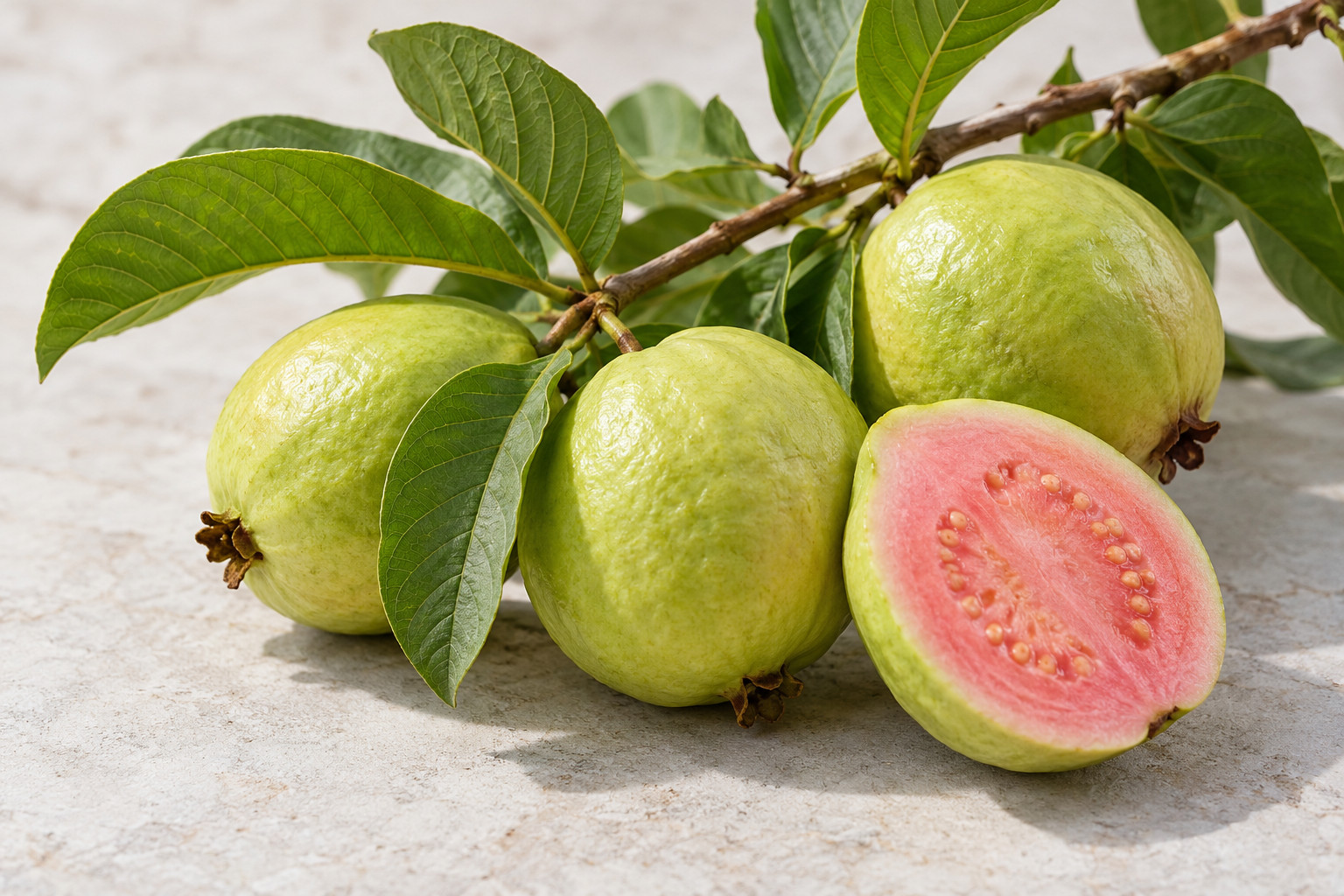
Guava fruit on a branch: a sensory reference for defining the target flavor profile.
How should a guava flavor profile be described without vague sensory adjectives?
A useful guava flavor profile states direction, timing, intensity, and exclusions. Tropical does not distinguish crisp white guava, ripe pink guava, candy fruit, cooked paste, or a sulfurous ripe edge.
Use Psidium guajava as the botanical reference, but treat pulp color as a direction rather than a universal rule. “White guava” can signal a green, crisp pear-citrus target; “pink guava” can signal a riper berry-estery, floral, and musky target. Genotype, maturity, peel, and flesh still change the aroma.
Describe perception in three windows:
- Top, 0–3 seconds: fresh-cut green, crushed leaf, grapefruit-like lift, mild lemon, or a bright fruity ester.
- Middle, 3–15 seconds: pear, banana, strawberry, pineapple, juicy pink pulp, floral, or candy body.
- Base, 15–60 seconds: sweet pulp, woody terpene, caramelized fruit, creamy mango-like depth, or restrained ripe musk.
Add 0–10 intensity, finish duration, and boundaries such as “no solvent,” “no perfume,” or “no lingering sulfur.”
Guava puree, guava juice concentrate, and guava fruit powder add fruit solids, sugar, acid, color, or fiber. A compounded flavor primarily controls aroma and taste at lower use. The flavor concentrate category for food manufacturing covers the broader family; this page owns the guava-specific decision.
Which top, middle, and base notes change a guava flavor brief?
Guava direction changes when the brief raises or lowers one note family. Studies across pink, red, white, and sour cultivars identify aldehydes, esters, terpenes, alcohols, sulfur compounds, and sweet furanone-like notes.
Flavor sample library in the LULIN laboratory
| Sensory tier | Direction to specify | Useful chemical vocabulary from guava research | Best-fit product cue | Failure signal |
|---|---|---|---|---|
| Top | Green, grassy, crushed leaf | (Z)-3-hexenal, (E)-2-hexenal, hexanal | Crisp white guava, low-sugar water | Raw bean, cut lawn, harsh peel |
| Top | Grapefruit, blackcurrant, fresh pungency | 3-sulfanyl-1-hexanol, 3-sulfanylhexyl acetate, acetaldehyde | Fresh pink guava, hard seltzer | Catty sulfur, fermented bite |
| Top-to-middle | Citrus and cool fruit lift | Limonene, 1,8-cineole | Sparkling drink, fruit blend | Minty or terpene-cleaner note |
| Middle | Juicy ester fruit | Ethyl butanoate, ethyl hexanoate, hexyl acetate | Nectar, gummy, dairy drink | Generic pineapple or banana candy |
| Middle | Floral and berry-pulp body | Cinnamyl alcohol, cinnamyl acetate, linalool, (E)-nerolidol | Pink guava, yogurt, frozen dessert | Perfume, rose soap, powdery finish |
| Base | Sweet cooked fruit | Furanone-like caramel sweetness, jammy fruit | Paste, bakery filling, confectionery | Burnt sugar or heavy syrup |
| Base | Woody, spicy, ripe depth | β-caryophyllene, α-cadinol, β-ionone | Adult tropical blend, dark fruit system | Dry wood, bitterness, excessive musk |
These names guide sensory language, not a formula prescription.
Four first-round briefs work well. Fresh pink guava combines green/grapefruit onset, berry-pear body, and restrained musk. Crisp white guava emphasizes pear, citrus, and C6-green lift. Ripe nectar or candy guava raises ester fruit and sweet pink-berry character. Cooked guava paste accepts jammy, caramelized, and floral body.
How do water, fat, protein, sugar, salt, acid, and serving temperature change guava perception?
The application matrix changes guava release, balance, and persistence, so rank samples in the finished base. Water can reverse the apparent order of two candidates once fat, protein, solids, acid, carbonation, and temperature enter the formula.
| Matrix variable | What changes | Typical guava symptom | Controlled comparison |
|---|---|---|---|
| Water and low solids | Fast diffusion for many volatiles; poor dispersion for some hydrophobic materials | Bright first sniff, thin middle, surface ring | Compare 0% fat water against the finished formula at the same 20°C |
| Fat | Lipophilic notes partition into the fat phase and release more slowly | Muted green/citrus top, longer floral or woody finish | Hold fat at 2%, 5%, or 10% and evaluate after full chilling |
| Protein | Reversible binding can retain aroma; aldehydes may also react during heat | Lost green top, delayed fruit body, cooked masking | Test whey, soy, pea, or milk protein at the actual 2–5% level |
| Sugar and total solids | Viscosity and cross-modal sweetness alter release and perceived ripeness | More jammy fruit, less crisp peel, stronger candy association | Hold one sweetener system at 8%, 10%, and 12% total soluble solids |
| Salt or sodium | Compound-dependent salting-out and taste interaction shift fruit impact | Sharper top at low salt or savory drift at high salt | Compare 0%, 0.05%, and 0.10% salt in one base |
| Acid and pH | Sourness changes fruit identity; heat and pH affect some aroma materials over time | Brighter attack, thinner body, ester loss, or protein haze | Fix citric/malic ratio and compare pH 2.8, 3.2, and 3.8 |
| Carbonation | Carbonic bite and gas release change aroma delivery and sweetness | Quick opening burst, drier finish, reduced sweet-pulp impression | Hold carbonation at 0, 2.5, and 5.0 g/L CO₂ |
| Serving temperature | Cold suppresses headspace and sweetness; warmth accelerates release | Quiet at 5°C, balanced at 20°C, perfumy when warm | Read every code at 5°C and 20°C before selection |
A water-screen winner may lose grapefruit lift in a 3% protein drink after 135°C for 5 seconds. An oil-compatible profile may persist in a 20% fat filling but fail clarity in still water. A syrup may need extra green contrast; an electrolyte drink may make it too sharp.
Change one variable at a time. Keep water, sweetener, acid, color, and package constant, then use food flavor formulation support for B2B R&D when the carrier or addition point needs adjustment.
Which guava flavor format should be tested for each matrix?
Select guava format by continuous phase, clarity, process, and handling. Liquid or powder describes physical form; water-soluble, oil-soluble, and emulsion describes delivery and dispersion.
| Format option | First matrix to test | Main advantage | Main risk | Required pilot check |
|---|---|---|---|---|
| Water-soluble liquid | Clear water, tea, syrup, alcohol-containing beverage | Fast dosing and clear dispersion | Volatile loss, carrier effect, weak oil-note delivery | Clarity, ring, pH, heat, headspace |
| Oil-soluble liquid | Chocolate, compound coating, fat filling, oil-based system | Direct compatibility with fat phase | Seizing in chocolate if the wrong carrier is used; haze in water | Viscosity, phase compatibility, cold release |
| Oil-in-water beverage emulsion | Cloudy soda, juice drink, dairy or plant beverage | Carries hydrophobic notes into water and can add cloud | Creaming, ring, separation, droplet instability | Homogenization, pH, heat, 30-day stability |
| Spray-dried powder | Dry beverage, protein mix, gummy premix, bakery blend | Dry handling and measured reconstitution | Carrier load, caking, dust, slower release | Moisture, bulk density, flow, reconstitution |
| Encapsulated powder | Heat-exposed mix, controlled-release dry system | Extra protection and delayed release | Higher cost-in-use and incomplete release | Process trigger, particle behavior, storage |
| Guava puree, juice concentrate, or fruit powder | Fruit-containing beverage, filling, nutrition-led formula | Fruit solids, color, acidity, identity | Changes Brix, fiber, water, color, and label | Formula rebalance; do not treat as a flavor equivalent |
The complete screen includes water-soluble liquid, oil-soluble liquid, oil-in-water beverage emulsion, spray-dried powder, and encapsulated powder. Treat puree, juice concentrate, and fruit powder separately. See the powder versus liquid food flavor guide for handling context.
Guava products differ sharply in strength: beverage guidance can sit below 0.10% w/w, reach 0.30% w/w for another liquid, and reach 0.50% w/w for an emulsion. Compare approved cost per 1,000 kg of finished product.
Why does guava flavoring drift after processing and storage?
Guava flavoring drifts when heat, open holding, shear, oxygen, light, moisture, or headspace shifts the balance between a fragile green top and a persistent sweet, floral, woody, or cooked base.
| Pilot challenge | Reference condition | Likely drift | Diagnostic action |
|---|---|---|---|
| Short beverage heat | 72°C for 15 seconds | Green/citrus flash-off; sweeter body remains | Compare pre-heat, post-heat, and 24-hour samples |
| Hot fill | 85°C for 30 seconds | Ester loss, cooked fruit, package aroma pickup | Record fill temperature, closure time, and headspace |
| UHT protein drink | 135°C for 5 seconds | Aldehyde loss, protein binding, cooked mask | Test addition before and after the severe heat step where permitted |
| Bakery | 180°C for 12 minutes | Fresh top weakens; jammy/floral base dominates | Score cooled product at 2 hours and 24 hours |
| Hard candy or gummy | 140°C cook; flavor added below 80°C | Heat loss or uneven late-stage distribution | Record actual mass temperature and mixing time |
| Frozen dessert | Freeze at -18°C; serve at -12°C and -5°C | Low release, muted sweetness, delayed finish | Evaluate frozen, partially warmed, and melted states |
| Ambient storage | Day 0, Day 7, Day 30 at 20°C | Oxidation, color shift, top-note fade | Use final package and normal headspace |
| Accelerated package screen | Day 0, Day 7, Day 30 at 40°C | Faster oxidation, emulsion ring, carrier interaction | Treat as a comparison challenge, not a shelf-life conversion |
Powders need moisture and caking checks. Emulsions need ring and separation checks. Judge every code after the complete process in the intended package, then retest changes to carrier, heat, package, headspace, or storage.
How should buyers compare guava flavor samples in the real application base?
Buyers should compare guava samples with blind codes, one master base, a complete dose ladder, process controls, and predetermined advancement rules.
Use this controlled protocol:
- Make one 5 kg master base and divide it after the formula is uniform.
- Prepare a blank, current reference, and each three-digit code twice.
- For a concentrated water-soluble liquid, test the complete ladder 0.05%, 0.10%, 0.15%, 0.20%, and 0.30% w/w. The high point, 0.30% w/w (3.0 g/kg), is the high-end beverage reference benchmark. Use the selected item’s technical boundary when it is lower.
- Process every sample identically; record °C, time, pH, fat, protein, solids, order, and headspace.
- Serve 30 mL or 30 g at 5°C and 20°C in randomized order; score each attribute from 0 to 10.
- Repeat on Day 0, Day 7, and Day 30. Record clarity, haze, ring, separation, sediment, color shift, caking, or viscosity change.
- Advance the lowest dose that reaches 75/100 without a mandatory failure, then confirm at pilot scale.
| Application screen | Batch | Key matrix controls | Process challenge | Serving check | Dose ladder |
|---|---|---|---|---|---|
| Clear still beverage | 1 kg | 0% fat; 10% solids; pH 3.2 | 72°C for 15 seconds | 5°C, 20°C | 0.05%, 0.10%, 0.15%, 0.20%, 0.30% |
| Carbonated drink | 1 kg | 0% fat; 8% solids; 5.0 g/L CO₂ | 72°C for 15 seconds | 5°C, 20°C | 0.05%, 0.10%, 0.15%, 0.20%, 0.30% |
| Dairy beverage | 1 kg | 2% fat; 3% protein; pH 6.7 | 95°C for 30 seconds | 5°C, 20°C | 0.05%, 0.10%, 0.15%, 0.20%, 0.30% |
| Plant-protein drink | 1 kg | 2% fat; 4% protein; pH 6.8 | 135°C for 5 seconds | 5°C, 20°C | 0.05%, 0.10%, 0.15%, 0.20%, 0.30% |
| Frozen dessert | 1 kg | 8% fat; 12% sugar; 4% protein | -18°C for 24 hours | -12°C, -5°C | 0.05%, 0.10%, 0.15%, 0.20%, 0.30% |
| Gummy | 1 kg | 78% solids; 0.8% acid | Add below 80°C | 20°C | 0.05%, 0.10%, 0.15%, 0.20%, 0.30% |
| Cake batter | 1 kg | 20% fat; 18% sugar | 180°C for 12 minutes | 20°C, 35°C | 0.05%, 0.10%, 0.15%, 0.20%, 0.30% |
| Dry drink powder | 1 kg | Reconstitute at 10% w/w | 25°C for 24 hours | 5°C, 20°C | 0.05%, 0.10%, 0.15%, 0.20%, 0.30% |
Replace these controlled laboratory bases with the real formulation before approval.
| Advancement criterion | Weight | Passing evidence |
|---|---|---|
| Recognizable guava identity | 20% | Guava remains identifiable after process and at serving temperature |
| Match to pink, white, candy, or cooked direction | 15% | Coded sample fits the written brief |
| Top-note retention | 15% | Required green, grapefruit, or citrus onset survives |
| Fruit body and sweetness balance | 10% | Pear, berry, ester, and sweet-pulp notes remain integrated |
| Clean finish and off-note control | 15% | No disqualifying solvent, perfume, sulfur, bitterness, or cooked note |
| Matrix integration | 10% | Flavor fits fat, protein, sugar, acid, salt, and carbonation |
| Physical stability | 10% | No unacceptable haze, ring, separation, sediment, or caking |
| Cost-in-use and supply fit | 5% | Approved dose produces an acceptable cost per 1,000 kg |
ISO 4120:2021 triangle testing can confirm a perceptible change, but not direction or preference. Use descriptive scoring for selection. Send the trial through the food flavor sample request route with the same base and decision rule.
What should a United States guava flavoring RFQ include?
A United States guava flavoring RFQ should connect sensory target, formula, process, label, documents, commercial terms, and importer responsibilities.
| RFQ block | Information the buyer supplies | Supplier response or document required |
|---|---|---|
| Guava direction | Pink, white, candy, or cooked; top/middle/base; 0–10 intensity; forbidden notes | Sample code, sensory profile, recommended format |
| Formula matrix | Water, fat %, protein source/%, sugar or solids %, salt %, acid system, pH, alcohol, CO₂, viscosity | Starting use level, solubility, clarity, carrier compatibility |
| Process and package | Mixing order, shear, heat time/temperature, fill temperature, headspace, oxygen/light barrier, storage, serving temperature | Addition point, process guidance, stability plan |
| Identity and label | United States market; natural, natural and artificial, or artificial target; characterizing-flavor wording; color use | Ingredient/non-flavor carrier statement and item-specific 21 CFR 101.22 status |
| Technical and quality files | Buyer’s document list and customer limits | TDS/specification, SDS, current-lot COA, allergen and cross-contact statement, shelf life, storage, lot traceability |
| Destination-market review | FDA food use, FSVP cooperation, state/customer requirements, TTB scope for alcohol when applicable | Regulatory/GRAS status statement, country of origin, facility and food-safety documents, change notification |
| Commercial and logistics | Trial quantity, annual forecast, destination, launch date | Sample size, MOQ, pack size, price basis, Incoterm, lead time, capacity, freight and dangerous-goods status |
Under 21 CFR 101.22, natural and artificial status depends on source and function; characterizing-flavor statements depend on the finished formula. Color does not prove guava identity. Dried fruit powder is not the same declaration category as carrier-based flavor powder.
FEMA GRAS applies to evaluated substances under intended flavor use, not a whole brand or finished flavor. FDA facility registration is not product approval. Use the food flavor compliance document guide for handoff; keep the broad definition on what artificial flavor means for B2B food buyers.
Compare quotations on approved cost-in-use, remaining shelf life, packaging, freight, lead time, and change control. Low price per kilogram can still mean high finished-product cost.
How does LULIN FLAVOR support a guava project from brief to production?
LULIN FLAVOR supplies application-matched guava liquids, oil-compatible systems, emulsions, spray-dried powders, encapsulated powders, sample adjustment, and technical documents. QUANZHOU LVLIN BIOENGINEERING CO., LTD. established the Quanzhou, Fujian operation in 2001.
The base includes more than 12 flavor engineers, over 20 years of application experience, three modernized lines, more than 50 employees, six acres, and over 8,000 m². Selected guava items are supported by TDS, SDS, COA, ingredient, allergen, market, and project-matched certification documents.
Send the base, sensory direction, dose, process, package, market, annual volume, and sample count. Contact LULIN FLAVOR about the guava project for review; the LULIN FLAVOR manufacturer profile provides company context.
Guava flavoring buyer FAQ
What does guava flavoring taste like?
Guava flavoring can combine green or grassy peel, pear, banana, mild lemon, berry, juicy tropical esters, floral notes, sweet pulp, woody terpene, and restrained ripe musk. The exact balance should be specified as pink, white, candy, fresh, or cooked rather than described only as sweet and tropical.
What is the difference between pink and white guava flavor directions?
Pink guava direction usually emphasizes ripe berry-estery fruit, floral body, sweet pulp, and a controlled musky or sulfurous finish. White guava direction usually emphasizes crisp pear, citrus, and green C6 notes with less jam. These are practical briefing directions, not universal cultivar specifications.
How much guava flavoring should a beverage developer test?
Use 0.30% w/w (3.0 g/kg) as a high-end reference benchmark for a first water-soluble liquid beverage screen. Test the complete 0.05%, 0.10%, 0.15%, 0.20%, and 0.30% w/w ladder in one finished base, then follow the selected item’s technical and regulatory use boundary.
Should a clear guava drink use a water-soluble liquid or an emulsion?
Start with a water-soluble liquid when the drink must remain clear. Test an oil-in-water emulsion when hydrophobic notes, cloud, or extra body are required. Compare clarity, surface ring, separation, pH, heat, carbonation, and 30-day package stability before approving either format.
Is guava flavor powder the same as guava fruit powder?
No. Guava flavor powder usually carries concentrated flavor materials on a dry carrier such as maltodextrin or gum acacia. Guava fruit powder is dried fruit material that contributes fruit solids, color, sugar, acid, fiber, and its own ingredient declaration. They are not direct weight-for-weight substitutes.
Can guava flavoring survive pasteurization, UHT processing, or baking?
Guava flavoring can be designed for thermal processes, but performance depends on the exact format, carrier, addition point, temperature, hold time, matrix, and package. Compare pre-process, post-process, and aged samples because green and citrus top notes may fall while jammy, floral, woody, or cooked notes remain.
Why does guava taste weaker in a high-fat or high-protein product?
Fat can retain lipophilic aroma and slow immediate release, while proteins can bind aroma compounds and react with some aldehydes during heat. Test the actual fat and protein system, compare oil-compatible or emulsion formats, and evaluate at the intended serving temperature after the full process.
How should buyers compare guava flavor samples?
Use blind three-digit codes, one master application base, duplicate preparations, identical processing, equal serving temperature, and a written 100-point scorecard. Evaluate a blank, current reference, and candidates on Day 0, Day 7, and Day 30, then advance the lowest dose that passes without a physical or regulatory failure.
Which documents belong in a United States guava flavoring RFQ?
Request the TDS or specification, SDS, current-lot COA, ingredient and carrier statement, allergen and cross-contact statement, item-specific natural/artificial status, regulatory or GRAS statement, shelf-life and storage data, country of origin, traceability and change-control terms, MOQ, pack size, price basis, Incoterm, lead time, and FSVP cooperation information.
Guava sample brief for the next round
Send one page: product; pink, white, candy, or cooked direction; required and forbidden notes; water, fat, protein, sugar, salt, acid, pH, alcohol, and carbonation; process; package; serving temperature; format; 0.05–0.30% liquid screen; market; documents; sample count; annual forecast; and decision date. LULIN FLAVOR can then return contrasting samples, technical files, and a production quotation.
Develop this flavor in your product
Send your product, target market and project goal. We will review the sample direction with you.